Tracie Moore 2019
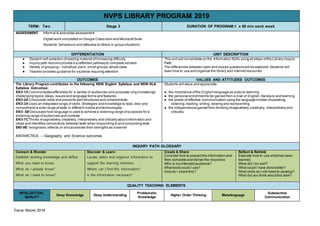
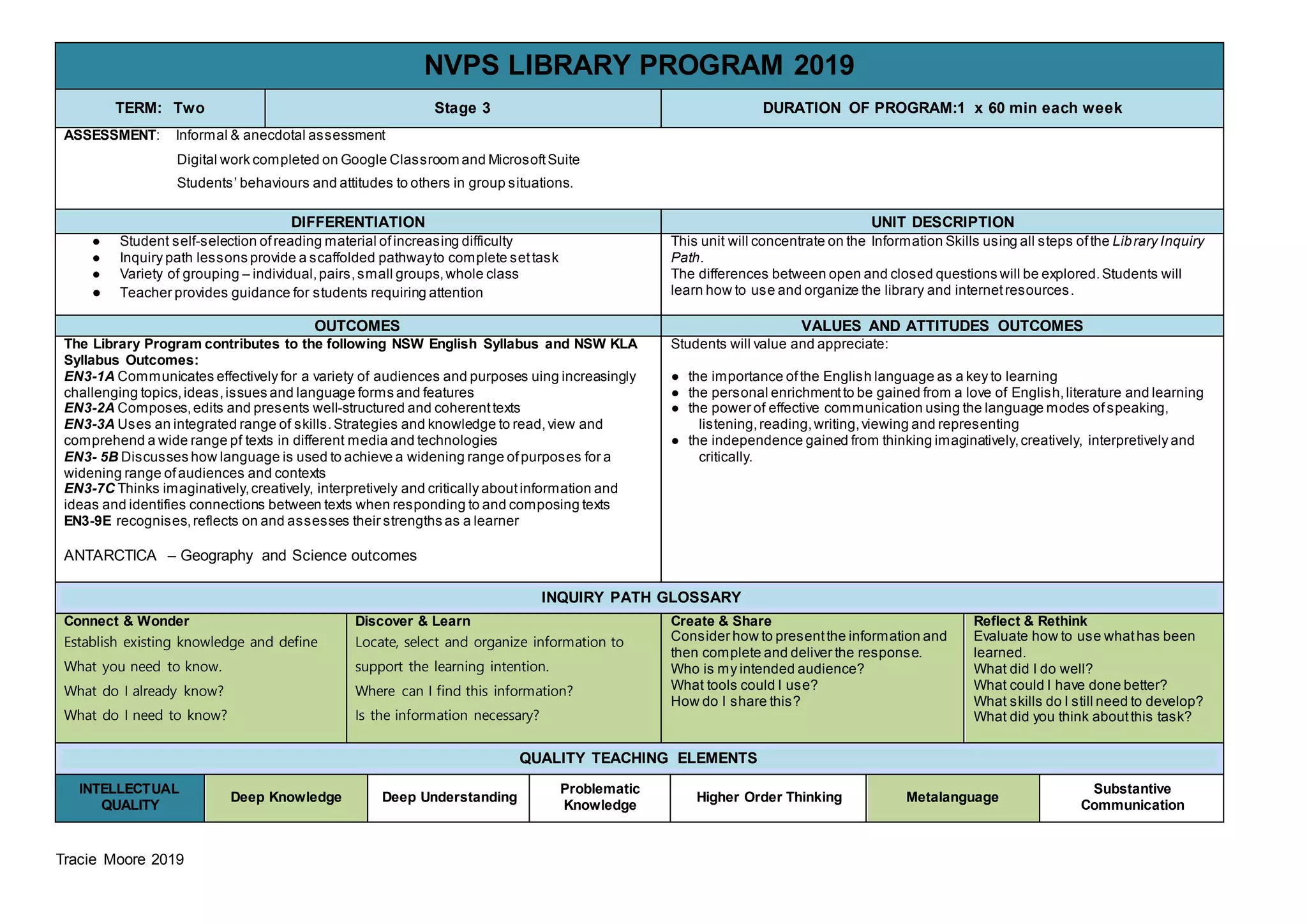
NVPS LIBRARY PROGRAM 2019
TERM: Two Stage 3 DURATION OF PROGRAM:1 x 60 min each week
ASSESSMENT: Informal & anecdotal assessment
Digital work completed on Google Classroom and MicrosoftSuite
Students’ behaviours and attitudes to others in group situations.
DIFFERENTIATION UNIT DESCRIPTION
● Student self-selection ofreading material ofincreasing difficulty
● Inquiry path lessons provide a scaffolded pathwayto complete settask
● Variety of grouping – individual,pairs,small groups,whole class
● Teacher provides guidance for students requiring attention
This unit will concentrate on the Information Skills using all steps ofthe Library Inquiry
Path.
The differences between open and closed questions will be explored.Students will
learn how to use and organize the library and internetresources.
OUTCOMES VALUES AND ATTITUDES OUTCOMES
The Library Program contributes to the following NSW English Syllabus and NSW KLA
Syllabus Outcomes:
EN3-1A Communicates effectively for a variety of audiences and purposes uing increasingly
challenging topics,ideas,issues and language forms and features
EN3-2A Composes,edits and presents well-structured and coherenttexts
EN3-3A Uses an integrated range of skills.Strategies and knowledge to read,view and
comprehend a wide range pf texts in different media and technologies
EN3- 5B Discusses how language is used to achieve a widening range ofpurposes for a
widening range ofaudiences and contexts
EN3-7C Thinks imaginatively,creatively, interpretively and critically aboutinformation and
ideas and identifies connections between texts when responding to and composing texts
EN3-9E recognises,reflects on and assesses their strengths as a learner
ANTARCTICA – Geography and Science outcomes
Students will value and appreciate:
● the importance ofthe English language as a key to learning 

● the personal enrichmentto be gained from a love of English,literature and learning
● the power of effective communication using the language modes ofspeaking,
listening,reading,writing,viewing and representing
● the independence gained from thinking imaginatively,creatively, interpretively and
critically.
INQUIRY PATH GLOSSARY
Connect & Wonder
Establish existing knowledge and define
What you need to know.
What do I already know?
What do I need to know?
Discover & Learn
Locate, select and organize information to
support the learning intention.
Where can I find this information?
Is the information necessary?
Create & Share
Consider how to presentthe information and
then complete and deliver the response.
Who is my intended audience?
What tools could I use?
How do I share this?
Reflect & Rethink
Evaluate how to use whathas been
learned.
What did I do well?
What could I have done better?
What skills do I still need to develop?
What did you think aboutthis task?
QUALITY TEACHING ELEMENTS
INTELLECTUAL
QUALITY
Deep Knowledge Deep Understanding
Problematic
Knowledge
Higher Order Thinking Metalanguage
Substantive
Communication
Tracie Moore 2019
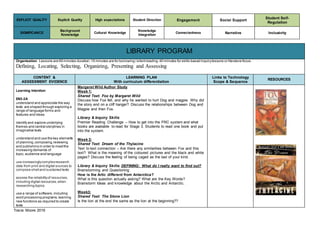
LIBRARY PROGRAM
Organisation: Lessons are 60 minutes duration. 15 minutes are for borrowing /silentreading.40 minutes for skills based inquirylessons or literature focus.
Defining, Locating, Selecting, Organizing, Presenting and Assessing
CONTENT &
ASSESSMENT EVIDENCE
LEARNING PLAN
With curriculum differentiation
Links to Technology
Scope & Sequence
RESOURCES
Learning Intention:
EN3-2A
understand and appreciate the way
texts are shaped through exploring a
range of language forms and
features and ideas
identify and explore underlying
themes and central storylines in
imaginative texts
understand and use the key elements
of planning,composing,reviewing
and publishing in order to meetthe
increasing demands of
topic, audience and language
use increasinglycomplexresearch
data from print and digital sources to
compose shortand sustained texts
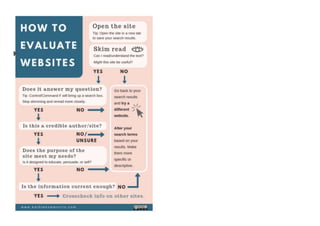
assess the reliabilityof resources,
including digital resources,when
researching topics
use a range of software,including
word processing programs,learning
new functions as required to create
texts
Margaret Wild Author Study
Week 1:
Shared Text: Fox by Margaret Wild
Discuss how Fox felt, and why he wanted to hurt Dog and magpie. Why did
the story end on a cliff hanger? Discuss the relationships between Dog and
Magpie and then Fox.
Library & Inquiry Skills:
Premier Reading Challenge – How to get into the PRC system and what
books are available to read for Stage 3. Students to read one book and put
into the system.
Week 2:
Shared Text: Dream of the Thylacine
Text to text connection – Are there any similarities between Fox and this
text? What is the meaning of the coloured pictures and the black and white
pages? Discuss the feeling of being caged as the last of your kind.
Library & Inquiry Skills: DEFINING: What do I really want to find out?
Brainstorming and Questioning
How is the Artic different from Antarctica?
What is this question actually asking? What are the Key Words?
Brainstorm Ideas and knowledge about the Arctic and Antarctic.
Week3:
Shared Text: The Stone Lion
Is the lion at the end the same as the lion at the beginning??
EXPLICIT QUALITY Explicit Quality High expectations Student Direction Engagement Social Support
Student Self-
Regulation
SIGNIFICANCE
Background
Knowledge
Cultural Knowledge
Knowledge
Integration
Connectedness Narrative Inclusivity
Tracie Moore 2019
EN3-3A
select,navigate and read texts for a
range of purposes,applying
appropriate text processing
strategies and interpreting structural
features,for example table of
contents,glossary,chapters,
headings and subheadings
navigate and read texts for specific
purposes applying appropriate text
processing strategies,for
example predictingand confirming,
monitoring
meaning, skimming and scanning
EN3-5B
investigate how the organisation of
texts into chapters,headings,
subheadings,home pages and sub
pages for online texts and according
to chronologyor topic can be used to
predictcontent and assistnavigation
analyse strategies authors use to
influence readers
identify and use a variety of
strategies to presentinformation and
opinions across a range oftexts
EN3-7C
interpretevents, situations and
characters in texts
think critically aboutaspects oftexts
such as ideas and events
identify, describe,and discuss
similarities and differences between
texts, including those bythe same
author or illustrator,and evaluate
characteristics thatdefine an author's
individual style
EN3-9E
develop criteria for assessing their
own and others'presentations
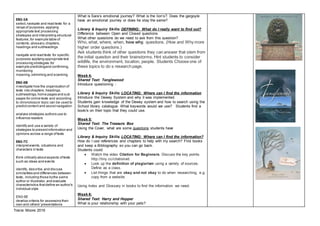
What is Sara’s emotional journey? What is the lion’s?. Does the gargoyle
have an emotional journey or does he stay the same?
Library & Inquiry Skills: DEFINING: What do I really want to find out?
Difference between Open and Closed questions
What other questions do we need to ask from this question?
Who, what, where, when, how why, questions. (How and Why more
higher order questions.)
Ask students think of other questions they can answer that stem from
the initial question and their brainstorms. Hint students to consider
wildlife, the environment, location, people. Students Choose one of
these topics to do s research page.
Week 4:
Shared Text: Tanglewood
Introduce questioning -
Library & Inquiry Skills: LOCATING: Where can I find the information
Introduce the Dewey System and why it was implemented.
Students gain knowledge of the Dewey system and how to search using the
School library catalogue. What keywords would we use? Students find a
book/s on their topic that they could use.
Week 5:
Shared Text: The Treasure Box
Using the Cover, what are some questions students have
Library & Inquiry Skills: LOCATING: Where can I find the information?
How do I use references and chapters to help with my search? Find books
and keep a Bibliography so you can go back.
Students could:
 Watch the video Citation for Beginners. Discuss the key points.
http://tiny.cc/citationvid
 Look up the definition of plagiarism using a variety of sources.
Define as a class.
 List things that are okay and not okay to do when researching, e.g.
copy from a website.
Using Index and Glossary in books to find the information we need.
Week 6:
Shared Text: Harry and Hopper
What is your relationship with your pets?
Tracie Moore 2019
formulate questions for specific
purposes,eg to clarify and reflect
Performance task:
Establish existing knowledge and
define what you need to know
about the topic through
brainstorming. This is a time of
immersion, building interest and
tuning in to learn research skills.
What do I already know?
What do I need to know?
Discussing the topic, brainstormingand
clarifying known information.
Finding information in books.
Summarising information
Presenting information
Evaluating information.
Success criteria:
● Students can distinguish
between a closed and open
question.
● Students can use the
Dewey system to locate
appropriate books in the
library for research.
● Students keep an easy
bibliographyofbooks
located in research.
● Students presenta short
text to answer the Main
question.
Look at how the illustrator has used colour to express different emotions.
They could talk about what emotions they associate with various colours
and why.
Library & Inquiry Skills: LOCATING: Where can I find the information?
Show how to use an Atlas to label a map.
Discuss landforms, regions, index in atlas, etc.
Using atlas locate cities, special features.
Week 7:
Shared Text: Vampyre
Using knowledge from the title and cover, what are some questions we
could ask about this book? Brainstorm vampires in small groups. Write
down things you’ve heard about them; books or movies they feature in;
feelings they arouse; objects, places or colours you associate
with them – anything at all.
A typical Gothic setting might be a castle or a graveyard.
What is the setting for this book? How does it fit into a Gothic theme?
What period of time do you think the story is set in?
 Are there any words that give hints of the setting (time and place)?
 What do the images convey about the setting?
 Consider the vampire in his setting – what relationship do we see between
him and the different places he inhabits?
Library & Inquiry Skills: SELECTING: What information do I really need
to use?
Skim and search resources
Practice skim reading -- give students one minute to read a short article.
Discuss what stood out. Headings? Bold words? Quotes? Then give
students ten minutes to read the same article and discuss deep reading.
List and discuss ways you can take notes while researching
How do I select relevant information?
What do I already know – use past experiences.
Students skim and scan their books to find relevant information on their
topic.
Resource to take notes on as model:
https://www.kidsnews.com.au/weather/greenland-villagers-evacuate-as-
massive-iceberg-sparks-tsunami-and-flood-fears/news-
story/b2d4e2f3981044d59dd3dd7248bdf13a
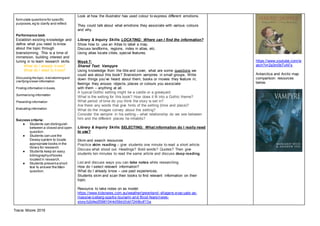
https://www.youtube.com/w
atch?v=2a3m0bTvAFs
Antarctica and Arctic map
comparison: resources
below.
Tracie Moore 2019
Reading eggs – Antarctica and Arctic Books to skim and scan to compare
information.
Week 8:
Shared Text: Woolvs in the Sitee
Before you read it, what kind of book did you think it is going to
be?
•Was there anything you liked about this book?
•Was there anything you disliked?
•Was there anything that puzzled you?
Discuss why the author has used the first person to tell this story and how it
affects how we read the narrative.
Library & Inquiry Skills: ORGANISING: How can I best use this
information?
Instruct on proper note taking skills – summarizing, not copy and pasting –
using own words.
Using subtitles for organizing work.
Select, identify and use key points of a story or experience.
Remember to always look at your question and remember what it is you are
answering.
Students organize their powerpoint page to present their information.
Week 9:
Shared Text: Let the Celebrations Begin! (YouTube Reading)
What is the purpose of this text (tell a story, give information, persuade,
etc.)? Does it have more than one purpose? How can you tell? Who is
the intended audience this book?
Some of the children can remember what their lives were like before
they were in the camp. How are their lives different from before?
The toys are going to be very special for the children as they grow up.
Do you have something that is very important to you because it holds
lots of memories for you? It could be a photo of you and your family,
something you found or a gift you received.
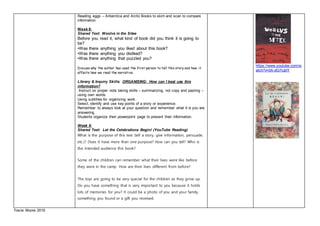
https://www.youtube.com/w
atch?v=0A-dG7rublY
Tracie Moore 2019
Library & Inquiry Skills: PRESENTING How can I present this
information?
Show a variety of programs to use to present information i.e. PowerPoint/
google slides, powtoons, word/ google docs.
Do my sentences make sense?
Students evaluate their sheet to see if organized correctly and information
answers to question.
Week 10:
Shared Text: The Very Best of Friends (YouTube reading)
Many families treat their pets as if they are people and yet we also
kill other animals for food. Is there a difference between the animals
we eat and the animals we keep as pets? Why or why not?
Library & Inquiry Skills: Complete their presentation – 1x PowerPoint
sheet with Heading, sub headings, own words, sentences edited and make
sense.. Picture adds meaning to the text.
Week 1 Term 3; Library & Inquiry Skills: ASSESSING
Self Reflection;
Did I answer the question?
 Evaluates the appropriateness of presentation format
 Evaluates elements of the presentation i.e. choice of font, background,
sound effects etc.
Peer reflection
identifies strengths and weaknesses
Evaluation:
Tracie Moore 2019
Tracie Moore 2019
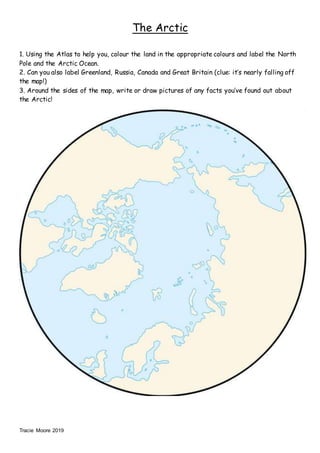
The Arctic
1. Using the Atlas to help you, colour the land in the appropriate colours and label the North
Pole and the Arctic Ocean.
2. Can you also label Greenland, Russia, Canada and Great Britain (clue: it’s nearly falling off
the map!)
3. Around the sides of the map, write or draw pictures of any facts you’ve found out about
the Arctic!
Tracie Moore 2019
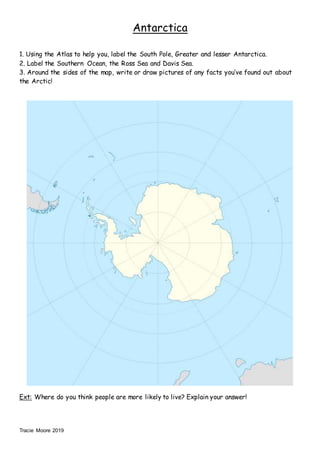
Antarctica
1. Using the Atlas to help you, label the South Pole, Greater and lesser Antarctica.
2. Label the Southern Ocean, the Ross Sea and Davis Sea.
3. Around the sides of the map, write or draw pictures of any facts you’ve found out about
the Arctic!
Ext: Where do you think people are more likely to live? Explain your answer!
Tracie Moore 2019

Stage 3 term 2 library program 2019

  • 1.
    Tracie Moore 2019 NVPSLIBRARY PROGRAM 2019 TERM: Two Stage 3 DURATION OF PROGRAM:1 x 60 min each week ASSESSMENT: Informal & anecdotal assessment Digital work completed on Google Classroom and MicrosoftSuite Students’ behaviours and attitudes to others in group situations. DIFFERENTIATION UNIT DESCRIPTION ● Student self-selection ofreading material ofincreasing difficulty ● Inquiry path lessons provide a scaffolded pathwayto complete settask ● Variety of grouping – individual,pairs,small groups,whole class ● Teacher provides guidance for students requiring attention This unit will concentrate on the Information Skills using all steps ofthe Library Inquiry Path. The differences between open and closed questions will be explored.Students will learn how to use and organize the library and internetresources. OUTCOMES VALUES AND ATTITUDES OUTCOMES The Library Program contributes to the following NSW English Syllabus and NSW KLA Syllabus Outcomes: EN3-1A Communicates effectively for a variety of audiences and purposes uing increasingly challenging topics,ideas,issues and language forms and features EN3-2A Composes,edits and presents well-structured and coherenttexts EN3-3A Uses an integrated range of skills.Strategies and knowledge to read,view and comprehend a wide range pf texts in different media and technologies EN3- 5B Discusses how language is used to achieve a widening range ofpurposes for a widening range ofaudiences and contexts EN3-7C Thinks imaginatively,creatively, interpretively and critically aboutinformation and ideas and identifies connections between texts when responding to and composing texts EN3-9E recognises,reflects on and assesses their strengths as a learner ANTARCTICA – Geography and Science outcomes Students will value and appreciate: ● the importance ofthe English language as a key to learning 
 ● the personal enrichmentto be gained from a love of English,literature and learning ● the power of effective communication using the language modes ofspeaking, listening,reading,writing,viewing and representing ● the independence gained from thinking imaginatively,creatively, interpretively and critically. INQUIRY PATH GLOSSARY Connect & Wonder Establish existing knowledge and define What you need to know. What do I already know? What do I need to know? Discover & Learn Locate, select and organize information to support the learning intention. Where can I find this information? Is the information necessary? Create & Share Consider how to presentthe information and then complete and deliver the response. Who is my intended audience? What tools could I use? How do I share this? Reflect & Rethink Evaluate how to use whathas been learned. What did I do well? What could I have done better? What skills do I still need to develop? What did you think aboutthis task? QUALITY TEACHING ELEMENTS INTELLECTUAL QUALITY Deep Knowledge Deep Understanding Problematic Knowledge Higher Order Thinking Metalanguage Substantive Communication
  • 2.
    Tracie Moore 2019 LIBRARYPROGRAM Organisation: Lessons are 60 minutes duration. 15 minutes are for borrowing /silentreading.40 minutes for skills based inquirylessons or literature focus. Defining, Locating, Selecting, Organizing, Presenting and Assessing CONTENT & ASSESSMENT EVIDENCE LEARNING PLAN With curriculum differentiation Links to Technology Scope & Sequence RESOURCES Learning Intention: EN3-2A understand and appreciate the way texts are shaped through exploring a range of language forms and features and ideas identify and explore underlying themes and central storylines in imaginative texts understand and use the key elements of planning,composing,reviewing and publishing in order to meetthe increasing demands of topic, audience and language use increasinglycomplexresearch data from print and digital sources to compose shortand sustained texts assess the reliabilityof resources, including digital resources,when researching topics use a range of software,including word processing programs,learning new functions as required to create texts Margaret Wild Author Study Week 1: Shared Text: Fox by Margaret Wild Discuss how Fox felt, and why he wanted to hurt Dog and magpie. Why did the story end on a cliff hanger? Discuss the relationships between Dog and Magpie and then Fox. Library & Inquiry Skills: Premier Reading Challenge – How to get into the PRC system and what books are available to read for Stage 3. Students to read one book and put into the system. Week 2: Shared Text: Dream of the Thylacine Text to text connection – Are there any similarities between Fox and this text? What is the meaning of the coloured pictures and the black and white pages? Discuss the feeling of being caged as the last of your kind. Library & Inquiry Skills: DEFINING: What do I really want to find out? Brainstorming and Questioning How is the Artic different from Antarctica? What is this question actually asking? What are the Key Words? Brainstorm Ideas and knowledge about the Arctic and Antarctic. Week3: Shared Text: The Stone Lion Is the lion at the end the same as the lion at the beginning?? EXPLICIT QUALITY Explicit Quality High expectations Student Direction Engagement Social Support Student Self- Regulation SIGNIFICANCE Background Knowledge Cultural Knowledge Knowledge Integration Connectedness Narrative Inclusivity
  • 3.
    Tracie Moore 2019 EN3-3A select,navigateand read texts for a range of purposes,applying appropriate text processing strategies and interpreting structural features,for example table of contents,glossary,chapters, headings and subheadings navigate and read texts for specific purposes applying appropriate text processing strategies,for example predictingand confirming, monitoring meaning, skimming and scanning EN3-5B investigate how the organisation of texts into chapters,headings, subheadings,home pages and sub pages for online texts and according to chronologyor topic can be used to predictcontent and assistnavigation analyse strategies authors use to influence readers identify and use a variety of strategies to presentinformation and opinions across a range oftexts EN3-7C interpretevents, situations and characters in texts think critically aboutaspects oftexts such as ideas and events identify, describe,and discuss similarities and differences between texts, including those bythe same author or illustrator,and evaluate characteristics thatdefine an author's individual style EN3-9E develop criteria for assessing their own and others'presentations What is Sara’s emotional journey? What is the lion’s?. Does the gargoyle have an emotional journey or does he stay the same? Library & Inquiry Skills: DEFINING: What do I really want to find out? Difference between Open and Closed questions What other questions do we need to ask from this question? Who, what, where, when, how why, questions. (How and Why more higher order questions.) Ask students think of other questions they can answer that stem from the initial question and their brainstorms. Hint students to consider wildlife, the environment, location, people. Students Choose one of these topics to do s research page. Week 4: Shared Text: Tanglewood Introduce questioning - Library & Inquiry Skills: LOCATING: Where can I find the information Introduce the Dewey System and why it was implemented. Students gain knowledge of the Dewey system and how to search using the School library catalogue. What keywords would we use? Students find a book/s on their topic that they could use. Week 5: Shared Text: The Treasure Box Using the Cover, what are some questions students have Library & Inquiry Skills: LOCATING: Where can I find the information? How do I use references and chapters to help with my search? Find books and keep a Bibliography so you can go back. Students could:  Watch the video Citation for Beginners. Discuss the key points. http://tiny.cc/citationvid  Look up the definition of plagiarism using a variety of sources. Define as a class.  List things that are okay and not okay to do when researching, e.g. copy from a website. Using Index and Glossary in books to find the information we need. Week 6: Shared Text: Harry and Hopper What is your relationship with your pets?
  • 4.
    Tracie Moore 2019 formulatequestions for specific purposes,eg to clarify and reflect Performance task: Establish existing knowledge and define what you need to know about the topic through brainstorming. This is a time of immersion, building interest and tuning in to learn research skills. What do I already know? What do I need to know? Discussing the topic, brainstormingand clarifying known information. Finding information in books. Summarising information Presenting information Evaluating information. Success criteria: ● Students can distinguish between a closed and open question. ● Students can use the Dewey system to locate appropriate books in the library for research. ● Students keep an easy bibliographyofbooks located in research. ● Students presenta short text to answer the Main question. Look at how the illustrator has used colour to express different emotions. They could talk about what emotions they associate with various colours and why. Library & Inquiry Skills: LOCATING: Where can I find the information? Show how to use an Atlas to label a map. Discuss landforms, regions, index in atlas, etc. Using atlas locate cities, special features. Week 7: Shared Text: Vampyre Using knowledge from the title and cover, what are some questions we could ask about this book? Brainstorm vampires in small groups. Write down things you’ve heard about them; books or movies they feature in; feelings they arouse; objects, places or colours you associate with them – anything at all. A typical Gothic setting might be a castle or a graveyard. What is the setting for this book? How does it fit into a Gothic theme? What period of time do you think the story is set in?  Are there any words that give hints of the setting (time and place)?  What do the images convey about the setting?  Consider the vampire in his setting – what relationship do we see between him and the different places he inhabits? Library & Inquiry Skills: SELECTING: What information do I really need to use? Skim and search resources Practice skim reading -- give students one minute to read a short article. Discuss what stood out. Headings? Bold words? Quotes? Then give students ten minutes to read the same article and discuss deep reading. List and discuss ways you can take notes while researching How do I select relevant information? What do I already know – use past experiences. Students skim and scan their books to find relevant information on their topic. Resource to take notes on as model: https://www.kidsnews.com.au/weather/greenland-villagers-evacuate-as- massive-iceberg-sparks-tsunami-and-flood-fears/news- story/b2d4e2f3981044d59dd3dd7248bdf13a https://www.youtube.com/w atch?v=2a3m0bTvAFs Antarctica and Arctic map comparison: resources below.
  • 5.
    Tracie Moore 2019 Readingeggs – Antarctica and Arctic Books to skim and scan to compare information. Week 8: Shared Text: Woolvs in the Sitee Before you read it, what kind of book did you think it is going to be? •Was there anything you liked about this book? •Was there anything you disliked? •Was there anything that puzzled you? Discuss why the author has used the first person to tell this story and how it affects how we read the narrative. Library & Inquiry Skills: ORGANISING: How can I best use this information? Instruct on proper note taking skills – summarizing, not copy and pasting – using own words. Using subtitles for organizing work. Select, identify and use key points of a story or experience. Remember to always look at your question and remember what it is you are answering. Students organize their powerpoint page to present their information. Week 9: Shared Text: Let the Celebrations Begin! (YouTube Reading) What is the purpose of this text (tell a story, give information, persuade, etc.)? Does it have more than one purpose? How can you tell? Who is the intended audience this book? Some of the children can remember what their lives were like before they were in the camp. How are their lives different from before? The toys are going to be very special for the children as they grow up. Do you have something that is very important to you because it holds lots of memories for you? It could be a photo of you and your family, something you found or a gift you received. https://www.youtube.com/w atch?v=0A-dG7rublY
  • 6.
    Tracie Moore 2019 Library& Inquiry Skills: PRESENTING How can I present this information? Show a variety of programs to use to present information i.e. PowerPoint/ google slides, powtoons, word/ google docs. Do my sentences make sense? Students evaluate their sheet to see if organized correctly and information answers to question. Week 10: Shared Text: The Very Best of Friends (YouTube reading) Many families treat their pets as if they are people and yet we also kill other animals for food. Is there a difference between the animals we eat and the animals we keep as pets? Why or why not? Library & Inquiry Skills: Complete their presentation – 1x PowerPoint sheet with Heading, sub headings, own words, sentences edited and make sense.. Picture adds meaning to the text. Week 1 Term 3; Library & Inquiry Skills: ASSESSING Self Reflection; Did I answer the question?  Evaluates the appropriateness of presentation format  Evaluates elements of the presentation i.e. choice of font, background, sound effects etc. Peer reflection identifies strengths and weaknesses Evaluation:
  • 7.
  • 8.
    Tracie Moore 2019 TheArctic 1. Using the Atlas to help you, colour the land in the appropriate colours and label the North Pole and the Arctic Ocean. 2. Can you also label Greenland, Russia, Canada and Great Britain (clue: it’s nearly falling off the map!) 3. Around the sides of the map, write or draw pictures of any facts you’ve found out about the Arctic!
  • 9.
    Tracie Moore 2019 Antarctica 1.Using the Atlas to help you, label the South Pole, Greater and lesser Antarctica. 2. Label the Southern Ocean, the Ross Sea and Davis Sea. 3. Around the sides of the map, write or draw pictures of any facts you’ve found out about the Arctic! Ext: Where do you think people are more likely to live? Explain your answer!
  • 10.