FARRELLY, Lorraine (2007) The Fundamentals of Architecture (AVA Publishing, Lausanne)
UNWIN, Simon (1997) Analysing Architecture (Routledge, London)
WILKINSON, Philip (2010) 50 architecture ideas you really need to know (Quercus, London)
TIME
HISTORY
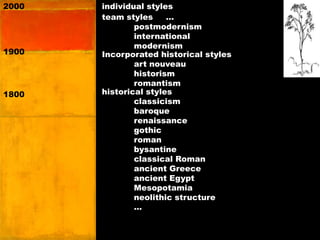
individual styles
team styles …
postmodernism
international
modernism
historical styles
classicism
baroque
renaissance
gothic
roman
bysantine
classical Roman
ancient Greece
ancient Egypt
Mesopotamia
neolithic structure
…
1800
1900
2000
Incorporated historical styles
art nouveau
historism
romantism
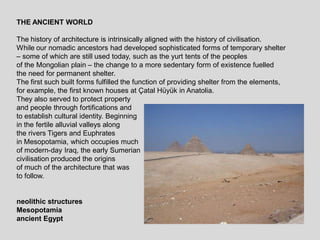
THE ANCIENT WORLD
The history of architecture is intrinsically aligned with the history of civilisation.
While our nomadic ancestors had developed sophisticated forms of temporary shelter
– some of which are still used today, such as the yurt tents of the peoples
of the Mongolian plain – the change to a more sedentary form of existence fuelled
the need for permanent shelter.
The first such built forms fulfilled the function of providing shelter from the elements,
for example, the first known houses at Çatal Hüyük in Anatolia.
They also served to protect property
and people through fortifications and
to establish cultural identity. Beginning
in the fertile alluvial valleys along
the rivers Tigers and Euphrates
in Mesopotamia, which occupies much
of modern-day Iraq, the early Sumerian
civilisation produced the origins
of much of the architecture that was
to follow.
neolithic structures
Mesopotamia
ancient Egypt
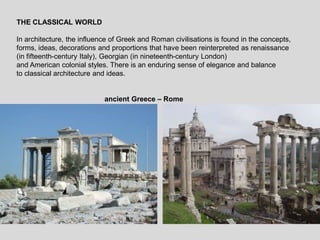
THE CLASSICAL WORLD
In architecture, the influence of Greek and Roman civilisations is found in the concepts,
forms, ideas, decorations and proportions that have been reinterpreted as renaissance
(in fifteenth-century Italy), Georgian (in nineteenth-century London)
and American colonial styles. There is an enduring sense of elegance and balance
to classical architecture and ideas.
ancient Greece – Rome
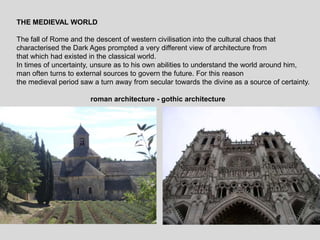
THE MEDIEVAL WORLD
The fall of Rome and the descent of western civilisation into the cultural chaos that
characterised the Dark Ages prompted a very different view of architecture from
that which had existed in the classical world.
In times of uncertainty, unsure as to his own abilities to understand the world around him,
man often turns to external sources to govern the future. For this reason
the medieval period saw a turn away from secular towards the divine as a source of certainty.
roman architecture - gothic architecture
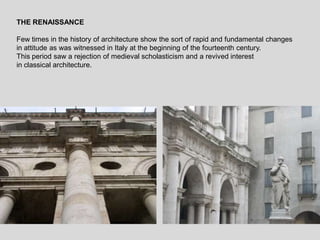
THE RENAISSANCE
Few times in the history of architecture show the sort of rapid and fundamental changes
in attitude as was witnessed in Italy at the beginning of the fourteenth century.
This period saw a rejection of medieval scholasticism and a revived interest
in classical architecture.
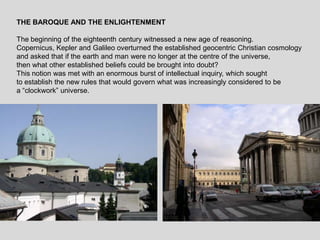
THE BAROQUE AND THE ENLIGHTENMENT
The beginning of the eighteenth century witnessed a new age of reasoning.
Copernicus, Kepler and Galileo overturned the established geocentric Christian cosmology
and asked that if the earth and man were no longer at the centre of the universe,
then what other established beliefs could be brought into doubt?
This notion was met with an enormous burst of intellectual inquiry, which sought
to establish the new rules that would govern what was increasingly considered to be
a “clockwork” universe.
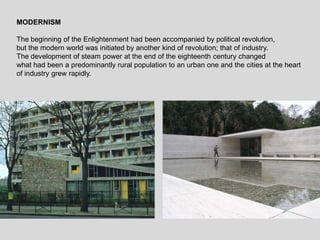
MODERNISM
The beginning of the Enlightenment had been accompanied by political revolution,
but the modern world was initiated by another kind of revolution; that of industry.
The development of steam power at the end of the eighteenth century changed
what had been a predominantly rural population to an urban one and the cities at the heart
of industry grew rapidly.
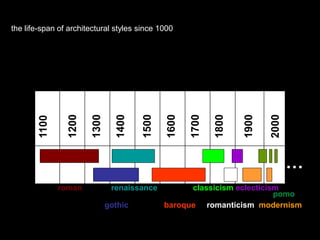
1100
1200
1300
1800
1900
1400
1500
1700
1600
2000
roman renaissance classicism eclecticism
pomo
gothic baroque romanticism modernism
the life-span of architectural styles since 1000
.…
ZEITGEIST - THE SPIRIT OF TIME
The German term zeitgeist refers to the spirit of a time. In terms of design
this is an inevitably changing and shifting notion. The zeitgeist naturally evolves
as it responds to current social and cultural phenomena.
- the spirit of the place and the spirit of the time / genius loci - zeitgeist
- styles, aesthetic preferences / rules
- historical layers: new versus old / relationship
- new building materials and structures / possibilities
- new building tasks / changements
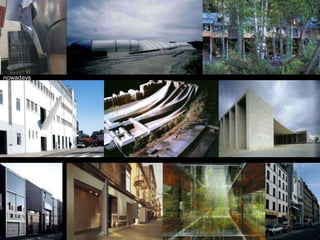
nowadays
PROCESS
project – from initial concept
analysis /site and program
design process
detail development
realisation – to finished construction
building – life of the building
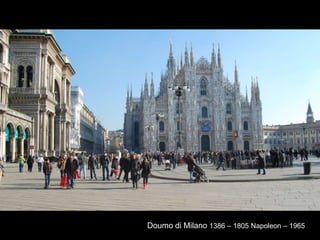
Doumo di Milano 1386 – 1805 Napoleon – 1965
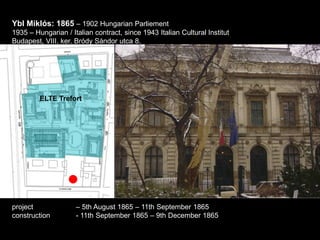
Ybl Miklós: 1865 – 1902 Hungarian Parliement
1935 – Hungarian / Italian contract, since 1943 Italian Cultural Institut
Budapest, VIII. ker. Bródy Sándor utca 8.
ELTE Trefort
project – 5th August 1865 – 11th September 1865
construction - 11th September 1865 – 9th December 1865
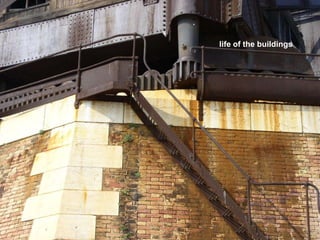
life of the buildings
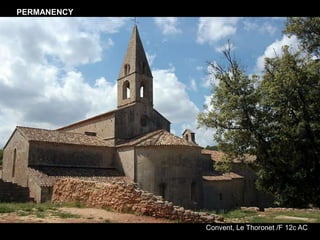
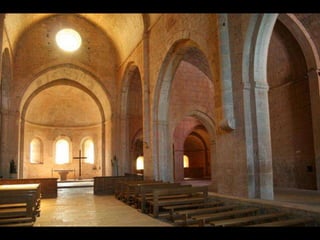
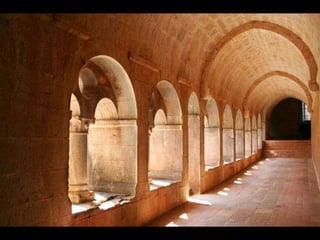
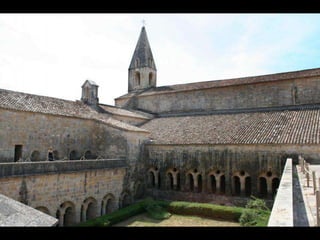
Convent, Le Thoronet /F 12c AC
PERMANENCY
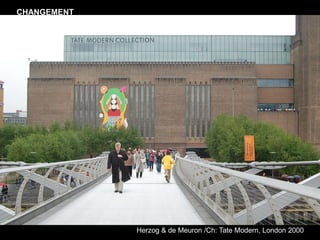
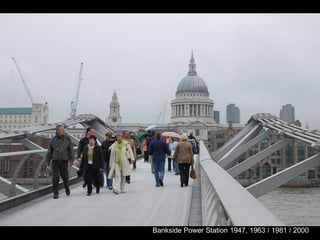
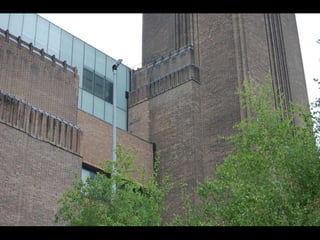
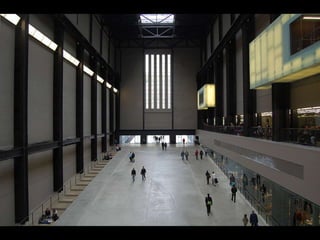
Herzog & de Meuron /Ch: Tate Modern, London 2000
CHANGEMENT
Bankside Power Station 1947, 1963 / 1981 / 2000
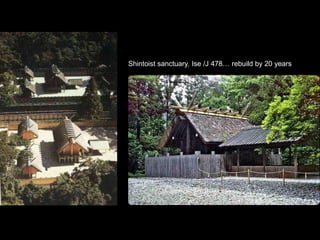
Shintoist sanctuary, Ise /J 478… rebuild by 20 years
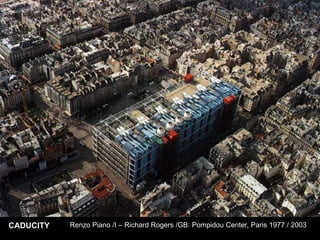
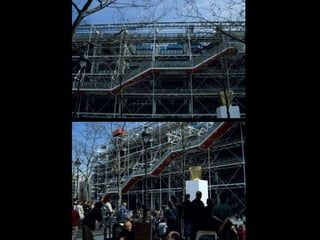
Renzo Piano /I – Richard Rogers /GB: Pompidou Center, Paris 1977 / 2003CADUCITY
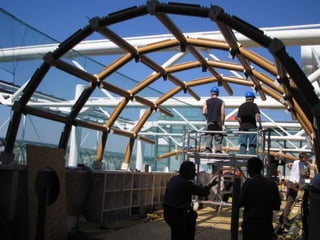
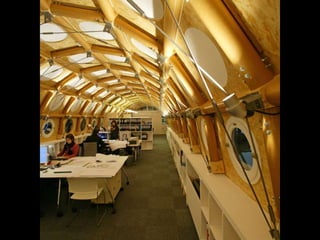
Shigeru Ban /J
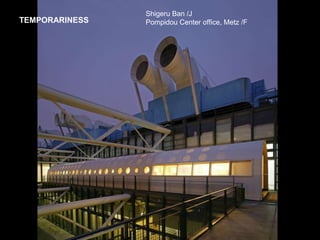
Pompidou Center office, Metz /FTEMPORARINESS
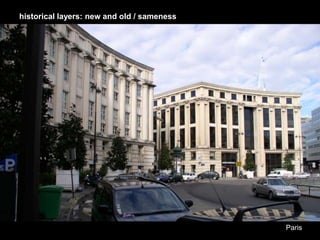
historical layers: new and old / sameness
Paris
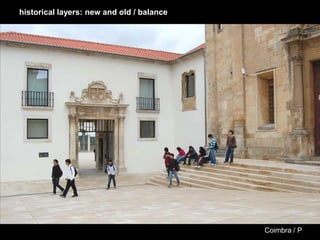
Coimbra / P
historical layers: new and old / balance
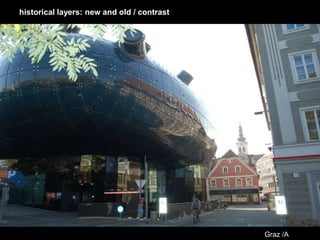
Graz /A
historical layers: new and old / contrast
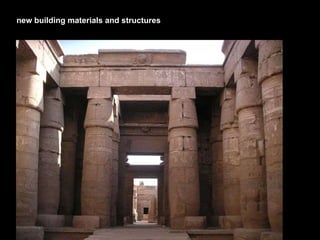
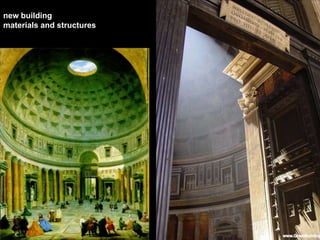
new building materials and structures
new building
materials and structures
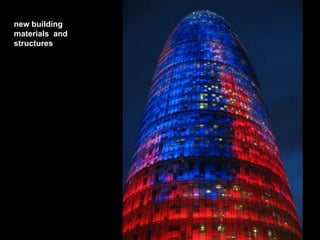
new building
materials and
structures
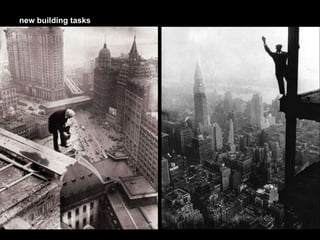
new building tasks
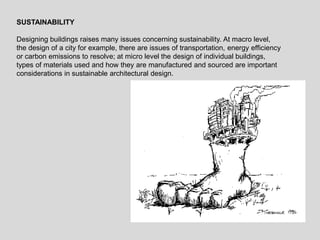
SUSTAINABILITY
Designing buildings raises many issues concerning sustainability. At macro level,
the design of a city for example, there are issues of transportation, energy efficiency
or carbon emissions to resolve; at micro level the design of individual buildings,
types of materials used and how they are manufactured and sourced are important
considerations in sustainable architectural design.
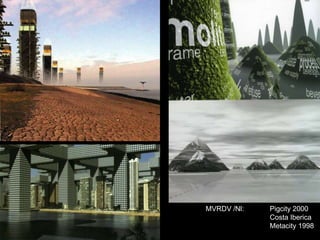
MVRDV /Nl: Pigcity 2000
Costa Iberica
Metacity 1998
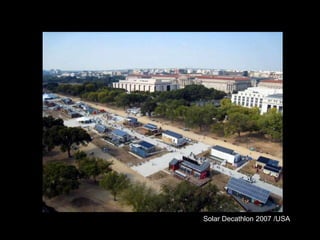
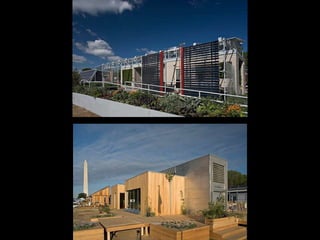
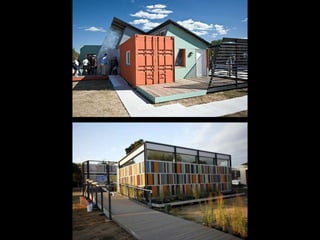
Solar Decathlon 2007 /USA
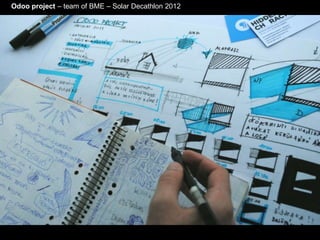
Odoo project – team of BME – Solar Decathlon 2012

Stage 1 formfinding

  • 1.
    FARRELLY, Lorraine (2007)The Fundamentals of Architecture (AVA Publishing, Lausanne) UNWIN, Simon (1997) Analysing Architecture (Routledge, London) WILKINSON, Philip (2010) 50 architecture ideas you really need to know (Quercus, London)
  • 2.
  • 3.
  • 4.
    individual styles team styles… postmodernism international modernism historical styles classicism baroque renaissance gothic roman bysantine classical Roman ancient Greece ancient Egypt Mesopotamia neolithic structure … 1800 1900 2000 Incorporated historical styles art nouveau historism romantism
  • 5.
    THE ANCIENT WORLD Thehistory of architecture is intrinsically aligned with the history of civilisation. While our nomadic ancestors had developed sophisticated forms of temporary shelter – some of which are still used today, such as the yurt tents of the peoples of the Mongolian plain – the change to a more sedentary form of existence fuelled the need for permanent shelter. The first such built forms fulfilled the function of providing shelter from the elements, for example, the first known houses at Çatal Hüyük in Anatolia. They also served to protect property and people through fortifications and to establish cultural identity. Beginning in the fertile alluvial valleys along the rivers Tigers and Euphrates in Mesopotamia, which occupies much of modern-day Iraq, the early Sumerian civilisation produced the origins of much of the architecture that was to follow. neolithic structures Mesopotamia ancient Egypt
  • 6.
    THE CLASSICAL WORLD Inarchitecture, the influence of Greek and Roman civilisations is found in the concepts, forms, ideas, decorations and proportions that have been reinterpreted as renaissance (in fifteenth-century Italy), Georgian (in nineteenth-century London) and American colonial styles. There is an enduring sense of elegance and balance to classical architecture and ideas. ancient Greece – Rome
  • 7.
    THE MEDIEVAL WORLD Thefall of Rome and the descent of western civilisation into the cultural chaos that characterised the Dark Ages prompted a very different view of architecture from that which had existed in the classical world. In times of uncertainty, unsure as to his own abilities to understand the world around him, man often turns to external sources to govern the future. For this reason the medieval period saw a turn away from secular towards the divine as a source of certainty. roman architecture - gothic architecture
  • 8.
    THE RENAISSANCE Few timesin the history of architecture show the sort of rapid and fundamental changes in attitude as was witnessed in Italy at the beginning of the fourteenth century. This period saw a rejection of medieval scholasticism and a revived interest in classical architecture.
  • 9.
    THE BAROQUE ANDTHE ENLIGHTENMENT The beginning of the eighteenth century witnessed a new age of reasoning. Copernicus, Kepler and Galileo overturned the established geocentric Christian cosmology and asked that if the earth and man were no longer at the centre of the universe, then what other established beliefs could be brought into doubt? This notion was met with an enormous burst of intellectual inquiry, which sought to establish the new rules that would govern what was increasingly considered to be a “clockwork” universe.
  • 10.
    MODERNISM The beginning ofthe Enlightenment had been accompanied by political revolution, but the modern world was initiated by another kind of revolution; that of industry. The development of steam power at the end of the eighteenth century changed what had been a predominantly rural population to an urban one and the cities at the heart of industry grew rapidly.
  • 11.
    1100 1200 1300 1800 1900 1400 1500 1700 1600 2000 roman renaissance classicismeclecticism pomo gothic baroque romanticism modernism the life-span of architectural styles since 1000 .…
  • 12.
    ZEITGEIST - THESPIRIT OF TIME The German term zeitgeist refers to the spirit of a time. In terms of design this is an inevitably changing and shifting notion. The zeitgeist naturally evolves as it responds to current social and cultural phenomena. - the spirit of the place and the spirit of the time / genius loci - zeitgeist - styles, aesthetic preferences / rules - historical layers: new versus old / relationship - new building materials and structures / possibilities - new building tasks / changements
  • 13.
  • 14.
    PROCESS project – frominitial concept analysis /site and program design process detail development realisation – to finished construction building – life of the building
  • 15.
    Doumo di Milano1386 – 1805 Napoleon – 1965
  • 16.
    Ybl Miklós: 1865– 1902 Hungarian Parliement 1935 – Hungarian / Italian contract, since 1943 Italian Cultural Institut Budapest, VIII. ker. Bródy Sándor utca 8. ELTE Trefort project – 5th August 1865 – 11th September 1865 construction - 11th September 1865 – 9th December 1865
  • 17.
    life of thebuildings
  • 18.
    Convent, Le Thoronet/F 12c AC PERMANENCY
  • 22.
    Herzog & deMeuron /Ch: Tate Modern, London 2000 CHANGEMENT
  • 23.
    Bankside Power Station1947, 1963 / 1981 / 2000
  • 26.
    Shintoist sanctuary, Ise/J 478… rebuild by 20 years
  • 27.
    Renzo Piano /I– Richard Rogers /GB: Pompidou Center, Paris 1977 / 2003CADUCITY
  • 30.
    Shigeru Ban /J PompidouCenter office, Metz /FTEMPORARINESS
  • 33.
    historical layers: newand old / sameness Paris
  • 34.
    Coimbra / P historicallayers: new and old / balance
  • 35.
    Graz /A historical layers:new and old / contrast
  • 36.
    new building materialsand structures
  • 37.
  • 38.
  • 39.
  • 40.
    SUSTAINABILITY Designing buildings raisesmany issues concerning sustainability. At macro level, the design of a city for example, there are issues of transportation, energy efficiency or carbon emissions to resolve; at micro level the design of individual buildings, types of materials used and how they are manufactured and sourced are important considerations in sustainable architectural design.
  • 41.
    MVRDV /Nl: Pigcity2000 Costa Iberica Metacity 1998
  • 42.
  • 45.
    Odoo project –team of BME – Solar Decathlon 2012