STAFFING PROCESS –
STEPS INVOLVED IN
STAFFING
1. Manpower requirements
2. Recruitment
3. Selection-
4. Orientation and Placement-
5. Training and Development
6. Remuneration
7. Performance Evaluation
8. Promotion and transfer
MANPOWER REQUIREMENTS
The very first step in staffing is to plan the manpower
inventory required by a concern in order to match them
with the job requirements and demands.
Therefore, it involves forecasting and determining the
future manpower needs of the concern.
RECRUITMENT:
 Once the requirements are notified, the concern invites
and solicits applications according to the invitations
made to the desirable candidates.
SELECTION-
This is the screening step of staffing in which the solicited
applications are screened out and suitable candidates are
appointed as per the requirements.
ORIENTATION AND PLACEMENT-
Once screening takes place, the appointed candidates are made
familiar to the work units and work environment through the
orientation programs.
placement takes place by putting right man on the right job.
TRAINING AND DEVELOPMENT-
Training is a part of incentives given to the workers in order to
develop and grow them within the concern. Training is generally
given according to the nature of activities and scope of
expansion in it.
Along with it, the workers are developed by providing them
extra benefits of in-depth knowledge of their functional areas.
Development also includes giving them key and important jobs
as a test or examination in order to analyze their performances.
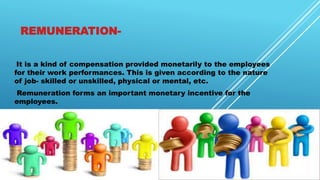
REMUNERATION-
It is a kind of compensation provided monetarily to the employees
for their work performances. This is given according to the nature
of job- skilled or unskilled, physical or mental, etc.
Remuneration forms an important monetary incentive for the
employees.
PERFORMANCE EVALUATION-
In order to keep a track or record of the behavior, attitudes as well
as opinions of the workers towards their jobs. For this regular
assessment is done to evaluate and supervise different work units
in a concern.
It is basically concerning to know the development cycle and growth
patterns of the employees in a concern.
PROMOTION AND TRANSFER-
Promotion is said to be a non- monetary incentive in which the
worker is shifted from a higher job demanding bigger
responsibilities as well as shifting the workers and transferring
them to different work units and branches of the same
organization.
 Staffing Process – Steps involved in Staffing
 Staffing Process – Steps involved in Staffing

Staffing Process – Steps involved in Staffing

  • 3.
    STAFFING PROCESS – STEPSINVOLVED IN STAFFING 1. Manpower requirements 2. Recruitment 3. Selection- 4. Orientation and Placement- 5. Training and Development 6. Remuneration 7. Performance Evaluation 8. Promotion and transfer
  • 4.
    MANPOWER REQUIREMENTS The veryfirst step in staffing is to plan the manpower inventory required by a concern in order to match them with the job requirements and demands. Therefore, it involves forecasting and determining the future manpower needs of the concern.
  • 5.
    RECRUITMENT:  Once therequirements are notified, the concern invites and solicits applications according to the invitations made to the desirable candidates.
  • 6.
    SELECTION- This is thescreening step of staffing in which the solicited applications are screened out and suitable candidates are appointed as per the requirements.
  • 7.
    ORIENTATION AND PLACEMENT- Oncescreening takes place, the appointed candidates are made familiar to the work units and work environment through the orientation programs. placement takes place by putting right man on the right job.
  • 8.
    TRAINING AND DEVELOPMENT- Trainingis a part of incentives given to the workers in order to develop and grow them within the concern. Training is generally given according to the nature of activities and scope of expansion in it. Along with it, the workers are developed by providing them extra benefits of in-depth knowledge of their functional areas. Development also includes giving them key and important jobs as a test or examination in order to analyze their performances.
  • 9.
    REMUNERATION- It is akind of compensation provided monetarily to the employees for their work performances. This is given according to the nature of job- skilled or unskilled, physical or mental, etc. Remuneration forms an important monetary incentive for the employees.
  • 10.
    PERFORMANCE EVALUATION- In orderto keep a track or record of the behavior, attitudes as well as opinions of the workers towards their jobs. For this regular assessment is done to evaluate and supervise different work units in a concern. It is basically concerning to know the development cycle and growth patterns of the employees in a concern.
  • 11.
    PROMOTION AND TRANSFER- Promotionis said to be a non- monetary incentive in which the worker is shifted from a higher job demanding bigger responsibilities as well as shifting the workers and transferring them to different work units and branches of the same organization.