PROJECT BY ARTHAR SILVESTER Page 1
PROJECT BY ARTHAR SILVESTER Page 2
AIM:
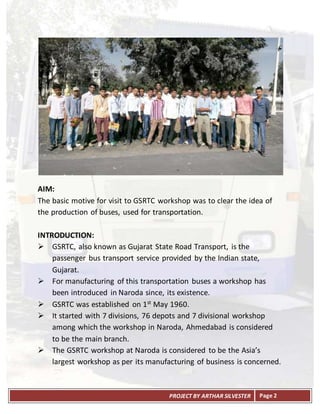
The basic motive for visit to GSRTC workshop was to clear the idea of
the production of buses, used for transportation.
INTRODUCTION:
 GSRTC, also known as Gujarat State Road Transport, is the
passenger bus transport service provided by the Indian state,
Gujarat.
 For manufacturing of this transportation buses a workshop has
been introduced in Naroda since, its existence.
 GSRTC was established on 1st
May 1960.
 It started with 7 divisions, 76 depots and 7 divisional workshop
among which the workshop in Naroda, Ahmedabad is considered
to be the main branch.
 The GSRTC workshop at Naroda is considered to be the Asia’s
largest workshop as per its manufacturing of business is concerned.
PROJECT BY ARTHAR SILVESTER Page 3
DEPARTMENTS:
1. Air compressor department
2. Cylinder head department
3. Engine washing and anti-rust treatment department
4. Crankshaft grinding department
5. Rotary pump testing department
6. Injector testing department
7. Engine testing center
8. Tyre molding department
9. Boiler room
10. Body fitting department
11. Welding department
12. Coach section
13. Bus body repair department
14. Painting department
15. Engine parts storage department
16. Oil storage department
17. Office work
18. Training centre
PROJECT BY ARTHAR SILVESTER Page 4
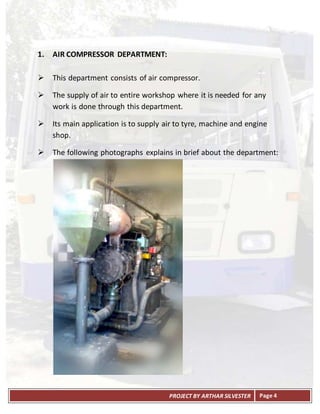
1. AIR COMPRESSOR DEPARTMENT:
 This department consists of air compressor.
 The supply of air to entire workshop where it is needed for any
work is done through this department.
 Its main application is to supply air to tyre, machine and engine
shop.
 The following photographs explains in brief about the department:
PROJECT BY ARTHAR SILVESTER Page 5
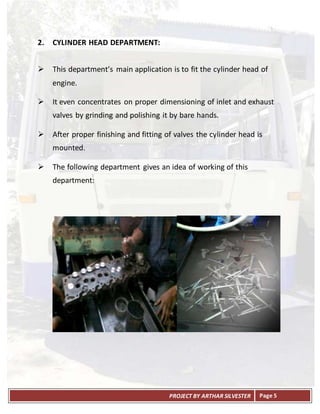
2. CYLINDER HEAD DEPARTMENT:
 This department’s main application is to fit the cylinder head of
engine.
 It even concentrates on proper dimensioning of inlet and exhaust
valves by grinding and polishing it by bare hands.
 After proper finishing and fitting of valves the cylinder head is
mounted.
 The following department gives an idea of working of this
department:
PROJECT BY ARTHAR SILVESTER Page 6
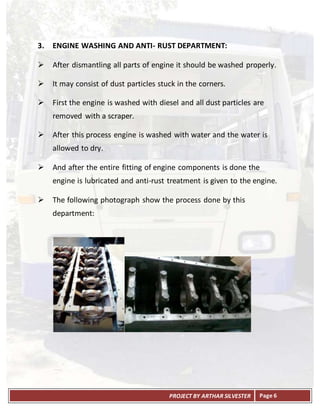
3. ENGINE WASHING AND ANTI- RUST DEPARTMENT:
 After dismantling all parts of engine it should be washed properly.
 It may consist of dust particles stuck in the corners.
 First the engine is washed with diesel and all dust particles are
removed with a scraper.
 After this process engine is washed with water and the water is
allowed to dry.
 And after the entire fitting of engine components is done the
engine is lubricated and anti-rust treatment is given to the engine.
 The following photograph show the process done by this
department:
PROJECT BY ARTHAR SILVESTER Page 7
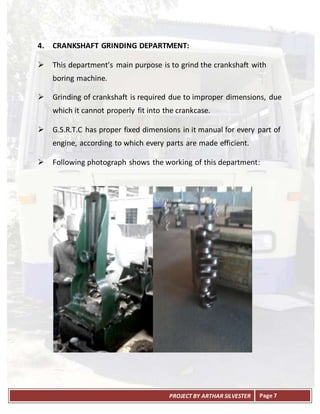
4. CRANKSHAFT GRINDING DEPARTMENT:
 This department’s main purpose is to grind the crankshaft with
boring machine.
 Grinding of crankshaft is required due to improper dimensions, due
which it cannot properly fit into the crankcase.
 G.S.R.T.C has proper fixed dimensions in it manual for every part of
engine, according to which every parts are made efficient.
 Following photograph shows the working of this department:
PROJECT BY ARTHAR SILVESTER Page 8
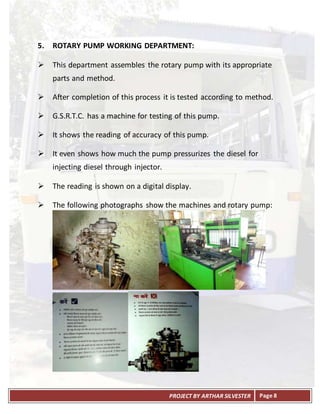
5. ROTARY PUMP WORKING DEPARTMENT:
 This department assembles the rotary pump with its appropriate
parts and method.
 After completion of this process it is tested according to method.
 G.S.R.T.C. has a machine for testing of this pump.
 It shows the reading of accuracy of this pump.
 It even shows how much the pump pressurizes the diesel for
injecting diesel through injector.
 The reading is shown on a digital display.
 The following photographs show the machines and rotary pump:
PROJECT BY ARTHAR SILVESTER Page 9
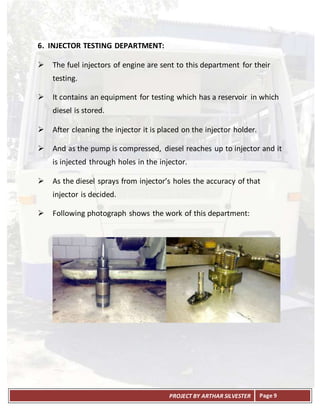
6. INJECTOR TESTING DEPARTMENT:
 The fuel injectors of engine are sent to this department for their
testing.
 It contains an equipment for testing which has a reservoir in which
diesel is stored.
 After cleaning the injector it is placed on the injector holder.
 And as the pump is compressed, diesel reaches up to injector and it
is injected through holes in the injector.
 As the diesel sprays from injector’s holes the accuracy of that
injector is decided.
 Following photograph shows the work of this department:
PROJECT BY ARTHAR SILVESTER Page 10
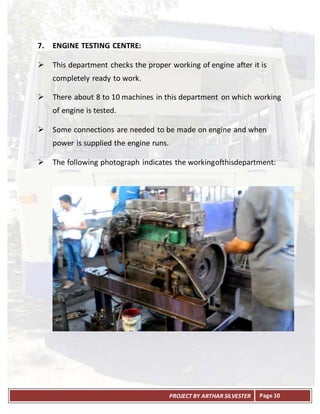
7. ENGINE TESTING CENTRE:
 This department checks the proper working of engine after it is
completely ready to work.
 There about 8 to 10 machines in this department on which working
of engine is tested.
 Some connections are needed to be made on engine and when
power is supplied the engine runs.
 The following photograph indicates the workingofthisdepartment:
PROJECT BY ARTHAR SILVESTER Page 11
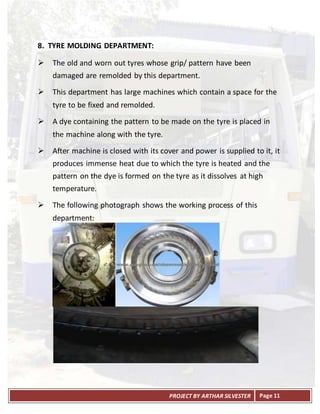
8. TYRE MOLDING DEPARTMENT:
 The old and worn out tyres whose grip/ pattern have been
damaged are remolded by this department.
 This department has large machines which contain a space for the
tyre to be fixed and remolded.
 A dye containing the pattern to be made on the tyre is placed in
the machine along with the tyre.
 After machine is closed with its cover and power is supplied to it, it
produces immense heat due to which the tyre is heated and the
pattern on the dye is formed on the tyre as it dissolves at high
temperature.
 The following photograph shows the working process of this
department:
PROJECT BY ARTHAR SILVESTER Page 12
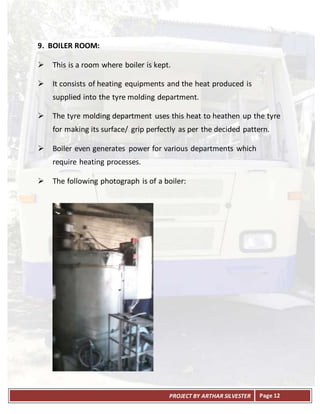
9. BOILER ROOM:
 This is a room where boiler is kept.
 It consists of heating equipments and the heat produced is
supplied into the tyre molding department.
 The tyre molding department uses this heat to heathen up the tyre
for making its surface/ grip perfectly as per the decided pattern.
 Boiler even generates power for various departments which
require heating processes.
 The following photograph is of a boiler:
PROJECT BY ARTHAR SILVESTER Page 13
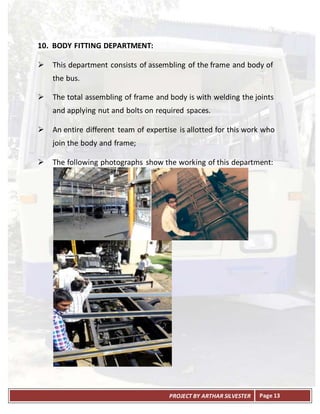
10. BODY FITTING DEPARTMENT:
 This department consists of assembling of the frame and body of
the bus.
 The total assembling of frame and body is with welding the joints
and applying nut and bolts on required spaces.
 An entire different team of expertise is allotted for this work who
join the body and frame;
 The following photographs show the working of this department:
PROJECT BY ARTHAR SILVESTER Page 14
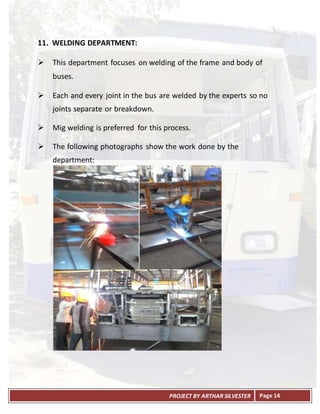
11. WELDING DEPARTMENT:
 This department focuses on welding of the frame and body of
buses.
 Each and every joint in the bus are welded by the experts so no
joints separate or breakdown.
 Mig welding is preferred for this process.
 The following photographs show the work done by the
department:
PROJECT BY ARTHAR SILVESTER Page 15
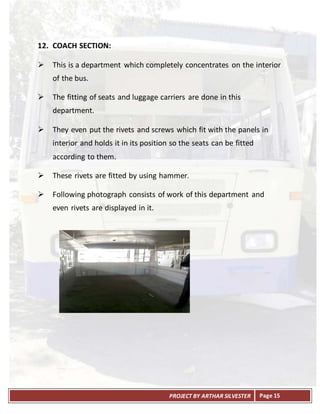
12. COACH SECTION:
 This is a department which completely concentrates on the interior
of the bus.
 The fitting of seats and luggage carriers are done in this
department.
 They even put the rivets and screws which fit with the panels in
interior and holds it in its position so the seats can be fitted
according to them.
 These rivets are fitted by using hammer.
 Following photograph consists of work of this department and
even rivets are displayed in it.
PROJECT BY ARTHAR SILVESTER Page 16
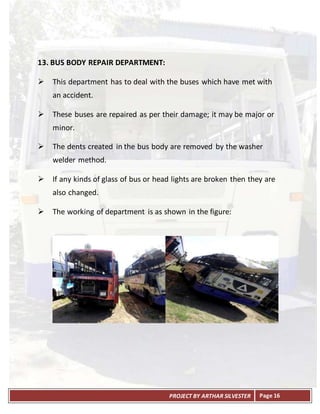
13. BUS BODY REPAIR DEPARTMENT:
 This department has to deal with the buses which have met with
an accident.
 These buses are repaired as per their damage; it may be major or
minor.
 The dents created in the bus body are removed by the washer
welder method.
 If any kinds of glass of bus or head lights are broken then they are
also changed.
 The working of department is as shown in the figure:
PROJECT BY ARTHAR SILVESTER Page 17
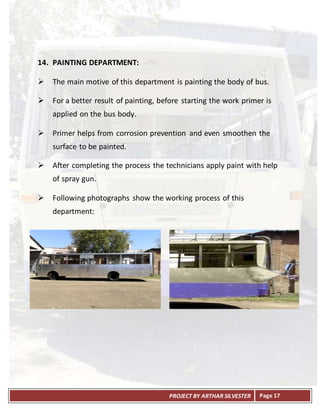
14. PAINTING DEPARTMENT:
 The main motive of this department is painting the body of bus.
 For a better result of painting, before starting the work primer is
applied on the bus body.
 Primer helps from corrosion prevention and even smoothen the
surface to be painted.
 After completing the process the technicians apply paint with help
of spray gun.
 Following photographs show the working process of this
department:
PROJECT BY ARTHAR SILVESTER Page 18
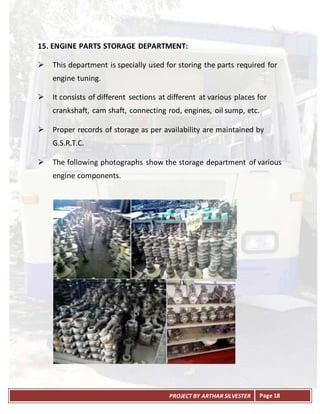
15. ENGINE PARTS STORAGE DEPARTMENT:
 This department is specially used for storing the parts required for
engine tuning.
 It consists of different sections at different at various places for
crankshaft, cam shaft, connecting rod, engines, oil sump, etc.
 Proper records of storage as per availability are maintained by
G.S.R.T.C.
 The following photographs show the storage department of various
engine components.
PROJECT BY ARTHAR SILVESTER Page 19
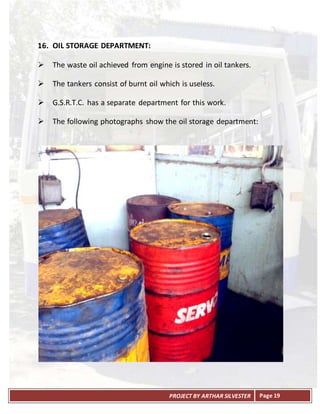
16. OIL STORAGE DEPARTMENT:
 The waste oil achieved from engine is stored in oil tankers.
 The tankers consist of burnt oil which is useless.
 G.S.R.T.C. has a separate department for this work.
 The following photographs show the oil storage department:
PROJECT BY ARTHAR SILVESTER Page 20
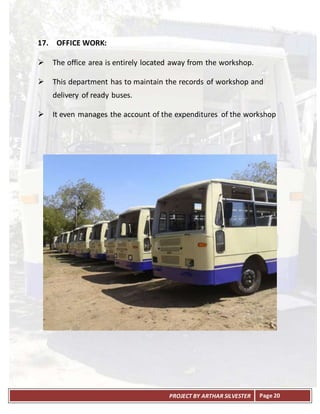
17. OFFICE WORK:
 The office area is entirely located away from the workshop.
 This department has to maintain the records of workshop and
delivery of ready buses.
 It even manages the account of the expenditures of the workshop
PROJECT BY ARTHAR SILVESTER Page 21
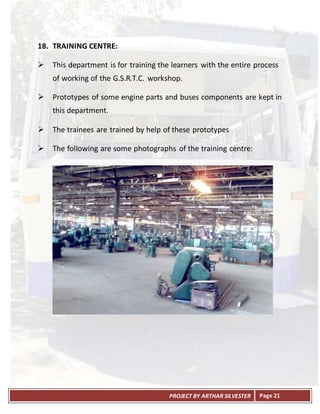
18. TRAINING CENTRE:
 This department is for training the learners with the entire process
of working of the G.S.R.T.C. workshop.
 Prototypes of some engine parts and buses components are kept in
this department.
 The trainees are trained by help of these prototypes
 The following are some photographs of the training centre:
PROJECT BY ARTHAR SILVESTER Page 22
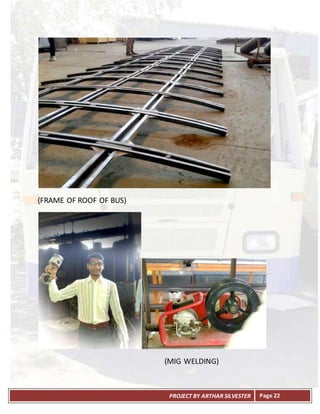
(FRAME OF ROOF OF BUS)
(MIG WELDING)
PROJECT BY ARTHAR SILVESTER Page 23
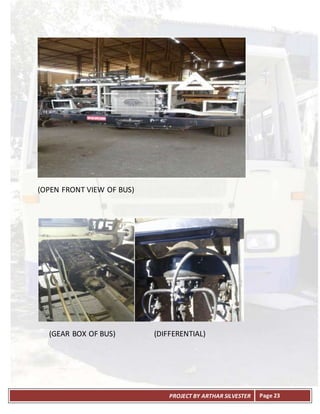
(OPEN FRONT VIEW OF BUS)
(GEAR BOX OF BUS) (DIFFERENTIAL)
PROJECT BY ARTHAR SILVESTER Page 24
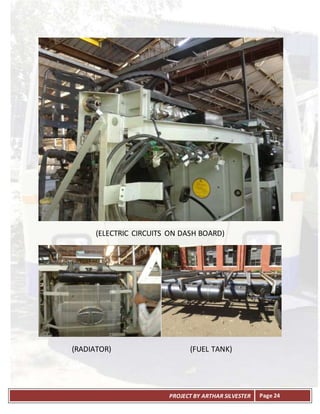
(ELECTRIC CIRCUITS ON DASH BOARD)
(RADIATOR) (FUEL TANK)
PROJECT BY ARTHAR SILVESTER Page 25
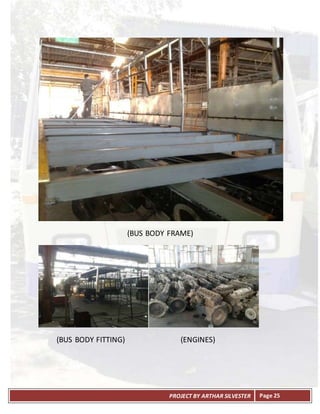
(BUS BODY FRAME)
(BUS BODY FITTING) (ENGINES)
PROJECT BY ARTHAR SILVESTER Page 26
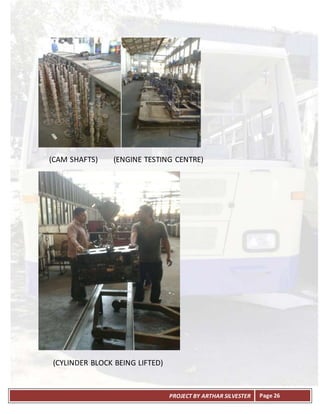
(CAM SHAFTS) (ENGINE TESTING CENTRE)
(CYLINDER BLOCK BEING LIFTED)
PROJECT BY ARTHAR SILVESTER Page 27
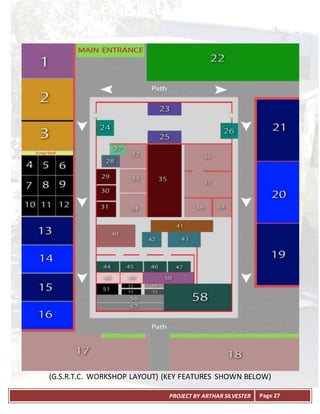
(G.S.R.T.C. WORKSHOP LAYOUT) (KEY FEATURES SHOWN BELOW)
PROJECT BY ARTHAR SILVESTER Page 28
KEY FOR WORKSHOP LAYOUT:
1. OFFICE
2. DIESEL
3. WASHING
4. CHANNEL
5. SHEET METAL
6. ROOF
7. SCRAP WHEEL AND DISK
8. RIM
9. CRANK SHAFT
10. GLASS
11. ENGINE
12. GEAR
13. ELECTRIC SUPPLY
14.
15.
16. GLASS
17. STORAGE CHASSIS
18. NEW BUS PARKING
19. PAINT SHOP
20. TRAINING CENTRE
PROJECT BY ARTHAR SILVESTER Page 29
21. NEW TRAINING SHOP
22. GARDEN
23. CYLINDER HEAD
24. ENGINE STORAGE
25. ENGINE TUNING DEPARTMENT
26. AIR COMPRESSOR ROOM
27.
28. ENGINE TESTING CENTRE
29. CYLINDER BLOCK
30. RE- POWER
31. ENGINE DISMANTELING
32. INJECTOR TESTING
33. CRANK AND CAM SHAFT
34. PISTON AND CONNECTING ROD
35. MACHINES AND EQUIPMENTS
36. TYRE STORAGE
37. TYRE MOLDING
38. HEATING CHAMBER
39. BOILER ROOM
40. ASSEMBLING OF ROOF
41. BUS BODY ASSEMBLING
PROJECT BY ARTHAR SILVESTER Page 30
42. HALF BODY
43. FULL BODY
44.
45.
46.
47.
48. ARC WELDING
49. ARC WELDING PARTS STORAGE
50. OFFICE
51.
52.
53.
54.
55.
56. MIG WELDING
57.
58. SHEETS
PROJECT BY ARTHAR SILVESTER Page 31

St workshop visit auto 2048 - final versionf ooter

  • 1.
    PROJECT BY ARTHARSILVESTER Page 1
  • 2.
    PROJECT BY ARTHARSILVESTER Page 2 AIM: The basic motive for visit to GSRTC workshop was to clear the idea of the production of buses, used for transportation. INTRODUCTION:  GSRTC, also known as Gujarat State Road Transport, is the passenger bus transport service provided by the Indian state, Gujarat.  For manufacturing of this transportation buses a workshop has been introduced in Naroda since, its existence.  GSRTC was established on 1st May 1960.  It started with 7 divisions, 76 depots and 7 divisional workshop among which the workshop in Naroda, Ahmedabad is considered to be the main branch.  The GSRTC workshop at Naroda is considered to be the Asia’s largest workshop as per its manufacturing of business is concerned.
  • 3.
    PROJECT BY ARTHARSILVESTER Page 3 DEPARTMENTS: 1. Air compressor department 2. Cylinder head department 3. Engine washing and anti-rust treatment department 4. Crankshaft grinding department 5. Rotary pump testing department 6. Injector testing department 7. Engine testing center 8. Tyre molding department 9. Boiler room 10. Body fitting department 11. Welding department 12. Coach section 13. Bus body repair department 14. Painting department 15. Engine parts storage department 16. Oil storage department 17. Office work 18. Training centre
  • 4.
    PROJECT BY ARTHARSILVESTER Page 4 1. AIR COMPRESSOR DEPARTMENT:  This department consists of air compressor.  The supply of air to entire workshop where it is needed for any work is done through this department.  Its main application is to supply air to tyre, machine and engine shop.  The following photographs explains in brief about the department:
  • 5.
    PROJECT BY ARTHARSILVESTER Page 5 2. CYLINDER HEAD DEPARTMENT:  This department’s main application is to fit the cylinder head of engine.  It even concentrates on proper dimensioning of inlet and exhaust valves by grinding and polishing it by bare hands.  After proper finishing and fitting of valves the cylinder head is mounted.  The following department gives an idea of working of this department:
  • 6.
    PROJECT BY ARTHARSILVESTER Page 6 3. ENGINE WASHING AND ANTI- RUST DEPARTMENT:  After dismantling all parts of engine it should be washed properly.  It may consist of dust particles stuck in the corners.  First the engine is washed with diesel and all dust particles are removed with a scraper.  After this process engine is washed with water and the water is allowed to dry.  And after the entire fitting of engine components is done the engine is lubricated and anti-rust treatment is given to the engine.  The following photograph show the process done by this department:
  • 7.
    PROJECT BY ARTHARSILVESTER Page 7 4. CRANKSHAFT GRINDING DEPARTMENT:  This department’s main purpose is to grind the crankshaft with boring machine.  Grinding of crankshaft is required due to improper dimensions, due which it cannot properly fit into the crankcase.  G.S.R.T.C has proper fixed dimensions in it manual for every part of engine, according to which every parts are made efficient.  Following photograph shows the working of this department:
  • 8.
    PROJECT BY ARTHARSILVESTER Page 8 5. ROTARY PUMP WORKING DEPARTMENT:  This department assembles the rotary pump with its appropriate parts and method.  After completion of this process it is tested according to method.  G.S.R.T.C. has a machine for testing of this pump.  It shows the reading of accuracy of this pump.  It even shows how much the pump pressurizes the diesel for injecting diesel through injector.  The reading is shown on a digital display.  The following photographs show the machines and rotary pump:
  • 9.
    PROJECT BY ARTHARSILVESTER Page 9 6. INJECTOR TESTING DEPARTMENT:  The fuel injectors of engine are sent to this department for their testing.  It contains an equipment for testing which has a reservoir in which diesel is stored.  After cleaning the injector it is placed on the injector holder.  And as the pump is compressed, diesel reaches up to injector and it is injected through holes in the injector.  As the diesel sprays from injector’s holes the accuracy of that injector is decided.  Following photograph shows the work of this department:
  • 10.
    PROJECT BY ARTHARSILVESTER Page 10 7. ENGINE TESTING CENTRE:  This department checks the proper working of engine after it is completely ready to work.  There about 8 to 10 machines in this department on which working of engine is tested.  Some connections are needed to be made on engine and when power is supplied the engine runs.  The following photograph indicates the workingofthisdepartment:
  • 11.
    PROJECT BY ARTHARSILVESTER Page 11 8. TYRE MOLDING DEPARTMENT:  The old and worn out tyres whose grip/ pattern have been damaged are remolded by this department.  This department has large machines which contain a space for the tyre to be fixed and remolded.  A dye containing the pattern to be made on the tyre is placed in the machine along with the tyre.  After machine is closed with its cover and power is supplied to it, it produces immense heat due to which the tyre is heated and the pattern on the dye is formed on the tyre as it dissolves at high temperature.  The following photograph shows the working process of this department:
  • 12.
    PROJECT BY ARTHARSILVESTER Page 12 9. BOILER ROOM:  This is a room where boiler is kept.  It consists of heating equipments and the heat produced is supplied into the tyre molding department.  The tyre molding department uses this heat to heathen up the tyre for making its surface/ grip perfectly as per the decided pattern.  Boiler even generates power for various departments which require heating processes.  The following photograph is of a boiler:
  • 13.
    PROJECT BY ARTHARSILVESTER Page 13 10. BODY FITTING DEPARTMENT:  This department consists of assembling of the frame and body of the bus.  The total assembling of frame and body is with welding the joints and applying nut and bolts on required spaces.  An entire different team of expertise is allotted for this work who join the body and frame;  The following photographs show the working of this department:
  • 14.
    PROJECT BY ARTHARSILVESTER Page 14 11. WELDING DEPARTMENT:  This department focuses on welding of the frame and body of buses.  Each and every joint in the bus are welded by the experts so no joints separate or breakdown.  Mig welding is preferred for this process.  The following photographs show the work done by the department:
  • 15.
    PROJECT BY ARTHARSILVESTER Page 15 12. COACH SECTION:  This is a department which completely concentrates on the interior of the bus.  The fitting of seats and luggage carriers are done in this department.  They even put the rivets and screws which fit with the panels in interior and holds it in its position so the seats can be fitted according to them.  These rivets are fitted by using hammer.  Following photograph consists of work of this department and even rivets are displayed in it.
  • 16.
    PROJECT BY ARTHARSILVESTER Page 16 13. BUS BODY REPAIR DEPARTMENT:  This department has to deal with the buses which have met with an accident.  These buses are repaired as per their damage; it may be major or minor.  The dents created in the bus body are removed by the washer welder method.  If any kinds of glass of bus or head lights are broken then they are also changed.  The working of department is as shown in the figure:
  • 17.
    PROJECT BY ARTHARSILVESTER Page 17 14. PAINTING DEPARTMENT:  The main motive of this department is painting the body of bus.  For a better result of painting, before starting the work primer is applied on the bus body.  Primer helps from corrosion prevention and even smoothen the surface to be painted.  After completing the process the technicians apply paint with help of spray gun.  Following photographs show the working process of this department:
  • 18.
    PROJECT BY ARTHARSILVESTER Page 18 15. ENGINE PARTS STORAGE DEPARTMENT:  This department is specially used for storing the parts required for engine tuning.  It consists of different sections at different at various places for crankshaft, cam shaft, connecting rod, engines, oil sump, etc.  Proper records of storage as per availability are maintained by G.S.R.T.C.  The following photographs show the storage department of various engine components.
  • 19.
    PROJECT BY ARTHARSILVESTER Page 19 16. OIL STORAGE DEPARTMENT:  The waste oil achieved from engine is stored in oil tankers.  The tankers consist of burnt oil which is useless.  G.S.R.T.C. has a separate department for this work.  The following photographs show the oil storage department:
  • 20.
    PROJECT BY ARTHARSILVESTER Page 20 17. OFFICE WORK:  The office area is entirely located away from the workshop.  This department has to maintain the records of workshop and delivery of ready buses.  It even manages the account of the expenditures of the workshop
  • 21.
    PROJECT BY ARTHARSILVESTER Page 21 18. TRAINING CENTRE:  This department is for training the learners with the entire process of working of the G.S.R.T.C. workshop.  Prototypes of some engine parts and buses components are kept in this department.  The trainees are trained by help of these prototypes  The following are some photographs of the training centre:
  • 22.
    PROJECT BY ARTHARSILVESTER Page 22 (FRAME OF ROOF OF BUS) (MIG WELDING)
  • 23.
    PROJECT BY ARTHARSILVESTER Page 23 (OPEN FRONT VIEW OF BUS) (GEAR BOX OF BUS) (DIFFERENTIAL)
  • 24.
    PROJECT BY ARTHARSILVESTER Page 24 (ELECTRIC CIRCUITS ON DASH BOARD) (RADIATOR) (FUEL TANK)
  • 25.
    PROJECT BY ARTHARSILVESTER Page 25 (BUS BODY FRAME) (BUS BODY FITTING) (ENGINES)
  • 26.
    PROJECT BY ARTHARSILVESTER Page 26 (CAM SHAFTS) (ENGINE TESTING CENTRE) (CYLINDER BLOCK BEING LIFTED)
  • 27.
    PROJECT BY ARTHARSILVESTER Page 27 (G.S.R.T.C. WORKSHOP LAYOUT) (KEY FEATURES SHOWN BELOW)
  • 28.
    PROJECT BY ARTHARSILVESTER Page 28 KEY FOR WORKSHOP LAYOUT: 1. OFFICE 2. DIESEL 3. WASHING 4. CHANNEL 5. SHEET METAL 6. ROOF 7. SCRAP WHEEL AND DISK 8. RIM 9. CRANK SHAFT 10. GLASS 11. ENGINE 12. GEAR 13. ELECTRIC SUPPLY 14. 15. 16. GLASS 17. STORAGE CHASSIS 18. NEW BUS PARKING 19. PAINT SHOP 20. TRAINING CENTRE
  • 29.
    PROJECT BY ARTHARSILVESTER Page 29 21. NEW TRAINING SHOP 22. GARDEN 23. CYLINDER HEAD 24. ENGINE STORAGE 25. ENGINE TUNING DEPARTMENT 26. AIR COMPRESSOR ROOM 27. 28. ENGINE TESTING CENTRE 29. CYLINDER BLOCK 30. RE- POWER 31. ENGINE DISMANTELING 32. INJECTOR TESTING 33. CRANK AND CAM SHAFT 34. PISTON AND CONNECTING ROD 35. MACHINES AND EQUIPMENTS 36. TYRE STORAGE 37. TYRE MOLDING 38. HEATING CHAMBER 39. BOILER ROOM 40. ASSEMBLING OF ROOF 41. BUS BODY ASSEMBLING
  • 30.
    PROJECT BY ARTHARSILVESTER Page 30 42. HALF BODY 43. FULL BODY 44. 45. 46. 47. 48. ARC WELDING 49. ARC WELDING PARTS STORAGE 50. OFFICE 51. 52. 53. 54. 55. 56. MIG WELDING 57. 58. SHEETS
  • 31.
    PROJECT BY ARTHARSILVESTER Page 31