e Frenc Revolutio
History Chapter 1
Early Modern France 1453-1789
Valois 1328- 1589 (13 Kings)
From the end of the feudal period
to early modern age
Philip VI (ruled 1328–1350); John the
Good (1350–1364); Charles V
(1364–1380); Charles VI (1380–1422);
Charles VII (1422–1461); Louis XI
(1461–1483); Charles VIII (1483–1498);
Louis XII (1498–1515); Francis I
(1515–1547); Henry II (1547–1559);
Francis II (1559–1560); Charles IX
(1560–1574); Henry III (1574–1589).
Bourbon 1589-1792
The Bourbon dynasty succeeded to the French
throne in 1589, following the assassination of the
last Valois king, Henry III.
Bourbon Dynasty
● 1589–1610 Henry IV.
● 1610–1643 Louis XIII.
● 1643–1715 Louis XIV (the
Sun King)
● 1715–1774 Louis XV.
● 1774–1792 Louis XVI.
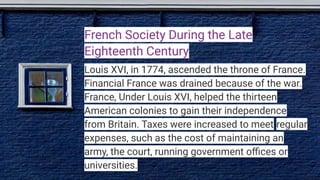
French Society During the Late
Eighteenth Century
Louis XVI, in 1774, ascended the throne of France.
Financial France was drained because of the war.
France, Under Louis XVI, helped the thirteen
American colonies to gain their independence
from Britain. Taxes were increased to meet regular
expenses, such as the cost of maintaining an
army, the court, running government offices or
universities.
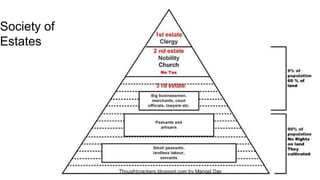
The country of France was divided into
three estates in the eighteenth century.
The feudal system was part of the society
estates dated back to the middle ages.
90 percent of the population was
dominated by peasants but only a small
number of them owned the land they
cultivated.
Louis XVI
*1774 ascended to
the throne
*20 year old and
married to Marie
Antoinette
*Found an empty
treasury
Why did Louis XVI find an empty treasury?
● Long years of war
● Cost of maintaining the palace of Versailles
● Financial and military support to 13 American
colonies to gain independence from Britain
● High interest charged by lenders (10%)
So Louis XVI decided to increases taxes
The country of France was divided into
three estates in the eighteenth century.
The feudal system was part of the society
estates dated back to the middle ages.
90 percent of the population was
dominated by peasants but only a small
number of them owned the land they
cultivated.
60 percent was owned by nobles, the Church and
other richer members of the third estate.
The clergy and the nobility, members of the first
two estates enjoyed certain privileges by birth.
These groups of members were exempted from
paying taxes and enjoyed feudal privileges.
All members of the third estate had to pay taxes
to the state which included a direct tax, called
taille, and a number of indirect taxes which were
levied on articles of everyday consumption like
salt or tobacco.
Old Regime
The Society and institutions of France
before 1789
The society of estates was part of the
feudal system that dated back to middle
ages
Society of
Estates
Privileges of Nobles and clergies
● 60% of the land was owned by the nobles,
church and other rich members of the third
estate
● Enjoyed privileges by birth - exemption from
paying taxes
● Enjoyed feudal privileges - feudal dues from
peasants, services from peasants
In the house, field and in army.
A Growing Middle Class Envisages an End to Privileges
Peasants used to participate in revolts against taxes
and food scarcity. Group of the third estate had
become prosperous and had access to education
and new ideas. In the eighteenth century, new social
groups emerged, termed the middle class, who
earned their wealth through expanding overseas
trade and by manufacturing woollen and silk textiles
that were either exported or bought by the richer
members of society.
Devolepment of Third
Estate: Education and
good ideas
Emergence of Middle
Classes ; Wealth through
expanding overseas
trade and production
of woolen and silk
clothes
The third estate included professions such as lawyers or
administrative officials. A person’s social position was
dependent on their merit.
All these groups were educated and believed that no
group in society should be privileged by birth. Rather, a
person’s social position must depend on his merit. A
new form of government was proposed by Rousseau
based on a social contract between people and their
representatives.
Social Position should be based on merit not
by birth
Rousseau proposed a government based on
social contract
Between people and representatives
Similarly, Montesquieu
proposed a division of power
within the government between
the legislative, the executive
and the judiciary. In the USA,
this model of government was
put into force. Louis Louis XVI
planned to impose further
taxes to meet the expenses.
The Outbreak of the Revolution
In France, the monarch didn’t have the power to impose
taxes. They had to call a meeting of the Estates-General, a
political body to which the three estates sent their
representatives, to pass proposals for new taxes. Louis
XVI, on 5 May 1789, called an assembly to pass proposals
for new taxes. Representatives from the first and second
estates were present and the third estate was represented
by its prosperous and educated members.
According to the principle each estate had one vote. But,
representatives from the third estate demanded each member
would have one vote. The demand was rejected so members of the
third estate walked out to protest. They swore not to disperse till a
constitution drafted for France that would limit the powers of the
monarch.
Due to the severe winter, bread price rose and people had to spend
hours in long queues. Rumours spread that the lords of the manor
hired bands of brigands to destroy the ripe crops. In fear, peasants
started looting hoarded grain and burnt down documents containing
records of manorial dues. Nobles fled from their homes.
Louis XVI accorded recognition to the National Assembly and
accepted the principle that his powers would from now on be
checked by a constitution. The Assembly passed a decree
abolishing the feudal system of obligations and taxes on 4
August 1789. Tithes were abolished and lands owned by the
Church were confiscated.
XVI, on 5 May
1789, called an
assembly to pass
proposals for new
taxes.
representatives from
the third estate
demanded each
member would have
one vote. 3rd estate
decided to draft a
Constitution
Rise in the bread price-Rumours spread that the lords are planning
to destroy ripe crops
So the peasants attacked them back- nobles left their homes to hide
outs. National Assembly and Constitution was accepted- Feudalism
was abolished , land from church was confiscated
1774- Louis XVI ascended to the throne
Old regime
Organisation of French Society
Subsistence Crisis
Middle class
Philosophers - John Locke: “Two treatises of the
government” -refuted the divine right
Rousseau: Social contract
Montesqueiu: “The spirit of the laws” -Division of
powers
Estates general- 5th May 1789
Denial of the demand of 3rd estate and their walk
out
Formation of National Assembly 20th June 1789
Mirabeau and Abbe Siyes: Leaders of National
Assembly
Destruction of the fortress-prison, Bastille
Abolishion of Feudal System: 4th August 1789
France Becomes a Constitutional
Monarchy
In 1791, The National Assembly
completed the draft of the constitution
and its main object was to limit the
powers of the monarch. These powers
were now separated and assigned to
different institutions – the legislature,
executive and judiciary. France became
a constitutional monarchy.
Citizens voted for a group of electors,
who in turn chose the Assembly, but
unfortunately, not every citizen had the
right to vote.
Men above 25 years of age who
paid taxes equal to at least 3 days
of a labourer’s wage were entitled to
vote.
The Constitution began with a
Declaration of the Rights of Man
and Citizen.
Rights such as the right to life,
freedom of speech, freedom of
opinion, equality before law, were
established as ‘natural and
inalienable’ rights, that is, they
belonged to each human being by
birth and could not be taken away.
Constitutional Monarchy:Monarchy= the
legislature, executive and judiciary.
Right to vote :
Declaration of the Rights of Man and Citizen
Rights such asfreedom of speech, freedom of
opinion, equality before law, were established as
‘natural and inalienable’ rights,
Reading political symbols
France Abolishes Monarchy and Becomes a Republic
The Conspiracy of Louis XVI with King of
Prussia and other neighboring countries
National Assembly on the information of the
conspiracy declared a counter attack to
Prussia and Austria on 1792
Marseillaise: Thousands of people came to Paris to
join the army
Among the patriotic songs a famous one was the
‘Marseillaise’ composed by Roget de L’Isle
It was sung for the first time by the volunteers from
Marseillaise so got its name
The Marseillaise is now the National Anthem of
France
Political Clubs
Large sections of the population were convinced that
the revolution had to be carried further to get their
political rights.
So to discuss about government policies and to plan
their own forms of action they have formed political
clubs
Jacobins Club was the most successful of these
clubs
The members of the Jacobin Club was
mainly the less prosperous sections of
society.
Their leader was Maximilian
Robespierre
Sans- Culottes - those who
without knee breeches
Convention
In 1792 August 10 a large number of Parisians
destroyed the palace of the Tuileries and held the
king as hostage
National Assembly imprisoned the royal family
Elections were conducted
All men of 21 years and above regardless of wealth
got the right to vote
The newly elected assembly was called the
convention
On 21 September 1792 the Convention
abolished monarchy and declared France as a
republic
Louis XVI was sentenced on the charge of
treason
On 21 January 1793 he was executed
The reign of Terror
The period from 1793-1794
Robespierre- severe control
His enemies ???
were arrested - sent to the tribunal-
found guilty- Guillotined
Policies of Robespierre
Maximum ceiling on wages and prices
Meat and bread were rationed
Peasants were forced to sell goods at prices fixed by the
government
Use of white flour was forbidden= equality bread, made of whole
wheat made compulsory
Equality in speech and address
Monsieur (sir) and Madame (Madam) were changed to Citoyen
and Citoyenne (citizen) Churches were turned into barracks or
offices
Due to the lack of support he was convicted by a court in July 1794
arrested and sent to the guillotine
A Directory Rules France
After the fall of Jacobin club the wealthier middle class
seized the power
Right to Vote to non-propertied sections of society
Two elected legislative councils - Directory of five
members
From one man rule to a group
Directors had clashes with Legislative councils- so the
council dismissed the Directory
This instability paved the way for the rise of a military
dictator- Napoleon Bonaparte
Louis XVI 1774
1789- National Assembly
Convention- 1792 September 21
Reign of terror- 1793-1794
Directory- 1795
Napoleon Bonaparte- 1799
Did women have a Revolution
Most women did not have access to education or job training
Women started their own political clubs and news papers
Eg. The Society of Revolutionary and Republican Women
Main demands- Same political rights as men
Early years the revolutionary government of third estate made some
favours to women but equality in political rights were not given
After the suffrage movement led by women in 1946 the women in France
won the right to vote
The Abolishion of slavery
There was a triangular slave trade between Europe, Africa and Americas
Throughout 18th century there was a little criticism of slavery in France
National Assembly did not pass any law to fearing the opposition from the
businessmen
1794- convention abolished slavery
1804- Napoleon reintroduced slavery
1848- Slavery was abolished in french colonies
The revolution and everyday life
The abolition of censorship
In the old regime all written material and cultural
activities published only after they had been approved
by the censors of the king
With the declaration of rights of man and citizen
Freedom of speech and expression made as natural
rights
1804 Napoleon came to power
He saw himself as the moderniser of
France
Protection of private property
Uniform system of weights and
measures provided by decimal system
From a liberators image soon he
became an invader
He was defeated at Waterloo
The ideas of Liberty, and democratic rights were the most important
legacy of French revolution
Tipu Sultan and Raja Rammohan Roy are two examples of
individuals who responded to the ideas coming from revolutionary
France

french revolution class 9 powerpoint presentation pdf

  • 1.
  • 2.
    Early Modern France1453-1789 Valois 1328- 1589 (13 Kings) From the end of the feudal period to early modern age Philip VI (ruled 1328–1350); John the Good (1350–1364); Charles V (1364–1380); Charles VI (1380–1422); Charles VII (1422–1461); Louis XI (1461–1483); Charles VIII (1483–1498); Louis XII (1498–1515); Francis I (1515–1547); Henry II (1547–1559); Francis II (1559–1560); Charles IX (1560–1574); Henry III (1574–1589). Bourbon 1589-1792 The Bourbon dynasty succeeded to the French throne in 1589, following the assassination of the last Valois king, Henry III. Bourbon Dynasty ● 1589–1610 Henry IV. ● 1610–1643 Louis XIII. ● 1643–1715 Louis XIV (the Sun King) ● 1715–1774 Louis XV. ● 1774–1792 Louis XVI.
  • 3.
    French Society Duringthe Late Eighteenth Century Louis XVI, in 1774, ascended the throne of France. Financial France was drained because of the war. France, Under Louis XVI, helped the thirteen American colonies to gain their independence from Britain. Taxes were increased to meet regular expenses, such as the cost of maintaining an army, the court, running government offices or universities.
  • 4.
    The country ofFrance was divided into three estates in the eighteenth century. The feudal system was part of the society estates dated back to the middle ages. 90 percent of the population was dominated by peasants but only a small number of them owned the land they cultivated.
  • 5.
    Louis XVI *1774 ascendedto the throne *20 year old and married to Marie Antoinette *Found an empty treasury
  • 6.
    Why did LouisXVI find an empty treasury? ● Long years of war ● Cost of maintaining the palace of Versailles ● Financial and military support to 13 American colonies to gain independence from Britain ● High interest charged by lenders (10%) So Louis XVI decided to increases taxes
  • 7.
    The country ofFrance was divided into three estates in the eighteenth century. The feudal system was part of the society estates dated back to the middle ages. 90 percent of the population was dominated by peasants but only a small number of them owned the land they cultivated.
  • 8.
    60 percent wasowned by nobles, the Church and other richer members of the third estate. The clergy and the nobility, members of the first two estates enjoyed certain privileges by birth. These groups of members were exempted from paying taxes and enjoyed feudal privileges. All members of the third estate had to pay taxes to the state which included a direct tax, called taille, and a number of indirect taxes which were levied on articles of everyday consumption like salt or tobacco.
  • 9.
    Old Regime The Societyand institutions of France before 1789 The society of estates was part of the feudal system that dated back to middle ages
  • 10.
  • 11.
    Privileges of Noblesand clergies ● 60% of the land was owned by the nobles, church and other rich members of the third estate ● Enjoyed privileges by birth - exemption from paying taxes ● Enjoyed feudal privileges - feudal dues from peasants, services from peasants In the house, field and in army.
  • 12.
    A Growing MiddleClass Envisages an End to Privileges Peasants used to participate in revolts against taxes and food scarcity. Group of the third estate had become prosperous and had access to education and new ideas. In the eighteenth century, new social groups emerged, termed the middle class, who earned their wealth through expanding overseas trade and by manufacturing woollen and silk textiles that were either exported or bought by the richer members of society.
  • 13.
    Devolepment of Third Estate:Education and good ideas Emergence of Middle Classes ; Wealth through expanding overseas trade and production of woolen and silk clothes
  • 14.
    The third estateincluded professions such as lawyers or administrative officials. A person’s social position was dependent on their merit. All these groups were educated and believed that no group in society should be privileged by birth. Rather, a person’s social position must depend on his merit. A new form of government was proposed by Rousseau based on a social contract between people and their representatives.
  • 15.
    Social Position shouldbe based on merit not by birth Rousseau proposed a government based on social contract Between people and representatives
  • 16.
    Similarly, Montesquieu proposed adivision of power within the government between the legislative, the executive and the judiciary. In the USA, this model of government was put into force. Louis Louis XVI planned to impose further taxes to meet the expenses.
  • 17.
    The Outbreak ofthe Revolution In France, the monarch didn’t have the power to impose taxes. They had to call a meeting of the Estates-General, a political body to which the three estates sent their representatives, to pass proposals for new taxes. Louis XVI, on 5 May 1789, called an assembly to pass proposals for new taxes. Representatives from the first and second estates were present and the third estate was represented by its prosperous and educated members.
  • 18.
    According to theprinciple each estate had one vote. But, representatives from the third estate demanded each member would have one vote. The demand was rejected so members of the third estate walked out to protest. They swore not to disperse till a constitution drafted for France that would limit the powers of the monarch. Due to the severe winter, bread price rose and people had to spend hours in long queues. Rumours spread that the lords of the manor hired bands of brigands to destroy the ripe crops. In fear, peasants started looting hoarded grain and burnt down documents containing records of manorial dues. Nobles fled from their homes.
  • 19.
    Louis XVI accordedrecognition to the National Assembly and accepted the principle that his powers would from now on be checked by a constitution. The Assembly passed a decree abolishing the feudal system of obligations and taxes on 4 August 1789. Tithes were abolished and lands owned by the Church were confiscated.
  • 20.
    XVI, on 5May 1789, called an assembly to pass proposals for new taxes. representatives from the third estate demanded each member would have one vote. 3rd estate decided to draft a Constitution Rise in the bread price-Rumours spread that the lords are planning to destroy ripe crops So the peasants attacked them back- nobles left their homes to hide outs. National Assembly and Constitution was accepted- Feudalism was abolished , land from church was confiscated
  • 21.
    1774- Louis XVIascended to the throne Old regime Organisation of French Society Subsistence Crisis Middle class Philosophers - John Locke: “Two treatises of the government” -refuted the divine right Rousseau: Social contract Montesqueiu: “The spirit of the laws” -Division of powers
  • 22.
    Estates general- 5thMay 1789 Denial of the demand of 3rd estate and their walk out Formation of National Assembly 20th June 1789 Mirabeau and Abbe Siyes: Leaders of National Assembly Destruction of the fortress-prison, Bastille Abolishion of Feudal System: 4th August 1789
  • 23.
    France Becomes aConstitutional Monarchy In 1791, The National Assembly completed the draft of the constitution and its main object was to limit the powers of the monarch. These powers were now separated and assigned to different institutions – the legislature, executive and judiciary. France became a constitutional monarchy. Citizens voted for a group of electors, who in turn chose the Assembly, but unfortunately, not every citizen had the right to vote. Men above 25 years of age who paid taxes equal to at least 3 days of a labourer’s wage were entitled to vote. The Constitution began with a Declaration of the Rights of Man and Citizen. Rights such as the right to life, freedom of speech, freedom of opinion, equality before law, were established as ‘natural and inalienable’ rights, that is, they belonged to each human being by birth and could not be taken away.
  • 24.
    Constitutional Monarchy:Monarchy= the legislature,executive and judiciary. Right to vote : Declaration of the Rights of Man and Citizen Rights such asfreedom of speech, freedom of opinion, equality before law, were established as ‘natural and inalienable’ rights,
  • 26.
  • 28.
    France Abolishes Monarchyand Becomes a Republic The Conspiracy of Louis XVI with King of Prussia and other neighboring countries National Assembly on the information of the conspiracy declared a counter attack to Prussia and Austria on 1792
  • 29.
    Marseillaise: Thousands ofpeople came to Paris to join the army Among the patriotic songs a famous one was the ‘Marseillaise’ composed by Roget de L’Isle It was sung for the first time by the volunteers from Marseillaise so got its name The Marseillaise is now the National Anthem of France
  • 30.
    Political Clubs Large sectionsof the population were convinced that the revolution had to be carried further to get their political rights. So to discuss about government policies and to plan their own forms of action they have formed political clubs Jacobins Club was the most successful of these clubs
  • 31.
    The members ofthe Jacobin Club was mainly the less prosperous sections of society. Their leader was Maximilian Robespierre Sans- Culottes - those who without knee breeches
  • 32.
    Convention In 1792 August10 a large number of Parisians destroyed the palace of the Tuileries and held the king as hostage National Assembly imprisoned the royal family Elections were conducted All men of 21 years and above regardless of wealth got the right to vote The newly elected assembly was called the convention
  • 33.
    On 21 September1792 the Convention abolished monarchy and declared France as a republic Louis XVI was sentenced on the charge of treason On 21 January 1793 he was executed
  • 34.
    The reign ofTerror The period from 1793-1794 Robespierre- severe control His enemies ??? were arrested - sent to the tribunal- found guilty- Guillotined
  • 35.
    Policies of Robespierre Maximumceiling on wages and prices Meat and bread were rationed Peasants were forced to sell goods at prices fixed by the government Use of white flour was forbidden= equality bread, made of whole wheat made compulsory Equality in speech and address Monsieur (sir) and Madame (Madam) were changed to Citoyen and Citoyenne (citizen) Churches were turned into barracks or offices Due to the lack of support he was convicted by a court in July 1794 arrested and sent to the guillotine
  • 36.
    A Directory RulesFrance After the fall of Jacobin club the wealthier middle class seized the power Right to Vote to non-propertied sections of society Two elected legislative councils - Directory of five members From one man rule to a group Directors had clashes with Legislative councils- so the council dismissed the Directory This instability paved the way for the rise of a military dictator- Napoleon Bonaparte
  • 37.
    Louis XVI 1774 1789-National Assembly Convention- 1792 September 21 Reign of terror- 1793-1794 Directory- 1795 Napoleon Bonaparte- 1799
  • 38.
    Did women havea Revolution Most women did not have access to education or job training Women started their own political clubs and news papers Eg. The Society of Revolutionary and Republican Women Main demands- Same political rights as men Early years the revolutionary government of third estate made some favours to women but equality in political rights were not given After the suffrage movement led by women in 1946 the women in France won the right to vote
  • 39.
    The Abolishion ofslavery There was a triangular slave trade between Europe, Africa and Americas Throughout 18th century there was a little criticism of slavery in France National Assembly did not pass any law to fearing the opposition from the businessmen 1794- convention abolished slavery 1804- Napoleon reintroduced slavery 1848- Slavery was abolished in french colonies
  • 40.
    The revolution andeveryday life The abolition of censorship In the old regime all written material and cultural activities published only after they had been approved by the censors of the king With the declaration of rights of man and citizen Freedom of speech and expression made as natural rights
  • 41.
    1804 Napoleon cameto power He saw himself as the moderniser of France Protection of private property Uniform system of weights and measures provided by decimal system From a liberators image soon he became an invader He was defeated at Waterloo
  • 42.
    The ideas ofLiberty, and democratic rights were the most important legacy of French revolution Tipu Sultan and Raja Rammohan Roy are two examples of individuals who responded to the ideas coming from revolutionary France