THE
FRENCH
REVOLUTIO
N
What is a Revolution?
 A revolution is basically an action
taken by a large group of people to try
to change the government, or form of
government, of a country; especially
by a violent action.
Events of 14th July,1789
 On 14th July1789, the city of Paris was in a
state of turmoil. The king had commanded
the troops to move into the city.
 Some 7000 men and women gathered in
front of the town hall and decided to form a
people’s militia .
 They broke into a number of government
buildings in search of arms.
 A group of several hundred people
marched towards the eastern part of the
city and stormed the fortress-prison, the
Bastille, where they hoped to find weapons.
 The commander of the Bastille was killed
and the prisoners were released.
Political Causes of French
Revolution
 In 1774, Louis XVI of the Bourbon
family ascended the throne. But he
found an empty treasury, as long
years of war had drained the financial
resources of France.
 The cost of maintaining an
extravagant court at the Palace of
Versailles was also huge.
 Under Louis XVI, France had also
helped the 13 American colonies gain
their independence from the common
enemy, Britain.
 The war added more debt to the
already huge debt, and the lenders
who had given the state credit now
started charging 10% interest on
loans.
 To meet its regular expenses, such as
the cost of maintaining an army, the
court, running government offices and
buildings and universities, the state
was forced to increase taxes.
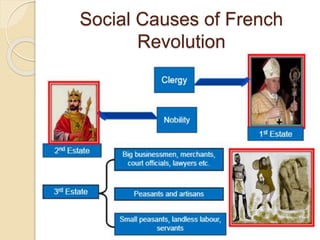
Social Causes of French
Revolution
 French society in the early 18th
century was divided into three estates:
The clergy, the nobility and the third
estate. Only members of the third
estate paid taxes.
 Peasants made up about 90% of the
population of France. However, only a
small number of them owned the land
they cultivated.
 60% of the land was owned by the
nobles, the Church and other richer
members of the third estate.
 The members of the Clergy and the
Nobility enjoyed certain privileges by
 The nobles further enjoyed feudal
privileges; this included feudal dues
which they extracted from the
peasants.
 Peasants were obliged to render
services to the lord-to work in his
house and fields- to participate in
building roads or to serve in the army.
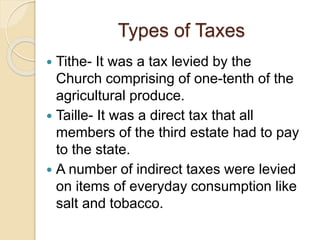
Types of Taxes
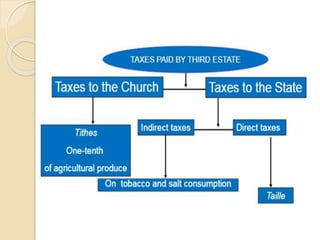
 Tithe- It was a tax levied by the
Church comprising of one-tenth of the
agricultural produce.
 Taille- It was a direct tax that all
members of the third estate had to pay
to the state.
 A number of indirect taxes were levied
on items of everyday consumption like
salt and tobacco.
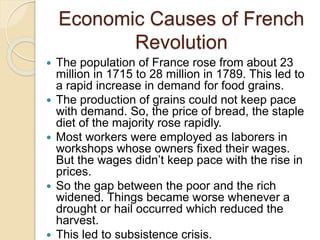
Economic Causes of French
Revolution
 The population of France rose from about 23
million in 1715 to 28 million in 1789. This led to
a rapid increase in demand for food grains.
 The production of grains could not keep pace
with demand. So, the price of bread, the staple
diet of the majority rose rapidly.
 Most workers were employed as laborers in
workshops whose owners fixed their wages.
But the wages didn’t keep pace with the rise in
prices.
 So the gap between the poor and the rich
widened. Things became worse whenever a
drought or hail occurred which reduced the
harvest.
 This led to subsistence crisis.
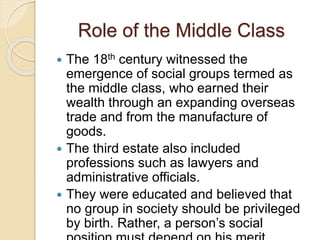
Role of the Middle Class
 The 18th century witnessed the
emergence of social groups termed as
the middle class, who earned their
wealth through an expanding overseas
trade and from the manufacture of
goods.
 The third estate also included
professions such as lawyers and
administrative officials.
 They were educated and believed that
no group in society should be privileged
by birth. Rather, a person’s social
Role of Philosophers
 John Locke: In his Two Treatises of
the Government, Locke sought to
refute the doctrine of the divine and
the absolute right of the monarch.
 Jean Jacques Rousseau: In The
Social Contract, Rousseau proposed
a form of government based on a
social contract between the people
and their representatives. He also put
forward the principle of one person
one vote.
 Montesquieu: In The Spirit of the
Laws, Montesquieu proposed a
division power within the government
between the executive, the legislature
and the judiciary. This model of
government was put into force in the
USA, after the thirteen American
colonies declared their independence
from Britain.
 Their ideas were discussed in salons
and coffee-houses and spread among
people through books and
newspapers. They were often read
Estates General
 In France of the Old Regime, the
monarch did not have the power to
impose taxes according to his will
alone.
 Rather he had to call a meeting of the
Estates General, which would then
pass his proposals for new taxes.
 The Estates General was a political
body to which the three estates sent
their representatives. However, the
monarch alone could decide when to
call a meeting of this body.
Assembly of Estates General,
1789
 On 5th May 1789, Louis XVI called
together an assembly of the Estates
General to pass proposals for new taxes.
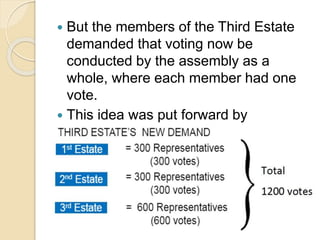
 The Clergy and Nobility sent 300
representatives each , who were seated
in rows facing each other.
 The 600 representatives of the Third
estates had to stand at the back. It was
represented by its more prosperous and
educated members. Peasants, artisans
and women were denied entry.
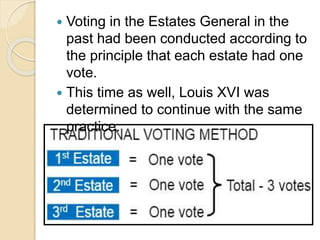
 Voting in the Estates General in the
past had been conducted according to
the principle that each estate had one
vote.
 This time as well, Louis XVI was
determined to continue with the same
practice.
 But the members of the Third Estate
demanded that voting now be
conducted by the assembly as a
whole, where each member had one
vote.
 This idea was put forward by
Rousseau in his The Social Contract.
National Assembly
 The representatives of the third estate
viewed themselves as spokesmen for
the entire French nation.
 On 20th June 1789, they assembled in
the hall of an indoor tennis court in the
grounds of Versailles.
 They declared themselves as the
National Assembly and swore not to
disperse until they drafted a constitution
for France that limited the powers of the
monarch.
 The National Assembly was lead by
Mirabeau and Abbé Sieyes.
 Mirabeau was born in a noble family
but was convinced with the need to do
away with a society of feudal privilege.
He brought put a journal and delivered
powerful speeches to the crowd
assembled at Versailles.
 Abbé Sieyes was originally a priest.
He wrote an influential pamphlet
called ‘What is the Third Estate’?
The Fall of the Bastille
 During this political turmoil, France
experienced a severe winter leading to
a bad harvest.
 This increased the price of bread.
 Angry women stormed into shops after
waiting for long hours in queues.
 At the same time, the King ordered the
troops to move into the city.
 On 14th July 1789, the crowd stormed
and destroyed the Bastille.
Revolt by the peasants
 In the countryside, rumors spread from
village to village that their ripe crops
would be destroyed by bands of
brigands, who had been hired by the
lords of the manor.
 Peasants in several districts seized hoes
and attacked the residences of their
manors.
 They looted hoarded grain and burnt
down documents containing records of
manorial dues.
Constitutional Monarchy of
1791
 The National Assembly completed the
draft of the constitution in 1791.
 Its main objective was to limit the
powers of the monarch.
 These powers instead of being
concentrated in the hands of one
person, were now separated and
assigned to the different institutions-
the executive, the legislature and the
judiciary.
 The Constitution of 1791 vested the
power to make laws in the National
Assembly.
 The Constitution began with a
Declaration of Rights of Man and
Citizen. Rights such as the right to life,
freedom of speech, freedom of opinion,
equality before law, were established as
‘natural and inalienable rights’, i.e., they
belonged to each human being by birth
and could not be taken away. It was the
duty of the state to protect each citizen’s
natural rights.
Voting Rights
 Not everyone had the right to vote.
 Only men above 25 years of age who
paid taxes equal to at least three days of
a laborer's wage were given the status of
active citizens, i.e., they were entitled to
vote.
 The remaining men and all women were
classed as passive citizens.
 To qualify as an elector and then as a
member of the Assembly, a man had to
belong to the highest bracket of
taxpayers.
Political Symbols
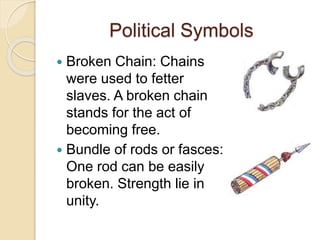
 Broken Chain: Chains
were used to fetter
slaves. A broken chain
stands for the act of
becoming free.
 Bundle of rods or fasces:
One rod can be easily
broken. Strength lie in
unity.
Political Symbols
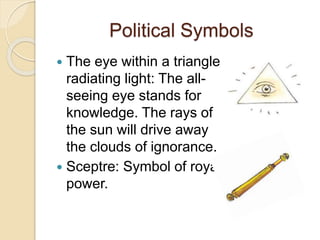
 The eye within a triangle
radiating light: The all-
seeing eye stands for
knowledge. The rays of
the sun will drive away
the clouds of ignorance.
 Sceptre: Symbol of royal
power.
Political Symbols
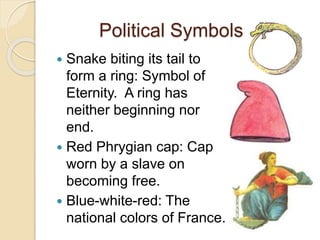
 Snake biting its tail to
form a ring: Symbol of
Eternity. A ring has
neither beginning nor
end.
 Red Phrygian cap: Cap
worn by a slave on
becoming free.
 Blue-white-red: The
national colors of France.
Political Symbols
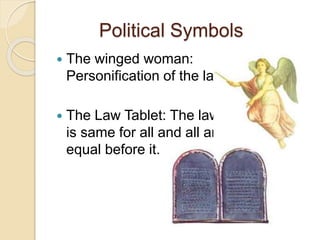
 The winged woman:
Personification of the law.
 The Law Tablet: The law
is same for all and all are
equal before it.
Marseillaise
 In April 1792, the National Assembly voted to
declare war against Prussia and Austria.
 Thousands of volunteers thronged from the
provinces to join the army.
 They saw this as a war of the people against
kings and aristocracies all over Europe.
 Among the patriotic songs they sang was the
‘Marseillaise’, composed by the poet Roget de
L’Isle.
 It was sung for the first time by volunteers from
Marseilles as they marched into Paris and so it
got its name.
 The Marseillaise is now the national anthem of
France.
Formation of Jacobins Club
 Political clubs became an important
rallying point for people who wished to
discuss government policies and plan
their own forms of action.
 The most successful of these clubs
was that of the Jacobins, which got its
name from the former convent of St.
Jacob in Paris.
Members of Jacobins Club
 The members of the Jacobin club
belonged mainly to the less
prosperous sections of the society.
 They included small shopkeepers,
artisans such as shoemakers, pastry
cooks, watch-makers, printers, as well
as servants and daily-wage workers.
 Their leader was Maximilian
Robespierre.
Achievements of Jacobin
Club
 In the summer of 1792 the Jacobins
planned an insurrection of a large
number of Parisians who were
angered by the short supplies and
high prices of food.
 On the morning of 10th August, they
stormed the Palace of the Tuileries,
massacred the king’s guards and held
the king himself as hostage for several
hours.
 Later the Assembly voted to imprison
the royal family.
 Elections were held. From now on all
men of 21 years and above,
regardless of wealth, got the right to
vote.
 The newly elected assembly was
called the Convention. On 21st
September 1792 it abolished the
monarchy and declared France as a
republic.
Sans-Culottes
 Those Jacobins who wore long striped
trousers similar to those worn by
dockworkers were known as sans-culottes.
 They did this to set themselves apart from the
fashionable sections of society, especially
nobles, who wore knee breeches.
 This was a way of proclaiming the end of the
power wielded by the wearers of knee
breeches.
 Sans-culottes literally means ‘those without
knee breeches’.
 Sans-culottes men wore in addition the red
cap that symbolized liberty. Women however
were not allowed to do so.
Execution of Louis XVI
 Louis XVI was sentenced to death by
a court on the charge of treason.
 On 21st January 1793, he was
executed publicly at the Place de la
Concorde.
 The queen, his wife, Marie Antoinette,
met with the same fate shortly after.
Reign of Terror
 The period of 1793 to 1794 is referred to
as the Reign of Terror. Robespierre
followed a policy of severe control and
punishment.
 All those whom he saw as being
‘enemies’ of the republic (ex-nobles and
clergy, members of other political parties,
even members of his own party who did
not agree with his methods) were
arrested, imprisoned and then tried by a
revolutionary tribunal.
 If the court found them guilty they were
guillotined. The guillotine was a device
consisting of two poles and a blade with
which a person was beheaded.
 Robespierre’s government issued laws
placing a maximum ceiling on wages and
prices. Meat and bread were rationed.
 Peasants were forced to transport their grain
to the cities and sell it at prices fixed by the
government. All citizens were required to eat
the equality bread-a loaf made of whole
wheat.
 Equality was also sought to be practiced
through forms of speech and address.
 Churches were shut down and their buildings
concerted into barracks.
Directory in France
 After the fall of the Jacobin government, a new
constitution was introduced which denied the
vote to non-propertied sections of society.
 It provided for two elected legislative councils.
These then appointed a Directory, an executive
made up of five members.
 However, the Directors often clashed with the
legislative councils, who then sought to dismiss
them.
 The political instability of the Directory made
way for the rise of a military dictator, Napoleon
Bonaparte.
Condition of Women in 18th
Century
 Most women of the third estate
had to work for a living. They
worked as seamstresses or
laundresses, sold flowers, fruits
and vegetables at the market, or
were employed as domestic
servants in the houses of
prosperous people.
 Most women did not have
access to education or job
training.
 Only daughters of nobles or wealthier
members of the third estate could
study at a convent, after which they
were married.
 Working women also had to take care
of their families, i.e., cook, fetch water,
queue up for bread and look after the
children.
 Their wages were lower than those of
men.
Role of Women in French
Revolution
 In order to discuss and voice their
interests women started their own
political clubs and newspapers.
 About 60 women’s clubs came up in
different French cities. The Society of
Revolutionary and Republican Women
was the most famous of them.
 One of their main demands was that
women enjoy the same political rights
as men.
 They were disappointed that the
Constitution of 1791 reduced them to
passive citizens.
 They demanded the right to vote, to
be elected to the Assembly and to
hold political office.
 They felt that only then would their
interests be represented in the new
government.
Improving the Condition of
Women
 The revolutionary government introduced
laws that helped improve the lives of women.
 Together with the creation of state schools,
schooling was made compulsory for all girls.
 Their fathers could no longer force them into
marriage against their will.
 Marriage was made into a contract entered
into freely and registered under civil law.
 Divorce was made legal and could be
applied for by both women and men.
 Women could now train for jobs , could
become artisans or run small businesses.
Slave Trade
 There was a shortage of labor in
plantations.
 The Europeans solved this problem by a
triangular slave trade between Europe,
Africa and the Americas. The slave trade
began in the seventeenth century.
 French merchants sailed from the ports
of Bordeaux and Nantes to the African
coast, where they bought slaves from
local chieftains. The slaves were then
packed tightly into ships for a three-
month long voyage across the Atlantic to
 They were then sold to plantation
owners.
 The exploitation of slave labor made it
possible to meet the growing demand
in European markets for sugar, coffee
and indigo.
 It was the Convention in 1794 which
legislated to free all slaves in the
French colonies.
 This was, however, a short-term
measure. Napoleon reintroduced
slavery ten years later, i.e., in 1804.
Impact of French Revolution
 One important law that came into
effect was the abolition of censorship.
 In the Old Regime, all written material
and cultural activities-books,
newspapers, plays- could be
published or performed only after they
had been approved by the censors of
the king.
 The Declaration of Rights of Man and
Citizen proclaimed freedom of speech
and expression to be a natural right.
 Newspapers, pamphlets, books and
printed pictures flooded the towns of
France from where they travelled
rapidly into the countryside.
 Freedom of the press also meant that
opposing views of events could be
expressed.
 Plays, songs and festive processions
attracted large numbers of people.
This was one way they could grasp
and identify with ideas such as liberty
or justice that political philosophers
wrote about.
Napoleon Bonaparte
 In 1804, Napoleon Bonaparte crowned
himself Emperor of France.
 He set out to conquer neighboring
European countries, dispossessing
dynasties and creating kingdoms where
he placed members of his family.
 Napoleon saw his role as a modernizer
of Europe. He introduces many laws
such as the protection of private property
and a uniform system of weights and
measures provided by the decimal
system.
 Initially, many saw Napoleon as a
liberator who would bring freedom for
the people.
 But soon the Napoleonic armies came
to be viewed everywhere as an
invading force.
 He was finally defeated at Waterloo in
1815.
Legacy of the French
Revolution
 The ideas of liberty and democratic
rights were the most important legacy of
the French Revolution.
 These spread from France to the rest of
Europe during the nineteenth century,
where feudal systems were abolished.
 Colonized people reworked the idea of
freedom from bondage to create a
sovereign nation state.
 In India, Tipu Sultan and Raja
Rammohan Roy responded to ideas
coming from revolutionary France.

French Revolution for class 9th ppt.pptx

  • 1.
  • 2.
    What is aRevolution?  A revolution is basically an action taken by a large group of people to try to change the government, or form of government, of a country; especially by a violent action.
  • 3.
    Events of 14thJuly,1789  On 14th July1789, the city of Paris was in a state of turmoil. The king had commanded the troops to move into the city.  Some 7000 men and women gathered in front of the town hall and decided to form a people’s militia .  They broke into a number of government buildings in search of arms.  A group of several hundred people marched towards the eastern part of the city and stormed the fortress-prison, the Bastille, where they hoped to find weapons.  The commander of the Bastille was killed and the prisoners were released.
  • 4.
    Political Causes ofFrench Revolution  In 1774, Louis XVI of the Bourbon family ascended the throne. But he found an empty treasury, as long years of war had drained the financial resources of France.  The cost of maintaining an extravagant court at the Palace of Versailles was also huge.  Under Louis XVI, France had also helped the 13 American colonies gain their independence from the common enemy, Britain.
  • 5.
     The waradded more debt to the already huge debt, and the lenders who had given the state credit now started charging 10% interest on loans.  To meet its regular expenses, such as the cost of maintaining an army, the court, running government offices and buildings and universities, the state was forced to increase taxes.
  • 6.
    Social Causes ofFrench Revolution
  • 7.
     French societyin the early 18th century was divided into three estates: The clergy, the nobility and the third estate. Only members of the third estate paid taxes.  Peasants made up about 90% of the population of France. However, only a small number of them owned the land they cultivated.  60% of the land was owned by the nobles, the Church and other richer members of the third estate.  The members of the Clergy and the Nobility enjoyed certain privileges by
  • 8.
     The noblesfurther enjoyed feudal privileges; this included feudal dues which they extracted from the peasants.  Peasants were obliged to render services to the lord-to work in his house and fields- to participate in building roads or to serve in the army.
  • 9.
    Types of Taxes Tithe- It was a tax levied by the Church comprising of one-tenth of the agricultural produce.  Taille- It was a direct tax that all members of the third estate had to pay to the state.  A number of indirect taxes were levied on items of everyday consumption like salt and tobacco.
  • 11.
    Economic Causes ofFrench Revolution  The population of France rose from about 23 million in 1715 to 28 million in 1789. This led to a rapid increase in demand for food grains.  The production of grains could not keep pace with demand. So, the price of bread, the staple diet of the majority rose rapidly.  Most workers were employed as laborers in workshops whose owners fixed their wages. But the wages didn’t keep pace with the rise in prices.  So the gap between the poor and the rich widened. Things became worse whenever a drought or hail occurred which reduced the harvest.  This led to subsistence crisis.
  • 12.
    Role of theMiddle Class  The 18th century witnessed the emergence of social groups termed as the middle class, who earned their wealth through an expanding overseas trade and from the manufacture of goods.  The third estate also included professions such as lawyers and administrative officials.  They were educated and believed that no group in society should be privileged by birth. Rather, a person’s social
  • 13.
    Role of Philosophers John Locke: In his Two Treatises of the Government, Locke sought to refute the doctrine of the divine and the absolute right of the monarch.  Jean Jacques Rousseau: In The Social Contract, Rousseau proposed a form of government based on a social contract between the people and their representatives. He also put forward the principle of one person one vote.
  • 14.
     Montesquieu: InThe Spirit of the Laws, Montesquieu proposed a division power within the government between the executive, the legislature and the judiciary. This model of government was put into force in the USA, after the thirteen American colonies declared their independence from Britain.  Their ideas were discussed in salons and coffee-houses and spread among people through books and newspapers. They were often read
  • 15.
    Estates General  InFrance of the Old Regime, the monarch did not have the power to impose taxes according to his will alone.  Rather he had to call a meeting of the Estates General, which would then pass his proposals for new taxes.  The Estates General was a political body to which the three estates sent their representatives. However, the monarch alone could decide when to call a meeting of this body.
  • 16.
    Assembly of EstatesGeneral, 1789  On 5th May 1789, Louis XVI called together an assembly of the Estates General to pass proposals for new taxes.  The Clergy and Nobility sent 300 representatives each , who were seated in rows facing each other.  The 600 representatives of the Third estates had to stand at the back. It was represented by its more prosperous and educated members. Peasants, artisans and women were denied entry.
  • 17.
     Voting inthe Estates General in the past had been conducted according to the principle that each estate had one vote.  This time as well, Louis XVI was determined to continue with the same practice.
  • 18.
     But themembers of the Third Estate demanded that voting now be conducted by the assembly as a whole, where each member had one vote.  This idea was put forward by Rousseau in his The Social Contract.
  • 19.
    National Assembly  Therepresentatives of the third estate viewed themselves as spokesmen for the entire French nation.  On 20th June 1789, they assembled in the hall of an indoor tennis court in the grounds of Versailles.  They declared themselves as the National Assembly and swore not to disperse until they drafted a constitution for France that limited the powers of the monarch.
  • 20.
     The NationalAssembly was lead by Mirabeau and Abbé Sieyes.  Mirabeau was born in a noble family but was convinced with the need to do away with a society of feudal privilege. He brought put a journal and delivered powerful speeches to the crowd assembled at Versailles.  Abbé Sieyes was originally a priest. He wrote an influential pamphlet called ‘What is the Third Estate’?
  • 21.
    The Fall ofthe Bastille  During this political turmoil, France experienced a severe winter leading to a bad harvest.  This increased the price of bread.  Angry women stormed into shops after waiting for long hours in queues.  At the same time, the King ordered the troops to move into the city.  On 14th July 1789, the crowd stormed and destroyed the Bastille.
  • 22.
    Revolt by thepeasants  In the countryside, rumors spread from village to village that their ripe crops would be destroyed by bands of brigands, who had been hired by the lords of the manor.  Peasants in several districts seized hoes and attacked the residences of their manors.  They looted hoarded grain and burnt down documents containing records of manorial dues.
  • 23.
    Constitutional Monarchy of 1791 The National Assembly completed the draft of the constitution in 1791.  Its main objective was to limit the powers of the monarch.  These powers instead of being concentrated in the hands of one person, were now separated and assigned to the different institutions- the executive, the legislature and the judiciary.
  • 24.
     The Constitutionof 1791 vested the power to make laws in the National Assembly.  The Constitution began with a Declaration of Rights of Man and Citizen. Rights such as the right to life, freedom of speech, freedom of opinion, equality before law, were established as ‘natural and inalienable rights’, i.e., they belonged to each human being by birth and could not be taken away. It was the duty of the state to protect each citizen’s natural rights.
  • 25.
    Voting Rights  Noteveryone had the right to vote.  Only men above 25 years of age who paid taxes equal to at least three days of a laborer's wage were given the status of active citizens, i.e., they were entitled to vote.  The remaining men and all women were classed as passive citizens.  To qualify as an elector and then as a member of the Assembly, a man had to belong to the highest bracket of taxpayers.
  • 26.
    Political Symbols  BrokenChain: Chains were used to fetter slaves. A broken chain stands for the act of becoming free.  Bundle of rods or fasces: One rod can be easily broken. Strength lie in unity.
  • 27.
    Political Symbols  Theeye within a triangle radiating light: The all- seeing eye stands for knowledge. The rays of the sun will drive away the clouds of ignorance.  Sceptre: Symbol of royal power.
  • 28.
    Political Symbols  Snakebiting its tail to form a ring: Symbol of Eternity. A ring has neither beginning nor end.  Red Phrygian cap: Cap worn by a slave on becoming free.  Blue-white-red: The national colors of France.
  • 29.
    Political Symbols  Thewinged woman: Personification of the law.  The Law Tablet: The law is same for all and all are equal before it.
  • 30.
    Marseillaise  In April1792, the National Assembly voted to declare war against Prussia and Austria.  Thousands of volunteers thronged from the provinces to join the army.  They saw this as a war of the people against kings and aristocracies all over Europe.  Among the patriotic songs they sang was the ‘Marseillaise’, composed by the poet Roget de L’Isle.  It was sung for the first time by volunteers from Marseilles as they marched into Paris and so it got its name.  The Marseillaise is now the national anthem of France.
  • 31.
    Formation of JacobinsClub  Political clubs became an important rallying point for people who wished to discuss government policies and plan their own forms of action.  The most successful of these clubs was that of the Jacobins, which got its name from the former convent of St. Jacob in Paris.
  • 32.
    Members of JacobinsClub  The members of the Jacobin club belonged mainly to the less prosperous sections of the society.  They included small shopkeepers, artisans such as shoemakers, pastry cooks, watch-makers, printers, as well as servants and daily-wage workers.  Their leader was Maximilian Robespierre.
  • 33.
    Achievements of Jacobin Club In the summer of 1792 the Jacobins planned an insurrection of a large number of Parisians who were angered by the short supplies and high prices of food.  On the morning of 10th August, they stormed the Palace of the Tuileries, massacred the king’s guards and held the king himself as hostage for several hours.  Later the Assembly voted to imprison the royal family.
  • 34.
     Elections wereheld. From now on all men of 21 years and above, regardless of wealth, got the right to vote.  The newly elected assembly was called the Convention. On 21st September 1792 it abolished the monarchy and declared France as a republic.
  • 35.
    Sans-Culottes  Those Jacobinswho wore long striped trousers similar to those worn by dockworkers were known as sans-culottes.  They did this to set themselves apart from the fashionable sections of society, especially nobles, who wore knee breeches.  This was a way of proclaiming the end of the power wielded by the wearers of knee breeches.  Sans-culottes literally means ‘those without knee breeches’.  Sans-culottes men wore in addition the red cap that symbolized liberty. Women however were not allowed to do so.
  • 36.
    Execution of LouisXVI  Louis XVI was sentenced to death by a court on the charge of treason.  On 21st January 1793, he was executed publicly at the Place de la Concorde.  The queen, his wife, Marie Antoinette, met with the same fate shortly after.
  • 37.
    Reign of Terror The period of 1793 to 1794 is referred to as the Reign of Terror. Robespierre followed a policy of severe control and punishment.  All those whom he saw as being ‘enemies’ of the republic (ex-nobles and clergy, members of other political parties, even members of his own party who did not agree with his methods) were arrested, imprisoned and then tried by a revolutionary tribunal.
  • 38.
     If thecourt found them guilty they were guillotined. The guillotine was a device consisting of two poles and a blade with which a person was beheaded.  Robespierre’s government issued laws placing a maximum ceiling on wages and prices. Meat and bread were rationed.  Peasants were forced to transport their grain to the cities and sell it at prices fixed by the government. All citizens were required to eat the equality bread-a loaf made of whole wheat.  Equality was also sought to be practiced through forms of speech and address.  Churches were shut down and their buildings concerted into barracks.
  • 39.
    Directory in France After the fall of the Jacobin government, a new constitution was introduced which denied the vote to non-propertied sections of society.  It provided for two elected legislative councils. These then appointed a Directory, an executive made up of five members.  However, the Directors often clashed with the legislative councils, who then sought to dismiss them.  The political instability of the Directory made way for the rise of a military dictator, Napoleon Bonaparte.
  • 40.
    Condition of Womenin 18th Century  Most women of the third estate had to work for a living. They worked as seamstresses or laundresses, sold flowers, fruits and vegetables at the market, or were employed as domestic servants in the houses of prosperous people.  Most women did not have access to education or job training.
  • 41.
     Only daughtersof nobles or wealthier members of the third estate could study at a convent, after which they were married.  Working women also had to take care of their families, i.e., cook, fetch water, queue up for bread and look after the children.  Their wages were lower than those of men.
  • 42.
    Role of Womenin French Revolution  In order to discuss and voice their interests women started their own political clubs and newspapers.  About 60 women’s clubs came up in different French cities. The Society of Revolutionary and Republican Women was the most famous of them.  One of their main demands was that women enjoy the same political rights as men.
  • 43.
     They weredisappointed that the Constitution of 1791 reduced them to passive citizens.  They demanded the right to vote, to be elected to the Assembly and to hold political office.  They felt that only then would their interests be represented in the new government.
  • 44.
    Improving the Conditionof Women  The revolutionary government introduced laws that helped improve the lives of women.  Together with the creation of state schools, schooling was made compulsory for all girls.  Their fathers could no longer force them into marriage against their will.  Marriage was made into a contract entered into freely and registered under civil law.  Divorce was made legal and could be applied for by both women and men.  Women could now train for jobs , could become artisans or run small businesses.
  • 45.
    Slave Trade  Therewas a shortage of labor in plantations.  The Europeans solved this problem by a triangular slave trade between Europe, Africa and the Americas. The slave trade began in the seventeenth century.  French merchants sailed from the ports of Bordeaux and Nantes to the African coast, where they bought slaves from local chieftains. The slaves were then packed tightly into ships for a three- month long voyage across the Atlantic to
  • 46.
     They werethen sold to plantation owners.  The exploitation of slave labor made it possible to meet the growing demand in European markets for sugar, coffee and indigo.  It was the Convention in 1794 which legislated to free all slaves in the French colonies.  This was, however, a short-term measure. Napoleon reintroduced slavery ten years later, i.e., in 1804.
  • 47.
    Impact of FrenchRevolution  One important law that came into effect was the abolition of censorship.  In the Old Regime, all written material and cultural activities-books, newspapers, plays- could be published or performed only after they had been approved by the censors of the king.  The Declaration of Rights of Man and Citizen proclaimed freedom of speech and expression to be a natural right.
  • 48.
     Newspapers, pamphlets,books and printed pictures flooded the towns of France from where they travelled rapidly into the countryside.  Freedom of the press also meant that opposing views of events could be expressed.  Plays, songs and festive processions attracted large numbers of people. This was one way they could grasp and identify with ideas such as liberty or justice that political philosophers wrote about.
  • 49.
    Napoleon Bonaparte  In1804, Napoleon Bonaparte crowned himself Emperor of France.  He set out to conquer neighboring European countries, dispossessing dynasties and creating kingdoms where he placed members of his family.  Napoleon saw his role as a modernizer of Europe. He introduces many laws such as the protection of private property and a uniform system of weights and measures provided by the decimal system.
  • 50.
     Initially, manysaw Napoleon as a liberator who would bring freedom for the people.  But soon the Napoleonic armies came to be viewed everywhere as an invading force.  He was finally defeated at Waterloo in 1815.
  • 51.
    Legacy of theFrench Revolution  The ideas of liberty and democratic rights were the most important legacy of the French Revolution.  These spread from France to the rest of Europe during the nineteenth century, where feudal systems were abolished.  Colonized people reworked the idea of freedom from bondage to create a sovereign nation state.  In India, Tipu Sultan and Raja Rammohan Roy responded to ideas coming from revolutionary France.