Software Testing and
Analysis
V & V goals
• Verification and validation should establish
confidence that the software is fit for purpo
se
• This does NOT mean completely free of de
fects
• Rather, it must be good enough for its inten
ded use and the type of use will determine
the degree of confidence that is needed
• Verification: The software should confor
m to its specification (Are we building the
product right?)
• Validation: The software should do what t
he user really requires (Are we building th
e right product?)
Verification vs. validation
• Is a whole life-cycle process - V & V must
be applied at each stage in the software p
rocess.
• Has two principal objectives
– The discovery of defects in a system
– The assessment of whether or not the syste
m is usable in an operational situation.
The V & V process
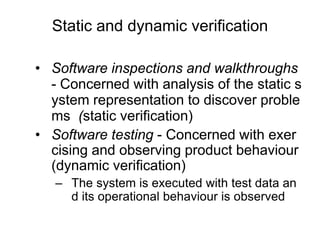
• Software inspections and walkthroughs
- Concerned with analysis of the static s
ystem representation to discover proble
ms (static verification)
• Software testing - Concerned with exer
cising and observing product behaviour
(dynamic verification)
– The system is executed with test data an
d its operational behaviour is observed
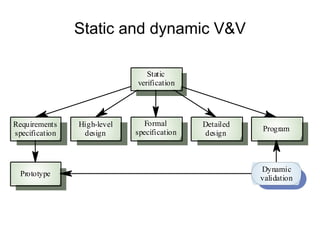
Static and dynamic verification
Static and dynamic V&V
Formal
specification
High-level
design
Requirements
specification
Detailed
design
Program
Prototype
Dynamic
validation
Static
verification
• Careful planning is required to get the most out
of testing and inspection processes
• Planning should start early in the development
process
• The plan should identify the balance between st
atic verification and testing
• Test planning is about defining standards for th
e testing process rather than describing product
tests
V & V planning
The V-model of development
Requirements
specification
System
specification
System
design
Detailed
design
Module and
unit code
and tess
Sub-system
integration
test plan
System
integration
test plan
Acceptance
test plan
Service
Acceptance
test
System
integration test
Sub-system
integration test
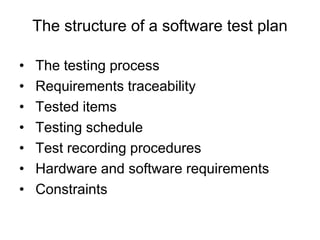
The structure of a software test plan
• The testing process
• Requirements traceability
• Tested items
• Testing schedule
• Test recording procedures
• Hardware and software requirements
• Constraints
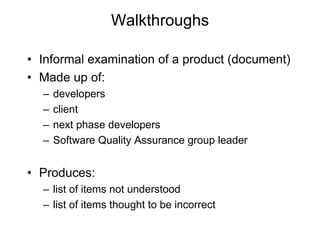
Walkthroughs
• Informal examination of a product (document)
• Made up of:
– developers
– client
– next phase developers
– Software Quality Assurance group leader
• Produces:
– list of items not understood
– list of items thought to be incorrect
Software inspections
• Involve people examining the source represent
ation with the aim of discovering anomalies and
defects
• Do not require execution of a system so may be
used before implementation
• May be applied to any representation of the syst
em (requirements, design, test data, etc.)
• Very effective technique for discovering errors
Inspection success
• Many different defects may be discovered
in a single inspection. In testing, one defe
ct may mask another so several execution
s are required
• The reuse domain and programming kno
wledge so reviewers are likely to have se
en the types of error that commonly arise
Inspections and testing
• Inspections and testing are complementary and
not opposing verification techniques
• Both should be used during the V & V process
• Inspections can check conformance with a spec
ification but not conformance with the customer’
s real requirements
• Inspections cannot check non-functional charac
teristics such as performance, usability, etc.
Inspection pre-conditions
• A precise specification must be available
• Team members must be familiar with the
organisation standards
• Syntactically correct code must be available
• An error checklist should be prepared
• Management must accept that inspection will
increase costs early in the software process
• Management must not use inspections for st
aff
appraisal
Inspection procedure
• System overview presented to inspection team
• Code and associated documents are
distributed to inspection team in advance
• Inspection takes place and discovered errors
are noted
• Modifications are made to repair discovered
errors
• Re-inspection may or may not be required
Inspection teams
• Made up of at least 4 members
• Author of the code being inspected
• Inspector who finds errors, omissions and inco
nsistencies
• Reader who reads the code to the team
• Moderator who chairs the meeting and notes
discovered errors
• Other roles are Scribe and Chief moderator
Inspection checklists
• Checklist of common errors should be used to
drive the inspection
• Error checklist is programming language
dependent
• The 'weaker' the type checking, the larger the
checklist
• Examples: Initialization, Constant naming, loop
termination, array bounds, etc.
Inspection rate
• 500 statements/hour during overview
• 125 source statement/hour during individual
preparation
• 90-125 statements/hour can be inspected
• Inspection is therefore an expensive process
• Inspecting 500 lines costs about 40 man/hours
effort (@ $50/hr = $2000!!!)
• Can reveal the presence of errors NOT their ab
sence
• A successful test is a test which discovers one
or more errors
• The only validation technique for non-functional
requirements
• Should be used in conjunction with static
verification to provide full V&V coverage
Program testing
Execution based testing
• “Program testing can be a very effective way t
o show the presents of bugs but is hopelessly
inadequate for showing their absence” [Dijkst
ra]
• Fault: “bug” incorrect piece of code
• Failure: result of a fault
• Error: mistake made by the programmer/deve
loper
• Defect testing and debugging are distinct
processes
• Verification and validation is concerned with est
ablishing the existence of defects in a program
• Debugging is concerned with locating and
repairing these errors
• Debugging involves formulating a hypothesis
about program behaviour then testing these
hypotheses to find the system error
Testing and debugging
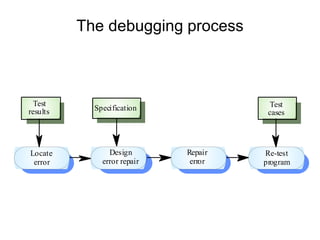
The debugging process
Locate
error
Design
error repair
Repair
error
Re-test
program
Test
results Specification Test
cases
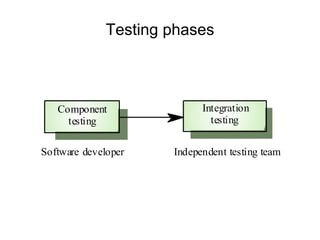
Testing phases
Component
testing
Integration
testing
Software developer Independent testing team
Testing phases
• Component testing
– Testing of individual program components
– Usually the responsibility of the component deve
loper (except sometimes for critical systems)
– Tests are derived from the developer’s experien
ce
• Integration testing
– Testing of groups of components integrated to c
reate a system or sub-system
– The responsibility of an independent testing tea
m
– Tests are based on a system specification
• Only exhaustive testing can show a program
is free from defects. However, exhaustive tes
ting is impossible
• Tests should exercise a system's capabilities
rather than its components
• Testing old capabilities is more important tha
n testing new capabilities
• Testing typical situations is more important t
han boundary value cases
Testing priorities
• Test data Inputs which have been devise
d to test the system
• Test cases Inputs to test the system and
the predicted outputs from these inputs if
the system operates according to its speci
fication
Test data and test cases

SENG202-v-and-v-modeling_121810.pptx

  • 1.
  • 2.
    V & Vgoals • Verification and validation should establish confidence that the software is fit for purpo se • This does NOT mean completely free of de fects • Rather, it must be good enough for its inten ded use and the type of use will determine the degree of confidence that is needed
  • 3.
    • Verification: Thesoftware should confor m to its specification (Are we building the product right?) • Validation: The software should do what t he user really requires (Are we building th e right product?) Verification vs. validation
  • 4.
    • Is awhole life-cycle process - V & V must be applied at each stage in the software p rocess. • Has two principal objectives – The discovery of defects in a system – The assessment of whether or not the syste m is usable in an operational situation. The V & V process
  • 5.
    • Software inspectionsand walkthroughs - Concerned with analysis of the static s ystem representation to discover proble ms (static verification) • Software testing - Concerned with exer cising and observing product behaviour (dynamic verification) – The system is executed with test data an d its operational behaviour is observed Static and dynamic verification
  • 6.
    Static and dynamicV&V Formal specification High-level design Requirements specification Detailed design Program Prototype Dynamic validation Static verification
  • 7.
    • Careful planningis required to get the most out of testing and inspection processes • Planning should start early in the development process • The plan should identify the balance between st atic verification and testing • Test planning is about defining standards for th e testing process rather than describing product tests V & V planning
  • 8.
    The V-model ofdevelopment Requirements specification System specification System design Detailed design Module and unit code and tess Sub-system integration test plan System integration test plan Acceptance test plan Service Acceptance test System integration test Sub-system integration test
  • 9.
    The structure ofa software test plan • The testing process • Requirements traceability • Tested items • Testing schedule • Test recording procedures • Hardware and software requirements • Constraints
  • 10.
    Walkthroughs • Informal examinationof a product (document) • Made up of: – developers – client – next phase developers – Software Quality Assurance group leader • Produces: – list of items not understood – list of items thought to be incorrect
  • 11.
    Software inspections • Involvepeople examining the source represent ation with the aim of discovering anomalies and defects • Do not require execution of a system so may be used before implementation • May be applied to any representation of the syst em (requirements, design, test data, etc.) • Very effective technique for discovering errors
  • 12.
    Inspection success • Manydifferent defects may be discovered in a single inspection. In testing, one defe ct may mask another so several execution s are required • The reuse domain and programming kno wledge so reviewers are likely to have se en the types of error that commonly arise
  • 13.
    Inspections and testing •Inspections and testing are complementary and not opposing verification techniques • Both should be used during the V & V process • Inspections can check conformance with a spec ification but not conformance with the customer’ s real requirements • Inspections cannot check non-functional charac teristics such as performance, usability, etc.
  • 14.
    Inspection pre-conditions • Aprecise specification must be available • Team members must be familiar with the organisation standards • Syntactically correct code must be available • An error checklist should be prepared • Management must accept that inspection will increase costs early in the software process • Management must not use inspections for st aff appraisal
  • 15.
    Inspection procedure • Systemoverview presented to inspection team • Code and associated documents are distributed to inspection team in advance • Inspection takes place and discovered errors are noted • Modifications are made to repair discovered errors • Re-inspection may or may not be required
  • 16.
    Inspection teams • Madeup of at least 4 members • Author of the code being inspected • Inspector who finds errors, omissions and inco nsistencies • Reader who reads the code to the team • Moderator who chairs the meeting and notes discovered errors • Other roles are Scribe and Chief moderator
  • 17.
    Inspection checklists • Checklistof common errors should be used to drive the inspection • Error checklist is programming language dependent • The 'weaker' the type checking, the larger the checklist • Examples: Initialization, Constant naming, loop termination, array bounds, etc.
  • 18.
    Inspection rate • 500statements/hour during overview • 125 source statement/hour during individual preparation • 90-125 statements/hour can be inspected • Inspection is therefore an expensive process • Inspecting 500 lines costs about 40 man/hours effort (@ $50/hr = $2000!!!)
  • 19.
    • Can revealthe presence of errors NOT their ab sence • A successful test is a test which discovers one or more errors • The only validation technique for non-functional requirements • Should be used in conjunction with static verification to provide full V&V coverage Program testing
  • 20.
    Execution based testing •“Program testing can be a very effective way t o show the presents of bugs but is hopelessly inadequate for showing their absence” [Dijkst ra] • Fault: “bug” incorrect piece of code • Failure: result of a fault • Error: mistake made by the programmer/deve loper
  • 21.
    • Defect testingand debugging are distinct processes • Verification and validation is concerned with est ablishing the existence of defects in a program • Debugging is concerned with locating and repairing these errors • Debugging involves formulating a hypothesis about program behaviour then testing these hypotheses to find the system error Testing and debugging
  • 22.
    The debugging process Locate error Design errorrepair Repair error Re-test program Test results Specification Test cases
  • 23.
  • 24.
    Testing phases • Componenttesting – Testing of individual program components – Usually the responsibility of the component deve loper (except sometimes for critical systems) – Tests are derived from the developer’s experien ce • Integration testing – Testing of groups of components integrated to c reate a system or sub-system – The responsibility of an independent testing tea m – Tests are based on a system specification
  • 25.
    • Only exhaustivetesting can show a program is free from defects. However, exhaustive tes ting is impossible • Tests should exercise a system's capabilities rather than its components • Testing old capabilities is more important tha n testing new capabilities • Testing typical situations is more important t han boundary value cases Testing priorities
  • 26.
    • Test dataInputs which have been devise d to test the system • Test cases Inputs to test the system and the predicted outputs from these inputs if the system operates according to its speci fication Test data and test cases