
Leonhard Dobusch
University of Innsbruck
Webinar Series
Strategizing Activities and Practices (SAP) Interest Group in the Academy of Management
June 18, 2020, Internet
OPEN STRATEGY AS A PRACTICE
CO
M
M
ERCIAL
BREAK
Dobusch, L. & Dobusch, L. (2019): The
Relation between Openness and Closure
in Open Strategy: Programmatic and
Constitutive Approaches to Openness. In
D. Seidl, G. von Krogh & R. Whittington
(eds.), The Cambridge Handbook of
Open Strategy. Cambridge: Cambridge
University Press, 326-336
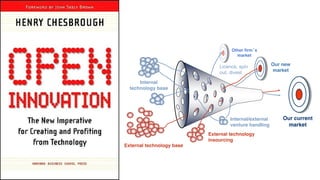
Openness as an Organizing Principle
11 EIRMA SIG III, 2005-10-20
Closed innovation
Our current
market
Our new
market
Other firm´s
market
Open innovation
External technology
insourcing
Internal
technology base
External technology base
Stolen with pride from Prof Henry Chesbrough UC Berkeley, Open Innovation: Renewing Growth from
Industrial R&D, 10th Annual Innovation Convergence, Minneapolis Sept 27, 2004
Internal/external
venture handling
Licence, spin
out, divest
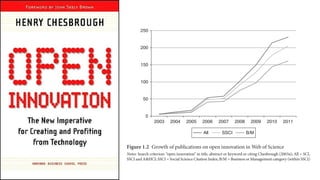
a lesser extent in the arts and humanities).
0
50
100
150
200
250
2003 2004 2005 2006 2007 2008 2009 2010 2011
All SSCI B/M
Figure 1.2 Growth of publications on open innovation in Web of Science
Notes: Search criterion: “open innovation” in title, abstract or keyword or citing Chesbrough (2003a); All = SCI,
SSCI and A&HCI; SSCI = Social Science Citation Index; B/M = Business or Management category (within SSCI)
Open Innovation and
Strategy
Henry W. Chesbrough
Melissa M. Appleyard
A
new breed of innovation—open innovation—is forcing firms to
reassess their leadership positions, which reflect the performance
outcomes of their business strategies. It is timely to juxtapose
some new phenomena in innovation with the traditional acade-
mic view of business strategy. More specifically, we wish to examine the increas-
ing adoption of more open approaches to innovation, and see how well this
adoption can be explained with theories of business strategy. In our view, open
innovation is creating new empirical phenomena that exist uneasily with well-
established theories of business strategy. Traditional business strategy has guidedQuelle: David Lerner, https://en.wikipedia.org/wiki/File:Internet_troll.jpg, http://creativecommons.org/licenses/by-sa/3.0/
Open strategy … embraces
the benefits of openness as a
means of expanding value
creation for organizations
“ Chesbrough & Appleyard (2007)
Open Innovation and
Strategy
Henry W. Chesbrough
Melissa M. Appleyard
A
new breed of innovation—open innovation—is forcing firms to
reassess their leadership positions, which reflect the performance
outcomes of their business strategies. It is timely to juxtapose
some new phenomena in innovation with the traditional acade-
mic view of business strategy. More specifically, we wish to examine the increas-
ing adoption of more open approaches to innovation, and see how well this
adoption can be explained with theories of business strategy. In our view, open
innovation is creating new empirical phenomena that exist uneasily with well-
established theories of business strategy. Traditional business strategy has guidedQuelle: David Lerner, https://en.wikipedia.org/wiki/File:Internet_troll.jpg, http://creativecommons.org/licenses/by-sa/3.0/
Open strategy … embraces
the benefits of openness as a
means of expanding value
creation for organizations
“ Chesbrough & Appleyard (2007)
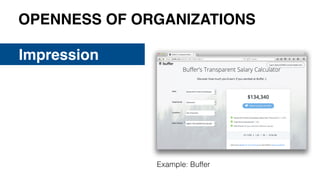
Impression
OPENNESS OF ORGANIZATIONS
Example: Buffer
Impression
Tool
OPENNESS OF ORGANIZATIONS
Bild: Chris Potter, CC-BY 2.0, https://www.flickr.com/photos/86530412@N02/8334443952
Impression
Tool
Value
OPENNESS OF ORGANIZATIONS
Various Domains of Openness
13
[S]trategy is traditionally
exclusive. […] Opacity is
important to strategy […].
Open strategy challenges
both these orthodoxies[.]
(Whittington et al., 2011, p. 535)
“ Open strategy balances
the tenets of traditional
business strategy with the
promise of open innovation.
(Chesbrough and
Appleyard 2007, p. 58)
“
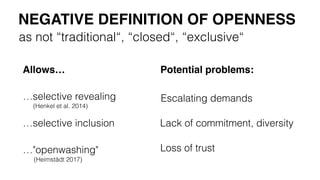
Allows…
as not “traditional“, “closed“, “exclusive“
NEGATIVE DEFINITION OF OPENNESS
…selective revealing
(Henkel et al. 2014)
…selective inclusion
…"openwashing"
(Heimstädt 2017)
Potential problems:
Escalating demands
Lack of commitment, diversity
Loss of trust
Quelle: David Lerner, https://en.wikipedia.org/wiki/File:Internet_troll.jpg, http://creativecommons.org/licenses/by-sa/3.0/
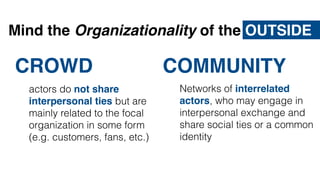
Mind the Organizationality of the OUTSIDE
CROWD
actors do not share
interpersonal ties but are
mainly related to the focal
organization in some form
(e.g. customers, fans, etc.)
Networks of interrelated
actors, who may engage in
interpersonal exchange and
share social ties or a common
identity
COMMUNITY
Quelle: David Lerner, https://en.wikipedia.org/wiki/File:Internet_troll.jpg, http://creativecommons.org/licenses/by-sa/3.0/
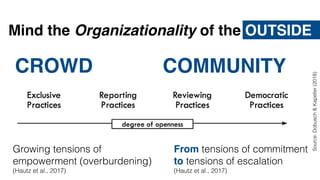
Mind the Organizationality of the OUTSIDE
From tensions of commitment
to tensions of escalation
(Hautz et al., 2017)
CROWD
Growing tensions of
empowerment (overburdening)
(Hautz et al., 2017)
COMMUNITYL. Dobusch, J. Kapeller / Long Range Planning 51 (2018) 561e579
Source:Dobusch&Kapeller(2018)
Quelle: David Lerner, https://en.wikipedia.org/wiki/File:Internet_troll.jpg, http://creativecommons.org/licenses/by-sa/3.0/
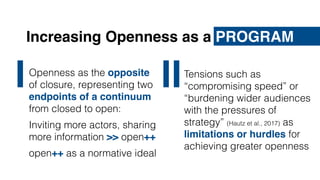
Increasing Openness as a PROGRAM
Tensions such as
“compromising speed” or
“burdening wider audiences
with the pressures of
strategy” (Hautz et al., 2017) as
limitations or hurdles for
achieving greater openness
IIIOpenness as the opposite
of closure, representing two
endpoints of a continuum
from closed to open:
Inviting more actors, sharing
more information >> open++
open++ as a normative ideal
Open Practices in Strategy-Making
19
Democratizing Strategy: How Crowdsourcing
Can Be Used for Strategy Dialogues
(Stieger et al. 2012)“
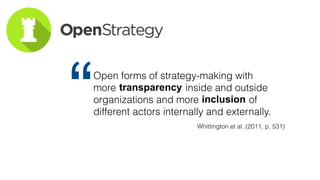
“Open forms of strategy-making with
more inside and outside
organizations and more of
different actors internally and externally.
Whittington et al. (2011, p. 531)
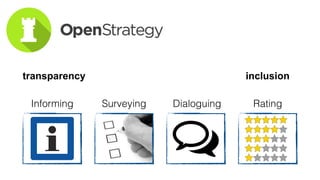
transparency
inclusion
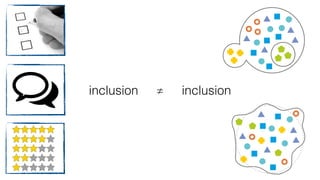
Surveying Dialoguing RatingInforming
transparency inclusion
inclusion inclusion≠
How are openness and inclusion connected?
How connected are openness and inclusion?
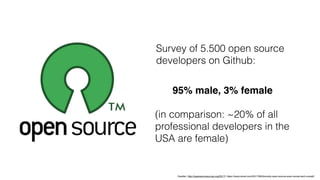
Survey of 5.500 open source
developers on Github:
95% male, 3% female
(in comparison: ~20% of all
professional developers in the
USA are female)
Quellen: http://opensourcesurvey.org/2017/; https://www.wired.com/2017/06/diversity-open-source-even-worse-tech-overall/
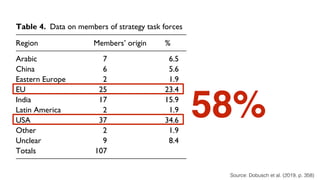
358 Organization S
Table 4. Data on members of strategy task forces
Region Members’ origin % Associated with Wikimedia Foundation
Arabic 7 6.5
China 6 5.6
Eastern Europe 2 1.9
EU 25 23.4 4 (2 WMB, 1 WMF, 1 WMC)
India 17 15.9 1 (WMB)
Latin America 2 1.9
USA 37 34.6 15 (3 WMB, 7 WMF, 5 WMC)
Other 2 1.9
Unclear 9 8.4
Totals 107 20
*includes Wikimedia Board (WMB), Foundation staff (WMF) und hired consultants (WMC)
Source: Dobusch et al. (2019, p. 358)
58%
Non-performativity of Openness?
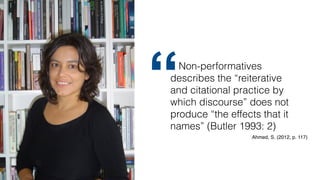
Non-performatives
describes the “reiterative
and citational practice by
which discourse” does not
produce “the effects that it
names” (Butler 1993: 2)
“
Ahmed, S. (2012, p. 117)
Bild ShashiBellamkonda, CC BY 2.0, : https://www.flickr.com/photos/drbeachvacation/4623702054/
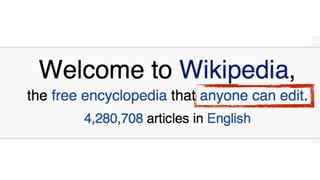
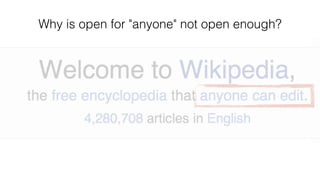
Why is open for "anyone" not open enough?
Exclusionary Openness
Lack of diversity in spite of radical openness?
because of
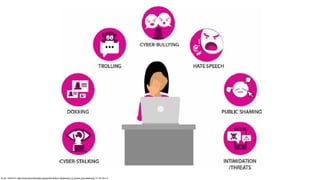
Photo: UNESCO, https://commons.wikimedia.org/wiki/File:Online_harassment_of_women_journalists.png. CC BY-SA 4.0
Quelle: David Lerner, https://en.wikipedia.org/wiki/File:Internet_troll.jpg, http://creativecommons.org/licenses/by-sa/3.0/
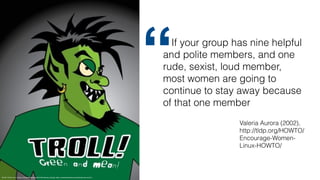
If your group has nine helpful
and polite members, and one
rude, sexist, loud member,
most women are going to
continue to stay away because
of that one member
“
Valeria Aurora (2002),
http://tldp.org/HOWTO/
Encourage-Women-
Linux-HOWTO/
From Degrees to Paradoxes of Openness
Quelle: David Lerner, https://en.wikipedia.org/wiki/File:Internet_troll.jpg, http://creativecommons.org/licenses/by-sa/3.0/
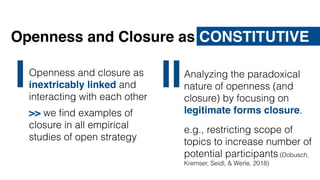
Openness and Closure as CONSTITUTIVE
Analyzing the paradoxical
nature of openness (and
closure) by focusing on
legitimate forms closure.
e.g., restricting scope of
topics to increase number of
potential participants (Dobusch,
Kremser, Seidl, & Werle, 2018)
IIIOpenness and closure as
inextricably linked and
interacting with each other
>> we find examples of
closure in all empirical
studies of open strategy
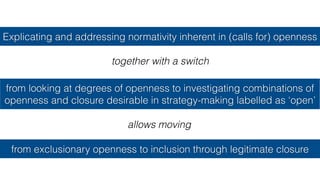
Explicating and addressing normativity inherent in (calls for) openness
from looking at degrees of openness to investigating combinations of
openness and closure desirable in strategy-making labelled as ‘open’
together with a switch
from exclusionary openness to inclusion through legitimate closure
allows moving
CONTACT
E-mail:
Leonhard.Dobusch@uibk.ac.at
Twitter:
@leonidobusch
Websites:
bit.ly/LD-UIBK // www.dobusch.net
Research blogs:
governancexborders.com // osconjunction.net
References
‣ Ahrne, G., & Brunsson, N. (eds.), Organisation outside Organizations: The Abundance of Partial
Organisation in Social Life. Cambridge: Cambridge University Press
‣ Chesbrough, H. W., & Appleyard, M. M. (2007). Open Innovation and Strategy. California Management
Review, 50, 57–76.
‣ Dobusch, L. (2014). How exclusive are inclusive organisations? Equality, Diversity and Inclusion: An
International Journal, 33(3), 220-234.
‣ Dobusch, L. & Dobusch, L. (2019): The Relation between Openness and Closure in Open Strategy:
Programmatic and Constitutive Approaches to Openness. In D. Seidl, G. von Krogh & R Whittington
(eds.), The Cambridge Handbook of Open Strategy. Cambridge: Cambridge University Press, 326-336
‣ Dobusch, L., Dobusch, L., & Müller-Seitz, G. (2019). Closing for the benefit of openness? The case of
Wikimedia’s open strategy process. Organization Studies, 40(3), 343-370.
‣ Dobusch, L., & Kapeller, J. (2018). Open strategy-making with crowds and communities: Comparing
Wikimedia and Creative Commons. Long Range Planning, 51(4), 561-579.
‣ Dobusch, L., Kremser, W., Seidl, D., & Werle, F. (2017). A communication perspective on open strategy
and open innovation. Managementforschung, 27(1), 5-25.
‣ Heimstädt, M. (2017). Openwashing: A decoupling perspective on organizational
transparency. Technological Forecasting and Social Change, 125, 77-86.
‣ Stieger, D., Matzler, K., Chatterjee, S., & Ladstaetter-Fussenegger, F. (2012). Democratizing Strategy:
How Crowdsourcing Can Be Used for Strategy Dialogues. California Management Review, 54, 44-69.
‣ Whittington, R., Cailluet, L., & Yakis-Douglas, B. (2011). Opening Strategy: Evolution of a Precarious
Profession. British Journal of Management, 22(3), 531-544. 44

Open Strategy as a Practice

  • 1.
    Leonhard Dobusch University ofInnsbruck Webinar Series Strategizing Activities and Practices (SAP) Interest Group in the Academy of Management June 18, 2020, Internet OPEN STRATEGY AS A PRACTICE
  • 2.
    CO M M ERCIAL BREAK Dobusch, L. &Dobusch, L. (2019): The Relation between Openness and Closure in Open Strategy: Programmatic and Constitutive Approaches to Openness. In D. Seidl, G. von Krogh & R. Whittington (eds.), The Cambridge Handbook of Open Strategy. Cambridge: Cambridge University Press, 326-336
  • 3.
    Openness as anOrganizing Principle
  • 4.
    11 EIRMA SIGIII, 2005-10-20 Closed innovation Our current market Our new market Other firm´s market Open innovation External technology insourcing Internal technology base External technology base Stolen with pride from Prof Henry Chesbrough UC Berkeley, Open Innovation: Renewing Growth from Industrial R&D, 10th Annual Innovation Convergence, Minneapolis Sept 27, 2004 Internal/external venture handling Licence, spin out, divest
  • 5.
    a lesser extentin the arts and humanities). 0 50 100 150 200 250 2003 2004 2005 2006 2007 2008 2009 2010 2011 All SSCI B/M Figure 1.2 Growth of publications on open innovation in Web of Science Notes: Search criterion: “open innovation” in title, abstract or keyword or citing Chesbrough (2003a); All = SCI, SSCI and A&HCI; SSCI = Social Science Citation Index; B/M = Business or Management category (within SSCI)
  • 6.
    Open Innovation and Strategy HenryW. Chesbrough Melissa M. Appleyard A new breed of innovation—open innovation—is forcing firms to reassess their leadership positions, which reflect the performance outcomes of their business strategies. It is timely to juxtapose some new phenomena in innovation with the traditional acade- mic view of business strategy. More specifically, we wish to examine the increas- ing adoption of more open approaches to innovation, and see how well this adoption can be explained with theories of business strategy. In our view, open innovation is creating new empirical phenomena that exist uneasily with well- established theories of business strategy. Traditional business strategy has guidedQuelle: David Lerner, https://en.wikipedia.org/wiki/File:Internet_troll.jpg, http://creativecommons.org/licenses/by-sa/3.0/ Open strategy … embraces the benefits of openness as a means of expanding value creation for organizations “ Chesbrough & Appleyard (2007)
  • 7.
    Open Innovation and Strategy HenryW. Chesbrough Melissa M. Appleyard A new breed of innovation—open innovation—is forcing firms to reassess their leadership positions, which reflect the performance outcomes of their business strategies. It is timely to juxtapose some new phenomena in innovation with the traditional acade- mic view of business strategy. More specifically, we wish to examine the increas- ing adoption of more open approaches to innovation, and see how well this adoption can be explained with theories of business strategy. In our view, open innovation is creating new empirical phenomena that exist uneasily with well- established theories of business strategy. Traditional business strategy has guidedQuelle: David Lerner, https://en.wikipedia.org/wiki/File:Internet_troll.jpg, http://creativecommons.org/licenses/by-sa/3.0/ Open strategy … embraces the benefits of openness as a means of expanding value creation for organizations “ Chesbrough & Appleyard (2007)
  • 8.
  • 9.
  • 10.
    Bild: Chris Potter,CC-BY 2.0, https://www.flickr.com/photos/86530412@N02/8334443952 Impression Tool Value OPENNESS OF ORGANIZATIONS
  • 11.
  • 13.
    13 [S]trategy is traditionally exclusive.[…] Opacity is important to strategy […]. Open strategy challenges both these orthodoxies[.] (Whittington et al., 2011, p. 535) “ Open strategy balances the tenets of traditional business strategy with the promise of open innovation. (Chesbrough and Appleyard 2007, p. 58) “
  • 14.
    Allows… as not “traditional“,“closed“, “exclusive“ NEGATIVE DEFINITION OF OPENNESS …selective revealing (Henkel et al. 2014) …selective inclusion …"openwashing" (Heimstädt 2017) Potential problems: Escalating demands Lack of commitment, diversity Loss of trust
  • 15.
    Quelle: David Lerner,https://en.wikipedia.org/wiki/File:Internet_troll.jpg, http://creativecommons.org/licenses/by-sa/3.0/ Mind the Organizationality of the OUTSIDE CROWD actors do not share interpersonal ties but are mainly related to the focal organization in some form (e.g. customers, fans, etc.) Networks of interrelated actors, who may engage in interpersonal exchange and share social ties or a common identity COMMUNITY
  • 16.
    Quelle: David Lerner,https://en.wikipedia.org/wiki/File:Internet_troll.jpg, http://creativecommons.org/licenses/by-sa/3.0/ Mind the Organizationality of the OUTSIDE From tensions of commitment to tensions of escalation (Hautz et al., 2017) CROWD Growing tensions of empowerment (overburdening) (Hautz et al., 2017) COMMUNITYL. Dobusch, J. Kapeller / Long Range Planning 51 (2018) 561e579 Source:Dobusch&Kapeller(2018)
  • 17.
    Quelle: David Lerner,https://en.wikipedia.org/wiki/File:Internet_troll.jpg, http://creativecommons.org/licenses/by-sa/3.0/ Increasing Openness as a PROGRAM Tensions such as “compromising speed” or “burdening wider audiences with the pressures of strategy” (Hautz et al., 2017) as limitations or hurdles for achieving greater openness IIIOpenness as the opposite of closure, representing two endpoints of a continuum from closed to open: Inviting more actors, sharing more information >> open++ open++ as a normative ideal
  • 18.
    Open Practices inStrategy-Making
  • 19.
    19 Democratizing Strategy: HowCrowdsourcing Can Be Used for Strategy Dialogues (Stieger et al. 2012)“
  • 20.
    “Open forms ofstrategy-making with more inside and outside organizations and more of different actors internally and externally. Whittington et al. (2011, p. 531) transparency inclusion
  • 21.
  • 22.
  • 23.
    How are opennessand inclusion connected?
  • 24.
    How connected areopenness and inclusion?
  • 26.
    Survey of 5.500open source developers on Github: 95% male, 3% female (in comparison: ~20% of all professional developers in the USA are female) Quellen: http://opensourcesurvey.org/2017/; https://www.wired.com/2017/06/diversity-open-source-even-worse-tech-overall/
  • 31.
    358 Organization S Table4. Data on members of strategy task forces Region Members’ origin % Associated with Wikimedia Foundation Arabic 7 6.5 China 6 5.6 Eastern Europe 2 1.9 EU 25 23.4 4 (2 WMB, 1 WMF, 1 WMC) India 17 15.9 1 (WMB) Latin America 2 1.9 USA 37 34.6 15 (3 WMB, 7 WMF, 5 WMC) Other 2 1.9 Unclear 9 8.4 Totals 107 20 *includes Wikimedia Board (WMB), Foundation staff (WMF) und hired consultants (WMC) Source: Dobusch et al. (2019, p. 358) 58%
  • 32.
  • 33.
    Non-performatives describes the “reiterative andcitational practice by which discourse” does not produce “the effects that it names” (Butler 1993: 2) “ Ahmed, S. (2012, p. 117)
  • 34.
    Bild ShashiBellamkonda, CCBY 2.0, : https://www.flickr.com/photos/drbeachvacation/4623702054/
  • 35.
    Why is openfor "anyone" not open enough?
  • 36.
  • 37.
    Lack of diversityin spite of radical openness? because of
  • 38.
  • 39.
    Quelle: David Lerner,https://en.wikipedia.org/wiki/File:Internet_troll.jpg, http://creativecommons.org/licenses/by-sa/3.0/ If your group has nine helpful and polite members, and one rude, sexist, loud member, most women are going to continue to stay away because of that one member “ Valeria Aurora (2002), http://tldp.org/HOWTO/ Encourage-Women- Linux-HOWTO/
  • 40.
    From Degrees toParadoxes of Openness
  • 41.
    Quelle: David Lerner,https://en.wikipedia.org/wiki/File:Internet_troll.jpg, http://creativecommons.org/licenses/by-sa/3.0/ Openness and Closure as CONSTITUTIVE Analyzing the paradoxical nature of openness (and closure) by focusing on legitimate forms closure. e.g., restricting scope of topics to increase number of potential participants (Dobusch, Kremser, Seidl, & Werle, 2018) IIIOpenness and closure as inextricably linked and interacting with each other >> we find examples of closure in all empirical studies of open strategy
  • 42.
    Explicating and addressingnormativity inherent in (calls for) openness from looking at degrees of openness to investigating combinations of openness and closure desirable in strategy-making labelled as ‘open’ together with a switch from exclusionary openness to inclusion through legitimate closure allows moving
  • 43.
  • 44.
    References ‣ Ahrne, G.,& Brunsson, N. (eds.), Organisation outside Organizations: The Abundance of Partial Organisation in Social Life. Cambridge: Cambridge University Press ‣ Chesbrough, H. W., & Appleyard, M. M. (2007). Open Innovation and Strategy. California Management Review, 50, 57–76. ‣ Dobusch, L. (2014). How exclusive are inclusive organisations? Equality, Diversity and Inclusion: An International Journal, 33(3), 220-234. ‣ Dobusch, L. & Dobusch, L. (2019): The Relation between Openness and Closure in Open Strategy: Programmatic and Constitutive Approaches to Openness. In D. Seidl, G. von Krogh & R Whittington (eds.), The Cambridge Handbook of Open Strategy. Cambridge: Cambridge University Press, 326-336 ‣ Dobusch, L., Dobusch, L., & Müller-Seitz, G. (2019). Closing for the benefit of openness? The case of Wikimedia’s open strategy process. Organization Studies, 40(3), 343-370. ‣ Dobusch, L., & Kapeller, J. (2018). Open strategy-making with crowds and communities: Comparing Wikimedia and Creative Commons. Long Range Planning, 51(4), 561-579. ‣ Dobusch, L., Kremser, W., Seidl, D., & Werle, F. (2017). A communication perspective on open strategy and open innovation. Managementforschung, 27(1), 5-25. ‣ Heimstädt, M. (2017). Openwashing: A decoupling perspective on organizational transparency. Technological Forecasting and Social Change, 125, 77-86. ‣ Stieger, D., Matzler, K., Chatterjee, S., & Ladstaetter-Fussenegger, F. (2012). Democratizing Strategy: How Crowdsourcing Can Be Used for Strategy Dialogues. California Management Review, 54, 44-69. ‣ Whittington, R., Cailluet, L., & Yakis-Douglas, B. (2011). Opening Strategy: Evolution of a Precarious Profession. British Journal of Management, 22(3), 531-544. 44