SUSTAINABLE ECONOMIC
SYSTEMS
By: Póciennik Sebatian
Introduction
The first decade of the twenty-first century witnessed the strong
impression that the global economy had become a sphere of extreme
uncertainty and risk. Considering the dimension of the crisis, which
started in 2007, this was not very surprising. The crisis didn't look like
another business cycle setback, a temporary overheating or a sectoral
bubble such as the previous ‘dot-coms crash’ of 2000. This was a
profound breakdown, strong enough to question the foundations of
modern approaches to the creation of welfare.
Apart from collapsing financial markets, there were rising
unemployment, deeper inequalities, a shrinking middle class, extreme
indebtedness, and inability of governments to force through reforms. In
addition, there were the increasing challenges of climate change and
availability of resources, which are necessary to develop new
technologies and keep economies growing. This was exactly what many
years ago was predicted by the German sociologist Ulrich Beck, who
coined the term ‘risk society’ (Beck, 1986).
The main reason for the current problems has been the inability of
modern societies to produce enough stability and sustainability. These
two elements have been produced so far in a rather fragmented way and
not always efficiently.
Stability
Firmness in position, permanence, and resistance to change, especially in a disruptive way
– these are general associations connected with the term ‘stability’. In an economic sense,
this association was more specific. The International Monetary Fund (IMF) describes it as
‘avoiding large swings in economic activity, high inflation, and excessive volatility in
exchange rates and financial markets’ (International Monetary Fund, 2012).
The overall pattern has been known at least since the analysis of the French economist
Jean Charles Leonard de Sismondi in 1819 and also the works of Joseph Schumpeter. It
says that within a few years every economy moves through periods of rapid growth with
rising demand, higher inflation and dropping unemployment, followed by depression with
reversal phenomena (Knoop, 2009).
In other words, extreme bubbles of economic activity must be calmed down before they
burst.
Tomas Sedlacek, the Czech author of an influential book on the history of economics,
reminds us in this context of the biblical parable about pharaoh's bad dream, in which
seven plump and healthy cows get devoured by seven lean cows. Joseph said to the
pharaoh that this dream was a prophecy showing seven affluent years and seven bad
years. The only way to react, then, is to save and store food in the time of plenty in order
to react when people will be in need during the dreary years (Sedlacek, 2011: 63).
Stability
This point of view has become clear since the Great Depression of 1929 when the
economy collapsed in a dramatic way after long years of post-war prosperity and
overproduction.
A decade later Keynes published his seminal work The General Theory of Employment,
Interest and Money, reviewed after 75 years in Cate, 2012, in which he designed a
theoretical framework proving why it makes sense to raise government spending in
harsh times in order to prevent long-lasting depressions. In the next half-century,
the capitalist world followed Keynes' hints, and economists refined them by developing
sophisticated models of fiscal and monetary policy.
The global crisis in the 1970s, the time of surprising stagflation (rise in inflation and
unemployment), opened the gates for new economic ideas. One of them was
monetarism and its premise that stabilization could be produced control of the amount
of money in circulation.
The 1990s still saw many collapses in the world economy, among them the Asian
financial crisis in 1997, the Russian crisis, followed by the disaster in Argentina, which
began in 1999. They were caused mainly by major political mistakes, but particularly
alarming were their contagion effects. Many countries got dragged into the turmoil. The
global interconnectedness, which was very advantageous to the world economy
because of exchange, showed its other, less appealing face.
Sustainability
Sustainability should be seen as different from stability, although at the first sight
the overlap seems obvious. It considers the long term capacities of a system to
exist, not its short-term resistance to change. A well-known definition of
sustainability, which emphasizes its economic notion, comes from the Bruntland
Report (World Commission on Environment and Development, 1987) prepared
for the United Nations in 1987. It says that ‘development that meets the needs of
the present without compromising the ability of future generations to meet their
own needs’ deserves the label of sustainability. In other words, it is about
responsible use of resources.
Economics had a certain problem with sustainability, analyzing mainly the
questions of long-term growth.
The message was both simple and convincing: new techniques of production
help to expand the size of output without raising necessary input. One of the
most popular long term growth concepts, the Solow-Swan model from the
1950s, saw the only chance for it in innovations. A sheer increase in the number
of resources added to input could lead to diminishing marginal returns only. New
ideas in technology and organization made it possible to overtake the steady
state of zero growth and induce development without increasing resources.
Sustainability
The endogenous factors, like human capital and education, were recognized as
crucial for growth and their application was free from the steady state problem of
classical resources.
At its very beginning, the capitalist system faced open/waste spaces of the globe
and was free to expand and exploit resources.
The pioneer was the British scholar Thomas Malthus, who published in 1798 a book
on the grim consequences of a rising population, which consumes all surplus food
production and thus prevents a rise in living standards.
The German social state, and also the Victorian welfare state, Marxist movements,
brought their own interpretations of, and solutions to, the question.
Modern debate on sustainability, focused mainly on environmental questions,
came later. In 1968 Garret Hardin wrote his famous work ‘Tragedy of the commons’,
in which he analyzed how public goods got exhausted by actors in a free market
economy (Hardin, 1968).
Sustainability perspective started to be visible not only in the environmental area.
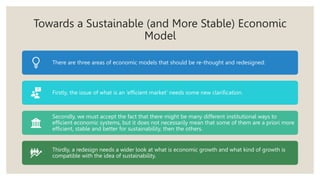
Towards a Sustainable (and More Stable) Economic
Model
There are three areas of economic models that should be re-thought and redesigned:
Firstly, the issue of what is an ‘efficient market’ needs some new clarification.
Secondly, we must accept the fact that there might be many different institutional ways to
efficient economic systems, but it does not necessarily mean that some of them are a priori more
efficient, stable and better for sustainability, then the others.
Thirdly, a redesign needs a wider look at what is economic growth and what kind of growth is
compatible with the idea of sustainability.
Complexity
Approach to
Markets
Markets are the most substantial, constructional element of economies. However,
nowadays we are dealing with biases which make understanding their functioning
puzzling. As a consequence, there are difficulties with efficient economic policy and,
obviously with providing stability and sustainability.
One of them is surely the formal concept of markets which dominates modern
economics. It is based on strong assumptions which make building theoretical models
easier, but, like many authors have concluded even before the crisis started, only partly
coincide with reality (Fulbrook, 2004; Keen, 2011). Individual actors in such models are
generally driven by a one-dimensional motivation of profit, are able to calculate
precisely costs and gains, take advantage of access to all necessary information and are
actually not disturbed by other actors who have more power over the market.
Another strong assumption is that markets tend always to a state of equilibrium set out
by forces of demand and supply. If there is a situation of imbalance caused by external
shocks, these forces push markets ‘automatically’ towards an efficient equilibrium level
of price, no matter what kind of shock caused them. There is a famous ‘rocking-horse’
metaphor of the Swedish economist Knut Wicksell referring to this feature of markets
(Louçã, 2001: 29): no matter the reason, a horse with blinkers will move in an expected
way.
This mechanistic paradigm has dominated economics since the nineteenth century, both
in academia and economic policy.
Complexity
Approach to
Markets
There is a huge need for a more holistic and organic
approach to economies. This social system should be
considered as a dynamic, non-linear, self-organizing
one with intelligent, flexible actors, rather than a set
of structurally similar markets, which all tend towards
equilibrium (Beinhocker, 2007).
Economic policy and regulation must also draw
consequences from the newest developments and
this is actually happening. Public agencies try to
collect more specific data about markets in order
to deal with complexity challenge.
There is a very serious problem with imposing such
new rules on more and more globally oriented
markets. Fragmented regulation of national markets
is insufficient since externalities have the global
dimension and produce the unequal distribution of
costs among countries.
Pluralism of Development Models
How
Convergence
Failed
Varieties of
Capitalism
How convergence Failed
◦ The years after 1980 put into the economic debate the issue of convergence of national economic models. The source of this consideration was
the rapid expansion of neoliberal ideology, which saw markets as the most efficient way of social coordination and true growth-
creating machines. Spectacular expansion of the globalization process, economic reforms in the USA, United Kingdom and Latin America, the
collapse of communism combined with shock therapies of previously state-led economies – all these created an ‘end of history’ atmosphere.
The neo-liberal agenda brought, however, some problems:
• Firstly, it increased exposition of the world economic systems on crisis and contagion effects since most
reforms were aiming at national deregulation which was not àreplaced' by efficient global regulation.
• The second problem concerned efficiency. The tacit and wide-spread assumption on the superiority of free
market solutions has some flaws. There are issues with short-termism, high volatility and inability to deal
with externalities (costs and benefits affecting third persons), which are directly connected with the challenge
of sustainability.
• The third problem is the legitimacy of market-based solutions. The market itself is not able to produce
legitimacy, but it needs the acceptance of all actors (Rodrik, 2007: 237–42). However, while starting with the
distribution of welfare and power over the competition mechanisms, the neo-liberal agenda has to have not
only a good idea of what to do with the winners (it certainly does) but also what to do with the losers.
• It has been easy to find examples of this clash. Greek people put under the pressure of very neo-liberal market
reforms after 2009 tend to vote more for extremist parties because they do not accept the distribution of
social burdens and its official grounds.
• The above arguments can be summed up with a metaphor of the American economist Dani Rodrik: ‘Markets
are the essence of a market economy in the same sense that lemons are the essence of lemonade.
Varieties of
Capitalism
This VoC is posited on a couple of basic assumptions. Firstly, it considers firms as the most important
actors for welfare creation in national economies, since they provide innovations and new products.
To achieve their goals, they need access to resources, to mention the most fundamental ones –
capital, labor and skills.
From the variety of systems, we can distinguish two outermost, theoretical models: liberal market
economy (LME) and coordinated market economy (CME). The first type, LME, can be characterized by
dynamic access to resources, which means, that it is relatively inexpensive to change conditions of
transactions or resign from it. We can see this feature in the design of markets for capital, labor and
skills. Capital in LMEs is derived often from stock markets, where assets can quickly change owners
and their value is estimated by price mechanisms.
The second outermost model is coordinated market economy (CME). Transactions are more stable and
longterm oriented. Capital is provided by banks which create loyalty-based relations with firms, thus
the access is ‘patient’. The labor market is characterized by long-term contracts and relatively low
differences in wage levels.
These two systems are of course extreme examples, and between them, there are many possible
combinations. Scandinavian models mix free market with a generous social insurance that encourages
people to invest in rare, specific skills.
There is also another argument for more diversity, important from the global perspective. Some
authors argue that LMEs and CMEs are in the world economy like pedals in vehicles (Acemoglu et al.,
2012). In fact, they are rarely in the same state.
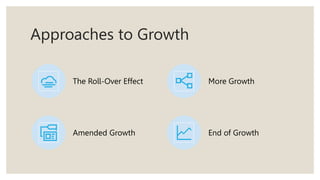
Approaches to Growth
The Roll-Over Effect More Growth
Amended Growth End of Growth
Roll-Over Growth
Modern capitalism developed in the last 200 years based itself on the assumption of growth and expansion. The more products we are able to deliver,
the better for everybody. Expression of this attitude is the domination of the GDP index in measurements of performance of national economies.
On more general level doubts about the quality of growth versus the sheer size of GDP can be analyzed in the context of stability and sustainability of
economic systems. A high number of goods delivered in a national economy translates to short-term growth, which combined with other short-term
indicators like inflation or unemployment rates can say a lot about stability.
There are many examples of the roll-over problem. Longer working time can quickly boost the supply of labor, but in the longer term, it can cause lower
birth rates, a higher propensity of diseases, in particular, burnout syndrome, depression and cardiovascular diseases – all in all, challenges for the labor
market. An even more outspoken example concerns the debt issue. Easy and inexpensive access to loans can make selling numbers explode and so, too,
the GDP rates. Perhaps, then, this is one of the reasons why modern capitalism has such a loud culture of overconsumption and capacities to make it
popular. The effect might be, however, a rising level of debt, which must be ‘solved’ later, by subsequent generations. The same scheme is about
resources. Today's growth and consumption are ‘innocent’ in terms of GDP, but they flourish due to ignoring the future; and this future can bring not
only scarce, more expensive resources, but a catastrophe of the entire system.
More Growth
There is a strong voice in favor of the continuation of the existing, dominating path. Economies should still take care
of their output level, so the GDP remains the most important point of reference.
Another assumption is a strong belief in technological progress. It will increase productivity and, in particular, save
resources. Hybrid or electric cars, bio-agriculture, recycling techniques, communication that reduces traveling, etc. –
all should contribute to faster, and simultaneously, better quality of growth.
This idea deserves, if necessary, some interventionism. Nicolas Stern, a British economist and former chief economist
of the World Bank, who prepared in 2006 a report on climate change prospects, treated the ecological challenges for
sustainability as classical economic externalities, which must be regulated, taxed and if necessary also balanced by
direct spending of 1–2 percent of GDP annually in order to prop up the non-carbon technologies (Stern, 2007). In
this sense, there is much more acceptance for regulation and the government intervening, but the logic of growth
remains the same: the more goods, the better.
Amended Growth
The second approach to growth is a more skeptical one. It sees the GDP index as an important measure of human
achievements, but it has to be combined with additional indexes which refer to several aspects of quality of life
and sustainability.
The only globally accepted measure of ‘amended’ growth and its quality is the Human Development Index (HDI). It
was created in 1990 by Mahbub ul Haq, the Pakistani economist, and then developed by the Indian Nobel Prize
Laureate Amartya Sen and used by the United Nations Developing Programme for comparative studies.
Another interesting group comprises indexes developed and applied at country level. Sometimes they build up the
reputation and become popular at the global level.
Some countries are pretty much advanced in the application of their own indexes. One of the best-known
examples is the Canadian Index of Wellbeing, which includes arts, culture and recreation, community vitality,
democratic engagement, education, environment, healthy populations, living standards and time use
End of
Growth
The search can be speeded up by the economic crisis and cassandric voices that our
global economic system is now at the end of its known shape. Many of its current
axioms, among them steady and fast growth of production and ‘obvious’ rise of welfare,
will be some of the first victims of the process. Tyler Cowen, a professor at George
Mason University in Virginia, prophesies that the world economy is moving towards a
time of a ‘great stagnation’. The close-to-recession statistical footprint of Japan in the
1990s, called the lost decade, should be perceived as ‘a new normality’ (Cowen, 2011).
Cowen says that there are no ‘low hanging fruits’ anymore. He means by this that the
day of inexpensive access to resources is over. One can also say that extreme increase of
productivity following from migration of the labor force and global competition is also
close to exhaustion. The most important argument is, however, a slower pace of
innovation – a crucial point for explaining lower rates of productivity rise. It is worth
stressing that until the eighteenth century the average growth of the world economy
was very low (1–1.5 percent annually) because real innovations were simply lacking.
The above arguments are of course speculations, and it is not difficult to find opposite,
optimistic views (see e.g. Brynjolfsson and McAfee, 2014). However, dreary visions
contain enough credibility to encourage ideas about a new concept of growth and
development, and thus new concepts of sustainability and stability. Dennis Meadows
seems to be on their side while saying that ‘sustainable development is a pointless word,
like peaceful war’ (in an interview for the German magazine Zeit, in 2012).
Innovations and production growth should be entirely subordinated to the balance
account of the system, including resources, energy, consumption biases, and debt. Such
opinion is expressed also by Tim Jackson, British economist, who criticized a ‘soft’
conciliation approach to growth represented by current green parties. From his point of
view switching to electric cars is just another bypass to save the old habits. He thinks
that the world must leave the traditional growth logic and search for progress in quality
of life, development of services, provision of local goods, shortened working time, end
of consumerism and higher public investment (Jackson, 2009).

Sustainable Economic Systems.pptx

  • 1.
  • 2.
    Introduction The first decadeof the twenty-first century witnessed the strong impression that the global economy had become a sphere of extreme uncertainty and risk. Considering the dimension of the crisis, which started in 2007, this was not very surprising. The crisis didn't look like another business cycle setback, a temporary overheating or a sectoral bubble such as the previous ‘dot-coms crash’ of 2000. This was a profound breakdown, strong enough to question the foundations of modern approaches to the creation of welfare. Apart from collapsing financial markets, there were rising unemployment, deeper inequalities, a shrinking middle class, extreme indebtedness, and inability of governments to force through reforms. In addition, there were the increasing challenges of climate change and availability of resources, which are necessary to develop new technologies and keep economies growing. This was exactly what many years ago was predicted by the German sociologist Ulrich Beck, who coined the term ‘risk society’ (Beck, 1986). The main reason for the current problems has been the inability of modern societies to produce enough stability and sustainability. These two elements have been produced so far in a rather fragmented way and not always efficiently.
  • 3.
    Stability Firmness in position,permanence, and resistance to change, especially in a disruptive way – these are general associations connected with the term ‘stability’. In an economic sense, this association was more specific. The International Monetary Fund (IMF) describes it as ‘avoiding large swings in economic activity, high inflation, and excessive volatility in exchange rates and financial markets’ (International Monetary Fund, 2012). The overall pattern has been known at least since the analysis of the French economist Jean Charles Leonard de Sismondi in 1819 and also the works of Joseph Schumpeter. It says that within a few years every economy moves through periods of rapid growth with rising demand, higher inflation and dropping unemployment, followed by depression with reversal phenomena (Knoop, 2009). In other words, extreme bubbles of economic activity must be calmed down before they burst. Tomas Sedlacek, the Czech author of an influential book on the history of economics, reminds us in this context of the biblical parable about pharaoh's bad dream, in which seven plump and healthy cows get devoured by seven lean cows. Joseph said to the pharaoh that this dream was a prophecy showing seven affluent years and seven bad years. The only way to react, then, is to save and store food in the time of plenty in order to react when people will be in need during the dreary years (Sedlacek, 2011: 63).
  • 4.
    Stability This point ofview has become clear since the Great Depression of 1929 when the economy collapsed in a dramatic way after long years of post-war prosperity and overproduction. A decade later Keynes published his seminal work The General Theory of Employment, Interest and Money, reviewed after 75 years in Cate, 2012, in which he designed a theoretical framework proving why it makes sense to raise government spending in harsh times in order to prevent long-lasting depressions. In the next half-century, the capitalist world followed Keynes' hints, and economists refined them by developing sophisticated models of fiscal and monetary policy. The global crisis in the 1970s, the time of surprising stagflation (rise in inflation and unemployment), opened the gates for new economic ideas. One of them was monetarism and its premise that stabilization could be produced control of the amount of money in circulation. The 1990s still saw many collapses in the world economy, among them the Asian financial crisis in 1997, the Russian crisis, followed by the disaster in Argentina, which began in 1999. They were caused mainly by major political mistakes, but particularly alarming were their contagion effects. Many countries got dragged into the turmoil. The global interconnectedness, which was very advantageous to the world economy because of exchange, showed its other, less appealing face.
  • 5.
    Sustainability Sustainability should beseen as different from stability, although at the first sight the overlap seems obvious. It considers the long term capacities of a system to exist, not its short-term resistance to change. A well-known definition of sustainability, which emphasizes its economic notion, comes from the Bruntland Report (World Commission on Environment and Development, 1987) prepared for the United Nations in 1987. It says that ‘development that meets the needs of the present without compromising the ability of future generations to meet their own needs’ deserves the label of sustainability. In other words, it is about responsible use of resources. Economics had a certain problem with sustainability, analyzing mainly the questions of long-term growth. The message was both simple and convincing: new techniques of production help to expand the size of output without raising necessary input. One of the most popular long term growth concepts, the Solow-Swan model from the 1950s, saw the only chance for it in innovations. A sheer increase in the number of resources added to input could lead to diminishing marginal returns only. New ideas in technology and organization made it possible to overtake the steady state of zero growth and induce development without increasing resources.
  • 6.
    Sustainability The endogenous factors,like human capital and education, were recognized as crucial for growth and their application was free from the steady state problem of classical resources. At its very beginning, the capitalist system faced open/waste spaces of the globe and was free to expand and exploit resources. The pioneer was the British scholar Thomas Malthus, who published in 1798 a book on the grim consequences of a rising population, which consumes all surplus food production and thus prevents a rise in living standards. The German social state, and also the Victorian welfare state, Marxist movements, brought their own interpretations of, and solutions to, the question. Modern debate on sustainability, focused mainly on environmental questions, came later. In 1968 Garret Hardin wrote his famous work ‘Tragedy of the commons’, in which he analyzed how public goods got exhausted by actors in a free market economy (Hardin, 1968). Sustainability perspective started to be visible not only in the environmental area.
  • 7.
    Towards a Sustainable(and More Stable) Economic Model There are three areas of economic models that should be re-thought and redesigned: Firstly, the issue of what is an ‘efficient market’ needs some new clarification. Secondly, we must accept the fact that there might be many different institutional ways to efficient economic systems, but it does not necessarily mean that some of them are a priori more efficient, stable and better for sustainability, then the others. Thirdly, a redesign needs a wider look at what is economic growth and what kind of growth is compatible with the idea of sustainability.
  • 8.
    Complexity Approach to Markets Markets arethe most substantial, constructional element of economies. However, nowadays we are dealing with biases which make understanding their functioning puzzling. As a consequence, there are difficulties with efficient economic policy and, obviously with providing stability and sustainability. One of them is surely the formal concept of markets which dominates modern economics. It is based on strong assumptions which make building theoretical models easier, but, like many authors have concluded even before the crisis started, only partly coincide with reality (Fulbrook, 2004; Keen, 2011). Individual actors in such models are generally driven by a one-dimensional motivation of profit, are able to calculate precisely costs and gains, take advantage of access to all necessary information and are actually not disturbed by other actors who have more power over the market. Another strong assumption is that markets tend always to a state of equilibrium set out by forces of demand and supply. If there is a situation of imbalance caused by external shocks, these forces push markets ‘automatically’ towards an efficient equilibrium level of price, no matter what kind of shock caused them. There is a famous ‘rocking-horse’ metaphor of the Swedish economist Knut Wicksell referring to this feature of markets (Louçã, 2001: 29): no matter the reason, a horse with blinkers will move in an expected way. This mechanistic paradigm has dominated economics since the nineteenth century, both in academia and economic policy.
  • 9.
    Complexity Approach to Markets There isa huge need for a more holistic and organic approach to economies. This social system should be considered as a dynamic, non-linear, self-organizing one with intelligent, flexible actors, rather than a set of structurally similar markets, which all tend towards equilibrium (Beinhocker, 2007). Economic policy and regulation must also draw consequences from the newest developments and this is actually happening. Public agencies try to collect more specific data about markets in order to deal with complexity challenge. There is a very serious problem with imposing such new rules on more and more globally oriented markets. Fragmented regulation of national markets is insufficient since externalities have the global dimension and produce the unequal distribution of costs among countries.
  • 10.
    Pluralism of DevelopmentModels How Convergence Failed Varieties of Capitalism
  • 11.
    How convergence Failed ◦The years after 1980 put into the economic debate the issue of convergence of national economic models. The source of this consideration was the rapid expansion of neoliberal ideology, which saw markets as the most efficient way of social coordination and true growth- creating machines. Spectacular expansion of the globalization process, economic reforms in the USA, United Kingdom and Latin America, the collapse of communism combined with shock therapies of previously state-led economies – all these created an ‘end of history’ atmosphere. The neo-liberal agenda brought, however, some problems: • Firstly, it increased exposition of the world economic systems on crisis and contagion effects since most reforms were aiming at national deregulation which was not àreplaced' by efficient global regulation. • The second problem concerned efficiency. The tacit and wide-spread assumption on the superiority of free market solutions has some flaws. There are issues with short-termism, high volatility and inability to deal with externalities (costs and benefits affecting third persons), which are directly connected with the challenge of sustainability. • The third problem is the legitimacy of market-based solutions. The market itself is not able to produce legitimacy, but it needs the acceptance of all actors (Rodrik, 2007: 237–42). However, while starting with the distribution of welfare and power over the competition mechanisms, the neo-liberal agenda has to have not only a good idea of what to do with the winners (it certainly does) but also what to do with the losers. • It has been easy to find examples of this clash. Greek people put under the pressure of very neo-liberal market reforms after 2009 tend to vote more for extremist parties because they do not accept the distribution of social burdens and its official grounds. • The above arguments can be summed up with a metaphor of the American economist Dani Rodrik: ‘Markets are the essence of a market economy in the same sense that lemons are the essence of lemonade.
  • 12.
    Varieties of Capitalism This VoCis posited on a couple of basic assumptions. Firstly, it considers firms as the most important actors for welfare creation in national economies, since they provide innovations and new products. To achieve their goals, they need access to resources, to mention the most fundamental ones – capital, labor and skills. From the variety of systems, we can distinguish two outermost, theoretical models: liberal market economy (LME) and coordinated market economy (CME). The first type, LME, can be characterized by dynamic access to resources, which means, that it is relatively inexpensive to change conditions of transactions or resign from it. We can see this feature in the design of markets for capital, labor and skills. Capital in LMEs is derived often from stock markets, where assets can quickly change owners and their value is estimated by price mechanisms. The second outermost model is coordinated market economy (CME). Transactions are more stable and longterm oriented. Capital is provided by banks which create loyalty-based relations with firms, thus the access is ‘patient’. The labor market is characterized by long-term contracts and relatively low differences in wage levels. These two systems are of course extreme examples, and between them, there are many possible combinations. Scandinavian models mix free market with a generous social insurance that encourages people to invest in rare, specific skills. There is also another argument for more diversity, important from the global perspective. Some authors argue that LMEs and CMEs are in the world economy like pedals in vehicles (Acemoglu et al., 2012). In fact, they are rarely in the same state.
  • 13.
    Approaches to Growth TheRoll-Over Effect More Growth Amended Growth End of Growth
  • 14.
    Roll-Over Growth Modern capitalismdeveloped in the last 200 years based itself on the assumption of growth and expansion. The more products we are able to deliver, the better for everybody. Expression of this attitude is the domination of the GDP index in measurements of performance of national economies. On more general level doubts about the quality of growth versus the sheer size of GDP can be analyzed in the context of stability and sustainability of economic systems. A high number of goods delivered in a national economy translates to short-term growth, which combined with other short-term indicators like inflation or unemployment rates can say a lot about stability. There are many examples of the roll-over problem. Longer working time can quickly boost the supply of labor, but in the longer term, it can cause lower birth rates, a higher propensity of diseases, in particular, burnout syndrome, depression and cardiovascular diseases – all in all, challenges for the labor market. An even more outspoken example concerns the debt issue. Easy and inexpensive access to loans can make selling numbers explode and so, too, the GDP rates. Perhaps, then, this is one of the reasons why modern capitalism has such a loud culture of overconsumption and capacities to make it popular. The effect might be, however, a rising level of debt, which must be ‘solved’ later, by subsequent generations. The same scheme is about resources. Today's growth and consumption are ‘innocent’ in terms of GDP, but they flourish due to ignoring the future; and this future can bring not only scarce, more expensive resources, but a catastrophe of the entire system.
  • 15.
    More Growth There isa strong voice in favor of the continuation of the existing, dominating path. Economies should still take care of their output level, so the GDP remains the most important point of reference. Another assumption is a strong belief in technological progress. It will increase productivity and, in particular, save resources. Hybrid or electric cars, bio-agriculture, recycling techniques, communication that reduces traveling, etc. – all should contribute to faster, and simultaneously, better quality of growth. This idea deserves, if necessary, some interventionism. Nicolas Stern, a British economist and former chief economist of the World Bank, who prepared in 2006 a report on climate change prospects, treated the ecological challenges for sustainability as classical economic externalities, which must be regulated, taxed and if necessary also balanced by direct spending of 1–2 percent of GDP annually in order to prop up the non-carbon technologies (Stern, 2007). In this sense, there is much more acceptance for regulation and the government intervening, but the logic of growth remains the same: the more goods, the better.
  • 16.
    Amended Growth The secondapproach to growth is a more skeptical one. It sees the GDP index as an important measure of human achievements, but it has to be combined with additional indexes which refer to several aspects of quality of life and sustainability. The only globally accepted measure of ‘amended’ growth and its quality is the Human Development Index (HDI). It was created in 1990 by Mahbub ul Haq, the Pakistani economist, and then developed by the Indian Nobel Prize Laureate Amartya Sen and used by the United Nations Developing Programme for comparative studies. Another interesting group comprises indexes developed and applied at country level. Sometimes they build up the reputation and become popular at the global level. Some countries are pretty much advanced in the application of their own indexes. One of the best-known examples is the Canadian Index of Wellbeing, which includes arts, culture and recreation, community vitality, democratic engagement, education, environment, healthy populations, living standards and time use
  • 17.
    End of Growth The searchcan be speeded up by the economic crisis and cassandric voices that our global economic system is now at the end of its known shape. Many of its current axioms, among them steady and fast growth of production and ‘obvious’ rise of welfare, will be some of the first victims of the process. Tyler Cowen, a professor at George Mason University in Virginia, prophesies that the world economy is moving towards a time of a ‘great stagnation’. The close-to-recession statistical footprint of Japan in the 1990s, called the lost decade, should be perceived as ‘a new normality’ (Cowen, 2011). Cowen says that there are no ‘low hanging fruits’ anymore. He means by this that the day of inexpensive access to resources is over. One can also say that extreme increase of productivity following from migration of the labor force and global competition is also close to exhaustion. The most important argument is, however, a slower pace of innovation – a crucial point for explaining lower rates of productivity rise. It is worth stressing that until the eighteenth century the average growth of the world economy was very low (1–1.5 percent annually) because real innovations were simply lacking. The above arguments are of course speculations, and it is not difficult to find opposite, optimistic views (see e.g. Brynjolfsson and McAfee, 2014). However, dreary visions contain enough credibility to encourage ideas about a new concept of growth and development, and thus new concepts of sustainability and stability. Dennis Meadows seems to be on their side while saying that ‘sustainable development is a pointless word, like peaceful war’ (in an interview for the German magazine Zeit, in 2012). Innovations and production growth should be entirely subordinated to the balance account of the system, including resources, energy, consumption biases, and debt. Such opinion is expressed also by Tim Jackson, British economist, who criticized a ‘soft’ conciliation approach to growth represented by current green parties. From his point of view switching to electric cars is just another bypass to save the old habits. He thinks that the world must leave the traditional growth logic and search for progress in quality of life, development of services, provision of local goods, shortened working time, end of consumerism and higher public investment (Jackson, 2009).