Definition Check: Utopian
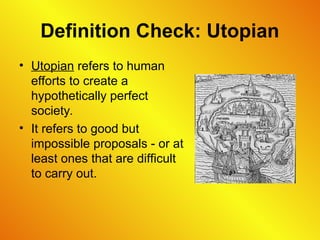
•Utopian refers to human
efforts to create a
hypothetically perfect
society.
• It refers to good but
impossible proposals - or at
least ones that are difficult
to carry out.
3.
Dystopian versus Utopian
•Dystopian is the opposite of utopian; it is often a
utopia gone sour, an imaginary place or state
where everything is as bad as it could possibly
be.
4.
Dystopian Novels
• Dystopiannovels usually include elements of
contemporary society and are seen as a
warning against some modern trend.
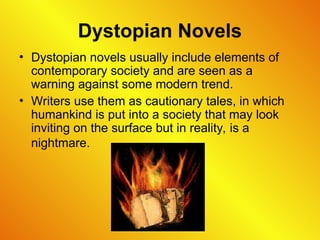
• Writers use them as cautionary tales, in which
humankind is put into a society that may look
inviting on the surface but in reality, is a
nightmare.
5.
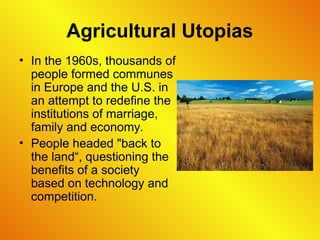
Examples of Dystopian
Novels
•1984
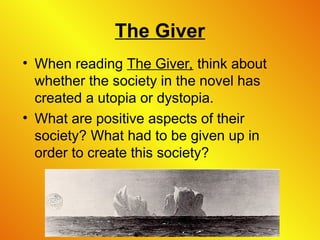
• Brave New World
• Fahrenheit 451
• A Clockwork
Orange
• Animal Farm
• The Time Machine
6.
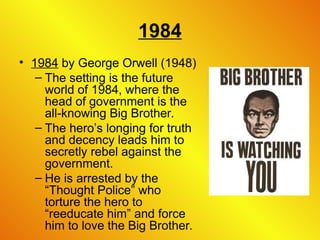
1984
• 1984 byGeorge Orwell (1948)
– The setting is the future
world of 1984, where the
head of government is the
all-knowing Big Brother.
– The hero’s longing for truth
and decency leads him to
secretly rebel against the
government.
– He is arrested by the
“Thought Police” who
torture the hero to
“reeducate him” and force
him to love the Big Brother.
7.
Relation to theReal World
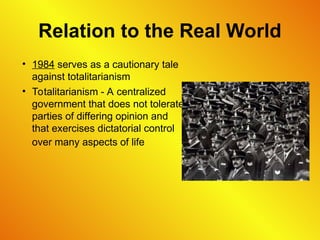
• 1984 serves as a cautionary tale
against totalitarianism
• Totalitarianism - A centralized
government that does not tolerate
parties of differing opinion and
that exercises dictatorial control
over many aspects of life
8.
Relation to theReal World
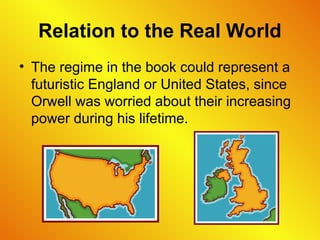
• The regime in the book could represent a
futuristic England or United States, since
Orwell was worried about their increasing
power during his lifetime.
9.
Relation to theReal World
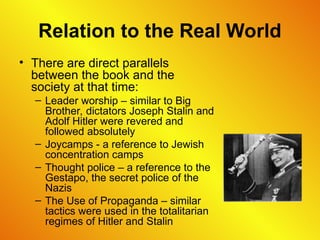
• There are direct parallels
between the book and the
society at that time:
– Leader worship – similar to Big
Brother, dictators Joseph Stalin and
Adolf Hitler were revered and
followed absolutely
– Joycamps - a reference to Jewish
concentration camps
– Thought police – a reference to the
Gestapo, the secret police of the
Nazis
– The Use of Propaganda – similar
tactics were used in the totalitarian
regimes of Hitler and Stalin
10.
Brave New World
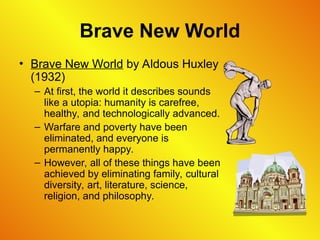
•Brave New World by Aldous Huxley
(1932)
– At first, the world it describes sounds
like a utopia: humanity is carefree,
healthy, and technologically advanced.
– Warfare and poverty have been
eliminated, and everyone is
permanently happy.
– However, all of these things have been
achieved by eliminating family, cultural
diversity, art, literature, science,
religion, and philosophy.
11.
Relation to theReal World
• The issues raised in the book were
influenced by the issues of Huxley’s
time.
– The Industrial Revolution had brought
massive changes to the world.
– Mass production made cars,
telephones, and radios cheap and
widely available.
– The effects of World War I and
totalitarian regimes were still being felt.
• Huxley used his book to express the
fear of losing individual identity in
the fast-paced world of the future.
12.
Relation to theReal World
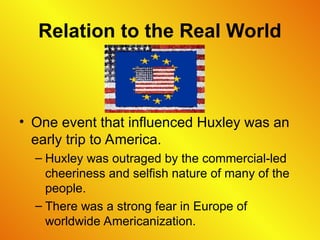
• One event that influenced Huxley was an
early trip to America.
– Huxley was outraged by the commercial-led
cheeriness and selfish nature of many of the
people.
– There was a strong fear in Europe of
worldwide Americanization.
13.
Relation to theReal World
• Therefore, in Brave New World,
Huxley explores the fears of both
Soviet communism and American
capitalism.
• Worse, he suggests that the price
of universal happiness will be the
sacrifice of everything important in
our culture: motherhood, home,
family, community, and love.
14.
1984 versus BraveNew World
• The major difference between
the two books is in 1984 people
are controlled by constant
government surveillance,
secret police, and torture.
• In Brave New World humans
are controlled by technological
interventions that start before
birth and last until death, and
actually change what people
want.
15.
Fahrenheit 451
• Fahrenheit451 by Ray Bradbury
(1953)
– The story takes place in the twenty-first
century, in an America where books are
banned.
– Society feels that “opinion” books contain
conflicting theories which are disruptive
to society.
– The penalty for owning one is having
one's house and books burnt by
"firemen."
– 451° F is stated as “the temperature at
which book paper catches fire and
burns…”
16.
Relation to theReal World
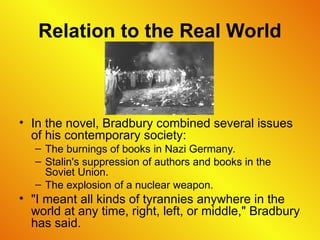
• In the novel, Bradbury combined several issues
of his contemporary society:
– The burnings of books in Nazi Germany.
– Stalin's suppression of authors and books in the
Soviet Union.
– The explosion of a nuclear weapon.
• "I meant all kinds of tyrannies anywhere in the
world at any time, right, left, or middle," Bradbury
has said.
17.
Relation to theReal World
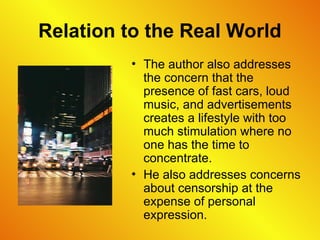
• The author also addresses
the concern that the
presence of fast cars, loud
music, and advertisements
creates a lifestyle with too
much stimulation where no
one has the time to
concentrate.
• He also addresses concerns
about censorship at the
expense of personal
expression.
18.
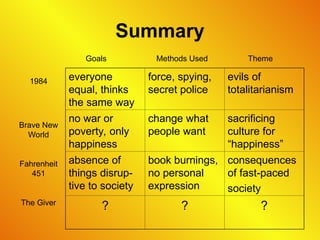
everyone
equal, thinks
the sameway
force, spying,
secret police
evils of
totalitarianism
no war or
poverty, only
happiness
change what
people want
sacrificing
culture for
“happiness”
absence of
things disrup-
tive to society
book burnings,
no personal
expression
consequences
of fast-paced
society
? ? ?
1984
Brave New
World
Fahrenheit
451
The Giver
Goals Methods Used Theme
Summary
19.
Summary
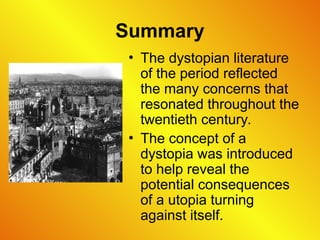
• The dystopianliterature
of the period reflected
the many concerns that
resonated throughout the
twentieth century.
• The concept of a
dystopia was introduced
to help reveal the
potential consequences
of a utopia turning
against itself.
20.
Examples of RealLife
Utopian Societies
• Religious
• Communistic
• Agricultural
21.
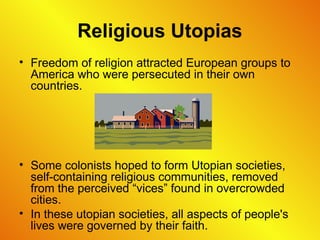
Religious Utopias
• Freedomof religion attracted European groups to
America who were persecuted in their own
countries.
• Some colonists hoped to form Utopian societies,
self-containing religious communities, removed
from the perceived “vices” found in overcrowded
cities.
• In these utopian societies, all aspects of people's
lives were governed by their faith.
22.
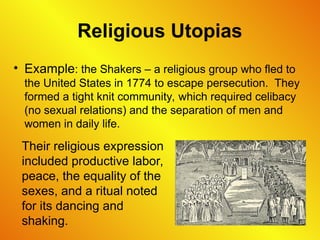
Religious Utopias
• Example:the Shakers – a religious group who fled to
the United States in 1774 to escape persecution. They
formed a tight knit community, which required celibacy
(no sexual relations) and the separation of men and
women in daily life.
Their religious expression
included productive labor,
peace, the equality of the
sexes, and a ritual noted
for its dancing and
shaking.
23.
Communistic Utopias
• TheSoviet Union represented the
creation of a political utopia on a
larger scale than had ever been
attempted before.
• Communism was seen as the
creation of a working society in
which all give according to their
means and take according to their
needs. This aspect promised the
future freedom of all people in a
world free of oppression and
inequality.
24.
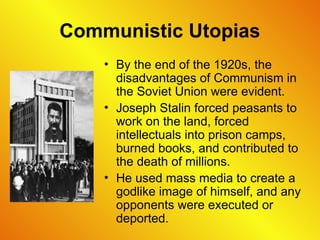
Communistic Utopias
• Bythe end of the 1920s, the
disadvantages of Communism in
the Soviet Union were evident.
• Joseph Stalin forced peasants to
work on the land, forced
intellectuals into prison camps,
burned books, and contributed to
the death of millions.
• He used mass media to create a
godlike image of himself, and any
opponents were executed or
deported.
25.
Agricultural Utopias
• Inthe 1960s, thousands of
people formed communes
in Europe and the U.S. in
an attempt to redefine the
institutions of marriage,
family and economy.
• People headed "back to
the land“, questioning the
benefits of a society
based on technology and
competition.
26.
Agricultural Utopias
• Whilemost of those
communities disbanded, many
have survived, emphasizing
economic and social
cooperation.
• Some communities are
separate from the rest of
society while others hope to
serve as an example of a
better lifestyle to the rest of the
world.
27.
Do they work?
•What do you think about forming a utopia?
• Is it possible to create a perfect world in
which to live?
28.
The Giver
• Whenreading The Giver, think about
whether the society in the novel has
created a utopia or dystopia.
• What are positive aspects of their
society? What had to be given up in
order to create this society?
Editor's Notes
#2 7th Grade English TEKS
7.12. Characteristics of Genres
A) Identify the purposes of different types of texts
B) Recognize the distinguishing features of genres
7.11. Literary Response
B) Interpret text ideas through varied means
D) Connect, compare, and contrast ideas, themes, and issues in texts
7th Grade Social Studies TEKS
7.21. Critical Thinking Skills
B) Analyze information using various methods
D) Identify points of view from the historical context and frame of reference
Image obtained from Thomas Morus’s book Utopia by Johann Froben in 1518
#3 7th Grade English TEKS
7.12. Characteristics of Genres
B) Recognize the distinguishing features of genres
7.11. Literary Response
D) Connect, compare, and contrast ideas, themes, and issues in texts
7th Grade Social Studies TEKS
7.17. Points of View in a Democratic Society
Identify different points of view of political parties and interest groups
7.20. Science/Technology/Society.
F) Make predictions about consequences resulting from future discoveries
7.21. Critical Thinking Skills
B) Analyze information using various methods
D) Identify points of view from the historical context and frame of reference
#4 7th Grade English TEKS
7.12. Characteristics of Genres
A) Identify the purposes of different types of texts
B) Recognize the distinguishing features of genres
7th Grade Social Studies TEKS
7.20. Science/Technology/Society
F) Make predictions about consequences resulting from future discoveries
7.21. Critical Thinking Skills
B) Analyze information using various methods
D) Identify points of view from the historical context and frame of reference
#5 7th Grade English TEKS
7.11. Literary Response
A) Offer observations, connections, and questions in response to the text
B) Interpret text ideas through varied means
7th Grade Social Studies TEKS
7.21. Critical Thinking Skills
D) Identify points of view from the historical context and frame of reference
#6 7th Grade English TEKS
7.12. Characteristics of Genres
A) Identify the purposes of different types of texts
7.11. Literary Response
A) Offer observations, connections, and questions in response to the text
B) Interpret text ideas through varied means
D) Connect, compare, and contrast ideas, themes, and issues in texts
7th Grade Social Studies TEKS
7.17. Points of View in a Democratic Society
Identify different points of view of political parties and interest groups
7.20. Science/Technology/Society
F) Make predictions about consequences resulting from future discoveries
7.21. Critical Thinking Skills
B) Analyze information using various methods
D) Identify points of view from the historical context and frame of reference
#7 7th Grade English TEKS
7.12. Characteristics of Genres
A) Identify the purposes of different types of texts
7.11. Literary Response
A) Offer observations, connections, and questions in response to the text
D) Connect, compare, and contrast ideas, themes, and issues in texts
7th Grade Social Studies TEKS
7.17. Points of View in a Democratic Society
Identify different points of view of political parties and interest groups
7.20. Science/Technology/Society
A) Compare types and uses of technology in the past and present.
F) Make predictions about consequences resulting from future discoveries
7.21. Critical Thinking Skills
B) Analyze information using various methods
D) Identify points of view from the historical context and frame of reference
#9 7th Grade English TEKS
7.11. Literary Response
A) Offer observations, connections, and questions in response to the text
D) Connect, compare, and contrast ideas, themes, and issues in texts
7th Grade Social Studies TEKS
7.20. Science/Technology/Society
A) Compare types and uses of technology in the past and present.
F) Make predictions about consequences resulting from future discoveries
7.21. Critical Thinking Skills
B) Analyze information using various methods
D) Identify points of view from the historical context and frame of reference
Image of Hermann Goring, creater of the Gestapo, picture from The SS: Hitler's Intrument of Terror,, p.29
#10 7th Grade English TEKS
7.12. Characteristics of Genres
A) Identify the purposes of different types of texts
7.11. Literary Response
A) Offer observations, connections, and questions in response to the text
D) Connect, compare, and contrast ideas, themes, and issues in texts
7th Grade Social Studies TEKS
7.20. Science/Technology/Society
A) Compare types and uses of technology in the past and present.
F) Make predictions about consequences resulting from future discoveries
7.21. Critical Thinking Skills
B) Analyze information using various methods
D) Identify points of view from the historical context and frame of reference
#11 7th Grade English TEKS
7.12. Characteristics of Genres
A) Identify the purposes of different types of texts
B) Recognize the distinguishing features of genres
7.11. Literary Response
A) Offer observations, connections, and questions in response to the text
B) Interpret text ideas through varied means
D) Connect, compare, and contrast ideas, themes, and issues in texts
7th Grade Social Studies TEKS
7.17. Points of View in a Democratic Society
Identify different points of view of political parties and interest groups
7.20. Science/Technology/Society
A) Compare types and uses of technology in the past and present.
F) Make predictions about consequences resulting from future discoveries
7.21. Critical Thinking Skills
B) Analyze information using various methods
D) Identify points of view from the historical context and frame of reference
#12 7th Grade English TEKS
7.11. Literary Response
A) Offer observations, connections, and questions in response to the text
B) Interpret text ideas through varied means
D) Connect, compare, and contrast ideas, themes, and issues in texts
7th Grade Social Studies TEKS
7.17. Points of View in a Democratic Society
Identify different points of view of political parties and interest groups
7.20. Science/Technology/Society
A) Compare types and uses of technology in the past and present.
F) Make predictions about consequences resulting from future discoveries
7.21. Critical Thinking Skills
B) Analyze information using various methods
D) Identify points of view from the historical context and frame of reference
#13 7th Grade English TEKS
7.11. Literary Response
A) Offer observations, connections, and questions in response to the text
B) Interpret text ideas through varied means
D) Connect, compare, and contrast ideas, themes, and issues in texts
7th Grade Social Studies TEKS
7.17. Points of View in a Democratic Society
Identify different points of view of political parties and interest groups
7.20. Science/Technology/Society
F) Make predictions about consequences resulting from future discoveries
7.21. Critical Thinking Skills
B) Analyze information using various methods
D) Identify points of view from the historical context and frame of reference
#14 7th Grade English TEKS
7.12. Characteristics of Genres
A) Identify the purposes of different types of texts
7.11. Literary Response
A) Offer observations, connections, and questions in response to the text
D) Connect, compare, and contrast ideas, themes, and issues in texts
7th Grade Social Studies TEKS
7.17. Points of View in a Democratic Society
Identify different points of view of political parties and interest groups
7.21. Critical Thinking Skills
B) Analyze information using various methods
D) Identify points of view from the historical context and frame of reference
#15 7th Grade English TEKS
7.11. Literary Response
A) Offer observations, connections, and questions in response to the text
B) Interpret text ideas through varied means
D) Connect, compare, and contrast ideas, themes, and issues in texts
7th Grade Social Studies TEKS
7.17. Points of View in a Democratic Society
Identify different points of view of political parties and interest groups
7.20. Science/Technology/Society
F) Make predictions about consequences resulting from future discoveries
7.21. Critical Thinking Skills
B) Analyze information using various methods
D) Identify points of view from the historical context and frame of reference
#16 7th Grade English TEKS
7.11. Literary Response
A) Offer observations, connections, and questions in response to the text
B) Interpret text ideas through varied means
D) Connect, compare, and contrast ideas, themes, and issues in texts
7th Grade Social Studies TEKS
7.17. Points of View in a Democratic Society
Identify different points of view of political parties and interest groups
7.20. Science/Technology/Society
A) Compare types and uses of technology in the past and present.
F) Make predictions about consequences resulting from future discoveries
7.21. Critical Thinking Skills
B) Analyze information using various methods
D) Identify points of view from the historical context and frame of reference
Image taken on May 6,1933, as Nazis ransacked libraries in Berlin; four days later as part of large public burnings of books viewed as "un-German," thousands of books were thrown into a huge bonfire.
#17 7th Grade English TEKS
7.12. Characteristics of Genres
B) Recognize the distinguishing features of genres
7.11. Literary Response
A) Offer observations, connections, and questions in response to the text
B) Interpret text ideas through varied means
D) Connect, compare, and contrast ideas, themes, and issues in texts
7th Grade Social Studies TEKS
7.17. Points of View in a Democratic Society
Identify different points of view of political parties and interest groups
7.20. Science/Technology/Society
A) Compare types and uses of technology in the past and present.
F) Make predictions about consequences resulting from future discoveries
7.21. Critical Thinking Skills
D) Identify points of view from the historical context and frame of reference
#19 7th Grade English TEKS
7.12. Characteristics of Genres
A) Identify the purposes of different types of texts
B) Recognize the distinguishing features of genres
7.11. Literary Response
A) Offer observations, connections, and questions in response to the text
D) Connect, compare, and contrast ideas, themes, and issues in texts
7th Grade Social Studies TEKS
7.20. Science/Technology/Society
F) Make predictions about consequences resulting from future discoveries
7.21. Critical Thinking Skills
D) Identify points of view from the historical context and frame of reference
Image obtained from the Library of Congress of the ruins of Dresden, Germany in 1947 following the American air raids.
#20 7th Grade English TEKS
7.11. Literary Response
A) Offer observations, connections, and questions in response to the text
B) Interpret text ideas through varied means
D) Connect, compare, and contrast ideas, themes, and issues in texts
7th Grade Social Studies TEKS
7.20. Science/Technology/Society
F) Make predictions about consequences resulting from future discoveries
7.21. Critical Thinking Skills
B) Analyze information using various methods
D) Identify points of view from the historical context and frame of reference
#21 7th Grade English TEKS
7.11. Literary Response
A) Offer observations, connections, and questions in response to the text
D) Connect, compare, and contrast ideas, themes, and issues in texts
7th Grade Social Studies TEKS
7.20. Science/Technology/Society
F) Make predictions about consequences resulting from future discoveries
7.21. Critical Thinking Skills
B) Analyze information using various methods
D) Identify points of view from the historical context and frame of reference
#22 7th Grade English TEKS
7.11. Literary Response
A) Offer observations, connections, and questions in response to the text
D) Connect, compare, and contrast ideas, themes, and issues in texts
7th Grade Social Studies TEKS
7.21. Critical Thinking Skills
B) Analyze information using various methods
D) Identify points of view from the historical context and frame of reference
Image obtained from the United Society of Believers in Christ’s Second Appearing website
#23 7th Grade English TEKS
7.12. Characteristics of Genres
B) Recognize the distinguishing features of genres
7.11. Literary Response
A) Offer observations, connections, and questions in response to the text
B) Interpret text ideas through varied means
D) Connect, compare, and contrast ideas, themes, and issues in texts
7th Grade Social Studies TEKS
7.20. Science/Technology/Society
F) Make predictions about consequences resulting from future discoveries
7.21. Critical Thinking Skills
B) Analyze information using various methods
D) Identify points of view from the historical context and frame of reference
#24 7th Grade English TEKS
7.11. Literary Response
A) Offer observations, connections, and questions in response to the text
B) Interpret text ideas through varied means
D) Connect, compare, and contrast ideas, themes, and issues in texts
7th Grade Social Studies TEKS
7.20. Science/Technology/Society
A) Compare types and uses of technology in the past and present.
F) Make predictions about consequences resulting from future discoveries
7.21. Critical Thinking Skills
B) Analyze information using various methods
D) Identify points of view from the historical context and frame of reference
Image obtained from the U.S. Department of Energy Office of History and Heritage Resources
#25 7th Grade English TEKS
7.11. Literary Response
A) Offer observations, connections, and questions in response to the text
B) Interpret text ideas through varied means
D) Connect, compare, and contrast ideas, themes, and issues in texts
7th Grade Social Studies TEKS
7.20. Science/Technology/Society
A) Compare types and uses of technology in the past and present.
F) Make predictions about consequences resulting from future discoveries
7.21. Critical Thinking Skills
B) Analyze information using various methods
D) Identify points of view from the historical context and frame of reference
#26 7th Grade English TEKS
7.11. Literary Response
A) Offer observations, connections, and questions in response to the text
D) Connect, compare, and contrast ideas, themes, and issues in texts
7th Grade Social Studies TEKS
7.17. Points of View in a Democratic Society
Identify different points of view of political parties and interest groups
7.20. Science/Technology/Society
A) Compare types and uses of technology in the past and present.
F) Make predictions about consequences resulting from future discoveries
7.21. Critical Thinking Skills
B) Analyze information using various methods
D) Identify points of view from the historical context and frame of reference
#27 7th Grade English TEKS
7.11. Literary Response
A) Offer observations, connections, and questions in response to the text
7th Grade Social Studies TEKS
7.20. Science/Technology/Society
A) Compare types and uses of technology in the past and present.
F) Make predictions about consequences resulting from future discoveries
7.21. Critical Thinking Skills
D) Identify points of view from the historical context and frame of reference
#28 7th Grade English TEKS
7.11. Literary Response
A) Offer observations, connections, and questions in response to the text
D) Connect, compare, and contrast ideas, themes, and issues in texts
7th Grade Social Studies TEKS
7.20. Science/Technology/Society
A) Compare types and uses of technology in the past and present.
F) Make predictions about consequences resulting from future discoveries
7.21. Critical Thinking Skills
D) Identify points of view from the historical context and frame of reference
Image is a painting from Frederik E. Church called "The Icebergs"
Why it represents a utopia or dystopia:
“As an iceberg, floating southward from the frozen North, is gradually undermined by warmer seas, and, become at least unstable, churns the sea to yeast for miles around by the mighty rockings that portend its overturn, so the barbaric industrial and social system, which has come down to us from savage anti-quity, undermined by the modern humane spirit, riddled by the criticism of economic science, is shaking the world with convulsions that presage its collapse”
Edward Bellamy
www.georgetown.edu/.../utopia/church1.gif