Transnational
 Communities-
- not your grandfather’s diaspora


                Framingham State University
                Alvaro Lima, September 2012
AGENDA:

I. What is “Immigrant Transnationalism”?

II. Traditional versus Transnational Lenses

III. Measuring Transnationalism

IV. Some Implications of Transnationalism

V.  Innovation Portfolio
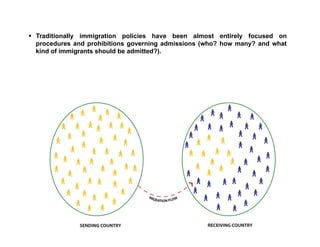
  Traditionally immigration policies have been almost entirely focused on
   procedures and prohibitions governing admissions (who? how many? and what
   kind of immigrants should be admitted?).
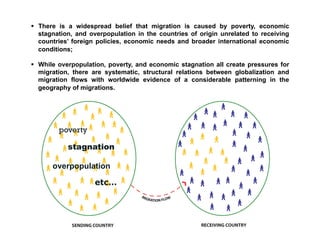
  There is a widespread belief that migration is caused by poverty, economic
   stagnation, and overpopulation in the countries of origin unrelated to receiving
   countries’ foreign policies, economic needs and broader international economic
   conditions;

  While overpopulation, poverty, and economic stagnation all create pressures for
   migration, there are systematic, structural relations between globalization and
   migration flows with worldwide evidence of a considerable patterning in the
   geography of migrations.


        poverty

           stagnation

      overpopulation

                    etc…
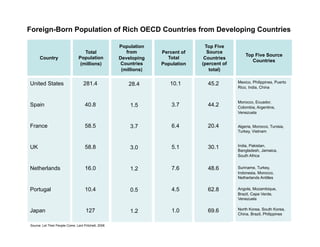
Foreign-Born Population of Rich OECD Countries from Developing Countries

                                                      Population                  Top Five
                                    Total                from       Percent of     Source
                                                                                                   Top Five Source
      Country                    Population           Developing      Total       Countries
                                                                                                      Countries
                                  (millions)           Countries    Population   (percent of
                                                       (millions)                   total)

United States                       281.4                              10.1        45.2        Mexico, Philippines, Puerto
                                                          28.4
                                                                                               Rico, India, China


                                                                                               Morocco, Ecuador,
Spain                                40.8                 1.5           3.7        44.2        Colombia, Argentina,
                                                                                               Venezuela


France                               58.5                 3.7           6.4        20.4        Algeria, Morocco, Tunisia,
                                                                                               Turkey, Vietnam


UK                                   58.8                               5.1        30.1        India, Pakistan,
                                                          3.0                                  Bangladesh, Jamaica,
                                                                                               South Africa


Netherlands                          16.0                 1.2           7.6        48.6        Suriname, Turkey,
                                                                                               Indonesia, Morocco,
                                                                                               Netherlands Antilles


Portugal                             10.4                 0.5           4.5        62.8        Angola, Mozambique,
                                                                                               Brazil, Cape Verde,
                                                                                               Venezuela


Japan                                 127                               1.0        69.6        North Korea, South Korea,
                                                          1.2                                  China, Brazil, Philippines

Source: Let Their People Come, Lant Pritchett, 2006
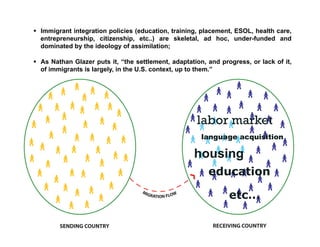
  Immigrant integration policies (education, training, placement, ESOL, health care,
   entrepreneurship, citizenship, etc..) are skeletal, ad hoc, under-funded and
   dominated by the ideology of assimilation;

  As Nathan Glazer puts it, “the settlement, adaptation, and progress, or lack of it,
   of immigrants is largely, in the U.S. context, up to them.”


                                                      labor market
                                                       language acquisition

                                                     housing
                                                          education

                                                                 etc…
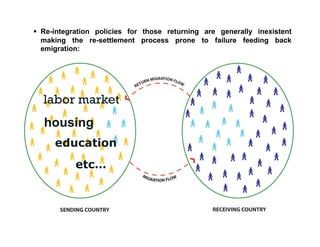
  Re-integration policies for those returning are generally inexistent
   making the re-settlement process prone to failure feeding back
   emigration:


  labor market
  housing
     education
           etc…
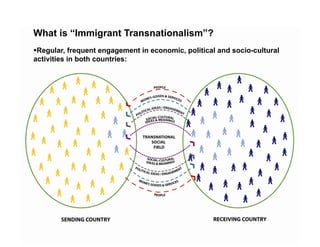
What is “Immigrant Transnationalism”?
 Regular, frequent engagement in economic, political and socio-cultural
activities in both countries:
Drivers of Transnationalism:

  Developments in the means of transportation and
   communications have changed the relations between people
   and places (costs);

  International migrations have become crucial to the
   demographic future of many developed countries;

  Global political transformations and new international legal
   regimes weakened the state as the only legitimate source of
   rights;

  Fostered by global consumption, global production, and
   immigration, cultural hybridization are substituting folkloric
   romanticism and political nationalism enshrined as essences
   of national cultures;
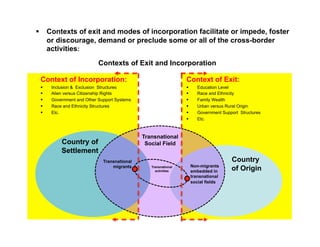
  Contexts of exit and modes of incorporation facilitate or impede, foster
   or discourage, demand or preclude some or all of the cross-border
   activities:
                           Contexts of Exit and Incorporation

 Context of Incorporation:                                      Context of Exit:
     Inclusion & Exclusion Structures                                 Education Level
     Alien versus Citizenship Rights                                  Race and Ethnicity
     Government and Other Support Systems                             Family Wealth
     Race and Ethnicity Structures                                    Urban versus Rural Origin
     Etc.                                                             Government Support Structures
                                                                       Etc.


                                             Transnational
          Country of                          Social Field
          Settlement
                             Transnational                                             Country
                                                                     Non-migrants
                                 migrants       Transnational
                                                  activities         embedded in       of Origin
                                                                     transnational
                                                                     social fields
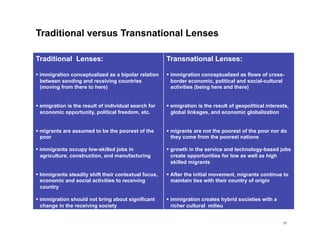
Traditional versus Transnational Lenses

Traditional Lenses:                                    Transnational Lenses:

  immigration conceptualized as a bipolar relation      immigration conceptualized as flows of cross-
   between sending and receiving countries                border economic, political and social-cultural
   (moving from there to here)                            activities (being here and there)


  emigration is the result of individual search for     emigration is the result of geopolitical interests,
   economic opportunity, political freedom, etc.          global linkages, and economic globalization


  migrants are assumed to be the poorest of the         migrants are not the poorest of the poor nor do
   poor                                                   they come from the poorest nations

  immigrants occupy low-skilled jobs in                 growth in the service and technology-based jobs
   agriculture, construction, and manufacturing           create opportunities for low as well as high
                                                          skilled migrants

  Immigrants steadily shift their contextual focus,     After the initial movement, migrants continue to
   economic and social activities to receiving            maintain ties with their country of origin
   country

  immigration should not bring about significant        immigration creates hybrid societies with a
   change in the receiving society                        richer cultural milieu


                                                                                                          11
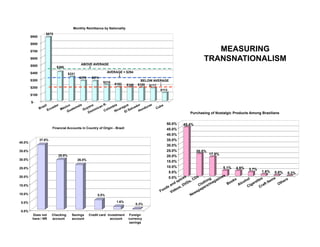
Monthly Remittance by Nationality
                  $875
        $900

        $800

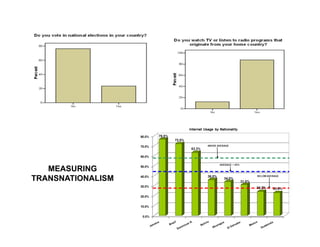
        $700                                                                                                         MEASURING
        $600                                                                                                      TRANSNATIONALISM
        $500                              ABOVE AVERAGE
                         $398
        $400                                                 AVERAGE = $294
                                  $331
                                          $278    $274
        $300                                                                        BELOW AVERAGE
                                                         $218
                                                                 $192     $188    $185 $177
        $200
                                                                                             $113
        $100

        $-


                                                                                                          Purchasing of Nostalgic Products Among Brazilians


                                                                                               50.0%   45.4%
                       Financial Accounts in Country of Origin - Brazil                        45.0%
                                                                                               40.0%
               37.6%                                                                           35.0%
40.0%
                                                                                               30.0%
35.0%                                                                                          25.0%           20.5%
                          28.9%                                                                                        17.8%
                                                                                               20.0%
30.0%                                    26.0%
                                                                                               15.0%
25.0%                                                                                          10.0%                           5.1%   4.9%   3.7%
                                                                                                5.0%                                                1.6%   0.8%   0.2%
20.0%                                                                                           0.0%

15.0%

10.0%                                                 5.5%

5.0%                                                              1.6%
                                                                                 0.3%

0.0%
         Does not      Checking     Savings      Credit card Investment    Foreign
         have / NR     account      account                    account     currency
                                                                           savings
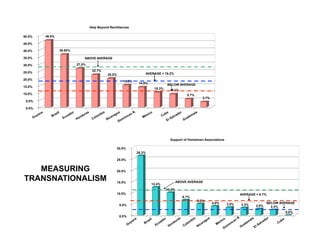
Help Beyond Remittances

50.0%   46.6%

45.0%

40.0%           36.80%

35.0%                         ABOVE AVERAGE

30.0%                    27.0%
                                  22.7%
25.0%                                                             AVERAGE = 19.2%
                                           20.0%
20.0%
                                                      15.3%
                                                               14.0%            BELOW AVERAGE
15.0%
                                                                        10.3%
                                                                                  9.1%
10.0%                                                                                        5.7%
                                                                                                       3.7%
 5.0%

 0.0%


                                                                                  Support of Hometown Associations

                                                   30.0%
                                                              26.3%

                                                   25.0%


   MEASURING                                       20.0%

TRANSNATIONALISM                                   15.0%                                ABOVE AVERAGE
                                                                       12.4%
                                                                                10.0%
                                                   10.0%                                                                    AVERAGE = 6.7%
                                                                                           6.7%
                                                                                                    5.0%
                                                                                                              4.0%   3.5%                    BELOW AVERAGE
                                                    5.0%                                                                    3.3%    2.8%       2.4%
                                                                                                                                                     0.0%
                                                    0.0%


                         13
MEASURING
TRANSNATIONALISM
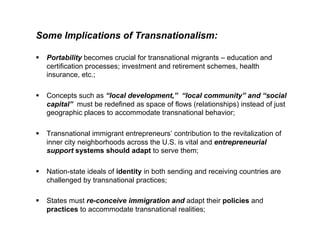
Some Implications of Transnationalism:

  Portability becomes crucial for transnational migrants – education and
   certification processes; investment and retirement schemes, health
   insurance, etc.;

  Concepts such as “local development,” “local community” and “social
   capital” must be redefined as space of flows (relationships) instead of just
   geographic places to accommodate transnational behavior;

  Transnational immigrant entrepreneurs’ contribution to the revitalization of
   inner city neighborhoods across the U.S. is vital and entrepreneurial
   support systems should adapt to serve them;

  Nation-state ideals of identity in both sending and receiving countries are
   challenged by transnational practices;

  States must re-conceive immigration and adapt their policies and
   practices to accommodate transnational realities;
1st Generation Innovation Portfolio:

Digaai.com

Transnational Index

Diaspora Capital Services

English for Speakers of Other Languages (ESOL)

Transnational Fellows

The Role of Transnational Immigrant Organizations
What if… (scenario 2)
Digaai.com
    2 million Brazilians around the world:

       communicate home with each other (social
        networking)

       register their experience/build unique archives
        through video, photos, etc.

       search newspapers, magazines, websites, etc.

       contribute to Brazilian diaspora wiki

       store personal information using private web space

                                                             17
18
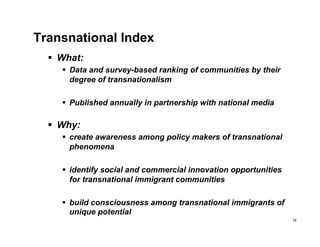
Transnational Index
    What:
       Data and survey-based ranking of communities by their
        degree of transnationalism

       Published annually in partnership with national media

    Why:
       create awareness among policy makers of transnational
        phenomena

       identify social and commercial innovation opportunities
        for transnational immigrant communities

       build consciousness among transnational immigrants of
        unique potential
                                                                  19
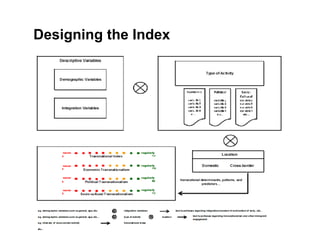
Designing the Index

Transnational Communities

  • 1.
    Transnational Communities- - notyour grandfather’s diaspora Framingham State University Alvaro Lima, September 2012
  • 2.
    AGENDA: I. What is “ImmigrantTransnationalism”? II. Traditional versus Transnational Lenses III. Measuring Transnationalism IV. Some Implications of Transnationalism V.  Innovation Portfolio
  • 3.
      Traditionally immigrationpolicies have been almost entirely focused on procedures and prohibitions governing admissions (who? how many? and what kind of immigrants should be admitted?).
  • 4.
      There isa widespread belief that migration is caused by poverty, economic stagnation, and overpopulation in the countries of origin unrelated to receiving countries’ foreign policies, economic needs and broader international economic conditions;   While overpopulation, poverty, and economic stagnation all create pressures for migration, there are systematic, structural relations between globalization and migration flows with worldwide evidence of a considerable patterning in the geography of migrations. poverty stagnation overpopulation etc…
  • 5.
    Foreign-Born Population ofRich OECD Countries from Developing Countries Population Top Five Total from Percent of Source Top Five Source Country Population Developing Total Countries Countries (millions) Countries Population (percent of (millions) total) United States 281.4 10.1 45.2 Mexico, Philippines, Puerto 28.4 Rico, India, China Morocco, Ecuador, Spain 40.8 1.5 3.7 44.2 Colombia, Argentina, Venezuela France 58.5 3.7 6.4 20.4 Algeria, Morocco, Tunisia, Turkey, Vietnam UK 58.8 5.1 30.1 India, Pakistan, 3.0 Bangladesh, Jamaica, South Africa Netherlands 16.0 1.2 7.6 48.6 Suriname, Turkey, Indonesia, Morocco, Netherlands Antilles Portugal 10.4 0.5 4.5 62.8 Angola, Mozambique, Brazil, Cape Verde, Venezuela Japan 127 1.0 69.6 North Korea, South Korea, 1.2 China, Brazil, Philippines Source: Let Their People Come, Lant Pritchett, 2006
  • 6.
      Immigrant integrationpolicies (education, training, placement, ESOL, health care, entrepreneurship, citizenship, etc..) are skeletal, ad hoc, under-funded and dominated by the ideology of assimilation;   As Nathan Glazer puts it, “the settlement, adaptation, and progress, or lack of it, of immigrants is largely, in the U.S. context, up to them.” labor market language acquisition housing education etc…
  • 7.
      Re-integration policiesfor those returning are generally inexistent making the re-settlement process prone to failure feeding back emigration: labor market housing education etc…
  • 8.
    What is “ImmigrantTransnationalism”?  Regular, frequent engagement in economic, political and socio-cultural activities in both countries:
  • 9.
    Drivers of Transnationalism:  Developments in the means of transportation and communications have changed the relations between people and places (costs);   International migrations have become crucial to the demographic future of many developed countries;   Global political transformations and new international legal regimes weakened the state as the only legitimate source of rights;   Fostered by global consumption, global production, and immigration, cultural hybridization are substituting folkloric romanticism and political nationalism enshrined as essences of national cultures;
  • 10.
      Contexts ofexit and modes of incorporation facilitate or impede, foster or discourage, demand or preclude some or all of the cross-border activities: Contexts of Exit and Incorporation Context of Incorporation: Context of Exit:   Inclusion & Exclusion Structures   Education Level   Alien versus Citizenship Rights   Race and Ethnicity   Government and Other Support Systems   Family Wealth   Race and Ethnicity Structures   Urban versus Rural Origin   Etc.   Government Support Structures   Etc. Transnational Country of Social Field Settlement Transnational Country Non-migrants migrants Transnational activities embedded in of Origin transnational social fields
  • 11.
    Traditional versus TransnationalLenses Traditional Lenses: Transnational Lenses:   immigration conceptualized as a bipolar relation   immigration conceptualized as flows of cross- between sending and receiving countries border economic, political and social-cultural (moving from there to here) activities (being here and there)   emigration is the result of individual search for   emigration is the result of geopolitical interests, economic opportunity, political freedom, etc. global linkages, and economic globalization   migrants are assumed to be the poorest of the   migrants are not the poorest of the poor nor do poor they come from the poorest nations   immigrants occupy low-skilled jobs in   growth in the service and technology-based jobs agriculture, construction, and manufacturing create opportunities for low as well as high skilled migrants   Immigrants steadily shift their contextual focus,   After the initial movement, migrants continue to economic and social activities to receiving maintain ties with their country of origin country   immigration should not bring about significant   immigration creates hybrid societies with a change in the receiving society richer cultural milieu 11
  • 12.
    Monthly Remittance byNationality $875 $900 $800 $700 MEASURING $600 TRANSNATIONALISM $500 ABOVE AVERAGE $398 $400 AVERAGE = $294 $331 $278 $274 $300 BELOW AVERAGE $218 $192 $188 $185 $177 $200 $113 $100 $- Purchasing of Nostalgic Products Among Brazilians 50.0% 45.4% Financial Accounts in Country of Origin - Brazil 45.0% 40.0% 37.6% 35.0% 40.0% 30.0% 35.0% 25.0% 20.5% 28.9% 17.8% 20.0% 30.0% 26.0% 15.0% 25.0% 10.0% 5.1% 4.9% 3.7% 5.0% 1.6% 0.8% 0.2% 20.0% 0.0% 15.0% 10.0% 5.5% 5.0% 1.6% 0.3% 0.0% Does not Checking Savings Credit card Investment Foreign have / NR account account account currency savings
  • 13.
    Help Beyond Remittances 50.0% 46.6% 45.0% 40.0% 36.80% 35.0% ABOVE AVERAGE 30.0% 27.0% 22.7% 25.0% AVERAGE = 19.2% 20.0% 20.0% 15.3% 14.0% BELOW AVERAGE 15.0% 10.3% 9.1% 10.0% 5.7% 3.7% 5.0% 0.0% Support of Hometown Associations 30.0% 26.3% 25.0% MEASURING 20.0% TRANSNATIONALISM 15.0% ABOVE AVERAGE 12.4% 10.0% 10.0% AVERAGE = 6.7% 6.7% 5.0% 4.0% 3.5% BELOW AVERAGE 5.0% 3.3% 2.8% 2.4% 0.0% 0.0% 13
  • 14.
  • 15.
    Some Implications ofTransnationalism:   Portability becomes crucial for transnational migrants – education and certification processes; investment and retirement schemes, health insurance, etc.;   Concepts such as “local development,” “local community” and “social capital” must be redefined as space of flows (relationships) instead of just geographic places to accommodate transnational behavior;   Transnational immigrant entrepreneurs’ contribution to the revitalization of inner city neighborhoods across the U.S. is vital and entrepreneurial support systems should adapt to serve them;   Nation-state ideals of identity in both sending and receiving countries are challenged by transnational practices;   States must re-conceive immigration and adapt their policies and practices to accommodate transnational realities;
  • 16.
    1st Generation InnovationPortfolio: Digaai.com Transnational Index Diaspora Capital Services English for Speakers of Other Languages (ESOL) Transnational Fellows The Role of Transnational Immigrant Organizations
  • 17.
    What if… (scenario2) Digaai.com   2 million Brazilians around the world:   communicate home with each other (social networking)   register their experience/build unique archives through video, photos, etc.   search newspapers, magazines, websites, etc.   contribute to Brazilian diaspora wiki   store personal information using private web space 17
  • 18.
  • 19.
    Transnational Index   What:   Data and survey-based ranking of communities by their degree of transnationalism   Published annually in partnership with national media   Why:   create awareness among policy makers of transnational phenomena   identify social and commercial innovation opportunities for transnational immigrant communities   build consciousness among transnational immigrants of unique potential 19
  • 20.