Prepared by
Dr.J.Jospin Jeya
Introduction to Spread Spectrum
• The basic idea in spread-spectrum systems is, as the
name implies, to spread the signal over a much wider
portion of the spectrum than usual.
• A simple audio signal that would normally occupy only
a few kilohertz of spectrum can be expanded to cover
many megahertz.
• Thus only a small portion of the signal is likely to be
masked by any interfering signal.
• Of course, the average power density, expressed in
watts per hertz of bandwidth, is also reduced, and this
often results in a signal-to-noise ratio of less than one
(that is, the signal power in any given frequency range is
less than the noise power in the same bandwidth).
Spread Spectrum
Spread Spectrum
• Analog or digital data
• Analog signal
• Spread data over wide bandwidth
• Makes jamming and interception harder
• Frequency hoping
– Signal broadcast over seemingly random series of frequencies
• Direct Sequence
– Each bit is represented by multiple bits in transmitted signal
– Chipping code
Spread Spectrum Concept
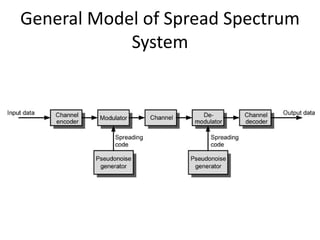
• Input fed into channel encoder
– Produces narrow bandwidth analog signal around central frequency
• Signal modulated using sequence of digits
– Spreading code/sequence
– Typically generated by pseudonoise/pseudorandom number generator
• Increases bandwidth significantly
– Spreads spectrum
• Receiver uses same sequence to demodulate signal
• Demodulated signal fed into channel decoder
General Model of Spread Spectrum
System

ss1.pdf

  • 1.
  • 2.
    • The basicidea in spread-spectrum systems is, as the name implies, to spread the signal over a much wider portion of the spectrum than usual. • A simple audio signal that would normally occupy only a few kilohertz of spectrum can be expanded to cover many megahertz. • Thus only a small portion of the signal is likely to be masked by any interfering signal. • Of course, the average power density, expressed in watts per hertz of bandwidth, is also reduced, and this often results in a signal-to-noise ratio of less than one (that is, the signal power in any given frequency range is less than the noise power in the same bandwidth). Spread Spectrum
  • 3.
    Spread Spectrum • Analogor digital data • Analog signal • Spread data over wide bandwidth • Makes jamming and interception harder • Frequency hoping – Signal broadcast over seemingly random series of frequencies • Direct Sequence – Each bit is represented by multiple bits in transmitted signal – Chipping code
  • 4.
    Spread Spectrum Concept •Input fed into channel encoder – Produces narrow bandwidth analog signal around central frequency • Signal modulated using sequence of digits – Spreading code/sequence – Typically generated by pseudonoise/pseudorandom number generator • Increases bandwidth significantly – Spreads spectrum • Receiver uses same sequence to demodulate signal • Demodulated signal fed into channel decoder
  • 5.
    General Model ofSpread Spectrum System