‫آینده‬ ‫همایش‬‫موبایل‬ ‫و‬ ‫وب‬
‫ماه‬ ‫اسفند‬1396
‫تهران‬
Big Data Frameworks &
Deep Learning In Action
By :
Mehdi Habibzadeh (@Habibzadeh1980)
March 2018
Outlines (March 2018) :
Big Data and Deep Learning
Review and Trends
Map-Reduce on Large Clusters
Hadoop Framework Programming
Spark and Flink Frameworks
Big Data and Cloud Computing
Big Data and NoSQL (Frameworks and Security Issue)
Deep Learning Approach
Big Data in the Real World
2017 Big Data and NoSQL Frameworks 2
Big Data and Challenges
Sources and Massive Information
Characteristics and Trends
The year 2015 was a big jump in the world of big data.
» Adoption of technologies, associated with unstructured data
» Ref : http://www.tableau.com/top-8-trends-big-data-2017?
2017 Big Data and NoSQL Frameworks 3
Big Data and Challenges (Cont.)
2017 Big Data and NoSQL Frameworks 4
Big Data and Challenges (Cont.)
2017 Big Data and NoSQL Frameworks 5
Big Data and Challenges (Cont.)
2017 Big Data and NoSQL Frameworks 6
Big Data and Challenges (Cont.)
2017 Big Data and NoSQL Frameworks 7
Big Data Retrieval Algorithms
Streaming
Online Data Management
Adapt to arbitrary and unstructured Input Data
Real-Time Analytical Processing (RTAP)
2017 Big Data and NoSQL Frameworks 8
Map-Reduce on Large Clusters
Motivation and Demand:
Tend to be very short, code-wise
Represent a data flow
2017 Big Data and NoSQL Frameworks 9
Map-Reduce (Cont.)
2017 Big Data and NoSQL Frameworks 10
Map-Reduce (Cont.)
2017 Big Data and NoSQL Frameworks 11
Map-Reduce (Cont.)
Each step has one Map phase and one Reduce phase
Convert any into MapReduce pattern
Great solution for one-pass computations
Not very efficient for Multi-pass computations and algorithms
2017 Big Data and NoSQL Frameworks 12
Hadoop Framework
Features :
Open Source Framework for Processing Large Data
Work on Cheap and Unreliable Clusters
Known in Companies who deal with Big Data Applications
Compatible with Java, Python and Scala
2017 Big Data and NoSQL Frameworks 13
Hadoop Framework (Cont.)
MapReduce Framework
Assign work for different nodes
Hadoop Distributed File System (HDFS)
Primary storage system used by Hadoop applications.
Copies each piece of data and distributes to individual nodes
Name Node (Meta Data) and Data Nodes (File Blocks)
Redundant information ( Three times by default)
Machines in a given cluster are cheap and unreliable
Decreases the risk of catastrophic failure
» Even in the event that numerous nodes fail
Links together the file systems on different nodes to make an
integrated big file system (Parallel Processing(
2017 Big Data and NoSQL Frameworks 14
Hadoop Framework (Cont.)
Hadoop V.2 : Hadoop NextGen MapReduce (YARN)
2017 Big Data and NoSQL Frameworks 15
Hadoop Framework (Cont.)
Hadoop Programming
Java
Full control of MapReduce , Cascading (Open Java Library)
Python , Scala, Ruby
Data Retrieval / Query Language
Hive
SQL- Like Language
Pig
Data Flow Language (Simple and Out of Small Steps)
Scalding
Library built on top of Scala (Elegant Model)
2017 Big Data and NoSQL Frameworks 16
Big Data Programming
R – Java- Python and Scala ( Commonly Used)
Three References : ( Recommended to Read)
https://www.linkit.nl/knowledge-
base/177/4_most_used_languages_in_big_data_projects_Java
https://www.linkit.nl/knowledge-
base/226/4_most_used_languages_in_big_data_projects_R
https://www.linkit.nl/eng/knowledge-
base/196/4_most_used_languages_in_big_data_projects_Python
2017 Big Data and NoSQL Frameworks 17
Hadoop Framework (Cont.)
2017 Big Data and NoSQL Frameworks 18
Apache Spark Framework
Spark Features (More than Distributed Processing)
Ease of use, and sophisticated analytics
In-memory data storage and near real-time processing
Holds intermediate results in memory
Store as much as data in memory and then goes to disk
Spark vs Hadoop
On top of existing HDFS
Data sets that are diverse in nature (Text, Videos, …)
Variety in source of data (Batch v. real-time streaming data).
100 times faster in memory, 10 times faster when running on disk.
2017 Big Data and NoSQL Frameworks 19
Apache Spark Framework (Cont.)
2017 Big Data and NoSQL Frameworks 20
Apache Spark Framework (Cont.)
Compatible with Java, Scala and Python
Perform Data Analytics and Machine Learning
SQL Queries, Streaming Data
Machine Learning and Graph Data Processing
Spark MLlib, Spark’s Machine Learning library
Spark and data stored in a Cassandra database
(Case Study)
2017 Big Data and NoSQL Frameworks 21
Apache Flink
Apache Flink is an open source platform
Distributed stream and batch data processing.”
https://flink.apache.org/
The definition in wikipedia:
https://en.wikipedia.org/wiki/Apache_Flink
2017 Big Data and NoSQL Frameworks 22
Apache Flink (Cont.)
written in Java and Scala, consists of:
Big data processing engine:
Distributed and scalable streaming dataflow engine
Several APIs in Java/Scala/Python:
DataSet API – Batch processing
DataStream API – Real-Time streaming analytics
Domain-Specific Libraries:
FlinkML: Machine Learning Library for Flink
Gelly: Graph Library for Flink
Table: Relational Queries
FlinkCEP: Complex Event Processing for Flink
2017 Big Data and NoSQL Frameworks 23
Apache Flink (Cont.)
2017 Big Data and NoSQL Frameworks 24
Apache Flink (Cont.)
2017 Big Data and NoSQL Frameworks 25
Real-Time stream processing
Machine Learning at scale
Graph Analysis
Batch Processing
Big Data and Cloud
Cloud Computing Platform & Services
(Cloudera, Hortonworks, MapR, Azure)
2017 Big Data and NoSQL Frameworks 26
Big Data and NoSQL
Key-values Stores
Unique key and a pointer to a particular item of data.
Tokyo Cabinet/Tyrant, Redis,
Voldemort, Oracle BDB (Oracle Big Data Solutions) ,
Amazon SimpleDB, Riak
Column Family Stores
Very large amounts of data distributed over Many machines.
Cassandra, HBase
2017 Big Data and NoSQL Frameworks 27
Big Data and NoSQL (Cont.)
Document Databases
Similar to key-value stores,
Semi-structured documents are stored in formats like JSON
Allowing nested values associated with each key.
Document databases support querying more efficiently.
CouchDB, MongoDb
2017 Big Data and NoSQL Frameworks 28
Big Data and NoSQL (Cont.)
Graph Database
Flexible graph model
Instead of tables of rows and columns and the rigid structure
of SQL
Scale across multiple machines (Scale Out)
Neo4J, InfoGrid, Infinite Graph, Titan
2017 Big Data and NoSQL Frameworks 29
MongoDB Intro
MongoDB Introduction
MongoDB is a document oriented
Leading NoSQL database
MongoDB Characteristics
High availability and performance
Horizontally scalable
Flexible(dynamic) schemas
Deep query ability
2017 Big Data and NoSQL Frameworks 30
MongoDB Intro (Cont.)
No complex joins
Tuning
Uses internal memory for storing the data
Data is stored in JSON form
Replication and Sharding
Indexing any attribute
Can be used with JavaScript
2017 Big Data and NoSQL Frameworks 31
MongoDB Intro (Cont.)
Where to Use?
Big Data
Content Management
Mobile and Social Infrastructure
User Data Management
Data Hub
Document and Collection concept:
A document is a set of key-value pairs
Collection is a group of MongoDB documents
Documents within a collection with different fields
2017 Big Data and NoSQL Frameworks 32
MongoDB Intro (Cont.)
2017 Big Data and NoSQL Frameworks 33
SQL MongoDB
database database
table collection
row document
column field
Table Join Embedded Documents
SQL MongoDB
database database
table collection
row document
column field
Table Join Embedded Documents
MongoDB Intro (Cont.)
JSON Format
2017 Big Data and NoSQL Frameworks 34
RDBMS NoSQL
Databae Database
Table, View Collection
Row Document (JSON, BSON)
Column Field
Index Index
Join Embedded Document
Foreign Key Reference
Partition Shard
> db.user.findOne({age:39})
{
"_id" : ObjectId("5114e0bd42…"),
"first" : "John",
"last" : "Doe",
"age" : 39,
"interests" : [
"Reading",
"Mountain Biking ]
"favorites": {
"color": "Blue",
"sport": "Soccer"}
}
MongoDB- Datatypes
String
This is the most commonly used datatype to store the data
String in MongoDB must be UTF-8 valid
Integer
This type is used to store a numerical value
Integer can be 32 bit or 64 bit depending upon your server
Boolean
This type is used to store a Boolean (true/ false) value
Double
This type is used to store floating point values
Min/ Max keys
This type is used to compare a value
Against the lowest and highest BSON elements
2017 Big Data and NoSQL Frameworks 35
MongoDB– Datatypes (Cont.)
Arrays
This type is used to store arrays or list or multiple values into one key
Timestamp
Timestamp
Can be handy for recording when a document has been modified or added
Object
This datatype is used for embedded documents
Null
This type is used to store a Null value
Symbol
This datatype is used identically to a string
It's generally reserved for languages that use a specific symbol type
Object ID
This datatype is used to store the document’s ID
2017 Big Data and NoSQL Frameworks 36
MongoDB– Datatypes (Cont.)
Date
Used to store the current date or time in UNIX time format
You can specify your own date time
By creating object of Date and passing day, month, year into it
Binary data
This datatype is used to store binary data
Code
This datatype is used to store JavaScript code into the document
Regular expression
This datatype is used to store regular expression
2017 Big Data and NoSQL Frameworks 37
MongoDB– ObjectID
Object Id
_id is 12 bytes hexadecimal number
Unique for every document in a collection
12 bytes are divided as follows
4 bytes timestamp (sec)
3 bytes machine id
2 bytes process id
3 bytes incrementer
Incrementing value starting with a random number
If we don't specify the _id parameter
MongoDB assigns a unique ObjectId for this document
2017 Big Data and NoSQL Frameworks 38
MongoDB– Aggregation
Aggregation Pipeline
Map-Reduce
Single Purpose Aggregation Operations
2017 Big Data and NoSQL Frameworks 39
MongoDB- Replication
How Replication Works in MongoDB
MongoDB achieves replication by the use of replica set
Replica set is a group of two or more nodes
Generally minimum 3 nodes are required
In a replica set
One node is primary node
Receives all write operations
Remaining nodes are secondary
Apply operations from the primary
They have the same data set
2017 Big Data and NoSQL Frameworks 40
MongoDB- Replication (Cont.)
All data replicates from primary to secondary node
At the time of automatic failover or maintenance
Election establishes for primary and a new primary node is elected
After the recovery of failed node
It again join the replica set and works as a secondary node
2017 Big Data and NoSQL Frameworks 41
MongoDB- Sharding
Distributing data and its replications across multiple
machines
Why Sharding:
 Handling large data sets
 High throughput operations
 Horizontal scaling
2017 Big Data and NoSQL Frameworks 42
MongoDB -GridFS
MongoDB specification for storing and retrieving large files
Such as images, audio files, video files, etc.
It is kind of a file system to store files
Store files even greater than its document size
Limit of 16MB
2017 Big Data and NoSQL Frameworks 43
MongoDB Atlas provides all of the features of MongoDB without
the operational heavy lifting required for any application.
Features:
 MongoDB Atlas is a
 For:
• Running
• Monitoring
• Maintaining
MongoDB deployments
 Allows to quickly provision it in the cloud and only pay an hourly fee
 Including the provisioning of dedicated servers for the MongoDB instances.
2017 MongoDB 44
MongoDB Atlas
Mongo atlas cont.
Atlas provides:
 Security features to protect access to your data
 Built in replication for always-on availability
 Tolerating complete data center failure
 Backups and point in time recovery to protect against data corruption
 Fine-gained monitoring to let you know when to scale
 A scale choice of providers, regions and billing options
2017 MongoDB 45
MongoDB Atlas (cont.)
2017 mongoDB 46
MongoDB Atlas (cont.)
Link:
https://www.mongodb.com/cloud/atlas/faq
2017 mongoDB 47
MongoDB Atlas (cont.)
 Easily analyze
Features:
• MongoDB Compass provides users with a of their MongoDB
• It minimizes performance impact on the database and can produce results quickly
• Write queries to reverse engineer the document structure, field name and data
types
2017 MongoDB 48
MongoDB Compass
Features:
• Insert/edit/delete/clone documents through the GUI
• Build and visually interact with geo/coordinate data to construct queries in a few
clicks of a button
• Visual explain plans to understand the performance of a query
• SSH tunnels to allow users to connect securely from outside of a datacenter
firewall
• Can be use for free during development
2017 Big Data and NoSQL Frameworks 49
MongoDB Compass (cont.)
• Can be use for free during development
• It is available for production use with MongoDB professional or
MongoDB Enterprise Advanced subscriptions
2017 Big Data and NoSQL Frameworks 50
MongoDB Compass(cont.)
MongoDB Compass
Benefit:
• Faster time to market
• Easier project handoffs
• Increased productivity
• MongoDB Compass for windows:
https://www.mongodb.com/download-center?jmp=nav#compass
2017 MongoDB 51
MongoDB Compass(cont.)
2017 Big Data and NoSQL Frameworks 52
MongoDB Compass(cont.)
mongoDB driver
Compatible with:
• C
• C++
• C#
• Java
• Node.js
• Ruby
• Scala
• Php
• Python
• Perl
2017 MongoDB 53
MongoDB driver
Full-Text Search
 MongoDB began with supporting using
 It has now become an
 It refers to the against the search criteria specified
by the user
 It is not proposed as a complete replacement of search engine databases
 It used for applications that are built with MongoDB
2017 MongoDB 54
Full-text search
Features:
• Indexes support the efficient resolution of queries
• Without indexes, MongoDB must scan every document of a
collection
• Indexes are special data structure
• Stores a small portion of data set in any easy to traverse form
• Stores the value of specific field
2017 Big Data and NoSQL Frameworks 55
Index Type
Index Types
MongoDB provides different types of indexes for different
purposes and different types of content.
Types:
• Single Field Indexes: only includes data from a single field of the documents
• Compound Indexes: includes more than one field of the documents
• Multikey Indexes: is an index on an array field, adding an index key for each value
2017 Big Data and NoSQL Frameworks 56
Index Type
Index Types (cont.)
• Geospatial Indexes and Queries:
• Support location-based searches on data
• Data store as either GeoJSON objects
• Text Indexes: Text indexes support search of string content in documents
• Hashed Index:
• Maintain entries with hashes of the values of the indexed field
• Are primarily used with sharded clusters to support hashed shard keys
• Index Properties: The properties you can specify when building indexes
• TTL Indexes: used for TTL collections, which expire data after a period of time
2017 Big Data and NoSQL Frameworks 57
Index Type (cont.)
Index Types (cont.)
• Unique Indexes: Causes to reject all documents that contain a duplicate value for the indexed field
• Sparse Indexes: Does not index documents that do not have the indexed field
• Index Creation: The options available when creating indexes
• Index Intersection: The use of index intersection to fulfill a query
• Multikey Index Bounds: The computation of bounds on a multikey index scan
2017 Big Data and NoSQL Frameworks 58
Index Type (cont.)
Companies that use MongoDB
• Atlassian
• Udacity
• BrightRoll
• RetailMeNot
• Hootsuite
• SurveyMonkey
• Shyp
• Criteo
• MuleSoft
• HackerRank
2017 Big Data and NoSQL Frameworks 59
• Twitter
• Castlight Health
• Thumbtack
• IBM
• Citrix
• T-Mobile
• Zendesk
• Sony
• HTC
• Techstars
Companies that use MongoDB
Few clients
 For search suggestions
 Metadata storage
 Cloud management
 Merchandizing categorization
To archive billions of records
For back-end storage SourceForge front pages,
 Project pages,
 And download pages for all projects
To store venues and user ‘check-inns’ into venues,
Sharding the data over more than 25 machines on Amazon EC2
2017 Big Data and NoSQL Frameworks 60
Few clients
Advantage and disadvantage
2017 Big Data and NoSQL Frameworks 61
Pros and Cons - MongoDB
Pros and Cons – MongoDB (Cont.)
The philosophy behind MongoDB :
 To retain as many functionalities as possible
 While permitting horizontal scale
 Make developer's life easier.
2017 Big Data and NoSQL Frameworks 62
Pros and Cons – MongoDB (Cont.)
Advantages :
AGPL license
 Every changes to the Mongodb is open sourced to the
community.
 Designed for big data storage and query
 Mongodb is a best fit in presence of a lot of data
2017 mongoDB 63
Pros and Cons – MongoDB (Cont.)
Aims at Social Network applications, Text Mining, Search
Engine, Ad hoc Documents.
Easy to scale out
 Its a breeze in NoSQL database like MongoDB.
Scale horizontally is hard task in relational database
 Add as the data and traffic grows
 Keep the responsive speed and availability.
2017 Big Data and NoSQL Frameworks 64
Pros and Cons – MongoDB (Cont.)
Document as basic storage unit
 A document is just a simple JSON like object,
 BSON in Mongodb,
 Indexing which implemented by B-Tree,
Index ; on unique field or multiple fields,
2017 Big Data and NoSQL Frameworks 65
Pros and Cons – MongoDB (Cont.)
No schema in MongoDB
 Document can have any number of fields
 Fit into the OOP model
Most programming language support today.
 Do a quick developing or prototyping ( Python, Ruby and PHP)
2017 Big Data and NoSQL Frameworks 66
Pros and Cons – MongoDB (Cont.)
Optional strict consistent level
 Insertions operation is fire-and-forget
 MongoDB supports auto sharding and auto failover,
Simple Querying
 Everything from that one document,
 No reference to other documents
 No concept of tables, rows, SQL, schemas
2017 Big Data and NoSQL Frameworks 67
Pros and Cons – MongoDB (Cont.)
Disadvantages :
Not support transaction
 They either all done, or nothing is done.
 RDBMS do this by transaction.
 The relation between MongoDB documents is weak.
 Stream of dependent events ( Bank Account !!)
 Many related bank data needs to be modified at the same time.
2017 mongoDB 68
Pros and Cons – MongoDB (Cont.)
Not support join operation
RAM limitation
 Size of your database is Limited by virtual memory provided by
Operating System and hardware.
 For production environment, a 64bits system is a must.
2017 Big Data and NoSQL Frameworks 69
 RDBMS replacement for .
 Content Management.
 Analytics & High-Speed Logging.
 Caching and
2017 Big Data and NoSQL Frameworks 70
What is MongoDB great for?
 Highly Application
 Problems requiring
2017 Big Data and NoSQL Frameworks 71
Not great for?
MongoDB- Security
Non-relational data stores
Think NoSQL databases, which by themselves usually lack
security
(which is instead provided, sort of, via middleware).
2017 mongoDB 72
NoSQL(Mongo DB) Security
 History
 Authentication
 Authorization
 Auditing
 Transport Encryption – SSL
 MongoDB Secure Development Lifecycle
 Documentation and Notifications
 Future Work
MongoDB- Security (Cont.)
History and Three A”s
• 2.4 offers a much better story around security
• Investing very heavily right now.
 Authentication
Who are you?
 Authorization
What can you do?
 Auditing
What have you done?
MongoDB- Security (Cont.)
Authentication
Authentication is about proving “who” you
are.
 Password Authentication:
 This is the only authentication mechanism
available in MongoDB version 2.2 and prior
 Still the only version available in the free
product
 In 2.4+ this mechanism is called MONGODB-
CR
Password Authentication
Use one-way function F
mongod
I am “username”, let me in
Prove it, here is a random # N
Here is F(N,
hash(<mypwd>))
Nobody else could know
that, welcome back!
Knows
only my
password
hash
Hash never
transmitted
over the
network!
MongoDB- Security (Cont.)
External Authentication
 Use common / standardized authentication
 SASL: Simple Authentication and Security Layer
 Framework for building authentication
 MongoDB uses the Cyrus sasl2 library
 Kerberos (available in the Enterprise Edition)
 GSSAPI
 Driver support in python, java, C#, Node.js, perl
MongoDB- Security (Cont.)
Granting privileges
# mongo mongodb.mycompany.com
> use appDB;
> db.system.users.find();
{
"_id": ObjectId("519e842804f5f7f7921dbf89"),
"user": "spencer"
"userSource": "$external",
"roles": ["readWrite", "dbAdmin”]
}
MongoDB- Security (Cont.)
Authorization
Once MongoDB has established “who” you are,
authorization is about determining “what” you are allowed
to do.
MongoDB- Security (Cont.)
Authorization Roles in 2.2 and Prior
 Database level read-only
 Database level read-write
 System-wide read-only
 System-wide read-write
Sample user document:
> db.system.users.find().pretty()
{
"_id": ObjectId("519e842804f5f7f7921dbf89"),
"user": "spencer"
"pwd": "22c83553ed7ce252d8b0c9f716cae4de",
"readOnly": false
}
MongoDB- Security (Cont.)
Authorization Roles in 2.4
 read
 readWrite
 dbAdmin
 userAdmin
 readAnyDatabase
 readWriteAnyDatabase
 dbAdminAnyDatabase
 userAdminAnyDatabase
 clusterAdmin
The roles that are bold can only be granted in the admin database.
userAdmin
 The userAdmin role on database “foo” lets you grant any db-level role to any user
from the “foo” database (including yourself).
 The userAdminAnyDatabase role lets you grant any role in the system to any user
(including yourself).
 This means they can be used to grant yourself roles you didn’t previously have!
 This makes userAdmin effectively a super-user
 Access to these roles should be carefully controlled!
Auditing
Monitor user activity:
 userID added to standard output in 2.4
 No separate audit log
 Much more coming in 2.6
Transport Encryption - SSL
http://docs.mongodb.org/manual/administration/ssl/
Application
SSL encryption
for client
connection
SSL encryption
for inter-server
traffic
Primary Secondary
Data Files Data Files
Securing your MongoDB Implementation, Spencer Brody
Future
• User-defined roles
• Collection level access control
• Field level access control
• Auditing
• X.509 authentication, for both user and intra-cluster
authentication.
• External configuration of user’s roles (LDAP)
MongoDB - Resources
2017 mongoDB 86
www.docs.mongodb.com
www.tutorialspoint.com/mongodb
www.codeschool.com/courses/the-magical-marvels-of-
mongodb
The time goes on…
Started in 2004
Released in 2010
In 2014, 70$ million in Series C funding
And now here is the 5.5.0 release with great components!
2017 Big Data and NoSQL Frameworks 87
What it gives to us?(cont.)
2017 Big Data and NoSQL Frameworks 88
What it gives to us?(cont.)
2017 Big Data and NoSQL Frameworks 89
What it gives to us?
2017 Big Data and NoSQL Frameworks 90
Who else uses it?(cont.)
2017 Big Data and NoSQL Frameworks 91
Supporting e-commerce
search for 60+ countries
in 21+languages
Generate Actionable value
from game play data and
server events
Searching Across 800
million listings in sub
seconds
Powering the search for
Interplanetary discovery
Delivering a better help
experience for over a
billion users
Providing search on azure
and powering social
dynamics
Who else uses it?
2017 Big Data and NoSQL Frameworks 92
Supporting e-commerce
search for 60+ countries
in 21+languages
Unlocking yesterday’s
content for the future of
media search
Reducing system
downtime at the basis of
cisco’s cloud native
Enhancing user
experience by processing
over a billion of events
every day
Aggregating business
metrics to control critical
marketplace behaviors
And many
others…
A case of usage…(cont.)
2017 Big Data and NoSQL Frameworks 93
A case of usage…(cont.)
2017 Big Data and NoSQL Frameworks 94
A case of usage…(cont.)
2017 Big Data and NoSQL Frameworks 95
A case of usage…(cont.)
2017 Big Data and NoSQL Frameworks 96
A case of usage…(cont.)
2017 Big Data and NoSQL Frameworks 97
A case of usage…(cont.)
2017 Big Data and NoSQL Frameworks 98
A case of usage…
2017 Big Data and NoSQL Frameworks 99
2017 Big Data and NoSQL Frameworks 100
Capabilities
Managing events and logs
Collect data
Parse data
Enrich data
Store data (for search and visualize)
2017 Big Data and NoSQL Frameworks 101
Working structure
2017 Big Data and NoSQL Frameworks 102
Architectural view
2017 Big Data and NoSQL Frameworks 103
2017 Big Data and NoSQL Frameworks 104
Capabilities
Store schema less data (create a schema for your data)
Manipulate your data record by record (use multi-document
APIs to o bulk ops)
Perform Queries/Filters on your data for insights
Use APIs to monitor the deployment site
Built-in Full-Text-Search and analysis
Auto completion
Percolate API
Scalability
2017 Big Data and NoSQL Frameworks 105
Auto Completion
2017 Big Data and NoSQL Frameworks 106
Auto Completion
2017 Big Data and NoSQL Frameworks 107
Percolate API
Store the queries in Elastic search
Pass docs as queries
Observe matched queries
2017 Big Data and NoSQL Frameworks 108
Percolate API
As a simple use case:
Assume that you tell the customer that he will be notified when
plane ticket will be available and cheaper.
For this case you should store customer’s criteria about
desired flight.
When you store flight data, match it against saved percolators.
2017 Big Data and NoSQL Frameworks 109
Percolate API
2017 Big Data and NoSQL Frameworks 110
Percolate API
2017 Big Data and NoSQL Frameworks 111
Snapshot/Restore
2017 Big Data and NoSQL Frameworks 112
Distributed and scalable
2017 Big Data and NoSQL Frameworks 113
Distributed and scalable
2017 Big Data and NoSQL Frameworks 114
Distributed and scalable
2017 Big Data and NoSQL Frameworks 115
API tour
2017 Big Data and NoSQL Frameworks 116
Create
API tour
2017 Big Data and NoSQL Frameworks 117
Update
API tour
2017 Big Data and NoSQL Frameworks 118
Delete
API tour
2017 Big Data and NoSQL Frameworks 119
Get
API tour
2017 Big Data and NoSQL Frameworks 120
Search
API tour
2017 Big Data and NoSQL Frameworks 121
Search Query DSL
2017 Big Data and NoSQL Frameworks 122
Kibana view
2017 Big Data and NoSQL Frameworks 123
Kibana view
2017 Big Data and NoSQL Frameworks 124
Kibana view
2017 Big Data and NoSQL Frameworks 125
Programming language support!
Java
JavaScript
Perl
PHP
Python
Ruby
Scala
2017 Big Data and NoSQL Frameworks 126
.Net
Lua
Clojure
Erlang
Go
Groovy
Haskell
What is my problem?
Data provides value for businesses
I have so much data or I can make some!
So Let’s check what can we do with that data?
2017 Big Data and NoSQL Frameworks 127
Domain data vs Application data
2017 Big Data and NoSQL Frameworks 128
Internal
Orders
Products
…
External
Social media streams
Emails
…
Log files
Metrics
Monitoring KPIs
…
The solution is…
2017 Big Data and NoSQL Frameworks 129
ELK ecosystem
2017 Big Data and NoSQL Frameworks 130
No architectural limitation!
2017 Big Data and NoSQL Frameworks 131
No architectural limitation!
2017 Big Data and NoSQL Frameworks 132
No architectural limitation!
2017 Big Data and NoSQL Frameworks 133
Which technology to choose?
We selected just two out of the box! There are a lot more…
But which one is better?
MongoDB or Elastic search?
2017 Big Data and NoSQL Frameworks 134
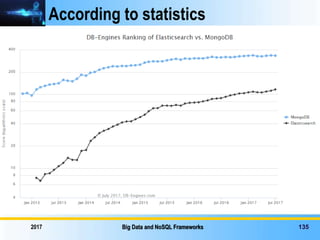
According to statistics
2017 Big Data and NoSQL Frameworks 135
According to statistics
2017 Big Data and NoSQL Frameworks 136
According to statistics
2017 Big Data and NoSQL Frameworks 137
For more detailed Comparison check this link:
https://db-engines.com/en/system/Elasticsearch%3BMongoDB
Why ELK?
Actually they are totally different solutions:
MongoDB is a general purpose database
Elastic search is a distributed text search engine
It’s so simple. Don’t use them in a situation which they aren’t
designed for !!
2017 Big Data and NoSQL Frameworks 138
Why ELK?
 Use mongoDB for your data store but Elastic
search for your high performance and
customizable full-text-search.
2017 Big Data and NoSQL Frameworks 139
 Although they have a portion of the other one’s
capabilities, but they are not the perfect choice
for that one!
Why ELK?
The main idea is that we can decide between a huge number
of technologies even when we know the below:
What is it designed for?
What is the main idea behind the technology?
What is my problem?
What are my limitations?
How can I design the architecture in a way that it solve the
solution?
…
2017 Big Data and NoSQL Frameworks 140
TITAN – Graph Info
Specific benefits of TITAN
Open-source and support for very large graphs.
Support for many concurrent transactions and operational graph
processing.
Support for global analytics and batch graph processing through
the Hadoop framework.
Support full text search for vertices and edges on large graphs.
Native support for popular property graph data mode
Exposed by Tinkerpop.
2017 Big Data and NoSQL Frameworks 141
TITAN – Graph Info (Cont.)
Specific benefits of TITAN (Cont.)
Native support for the graph traversal language, the Gremlin.
Easy integration with the Gremlin graph server.
Numerous graph-level configurations provide knobs for tuning
performance.
Provide an optimized disk representation to allow for efficient use
of storage and speed of access.
2017 Big Data and NoSQL Frameworks 142
TITAN – Graph Info (Cont.)
2017 Big Data and NoSQL Frameworks 143
TITAN – Graph Info (Cont.)
CAP Theorem : (3 supporting backbends)
C= Consistency, A= Availability, P= Partitionability
2017 Big Data and NoSQL Frameworks 144
TITAN – Graph Info (Cont.)
Benefits of TITAN with Cassandra:
Continuously available with no single point of failure.
No read/write bottlenecks to the graph as there isn’t master/slave
architecture
Caching layer ensures that accessed data is available in memory.
Increase the size of the cache by adding more machines to the
cluster.
2017 Big Data and NoSQL Frameworks 145
TITAN – Graph Info (Cont.)
Benefits of TITAN with HBase:
Tight integration with the Hadoop ecosystem.
Native support for strong consistency.
Convenient base classes for Hadoop Map-Reduce job with HBase
2017 Big Data and NoSQL Frameworks 146
What is Machine Learning?
Machine learning, a branch of artificial intelligence, is about the
construction and study of systems that can learn from data.
Ability to learn without being explicitly programmed
Machine learning, is about predicting the future based on the past.
2017 Applied Machine Learning and Image Processing
Application of Machine Learning
2017 Applied Machine Learning and Image Processing
Machine Learning Requirements
 Operating System :
Windows 10 ,Linux Ubuntu
 Programming Language :
Back-End : Python and its libraries ( Machine Intelligence )
Front-End : Java, PHP
 Database and Storage
 SQL : SQL server, Oracle, PostgreSQL
NoSQL: MongoDB, Apache HBase, Titan and Neo4j
149
Requirements (Cont.)
 Distributed Computing and Big Data
Hadoop Ecosystem
 Search Engine Platforms
Elasticsearch: RESTful, Distributed Search & Analytics
Apache Solr : Full-text search, highlighting, Real-time Indexing
 Real-time Computing
Apache Spark; The largest open source project in Data Processing.
Apache Kafka; Open-source Stream Processing
Apache Storm; Distributed Stream Processing
150
Requirements (Cont.)
 GPU Accelerated Computing with NVIDIA Developer
151
Image Processing
Algorithms to perform image processing on Digital images
Image Capturing and Color map Selection
Pre-Processing and Image Enhancement
Foreground and Background Separation
Object Detection and Classification
Conventional methods
Object segmentation
Feature Extraction
Feature Selection
Deep Learning Approach
Deep Hierarchical Feature Learning
Classifiers
Classic and Deep learning
2017 Applied Machine Learning and Image Processing
Video Processing
Video processing on digital Hierarchy of Digital Frames,
Video Capturing and Color map Selection
Adaptive Image Super-resolution
Adaptive Digital Watermarking for Copyright Protection
Beat Event Detection in Movies
Shot Detection in Movies
Key Frames Extraction from each Shot
classify shots in the video
Grouping consecutive shots
Digital Fingerprinting
Check Distribution of unauthorized copied content
Video Summarization
Semantic contents of the video like objects, events, and actions.
2017 Applied Machine Learning and Image Processing
Text Processing
Language Detection ( English , French , Persian ,….)
Text Normalization and Tokenization
Sentence and Word Tokenization
Removing Stopwords
Stemming and Lemmatization
Parts of Speech (POS) Tagging
Feature and Keyword Extraction
Bag of Words , TF-IDF Model
Word Vectorization Models
Text Summarization and Information Extraction
Topic Modeling
Text classification (Conventional and Deep learning)
Text similarity and Clustering
2017 Applied Machine Learning and Image Processing
Deep Neural Network
2017 Applied Machine Learning and Image Processing
Convolution Neural Network
Extract topological invariant properties (Spatially local connections
(receptive fields) ) from digital image
CNN is composed of four distinct parts :
Convolutional layers to extract hierarchical features
Pooling to extract main features
Fully connected layers to merge and combine all tensor features into 2D
vector
Classifiers
156
Deep Learning on Demand
Certain methods may to be used
• Supervised Pre-trained Networks
• Unsupervised Pre-trained Networks
• Convolutional Neural Networks (ConvNets)
• Recurrent Neural Networks (RNNs)
• Recursive Neural Networks
• Long Short-Term Memory Recurrent Neural Network
• Convolutional Spike-and-Slab RBMs
• Restricted Boltzmann machine
• Spiking Deep Networks (SpikeCNN)
• The Shape Boltzmann Machine
• Generative Adversarial Networks (GANs)
2017 Applied Machine Learning and Image Processing
Machine Learning In Medicine
Classification
Predict whether a person’s mole is cancerous or not
Clustering
Creating a model based on a year’s worth of patient data
Image Segmentation
Region of Interest i.e. locate tumor, lesion and other abnormalities
2017 Applied Machine Learning and Image Processing
Cancer Type Classification
2017 Applied Machine Learning and Image Processing
Cancer Detection
Proposed deep learning settings
Pre-Trained Models and Frameworks
Cancer detection via computer-aided diagnosis (CAD)
Four cancer types )5502 training samples(
900 cancer evaluation data-set,
On average 99.88 %, 99.66 % and 97.44
AUC scores above 0.9963, 0.9992 and 0.9829
Small average false negative (FN) 0, 1, 3
False positive (FP) with 0, 1, 13 values in cancer detection.
160
WBC Type Classification
2017 Applied Machine Learning and Image Processing
Treatment of Infertility
2017 Applied Machine Learning and Image Processing
Treatment of Infertility (Cont.)
2017 Applied Machine Learning and Image Processing
NLP in Medical Papers: Text Summarization
2017 Applied Machine Learning and Image Processing
Text Mining
English Dataset (Social topics, … )
• Economic News
• Positive polarity – Movie Review
• Negative polarity – Movie Review
• Fashion
• Finance
• Law
• Lifestyle
2017 Applied Machine Learning and Image Processing
Text Mining (Cont.)
2017 Applied Machine Learning and Image Processing
Topics ( One Versus One) Accuracy Rate
Economic vs Movie Comments (English) 0.99
Fashion vs Lifestyle (English) 0.97
Economics vs Lifestyle (Persian) 0.98
Not suitable text content vs Lifestyle (Persian) 0.99
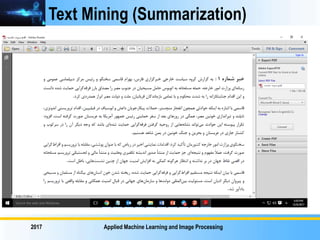
Text Mining (Summarization)
2017 Applied Machine Learning and Image Processing
Text Mining (Summarization)
2017 Applied Machine Learning and Image Processing
Steel Industries (Cont.)
Image Processing
2017 Applied Machine Learning and Image Processing
Steel Industries (Cont.)
Image Processing
2017 Applied Machine Learning and Image Processing
Steel Industries (Cont.)
Image Processing
2017 Applied Machine Learning and Image Processing
Steel Industries (Cont.)
Image Processing
2017 Applied Machine Learning and Image Processing
Steel Industries (Cont.)
Image Processing
2017 Applied Machine Learning and Image Processing
Object Detection (Vehicle Detection)
Vehicle Classification
2017 Applied Machine Learning and Image Processing
Object Detection (Vehicle Detection)
Vehicle Classification (Cont.)
2017 Applied Machine Learning and Image Processing
Object Detection (Human Detection)
Person Detection
2017 Applied Machine Learning and Image Processing
Object Detection (Logo Detection)
Satanism Symbol
2017 Applied Machine Learning and Image Processing
Object Detection (Logo Detection)
Satanism Symbol
2017 Applied Machine Learning and Image Processing
Object Detection (Logo Detection)
Satanism Symbol
2017 Applied Machine Learning and Image Processing
Object Detection (Logo Detection)
Satanism Symbol
2017 Applied Machine Learning and Image Processing
Text on Image (EN- FA- AR) – (Cont.)
2017 Applied Machine Learning and Image Processing
Text on Image (EN- FA- AR)
2017 Applied Machine Learning and Image Processing
Text on Image (EN- FA- AR)
2017 Applied Machine Learning and Image Processing
Text on Image (EN- FA- AR)
2017 Applied Machine Learning and Image Processing
Big Data in the Real World
Social Network Analysis
Climate data, Large scale health care
Complex Image Processing
Personalization ( Facebook, Telegram, ….)
Advertising, Mobile Telecommunication Networks (i.e., 5G),
E-commerce and E- Banking Applications
2017 Big Data and NoSQL Frameworks 186
Big Data in the Real world (Cont.)
Banking Systems; Big Data and Deep Learning
Banknote Authentication and Forgery Detection
Financial Fraud Detection
Bank Embezzlement & Money Laundering
Boost e-commerce Sales
Losing From Disgruntled Customers
Loan Approval Prediction
2017 Big Data and NoSQL Frameworks 187
Big Data in the real world (Cont.)
Deep Learning Algorithm Transcribes House Numbers (Google)
2017 Big Data and NoSQL Frameworks 188
Big Data in the real world (Cont.)
Car Classification using Deep Learning Approach
2017 Big Data and NoSQL Frameworks 189
Contact Info
Mehdi Habibzadeh (PhD in Computer Science)
Telephone and Telegram :
+98 922 717 8939
Email
Nimahm@gmail.com
Hossein Shemshadi ( MSc in IT)
Telephone and Telegram :
+98 9307513096….
@HosseinShemshadi
Email
Hossein.Shemshadi@gmail.com
2017 Big Data and NoSQL Frameworks 190
Q/A ?
Thanks
Any Question?

2017 Big Data and NoSQL Frameworks 191

معرفی کاربردهای یادگیری عمیق و چالش های آن در کلان داده

  • 1.
    ‫آینده‬ ‫همایش‬‫موبایل‬ ‫و‬‫وب‬ ‫ماه‬ ‫اسفند‬1396 ‫تهران‬ Big Data Frameworks & Deep Learning In Action By : Mehdi Habibzadeh (@Habibzadeh1980) March 2018
  • 2.
    Outlines (March 2018): Big Data and Deep Learning Review and Trends Map-Reduce on Large Clusters Hadoop Framework Programming Spark and Flink Frameworks Big Data and Cloud Computing Big Data and NoSQL (Frameworks and Security Issue) Deep Learning Approach Big Data in the Real World 2017 Big Data and NoSQL Frameworks 2
  • 3.
    Big Data andChallenges Sources and Massive Information Characteristics and Trends The year 2015 was a big jump in the world of big data. » Adoption of technologies, associated with unstructured data » Ref : http://www.tableau.com/top-8-trends-big-data-2017? 2017 Big Data and NoSQL Frameworks 3
  • 4.
    Big Data andChallenges (Cont.) 2017 Big Data and NoSQL Frameworks 4
  • 5.
    Big Data andChallenges (Cont.) 2017 Big Data and NoSQL Frameworks 5
  • 6.
    Big Data andChallenges (Cont.) 2017 Big Data and NoSQL Frameworks 6
  • 7.
    Big Data andChallenges (Cont.) 2017 Big Data and NoSQL Frameworks 7
  • 8.
    Big Data RetrievalAlgorithms Streaming Online Data Management Adapt to arbitrary and unstructured Input Data Real-Time Analytical Processing (RTAP) 2017 Big Data and NoSQL Frameworks 8
  • 9.
    Map-Reduce on LargeClusters Motivation and Demand: Tend to be very short, code-wise Represent a data flow 2017 Big Data and NoSQL Frameworks 9
  • 10.
    Map-Reduce (Cont.) 2017 BigData and NoSQL Frameworks 10
  • 11.
    Map-Reduce (Cont.) 2017 BigData and NoSQL Frameworks 11
  • 12.
    Map-Reduce (Cont.) Each stephas one Map phase and one Reduce phase Convert any into MapReduce pattern Great solution for one-pass computations Not very efficient for Multi-pass computations and algorithms 2017 Big Data and NoSQL Frameworks 12
  • 13.
    Hadoop Framework Features : OpenSource Framework for Processing Large Data Work on Cheap and Unreliable Clusters Known in Companies who deal with Big Data Applications Compatible with Java, Python and Scala 2017 Big Data and NoSQL Frameworks 13
  • 14.
    Hadoop Framework (Cont.) MapReduceFramework Assign work for different nodes Hadoop Distributed File System (HDFS) Primary storage system used by Hadoop applications. Copies each piece of data and distributes to individual nodes Name Node (Meta Data) and Data Nodes (File Blocks) Redundant information ( Three times by default) Machines in a given cluster are cheap and unreliable Decreases the risk of catastrophic failure » Even in the event that numerous nodes fail Links together the file systems on different nodes to make an integrated big file system (Parallel Processing( 2017 Big Data and NoSQL Frameworks 14
  • 15.
    Hadoop Framework (Cont.) HadoopV.2 : Hadoop NextGen MapReduce (YARN) 2017 Big Data and NoSQL Frameworks 15
  • 16.
    Hadoop Framework (Cont.) HadoopProgramming Java Full control of MapReduce , Cascading (Open Java Library) Python , Scala, Ruby Data Retrieval / Query Language Hive SQL- Like Language Pig Data Flow Language (Simple and Out of Small Steps) Scalding Library built on top of Scala (Elegant Model) 2017 Big Data and NoSQL Frameworks 16
  • 17.
    Big Data Programming R– Java- Python and Scala ( Commonly Used) Three References : ( Recommended to Read) https://www.linkit.nl/knowledge- base/177/4_most_used_languages_in_big_data_projects_Java https://www.linkit.nl/knowledge- base/226/4_most_used_languages_in_big_data_projects_R https://www.linkit.nl/eng/knowledge- base/196/4_most_used_languages_in_big_data_projects_Python 2017 Big Data and NoSQL Frameworks 17
  • 18.
    Hadoop Framework (Cont.) 2017Big Data and NoSQL Frameworks 18
  • 19.
    Apache Spark Framework SparkFeatures (More than Distributed Processing) Ease of use, and sophisticated analytics In-memory data storage and near real-time processing Holds intermediate results in memory Store as much as data in memory and then goes to disk Spark vs Hadoop On top of existing HDFS Data sets that are diverse in nature (Text, Videos, …) Variety in source of data (Batch v. real-time streaming data). 100 times faster in memory, 10 times faster when running on disk. 2017 Big Data and NoSQL Frameworks 19
  • 20.
    Apache Spark Framework(Cont.) 2017 Big Data and NoSQL Frameworks 20
  • 21.
    Apache Spark Framework(Cont.) Compatible with Java, Scala and Python Perform Data Analytics and Machine Learning SQL Queries, Streaming Data Machine Learning and Graph Data Processing Spark MLlib, Spark’s Machine Learning library Spark and data stored in a Cassandra database (Case Study) 2017 Big Data and NoSQL Frameworks 21
  • 22.
    Apache Flink Apache Flinkis an open source platform Distributed stream and batch data processing.” https://flink.apache.org/ The definition in wikipedia: https://en.wikipedia.org/wiki/Apache_Flink 2017 Big Data and NoSQL Frameworks 22
  • 23.
    Apache Flink (Cont.) writtenin Java and Scala, consists of: Big data processing engine: Distributed and scalable streaming dataflow engine Several APIs in Java/Scala/Python: DataSet API – Batch processing DataStream API – Real-Time streaming analytics Domain-Specific Libraries: FlinkML: Machine Learning Library for Flink Gelly: Graph Library for Flink Table: Relational Queries FlinkCEP: Complex Event Processing for Flink 2017 Big Data and NoSQL Frameworks 23
  • 24.
    Apache Flink (Cont.) 2017Big Data and NoSQL Frameworks 24
  • 25.
    Apache Flink (Cont.) 2017Big Data and NoSQL Frameworks 25 Real-Time stream processing Machine Learning at scale Graph Analysis Batch Processing
  • 26.
    Big Data andCloud Cloud Computing Platform & Services (Cloudera, Hortonworks, MapR, Azure) 2017 Big Data and NoSQL Frameworks 26
  • 27.
    Big Data andNoSQL Key-values Stores Unique key and a pointer to a particular item of data. Tokyo Cabinet/Tyrant, Redis, Voldemort, Oracle BDB (Oracle Big Data Solutions) , Amazon SimpleDB, Riak Column Family Stores Very large amounts of data distributed over Many machines. Cassandra, HBase 2017 Big Data and NoSQL Frameworks 27
  • 28.
    Big Data andNoSQL (Cont.) Document Databases Similar to key-value stores, Semi-structured documents are stored in formats like JSON Allowing nested values associated with each key. Document databases support querying more efficiently. CouchDB, MongoDb 2017 Big Data and NoSQL Frameworks 28
  • 29.
    Big Data andNoSQL (Cont.) Graph Database Flexible graph model Instead of tables of rows and columns and the rigid structure of SQL Scale across multiple machines (Scale Out) Neo4J, InfoGrid, Infinite Graph, Titan 2017 Big Data and NoSQL Frameworks 29
  • 30.
    MongoDB Intro MongoDB Introduction MongoDBis a document oriented Leading NoSQL database MongoDB Characteristics High availability and performance Horizontally scalable Flexible(dynamic) schemas Deep query ability 2017 Big Data and NoSQL Frameworks 30
  • 31.
    MongoDB Intro (Cont.) Nocomplex joins Tuning Uses internal memory for storing the data Data is stored in JSON form Replication and Sharding Indexing any attribute Can be used with JavaScript 2017 Big Data and NoSQL Frameworks 31
  • 32.
    MongoDB Intro (Cont.) Whereto Use? Big Data Content Management Mobile and Social Infrastructure User Data Management Data Hub Document and Collection concept: A document is a set of key-value pairs Collection is a group of MongoDB documents Documents within a collection with different fields 2017 Big Data and NoSQL Frameworks 32
  • 33.
    MongoDB Intro (Cont.) 2017Big Data and NoSQL Frameworks 33 SQL MongoDB database database table collection row document column field Table Join Embedded Documents SQL MongoDB database database table collection row document column field Table Join Embedded Documents
  • 34.
    MongoDB Intro (Cont.) JSONFormat 2017 Big Data and NoSQL Frameworks 34 RDBMS NoSQL Databae Database Table, View Collection Row Document (JSON, BSON) Column Field Index Index Join Embedded Document Foreign Key Reference Partition Shard > db.user.findOne({age:39}) { "_id" : ObjectId("5114e0bd42…"), "first" : "John", "last" : "Doe", "age" : 39, "interests" : [ "Reading", "Mountain Biking ] "favorites": { "color": "Blue", "sport": "Soccer"} }
  • 35.
    MongoDB- Datatypes String This isthe most commonly used datatype to store the data String in MongoDB must be UTF-8 valid Integer This type is used to store a numerical value Integer can be 32 bit or 64 bit depending upon your server Boolean This type is used to store a Boolean (true/ false) value Double This type is used to store floating point values Min/ Max keys This type is used to compare a value Against the lowest and highest BSON elements 2017 Big Data and NoSQL Frameworks 35
  • 36.
    MongoDB– Datatypes (Cont.) Arrays Thistype is used to store arrays or list or multiple values into one key Timestamp Timestamp Can be handy for recording when a document has been modified or added Object This datatype is used for embedded documents Null This type is used to store a Null value Symbol This datatype is used identically to a string It's generally reserved for languages that use a specific symbol type Object ID This datatype is used to store the document’s ID 2017 Big Data and NoSQL Frameworks 36
  • 37.
    MongoDB– Datatypes (Cont.) Date Usedto store the current date or time in UNIX time format You can specify your own date time By creating object of Date and passing day, month, year into it Binary data This datatype is used to store binary data Code This datatype is used to store JavaScript code into the document Regular expression This datatype is used to store regular expression 2017 Big Data and NoSQL Frameworks 37
  • 38.
    MongoDB– ObjectID Object Id _idis 12 bytes hexadecimal number Unique for every document in a collection 12 bytes are divided as follows 4 bytes timestamp (sec) 3 bytes machine id 2 bytes process id 3 bytes incrementer Incrementing value starting with a random number If we don't specify the _id parameter MongoDB assigns a unique ObjectId for this document 2017 Big Data and NoSQL Frameworks 38
  • 39.
    MongoDB– Aggregation Aggregation Pipeline Map-Reduce SinglePurpose Aggregation Operations 2017 Big Data and NoSQL Frameworks 39
  • 40.
    MongoDB- Replication How ReplicationWorks in MongoDB MongoDB achieves replication by the use of replica set Replica set is a group of two or more nodes Generally minimum 3 nodes are required In a replica set One node is primary node Receives all write operations Remaining nodes are secondary Apply operations from the primary They have the same data set 2017 Big Data and NoSQL Frameworks 40
  • 41.
    MongoDB- Replication (Cont.) Alldata replicates from primary to secondary node At the time of automatic failover or maintenance Election establishes for primary and a new primary node is elected After the recovery of failed node It again join the replica set and works as a secondary node 2017 Big Data and NoSQL Frameworks 41
  • 42.
    MongoDB- Sharding Distributing dataand its replications across multiple machines Why Sharding:  Handling large data sets  High throughput operations  Horizontal scaling 2017 Big Data and NoSQL Frameworks 42
  • 43.
    MongoDB -GridFS MongoDB specificationfor storing and retrieving large files Such as images, audio files, video files, etc. It is kind of a file system to store files Store files even greater than its document size Limit of 16MB 2017 Big Data and NoSQL Frameworks 43
  • 44.
    MongoDB Atlas providesall of the features of MongoDB without the operational heavy lifting required for any application. Features:  MongoDB Atlas is a  For: • Running • Monitoring • Maintaining MongoDB deployments  Allows to quickly provision it in the cloud and only pay an hourly fee  Including the provisioning of dedicated servers for the MongoDB instances. 2017 MongoDB 44 MongoDB Atlas
  • 45.
    Mongo atlas cont. Atlasprovides:  Security features to protect access to your data  Built in replication for always-on availability  Tolerating complete data center failure  Backups and point in time recovery to protect against data corruption  Fine-gained monitoring to let you know when to scale  A scale choice of providers, regions and billing options 2017 MongoDB 45 MongoDB Atlas (cont.)
  • 46.
  • 47.
  • 48.
     Easily analyze Features: •MongoDB Compass provides users with a of their MongoDB • It minimizes performance impact on the database and can produce results quickly • Write queries to reverse engineer the document structure, field name and data types 2017 MongoDB 48 MongoDB Compass
  • 49.
    Features: • Insert/edit/delete/clone documentsthrough the GUI • Build and visually interact with geo/coordinate data to construct queries in a few clicks of a button • Visual explain plans to understand the performance of a query • SSH tunnels to allow users to connect securely from outside of a datacenter firewall • Can be use for free during development 2017 Big Data and NoSQL Frameworks 49 MongoDB Compass (cont.)
  • 50.
    • Can beuse for free during development • It is available for production use with MongoDB professional or MongoDB Enterprise Advanced subscriptions 2017 Big Data and NoSQL Frameworks 50 MongoDB Compass(cont.)
  • 51.
    MongoDB Compass Benefit: • Fastertime to market • Easier project handoffs • Increased productivity • MongoDB Compass for windows: https://www.mongodb.com/download-center?jmp=nav#compass 2017 MongoDB 51 MongoDB Compass(cont.)
  • 52.
    2017 Big Dataand NoSQL Frameworks 52 MongoDB Compass(cont.)
  • 53.
    mongoDB driver Compatible with: •C • C++ • C# • Java • Node.js • Ruby • Scala • Php • Python • Perl 2017 MongoDB 53 MongoDB driver
  • 54.
    Full-Text Search  MongoDBbegan with supporting using  It has now become an  It refers to the against the search criteria specified by the user  It is not proposed as a complete replacement of search engine databases  It used for applications that are built with MongoDB 2017 MongoDB 54 Full-text search
  • 55.
    Features: • Indexes supportthe efficient resolution of queries • Without indexes, MongoDB must scan every document of a collection • Indexes are special data structure • Stores a small portion of data set in any easy to traverse form • Stores the value of specific field 2017 Big Data and NoSQL Frameworks 55 Index Type
  • 56.
    Index Types MongoDB providesdifferent types of indexes for different purposes and different types of content. Types: • Single Field Indexes: only includes data from a single field of the documents • Compound Indexes: includes more than one field of the documents • Multikey Indexes: is an index on an array field, adding an index key for each value 2017 Big Data and NoSQL Frameworks 56 Index Type
  • 57.
    Index Types (cont.) •Geospatial Indexes and Queries: • Support location-based searches on data • Data store as either GeoJSON objects • Text Indexes: Text indexes support search of string content in documents • Hashed Index: • Maintain entries with hashes of the values of the indexed field • Are primarily used with sharded clusters to support hashed shard keys • Index Properties: The properties you can specify when building indexes • TTL Indexes: used for TTL collections, which expire data after a period of time 2017 Big Data and NoSQL Frameworks 57 Index Type (cont.)
  • 58.
    Index Types (cont.) •Unique Indexes: Causes to reject all documents that contain a duplicate value for the indexed field • Sparse Indexes: Does not index documents that do not have the indexed field • Index Creation: The options available when creating indexes • Index Intersection: The use of index intersection to fulfill a query • Multikey Index Bounds: The computation of bounds on a multikey index scan 2017 Big Data and NoSQL Frameworks 58 Index Type (cont.)
  • 59.
    Companies that useMongoDB • Atlassian • Udacity • BrightRoll • RetailMeNot • Hootsuite • SurveyMonkey • Shyp • Criteo • MuleSoft • HackerRank 2017 Big Data and NoSQL Frameworks 59 • Twitter • Castlight Health • Thumbtack • IBM • Citrix • T-Mobile • Zendesk • Sony • HTC • Techstars Companies that use MongoDB
  • 60.
    Few clients  Forsearch suggestions  Metadata storage  Cloud management  Merchandizing categorization To archive billions of records For back-end storage SourceForge front pages,  Project pages,  And download pages for all projects To store venues and user ‘check-inns’ into venues, Sharding the data over more than 25 machines on Amazon EC2 2017 Big Data and NoSQL Frameworks 60 Few clients
  • 61.
    Advantage and disadvantage 2017Big Data and NoSQL Frameworks 61 Pros and Cons - MongoDB
  • 62.
    Pros and Cons– MongoDB (Cont.) The philosophy behind MongoDB :  To retain as many functionalities as possible  While permitting horizontal scale  Make developer's life easier. 2017 Big Data and NoSQL Frameworks 62
  • 63.
    Pros and Cons– MongoDB (Cont.) Advantages : AGPL license  Every changes to the Mongodb is open sourced to the community.  Designed for big data storage and query  Mongodb is a best fit in presence of a lot of data 2017 mongoDB 63
  • 64.
    Pros and Cons– MongoDB (Cont.) Aims at Social Network applications, Text Mining, Search Engine, Ad hoc Documents. Easy to scale out  Its a breeze in NoSQL database like MongoDB. Scale horizontally is hard task in relational database  Add as the data and traffic grows  Keep the responsive speed and availability. 2017 Big Data and NoSQL Frameworks 64
  • 65.
    Pros and Cons– MongoDB (Cont.) Document as basic storage unit  A document is just a simple JSON like object,  BSON in Mongodb,  Indexing which implemented by B-Tree, Index ; on unique field or multiple fields, 2017 Big Data and NoSQL Frameworks 65
  • 66.
    Pros and Cons– MongoDB (Cont.) No schema in MongoDB  Document can have any number of fields  Fit into the OOP model Most programming language support today.  Do a quick developing or prototyping ( Python, Ruby and PHP) 2017 Big Data and NoSQL Frameworks 66
  • 67.
    Pros and Cons– MongoDB (Cont.) Optional strict consistent level  Insertions operation is fire-and-forget  MongoDB supports auto sharding and auto failover, Simple Querying  Everything from that one document,  No reference to other documents  No concept of tables, rows, SQL, schemas 2017 Big Data and NoSQL Frameworks 67
  • 68.
    Pros and Cons– MongoDB (Cont.) Disadvantages : Not support transaction  They either all done, or nothing is done.  RDBMS do this by transaction.  The relation between MongoDB documents is weak.  Stream of dependent events ( Bank Account !!)  Many related bank data needs to be modified at the same time. 2017 mongoDB 68
  • 69.
    Pros and Cons– MongoDB (Cont.) Not support join operation RAM limitation  Size of your database is Limited by virtual memory provided by Operating System and hardware.  For production environment, a 64bits system is a must. 2017 Big Data and NoSQL Frameworks 69
  • 70.
     RDBMS replacementfor .  Content Management.  Analytics & High-Speed Logging.  Caching and 2017 Big Data and NoSQL Frameworks 70 What is MongoDB great for?
  • 71.
     Highly Application Problems requiring 2017 Big Data and NoSQL Frameworks 71 Not great for?
  • 72.
    MongoDB- Security Non-relational datastores Think NoSQL databases, which by themselves usually lack security (which is instead provided, sort of, via middleware). 2017 mongoDB 72
  • 73.
    NoSQL(Mongo DB) Security History  Authentication  Authorization  Auditing  Transport Encryption – SSL  MongoDB Secure Development Lifecycle  Documentation and Notifications  Future Work MongoDB- Security (Cont.)
  • 74.
    History and ThreeA”s • 2.4 offers a much better story around security • Investing very heavily right now.  Authentication Who are you?  Authorization What can you do?  Auditing What have you done? MongoDB- Security (Cont.)
  • 75.
    Authentication Authentication is aboutproving “who” you are.  Password Authentication:  This is the only authentication mechanism available in MongoDB version 2.2 and prior  Still the only version available in the free product  In 2.4+ this mechanism is called MONGODB- CR
  • 76.
    Password Authentication Use one-wayfunction F mongod I am “username”, let me in Prove it, here is a random # N Here is F(N, hash(<mypwd>)) Nobody else could know that, welcome back! Knows only my password hash Hash never transmitted over the network! MongoDB- Security (Cont.)
  • 77.
    External Authentication  Usecommon / standardized authentication  SASL: Simple Authentication and Security Layer  Framework for building authentication  MongoDB uses the Cyrus sasl2 library  Kerberos (available in the Enterprise Edition)  GSSAPI  Driver support in python, java, C#, Node.js, perl MongoDB- Security (Cont.)
  • 78.
    Granting privileges # mongomongodb.mycompany.com > use appDB; > db.system.users.find(); { "_id": ObjectId("519e842804f5f7f7921dbf89"), "user": "spencer" "userSource": "$external", "roles": ["readWrite", "dbAdmin”] } MongoDB- Security (Cont.)
  • 79.
    Authorization Once MongoDB hasestablished “who” you are, authorization is about determining “what” you are allowed to do. MongoDB- Security (Cont.)
  • 80.
    Authorization Roles in2.2 and Prior  Database level read-only  Database level read-write  System-wide read-only  System-wide read-write Sample user document: > db.system.users.find().pretty() { "_id": ObjectId("519e842804f5f7f7921dbf89"), "user": "spencer" "pwd": "22c83553ed7ce252d8b0c9f716cae4de", "readOnly": false } MongoDB- Security (Cont.)
  • 81.
    Authorization Roles in2.4  read  readWrite  dbAdmin  userAdmin  readAnyDatabase  readWriteAnyDatabase  dbAdminAnyDatabase  userAdminAnyDatabase  clusterAdmin The roles that are bold can only be granted in the admin database.
  • 82.
    userAdmin  The userAdminrole on database “foo” lets you grant any db-level role to any user from the “foo” database (including yourself).  The userAdminAnyDatabase role lets you grant any role in the system to any user (including yourself).  This means they can be used to grant yourself roles you didn’t previously have!  This makes userAdmin effectively a super-user  Access to these roles should be carefully controlled!
  • 83.
    Auditing Monitor user activity: userID added to standard output in 2.4  No separate audit log  Much more coming in 2.6
  • 84.
    Transport Encryption -SSL http://docs.mongodb.org/manual/administration/ssl/ Application SSL encryption for client connection SSL encryption for inter-server traffic Primary Secondary Data Files Data Files Securing your MongoDB Implementation, Spencer Brody
  • 85.
    Future • User-defined roles •Collection level access control • Field level access control • Auditing • X.509 authentication, for both user and intra-cluster authentication. • External configuration of user’s roles (LDAP)
  • 86.
    MongoDB - Resources 2017mongoDB 86 www.docs.mongodb.com www.tutorialspoint.com/mongodb www.codeschool.com/courses/the-magical-marvels-of- mongodb
  • 87.
    The time goeson… Started in 2004 Released in 2010 In 2014, 70$ million in Series C funding And now here is the 5.5.0 release with great components! 2017 Big Data and NoSQL Frameworks 87
  • 88.
    What it givesto us?(cont.) 2017 Big Data and NoSQL Frameworks 88
  • 89.
    What it givesto us?(cont.) 2017 Big Data and NoSQL Frameworks 89
  • 90.
    What it givesto us? 2017 Big Data and NoSQL Frameworks 90
  • 91.
    Who else usesit?(cont.) 2017 Big Data and NoSQL Frameworks 91 Supporting e-commerce search for 60+ countries in 21+languages Generate Actionable value from game play data and server events Searching Across 800 million listings in sub seconds Powering the search for Interplanetary discovery Delivering a better help experience for over a billion users Providing search on azure and powering social dynamics
  • 92.
    Who else usesit? 2017 Big Data and NoSQL Frameworks 92 Supporting e-commerce search for 60+ countries in 21+languages Unlocking yesterday’s content for the future of media search Reducing system downtime at the basis of cisco’s cloud native Enhancing user experience by processing over a billion of events every day Aggregating business metrics to control critical marketplace behaviors And many others…
  • 93.
    A case ofusage…(cont.) 2017 Big Data and NoSQL Frameworks 93
  • 94.
    A case ofusage…(cont.) 2017 Big Data and NoSQL Frameworks 94
  • 95.
    A case ofusage…(cont.) 2017 Big Data and NoSQL Frameworks 95
  • 96.
    A case ofusage…(cont.) 2017 Big Data and NoSQL Frameworks 96
  • 97.
    A case ofusage…(cont.) 2017 Big Data and NoSQL Frameworks 97
  • 98.
    A case ofusage…(cont.) 2017 Big Data and NoSQL Frameworks 98
  • 99.
    A case ofusage… 2017 Big Data and NoSQL Frameworks 99
  • 100.
    2017 Big Dataand NoSQL Frameworks 100
  • 101.
    Capabilities Managing events andlogs Collect data Parse data Enrich data Store data (for search and visualize) 2017 Big Data and NoSQL Frameworks 101
  • 102.
    Working structure 2017 BigData and NoSQL Frameworks 102
  • 103.
    Architectural view 2017 BigData and NoSQL Frameworks 103
  • 104.
    2017 Big Dataand NoSQL Frameworks 104
  • 105.
    Capabilities Store schema lessdata (create a schema for your data) Manipulate your data record by record (use multi-document APIs to o bulk ops) Perform Queries/Filters on your data for insights Use APIs to monitor the deployment site Built-in Full-Text-Search and analysis Auto completion Percolate API Scalability 2017 Big Data and NoSQL Frameworks 105
  • 106.
    Auto Completion 2017 BigData and NoSQL Frameworks 106
  • 107.
    Auto Completion 2017 BigData and NoSQL Frameworks 107
  • 108.
    Percolate API Store thequeries in Elastic search Pass docs as queries Observe matched queries 2017 Big Data and NoSQL Frameworks 108
  • 109.
    Percolate API As asimple use case: Assume that you tell the customer that he will be notified when plane ticket will be available and cheaper. For this case you should store customer’s criteria about desired flight. When you store flight data, match it against saved percolators. 2017 Big Data and NoSQL Frameworks 109
  • 110.
    Percolate API 2017 BigData and NoSQL Frameworks 110
  • 111.
    Percolate API 2017 BigData and NoSQL Frameworks 111
  • 112.
    Snapshot/Restore 2017 Big Dataand NoSQL Frameworks 112
  • 113.
    Distributed and scalable 2017Big Data and NoSQL Frameworks 113
  • 114.
    Distributed and scalable 2017Big Data and NoSQL Frameworks 114
  • 115.
    Distributed and scalable 2017Big Data and NoSQL Frameworks 115
  • 116.
    API tour 2017 BigData and NoSQL Frameworks 116 Create
  • 117.
    API tour 2017 BigData and NoSQL Frameworks 117 Update
  • 118.
    API tour 2017 BigData and NoSQL Frameworks 118 Delete
  • 119.
    API tour 2017 BigData and NoSQL Frameworks 119 Get
  • 120.
    API tour 2017 BigData and NoSQL Frameworks 120 Search
  • 121.
    API tour 2017 BigData and NoSQL Frameworks 121 Search Query DSL
  • 122.
    2017 Big Dataand NoSQL Frameworks 122
  • 123.
    Kibana view 2017 BigData and NoSQL Frameworks 123
  • 124.
    Kibana view 2017 BigData and NoSQL Frameworks 124
  • 125.
    Kibana view 2017 BigData and NoSQL Frameworks 125
  • 126.
    Programming language support! Java JavaScript Perl PHP Python Ruby Scala 2017Big Data and NoSQL Frameworks 126 .Net Lua Clojure Erlang Go Groovy Haskell
  • 127.
    What is myproblem? Data provides value for businesses I have so much data or I can make some! So Let’s check what can we do with that data? 2017 Big Data and NoSQL Frameworks 127
  • 128.
    Domain data vsApplication data 2017 Big Data and NoSQL Frameworks 128 Internal Orders Products … External Social media streams Emails … Log files Metrics Monitoring KPIs …
  • 129.
    The solution is… 2017Big Data and NoSQL Frameworks 129
  • 130.
    ELK ecosystem 2017 BigData and NoSQL Frameworks 130
  • 131.
    No architectural limitation! 2017Big Data and NoSQL Frameworks 131
  • 132.
    No architectural limitation! 2017Big Data and NoSQL Frameworks 132
  • 133.
    No architectural limitation! 2017Big Data and NoSQL Frameworks 133
  • 134.
    Which technology tochoose? We selected just two out of the box! There are a lot more… But which one is better? MongoDB or Elastic search? 2017 Big Data and NoSQL Frameworks 134
  • 135.
    According to statistics 2017Big Data and NoSQL Frameworks 135
  • 136.
    According to statistics 2017Big Data and NoSQL Frameworks 136
  • 137.
    According to statistics 2017Big Data and NoSQL Frameworks 137 For more detailed Comparison check this link: https://db-engines.com/en/system/Elasticsearch%3BMongoDB
  • 138.
    Why ELK? Actually theyare totally different solutions: MongoDB is a general purpose database Elastic search is a distributed text search engine It’s so simple. Don’t use them in a situation which they aren’t designed for !! 2017 Big Data and NoSQL Frameworks 138
  • 139.
    Why ELK?  UsemongoDB for your data store but Elastic search for your high performance and customizable full-text-search. 2017 Big Data and NoSQL Frameworks 139  Although they have a portion of the other one’s capabilities, but they are not the perfect choice for that one!
  • 140.
    Why ELK? The mainidea is that we can decide between a huge number of technologies even when we know the below: What is it designed for? What is the main idea behind the technology? What is my problem? What are my limitations? How can I design the architecture in a way that it solve the solution? … 2017 Big Data and NoSQL Frameworks 140
  • 141.
    TITAN – GraphInfo Specific benefits of TITAN Open-source and support for very large graphs. Support for many concurrent transactions and operational graph processing. Support for global analytics and batch graph processing through the Hadoop framework. Support full text search for vertices and edges on large graphs. Native support for popular property graph data mode Exposed by Tinkerpop. 2017 Big Data and NoSQL Frameworks 141
  • 142.
    TITAN – GraphInfo (Cont.) Specific benefits of TITAN (Cont.) Native support for the graph traversal language, the Gremlin. Easy integration with the Gremlin graph server. Numerous graph-level configurations provide knobs for tuning performance. Provide an optimized disk representation to allow for efficient use of storage and speed of access. 2017 Big Data and NoSQL Frameworks 142
  • 143.
    TITAN – GraphInfo (Cont.) 2017 Big Data and NoSQL Frameworks 143
  • 144.
    TITAN – GraphInfo (Cont.) CAP Theorem : (3 supporting backbends) C= Consistency, A= Availability, P= Partitionability 2017 Big Data and NoSQL Frameworks 144
  • 145.
    TITAN – GraphInfo (Cont.) Benefits of TITAN with Cassandra: Continuously available with no single point of failure. No read/write bottlenecks to the graph as there isn’t master/slave architecture Caching layer ensures that accessed data is available in memory. Increase the size of the cache by adding more machines to the cluster. 2017 Big Data and NoSQL Frameworks 145
  • 146.
    TITAN – GraphInfo (Cont.) Benefits of TITAN with HBase: Tight integration with the Hadoop ecosystem. Native support for strong consistency. Convenient base classes for Hadoop Map-Reduce job with HBase 2017 Big Data and NoSQL Frameworks 146
  • 147.
    What is MachineLearning? Machine learning, a branch of artificial intelligence, is about the construction and study of systems that can learn from data. Ability to learn without being explicitly programmed Machine learning, is about predicting the future based on the past. 2017 Applied Machine Learning and Image Processing
  • 148.
    Application of MachineLearning 2017 Applied Machine Learning and Image Processing
  • 149.
    Machine Learning Requirements Operating System : Windows 10 ,Linux Ubuntu  Programming Language : Back-End : Python and its libraries ( Machine Intelligence ) Front-End : Java, PHP  Database and Storage  SQL : SQL server, Oracle, PostgreSQL NoSQL: MongoDB, Apache HBase, Titan and Neo4j 149
  • 150.
    Requirements (Cont.)  DistributedComputing and Big Data Hadoop Ecosystem  Search Engine Platforms Elasticsearch: RESTful, Distributed Search & Analytics Apache Solr : Full-text search, highlighting, Real-time Indexing  Real-time Computing Apache Spark; The largest open source project in Data Processing. Apache Kafka; Open-source Stream Processing Apache Storm; Distributed Stream Processing 150
  • 151.
    Requirements (Cont.)  GPUAccelerated Computing with NVIDIA Developer 151
  • 152.
    Image Processing Algorithms toperform image processing on Digital images Image Capturing and Color map Selection Pre-Processing and Image Enhancement Foreground and Background Separation Object Detection and Classification Conventional methods Object segmentation Feature Extraction Feature Selection Deep Learning Approach Deep Hierarchical Feature Learning Classifiers Classic and Deep learning 2017 Applied Machine Learning and Image Processing
  • 153.
    Video Processing Video processingon digital Hierarchy of Digital Frames, Video Capturing and Color map Selection Adaptive Image Super-resolution Adaptive Digital Watermarking for Copyright Protection Beat Event Detection in Movies Shot Detection in Movies Key Frames Extraction from each Shot classify shots in the video Grouping consecutive shots Digital Fingerprinting Check Distribution of unauthorized copied content Video Summarization Semantic contents of the video like objects, events, and actions. 2017 Applied Machine Learning and Image Processing
  • 154.
    Text Processing Language Detection( English , French , Persian ,….) Text Normalization and Tokenization Sentence and Word Tokenization Removing Stopwords Stemming and Lemmatization Parts of Speech (POS) Tagging Feature and Keyword Extraction Bag of Words , TF-IDF Model Word Vectorization Models Text Summarization and Information Extraction Topic Modeling Text classification (Conventional and Deep learning) Text similarity and Clustering 2017 Applied Machine Learning and Image Processing
  • 155.
    Deep Neural Network 2017Applied Machine Learning and Image Processing
  • 156.
    Convolution Neural Network Extracttopological invariant properties (Spatially local connections (receptive fields) ) from digital image CNN is composed of four distinct parts : Convolutional layers to extract hierarchical features Pooling to extract main features Fully connected layers to merge and combine all tensor features into 2D vector Classifiers 156
  • 157.
    Deep Learning onDemand Certain methods may to be used • Supervised Pre-trained Networks • Unsupervised Pre-trained Networks • Convolutional Neural Networks (ConvNets) • Recurrent Neural Networks (RNNs) • Recursive Neural Networks • Long Short-Term Memory Recurrent Neural Network • Convolutional Spike-and-Slab RBMs • Restricted Boltzmann machine • Spiking Deep Networks (SpikeCNN) • The Shape Boltzmann Machine • Generative Adversarial Networks (GANs) 2017 Applied Machine Learning and Image Processing
  • 158.
    Machine Learning InMedicine Classification Predict whether a person’s mole is cancerous or not Clustering Creating a model based on a year’s worth of patient data Image Segmentation Region of Interest i.e. locate tumor, lesion and other abnormalities 2017 Applied Machine Learning and Image Processing
  • 159.
    Cancer Type Classification 2017Applied Machine Learning and Image Processing
  • 160.
    Cancer Detection Proposed deeplearning settings Pre-Trained Models and Frameworks Cancer detection via computer-aided diagnosis (CAD) Four cancer types )5502 training samples( 900 cancer evaluation data-set, On average 99.88 %, 99.66 % and 97.44 AUC scores above 0.9963, 0.9992 and 0.9829 Small average false negative (FN) 0, 1, 3 False positive (FP) with 0, 1, 13 values in cancer detection. 160
  • 161.
    WBC Type Classification 2017Applied Machine Learning and Image Processing
  • 162.
    Treatment of Infertility 2017Applied Machine Learning and Image Processing
  • 163.
    Treatment of Infertility(Cont.) 2017 Applied Machine Learning and Image Processing
  • 164.
    2017 Applied MachineLearning and Image Processing NLP in Medical Papers: Text Summarization
  • 165.
    NLP in MedicalPapers: Text Summarization 2017 Applied Machine Learning and Image Processing
  • 166.
    Text Mining English Dataset(Social topics, … ) • Economic News • Positive polarity – Movie Review • Negative polarity – Movie Review • Fashion • Finance • Law • Lifestyle 2017 Applied Machine Learning and Image Processing
  • 167.
    Text Mining (Cont.) 2017Applied Machine Learning and Image Processing Topics ( One Versus One) Accuracy Rate Economic vs Movie Comments (English) 0.99 Fashion vs Lifestyle (English) 0.97 Economics vs Lifestyle (Persian) 0.98 Not suitable text content vs Lifestyle (Persian) 0.99
  • 168.
    Text Mining (Summarization) 2017Applied Machine Learning and Image Processing
  • 169.
    Text Mining (Summarization) 2017Applied Machine Learning and Image Processing
  • 170.
    Steel Industries (Cont.) ImageProcessing 2017 Applied Machine Learning and Image Processing
  • 171.
    Steel Industries (Cont.) ImageProcessing 2017 Applied Machine Learning and Image Processing
  • 172.
    Steel Industries (Cont.) ImageProcessing 2017 Applied Machine Learning and Image Processing
  • 173.
    Steel Industries (Cont.) ImageProcessing 2017 Applied Machine Learning and Image Processing
  • 174.
    Steel Industries (Cont.) ImageProcessing 2017 Applied Machine Learning and Image Processing
  • 175.
    Object Detection (VehicleDetection) Vehicle Classification 2017 Applied Machine Learning and Image Processing
  • 176.
    Object Detection (VehicleDetection) Vehicle Classification (Cont.) 2017 Applied Machine Learning and Image Processing
  • 177.
    Object Detection (HumanDetection) Person Detection 2017 Applied Machine Learning and Image Processing
  • 178.
    Object Detection (LogoDetection) Satanism Symbol 2017 Applied Machine Learning and Image Processing
  • 179.
    Object Detection (LogoDetection) Satanism Symbol 2017 Applied Machine Learning and Image Processing
  • 180.
    Object Detection (LogoDetection) Satanism Symbol 2017 Applied Machine Learning and Image Processing
  • 181.
    Object Detection (LogoDetection) Satanism Symbol 2017 Applied Machine Learning and Image Processing
  • 182.
    Text on Image(EN- FA- AR) – (Cont.) 2017 Applied Machine Learning and Image Processing
  • 183.
    Text on Image(EN- FA- AR) 2017 Applied Machine Learning and Image Processing
  • 184.
    Text on Image(EN- FA- AR) 2017 Applied Machine Learning and Image Processing
  • 185.
    Text on Image(EN- FA- AR) 2017 Applied Machine Learning and Image Processing
  • 186.
    Big Data inthe Real World Social Network Analysis Climate data, Large scale health care Complex Image Processing Personalization ( Facebook, Telegram, ….) Advertising, Mobile Telecommunication Networks (i.e., 5G), E-commerce and E- Banking Applications 2017 Big Data and NoSQL Frameworks 186
  • 187.
    Big Data inthe Real world (Cont.) Banking Systems; Big Data and Deep Learning Banknote Authentication and Forgery Detection Financial Fraud Detection Bank Embezzlement & Money Laundering Boost e-commerce Sales Losing From Disgruntled Customers Loan Approval Prediction 2017 Big Data and NoSQL Frameworks 187
  • 188.
    Big Data inthe real world (Cont.) Deep Learning Algorithm Transcribes House Numbers (Google) 2017 Big Data and NoSQL Frameworks 188
  • 189.
    Big Data inthe real world (Cont.) Car Classification using Deep Learning Approach 2017 Big Data and NoSQL Frameworks 189
  • 190.
    Contact Info Mehdi Habibzadeh(PhD in Computer Science) Telephone and Telegram : +98 922 717 8939 Email Nimahm@gmail.com Hossein Shemshadi ( MSc in IT) Telephone and Telegram : +98 9307513096…. @HosseinShemshadi Email Hossein.Shemshadi@gmail.com 2017 Big Data and NoSQL Frameworks 190
  • 191.
    Q/A ? Thanks Any Question?  2017Big Data and NoSQL Frameworks 191