San Francisco Municipal Transportation Agency 1
San Francisco
Pedestrian
Strategy
January 2013
Prepared by the Mayor's
Pedestrian Safety Task Force
2 3San Francisco Municipal Transportation AgencySan Francisco Pedestrian Strategy
Vision Statement
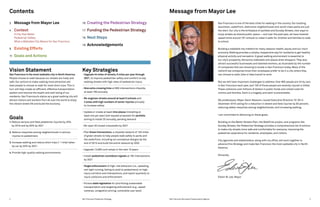
San Francisco is the most walkable city in North America.
People choose to walk because our streets are lively and
safe. Our actions to make walking more attractive will
lead people to choose to walk for most short trips. This in
turn will help create an efficient, effective transportation
system and improve the health and well-being of our
residents. San Francisco’s status as a great walking city will
attract visitors and workers from all over the world to enjoy
the vibrant street life and build the economy.
Goals
1. Reduce serious and fatal pedestrian injuries by 25%
by 2016 and by 50% by 2021
2. Reduce inequities among neighborhoods in serious
injuries to pedestrians
3. Increase walking and reduce short trips ( 1 mile) taken
by car by 25% by 2021.
4. Provide high-quality walking environments
Key Strategies
• Upgrade 44 miles of streets, 5 miles per year through
2021, to improve pedestrian safety and comfort on key
walking streets with high rates of pedestrian injury.
• Give extra crossing time at 800 intersections citywide,
at least 160 annually
• Re-engineer streets around at least 5 schools and
2 areas with high numbers of senior injuries annually
to increase safety
• Update or create at least nine plazas (installing at
least one per year) and request proposals for parklets
aiming to install 20 annually, pending demand
• Re-open 20 closed crosswalks by 2021
• Plan Green Connections, a citywide network of 140 miles
of green streets to help people walk safely to parks and
the waterfront, including six conceptual designs by the
end of 2013 and build the entire network by 2032
• Upgrade 13,000 curb ramps in the next 10 years
• Install pedestrian countdown signals at 184 intersections
by 2021
• Target enforcement of high-risk behaviors (i.e., speeding,
red-light running, failing to yield to pedestrians) on high-
injury corridors and intersections, and report quarterly on
injury collisions and enforcement
• Pursue state legislation for prioritizing sustainable
transportation and targeting enforcement (e.g., speed
cameras, congestion pricing, vulnerable user laws)
San Francisco is one of the best cities for walking in the country. Our bustling
downtown, waterfront, distinctive neighborhoods and world-class parks are just
the start. Our city is the birthplace of parklets and Sunday Streets, new ways to
enjoy streets as shared public space — and over the past year, we have lowered
speed limits around 181 schools to make it safer for children and families to walk
to school.
Building a walkable city matters for many reasons: health, equity and our city’s
economy. Walking provides a simple, inexpensive way for residents to get healthy
physical activity and recreation. A great walking environment is essential to
our city’s prosperity. Attractive sidewalks and plazas draw shoppers. They also
attract successful businesses and talented workers, as illustrated by the number
of companies that are choosing to locate in San Francisco today. Many of the
nation’s top companies know their employees prefer to be in a city where they
can choose to walk, bike or take transit to work.
But we still have important challenges to address. Over 800 people are hit by cars
in San Francisco each year, and 100 of those people are severely injured or killed.
These collisions cost millions of dollars in public funds and untold costs for
victims and families. Each is a tragedy, and each is preventable.
My predecessor, Mayor Gavin Newsom, issued Executive Directive 10–03 in
December 2010 calling for a reduction in severe and fatal injuries by 50 percent,
reducing safety inequities among neighborhoods, and increasing walking.
I am committed to delivering on these goals.
Building on the Better Streets Plan, the WalkFirst project, and programs like
Sunday Streets, the Pedestrian Strategy provides a comprehensive list of actions
to make city streets more safe and comfortable for everyone, improving the
pedestrian experience for residents, employees, and visitors.
City agencies and stakeholders, along with my office, will work together to
advance this Strategy and make San Francisco the most walkable city in North
America.
Sincerely,
Edwin M. Lee, Mayor
Contents
3	 Message from Mayor Lee
4	 Context
	 A City that Walks
	 Pedestrian Safety
	 What a Walkable City Means for San Francisco
9	 Existing Efforts
11	 Goals and Actions
16	 Creating the Pedestrian Strategy
17	 Funding the Pedestrian Strategy
18	 Next Steps
19	 Acknowledgements
Message from Mayor Lee
San Francisco Pedestrian Strategy4 San Francisco Municipal Transportation Agency 5
A City for Walking
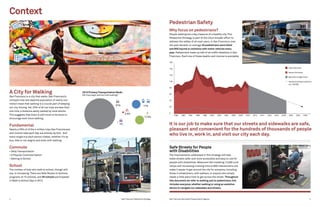
San Francisco is a city that walks. San Francisco’s
compact size and daytime population of nearly one
million mean that walking is a crucial part of keeping
our city moving. Yet, 25% of all car trips are less than
one mile, a distance easily walked by most adults.
This suggests that there is still much to be done to
encourage even more walking.
Fundamental
Nearly a fifth of of the 4 million trips San Franciscans
and visitors take each day are entirely by foot. And
every single trip each person makes, whether it’s by
bus, bike or car, begins and ends with walking.
Commute
• Daily Transportation
• A Popular Commute Option
• Getting to School
School
The number of kids who walk to school, though still
low, is increasing. There are Safe Routes to Schools
programs at 15 schools, and 55 schools participated
in Walk to School Day in 2012.
Context
Safe Streets for People
with Disabilities
The improvements addressed in this strategy will help
make streets safer and more accessible and easy to use for
people with disabilities. Measures like installing 13,000 curb
ramps and increasing crossing time at 800 intersections will
make it easier to get around the city for everyone, including
those in wheelchairs, with walkers, or anyone who simply
needs a little extra time to get across the street. Throughout
this document we refer to walking and to pedestrians;this
includes everyone, whether walking or using an assistive
device to navigate our sidewalks and streets.
Pedestrian Safety
Why focus on pedestrians?
People walking are a key measure of a healthy city. This
Pedestrian Strategy is part of the City’s broader effort to
address the safety of all road users. In San Francisco, over
the past decade, on average 20 pedestrians were killed
and 800 injured in collisions with motor vehicles every
year. Pedestrians make up half of all traffic fatalities in San
Francisco. Each one of these deaths and injuries is avoidable.
It is our job to make sure that our streets and sidewalks are safe,
pleasant and convenient for the hundreds of thousands of people
who live in, work in, and visit our city each day.
1990 1992 1994 1996 1998 2000 2002 2004 2006 2008 2010 2012 2014 2016 2018 2020 2022 2024 2026
160
140
120
100
80
60
40
20
0
2010 Primary Transportation Mode
(All trips begin and end with walking)1
1%
3.5%
61% 17%
17.5%
� Fatal Collisions
� Severe Collisions
� Reduction Target Trend
— Severe and Fatal Collisions
per 100,000
San Francisco Pedestrian Strategy6 San Francisco Municipal Transportation Agency 7
SunsetBlvd
MissionSt
Taraval St
19thAve
ValenciaSt
18th St
16th St
Geneva Ave
M
arket St
Geary Blvd
SanBrunoAve
Palou Ave
Lombard St
Colum
bus
Ave
4th
St
Em
barcadero
6th
St
VanNessAve
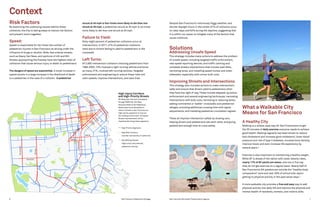
Risk Factors
By examining the underlying causes behind these
collisions, the City is taking steps to reduce risk factors
and prevent more tragedies.
Speed:
Speed is responsible for ten times the number of
pedestrian injuries in San Francisco as driving under the
influence of drugs or alcohol. Wide, fast arterial streets,
such as Geary, Van Ness, and sections of 4th and 6th
Streets approaching the freeway have the highest rates of
collisions that cause serious injury or death to pedestrians.
The dangers of speed are exponential. A small increase in
speed results in a large increase in the likelihood of death
to a pedestrian in the case of a collision. A pedestrian
struck at 40 mph is four times more likely to die than one
struck at 30 mph; a pedestrian struck at 30 mph is six times
more likely to die than one struck at 20 mph.
Failure to Yield:
Sixty-eight percent of pedestrian collisions occur at
intersections. In 2011, 41% of pedestrian collisions
were due to drivers failing to yield to pedestrians in the
crosswalk.
Left Turns:
Of 2,692 intersection collisions involving pedestrians from
1999-2003, 15% involved a right-turning vehicle and twice
as many, 31%, involved left-turning vehicles. Targeted
enforcement and engineering to reduce these risks will
calm speeds, improve intersections, and save lives.
What a Walkable City
Means for San Francisco
A Healthy City
Walking is a simple, easy way for San Franciscans to get
the 30 minutes of daily exercise everyone needs to achieve
good health. Walking regularly has been shown to reduce
bad cholesterol and increase good cholesterol, lower blood
pressure and risk of type II diabetes, increase bone density,
improve mood, and even increase life expectancy by
several years.3
Exercise is also important to maintaining a healthy weight.
While SF is ahead of the nation with lower obesity rates,
nearly 17% of SF adults are obese, and one in five say
they do not get exercise on a regular basis. Nearly half of
San Francisco’s 5th graders are outside the “healthy body
composition” zone and over 20% of school kids report
getting no physical activity in the past seven days.4
A more walkable city provides a free and easy way to add
physical activity into daily life and improve the physical and
mental health of residents, workers, and visitors alike.
Context
Despite San Francisco’s notoriously foggy weather, and
shorter daylight hours in the winter, 67% of collisions occur
on clear days and 62% during the daytime, suggesting that
it is within our power to mitigate many of the factors that
cause collisions.
Solutions
Addressing Unsafe Speed
This strategy includes many actions to address the problem
of unsafe speed, including targeted traffic enforcement,
new speed reporting devices, and traffic calming and
complete streets interventions that include road diets,
narrowing lanes, and installing speed humps and wider
sidewalks, especially with corner bulb-outs.
Improving Streets and Intersections
This strategy also includes actions to make intersections
safer and ensure that drivers yield to pedestrians when
they have the right of way. These include stepped-up police
enforcement and several engineering techniques: narrowing
intersections with bulb-outs; narrowing or reducing lanes;
adding continental or ‘ladder’ crosswalks and pedestrian
refuges; providing additional crossing time with signal
adjustments; and installing pedestrian countdown signals.
These all improve intersection safety by slowing cars,
helping drivers and pedestrians see each other, and giving
pedestrians enough time to cross safely.
High-Injury Corridors
and High-Priority Streets
Building upon the work completed
through WalkFirst, the Data
Subcommittee of the Pedestrian
Safety Task Force identified 44
miles of streets in San Francisco as
high priority segments to improve
the walking environment. Complete
Streets improvements will be
implemented along these segments.
— High Priority Segments
— High Risk Corridors
(number and severity of collisions)
— Key Walking Streets
(high actual and potential
pedestrian activity)
San Francisco Pedestrian Strategy8 San Francisco Municipal Transportation Agency 9
A Prosperous City
The investments the City is making in walkable streets
are paying off for local business. For instance, after the
City slimmed traffic lanes and widened the sidewalks
on Valencia Street, merchants reported increased sales,
and more area residents shopping locally. Two-thirds of
respondents said that increased levels of walking and
bicycling helped improve business and sales.5
Special
events such as Sunday Streets bring additional foot traffic
to neighborhoods and boost local economies.
Larger companies are choosing to stay in San Francisco, or
relocating here from the Peninsula because they know their
employees value living somewhere that they can choose to
walk, bike or take transit to work.6
Walkable streets are also essential to attract tourists.
The tourism industry generates over $526 million in tax
revenue for the City of San Francisco each year. Nearly
half of tourists report that they come to San Francisco to
experience the city’s overall ambiance, atmosphere (48%)
and scenic beauty (42%). Upon leaving, many note that
their least favorite thing about the City was traffic or other
transit issues (10%). This is despite the fact that many
tourists remain in a small, entirely walkable portion of
the city, suggesting that more can be done to improve the
walking environment for these valuable visitors.
A Sustainable City
33% of trips one mile or less are still taken by cars in San
Francisco. For many able-bodied people this is a distance
easily traveled by foot. By shifting more of these trips to
walking we can help reduce congestion for those who may
still need to drive, and help meet the City’s goals of cutting
greenhouse gases (below 1990 levels) by 25% by 2017 and
40% by 2025.
An Equitable City
Pedestrian collisions have a disproportionate impact on
certain neighborhoods, as the map on page 6 of this report
shows. Children and seniors face disproportionate risks
from collisions. Seniors are four times as likely as other
adults to be killed by a car in Francisco; about half of fatal
crash victims are seniors, though seniors only account for
15% of the population.7
One out of every five trauma cases in San Francisco is a
pedestrian hit by a car, and San Franciscans pay about
$15 million per year in public costs for hospital expenses
related to pedestrian crashes.8
That’s on top of lost days of
work for the victim and caretakers, not to mention the pain
and emotional trauma for all involved.
Nearly one-third of San Franciscans do not own a car. For
these families, walking is an essential part of daily travel.
40% of trips in San Francisco are under a mile, about 20
minutes by foot; walking these short trips helps to alleviate
traffic congestion, improve air quality and support public
health.
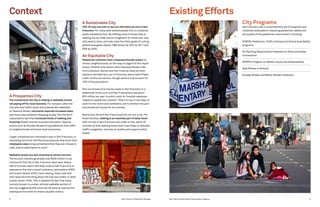
City Programs
San Francisco has a comprehensive set of programs and
initiatives dedicated to improving pedestrian safety and
the quality of the pedestrian environment, including:
SFMTA’s Pedestrian, Traffic Calming and School Area Safety
programs
SF Planning Department’s Pavement to Parks and Green
Connections
SFDPH’s Program on Health, Equity and Sustainability
Safe Routes to Schools
Sunday Streets and Better Streets initiatives
Context Existing Efforts
San Francisco Pedestrian Strategy10 San Francisco Municipal Transportation Agency 11
Walkscore:
2nd Most Walkable
City in U.S., 2012
University of
North Carolina:
Gold Level Walk
Friendly Community
2012 Sustainable
Transport Award:
for SFpark,
cycling and public
space improvements
San Francisco Bicycle
Coalition’s Golden Wheel
Award:for installation
of parklets
Existing Efforts Goals and Actions
• Created a Pedestrian Environmental Quality Index and
pedestrian injury prediction models to focus resources
strategically in the areas of greatest need
• Launched Sunday Streets, which attracts thousands of
San Franciscans and visitors to walk and enjoy vibrant
events in car-free streets
• Supported the creation of over 100 parklets, creative ways
to use street space to provide seating and other amenities
for pedestrians and shoppers
• Built four new plazas and one promenade to enliven
streets and provide more space for people on foot
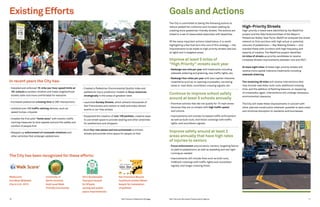
In recent years the City has:
• Installed and enforced 15-mile-per-hour speed limits at
181 schools to protect children and make neighborhood
streets safer and more comfortable for everyone
• Increased pedestrian crossing time at 390 intersections
• Installed over 200 traffic calming devices, such as
speed humps, citywide
• Created the first pilot “home zone,” with holistic traffic
calming measures to slow speeds and put the safety and
comfort of people first
• Stepped up enforcement of crosswalk violations and
other activities that endanger pedestrians
The City has been recognized for these efforts:
The City is committed to taking the following actions to
reduce pedestrian collisions and increase walking by
creating more pedestrian-friendly streets. The actions are
linked to a set of measurable objectives with deadlines.
Of the many important actions listed below, it is worth
highlighting a few that form the core of this strategy — the
improvements to be made on high-priority streets (see box
at right) and in targeted areas.
Improve at least 5 miles of
High Priority streets each year
• Redesign one mile per year with treatments including
sidewalk widening and greening, new traffic lights, etc.
• Redesign four miles per year with less capital-intensive
treatments such as re-opening crosswalks, narrowing
lanes or road diets, countdown crossing signals, etc.
Continue to improve school safety
around at least 5 schools annually
• Prioritize schools that did not qualify for 15-mph zones
because they are on streets with high traffic speed
and volume.
• Improvements will include increased traffic enforcement
as well as bulb-outs, mid-block crossings with traffic
lights, and countdown signals.
Improve safety around at least 2
areas annually that have high rates
of injuries to seniors
• Focus enforcement around senior centers, targeting failure
to yield to pedestrians, as well as speeding and red-light
running as needed.
• Improvements will include fixes such as bulb-outs,
midblock crossings with traffic lights and countdown
signals, and longer crossing times.
High-Priority Streets
High-priority s treets were identified by the WalkFirst
project and the Data Subcommittee of the Mayor’s
Pedestrian Safety Task Force. WalkFirst analyzed the street
network to find corridors with high actual or potential
volumes of pedestrians — Key Walking Streets — and
overlaid these with corridors with high frequency and
severity of crashes. The WalkFirst project identified
44 miles of streets as priority candidates to receive
Complete Streets improvements between now and 2021.
At least eight miles of these high-priority streets will
receive more capital intensive treatments including
sidewalk widening.
The remaining 36 miles will receive interventions that
may include road diets, bulb-outs, additional crossing
time, and the addition of flashing beacons, or reopening
of crosswalks; again, interventions will undergo necessary
environmental clearance.
The City will make these improvements in concert with
other planned construction wherever possible to save costs
and minimize disruption to residents and businesses.
San Francisco Pedestrian Strategy12 San Francisco Municipal Transportation Agency 13
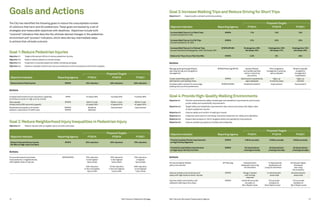
Goal 3:Increase WalkingTrips and Reduce Driving for ShortTrips
Objective 3.1 	 Expand public outreach promoting walking
			 Proposed Targets
Objective Indicator	 Reporting Agency	 FY2014		 FY2016	 FY2021
Increase Walk Trips as % of Work Trips	 SFMTA	 11%		 12%	 13%
Current Conditions 9–10%	
Increase Walk Trips as % of All Trips	 SFMTA	21%		22%	 23%
Current Conditions 18–20%	
Increase Walk Trips as % of School Trips	 SFMTA/SFUSD	 Kindergarten:28%		 Kindergarten:28% 	 Kindergarten:32%
Current Conditions Kindergarten: 25%, 5th Grade: 23%		 5th Grade:25%		 5th Grade:27%	 5th Grade:29%
Reduce Car Trips of Less Than One Mile	 SFMTA	 2.5%		 5%	 25%
Actions
Manage parking through SFpark,	 SFMTA/Planning/SFCTA	 Expand SFpark		 Pilot congestion	 SFpark citywide;
planning/zoning, and congestion		 and update parking	 management; parking	 congestion
management		 policy in planning		 policy adopted	 management
		 documents			 established
Create wayfinding signs with	 SFMTA	 Destinations established,		 Signs up	 Signs up
destinations and walking times		 signs designed		 in priority areas	 citywide	
Increase public outreach to encourage	 SFMTA/SFDPH	 Establish baseline		 Improvement	 Improvement
walking and prioritize pedestrians
Goal 4:Provide High-Quality Walking Environments
		
			 Proposed Targets
Objective Indicator	 Reporting Agency	 FY2014		 FY2016	 FY2021
Provide Complete Streets Improvements	 SFMTA	 5 Miles annually		 5 Miles annually	 5 Miles annually
on High Priority Segments	
Provide Focused Safety Improvements	 SFMTA	 20 intersections/		20 intersections/	 20 intersections/
on High Injury-Density Corridors		 crossings annually		 crossings annually 	 crossings annually
Actions
Put the Complete Streets 	 SF Planning	 6 departments		 12 departments 		 All relevant depts.
policy into practice		 developed and using		 developed and	 developed
		 CS checklists	 using CS checklists 	 and using
					 CS checklists
Improve streets around schools and	 SFMTA	 Design initiated 		 14 school/senior	 49 school/senior
areas with high levels of senior injuries		 and funding		 areas total	 areas total
		 obtained		
Improve safety and visibility with	 SFMTA	 Install 35 bus bulbs		 70 bus bulbs 	 172 bus bulbs
sidewalk widening at bus stops		 annually on		 installed on	 installed on
		 Muni Rapid routes	 Muni Rapid routes 	 Muni Rapid routes
The City has identified the following goals to reduce the unacceptable number
of collisions that harm and kill pedestrians. These goals are backed by a set of
strategies and measurable objectives with deadlines. Objectives include both
“outcome” indicators that describe the ultimate desired changes in the pedestrian
environment and “process” indicators, which describe key intermediate steps
to achieve that ultimate outcome. 
Goal 1:Reduce Pedestrian Injuries
Objective 1.1 	 Target enforcement efforts to reduce pedestrian injuries
Objective 1.2 	 Reduce vehicle speeds on arterial streets
Objective 1.3	 Implement a citywide pedestrian safety marketing campaign
Objective 1.4	 Advance complete collision and injury surveillance to inform prevention and monitor progress
			
			 Proposed Targets
Objective Indicator	 Reporting Agency	 FY2014		 FY2016	 FY2021
Reduce Severe/Fatal Injuries	 SFDPH	 15% reduction		 25% reduction	 50% reduction	
Actions
Increase enforcement hours focused on speeding 	 SFPD	 Increase 20%		 Increase 20%	 Increase 30%
and failure to yield, on high-priority streets
Slow speeds	 SFMTA	 Within 5 mph		 Within 4 mph	 Within 5 mph
(measured by 85th percentile speeds)		 of speed limit		 of speed limit	 of speed limit
Residential perceptions of traveler	 SFMTA/	 Establish		 Improvement	 Improvement
behavior, importance of traffic laws	 SFDPH	 Baseline			
Goal 2:Reduce Neighborhood Injury Inequalities in Pedestrian Injury
Objective 2.1 	 Reduce injuries both on highest injury corridors and areas
			 Proposed Targets
Objective Indicator	 Reporting Agency	 FY2014		 FY2016	 FY2021
Reduce Fatal and Severe Injuries 	 SFDPH	 25% reduction		 50% reduction	 75% reduction
Per Mile on High-Injury Corridors	
Actions
Focus enforcement and street	 SFMTA/SFPD	 15% reduction		 25% reduction	 75% reduction
improvements in neighborhoods		 in the highest		 in the highest	 in highest
with highest rates of injuries.		 injury areas		 injury areas	 injury areas
					
		 10% reduction 		 12.5% reduction	 50% reduction
		 in the 2nd highest		 in the 2nd highest	 in 2nd highest
		 injury areas		 injury areas	 injury areas	
Goals and Actions
Objective 4.1 	Provide comprehensive safety, streetscape and walkability improvements and focused,
proven safety and accessibility improvements
Objective 4.2 	Target safety and walkability improvements near schools and areas with higher rates
of senior pedestrian injuries
Objective 4.3 	 Improve safety and comfort of walking to transit
Objective 4.4 	 Implement pilot tests for promising, innovative treatments for safety and walkability
Objective 4.5 	 Expand data analysis to inform targeted safety and walkability improvements
Objective 4.6 	 Improve resident perceptions of safety and walkability
San Francisco Pedestrian Strategy14 San Francisco Municipal Transportation Agency 15
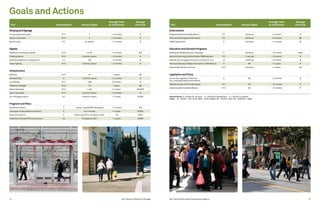
Improvements:S = safety for all users  V = visibility of pedestrians  C = comfort for people
Costs:  $ = $100K  $ $ = $100-500K  $ $ $ =$500K-1M  $ $ $ $ = $1M–5M  $ $ $ $ $ =  $5M
Goals and Actions
	 			Average Time	 Average
Tool	 Improvement	 Annual Target		to Implement	 Unit Cost
Striping and Signage
15 mph speed limit signs	 S V C	 5		  12 months	 $
Reopen crosswalks	 S V C	 2		  12 months	 $
Narrow lanes	 S C	 as needed		  12 months	 $
Signals
Pedestrian countdown signals	 S V C	 15–20		  12 months	 $ $
Flashing beacon	 S V C	 3 (within 2 years)		  12 months	 $
Extended pedestrian crossing time	 S C	 160		  12 months	 $
Smart lighting	 S V C	 3 (within 2 years)		  12 months	 $
Infrastructure
Bulbouts	 S V C	 10		 2 years	 $ $
Rumble Strips	 S	 3 (within 4 years)		  12 months	 $
Curb Ramps	 S V C	 1300		 18 months	 $
Pedestrian Refuges	 S V C	 10		 2 years	 $ $
Widen Sidewalks	 S V C	 1 mile		 2–3 years	 $ $ $ $ $
Raise Crosswalks	 S V C	 3 (within 2 years)		  12 months	 $
Eco-drainage projects	 S C	 5 (within 4 years)		 1–2 years	 $ $ $ $
Programs and Plans
Pavement to Parks	 C	 1 plaza, 1 parklet RFP, 20 parklets		  12 months	 $ $
Close gaps in the pedestrian network	 C	 14 in 10 years		 1–2 years	 $ $ $ $
Green Connections	 C	 Planning by 2013, installed by 2032		 n/a	 $ $ $
Pedestrian-Oriented/Priority Corridors	 S C	 Complete by 2021		 1–2 years	 $ $ $ $
	 			Average Time	 Average
Tool	 Improvement	 Annual Target		to Implement	 Unit Cost
Enforcement
Targeted Pedestrian Safety Efforts	 S V	 Continual		  2 months	 $
Pilot automated speed enforcement	 S V	 Continual		 12 months	 $$
LIDAR Speed Guns	 S	 Continual		  12 months	 $
Education and Outreach Programs
Walking and Safety Outreach Campaign	 S	 Continual		  12 months	 $ $ $
Special Events (e.g. Sunday Streets, PARK(ing) day)	 V C	 11 per year		  12 months	 $
Website with Strategy Information and Click It, Fix It	 V C	 Continual		  6 months	 $
Enhance Pedestrian Safety Information in DMV Manual	 S	 NA		 1–2 years	 $
Expand Safe Routes to School	 S V C	 Continual		 1–2 years	 $ $
Legislation and Policy
Pursue Top Legislative Prioirities	 S	 NA		  12 months	 $
(e.g. automated speed enforcement)
Mobility Access and Pricing Program	 S C	 NA		  12 months	 $
Institutionalize Complete Streets	 S V C	 NA		  12 months	 $
San Francisco Pedestrian Strategy16 San Francisco Municipal Transportation Agency 17
Creating the Pedestrian Strategy Funding the Pedestrian Strategy
In 2010, the Mayor issued Executive Directive 10-03, which
calls on the City to reduce fatal and serious injuries to
pedestrians by 25% by 2016 and 50% by 2021 (compared
to a 2008 baseline). The directive also called for the
development of a Pedestrian Strategy, which would
examine current conditions and make recommendations
for near- and long-term actions and funding sources to
improve safety and walkability.
The existing conditions report was created by WalkFirst,
an interagency collaboration between the San Francisco
Department of Public Health (SFDPH), Planning
Department, Municipal Transportation Agency (SFMTA), and
the County Transportation Authority. WalkFirst identified
key walking streets throughout San Francisco and
established criteria to prioritize and improve pedestrian
safety and walking conditions, encourage walking, and
enhance pedestrian connections to key destinations. More
information can be found on the SF Planning Department’s
website: http://walkfirst.sfplanning.org
The Pedestrian Safety Task Force was convened by the
Mayor and led by SFMTA and SFDPH; it was comprised
of key city agencies including Planning, the County
Transportation Authority (SFCTA), Department of Public
Works (SFDPW), the Police Department, the District
Attorney’s Office as well as community stakeholders
including Walk San Francisco, members of the Pedestrian
Safety Advisory Committee, and Senior Action Network.
The Pedestrian Safety Task Force’s Steering Committee, led
by SFMTA, was responsible for the creation of this report.
The Data Subcommittee of the Pedestrian Safety Task
Force took the maps developed via WalkFirst and added a
layer of traffic safety data, and used this new dataset to
identify the 44 miles of “high priority” streets referenced
in this document where the City will prioritize safety and
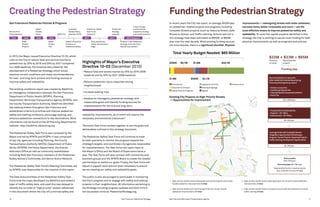
In recent years the City has spent, on average, $32M/year
on pedestrian-related projects and programs including
Complete Streets projects (such as Valencia Street), Safe
Routes to School, and Traffic Calming. Actions laid out in
this strategy have been estimated at $650M, or $65M/
year over the next decade. While existing funding sources
are more flexible, there is a significant shortfall. Physical
improvements — redesigning streets with wider sidewalks,
narrower lanes, better crosswalks and more — are the
most effective means to improve pedestrian safety and
walkability. To cover the capital projects identified in this
strategy, the City is working to secure more funding for both
physical improvements as well as programs and policies.
Highlights of Mayor’s Executive
Directive 10-03 (December 2010)
• Reduce fatal and severe injuries by 25% by 2016 (2008
baseline) and by 50% by 2021 (2008 baseline)
• Reduce pedestrian injury inequities among
neighborhoods
• Increase walking trips
• Develop an interagency pedestrian strategy with
measurable goals and identify funding sources for
implementation for the mid and long-term.
walkability improvements, all of which will require the
necessary environmental clearances.
The entire Task Force worked together to set the goals and
deliverables outlined in this strategy document.
The Pedestrian Safety Task Force will continue to meet
at least quarterly to monitor the progress towards the
strategy’s targets, and coordinate city agencies responsible
for implementation. The Task Force will report back to
the Mayor’s Office and the Board of Supervisors twice a
year. The Task Force will also connect with community and
business groups and the SFMTA Board to create the needed
partnerships to realize our goals. Finally, the Task Force will
adjust or expand upon actions when necessary to ensure
we are meeting our safety and walkability goals.
The public is also encouraged to participate in monitoring
the City’s progress and to engage with safety and walking
projects in their neighborhood. All information pertaining to
the Strategy including progress updates and Click It Fix It
will be posted online at: PedestrianStrategy.org.
San Francisco’s Pedestrian Policies  Programs
Pedestrian Safety
Task Force
Convened
Pedestrian
Strategy
released
Project design,
environmental
clearance, funding
and implementation
Projects in the Pedestrian
Strategy enter the City’s
Capital Improvement
Early pedestrian
safety interventions
begin
Better
Streets
Plan
Better
Streets
Policy
Transit-First
Policy Adopted WalkFirst
201120102005 20061973
Great
Streets
Program
Complete
Streets Policy
Adopted (2010)
Mayor’s Executive
Directive on
Pedestrian Safety
2013  Beyond2013
Total Yearly Budget Needed: $65 Million
$32M + $33M = $65M
Business	New/expanded
as usual	 projects
Funding Gap
Enforcement
Education  Outreach
Capital Plans  Programs
Legislation  Policy
Striping  Signage
Signals
Infrastructure
$390K $9.7M $1.8M $49.1M
$1.8M $500K $4.1M
Existing City Projects on High-Priority Streets
 — Opportunities for Improvement
— High-priority streets where streetscape and transit projects will include
funded pedestrian improvements: 5 miles
— High-priority streets with transit projects that do not yet include
pedestrian improvements: 27 miles
— High-priority streets where repaving projects do not yet include pedestrian
improvements: 3 miles
— High-priority streets where no projects are yet planned; potential for arterial
traffic calming: 9 miles
Leverage funds with Complete Streets
integration opportunities (Streetscape
Program,Transit Projects, Repaving Projects,
Traffic Calming, Development Agreements).
$2.3M/year
$10 – 20M/year
Recommendations to generate
$100–200M (2010 Street Resurfacing
Financing Working Group report)
• Vehicle License Fee
• Conditional General Tax
• Citywide Benefit Assessment District
• Parcel Tax
$3 – 5M/year
• Transportation Sustainability
• Program:~$1 – 2M/yr
• Enforcement:~$2 – 3M/yr
Total possible:
$15-27M/year
Remaining Gap:$6-18M/year
Need another bond or revenue source
(e.g., sales tax) to close the gap.
San Francisco Pedestrian Strategy18 San Francisco Municipal Transportation Agency 19
This Pedestrian Strategy provides a path towards making
San Francisco the most walkable city in North America.
The City is committed to advancing this strategy quickly.
As San Francisco continues to grow, our policies will also
encourage dense mixed-use development with excellent
public transit to reduce the need to drive and encourage
walking, bicycling and public transit use.
Below are some early action steps, either under way or
beginning in 2013 to advance the Pedestrian Strategy.
Physical Street Improvements
Identify key priority segments to be improved each year
(approximately 5 miles):
• Develop walk audit of the key walking streets by district
• Convene key stakeholder groups to identify priority areas
in each district
• Walk corridors and complete safety and comfort
assessment
• With the City Controller's Office, prioritize treatments
for high-priority streets as well as identify treatments
citywide for inclusion in the city Capital Plan
Education  Outreach
Promote the benefits of walking:
• Make San Francisco the first city in the nation to launch
Walk to Work Day on April 12, 2013
• Develop multi-media campaign to encourage walking
and pedestrian priority
• Positively reinforce good behavior for people driving,
bicycling and walking
• Complete Sunday Streets evaluation and target key
walking streets as part of 2013 routes
Next Steps
Enforcement
• Target enforcement on key walking safety streets
• Start Monthly Safety Data Reports by SFPD on collisions
and enforcement
Policy and Institutions
• Prioritize key polices for agency adoption and approval
• Identify key walking safety legislation for city and state
approval including automated speed enforcement
• Improve the City’s project delivery process
• Tailor the Better Streets Plan’s Complete Streets
Checklist and adopt among implementing agencies
Performance Monitoring
City website dedicated to Pedestrian Strategy updates:
• Directors’ updates to Mayor and Task Force quarterly
• Multi-agency collision data collection, analysis,
and reporting
Notes
1. San Francisco County Transportation Authority
(2010). San Francisco County Transportation Authority
SFCHAMP Model [Software]2. SFMTA. New York City's
Pedestrian Safety Study and San Francisco Data, Oct
2010.
3. http://www.nlm.nih.gov/medlineplus/news/
fullstory_131058.html
4. Community Health Status Assessment: City and
County of San Francisco, July 2012. Accessed via: http://
www.sfdph.org/dph/files/hc/HCAgen/HCAgen2012/
Oct%2016/San%20Francisco%20CHSA_Final.pdf
5. http://www.smartgrowthamerica.org/documents/cs/
factsheets/cs-revitalize.pdf
6 Florida, Richard. The Joys of Urban Tech, Wall Street
Journal. August 31, 2012. Accessed via: http://online.
wsj.com/article/SB100008723963904449149045776194
41778073340.html
7. Dicker, Rochelle MD. Evaluation of Pedestrian
Injury and it's Associated Hospital Costs in San
Francisco,UCSF Department of Surgery. Accessed via:
http://sfic.surgery.ucsf.edu/full-research-descriptions/
cost-of-pedestrian-injury.aspx
8. ibid
Photo Credits
Cover: Jeremy Brooks;
Rentum rersped entionseque voloris volum sit, que
doluptas ut ullorep udipidem. Edit fugiam labo.
Fersperum ellatiscimi, utem fuga. Us perum volecere
pre, cullace rrovide rspit, sa volupti te re sam eos
magnationet omnientiur? Con porum inis as nosae es
de et, solore solore ima dollatem explit, quid et untias
sitis aut dolorrum volent voluptas et id mosandae.
Otatem quatium vendes aut quas simoditas doles ratqui
delit, si te renectusape et facerum que omnimaio quid
modipsanis rae num quatiis perae aut odi corecus
dolliqui aut accum ute perum voluptur arum voluptiae.
Era debitas alitatem. Pellacea quatini volor sam volupta
eum incto tempor modi sum repudite si rem si volorep
elibus, similic ientem ea dolorro vitaquis quia conserio
dolorem posam, quoditi consequis accabo. Num inus.
Reperep udissunt fugitas eum acculparibus di ut aut
perundi genisqui occatur aut apelitatur sum
Acknowledgements
Executive Leadership
Mayor Edwin M. Lee
Gillian Gillett
Mayor’s Office, Director of Transportation Policy
Edward D. Reiskin
Director of Transportation, San Francisco Municipal
Transportation Agency
Barbara A. Garcia
Director, Department of Public Health
John Rahaim
Director, Planning Department
Jose Luis Moscovich
Executive Director, San Francisco County
Transportation Agency
Pedestrian Safety Task Force
Timothy Papandreou
San Francisco Municipal Transportation Agency,
Deputy Director of Sustainable Streets Division,
Co-Chair
Rajiv Bhatia, MD, MPH
SF Department of Public Health,
Director of Environmental Health, Co-Chair
Steering Committee
San Francisco Municipal Transportation Agency
Frank Markowitz
Mari Hunter
Luis Montoya
Bridget Smith
San Francisco Department of Public Health
Megan Wier
Ana Validzic
San Francisco Planning Department
Adam Varat
Lily Langlois
San Francisco County Transportation Authority
Tilly Chang
Seon Joo Kim
Jesse Koehler
San Francisco Police Department
Capt. Al Casciato
Capt. Denis O’Leary
Walk San Francisco
Elizabeth Stampe
Other Task Force Organizations
San Francisco Department of Public Works
Peg Divine	
Ken Spielman
Cristina Olea
San Francisco United School District
Nik Kaestner
Pedestrian Safety Advisory Committee
Robin Brasso
Jay Lee
John Alex Lowell
Senior Action Network/California Walks
Bob Planthold
Mayor’s Office on Disability
Joanna Fraguli
San Francisco Department of the Environment
Krute Singa
San Francisco District Attorney’s Office
Rebecca Prozan
San Francisco City Administrator’s
Office/Capital Planning
Brian Strong
San Francisco Fire Department
Andy Zanoff
San Francisco Public Utilities Commission
Rachel Kraai
San Francisco Recreation and Parks Department
Sarah Ballard
The Task Force gratefully acknowledges report
editing  website assistance from:
Anne Fritzler, SFMTA
Kathleen Phu, SFMTA
Lindsey Realmuto, SFDPH
Dani Simons, Simons Consulting
Isaac Gertman, Paperwhite Studio
Open Plans
San Francisco Pedestrian Strategy20
Acknowledgements
Back Cover
####

샌프란시스코시 보행자 전략

  • 1.
    San Francisco MunicipalTransportation Agency 1 San Francisco Pedestrian Strategy January 2013 Prepared by the Mayor's Pedestrian Safety Task Force
  • 2.
    2 3San FranciscoMunicipal Transportation AgencySan Francisco Pedestrian Strategy Vision Statement San Francisco is the most walkable city in North America. People choose to walk because our streets are lively and safe. Our actions to make walking more attractive will lead people to choose to walk for most short trips. This in turn will help create an efficient, effective transportation system and improve the health and well-being of our residents. San Francisco’s status as a great walking city will attract visitors and workers from all over the world to enjoy the vibrant street life and build the economy. Goals 1. Reduce serious and fatal pedestrian injuries by 25% by 2016 and by 50% by 2021 2. Reduce inequities among neighborhoods in serious injuries to pedestrians 3. Increase walking and reduce short trips ( 1 mile) taken by car by 25% by 2021. 4. Provide high-quality walking environments Key Strategies • Upgrade 44 miles of streets, 5 miles per year through 2021, to improve pedestrian safety and comfort on key walking streets with high rates of pedestrian injury. • Give extra crossing time at 800 intersections citywide, at least 160 annually • Re-engineer streets around at least 5 schools and 2 areas with high numbers of senior injuries annually to increase safety • Update or create at least nine plazas (installing at least one per year) and request proposals for parklets aiming to install 20 annually, pending demand • Re-open 20 closed crosswalks by 2021 • Plan Green Connections, a citywide network of 140 miles of green streets to help people walk safely to parks and the waterfront, including six conceptual designs by the end of 2013 and build the entire network by 2032 • Upgrade 13,000 curb ramps in the next 10 years • Install pedestrian countdown signals at 184 intersections by 2021 • Target enforcement of high-risk behaviors (i.e., speeding, red-light running, failing to yield to pedestrians) on high- injury corridors and intersections, and report quarterly on injury collisions and enforcement • Pursue state legislation for prioritizing sustainable transportation and targeting enforcement (e.g., speed cameras, congestion pricing, vulnerable user laws) San Francisco is one of the best cities for walking in the country. Our bustling downtown, waterfront, distinctive neighborhoods and world-class parks are just the start. Our city is the birthplace of parklets and Sunday Streets, new ways to enjoy streets as shared public space — and over the past year, we have lowered speed limits around 181 schools to make it safer for children and families to walk to school. Building a walkable city matters for many reasons: health, equity and our city’s economy. Walking provides a simple, inexpensive way for residents to get healthy physical activity and recreation. A great walking environment is essential to our city’s prosperity. Attractive sidewalks and plazas draw shoppers. They also attract successful businesses and talented workers, as illustrated by the number of companies that are choosing to locate in San Francisco today. Many of the nation’s top companies know their employees prefer to be in a city where they can choose to walk, bike or take transit to work. But we still have important challenges to address. Over 800 people are hit by cars in San Francisco each year, and 100 of those people are severely injured or killed. These collisions cost millions of dollars in public funds and untold costs for victims and families. Each is a tragedy, and each is preventable. My predecessor, Mayor Gavin Newsom, issued Executive Directive 10–03 in December 2010 calling for a reduction in severe and fatal injuries by 50 percent, reducing safety inequities among neighborhoods, and increasing walking. I am committed to delivering on these goals. Building on the Better Streets Plan, the WalkFirst project, and programs like Sunday Streets, the Pedestrian Strategy provides a comprehensive list of actions to make city streets more safe and comfortable for everyone, improving the pedestrian experience for residents, employees, and visitors. City agencies and stakeholders, along with my office, will work together to advance this Strategy and make San Francisco the most walkable city in North America. Sincerely, Edwin M. Lee, Mayor Contents 3 Message from Mayor Lee 4 Context A City that Walks Pedestrian Safety What a Walkable City Means for San Francisco 9 Existing Efforts 11 Goals and Actions 16 Creating the Pedestrian Strategy 17 Funding the Pedestrian Strategy 18 Next Steps 19 Acknowledgements Message from Mayor Lee
  • 3.
    San Francisco PedestrianStrategy4 San Francisco Municipal Transportation Agency 5 A City for Walking San Francisco is a city that walks. San Francisco’s compact size and daytime population of nearly one million mean that walking is a crucial part of keeping our city moving. Yet, 25% of all car trips are less than one mile, a distance easily walked by most adults. This suggests that there is still much to be done to encourage even more walking. Fundamental Nearly a fifth of of the 4 million trips San Franciscans and visitors take each day are entirely by foot. And every single trip each person makes, whether it’s by bus, bike or car, begins and ends with walking. Commute • Daily Transportation • A Popular Commute Option • Getting to School School The number of kids who walk to school, though still low, is increasing. There are Safe Routes to Schools programs at 15 schools, and 55 schools participated in Walk to School Day in 2012. Context Safe Streets for People with Disabilities The improvements addressed in this strategy will help make streets safer and more accessible and easy to use for people with disabilities. Measures like installing 13,000 curb ramps and increasing crossing time at 800 intersections will make it easier to get around the city for everyone, including those in wheelchairs, with walkers, or anyone who simply needs a little extra time to get across the street. Throughout this document we refer to walking and to pedestrians;this includes everyone, whether walking or using an assistive device to navigate our sidewalks and streets. Pedestrian Safety Why focus on pedestrians? People walking are a key measure of a healthy city. This Pedestrian Strategy is part of the City’s broader effort to address the safety of all road users. In San Francisco, over the past decade, on average 20 pedestrians were killed and 800 injured in collisions with motor vehicles every year. Pedestrians make up half of all traffic fatalities in San Francisco. Each one of these deaths and injuries is avoidable. It is our job to make sure that our streets and sidewalks are safe, pleasant and convenient for the hundreds of thousands of people who live in, work in, and visit our city each day. 1990 1992 1994 1996 1998 2000 2002 2004 2006 2008 2010 2012 2014 2016 2018 2020 2022 2024 2026 160 140 120 100 80 60 40 20 0 2010 Primary Transportation Mode (All trips begin and end with walking)1 1% 3.5% 61% 17% 17.5% � Fatal Collisions � Severe Collisions � Reduction Target Trend — Severe and Fatal Collisions per 100,000
  • 4.
    San Francisco PedestrianStrategy6 San Francisco Municipal Transportation Agency 7 SunsetBlvd MissionSt Taraval St 19thAve ValenciaSt 18th St 16th St Geneva Ave M arket St Geary Blvd SanBrunoAve Palou Ave Lombard St Colum bus Ave 4th St Em barcadero 6th St VanNessAve Risk Factors By examining the underlying causes behind these collisions, the City is taking steps to reduce risk factors and prevent more tragedies. Speed: Speed is responsible for ten times the number of pedestrian injuries in San Francisco as driving under the influence of drugs or alcohol. Wide, fast arterial streets, such as Geary, Van Ness, and sections of 4th and 6th Streets approaching the freeway have the highest rates of collisions that cause serious injury or death to pedestrians. The dangers of speed are exponential. A small increase in speed results in a large increase in the likelihood of death to a pedestrian in the case of a collision. A pedestrian struck at 40 mph is four times more likely to die than one struck at 30 mph; a pedestrian struck at 30 mph is six times more likely to die than one struck at 20 mph. Failure to Yield: Sixty-eight percent of pedestrian collisions occur at intersections. In 2011, 41% of pedestrian collisions were due to drivers failing to yield to pedestrians in the crosswalk. Left Turns: Of 2,692 intersection collisions involving pedestrians from 1999-2003, 15% involved a right-turning vehicle and twice as many, 31%, involved left-turning vehicles. Targeted enforcement and engineering to reduce these risks will calm speeds, improve intersections, and save lives. What a Walkable City Means for San Francisco A Healthy City Walking is a simple, easy way for San Franciscans to get the 30 minutes of daily exercise everyone needs to achieve good health. Walking regularly has been shown to reduce bad cholesterol and increase good cholesterol, lower blood pressure and risk of type II diabetes, increase bone density, improve mood, and even increase life expectancy by several years.3 Exercise is also important to maintaining a healthy weight. While SF is ahead of the nation with lower obesity rates, nearly 17% of SF adults are obese, and one in five say they do not get exercise on a regular basis. Nearly half of San Francisco’s 5th graders are outside the “healthy body composition” zone and over 20% of school kids report getting no physical activity in the past seven days.4 A more walkable city provides a free and easy way to add physical activity into daily life and improve the physical and mental health of residents, workers, and visitors alike. Context Despite San Francisco’s notoriously foggy weather, and shorter daylight hours in the winter, 67% of collisions occur on clear days and 62% during the daytime, suggesting that it is within our power to mitigate many of the factors that cause collisions. Solutions Addressing Unsafe Speed This strategy includes many actions to address the problem of unsafe speed, including targeted traffic enforcement, new speed reporting devices, and traffic calming and complete streets interventions that include road diets, narrowing lanes, and installing speed humps and wider sidewalks, especially with corner bulb-outs. Improving Streets and Intersections This strategy also includes actions to make intersections safer and ensure that drivers yield to pedestrians when they have the right of way. These include stepped-up police enforcement and several engineering techniques: narrowing intersections with bulb-outs; narrowing or reducing lanes; adding continental or ‘ladder’ crosswalks and pedestrian refuges; providing additional crossing time with signal adjustments; and installing pedestrian countdown signals. These all improve intersection safety by slowing cars, helping drivers and pedestrians see each other, and giving pedestrians enough time to cross safely. High-Injury Corridors and High-Priority Streets Building upon the work completed through WalkFirst, the Data Subcommittee of the Pedestrian Safety Task Force identified 44 miles of streets in San Francisco as high priority segments to improve the walking environment. Complete Streets improvements will be implemented along these segments. — High Priority Segments — High Risk Corridors (number and severity of collisions) — Key Walking Streets (high actual and potential pedestrian activity)
  • 5.
    San Francisco PedestrianStrategy8 San Francisco Municipal Transportation Agency 9 A Prosperous City The investments the City is making in walkable streets are paying off for local business. For instance, after the City slimmed traffic lanes and widened the sidewalks on Valencia Street, merchants reported increased sales, and more area residents shopping locally. Two-thirds of respondents said that increased levels of walking and bicycling helped improve business and sales.5 Special events such as Sunday Streets bring additional foot traffic to neighborhoods and boost local economies. Larger companies are choosing to stay in San Francisco, or relocating here from the Peninsula because they know their employees value living somewhere that they can choose to walk, bike or take transit to work.6 Walkable streets are also essential to attract tourists. The tourism industry generates over $526 million in tax revenue for the City of San Francisco each year. Nearly half of tourists report that they come to San Francisco to experience the city’s overall ambiance, atmosphere (48%) and scenic beauty (42%). Upon leaving, many note that their least favorite thing about the City was traffic or other transit issues (10%). This is despite the fact that many tourists remain in a small, entirely walkable portion of the city, suggesting that more can be done to improve the walking environment for these valuable visitors. A Sustainable City 33% of trips one mile or less are still taken by cars in San Francisco. For many able-bodied people this is a distance easily traveled by foot. By shifting more of these trips to walking we can help reduce congestion for those who may still need to drive, and help meet the City’s goals of cutting greenhouse gases (below 1990 levels) by 25% by 2017 and 40% by 2025. An Equitable City Pedestrian collisions have a disproportionate impact on certain neighborhoods, as the map on page 6 of this report shows. Children and seniors face disproportionate risks from collisions. Seniors are four times as likely as other adults to be killed by a car in Francisco; about half of fatal crash victims are seniors, though seniors only account for 15% of the population.7 One out of every five trauma cases in San Francisco is a pedestrian hit by a car, and San Franciscans pay about $15 million per year in public costs for hospital expenses related to pedestrian crashes.8 That’s on top of lost days of work for the victim and caretakers, not to mention the pain and emotional trauma for all involved. Nearly one-third of San Franciscans do not own a car. For these families, walking is an essential part of daily travel. 40% of trips in San Francisco are under a mile, about 20 minutes by foot; walking these short trips helps to alleviate traffic congestion, improve air quality and support public health. City Programs San Francisco has a comprehensive set of programs and initiatives dedicated to improving pedestrian safety and the quality of the pedestrian environment, including: SFMTA’s Pedestrian, Traffic Calming and School Area Safety programs SF Planning Department’s Pavement to Parks and Green Connections SFDPH’s Program on Health, Equity and Sustainability Safe Routes to Schools Sunday Streets and Better Streets initiatives Context Existing Efforts
  • 6.
    San Francisco PedestrianStrategy10 San Francisco Municipal Transportation Agency 11 Walkscore: 2nd Most Walkable City in U.S., 2012 University of North Carolina: Gold Level Walk Friendly Community 2012 Sustainable Transport Award: for SFpark, cycling and public space improvements San Francisco Bicycle Coalition’s Golden Wheel Award:for installation of parklets Existing Efforts Goals and Actions • Created a Pedestrian Environmental Quality Index and pedestrian injury prediction models to focus resources strategically in the areas of greatest need • Launched Sunday Streets, which attracts thousands of San Franciscans and visitors to walk and enjoy vibrant events in car-free streets • Supported the creation of over 100 parklets, creative ways to use street space to provide seating and other amenities for pedestrians and shoppers • Built four new plazas and one promenade to enliven streets and provide more space for people on foot In recent years the City has: • Installed and enforced 15-mile-per-hour speed limits at 181 schools to protect children and make neighborhood streets safer and more comfortable for everyone • Increased pedestrian crossing time at 390 intersections • Installed over 200 traffic calming devices, such as speed humps, citywide • Created the first pilot “home zone,” with holistic traffic calming measures to slow speeds and put the safety and comfort of people first • Stepped up enforcement of crosswalk violations and other activities that endanger pedestrians The City has been recognized for these efforts: The City is committed to taking the following actions to reduce pedestrian collisions and increase walking by creating more pedestrian-friendly streets. The actions are linked to a set of measurable objectives with deadlines. Of the many important actions listed below, it is worth highlighting a few that form the core of this strategy — the improvements to be made on high-priority streets (see box at right) and in targeted areas. Improve at least 5 miles of High Priority streets each year • Redesign one mile per year with treatments including sidewalk widening and greening, new traffic lights, etc. • Redesign four miles per year with less capital-intensive treatments such as re-opening crosswalks, narrowing lanes or road diets, countdown crossing signals, etc. Continue to improve school safety around at least 5 schools annually • Prioritize schools that did not qualify for 15-mph zones because they are on streets with high traffic speed and volume. • Improvements will include increased traffic enforcement as well as bulb-outs, mid-block crossings with traffic lights, and countdown signals. Improve safety around at least 2 areas annually that have high rates of injuries to seniors • Focus enforcement around senior centers, targeting failure to yield to pedestrians, as well as speeding and red-light running as needed. • Improvements will include fixes such as bulb-outs, midblock crossings with traffic lights and countdown signals, and longer crossing times. High-Priority Streets High-priority s treets were identified by the WalkFirst project and the Data Subcommittee of the Mayor’s Pedestrian Safety Task Force. WalkFirst analyzed the street network to find corridors with high actual or potential volumes of pedestrians — Key Walking Streets — and overlaid these with corridors with high frequency and severity of crashes. The WalkFirst project identified 44 miles of streets as priority candidates to receive Complete Streets improvements between now and 2021. At least eight miles of these high-priority streets will receive more capital intensive treatments including sidewalk widening. The remaining 36 miles will receive interventions that may include road diets, bulb-outs, additional crossing time, and the addition of flashing beacons, or reopening of crosswalks; again, interventions will undergo necessary environmental clearance. The City will make these improvements in concert with other planned construction wherever possible to save costs and minimize disruption to residents and businesses.
  • 7.
    San Francisco PedestrianStrategy12 San Francisco Municipal Transportation Agency 13 Goal 3:Increase WalkingTrips and Reduce Driving for ShortTrips Objective 3.1 Expand public outreach promoting walking Proposed Targets Objective Indicator Reporting Agency FY2014 FY2016 FY2021 Increase Walk Trips as % of Work Trips SFMTA 11% 12% 13% Current Conditions 9–10% Increase Walk Trips as % of All Trips SFMTA 21% 22% 23% Current Conditions 18–20% Increase Walk Trips as % of School Trips SFMTA/SFUSD Kindergarten:28% Kindergarten:28% Kindergarten:32% Current Conditions Kindergarten: 25%, 5th Grade: 23% 5th Grade:25% 5th Grade:27% 5th Grade:29% Reduce Car Trips of Less Than One Mile SFMTA 2.5% 5% 25% Actions Manage parking through SFpark, SFMTA/Planning/SFCTA Expand SFpark Pilot congestion SFpark citywide; planning/zoning, and congestion and update parking management; parking congestion management policy in planning policy adopted management documents established Create wayfinding signs with SFMTA Destinations established, Signs up Signs up destinations and walking times signs designed in priority areas citywide Increase public outreach to encourage SFMTA/SFDPH Establish baseline Improvement Improvement walking and prioritize pedestrians Goal 4:Provide High-Quality Walking Environments Proposed Targets Objective Indicator Reporting Agency FY2014 FY2016 FY2021 Provide Complete Streets Improvements SFMTA 5 Miles annually 5 Miles annually 5 Miles annually on High Priority Segments Provide Focused Safety Improvements SFMTA 20 intersections/ 20 intersections/ 20 intersections/ on High Injury-Density Corridors crossings annually crossings annually crossings annually Actions Put the Complete Streets SF Planning 6 departments 12 departments All relevant depts. policy into practice developed and using developed and developed CS checklists using CS checklists and using CS checklists Improve streets around schools and SFMTA Design initiated 14 school/senior 49 school/senior areas with high levels of senior injuries and funding areas total areas total obtained Improve safety and visibility with SFMTA Install 35 bus bulbs 70 bus bulbs 172 bus bulbs sidewalk widening at bus stops annually on installed on installed on Muni Rapid routes Muni Rapid routes Muni Rapid routes The City has identified the following goals to reduce the unacceptable number of collisions that harm and kill pedestrians. These goals are backed by a set of strategies and measurable objectives with deadlines. Objectives include both “outcome” indicators that describe the ultimate desired changes in the pedestrian environment and “process” indicators, which describe key intermediate steps to achieve that ultimate outcome.  Goal 1:Reduce Pedestrian Injuries Objective 1.1 Target enforcement efforts to reduce pedestrian injuries Objective 1.2 Reduce vehicle speeds on arterial streets Objective 1.3 Implement a citywide pedestrian safety marketing campaign Objective 1.4 Advance complete collision and injury surveillance to inform prevention and monitor progress Proposed Targets Objective Indicator Reporting Agency FY2014 FY2016 FY2021 Reduce Severe/Fatal Injuries SFDPH 15% reduction 25% reduction 50% reduction Actions Increase enforcement hours focused on speeding SFPD Increase 20% Increase 20% Increase 30% and failure to yield, on high-priority streets Slow speeds SFMTA Within 5 mph Within 4 mph Within 5 mph (measured by 85th percentile speeds) of speed limit of speed limit of speed limit Residential perceptions of traveler SFMTA/ Establish Improvement Improvement behavior, importance of traffic laws SFDPH Baseline Goal 2:Reduce Neighborhood Injury Inequalities in Pedestrian Injury Objective 2.1 Reduce injuries both on highest injury corridors and areas Proposed Targets Objective Indicator Reporting Agency FY2014 FY2016 FY2021 Reduce Fatal and Severe Injuries SFDPH 25% reduction 50% reduction 75% reduction Per Mile on High-Injury Corridors Actions Focus enforcement and street SFMTA/SFPD 15% reduction 25% reduction 75% reduction improvements in neighborhoods in the highest in the highest in highest with highest rates of injuries. injury areas injury areas injury areas 10% reduction 12.5% reduction 50% reduction in the 2nd highest in the 2nd highest in 2nd highest injury areas injury areas injury areas Goals and Actions Objective 4.1 Provide comprehensive safety, streetscape and walkability improvements and focused, proven safety and accessibility improvements Objective 4.2 Target safety and walkability improvements near schools and areas with higher rates of senior pedestrian injuries Objective 4.3 Improve safety and comfort of walking to transit Objective 4.4 Implement pilot tests for promising, innovative treatments for safety and walkability Objective 4.5 Expand data analysis to inform targeted safety and walkability improvements Objective 4.6 Improve resident perceptions of safety and walkability
  • 8.
    San Francisco PedestrianStrategy14 San Francisco Municipal Transportation Agency 15 Improvements:S = safety for all users  V = visibility of pedestrians  C = comfort for people Costs:  $ = $100K  $ $ = $100-500K  $ $ $ =$500K-1M  $ $ $ $ = $1M–5M  $ $ $ $ $ = $5M Goals and Actions Average Time Average Tool Improvement Annual Target to Implement Unit Cost Striping and Signage 15 mph speed limit signs S V C 5 12 months $ Reopen crosswalks S V C 2 12 months $ Narrow lanes S C as needed 12 months $ Signals Pedestrian countdown signals S V C 15–20 12 months $ $ Flashing beacon S V C 3 (within 2 years) 12 months $ Extended pedestrian crossing time S C 160 12 months $ Smart lighting S V C 3 (within 2 years) 12 months $ Infrastructure Bulbouts S V C 10 2 years $ $ Rumble Strips S 3 (within 4 years) 12 months $ Curb Ramps S V C 1300 18 months $ Pedestrian Refuges S V C 10 2 years $ $ Widen Sidewalks S V C 1 mile 2–3 years $ $ $ $ $ Raise Crosswalks S V C 3 (within 2 years) 12 months $ Eco-drainage projects S C 5 (within 4 years) 1–2 years $ $ $ $ Programs and Plans Pavement to Parks C 1 plaza, 1 parklet RFP, 20 parklets 12 months $ $ Close gaps in the pedestrian network C 14 in 10 years 1–2 years $ $ $ $ Green Connections C Planning by 2013, installed by 2032 n/a $ $ $ Pedestrian-Oriented/Priority Corridors S C Complete by 2021 1–2 years $ $ $ $ Average Time Average Tool Improvement Annual Target to Implement Unit Cost Enforcement Targeted Pedestrian Safety Efforts S V Continual 2 months $ Pilot automated speed enforcement S V Continual 12 months $$ LIDAR Speed Guns S Continual 12 months $ Education and Outreach Programs Walking and Safety Outreach Campaign S Continual 12 months $ $ $ Special Events (e.g. Sunday Streets, PARK(ing) day) V C 11 per year 12 months $ Website with Strategy Information and Click It, Fix It V C Continual 6 months $ Enhance Pedestrian Safety Information in DMV Manual S NA 1–2 years $ Expand Safe Routes to School S V C Continual 1–2 years $ $ Legislation and Policy Pursue Top Legislative Prioirities S NA 12 months $ (e.g. automated speed enforcement) Mobility Access and Pricing Program S C NA 12 months $ Institutionalize Complete Streets S V C NA 12 months $
  • 9.
    San Francisco PedestrianStrategy16 San Francisco Municipal Transportation Agency 17 Creating the Pedestrian Strategy Funding the Pedestrian Strategy In 2010, the Mayor issued Executive Directive 10-03, which calls on the City to reduce fatal and serious injuries to pedestrians by 25% by 2016 and 50% by 2021 (compared to a 2008 baseline). The directive also called for the development of a Pedestrian Strategy, which would examine current conditions and make recommendations for near- and long-term actions and funding sources to improve safety and walkability. The existing conditions report was created by WalkFirst, an interagency collaboration between the San Francisco Department of Public Health (SFDPH), Planning Department, Municipal Transportation Agency (SFMTA), and the County Transportation Authority. WalkFirst identified key walking streets throughout San Francisco and established criteria to prioritize and improve pedestrian safety and walking conditions, encourage walking, and enhance pedestrian connections to key destinations. More information can be found on the SF Planning Department’s website: http://walkfirst.sfplanning.org The Pedestrian Safety Task Force was convened by the Mayor and led by SFMTA and SFDPH; it was comprised of key city agencies including Planning, the County Transportation Authority (SFCTA), Department of Public Works (SFDPW), the Police Department, the District Attorney’s Office as well as community stakeholders including Walk San Francisco, members of the Pedestrian Safety Advisory Committee, and Senior Action Network. The Pedestrian Safety Task Force’s Steering Committee, led by SFMTA, was responsible for the creation of this report. The Data Subcommittee of the Pedestrian Safety Task Force took the maps developed via WalkFirst and added a layer of traffic safety data, and used this new dataset to identify the 44 miles of “high priority” streets referenced in this document where the City will prioritize safety and In recent years the City has spent, on average, $32M/year on pedestrian-related projects and programs including Complete Streets projects (such as Valencia Street), Safe Routes to School, and Traffic Calming. Actions laid out in this strategy have been estimated at $650M, or $65M/ year over the next decade. While existing funding sources are more flexible, there is a significant shortfall. Physical improvements — redesigning streets with wider sidewalks, narrower lanes, better crosswalks and more — are the most effective means to improve pedestrian safety and walkability. To cover the capital projects identified in this strategy, the City is working to secure more funding for both physical improvements as well as programs and policies. Highlights of Mayor’s Executive Directive 10-03 (December 2010) • Reduce fatal and severe injuries by 25% by 2016 (2008 baseline) and by 50% by 2021 (2008 baseline) • Reduce pedestrian injury inequities among neighborhoods • Increase walking trips • Develop an interagency pedestrian strategy with measurable goals and identify funding sources for implementation for the mid and long-term. walkability improvements, all of which will require the necessary environmental clearances. The entire Task Force worked together to set the goals and deliverables outlined in this strategy document. The Pedestrian Safety Task Force will continue to meet at least quarterly to monitor the progress towards the strategy’s targets, and coordinate city agencies responsible for implementation. The Task Force will report back to the Mayor’s Office and the Board of Supervisors twice a year. The Task Force will also connect with community and business groups and the SFMTA Board to create the needed partnerships to realize our goals. Finally, the Task Force will adjust or expand upon actions when necessary to ensure we are meeting our safety and walkability goals. The public is also encouraged to participate in monitoring the City’s progress and to engage with safety and walking projects in their neighborhood. All information pertaining to the Strategy including progress updates and Click It Fix It will be posted online at: PedestrianStrategy.org. San Francisco’s Pedestrian Policies Programs Pedestrian Safety Task Force Convened Pedestrian Strategy released Project design, environmental clearance, funding and implementation Projects in the Pedestrian Strategy enter the City’s Capital Improvement Early pedestrian safety interventions begin Better Streets Plan Better Streets Policy Transit-First Policy Adopted WalkFirst 201120102005 20061973 Great Streets Program Complete Streets Policy Adopted (2010) Mayor’s Executive Directive on Pedestrian Safety 2013 Beyond2013 Total Yearly Budget Needed: $65 Million $32M + $33M = $65M Business New/expanded as usual projects Funding Gap Enforcement Education Outreach Capital Plans Programs Legislation Policy Striping Signage Signals Infrastructure $390K $9.7M $1.8M $49.1M $1.8M $500K $4.1M Existing City Projects on High-Priority Streets  — Opportunities for Improvement — High-priority streets where streetscape and transit projects will include funded pedestrian improvements: 5 miles — High-priority streets with transit projects that do not yet include pedestrian improvements: 27 miles — High-priority streets where repaving projects do not yet include pedestrian improvements: 3 miles — High-priority streets where no projects are yet planned; potential for arterial traffic calming: 9 miles Leverage funds with Complete Streets integration opportunities (Streetscape Program,Transit Projects, Repaving Projects, Traffic Calming, Development Agreements). $2.3M/year $10 – 20M/year Recommendations to generate $100–200M (2010 Street Resurfacing Financing Working Group report) • Vehicle License Fee • Conditional General Tax • Citywide Benefit Assessment District • Parcel Tax $3 – 5M/year • Transportation Sustainability • Program:~$1 – 2M/yr • Enforcement:~$2 – 3M/yr Total possible: $15-27M/year Remaining Gap:$6-18M/year Need another bond or revenue source (e.g., sales tax) to close the gap.
  • 10.
    San Francisco PedestrianStrategy18 San Francisco Municipal Transportation Agency 19 This Pedestrian Strategy provides a path towards making San Francisco the most walkable city in North America. The City is committed to advancing this strategy quickly. As San Francisco continues to grow, our policies will also encourage dense mixed-use development with excellent public transit to reduce the need to drive and encourage walking, bicycling and public transit use. Below are some early action steps, either under way or beginning in 2013 to advance the Pedestrian Strategy. Physical Street Improvements Identify key priority segments to be improved each year (approximately 5 miles): • Develop walk audit of the key walking streets by district • Convene key stakeholder groups to identify priority areas in each district • Walk corridors and complete safety and comfort assessment • With the City Controller's Office, prioritize treatments for high-priority streets as well as identify treatments citywide for inclusion in the city Capital Plan Education Outreach Promote the benefits of walking: • Make San Francisco the first city in the nation to launch Walk to Work Day on April 12, 2013 • Develop multi-media campaign to encourage walking and pedestrian priority • Positively reinforce good behavior for people driving, bicycling and walking • Complete Sunday Streets evaluation and target key walking streets as part of 2013 routes Next Steps Enforcement • Target enforcement on key walking safety streets • Start Monthly Safety Data Reports by SFPD on collisions and enforcement Policy and Institutions • Prioritize key polices for agency adoption and approval • Identify key walking safety legislation for city and state approval including automated speed enforcement • Improve the City’s project delivery process • Tailor the Better Streets Plan’s Complete Streets Checklist and adopt among implementing agencies Performance Monitoring City website dedicated to Pedestrian Strategy updates: • Directors’ updates to Mayor and Task Force quarterly • Multi-agency collision data collection, analysis, and reporting Notes 1. San Francisco County Transportation Authority (2010). San Francisco County Transportation Authority SFCHAMP Model [Software]2. SFMTA. New York City's Pedestrian Safety Study and San Francisco Data, Oct 2010. 3. http://www.nlm.nih.gov/medlineplus/news/ fullstory_131058.html 4. Community Health Status Assessment: City and County of San Francisco, July 2012. Accessed via: http:// www.sfdph.org/dph/files/hc/HCAgen/HCAgen2012/ Oct%2016/San%20Francisco%20CHSA_Final.pdf 5. http://www.smartgrowthamerica.org/documents/cs/ factsheets/cs-revitalize.pdf 6 Florida, Richard. The Joys of Urban Tech, Wall Street Journal. August 31, 2012. Accessed via: http://online. wsj.com/article/SB100008723963904449149045776194 41778073340.html 7. Dicker, Rochelle MD. Evaluation of Pedestrian Injury and it's Associated Hospital Costs in San Francisco,UCSF Department of Surgery. Accessed via: http://sfic.surgery.ucsf.edu/full-research-descriptions/ cost-of-pedestrian-injury.aspx 8. ibid Photo Credits Cover: Jeremy Brooks; Rentum rersped entionseque voloris volum sit, que doluptas ut ullorep udipidem. Edit fugiam labo. Fersperum ellatiscimi, utem fuga. Us perum volecere pre, cullace rrovide rspit, sa volupti te re sam eos magnationet omnientiur? Con porum inis as nosae es de et, solore solore ima dollatem explit, quid et untias sitis aut dolorrum volent voluptas et id mosandae. Otatem quatium vendes aut quas simoditas doles ratqui delit, si te renectusape et facerum que omnimaio quid modipsanis rae num quatiis perae aut odi corecus dolliqui aut accum ute perum voluptur arum voluptiae. Era debitas alitatem. Pellacea quatini volor sam volupta eum incto tempor modi sum repudite si rem si volorep elibus, similic ientem ea dolorro vitaquis quia conserio dolorem posam, quoditi consequis accabo. Num inus. Reperep udissunt fugitas eum acculparibus di ut aut perundi genisqui occatur aut apelitatur sum Acknowledgements Executive Leadership Mayor Edwin M. Lee Gillian Gillett Mayor’s Office, Director of Transportation Policy Edward D. Reiskin Director of Transportation, San Francisco Municipal Transportation Agency Barbara A. Garcia Director, Department of Public Health John Rahaim Director, Planning Department Jose Luis Moscovich Executive Director, San Francisco County Transportation Agency Pedestrian Safety Task Force Timothy Papandreou San Francisco Municipal Transportation Agency, Deputy Director of Sustainable Streets Division, Co-Chair Rajiv Bhatia, MD, MPH SF Department of Public Health, Director of Environmental Health, Co-Chair Steering Committee San Francisco Municipal Transportation Agency Frank Markowitz Mari Hunter Luis Montoya Bridget Smith San Francisco Department of Public Health Megan Wier Ana Validzic San Francisco Planning Department Adam Varat Lily Langlois San Francisco County Transportation Authority Tilly Chang Seon Joo Kim Jesse Koehler San Francisco Police Department Capt. Al Casciato Capt. Denis O’Leary Walk San Francisco Elizabeth Stampe Other Task Force Organizations San Francisco Department of Public Works Peg Divine Ken Spielman Cristina Olea San Francisco United School District Nik Kaestner Pedestrian Safety Advisory Committee Robin Brasso Jay Lee John Alex Lowell Senior Action Network/California Walks Bob Planthold Mayor’s Office on Disability Joanna Fraguli San Francisco Department of the Environment Krute Singa San Francisco District Attorney’s Office Rebecca Prozan San Francisco City Administrator’s Office/Capital Planning Brian Strong San Francisco Fire Department Andy Zanoff San Francisco Public Utilities Commission Rachel Kraai San Francisco Recreation and Parks Department Sarah Ballard The Task Force gratefully acknowledges report editing website assistance from: Anne Fritzler, SFMTA Kathleen Phu, SFMTA Lindsey Realmuto, SFDPH Dani Simons, Simons Consulting Isaac Gertman, Paperwhite Studio Open Plans
  • 11.
    San Francisco PedestrianStrategy20 Acknowledgements Back Cover ####