Planning: The history, theory, and impact
of of business planning in contemporary
businesses and in business schools:
A critical perspective
Benson Honig
Teresca Cascioli Chair in Entrepreneurial Leadership
McMaster University, Hamilton, Ontario Canada
bhonig@mcmaster.ca
2
THE UNTOLD STORY OF BUSINESS PLANNING IN NEW
ORGANIZATIONS
 Why plan?
 Who plans?
 Who doesn’t plan?
 Who should plan?
 Who should not plan?
3
Why plan?
 “why plan” is tantamount to asking “why learn”?
 Advocates of planning exist at every turn, inhabiting the
political, social, cultural, economic, and educational spheres
 theories to guide the potential planning process are virtually
nonexistent
4
Why plan?
 Humans are not the only species that can be accused of
planning, although we are certainly the most capable
(squirrels are pretty good!)
 For many of us, plans become the end objective, as
opposed to the means of attaining particular goals
 a set of objectives for determining potential activities in
pursuit of future circumstances currently preferred by actors
with resources, or seeking resources, in order to influence
specific outcomes (Troub, 1982).
 Planning assumes that the future is predictable, linear, and
manageable
5
Are planning outcomes necessary and
positive?
 The pyramids, one of the wonders of the world, took many decades to
build, and were obviously well planned activities. Planners would have
required precise and elaborate consideration regarding a range of
issues including labor, economics, materials, and organizational
management.
 Is planning an essential component of civilization, technological
development, production, organization, and all achievements of any
importance? Do we have ‘accidental’ achievements?
 The Easter Island Moai construction project, the successful
implementation of numerous carefully implemented plans, led to the
virtual ecological collapse for the island and its’ people (Wright, 2004;
Diamond, 2005)
6
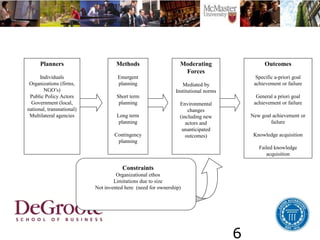
Planners
Individuals
Organizations (firms,
NGO’s)
Public Policy Actors
Government (local,
national, transnational)
Multilateral agencies
Methods
Emergent
planning
Short term
planning
Long term
planning
Contingency
planning
Outcomes
Specific a-priori goal
achievement or failure
General a priori goal
achievement or failure
New goal achievement or
failure
Knowledge acquisition
Failed knowledge
acquisition
Moderating
Forces
Mediated by
Institutional norms
Environmental
changes
(including new
actors and
unanticipated
outcomes)
Constraints
Organizational ethos
Limitations due to size
Not invented here (need for ownership)
7
Empirical Record
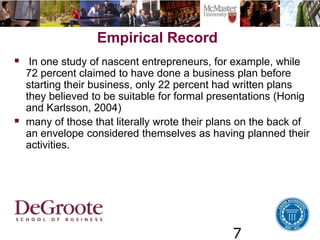
 In one study of nascent entrepreneurs, for example, while
72 percent claimed to have done a business plan before
starting their business, only 22 percent had written plans
they believed to be suitable for formal presentations (Honig
and Karlsson, 2004)
 many of those that literally wrote their plans on the back of
an envelope considered themselves as having planned their
activities.
8
Theory
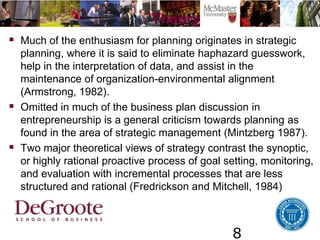
 Much of the enthusiasm for planning originates in strategic
planning, where it is said to eliminate haphazard guesswork,
help in the interpretation of data, and assist in the
maintenance of organization-environmental alignment
(Armstrong, 1982).
 Omitted in much of the business plan discussion in
entrepreneurship is a general criticism towards planning as
found in the area of strategic management (Mintzberg 1987).
 Two major theoretical views of strategy contrast the synoptic,
or highly rational proactive process of goal setting, monitoring,
and evaluation with incremental processes that are less
structured and rational (Fredrickson and Mitchell, 1984)
9
Environmental Stability
 In a comparatively static environment, such as the
building of a house, or the re-establishment of a
proven project (such as a franchise, or a mature
industry) the degree of variability faced by the
planner may be limited, and the advantages of using
a plan significantly greater (Fredrickson and Mitchell,
1984)
 When the environment is subject to rapid changes,
such as the emergence of a new industry, paradigm
shifts, and new types of competition, the planner
faces considerably more challenges (Christensen,
1997; Kanter, 2001)
.
Environmental Stability: Empirical Record
 nascents who perceived their competitive environment to be
more uncertain, and who asked financial institutions for
loans, were more likely to plan than those who did not.
 Thus: nascents who ask for funding, facing increasing
competitive or operational uncertainty, are more likely to
plan – while those facing increasing financial uncertainty
and asking for funding, are less likely to plan.
Environmental Stability: Empirical Record
 we found that those nascent entrepreneurs who indicated
their environment had low financial uncertainty (e.g., was
comparatively certain), and who also asked financial
institutions for funding, were more likely to plan than those
who did not (Honig and Liao, 08)
 In more financially secure situations, entrepreneurs appear
better able to resist coercive planning forces.
 Entrepreneurs who ask for funding, in increasingly
competitive circumstances, are more likely to plan than
those asking for funding in less competitive circumstances.
 entrepreneurs who asked for money and were exposed to
increasing operational uncertainty were more likely to plan
than those who were not so exposed.
Judging a book by its cover
(Karlsson and Honig, JBV)
Bankers had no way of evaluating business
plans – they were simply
Checking off a box”
2
3
Perspective
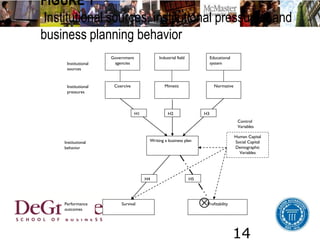
 Our view (Honig and Karlsson, 2004) is that planning
provides legitimacy and signals reputational conformity, but
does not provide advantages in the actual process of
organizational evolution.
14
FIGURE 1
Institutional sources, institutional pressures, and
business planning behavior
Government
agencies
Industrial field Educational
system
NormativeMimeticCoercive
Human Capital
Social Capital
Demographic
Variables
Survival Profitability
Institutional
sources
Institutional
pressures
Performance
outcomes
Control
Variables
Writing a business planInstitutional
behavior
H1 H2 H3
H4

H5
15
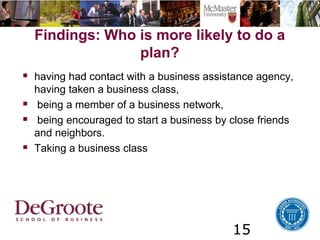
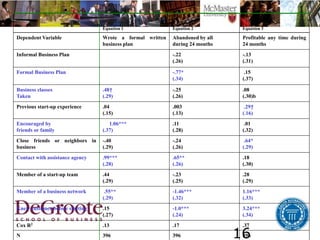
Findings: Who is more likely to do a
plan?
 having had contact with a business assistance agency,
having taken a business class,
 being a member of a business network,
 being encouraged to start a business by close friends
and neighbors.
 Taking a business class
16
.
Equation 1 Equation 2 Equation 3
Dependent Variable Wrote a formal written
business plan
Abandoned by all
during 24 months
Profitable any time during
24 months
Informal Business Plan -.22
(.26)
-.13
(.31)
Formal Business Plan -.77*
(.34)
.15
(.37)
Business classes
Taken
.48†
(.29)
-.25
(.26)
.08
(.30)b
Previous start-up experience .04
(.15)
.003
(.13)
.29†
(.16)
Encouraged by
friends or family
1.06***
(.37)
.11
(.28)
.01
(.32)
Close friends or neighbors in
business
-.40
(.29)
-.24
(.26)
.64*
(.29)
Contact with assistance agency .99***
(.28)
.65**
(.26)
.18
(.30)
Member of a start-up team .44
(.29)
-.23
(.25)
.28
(.29)
Member of a business network .55**
(.29)
-1.46***
(.32)
1.16***
(.33)
Knew customer before starting .15
(.27)
-1.0***
(.24)
3.24***
(.34)
Cox R2 .13 .17 .37
N 396 396 396
17
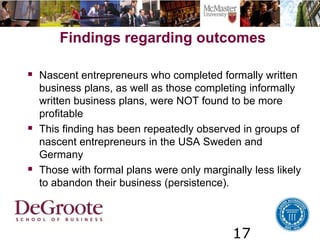
Findings regarding outcomes
 Nascent entrepreneurs who completed formally written
business plans, as well as those completing informally
written business plans, were NOT found to be more
profitable
 This finding has been repeatedly observed in groups of
nascent entrepreneurs in the USA Sweden and
Germany
 Those with formal plans were only marginally less likely
to abandon their business (persistence).
18
Findings: success factors
 social capital related variables:
 Having close friends or neighbors in business
 being a member of a business network
 knowing the customer before starting the business
 were all factors that appeared to significantly increase profitability,
and were negatively associated with project abandonment.
19
So why do plans?
 entrepreneurs may appear more legitimate for having
produced an “award winning” business plan,
 this legitimacy may be a sufficient return on their
psychological and resource investments.
 , the b- plan is sufficiently imbedded in our cultural
landscape as to be supported by actors and agents in a
coercive manner.
 Banks, lending institutions, venture capitalists, small
business associations, and business assistance agencies
all rely upon, and promote, the production and
dissemination of the business plan
20
Alternatives to planning and education
 Honig, (2004) A contingency model of business planning,
Academy of Management, Learning and Education
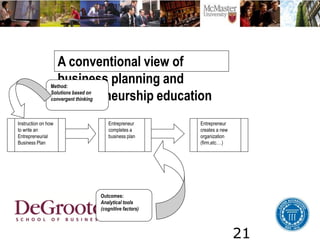
21
Instruction on how
to write an
Entrepreneurial
Business Plan
Entrepreneur
completes a
business plan
Entrepreneur
creates a new
organization
(firm,etc…)
A conventional view of
business planning and
entrepreneurship education
Method:
Solutions based on
convergent thinking
Outcomes:
Analytical tools
(cognitive factors)
22
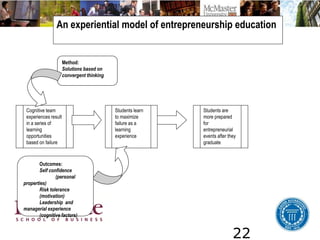
Cognitive team
experiences result
in a series of
learning
opportunities
based on failure
Students learn
to maximize
failure as a
learning
experience
Students are
more prepared
for
entrepreneurial
events after they
graduate
Method:
Solutions based on
convergent thinking
Outcomes:
Self confidence
(personal
properties)
Risk tolerance
(motivation)
Leadership and
managerial experience
(cognitive factors)
An experiential model of entrepreneurship education
23
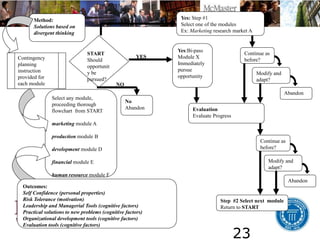
Contingency
planning
instruction
provided for
each module
Yes:Bi-pass
Module X
Immediately
pursue
opportunity
Yes: Step #1
Select one of the modules
Ex: Marketing research market A
Modify and
adapt?
Continue as
before?
Select any module,
proceeding thorough
flowchart from START
marketing module A
production module B
development module D
financial module E
human resource module F
Method:
Solutions based on
divergent thinking
START
Should
opportunit
y be
pursued?
Outcomes:
Self Confidence (personal properties)
Risk Tolerance (motivation)
Leadership and Managerial Tools (cognitive factors)
Practical solutions to new problems (cognitive factors)
Organizational development tools (cognitive factors)
Evaluation tools (cognitive factors)
Abandon
Step #2 Select next module
Return to START
Evaluation
Evaluate Progress
Continue as
before?
Modify and
adapt?
Abandon
No
Abandon
YES
YES
NO
24
Contingency business plan
 activities should be developed that interrelate in an
open ended, dialectic manner, supporting the
development of tacit knowledge and the ability to adapt
and modify a plan, rather than the ability to preconceive
and detail one.
25
Contingency planning
 In the contingency model of business planning
introduced here, there are no direct linear
relationships between the different phases
consisting of opportunity recognition and
exploitation.
 Rather than present a linear relationship based on
information retrieval, analysis, and decision making,
 this model is designed as an open system that can
be started from virtually any point in the
entrepreneurial cycle.
26
Contingency business planning
 Unlike the previous two models, students using the
contingency planning model are encouraged to
pursue divergent thinking (Getzels & Jackson,
1962).
 there is no expectation that any or all modules be
completed before beginning entrepreneurial
activity.
 This is helpful in supporting entrepreneurs to act on
the moment, maximizing opportunity, as opposed
to waiting and deliberating with further analysis
27
Contingency business planning
 The contingency model utilizes Piaget’s theory of
equilibrium, a dynamic process of incremental
knowledge assimulation.
 individuals dynamically and incrementally learn
new approaches to entrepreneurship and apply
them as they make sense in terms of novelty,
appropriateness, and cognitive development
 Divergent thinking is encouraged
 More closely attuned to effectuation (Sarasvathy,
2001),
28
Causation and Effectuation
 How does one pursue solving problems – in particular
those that are ambiguous and changing, as with
entrepreneurship?
 Causation: take a particular effect as given and focuses
on selecting betrween means to create that effect
 Effectuation: takes a set of means as given and focuses
on selecting between different effects that can be created
with a certain set of means
29
Causation
 A client demands a certain menu, the chef lists the ingredients, has
them purchased, and cooks the meal.
 Relies on marketing management – segmentation, targeting and
positioning.
 Requires analytical effort – research, resources, strategies.
30
Effectuation
 The chef looks in his kitchen, sees what is available, and plans a
meal according the the ingredients and utensils available to
him/her.
 Look at the resources available, create an idea acceptable given
the constraints (alliance, renting, etc..)
 End goal might be vastly different from starting point or original
objective.
31
Causal decision making
 Goal is established
 Alternative means identified
 Constraints on means
 Selection process between the different means takes place
32
Effectuation decision process
 A given set of means are identified
 A set of effects or outcomes are examined
 Constraints on effects are identified
 A selection process occurs regarding the different available effects
33
Theory of effectuation (Sarasvathy)
 Affordable loss rather than expected returns – not maximizing
returns, but minimizing loss
 Strategic alliances rather than competitive analysis
 Exploiting unexpected contingencies, not preexisting knowledge.
 To the extent that we can control the future, we do not need to
predict it.
Dr. Boaz Tamir
 Letter to Shai Agassi
 “Managing a startup requires the ability to make sharp
turns. It's a learning process that goes through a series
of trials and market checks in direct contact with
customers. The plan has to be replaced with planning
that includes a series of hypotheses that require
confirmation or a bold change of direction ”.

מצגת פרופ בנסון הוניג

  • 1.
    Planning: The history,theory, and impact of of business planning in contemporary businesses and in business schools: A critical perspective Benson Honig Teresca Cascioli Chair in Entrepreneurial Leadership McMaster University, Hamilton, Ontario Canada bhonig@mcmaster.ca
  • 2.
    2 THE UNTOLD STORYOF BUSINESS PLANNING IN NEW ORGANIZATIONS  Why plan?  Who plans?  Who doesn’t plan?  Who should plan?  Who should not plan?
  • 3.
    3 Why plan?  “whyplan” is tantamount to asking “why learn”?  Advocates of planning exist at every turn, inhabiting the political, social, cultural, economic, and educational spheres  theories to guide the potential planning process are virtually nonexistent
  • 4.
    4 Why plan?  Humansare not the only species that can be accused of planning, although we are certainly the most capable (squirrels are pretty good!)  For many of us, plans become the end objective, as opposed to the means of attaining particular goals  a set of objectives for determining potential activities in pursuit of future circumstances currently preferred by actors with resources, or seeking resources, in order to influence specific outcomes (Troub, 1982).  Planning assumes that the future is predictable, linear, and manageable
  • 5.
    5 Are planning outcomesnecessary and positive?  The pyramids, one of the wonders of the world, took many decades to build, and were obviously well planned activities. Planners would have required precise and elaborate consideration regarding a range of issues including labor, economics, materials, and organizational management.  Is planning an essential component of civilization, technological development, production, organization, and all achievements of any importance? Do we have ‘accidental’ achievements?  The Easter Island Moai construction project, the successful implementation of numerous carefully implemented plans, led to the virtual ecological collapse for the island and its’ people (Wright, 2004; Diamond, 2005)
  • 6.
    6 Planners Individuals Organizations (firms, NGO’s) Public PolicyActors Government (local, national, transnational) Multilateral agencies Methods Emergent planning Short term planning Long term planning Contingency planning Outcomes Specific a-priori goal achievement or failure General a priori goal achievement or failure New goal achievement or failure Knowledge acquisition Failed knowledge acquisition Moderating Forces Mediated by Institutional norms Environmental changes (including new actors and unanticipated outcomes) Constraints Organizational ethos Limitations due to size Not invented here (need for ownership)
  • 7.
    7 Empirical Record  Inone study of nascent entrepreneurs, for example, while 72 percent claimed to have done a business plan before starting their business, only 22 percent had written plans they believed to be suitable for formal presentations (Honig and Karlsson, 2004)  many of those that literally wrote their plans on the back of an envelope considered themselves as having planned their activities.
  • 8.
    8 Theory  Much ofthe enthusiasm for planning originates in strategic planning, where it is said to eliminate haphazard guesswork, help in the interpretation of data, and assist in the maintenance of organization-environmental alignment (Armstrong, 1982).  Omitted in much of the business plan discussion in entrepreneurship is a general criticism towards planning as found in the area of strategic management (Mintzberg 1987).  Two major theoretical views of strategy contrast the synoptic, or highly rational proactive process of goal setting, monitoring, and evaluation with incremental processes that are less structured and rational (Fredrickson and Mitchell, 1984)
  • 9.
    9 Environmental Stability  Ina comparatively static environment, such as the building of a house, or the re-establishment of a proven project (such as a franchise, or a mature industry) the degree of variability faced by the planner may be limited, and the advantages of using a plan significantly greater (Fredrickson and Mitchell, 1984)  When the environment is subject to rapid changes, such as the emergence of a new industry, paradigm shifts, and new types of competition, the planner faces considerably more challenges (Christensen, 1997; Kanter, 2001)
  • 10.
    . Environmental Stability: EmpiricalRecord  nascents who perceived their competitive environment to be more uncertain, and who asked financial institutions for loans, were more likely to plan than those who did not.  Thus: nascents who ask for funding, facing increasing competitive or operational uncertainty, are more likely to plan – while those facing increasing financial uncertainty and asking for funding, are less likely to plan.
  • 11.
    Environmental Stability: EmpiricalRecord  we found that those nascent entrepreneurs who indicated their environment had low financial uncertainty (e.g., was comparatively certain), and who also asked financial institutions for funding, were more likely to plan than those who did not (Honig and Liao, 08)  In more financially secure situations, entrepreneurs appear better able to resist coercive planning forces.  Entrepreneurs who ask for funding, in increasingly competitive circumstances, are more likely to plan than those asking for funding in less competitive circumstances.  entrepreneurs who asked for money and were exposed to increasing operational uncertainty were more likely to plan than those who were not so exposed.
  • 12.
    Judging a bookby its cover (Karlsson and Honig, JBV) Bankers had no way of evaluating business plans – they were simply Checking off a box” 2
  • 13.
    3 Perspective  Our view(Honig and Karlsson, 2004) is that planning provides legitimacy and signals reputational conformity, but does not provide advantages in the actual process of organizational evolution.
  • 14.
    14 FIGURE 1 Institutional sources,institutional pressures, and business planning behavior Government agencies Industrial field Educational system NormativeMimeticCoercive Human Capital Social Capital Demographic Variables Survival Profitability Institutional sources Institutional pressures Performance outcomes Control Variables Writing a business planInstitutional behavior H1 H2 H3 H4  H5
  • 15.
    15 Findings: Who ismore likely to do a plan?  having had contact with a business assistance agency, having taken a business class,  being a member of a business network,  being encouraged to start a business by close friends and neighbors.  Taking a business class
  • 16.
    16 . Equation 1 Equation2 Equation 3 Dependent Variable Wrote a formal written business plan Abandoned by all during 24 months Profitable any time during 24 months Informal Business Plan -.22 (.26) -.13 (.31) Formal Business Plan -.77* (.34) .15 (.37) Business classes Taken .48† (.29) -.25 (.26) .08 (.30)b Previous start-up experience .04 (.15) .003 (.13) .29† (.16) Encouraged by friends or family 1.06*** (.37) .11 (.28) .01 (.32) Close friends or neighbors in business -.40 (.29) -.24 (.26) .64* (.29) Contact with assistance agency .99*** (.28) .65** (.26) .18 (.30) Member of a start-up team .44 (.29) -.23 (.25) .28 (.29) Member of a business network .55** (.29) -1.46*** (.32) 1.16*** (.33) Knew customer before starting .15 (.27) -1.0*** (.24) 3.24*** (.34) Cox R2 .13 .17 .37 N 396 396 396
  • 17.
    17 Findings regarding outcomes Nascent entrepreneurs who completed formally written business plans, as well as those completing informally written business plans, were NOT found to be more profitable  This finding has been repeatedly observed in groups of nascent entrepreneurs in the USA Sweden and Germany  Those with formal plans were only marginally less likely to abandon their business (persistence).
  • 18.
    18 Findings: success factors social capital related variables:  Having close friends or neighbors in business  being a member of a business network  knowing the customer before starting the business  were all factors that appeared to significantly increase profitability, and were negatively associated with project abandonment.
  • 19.
    19 So why doplans?  entrepreneurs may appear more legitimate for having produced an “award winning” business plan,  this legitimacy may be a sufficient return on their psychological and resource investments.  , the b- plan is sufficiently imbedded in our cultural landscape as to be supported by actors and agents in a coercive manner.  Banks, lending institutions, venture capitalists, small business associations, and business assistance agencies all rely upon, and promote, the production and dissemination of the business plan
  • 20.
    20 Alternatives to planningand education  Honig, (2004) A contingency model of business planning, Academy of Management, Learning and Education
  • 21.
    21 Instruction on how towrite an Entrepreneurial Business Plan Entrepreneur completes a business plan Entrepreneur creates a new organization (firm,etc…) A conventional view of business planning and entrepreneurship education Method: Solutions based on convergent thinking Outcomes: Analytical tools (cognitive factors)
  • 22.
    22 Cognitive team experiences result ina series of learning opportunities based on failure Students learn to maximize failure as a learning experience Students are more prepared for entrepreneurial events after they graduate Method: Solutions based on convergent thinking Outcomes: Self confidence (personal properties) Risk tolerance (motivation) Leadership and managerial experience (cognitive factors) An experiential model of entrepreneurship education
  • 23.
    23 Contingency planning instruction provided for each module Yes:Bi-pass ModuleX Immediately pursue opportunity Yes: Step #1 Select one of the modules Ex: Marketing research market A Modify and adapt? Continue as before? Select any module, proceeding thorough flowchart from START marketing module A production module B development module D financial module E human resource module F Method: Solutions based on divergent thinking START Should opportunit y be pursued? Outcomes: Self Confidence (personal properties) Risk Tolerance (motivation) Leadership and Managerial Tools (cognitive factors) Practical solutions to new problems (cognitive factors) Organizational development tools (cognitive factors) Evaluation tools (cognitive factors) Abandon Step #2 Select next module Return to START Evaluation Evaluate Progress Continue as before? Modify and adapt? Abandon No Abandon YES YES NO
  • 24.
    24 Contingency business plan activities should be developed that interrelate in an open ended, dialectic manner, supporting the development of tacit knowledge and the ability to adapt and modify a plan, rather than the ability to preconceive and detail one.
  • 25.
    25 Contingency planning  Inthe contingency model of business planning introduced here, there are no direct linear relationships between the different phases consisting of opportunity recognition and exploitation.  Rather than present a linear relationship based on information retrieval, analysis, and decision making,  this model is designed as an open system that can be started from virtually any point in the entrepreneurial cycle.
  • 26.
    26 Contingency business planning Unlike the previous two models, students using the contingency planning model are encouraged to pursue divergent thinking (Getzels & Jackson, 1962).  there is no expectation that any or all modules be completed before beginning entrepreneurial activity.  This is helpful in supporting entrepreneurs to act on the moment, maximizing opportunity, as opposed to waiting and deliberating with further analysis
  • 27.
    27 Contingency business planning The contingency model utilizes Piaget’s theory of equilibrium, a dynamic process of incremental knowledge assimulation.  individuals dynamically and incrementally learn new approaches to entrepreneurship and apply them as they make sense in terms of novelty, appropriateness, and cognitive development  Divergent thinking is encouraged  More closely attuned to effectuation (Sarasvathy, 2001),
  • 28.
    28 Causation and Effectuation How does one pursue solving problems – in particular those that are ambiguous and changing, as with entrepreneurship?  Causation: take a particular effect as given and focuses on selecting betrween means to create that effect  Effectuation: takes a set of means as given and focuses on selecting between different effects that can be created with a certain set of means
  • 29.
    29 Causation  A clientdemands a certain menu, the chef lists the ingredients, has them purchased, and cooks the meal.  Relies on marketing management – segmentation, targeting and positioning.  Requires analytical effort – research, resources, strategies.
  • 30.
    30 Effectuation  The cheflooks in his kitchen, sees what is available, and plans a meal according the the ingredients and utensils available to him/her.  Look at the resources available, create an idea acceptable given the constraints (alliance, renting, etc..)  End goal might be vastly different from starting point or original objective.
  • 31.
    31 Causal decision making Goal is established  Alternative means identified  Constraints on means  Selection process between the different means takes place
  • 32.
    32 Effectuation decision process A given set of means are identified  A set of effects or outcomes are examined  Constraints on effects are identified  A selection process occurs regarding the different available effects
  • 33.
    33 Theory of effectuation(Sarasvathy)  Affordable loss rather than expected returns – not maximizing returns, but minimizing loss  Strategic alliances rather than competitive analysis  Exploiting unexpected contingencies, not preexisting knowledge.  To the extent that we can control the future, we do not need to predict it.
  • 34.
    Dr. Boaz Tamir Letter to Shai Agassi  “Managing a startup requires the ability to make sharp turns. It's a learning process that goes through a series of trials and market checks in direct contact with customers. The plan has to be replaced with planning that includes a series of hypotheses that require confirmation or a bold change of direction ”.