
© Siemens AG, Corporate Technology
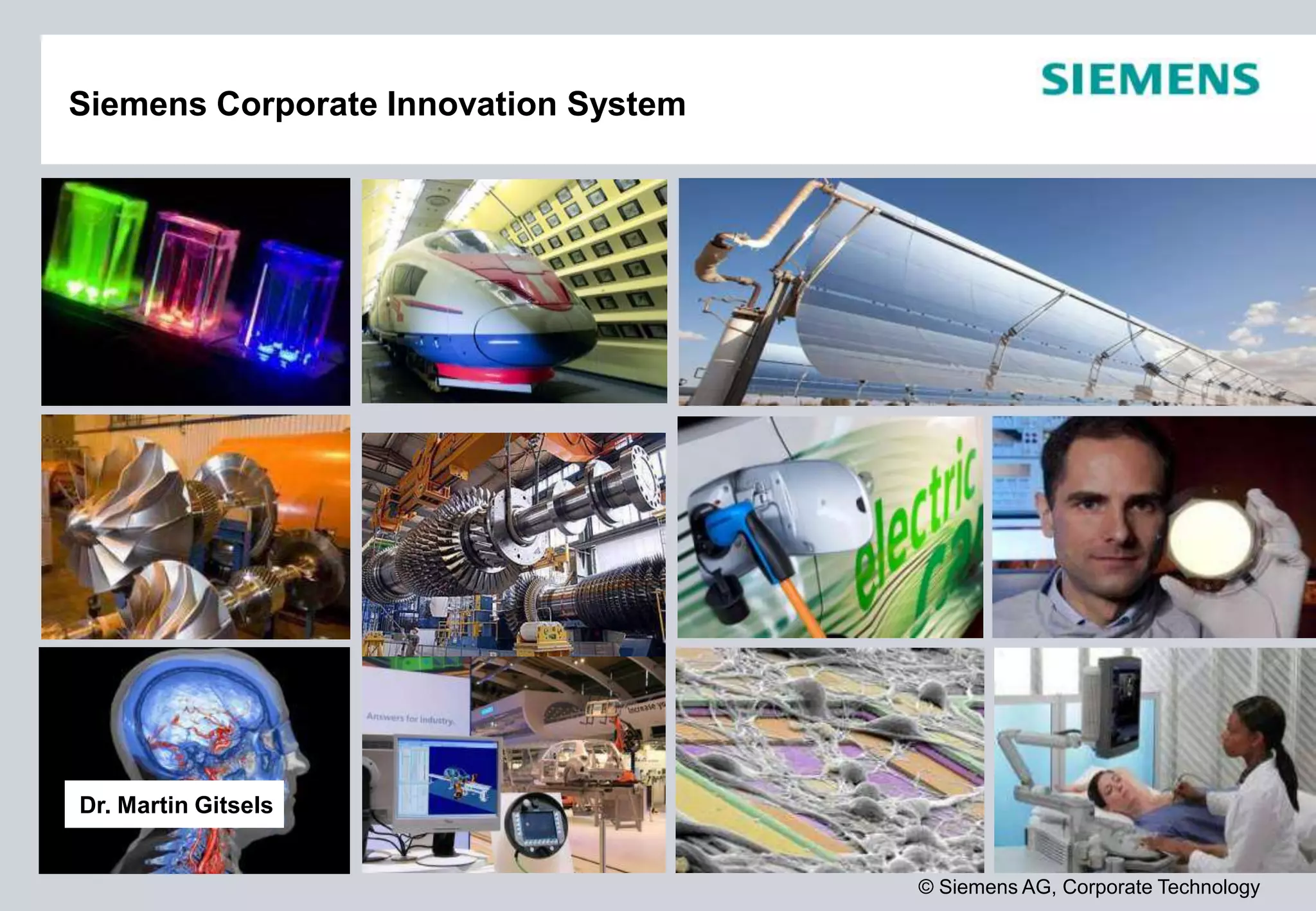
Siemens Corporate Innovation System
Dr. Martin Gitsels
© Siemens AG, Corporate Technology
Siemens around the World
 Siemens is the largest electric and electronics company,
a world leader in solutions for a wide range of industries.
 Since more than 165 years the Siemens brand stands
for advanced technologies, progress and constant
growth.
 Today the company operates in more than 190 countries
across the world with more than 370 000 employees.
 In FY 2012 (as of September 30, 2012) sales reached
78,3 bln euro, while the profit exceeded 4,59 bln euro.
© Siemens AG, Corporate Technology
Today’s business
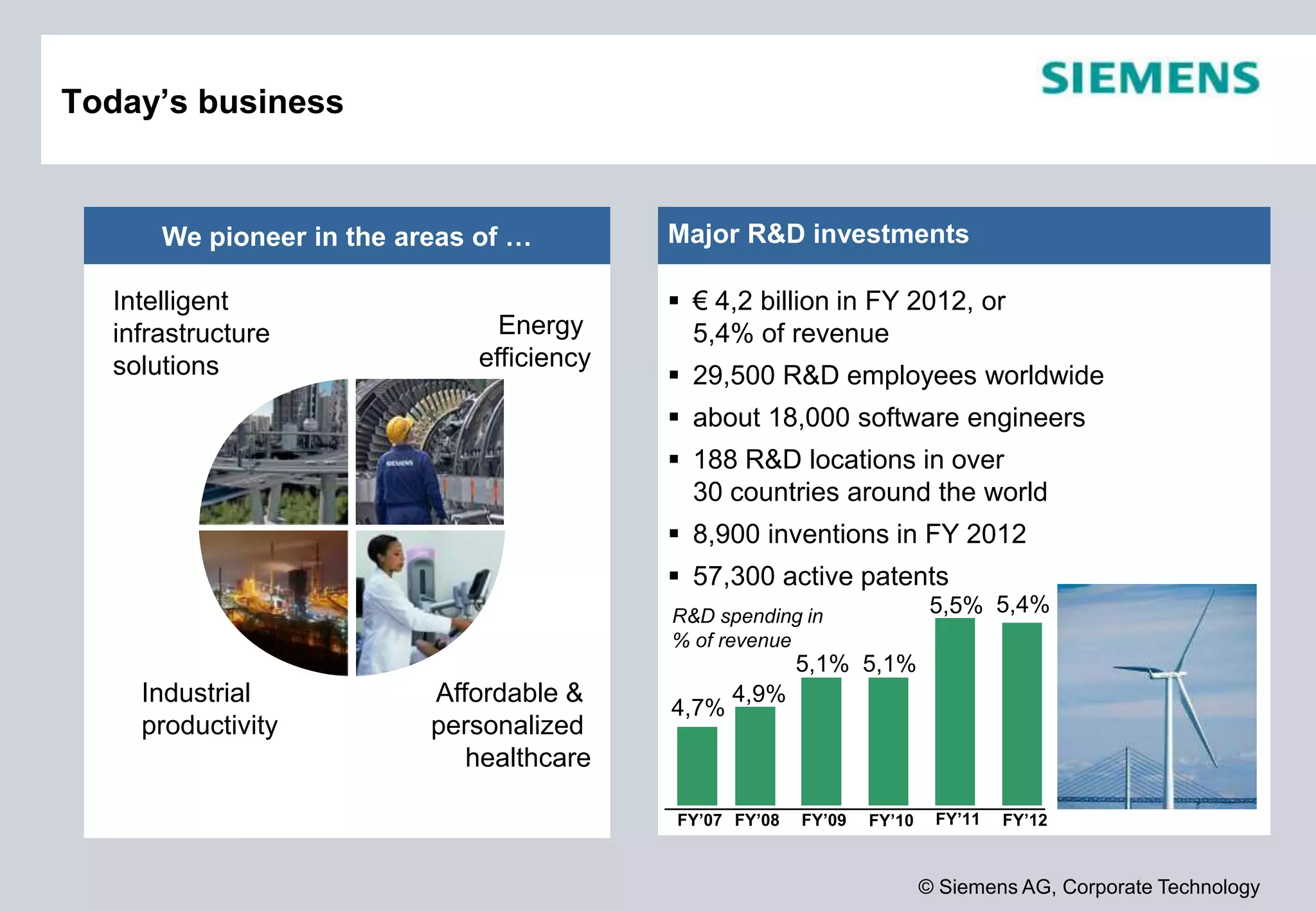
Major R&D investments
 € 4,2 billion in FY 2012, or
5,4% of revenue
 29,500 R&D employees worldwide
 about 18,000 software engineers
 188 R&D locations in over
30 countries around the world
 8,900 inventions in FY 2012
 57,300 active patents
FY’07
5,1%
4,7%
4,9%
5,1%
R&D spending in
% of revenue
5,5%
FY’08 FY’09 FY’10 FY’11
We pioneer in the areas of …
Energy
efficiency
Intelligent
infrastructure
solutions
Affordable &
personalized
healthcare
Industrial
productivity
FY’12
5,4%
© Siemens AG, Corporate Technology
Research and innovation complement each other
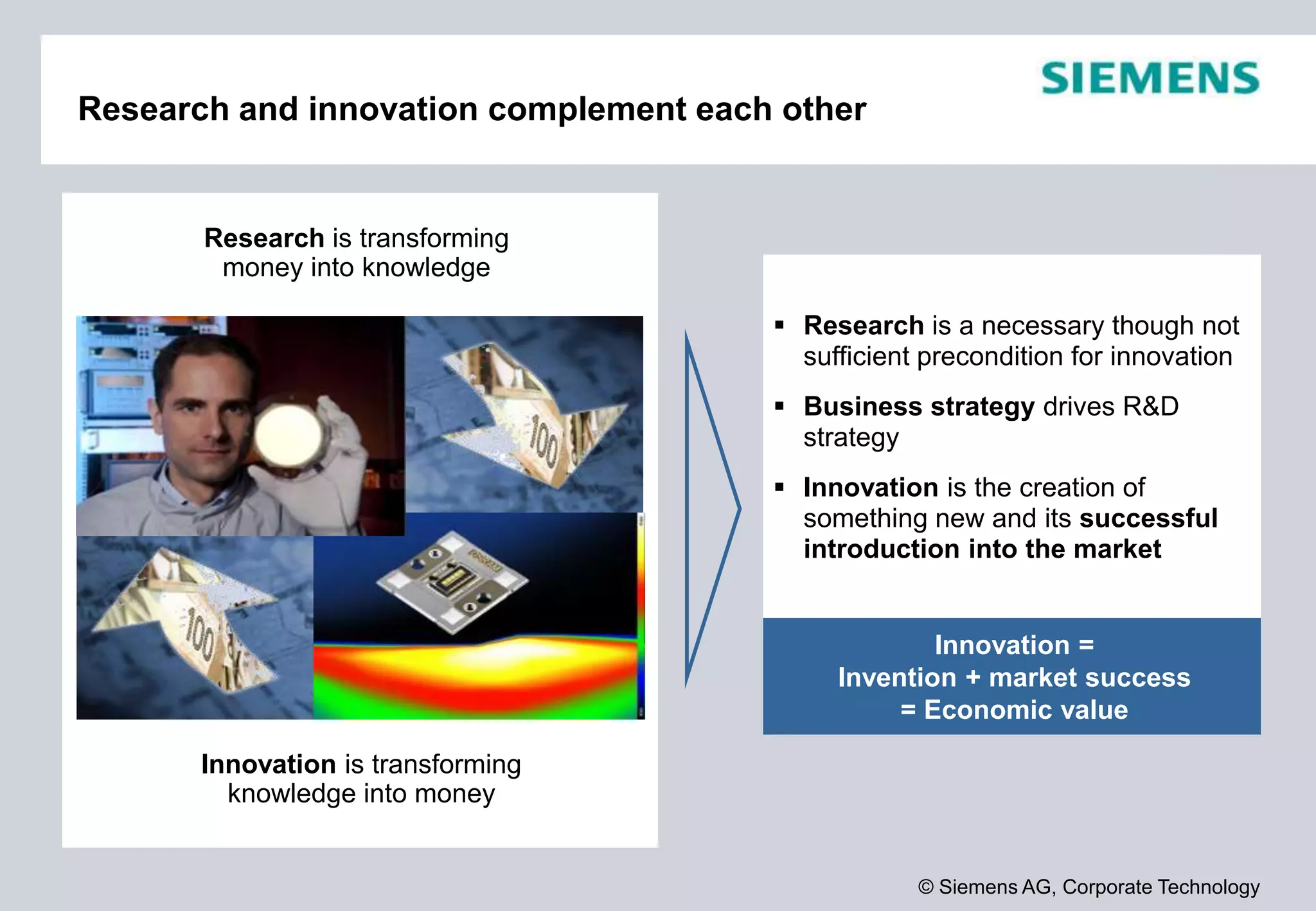
 Research is a necessary though not
sufficient precondition for innovation
 Business strategy drives R&D
strategy
 Innovation is the creation of
something new and its successful
introduction into the market
Innovation is transforming
knowledge into money
Research is transforming
money into knowledge
Innovation =
Invention + market success
= Economic value
© Siemens AG, Corporate Technology
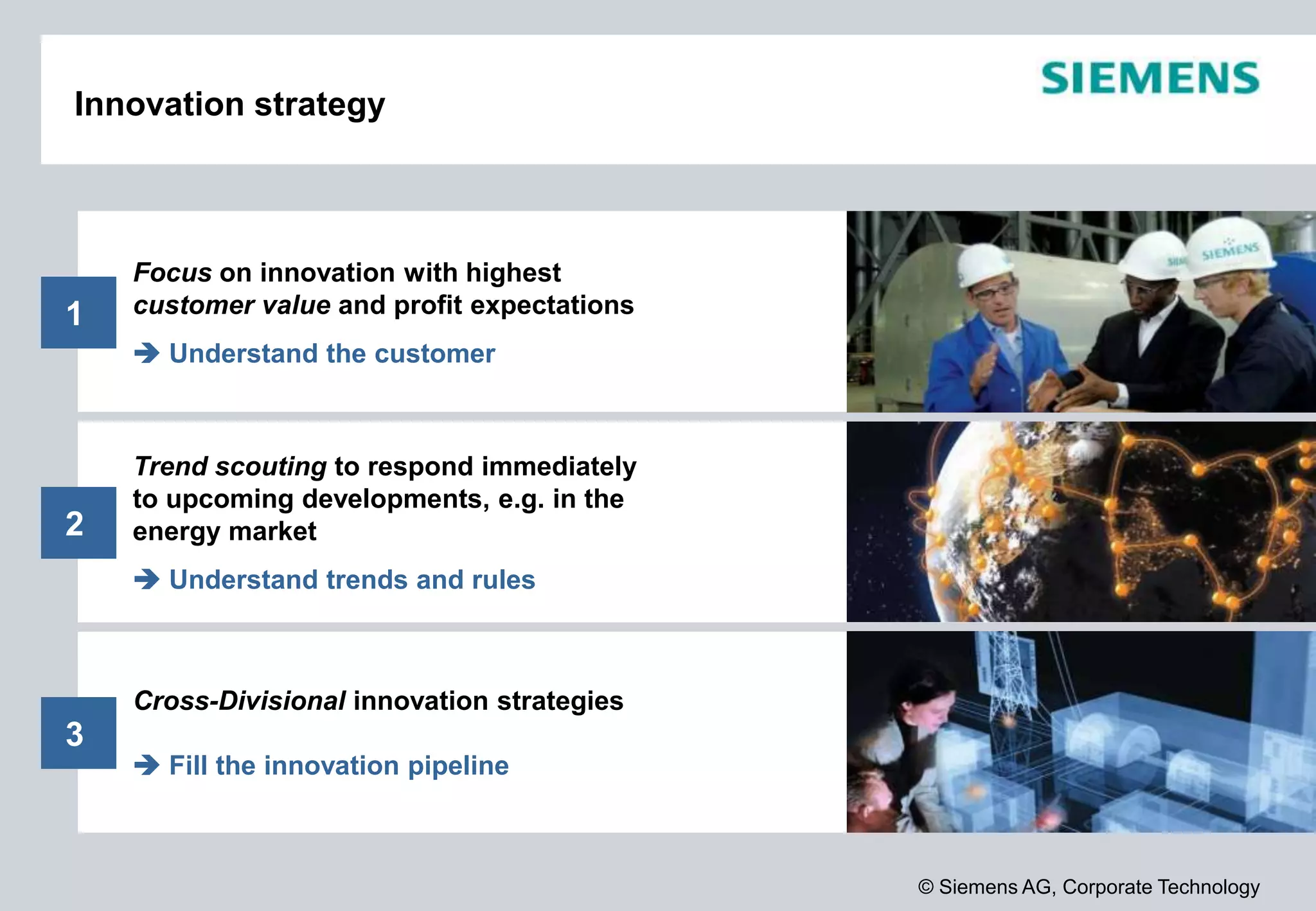
Innovation strategy
Focus on innovation with highest
customer value and profit expectations
 Understand the customer
Trend scouting to respond immediately
to upcoming developments, e.g. in the
energy market
 Understand trends and rules
Cross-Divisional innovation strategies
 Fill the innovation pipeline
2
1
3
© Siemens AG, Corporate Technology
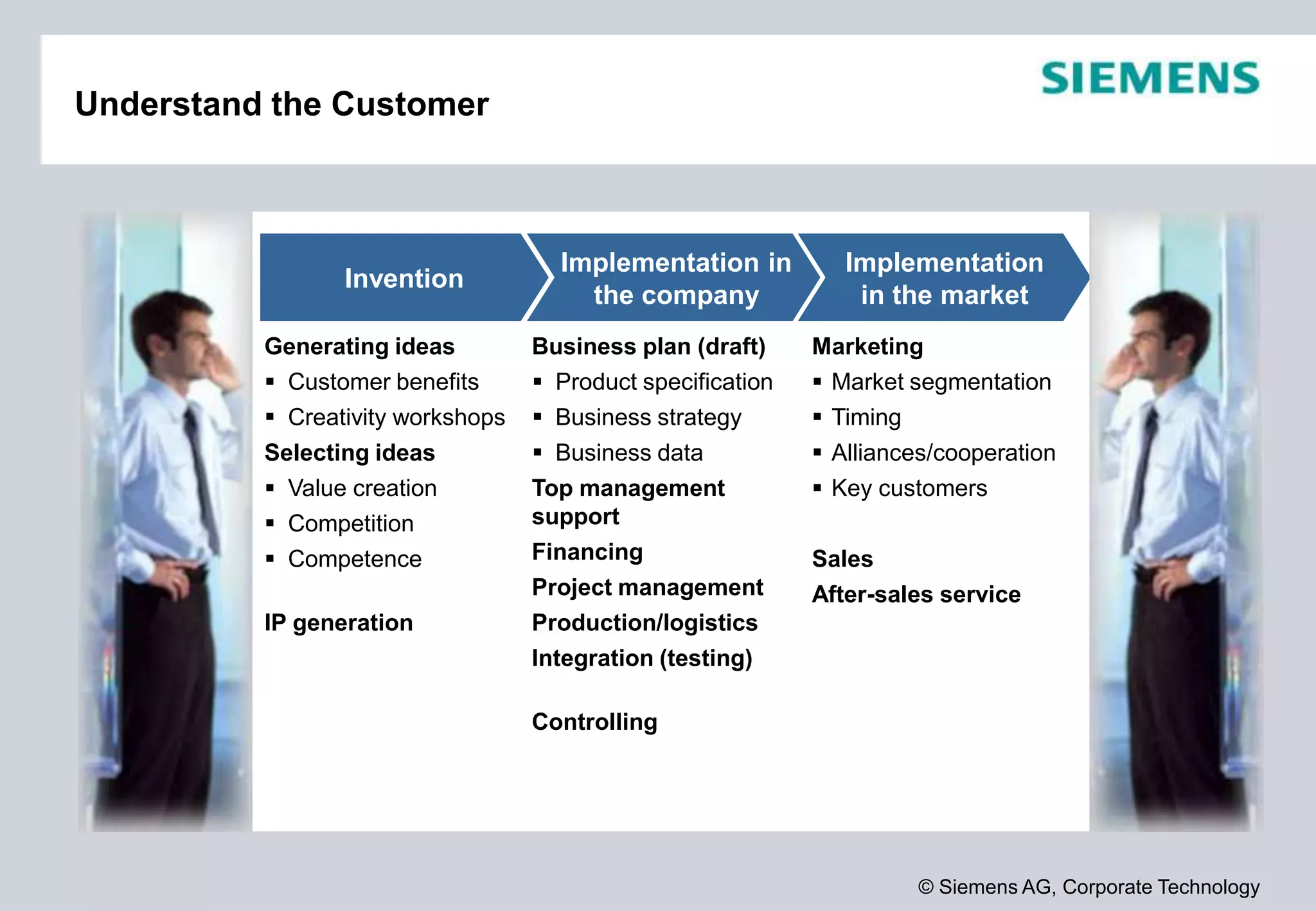
Understand the Customer
Anforderun
gen des
Kunden
Invention
Implementation in
the company
Implementation
in the market
Generating ideas
 Customer benefits
 Creativity workshops
Selecting ideas
 Value creation
 Competition
 Competence
IP generation
Business plan (draft)
 Product specification
 Business strategy
 Business data
Top management
support
Financing
Project management
Production/logistics
Integration (testing)
Controlling
Marketing
 Market segmentation
 Timing
 Alliances/cooperation
 Key customers
Sales
After-sales service
Lösungen
für den
Kunden
© Siemens AG, Corporate Technology
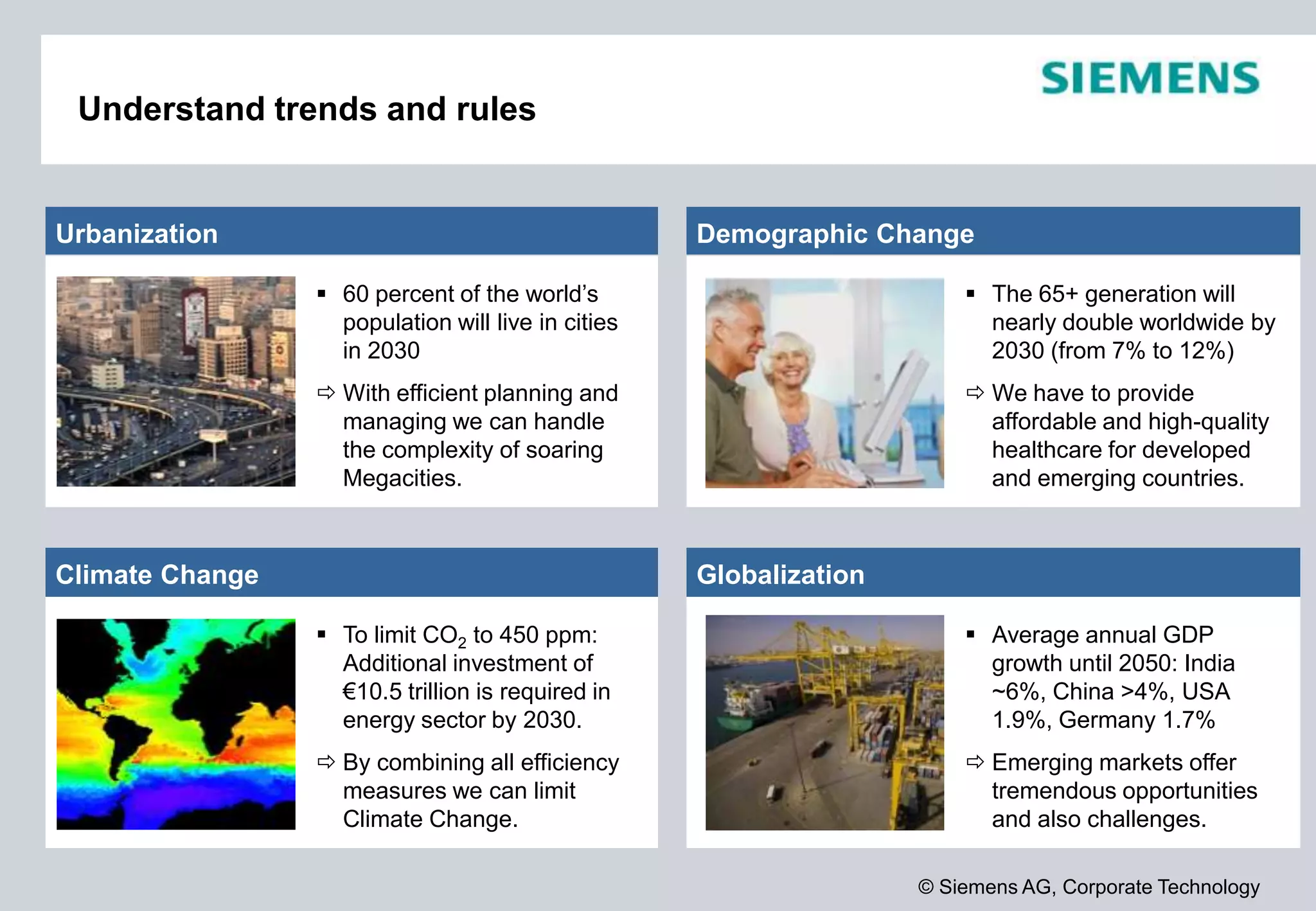
Understand trends and rules
Urbanization
 60 percent of the world’s
population will live in cities
in 2030
 With efficient planning and
managing we can handle
the complexity of soaring
Megacities.
Demographic Change
 The 65+ generation will
nearly double worldwide by
2030 (from 7% to 12%)
 We have to provide
affordable and high-quality
healthcare for developed
and emerging countries.
Climate Change
 To limit CO2 to 450 ppm:
Additional investment of
€10.5 trillion is required in
energy sector by 2030.
 By combining all efficiency
measures we can limit
Climate Change.
Globalization
 Average annual GDP
growth until 2050: India
~6%, China >4%, USA
1.9%, Germany 1.7%
 Emerging markets offer
tremendous opportunities
and also challenges.
© Siemens AG, Corporate Technology
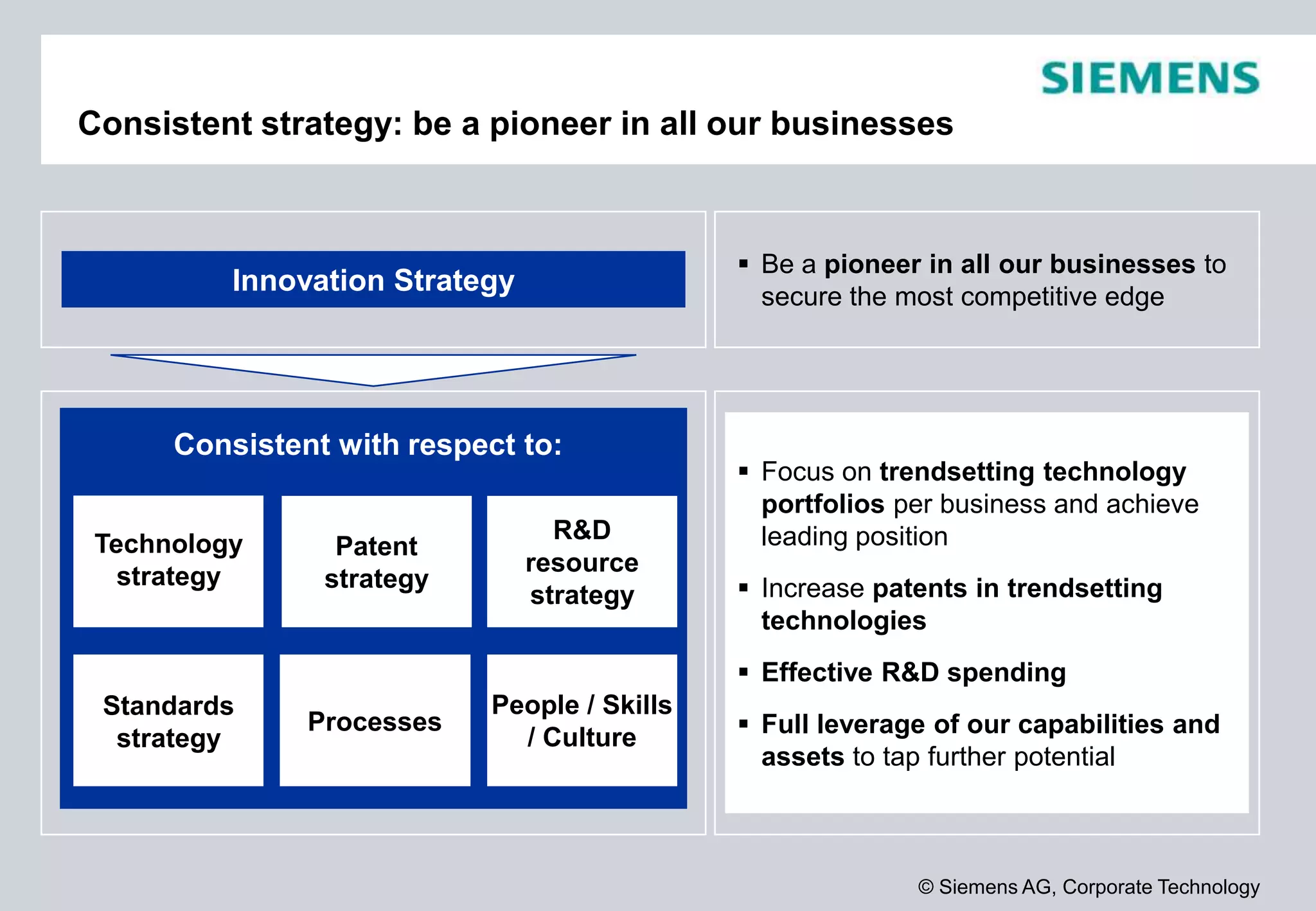
Innovation Strategy
Consistent with respect to:
Consistent strategy: be a pioneer in all our businesses
Technology
strategy
Patent
strategy
R&D
resource
strategy
Standards
strategy
Processes
People / Skills
/ Culture
 Be a pioneer in all our businesses to
secure the most competitive edge
 Focus on trendsetting technology
portfolios per business and achieve
leading position
 Increase patents in trendsetting
technologies
 Effective R&D spending
 Full leverage of our capabilities and
assets to tap further potential
© Siemens AG, Corporate Technology
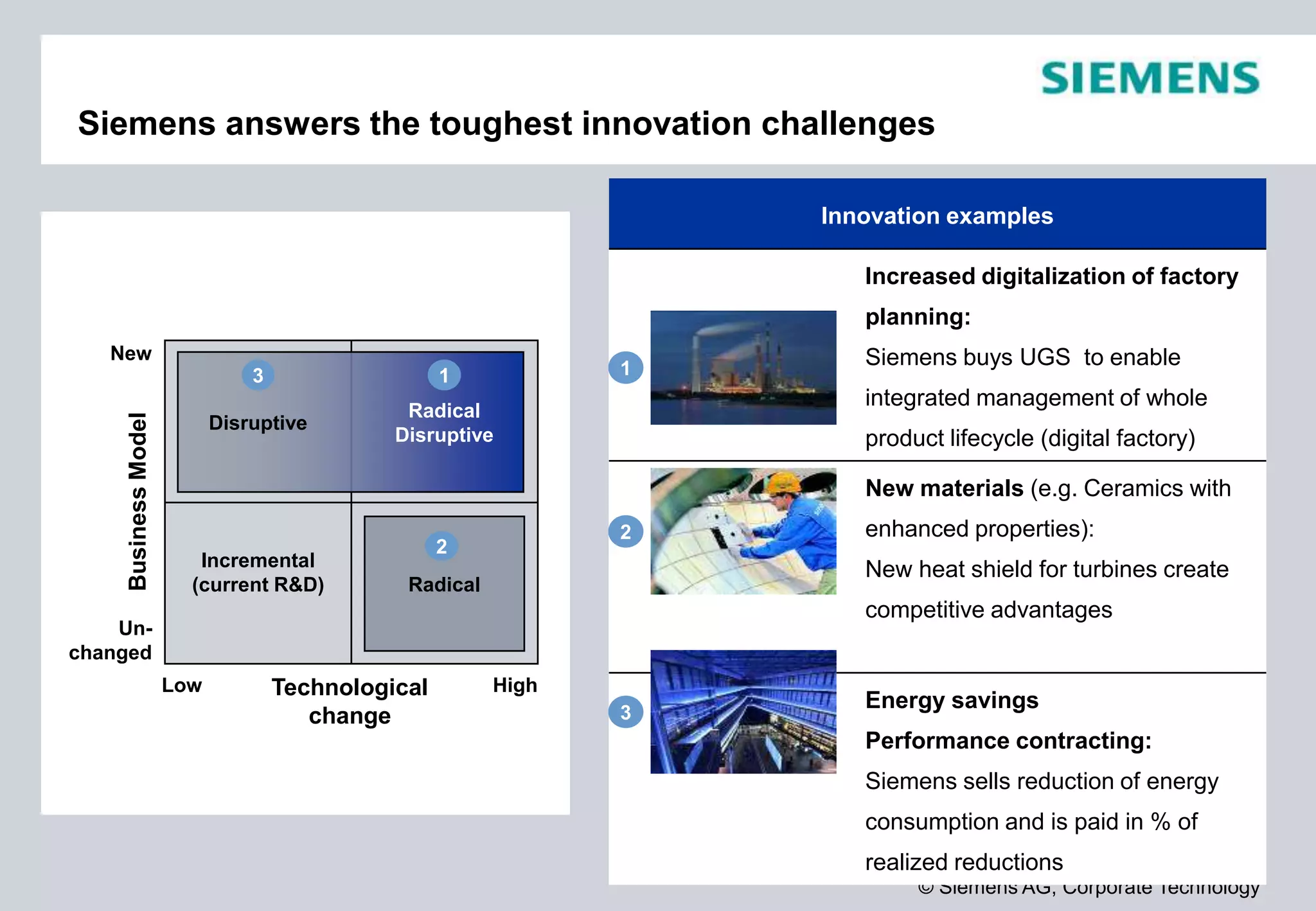
Siemens answers the toughest innovation challenges
Technological
change
BusinessModel
Low High
New
Un-
changed
Radical
Disruptive
Disruptive
Radical
Incremental
(current R&D)
13
2
Innovation examples
Increased digitalization of factory
planning:
Siemens buys UGS to enable
integrated management of whole
product lifecycle (digital factory)
New materials (e.g. Ceramics with
enhanced properties):
New heat shield for turbines create
competitive advantages
Energy savings
Performance contracting:
Siemens sells reduction of energy
consumption and is paid in % of
realized reductions
1
2
3
© Siemens AG, Corporate Technology
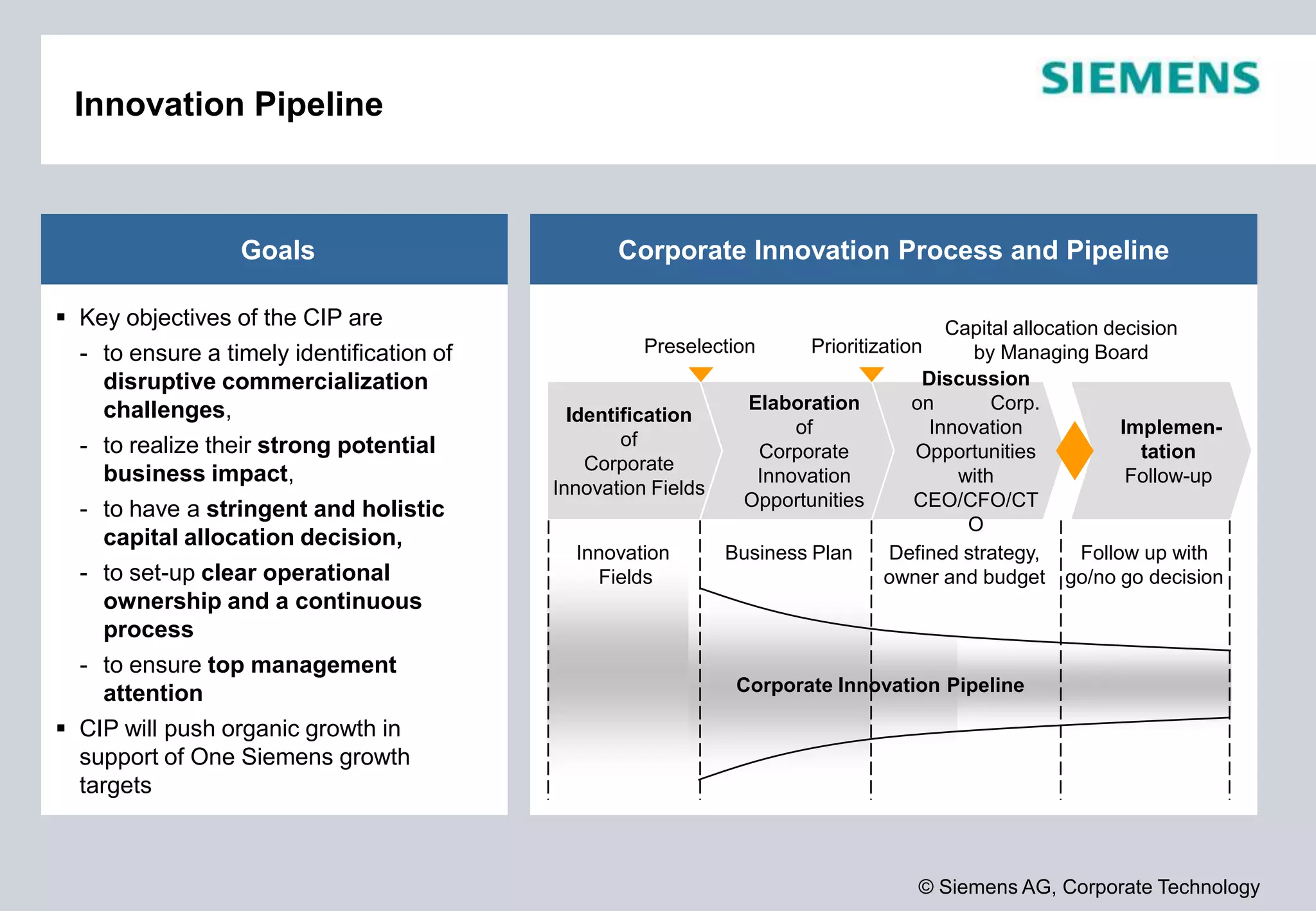
Innovation Pipeline
 Key objectives of the CIP are
- to ensure a timely identification of
disruptive commercialization
challenges,
- to realize their strong potential
business impact,
- to have a stringent and holistic
capital allocation decision,
- to set-up clear operational
ownership and a continuous
process
- to ensure top management
attention
 CIP will push organic growth in
support of One Siemens growth
targets
Goals Corporate Innovation Process and Pipeline
Discussion
on Corp.
Innovation
Opportunities
with
CEO/CFO/CT
O
Elaboration
of
Corporate
Innovation
Opportunities
Identification
of
Corporate
Innovation Fields
Implemen-
tation
Follow-up
Capital allocation decision
by Managing BoardPrioritizationPreselection
Corporate Innovation Pipeline
Business Plan Follow up with
go/no go decision
Defined strategy,
owner and budget
Innovation
Fields
© Siemens AG, Corporate Technology
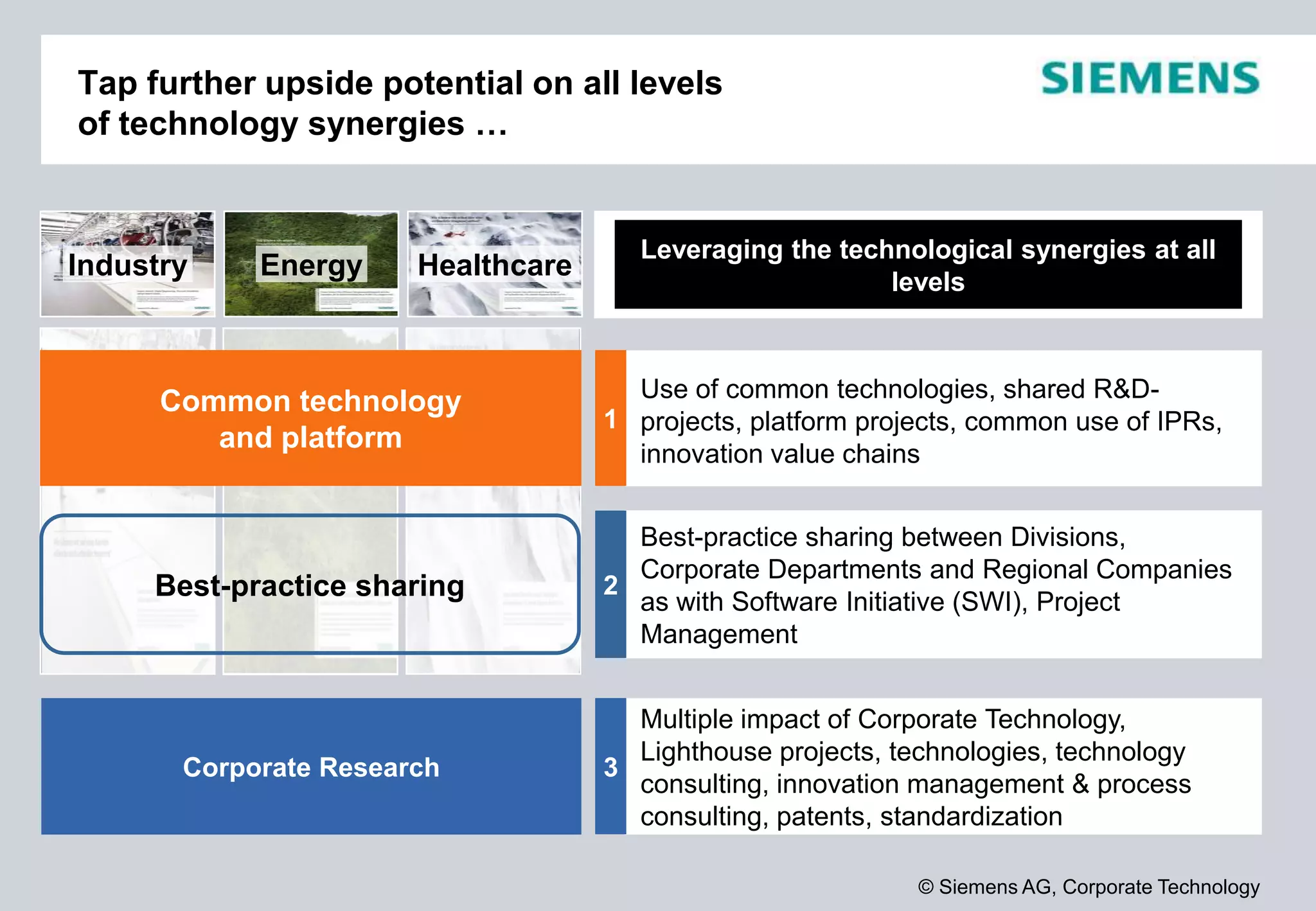
Leveraging the technological synergies at all
levels
Industry Energy Healthcare
Tap further upside potential on all levels
of technology synergies …
Best-practice sharing between Divisions,
Corporate Departments and Regional Companies
as with Software Initiative (SWI), Project
Management
3
Multiple impact of Corporate Technology,
Lighthouse projects, technologies, technology
consulting, innovation management & process
consulting, patents, standardization
Corporate Research
Best-practice sharing
Use of common technologies, shared R&D-
projects, platform projects, common use of IPRs,
innovation value chains
Common technology
and platform
1
2
© Siemens AG, Corporate Technology
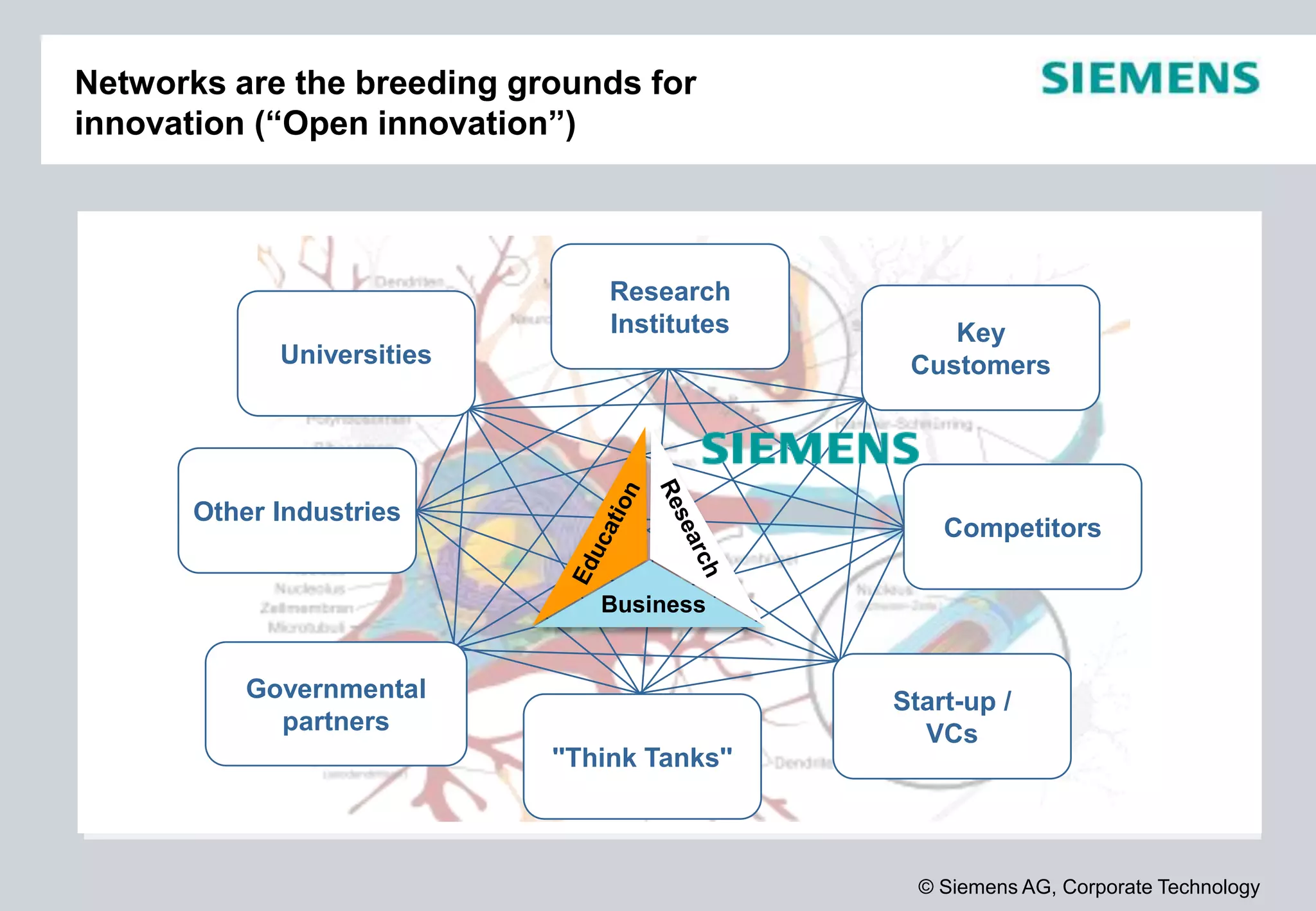
Networks are the breeding grounds for
innovation (“Open innovation”)
Start-up /
VCs
''Think Tanks''
Competitors
Key
Customers
Research
Institutes
Universities
Other Industries
Governmental
partners
Business
© Siemens AG, Corporate Technology
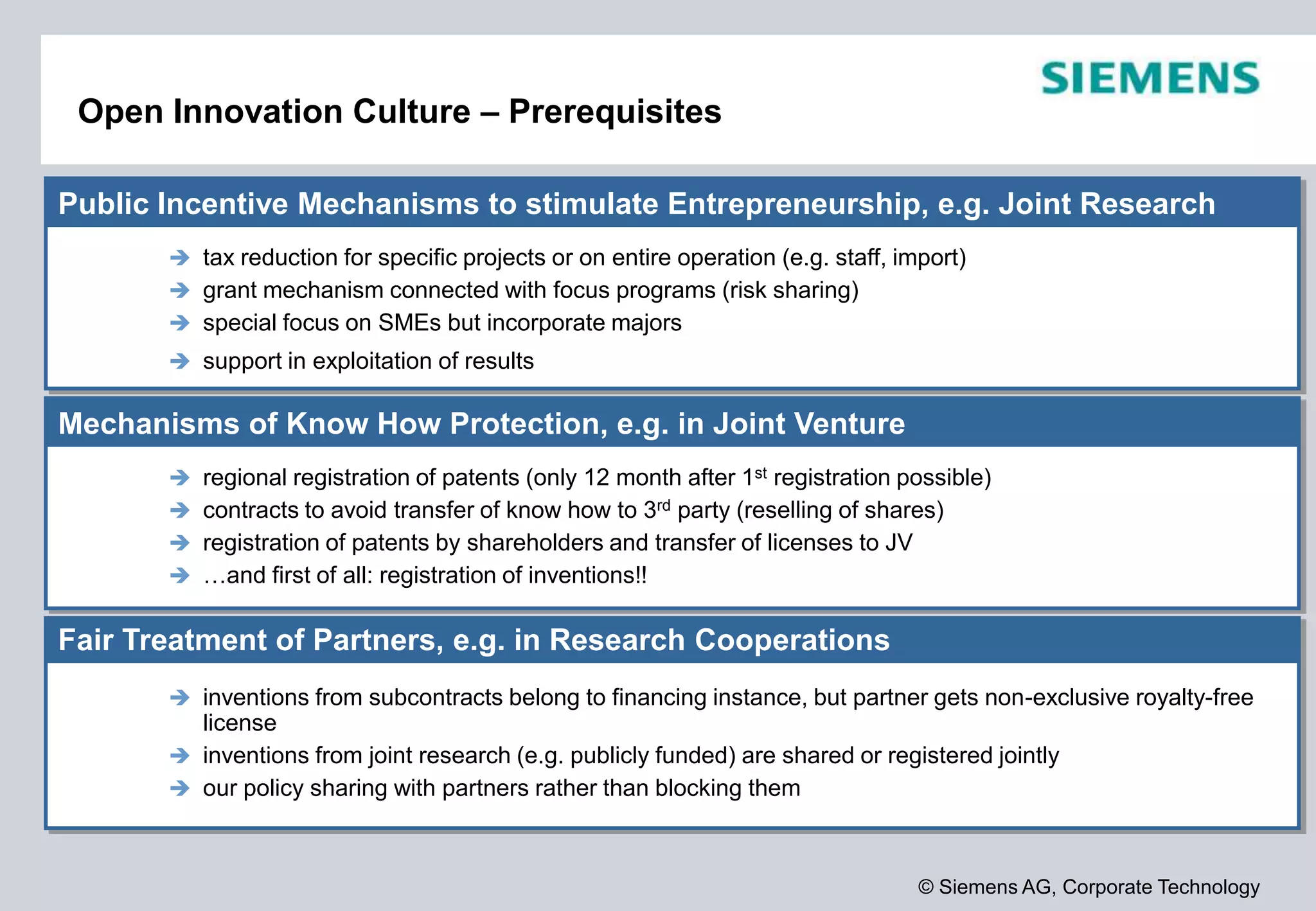
Open Innovation Culture – Prerequisites
Public Incentive Mechanisms to stimulate Entrepreneurship, e.g. Joint Research
 tax reduction for specific projects or on entire operation (e.g. staff, import)
 grant mechanism connected with focus programs (risk sharing)
 special focus on SMEs but incorporate majors
 support in exploitation of results
Mechanisms of Know How Protection, e.g. in Joint Venture
 regional registration of patents (only 12 month after 1st registration possible)
 contracts to avoid transfer of know how to 3rd party (reselling of shares)
 registration of patents by shareholders and transfer of licenses to JV
 …and first of all: registration of inventions!!
Fair Treatment of Partners, e.g. in Research Cooperations
 inventions from subcontracts belong to financing instance, but partner gets non-exclusive royalty-free
license
 inventions from joint research (e.g. publicly funded) are shared or registered jointly
 our policy sharing with partners rather than blocking them
© Siemens AG, Corporate Technology
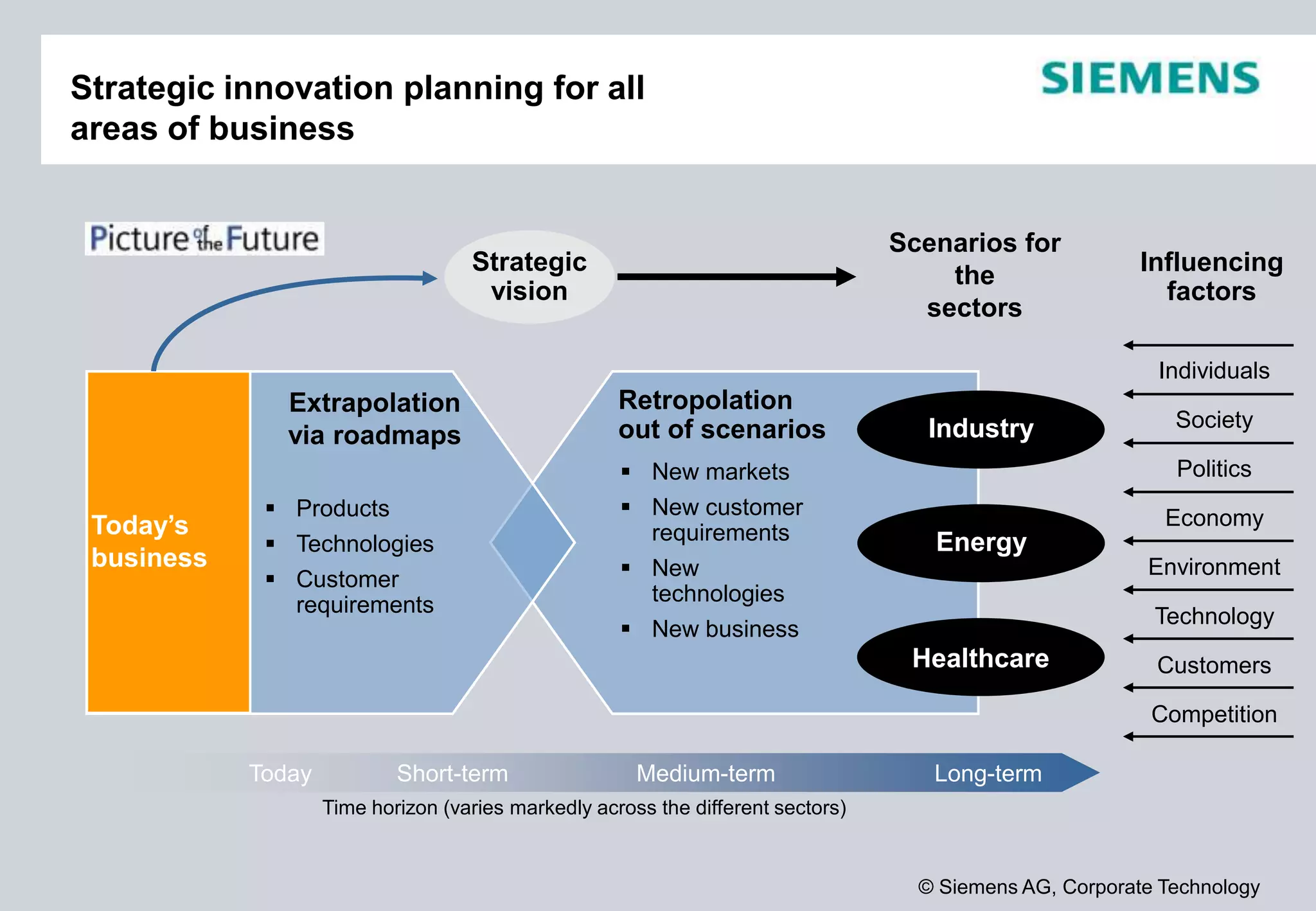
Scenarios for
the
sectors
Time horizon (varies markedly across the different sectors)
Short-term Medium-term Long-termToday
Influencing
factors
 New markets
 New customer
requirements
 New
technologies
 New business
Today’s
business
Extrapolation
via roadmaps
 Products
 Technologies
 Customer
requirements
Retropolation
out of scenarios
Individuals
Society
Politics
Economy
Environment
Technology
Customers
Competition
Strategic
vision
Strategic innovation planning for all
areas of business
Industry
Energy
Healthcare
© Siemens AG, Corporate Technology
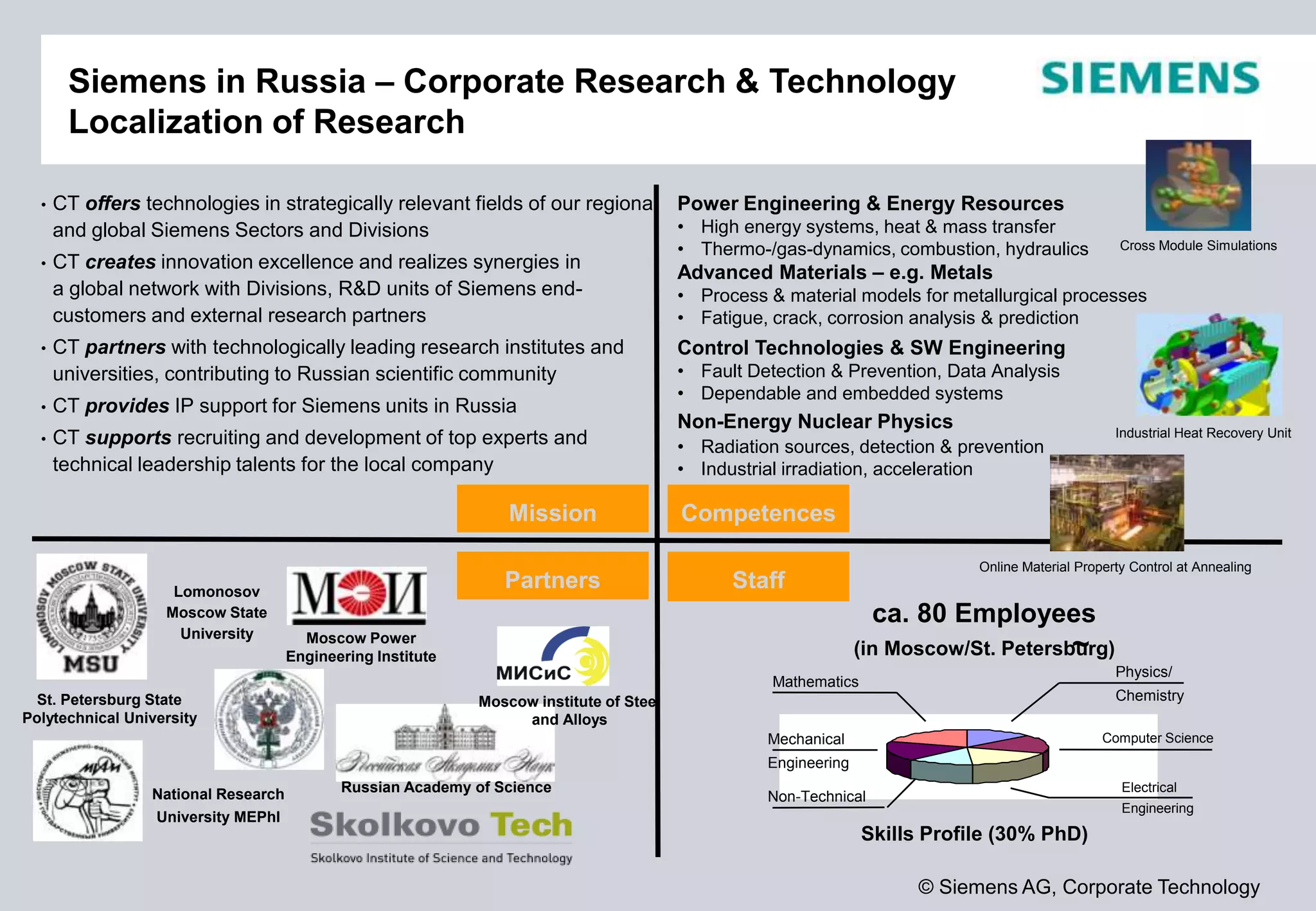
Mission
Computer Science
Electrical
Engineering
Physics/
Chemistry
Mathematics
Mechanical
Engineering
Non-Technical
Skills Profile (30% PhD)
Our Competence ~
ca. 80 Employees
(in Moscow/St. Petersburg)
Partners
Competences
StaffLomonosov
Moscow State
University
National Research
University MEPhI
Moscow Power
Engineering Institute
St. Petersburg State
Polytechnical University
Moscow institute of Steel
and Alloys
Russian Academy of Science
Power Engineering & Energy Resources
• High energy systems, heat & mass transfer
• Thermo-/gas-dynamics, combustion, hydraulics
Advanced Materials – e.g. Metals
• Process & material models for metallurgical processes
• Fatigue, crack, corrosion analysis & prediction
Control Technologies & SW Engineering
• Fault Detection & Prevention, Data Analysis
• Dependable and embedded systems
Non-Energy Nuclear Physics
• Radiation sources, detection & prevention
• Industrial irradiation, acceleration
Siemens in Russia – Corporate Research & Technology
Localization of Research
• CT offers technologies in strategically relevant fields of our regional
and global Siemens Sectors and Divisions
• CT creates innovation excellence and realizes synergies in
a global network with Divisions, R&D units of Siemens end-
customers and external research partners
• CT partners with technologically leading research institutes and
universities, contributing to Russian scientific community
• CT provides IP support for Siemens units in Russia
• CT supports recruiting and development of top experts and
technical leadership talents for the local company
Cross Module Simulations
Industrial Heat Recovery Unit
Online Material Property Control at Annealing
© Siemens AG, Corporate Technology
Closing the Gap of Innovation – The Siemens Approach
Summary
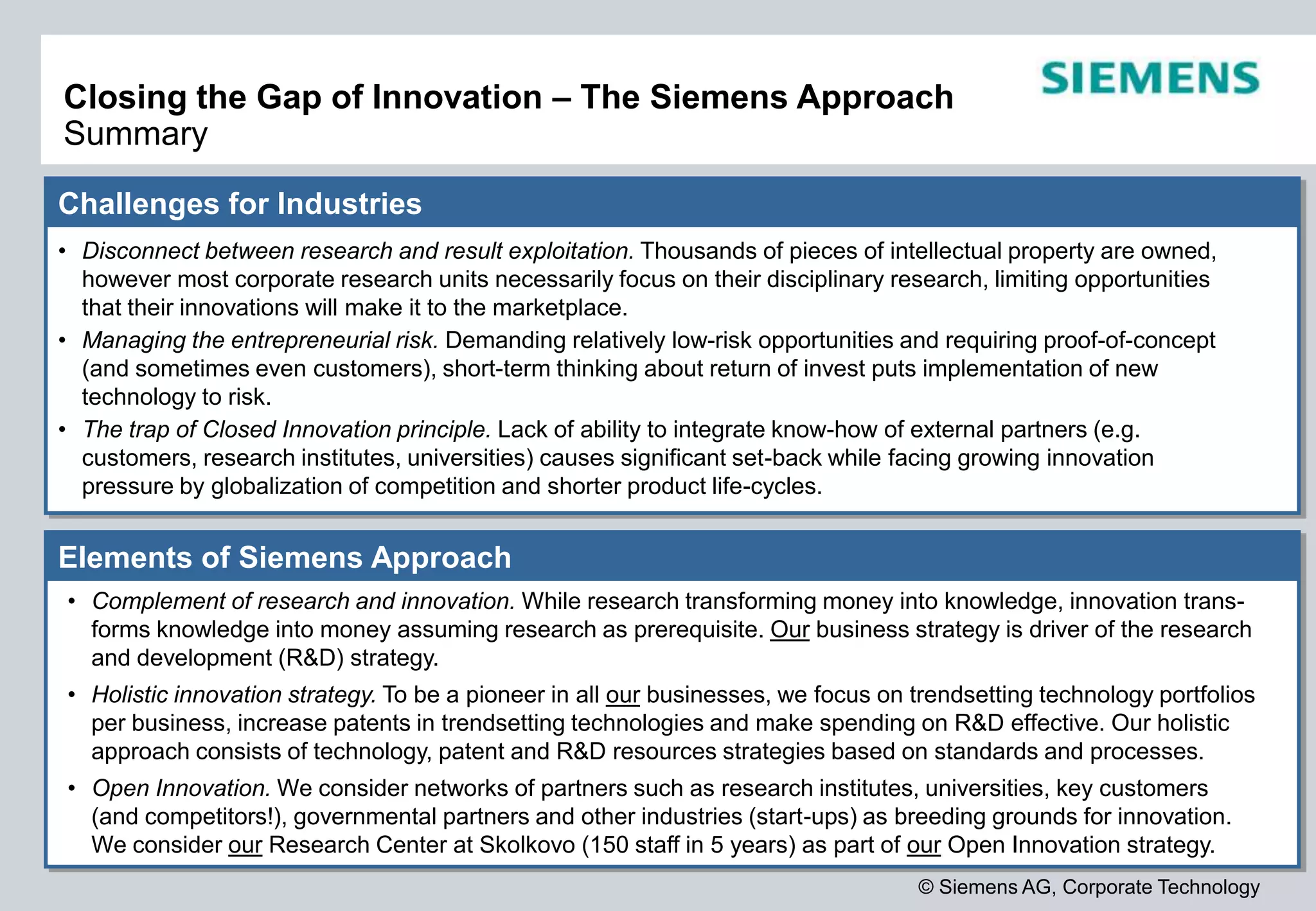
Challenges for Industries
• Disconnect between research and result exploitation. Thousands of pieces of intellectual property are owned,
however most corporate research units necessarily focus on their disciplinary research, limiting opportunities
that their innovations will make it to the marketplace.
• Managing the entrepreneurial risk. Demanding relatively low-risk opportunities and requiring proof-of-concept
(and sometimes even customers), short-term thinking about return of invest puts implementation of new
technology to risk.
• The trap of Closed Innovation principle. Lack of ability to integrate know-how of external partners (e.g.
customers, research institutes, universities) causes significant set-back while facing growing innovation
pressure by globalization of competition and shorter product life-cycles.
Elements of Siemens Approach
• Complement of research and innovation. While research transforming money into knowledge, innovation trans-
forms knowledge into money assuming research as prerequisite. Our business strategy is driver of the research
and development (R&D) strategy.
• Holistic innovation strategy. To be a pioneer in all our businesses, we focus on trendsetting technology portfolios
per business, increase patents in trendsetting technologies and make spending on R&D effective. Our holistic
approach consists of technology, patent and R&D resources strategies based on standards and processes.
• Open Innovation. We consider networks of partners such as research institutes, universities, key customers
(and competitors!), governmental partners and other industries (start-ups) as breeding grounds for innovation.
We consider our Research Center at Skolkovo (150 staff in 5 years) as part of our Open Innovation strategy.
© Siemens AG, Corporate Technology
Thank you!
Siemens LLC
115093, Moscow,
Dubininskaya str, 96
www.siemens.ru
Questions?

Gitzels

  • 1.
    © Siemens AG,Corporate Technology Siemens Corporate Innovation System Dr. Martin Gitsels
  • 2.
    © Siemens AG,Corporate Technology Siemens around the World  Siemens is the largest electric and electronics company, a world leader in solutions for a wide range of industries.  Since more than 165 years the Siemens brand stands for advanced technologies, progress and constant growth.  Today the company operates in more than 190 countries across the world with more than 370 000 employees.  In FY 2012 (as of September 30, 2012) sales reached 78,3 bln euro, while the profit exceeded 4,59 bln euro.
  • 3.
    © Siemens AG,Corporate Technology Today’s business Major R&D investments  € 4,2 billion in FY 2012, or 5,4% of revenue  29,500 R&D employees worldwide  about 18,000 software engineers  188 R&D locations in over 30 countries around the world  8,900 inventions in FY 2012  57,300 active patents FY’07 5,1% 4,7% 4,9% 5,1% R&D spending in % of revenue 5,5% FY’08 FY’09 FY’10 FY’11 We pioneer in the areas of … Energy efficiency Intelligent infrastructure solutions Affordable & personalized healthcare Industrial productivity FY’12 5,4%
  • 4.
    © Siemens AG,Corporate Technology Research and innovation complement each other  Research is a necessary though not sufficient precondition for innovation  Business strategy drives R&D strategy  Innovation is the creation of something new and its successful introduction into the market Innovation is transforming knowledge into money Research is transforming money into knowledge Innovation = Invention + market success = Economic value
  • 5.
    © Siemens AG,Corporate Technology Innovation strategy Focus on innovation with highest customer value and profit expectations  Understand the customer Trend scouting to respond immediately to upcoming developments, e.g. in the energy market  Understand trends and rules Cross-Divisional innovation strategies  Fill the innovation pipeline 2 1 3
  • 6.
    © Siemens AG,Corporate Technology Understand the Customer Anforderun gen des Kunden Invention Implementation in the company Implementation in the market Generating ideas  Customer benefits  Creativity workshops Selecting ideas  Value creation  Competition  Competence IP generation Business plan (draft)  Product specification  Business strategy  Business data Top management support Financing Project management Production/logistics Integration (testing) Controlling Marketing  Market segmentation  Timing  Alliances/cooperation  Key customers Sales After-sales service Lösungen für den Kunden
  • 7.
    © Siemens AG,Corporate Technology Understand trends and rules Urbanization  60 percent of the world’s population will live in cities in 2030  With efficient planning and managing we can handle the complexity of soaring Megacities. Demographic Change  The 65+ generation will nearly double worldwide by 2030 (from 7% to 12%)  We have to provide affordable and high-quality healthcare for developed and emerging countries. Climate Change  To limit CO2 to 450 ppm: Additional investment of €10.5 trillion is required in energy sector by 2030.  By combining all efficiency measures we can limit Climate Change. Globalization  Average annual GDP growth until 2050: India ~6%, China >4%, USA 1.9%, Germany 1.7%  Emerging markets offer tremendous opportunities and also challenges.
  • 8.
    © Siemens AG,Corporate Technology Innovation Strategy Consistent with respect to: Consistent strategy: be a pioneer in all our businesses Technology strategy Patent strategy R&D resource strategy Standards strategy Processes People / Skills / Culture  Be a pioneer in all our businesses to secure the most competitive edge  Focus on trendsetting technology portfolios per business and achieve leading position  Increase patents in trendsetting technologies  Effective R&D spending  Full leverage of our capabilities and assets to tap further potential
  • 9.
    © Siemens AG,Corporate Technology Siemens answers the toughest innovation challenges Technological change BusinessModel Low High New Un- changed Radical Disruptive Disruptive Radical Incremental (current R&D) 13 2 Innovation examples Increased digitalization of factory planning: Siemens buys UGS to enable integrated management of whole product lifecycle (digital factory) New materials (e.g. Ceramics with enhanced properties): New heat shield for turbines create competitive advantages Energy savings Performance contracting: Siemens sells reduction of energy consumption and is paid in % of realized reductions 1 2 3
  • 10.
    © Siemens AG,Corporate Technology Innovation Pipeline  Key objectives of the CIP are - to ensure a timely identification of disruptive commercialization challenges, - to realize their strong potential business impact, - to have a stringent and holistic capital allocation decision, - to set-up clear operational ownership and a continuous process - to ensure top management attention  CIP will push organic growth in support of One Siemens growth targets Goals Corporate Innovation Process and Pipeline Discussion on Corp. Innovation Opportunities with CEO/CFO/CT O Elaboration of Corporate Innovation Opportunities Identification of Corporate Innovation Fields Implemen- tation Follow-up Capital allocation decision by Managing BoardPrioritizationPreselection Corporate Innovation Pipeline Business Plan Follow up with go/no go decision Defined strategy, owner and budget Innovation Fields
  • 11.
    © Siemens AG,Corporate Technology Leveraging the technological synergies at all levels Industry Energy Healthcare Tap further upside potential on all levels of technology synergies … Best-practice sharing between Divisions, Corporate Departments and Regional Companies as with Software Initiative (SWI), Project Management 3 Multiple impact of Corporate Technology, Lighthouse projects, technologies, technology consulting, innovation management & process consulting, patents, standardization Corporate Research Best-practice sharing Use of common technologies, shared R&D- projects, platform projects, common use of IPRs, innovation value chains Common technology and platform 1 2
  • 12.
    © Siemens AG,Corporate Technology Networks are the breeding grounds for innovation (“Open innovation”) Start-up / VCs ''Think Tanks'' Competitors Key Customers Research Institutes Universities Other Industries Governmental partners Business
  • 13.
    © Siemens AG,Corporate Technology Open Innovation Culture – Prerequisites Public Incentive Mechanisms to stimulate Entrepreneurship, e.g. Joint Research  tax reduction for specific projects or on entire operation (e.g. staff, import)  grant mechanism connected with focus programs (risk sharing)  special focus on SMEs but incorporate majors  support in exploitation of results Mechanisms of Know How Protection, e.g. in Joint Venture  regional registration of patents (only 12 month after 1st registration possible)  contracts to avoid transfer of know how to 3rd party (reselling of shares)  registration of patents by shareholders and transfer of licenses to JV  …and first of all: registration of inventions!! Fair Treatment of Partners, e.g. in Research Cooperations  inventions from subcontracts belong to financing instance, but partner gets non-exclusive royalty-free license  inventions from joint research (e.g. publicly funded) are shared or registered jointly  our policy sharing with partners rather than blocking them
  • 14.
    © Siemens AG,Corporate Technology Scenarios for the sectors Time horizon (varies markedly across the different sectors) Short-term Medium-term Long-termToday Influencing factors  New markets  New customer requirements  New technologies  New business Today’s business Extrapolation via roadmaps  Products  Technologies  Customer requirements Retropolation out of scenarios Individuals Society Politics Economy Environment Technology Customers Competition Strategic vision Strategic innovation planning for all areas of business Industry Energy Healthcare
  • 15.
    © Siemens AG,Corporate Technology Mission Computer Science Electrical Engineering Physics/ Chemistry Mathematics Mechanical Engineering Non-Technical Skills Profile (30% PhD) Our Competence ~ ca. 80 Employees (in Moscow/St. Petersburg) Partners Competences StaffLomonosov Moscow State University National Research University MEPhI Moscow Power Engineering Institute St. Petersburg State Polytechnical University Moscow institute of Steel and Alloys Russian Academy of Science Power Engineering & Energy Resources • High energy systems, heat & mass transfer • Thermo-/gas-dynamics, combustion, hydraulics Advanced Materials – e.g. Metals • Process & material models for metallurgical processes • Fatigue, crack, corrosion analysis & prediction Control Technologies & SW Engineering • Fault Detection & Prevention, Data Analysis • Dependable and embedded systems Non-Energy Nuclear Physics • Radiation sources, detection & prevention • Industrial irradiation, acceleration Siemens in Russia – Corporate Research & Technology Localization of Research • CT offers technologies in strategically relevant fields of our regional and global Siemens Sectors and Divisions • CT creates innovation excellence and realizes synergies in a global network with Divisions, R&D units of Siemens end- customers and external research partners • CT partners with technologically leading research institutes and universities, contributing to Russian scientific community • CT provides IP support for Siemens units in Russia • CT supports recruiting and development of top experts and technical leadership talents for the local company Cross Module Simulations Industrial Heat Recovery Unit Online Material Property Control at Annealing
  • 16.
    © Siemens AG,Corporate Technology Closing the Gap of Innovation – The Siemens Approach Summary Challenges for Industries • Disconnect between research and result exploitation. Thousands of pieces of intellectual property are owned, however most corporate research units necessarily focus on their disciplinary research, limiting opportunities that their innovations will make it to the marketplace. • Managing the entrepreneurial risk. Demanding relatively low-risk opportunities and requiring proof-of-concept (and sometimes even customers), short-term thinking about return of invest puts implementation of new technology to risk. • The trap of Closed Innovation principle. Lack of ability to integrate know-how of external partners (e.g. customers, research institutes, universities) causes significant set-back while facing growing innovation pressure by globalization of competition and shorter product life-cycles. Elements of Siemens Approach • Complement of research and innovation. While research transforming money into knowledge, innovation trans- forms knowledge into money assuming research as prerequisite. Our business strategy is driver of the research and development (R&D) strategy. • Holistic innovation strategy. To be a pioneer in all our businesses, we focus on trendsetting technology portfolios per business, increase patents in trendsetting technologies and make spending on R&D effective. Our holistic approach consists of technology, patent and R&D resources strategies based on standards and processes. • Open Innovation. We consider networks of partners such as research institutes, universities, key customers (and competitors!), governmental partners and other industries (start-ups) as breeding grounds for innovation. We consider our Research Center at Skolkovo (150 staff in 5 years) as part of our Open Innovation strategy.
  • 17.
    © Siemens AG,Corporate Technology Thank you! Siemens LLC 115093, Moscow, Dubininskaya str, 96 www.siemens.ru Questions?