School-based model in going digital
Jouni Immonen
IEFE 2013 Workshop
Riyadh, KSA
jouni.immonen@fcg.fi
“ICT –based Education as a Driver of
Change in Teaching - Studying – Learning”
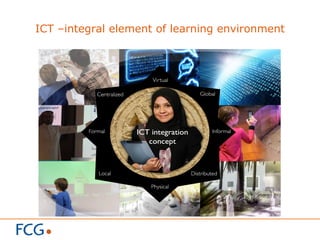
ICT –integral element of learning environment
ICT Challenges Education
Schools:
•  Changes in teaching – studying – learning process
•  School culture – collaborative development
•  Research–based development
•  Supporting and future oriented leadership
•  Integration of ICTs in other elements of learning
environment – hybrid learning
•  School–based professional development
•  Networking
•  Strategic approach to the
use of ICT
•  Continuous evaluation
ICT Challenges Education
Teachers:
•  New pedagogical
models and practices
– versatile
learning environments
•  Learner-centred strategies
•  Competencies in pedagogical use of ICT
•  Research-based approach to teaching
•  No longer primary source of information – facilitates,
coaches, creates structure, monitors the progress
•  Utilisation of students informal learning
•  Collaboration with other teachers – team work
•  Networking locally and globally
ICT Challenges Education
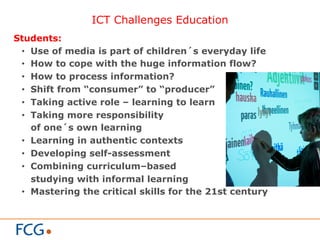
Students:
•  Use of media is part of children´s everyday life
•  How to cope with the huge information flow?
•  How to process information?
•  Shift from “consumer” to “producer”
•  Taking active role – learning to learn
•  Taking more responsibility
of one´s own learning
•  Learning in authentic contexts
•  Developing self-assessment
•  Combining curriculum–based
studying with informal learning
•  Mastering the critical skills for the 21st century
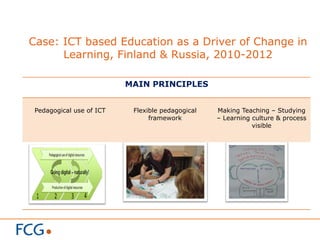
Case: ICT based Education as a Driver of Change in
Learning, Finland & Russia, 2010-2012
MAIN PRINCIPLES
Pedagogical use of ICT Flexible pedagogical
framework
Making Teaching – Studying
– Learning culture & process
visible
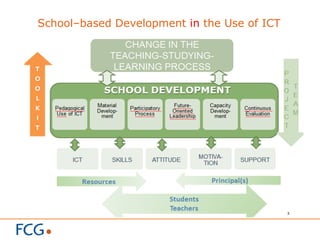
School–based Development in the Use of ICT
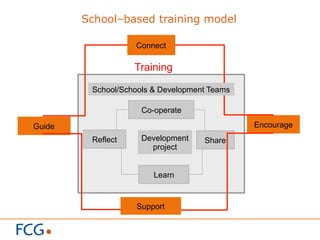
EncourageGuide
Support
Connect
Reflect Share
Co-operate
Training
Development
project
School/Schools & Development Teams
Learn
School–based training model
ELEMENTS OF THE PROGRAMME
– BLENDED LEARNING APPROACH
•  Face-to-face workshops
•  On-line learning (Moodle, Skype)
•  Expert consultations – on-line & face to face
•  Development teams in the pilot schools producing
digital learning materials
•  School pairs from two countries working together
•  Supporting materials (digital, printed)
•  Tools for continuous evaluation of the process and
product – criteria & guiding questions
Evaluation Practices in the Programme
Integrated
Process
Product &
Project evaluation
Tailored evaluation criteria and tools for the
development of digital learning materials.
EVALUATION CRITERIA
”Six Ps”
P 1 – Purposeful
•  Identification of a problem or need in current practice
•  Goal setting
•  E-resource can be used for different purposes
P 2 - Practical
•  Achievability
•  Relevance of the use of ICT
•  Problem based
P 3 – Participatory
•  Engaging the whole school
•  Dialogue and co-operation
•  Collective activity
EVALUATION CRITERIA
”Six Ps”
P 4 – Poly-functional
•  Capacity building
•  Adaptability
•  Variation
P 5 – Poly-cultural
•  Culture and context sensitivity
•  Long-termpartnerships
•  Future-orientation
P 6 – Positive
•  Motivation to quality improvement
•  Encouragement to risk-takingandinnovations
•  Continuous assessment and reflection
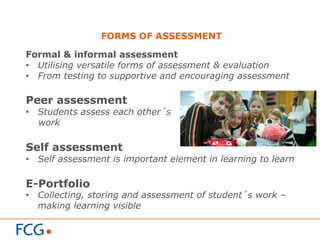
FORMS OF ASSESSMENT
Formal & informal assessment
•  Utilising versatile forms of assessment & evaluation
•  From testing to supportive and encouraging assessment
Peer assessment
•  Students assess each other´s
work
Self assessment
•  Self assessment is important element in learning to learn
E-Portfolio
•  Collecting, storing and assessment of student´s work –
making learning visible
2/26/13 Page 14
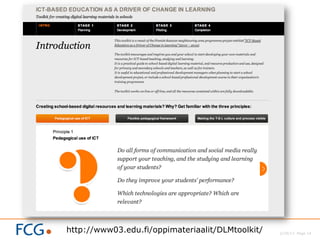
http://www03.edu.fi/oppimateriaalit/DLMtoolkit/
2/26/13 Page 15
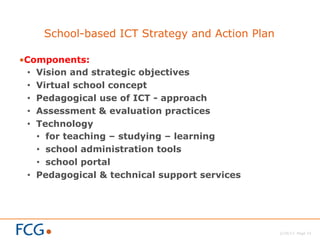
School-based ICT Strategy and Action Plan
• Components:
•  Vision and strategic objectives
•  Virtual school concept
•  Pedagogical use of ICT - approach
•  Assessment & evaluation practices
•  Technology
•  for teaching – studying – learning
•  school administration tools
•  school portal
•  Pedagogical & technical support services
2/26/13 Page 16
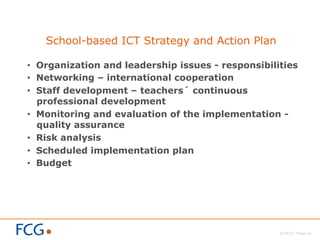
School-based ICT Strategy and Action Plan
•  Organization and leadership issues - responsibilities
•  Networking – international cooperation
•  Staff development – teachers´ continuous
professional development
•  Monitoring and evaluation of the implementation -
quality assurance
•  Risk analysis
•  Scheduled implementation plan
•  Budget
Jouni Immonen
FCG Finnish Consulting Group Ltd.
jouni.immonen@fcg.fi

التقنيات الحديثة في التعلُم أصول تدريس جديدة – تقويم جديد؟ يوني ايممونين

  • 1.
    School-based model ingoing digital Jouni Immonen IEFE 2013 Workshop Riyadh, KSA jouni.immonen@fcg.fi “ICT –based Education as a Driver of Change in Teaching - Studying – Learning”
  • 2.
    ICT –integral elementof learning environment
  • 3.
    ICT Challenges Education Schools: • Changes in teaching – studying – learning process •  School culture – collaborative development •  Research–based development •  Supporting and future oriented leadership •  Integration of ICTs in other elements of learning environment – hybrid learning •  School–based professional development •  Networking •  Strategic approach to the use of ICT •  Continuous evaluation
  • 4.
    ICT Challenges Education Teachers: • New pedagogical models and practices – versatile learning environments •  Learner-centred strategies •  Competencies in pedagogical use of ICT •  Research-based approach to teaching •  No longer primary source of information – facilitates, coaches, creates structure, monitors the progress •  Utilisation of students informal learning •  Collaboration with other teachers – team work •  Networking locally and globally
  • 5.
    ICT Challenges Education Students: • Use of media is part of children´s everyday life •  How to cope with the huge information flow? •  How to process information? •  Shift from “consumer” to “producer” •  Taking active role – learning to learn •  Taking more responsibility of one´s own learning •  Learning in authentic contexts •  Developing self-assessment •  Combining curriculum–based studying with informal learning •  Mastering the critical skills for the 21st century
  • 6.
    Case: ICT basedEducation as a Driver of Change in Learning, Finland & Russia, 2010-2012 MAIN PRINCIPLES Pedagogical use of ICT Flexible pedagogical framework Making Teaching – Studying – Learning culture & process visible
  • 7.
  • 8.
  • 9.
    ELEMENTS OF THEPROGRAMME – BLENDED LEARNING APPROACH •  Face-to-face workshops •  On-line learning (Moodle, Skype) •  Expert consultations – on-line & face to face •  Development teams in the pilot schools producing digital learning materials •  School pairs from two countries working together •  Supporting materials (digital, printed) •  Tools for continuous evaluation of the process and product – criteria & guiding questions
  • 10.
    Evaluation Practices inthe Programme Integrated Process Product & Project evaluation Tailored evaluation criteria and tools for the development of digital learning materials.
  • 11.
    EVALUATION CRITERIA ”Six Ps” P1 – Purposeful •  Identification of a problem or need in current practice •  Goal setting •  E-resource can be used for different purposes P 2 - Practical •  Achievability •  Relevance of the use of ICT •  Problem based P 3 – Participatory •  Engaging the whole school •  Dialogue and co-operation •  Collective activity
  • 12.
    EVALUATION CRITERIA ”Six Ps” P4 – Poly-functional •  Capacity building •  Adaptability •  Variation P 5 – Poly-cultural •  Culture and context sensitivity •  Long-termpartnerships •  Future-orientation P 6 – Positive •  Motivation to quality improvement •  Encouragement to risk-takingandinnovations •  Continuous assessment and reflection
  • 13.
    FORMS OF ASSESSMENT Formal& informal assessment •  Utilising versatile forms of assessment & evaluation •  From testing to supportive and encouraging assessment Peer assessment •  Students assess each other´s work Self assessment •  Self assessment is important element in learning to learn E-Portfolio •  Collecting, storing and assessment of student´s work – making learning visible
  • 14.
  • 15.
    2/26/13 Page 15 School-basedICT Strategy and Action Plan • Components: •  Vision and strategic objectives •  Virtual school concept •  Pedagogical use of ICT - approach •  Assessment & evaluation practices •  Technology •  for teaching – studying – learning •  school administration tools •  school portal •  Pedagogical & technical support services
  • 16.
    2/26/13 Page 16 School-basedICT Strategy and Action Plan •  Organization and leadership issues - responsibilities •  Networking – international cooperation •  Staff development – teachers´ continuous professional development •  Monitoring and evaluation of the implementation - quality assurance •  Risk analysis •  Scheduled implementation plan •  Budget
  • 17.
    Jouni Immonen FCG FinnishConsulting Group Ltd. jouni.immonen@fcg.fi