Download to read offline


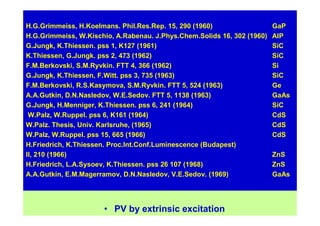


Early research in the 1960s by several European groups found that the photovoltaic effect could be achieved through extrinsic, two-photon excitation using impurity levels rather than requiring photon energies greater than the bandgap. This extrinsic photovoltaic effect was demonstrated in semiconductors like GaP, AlP, SiC, Si, Ge, GaAs, CdS, and ZnS. The effect was explained by optical excitation transferring carriers between impurity levels and bands. Thiessen later outlined the conditions needed for generating both minority and majority carriers via optical excitation to impurity levels. This extrinsic effect could potentially extend the spectral range of solar cells but would require materials with wider bandgaps than silicon


