Finding a Sustainable Balance: A Comparative Analysis
Of Tourism Management in Bhutan and Peru
A Senior Project
presented to
the Faculty of the Recreation, Parks, & Tourism Administration Department
California Polytechnic State University, San Luis Obispo
In Partial Fulfillment
of the Requirements for the Degree
Bachelor of Science
by
Erin Rugh
March, 2016
© 2016 Erin Rugh
ii
ABSTRACT
FINDING A SUSTAINABLE BALANCE: A COMPARATIVE ANALYSIS
OF TOURISM MANAGEMENT IN BHUTAN AND PERU
ERIN RUGH
MARCH, 2016
Tourism is an enormous global industry that impacts the traveler, as well as locals to the
destination. Destinations manage tourism in a variety of ways, ranging from heavy
government regulation to minimal involvement. The purpose of this study was to
compare and contrast tourist destination management in Bhutan and Peru. The researcher
used a guide to collect information about each of these countries. The study found that
each destination’s involvement and management practices are impacted by their views
and ultimate goals for what they want to achieve through their individual tourism
industry. Destinations should utilize tourism management practices to involve their
communities and manage growth in order to ultimately achieve a more sustainable
tourism industry for themselves.
Keywords: tourism, destination management, Bhutan, Peru, sustainability
iii
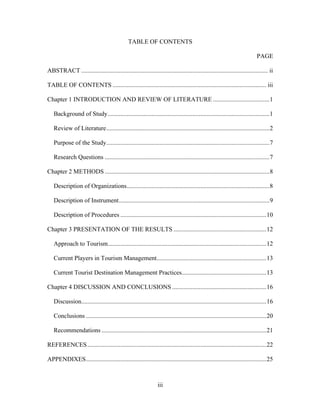
TABLE OF CONTENTS
PAGE
ABSTRACT ....................................................................................................................... ii	
  
TABLE OF CONTENTS .................................................................................................. iii	
  
Chapter 1 INTRODUCTION AND REVIEW OF LITERATURE ....................................1	
  
Background of Study.......................................................................................................1	
  
Review of Literature........................................................................................................2	
  
Purpose of the Study........................................................................................................7	
  
Research Questions .........................................................................................................7	
  
Chapter 2 METHODS .........................................................................................................8	
  
Description of Organizations...........................................................................................8	
  
Description of Instrument................................................................................................9	
  
Description of Procedures .............................................................................................10	
  
Chapter 3 PRESENTATION OF THE RESULTS ...........................................................12	
  
Approach to Tourism.....................................................................................................12	
  
Current Players in Tourism Management......................................................................13	
  
Current Tourist Destination Management Practices......................................................13	
  
Chapter 4 DISCUSSION AND CONCLUSIONS ............................................................16	
  
Discussion......................................................................................................................16	
  
Conclusions ...................................................................................................................20	
  
Recommendations .........................................................................................................21	
  
REFERENCES..................................................................................................................22	
  
APPENDIXES...................................................................................................................25	
  
1
Chapter 1
INTRODUCTION AND REVIEW OF LITERATURE
Background of Study
Tourism is a huge global industry that allows people to escape from their
everyday life. In 2014 alone, the travel and tourism industry contributed a total of $7.58
trillion to the global economy, with a direct contribution of $2.36 trillion (Statista, 2016).
The industry is continuing to grow as more and more people begin to appreciate the value
of travel. Tourism can be local or international, and many people use tourism as a means
to see the world and experience cultures that differ from their own. This has implications
for the people that are native to the tourist destination, as travelers passing through
interact with the locals and their environment.
Tourism can be a major source of profit for a given region and provide jobs for
locals; however, too much reliance on tourism can be detrimental. For instance, changes
in trends and environmental disasters can lead to fluctuations in the number of visitors to
a given location. An example of this is the rapid decrease in visitors to New Orleans
following Hurricane Katrina (Elliott, 2015). In addition to economic impacts, tourism can
impact the local culture, the natural environment, and resource use.
With all these considerations, Some locations have developed tourism destination
management plans to control the number of visitors and allow for economically and
environmentally sustainable development, while other areas do much less to regulate
their tourism industry. Therefore, with these variances in mind, the purpose of this study
was to compare and contrast tourist destination management in Bhutan and Peru.
2
Review of Literature
Research for this review of literature was conducted at Robert E. Kennedy
Library on the campus of California Polytechnic State University, San Luis Obispo. In
addition to books and other resources, the following online databases were utilized:
ABI/INFORM Complete, Academic Search Premier, Google Scholar, and Hospitality
and Tourism Complete. This review of literature is organized into three subsections:
evolution of tourism, impact of tourism on host communities, and tourism management
practices.
Over the past 30 decades, tourism has become a rapidly developing industry
(Walton, 2009). In fact, tourism supports 277 million jobs and generates 9.8% of world
GDP, making it one of the largest industries in the world (World Travel and Tourism
Council, 2016). According to go2HR (2016), “Tourism is the activities of people
traveling to and staying in places outside their usual environment for leisure, business or
other purposes for not more than one consecutive year.” The author goes on to say that
the tourism industry is dynamic and constantly changing in order to accommodate
changes in trends and desires. Recently, these changing trends and desires have become
evident in the various tourism niches, including: ecotourism, “green” tourism, heritage
tourism, adventure tourism, soft tourism, and resort tourism (Hassan, p. 240). Because
tourism is so dynamic, different niche tourism areas may grow or decline at different
rates. For instance, according to Hassan, “interest in ecotourism experiences is growing
by 25% to 30% per year and cultural tourism at 10% to 15% per year, compared to an
overall average of 4% to 5% for the tourism industry in general” (p. 240). Destinations
3
may then use these trends to market their location to remain competitive in the global
market.
Several decades ago, before tourism was the enormous industry that it is today,
tourism managers believed that tourism had unlimited growth potential, and thus could
handle rapid growth (Walton, 2009). Eventually, managers realized there is a cycle that
tourist destinations go through. Hassan (2000) and Papatheodorou (2004) both agree that
the cycle begins with exploration, in which a few tourists visit the location. Next, the
location attracts even more tourists, which leads to development and growth. As the
destination becomes more and more popular, it begins to approach its carrying capacity,
at which point the number of visitors can stagnate. However, if carrying capacity is
exceeded, the destination can decay and deteriorate, and tourists will no longer be
attracted to it. Destination managers have a desire to expand their tourism industry
without collapsing it and many customers have a desire to experience all that a location
has to offer, without degradation. This has led to the emergence of sustainable tourism,
which “refers to tourism that attempts to minimize environmental impacts and
sociocultural changes and also contributes to prolonging the life expectancy of
destinations and creating a unique economic opportunity for local communities” (Hassan,
p. 244). If sustainable tourism is achieved the community, the tourist, and the tourist
manager all benefit.
Finding the balance within sustainable tourism can be tricky as there are many
potential changes and impacts that tourism can have on a host community, both positive
and negative. To begin with, tourism growth can lead to many positive benefits for a
community. One potential benefit is that it can bring awareness to environmental
4
concerns and lead to greater value, appreciation, protection, and conservation. Not only
this, but tourism can have positive socio-cultural impacts as well. For example, in a case
study involving Annapurna and Northwest Yunnan, locals from both locations thought
that tourism empowers women because it allows them to sell things to tourists to make an
independent income, and exposes them to empowered women solo travelers (Nyaupane,
Morais, & Dowler, 2005). Respondents from both locations also reported that their
quality of life increased due to educational experiences from interacting with people from
other parts of the world, learning new languages, more regular trash cleanup and proper
sanitation, and higher incomes. Moreover, interacting with people from other cultures
has taught them to value their differences and motivate them to preserve their own unique
culture. Finally, as one of the largest global industries, the main reason communities
support tourism development is because of the economic benefits of revenue and job
creation (United Nations Environment Programme, UNEP, 2016).
Just as there are potential benefits of tourism, there are also potential negative
impacts. For instance, in the case of tourism in Turkey, economic growth is the priority,
regardless of the impacts on the culture, the environment, or the people (Tosun, 2000).
This proved to be unsustainable as the negative impacts on the culture, the environment,
and the people began to be felt. The environment can be negatively impacted as
development leads to construction of new infrastructure (UNEP, 2016). Additionally, as
the area reaches its carrying capacity, resource use increases, which causes increased
demand on the environment. In the Nepal Himalayas, Sagarmatha National Park has
seen waste accumulation and deforestation, and the Annapurna Area has also seen
deforestation and erosion coinciding with the increase in tourism (Nepal, 2000). Finally,
5
socio-cultural impacts of tourism can be felt in a variety of ways. Going back to the case
study of Northwest Yunnan and Annapurna mentioned earlier,
Participants from Northwest Yunnan were more critical of tourism’s promotion of
prostitution, the degradation of the younger generation’s values, and the control of
tourism by outsiders. In Annapurna, the participants were more critical about
disruptions of traditional kinship and community bonds” (Nyaupane et al., 2005,
p. 1380).
Additionally, the Sherpa population’s roles have changed as the men are out leading
climbing expeditions for travelers, and culture has changed as western influence brings
the people away from their religious traditions (Nepal, 2000). These locations have all
been working towards solutions to reduce the negative impacts of tourism in order to
move even closer towards sustainable tourism models.
Finding a balance between growth and sustainability can be a huge challenge for
tourism destination management. This is especially true when all of the aspects, such as
economy, environment, and socio-culture, are dependent on one another and require
trade-offs. However, there are management practices that can be used to maximize the
benefits and minimize the impacts on local host communities.
One strategy is to focus on the resources that a given location possesses that are
unique and can be marketed to gain a comparative advantage (Hassan, 2000). If tourists
are drawn to a location because of it’s beautiful environment, and management steps are
not taken, the location may exceed it’s carrying capacity, which degrades the
environment and makes the location less desirable since its unique competitive advantage
is no longer there. As a tourist destination manager, one can identify the qualities that
6
make that location unique and desirable, and then take management steps to preserve
those specific qualities.
A second approach is relationship-based and it requires partnerships between the
private sector, the public sector, nongovernmental organizations (NGOs), and informal
citizen groups (Hassan, 2000). In order for this approach to succeed, all three groups
must work together to solve sustainability issues. In regards to Turkey, one of the
reasons their development approach failed was because it was driven by international
companies that did not have a community perspective and were not invested in the
outcomes for the local communities (Tosun, 2000). Utilizing the relationship-based
approach would mean that instead of tourism decisions being dominated by private
companies, the public sector, NGOs, and informal citizen groups would also be involved.
Host community involvement in destination management is important because,
according to Simpson (2006), “A community’s sense of ownership, feeling of
responsibility and practical involvement in tourism has since been heralded by
researchers and practitioners as central to the sustainability of tourism and of great
importance to planners, managers and operators” (p. 1). Tourism operators benefit from
host community involvement because locals have a better understanding of the region
and can positively contribute to tourism by helping to share their culture and set the tone
of the environment (Nyaupane et al., 2005). The more the host community is involved or
considered, the more sustainable the destination will be in the long-term because it will
be more representative of the interests of all groups instead of just the interests of one.
In many of the case studies, the policies that were created were in reaction to
problems that were already occurring, as opposed to proactive steps to prevent problems
7
from occurring. There are costs and benefits to any destination management style and
managers must decide what is most important. As Hassan (2000) stated, “Sustainable
development can occur only when the quality of the environment and community life can
be preserved indefinitely. To achieve this goal, the local community needs to be included
in all stages of development” (p. 243). Moving forward, proactive management steps can
be taken to make destinations more sustainable so that they will be able to experience
maximum benefits and sustained positive growth with minimal negative effects.
Purpose of the Study
The purpose of this study was to compare and contrast tourist destination
management in Bhutan and Peru.
Research Questions
This study attempted to answer the following research questions:
1. What stage of the tourism cycle is each destination in?
2. What management practices are used in each location?
3. How do management practices impact host community involvement?
8
Chapter 2
METHODS
The purpose of this study was to compare and contrast tourist destination
management in Bhutan and Peru. This chapter includes the following sections:
description of organizations, description of instrument, and description of procedures.
Description of Organizations
A comparative analysis was conducted on tourist destination management
practices in Bhutan and Peru. Bhutan is located in Southern Asia, between India and
China, with a population of approximately 750,000 (“Bhutan country profile,” 2015). It is
landlocked and mountainous, with about 85.5% of their land use comprised of forests
(Central Intelligence Agency, CIA, 2016). The climate varies widely, ranging from
tropical in the south, to severe winters in the Himalayas, and the country is rich in
biodiversity and endangered species. About 38.6% of the population lives in urban areas
with a 3.69% annual rate of change. The governmental structure of Bhutan is a monarchy
with a Parliament, and because Buddhism is the country’s official religion, civil law is
based on Buddhist religious law. They only first began to allow foreign tourists into their
country in 1974 (“Bhutan country profile”). Currently, the government of Bhutan has a
strong desire to protect their environment and cultural traditions, and therefore
encourages upscale, environmentally aware travelers (CIA).
Peru is located in Western South American bordering the Pacific Ocean, Ecuador,
Colombia, Brazil, Bolivia, and Chile with a population of 30,444,999 people (CIA,
9
2016). Spanish is the official language, and the majority of the population (84.1%) is
Roman Catholic. Peru has a high national poverty rate of 30%, and an even higher rate of
55% in rural areas. However, the majority of the population (78.6%) lives in urban areas.
Similar to Bhutan, the climate varies by region, ranging from tropical in the jungle to
frigid in the Andes. Approximately 53% of the land is made up of forests. Currently, the
country is facing deforestation, overgrazing, desertification, pollution, and endangered
species. The government is a constitutional republic with a president and it is guided by a
civil law system.
Description of Instrument
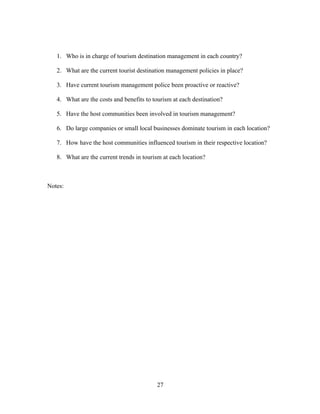
The instrument used in this study was a guide developed by the researcher (see
Appendix A). The guide was developed based on information collected in the review of
literature on host community involvement and tourist destination management practices.
The purpose of developing this guide was to collect qualitative data to answer the
research questions regarding what stage of the tourism cycle each destination is in, the
current destination management practices being used, and the level of involvement of the
host communities. The researcher conducted a pilot study of Indonesia on February 6th
,
2016. The pilot study was conducted in order to test the instrument. Based on the results
of the pilot study, the instrument was altered to be more open-ended in order to collect
more qualitative data.
10
Description of Procedures
A comparative analysis was conducted on tourist destination management
practices in Bhutan and Peru. The instrument used in this study was a guide developed by
the researcher. Research for the study was conducted during February and early March
2016. Information about tourism in Bhutan was collected from the Tourism Council of
Bhutan website, the Kingdom of Bhutan website, and the Lonely Planet website.
Information on Peru was collected from the Lonely Planet website, the Peru official
travel and tourism portal, and the US Department of State’s web page for U.S. Passports
and International Travel. On the Tourism Council of Bhutan website, the researcher
clicked on the Trip Planner tab, and then clicked on the following sub tabs: Minimum
Daily Package, Tour Guides, Tour Operators, Tour Booking Guide (open PDF), Travel
Tips (click “More” for Photography, Customs, and Clothes and Other Paraphernalia),
Visa, Accommodation, FAQ, and Travel Requirements. The researcher also clicked on
the About Us tab, and viewed the Tourism Policy sub tab. On the Kingdom of Bhutan
website, the researcher clicked on the Visitor Information tab and selected the Tourism
Information sub tab. The researcher used the Lonely Planet website for research on both
locations. From the home page the researcher clicked in the search bar at the top of the
page and searched for each destination (“Bhutan” or “Peru”). Under the Essential
information heading, the researcher clicked on the box titled Entry and exit formalities.
On the Peru official travel and tourism portal, the researcher selected the Plan Your Trip
tab and viewed the following sub tabs: Travel and Tourism Agencies, Travel Tips,
Entering Peru, and Leaving Peru. The researcher also used the U.S. Department of
11
State’s web page for U.S. Passports and International Travel by clicking on the Country
Information tab and searching for “Peru.” Then, the researcher scrolled down the page
and expanded the section on Local Laws & Special Circumstances. The data collected
from these sources will be discussed in the following chapter.
12
Chapter 3
PRESENTATION OF THE RESULTS
The purpose of this study was to compare and contrast tourist destination
management in Bhutan and Peru. A comparative analysis was utilized to examine Bhutan
and Peru. This chapter includes the following sections: approach to tourism, current
players in tourism management, and current tourist destination management practices.
Approach to Tourism
While Bhutan and Peru are both developing countries, they have noticeably
different approaches to tourism. The goal of the Royal Government of Bhutan’s policy
of ‘high value, low impact tourism’ is to attract tourists that respect Bhutanese culture
and values, while providing a unique experience. Their exclusivity allows them to
provide an authentic cultural experience and natural environment. While the government
recognizes tourism as a means of development, they have taken a very cautious approach.
This means that they are founded on the principle of sustainability, as demonstrated in the
Tourism Council of Bhutan’s vision of conservation of environment, promotion of
cultural heritage, and safeguarding sovereign status of the Nation for significantly
contributing to Gross National Happiness.
Peru has more of an open country policy with fewer restrictions on tourism. In
fact, tourism is the third largest industry in Peru. Biodiversity is considered of high
value, but even so, many species are in danger of extinction due to exploitation and
trafficking. Additionally, Peru is very rich in culture and has highly valued historical
13
sites. Tourism management in Peru is very inclusive and while their focus is more on
economic development, they still place high value on cultural preservation and
environmental conservation.
Current Players in Tourism Management
The Royal Government of Bhutan is very involved in their tourism management.
There are several government agencies that work together to regulate tourism in Bhutan.
In particular, the Tourism Council of Bhutan (TCB) is responsible for monitoring all
registered tour operators and ensuring that tour guides are trained and licensed. The
government, council, and tour companies all work together to enforce tourism
management practices.
Peru has much less government involvement in their tourism management
practices. The government is involved in some aspects of tourism regulation; however,
the have much less restrictions and therefore do not need to be as involved in the
management and monitoring of tourism. There is also a Peru Tourism Board that
provides suggestions to tourists about tour guides, accommodations, and packages, but
this serves more as a resource for tourists rather than a manager because tourists are not
required to use this service.
Current Tourist Destination Management Practices
Tourist destination management practices in Bhutan and Peru differ significantly;
however, they also share some similarities. To begin with, the government of Bhutan
requires that all tourists book their trip through a licensed Bhutanese tour operator or one
14
of their international partners. Then, the tour operator will apply for a visa for the
traveler with the Tourism Council of Bhutan (TCB). Even though a visa is required, there
is no limit placed on the number of tourists allowed to enter the country each year. On
the other hand, Peru does not require a tourist visa for travelers from most American and
Western European countries. However, they do have a maximum stay of 183 days and
travelers are required to provide proof of a return ticket or onward ticket. And while they
do not require that a licensed guide accompany tourists, the Peru Tourism Board does
offer travel services and packages through recommended travel agencies.
In Bhutan, there are hundreds of registered tour companies and over one thousand
licensed tour guides. Guides are required to complete a training course and specialize in
either cultural or adventure tours. The TCB oversees all of the tour operators to ensure
that they are meeting all of the requirements to serve international tourists and providing
high quality service. Additionally, prior to arrival, tourists are required to purchase a
minimum daily package, set by the Royal Government of Bhutan, which includes
accommodations, meals, guides, internal transport, and equipment. It also includes a
sustainable tourism Royalty, which goes towards education, healthcare, poverty
alleviation, and building of infrastructure for people in Bhutan.
In both countries, exports are monitored to preserve artifacts and wildlife. In
Bhutan, antiques are not allowed to be bought or sold. Therefore, old and used items
may not be allowed to be exported without a clearance certificate. This is especially true
for items of religious or cultural significance. Tour guides can clear souvenirs as non-
antique with the Division of Cultural Properties. Likewise, in Peru artifacts belonging to
the National Cultural Patrimony are not allowed to be exported. In order to export a
15
replica, a tourist would need to obtain a certificate stating that the item does not belong to
the National Cultural Patrimony through the Ministry of Culture. Additionally,
transportation of products made from endangered species is illegal.
Both countries have tourist regulations to protect valued locations. For instance,
in Bhutan, many monasteries, temples, and religious institutions prohibit photography,
expect modest clothing, and require that a tour guide accompany guests. Moreover, areas
outside of the Paro and Thimphu valleys are restricted areas. If the tourist’s itinerary
includes locations in restricted areas, the tour operator must obtain a special permit to be
checked at immigration checkpoints along the way. This is all done to minimize the
impact that tourists have on religious practices and culture. In Peru, they limit access to
areas in order to protect biodiversity and natural resources. One way they do this is by
charging government fees and putting limits on the number of hikers allowed on trails,
such as the Inca Trail. During the month of February, no visitors are allowed on the Inca
Trail to allow for yearly maintenance. Additionally, historic sites, such as Machu Picchu,
have a limit on daily number of visitors and visitors are encouraged to register when
entering national parks.
Both locations acknowledge the importance of tourism and the economic benefits
that it can bring. However, there are significant differences in how each location
manages their tourism industry. These differences will be discussed in greater detail in
the following chapter.
16
Chapter 4
DISCUSSION AND CONCLUSIONS
Tourism destination management practices can vary greatly from location to
location depending on the ultimate goals of the location. This is true in the case of Bhutan
and Peru because although both developing countries are primarily made up of forest,
with rich species biodiversity and a variety of climates, they ultimately have different
tourism goals. This concluding chapter includes the following: a discussion of the major
findings (including implications), limitations, conclusions (based on research questions),
and recommendations for the organizations, industry, and future research.
Discussion
Bhutan and Peru view tourism differently. Bhutan has strict limitations on
tourism, which makes them one of the most exclusive destinations in the world. The
purpose of this is to develop sustainable tourism and preserve Bhutan’s environment and
culture. On the other hand, Peru views tourism very inclusively with few restrictions. The
purpose of this is to maximize economic revenue to improve their struggling economy.
Due to their different viewpoints, Bhutan and Peru are both at different stages of the
cycle that tourism locations typically go through, as outlined by Hassan (2000) and
Papatheodorou (2004). Because of Bhutan’s cautious approach, they have intentionally
kept themselves in the earlier stages of exploration and minor growth. Since there is a
growing demand to visit Bhutan, they could be growing at a much more rapid rate if they
were to reduce restrictions. Conversely, Peru does not have restrictions on tourists
entering the country, so they are at later stages where they have had unlimited
17
development. This has caused them to reach carrying capacity in particularly popular
areas, which has led to daily restrictions on the number of visitors allowed to visit that
area each day. These differences demonstrate that there may be a need to find a
sustainable balance. Bhutan could reduce restrictions slightly to maintain sustainability,
while taking better advantage of the economic potential. Meanwhile, Peru could place
more restrictions on tourism to prevent them from exceeding carrying capacity or
overusing resources at locations that are growing in popularity.
Each destination's view on tourism leads to their specific management practices
and strategies. A strategy discussed by Hassan (2000) is to focus on managing and
marketing a location’s unique qualities to gain a comparative advantage. Bhutan has done
this by identifying their environment and culture as unique elements that they would like
to protect, which allows them to maintain these qualities. This ensures that their location
is desirable and marketable indefinitely. Peru has also implemented this strategy in
specific popular locations, such as the Inca trail. If the trail were to exceed capacity, the
resources and beauty would be diminished and the trail would becomes less desirable for
travelers. However, since management practices are taken to maintain the trail, such as
daily capacity limits and yearly restoration, the beauty of the trail is preserved, and it
remains a desirable destination. A second approach that Hassan discussed is partnerships
between government and nongovernmental organizations (NGOs). Bhutan utilizes this
approach through its establishment of the Tourism Council of Bhutan (TCB). The TCB
is a government agency that oversees all privately owned Bhutanese tourism companies.
This has led to the government and companies building a strong partnership, working
together to manage tourism, and working towards sustainable solutions. Peru does not
18
utilize this approach as much because of the lack of government oversight. Since the
government does not work directly with the tourism companies, they do not work
together to gain community and governmental perspectives when approaching issues. As
Tosun (2000) discusses, if groups do not work together, international organizations that
do not care about the outcomes to local communities can end up dominating the decision-
making. If the government of Peru were to become more involved in the management of
tourism companies, they could increase the involvement of local companies so that their
community perspective is considered when addressing tourism issues.
Simpson (2006) believes that it is extremely important that communities feel a
sense of responsibility for tourism because it is key to sustainability and planning,
managing, and operating tourism businesses. Likewise, Nyaupane et al. (2005) believe
that host community involvement benefits tourism operators because the have the most
knowledge of the region and culture. In Bhutan, host communities are inherently
involved in tourism management because, due to government regulations, they are the
tour operators and guides. In this sense, communities can choose what to allow tourists
to experience or not, and they feel a responsibility for tourism due to their management
role in the industry. On the other hand, because the Bhutanese government is so involved
in tourism management and trains and certifies all tourism companies and guides,
communities are limited in how they choose to run their businesses or interact with
tourists. While the government makes an effort to shield citizens from western influences
in order to protect their culture and religious values, allowing companies and guides to
have a little more freedom and flexibility in their arrangements and itineraries gives them
a sense of autonomy and could increase their sense of ownership, responsibility, and
19
involvement even more. In Peru, host communities are involved as much as they would
like to be involved. Due to the lack of regulations, tour companies can be international
and guides may not be local to Peru. This means that those companies may not be as
invested in the community. Since they are not a part of the community, they may not feel
as responsible for preserving its environment or values, and therefore may make
decisions that the community does not agree with. As mentioned before, this could be
managed through increased government involvement to ensure that all parties are heard
when making important tourism related decisions.
Overall, this study yielded useful conclusions and recommendations; however,
limitations to this study may still be present. One example is that strictly online sources
were used during research. This may not provide a comprehensive view of the issue.
Additionally, bias could be present because organizational websites were used.
Specifically, in Bhutan tourism is managed through the Tourism Council of Bhutan
(TCB), so it was difficult to find outside sources or information on individual travel
companies. Moreover, the data required for this study was difficult to measure and
quantify; therefore, the researcher relied on the qualitative observations of others to
gather data. Finally, practices and host community involvement vary widely from
country to country. There is no standard to compare against, so case studies were used as
a comparison tool.
While tourism management practices in Bhutan and Peru may differ, they are
ultimately similar in their approach to protect the values and resources that are important
to them. Bhutan has a cautious approach, which allows them to limit development and
outside influences, and preserve their environment, culture, and sense of involvement in
20
tourism management. Peru has been much more supportive of development, which has
led to tourism being an important part of the Peruvian economy. Locals may choose to
interact with tourists as little or as much as they would like, and they provide the
opportunity for as many people to experience Peru as possible. Both countries have been
successful at developing tourism industries that fit their needs and fulfill their desired
outcomes.
Conclusions
Based on the findings of this study, the following conclusions are drawn:
1. Bhutan intentionally manages their stage in the tourism cycle by being
cautious and limiting development, while Peru has exceeded carrying
capacities in certain areas and is now beginning to implement practices to
limit tourism.
2. Bhutan and Peru each use different management practices to be successful by
preserving and marketing their unique strengths, as well as utilizing
partnerships.
3. Management practices can impact host community involvement because
regulations can limit autonomy, but lack of regulations can lead to un-
involvement.
21
Recommendations
Based on the conclusions of this study, the following recommendations are made:
1. Greater tourism destination management involvement can help locations and
communities work towards specific goals and desired outcomes.
2. Bhutan should slightly reduce restrictions to take advantage of economic
potential, while still maintaining sustainability.
3. Peru should use more preventative management practices to anticipate when
they are nearing carrying capacity and implement tourism limitations.
4. Peru should increase government involvement in tourism destination
management to ensure that host communities are involved and considered
when important tourism related decisions are made.
5. Bhutan should grant a little bit more autonomy to their travel companies so
that they have an increased sense of ownership and responsibility in the
tourism sector.
6. Future research should examine a wider range of destinations to identify key
trends in management practices.
22
REFERENCES
23
REFERENCES
Bhutan country profile. (2015, October 11). BBC News. Retrieved from
http://www.bbc.com/news/world-south-asia-12480707
Central Intelligence Agency. (2016). The world factbook. Retrieved from
https://www.cia.gov/library/publications/resources/the-world-factbook/
Elliott, C. (2015). New Orleans tourism grapples with ‘lost decade,’ 10 years after
Katrina. Fortune. Retrieved from http://fortune.com/2015/08/27/hurricanekatrina-
new-orleans-tourism/
go2HR. (2016). What is tourism? Retrieved from
https://www.go2hr.ca/bc-tourism-industry/what-tourism
Hassan, S. S. (2000). Determinants of market competitiveness in an environmentally
sustainable tourism industry. Journal of Travel Research, 38 (3). 239-245.
Retrieved from http://jtr.sagepub.com/
Nepal, S. K. (2000). Tourism in protected areas: The Nepalese Himalaya. Annals of
Tourism Research, 27 (3), 661-681. Retrieved from
http://www.journals.elsevier.com/annals-of-tourism-research
Nyaupane, G. P., Morais, D. B., & Dowler, L. (2005). The role of community
involvement and number/type of visitors on tourism impacts: A controlled
comparison of Annapurna, Nepal and Northwest Yunnan, China. Tourism
Management, 27 (2006), 1373-1385. doi:10.1016/j.tourman.2005.12.013
Papatheodorou, A. (2004). Exploring the evolution of tourism resorts. Annals of Tourism
Research, 31 (1), 219-237. doi:10.1016/j.annals.2003.10.004
24
Simpson, M. C. (2006). Community benefit tourism initiatives- A conceptual oxymoron?
Tourism Management, 29 (2008), 1-18. doi:10.1016/j.tourman.2007.06.005
Statista. (2016). Direct and total contribution of travel and tourism to the global economy
from 2006 to 2014 (in trillion U.S. dollars). Retrieved from
http://www.statista.com/statistics/233223/travel-and-tourism--total-
economiccontribution-worldwide/
Tosun, C. (2000). Challenges of sustainable tourism development in the developing
world: The case of Turkey. Tourism Management, 22 (2001), 289-303. Retrieved
from http://www.journals.elsevier.com/tourism-management
doi:10.1016/j.geoforum.2004.06.003
United Nations Environment Programme. (2016). Impacts of tourism. Retrieved from
http://www.unep.org/resourceefficiency/Business/SectoralActivities/Tourism/Fact
sandFiguresaboutTourism/ImpactsofTourism/tabid/78774/Default.aspx
Walton, J. K. (2009). Prospects in tourism history: Evolution, state of play and future
development. Tourism Management, 30 (2009), 783-793.
doi:10.1016/j.tourman.2009.05.010
World Travel and Tourism Council. (2016). Home page. Retrieved from
http://www.wttc.org/
25
APPENDIXES
26
Appendix A
Instrument
27
1. Who is in charge of tourism destination management in each country?
2. What are the current tourist destination management policies in place?
3. Have current tourism management police been proactive or reactive?
4. What are the costs and benefits to tourism at each destination?
5. Have the host communities been involved in tourism management?
6. Do large companies or small local businesses dominate tourism in each location?
7. How have the host communities influenced tourism in their respective location?
8. What are the current trends in tourism at each location?
Notes:

srproj_rugh_w16 (1)

  • 1.
    Finding a SustainableBalance: A Comparative Analysis Of Tourism Management in Bhutan and Peru A Senior Project presented to the Faculty of the Recreation, Parks, & Tourism Administration Department California Polytechnic State University, San Luis Obispo In Partial Fulfillment of the Requirements for the Degree Bachelor of Science by Erin Rugh March, 2016 © 2016 Erin Rugh
  • 2.
    ii ABSTRACT FINDING A SUSTAINABLEBALANCE: A COMPARATIVE ANALYSIS OF TOURISM MANAGEMENT IN BHUTAN AND PERU ERIN RUGH MARCH, 2016 Tourism is an enormous global industry that impacts the traveler, as well as locals to the destination. Destinations manage tourism in a variety of ways, ranging from heavy government regulation to minimal involvement. The purpose of this study was to compare and contrast tourist destination management in Bhutan and Peru. The researcher used a guide to collect information about each of these countries. The study found that each destination’s involvement and management practices are impacted by their views and ultimate goals for what they want to achieve through their individual tourism industry. Destinations should utilize tourism management practices to involve their communities and manage growth in order to ultimately achieve a more sustainable tourism industry for themselves. Keywords: tourism, destination management, Bhutan, Peru, sustainability
  • 3.
    iii TABLE OF CONTENTS PAGE ABSTRACT....................................................................................................................... ii   TABLE OF CONTENTS .................................................................................................. iii   Chapter 1 INTRODUCTION AND REVIEW OF LITERATURE ....................................1   Background of Study.......................................................................................................1   Review of Literature........................................................................................................2   Purpose of the Study........................................................................................................7   Research Questions .........................................................................................................7   Chapter 2 METHODS .........................................................................................................8   Description of Organizations...........................................................................................8   Description of Instrument................................................................................................9   Description of Procedures .............................................................................................10   Chapter 3 PRESENTATION OF THE RESULTS ...........................................................12   Approach to Tourism.....................................................................................................12   Current Players in Tourism Management......................................................................13   Current Tourist Destination Management Practices......................................................13   Chapter 4 DISCUSSION AND CONCLUSIONS ............................................................16   Discussion......................................................................................................................16   Conclusions ...................................................................................................................20   Recommendations .........................................................................................................21   REFERENCES..................................................................................................................22   APPENDIXES...................................................................................................................25  
  • 4.
    1 Chapter 1 INTRODUCTION ANDREVIEW OF LITERATURE Background of Study Tourism is a huge global industry that allows people to escape from their everyday life. In 2014 alone, the travel and tourism industry contributed a total of $7.58 trillion to the global economy, with a direct contribution of $2.36 trillion (Statista, 2016). The industry is continuing to grow as more and more people begin to appreciate the value of travel. Tourism can be local or international, and many people use tourism as a means to see the world and experience cultures that differ from their own. This has implications for the people that are native to the tourist destination, as travelers passing through interact with the locals and their environment. Tourism can be a major source of profit for a given region and provide jobs for locals; however, too much reliance on tourism can be detrimental. For instance, changes in trends and environmental disasters can lead to fluctuations in the number of visitors to a given location. An example of this is the rapid decrease in visitors to New Orleans following Hurricane Katrina (Elliott, 2015). In addition to economic impacts, tourism can impact the local culture, the natural environment, and resource use. With all these considerations, Some locations have developed tourism destination management plans to control the number of visitors and allow for economically and environmentally sustainable development, while other areas do much less to regulate their tourism industry. Therefore, with these variances in mind, the purpose of this study was to compare and contrast tourist destination management in Bhutan and Peru.
  • 5.
    2 Review of Literature Researchfor this review of literature was conducted at Robert E. Kennedy Library on the campus of California Polytechnic State University, San Luis Obispo. In addition to books and other resources, the following online databases were utilized: ABI/INFORM Complete, Academic Search Premier, Google Scholar, and Hospitality and Tourism Complete. This review of literature is organized into three subsections: evolution of tourism, impact of tourism on host communities, and tourism management practices. Over the past 30 decades, tourism has become a rapidly developing industry (Walton, 2009). In fact, tourism supports 277 million jobs and generates 9.8% of world GDP, making it one of the largest industries in the world (World Travel and Tourism Council, 2016). According to go2HR (2016), “Tourism is the activities of people traveling to and staying in places outside their usual environment for leisure, business or other purposes for not more than one consecutive year.” The author goes on to say that the tourism industry is dynamic and constantly changing in order to accommodate changes in trends and desires. Recently, these changing trends and desires have become evident in the various tourism niches, including: ecotourism, “green” tourism, heritage tourism, adventure tourism, soft tourism, and resort tourism (Hassan, p. 240). Because tourism is so dynamic, different niche tourism areas may grow or decline at different rates. For instance, according to Hassan, “interest in ecotourism experiences is growing by 25% to 30% per year and cultural tourism at 10% to 15% per year, compared to an overall average of 4% to 5% for the tourism industry in general” (p. 240). Destinations
  • 6.
    3 may then usethese trends to market their location to remain competitive in the global market. Several decades ago, before tourism was the enormous industry that it is today, tourism managers believed that tourism had unlimited growth potential, and thus could handle rapid growth (Walton, 2009). Eventually, managers realized there is a cycle that tourist destinations go through. Hassan (2000) and Papatheodorou (2004) both agree that the cycle begins with exploration, in which a few tourists visit the location. Next, the location attracts even more tourists, which leads to development and growth. As the destination becomes more and more popular, it begins to approach its carrying capacity, at which point the number of visitors can stagnate. However, if carrying capacity is exceeded, the destination can decay and deteriorate, and tourists will no longer be attracted to it. Destination managers have a desire to expand their tourism industry without collapsing it and many customers have a desire to experience all that a location has to offer, without degradation. This has led to the emergence of sustainable tourism, which “refers to tourism that attempts to minimize environmental impacts and sociocultural changes and also contributes to prolonging the life expectancy of destinations and creating a unique economic opportunity for local communities” (Hassan, p. 244). If sustainable tourism is achieved the community, the tourist, and the tourist manager all benefit. Finding the balance within sustainable tourism can be tricky as there are many potential changes and impacts that tourism can have on a host community, both positive and negative. To begin with, tourism growth can lead to many positive benefits for a community. One potential benefit is that it can bring awareness to environmental
  • 7.
    4 concerns and leadto greater value, appreciation, protection, and conservation. Not only this, but tourism can have positive socio-cultural impacts as well. For example, in a case study involving Annapurna and Northwest Yunnan, locals from both locations thought that tourism empowers women because it allows them to sell things to tourists to make an independent income, and exposes them to empowered women solo travelers (Nyaupane, Morais, & Dowler, 2005). Respondents from both locations also reported that their quality of life increased due to educational experiences from interacting with people from other parts of the world, learning new languages, more regular trash cleanup and proper sanitation, and higher incomes. Moreover, interacting with people from other cultures has taught them to value their differences and motivate them to preserve their own unique culture. Finally, as one of the largest global industries, the main reason communities support tourism development is because of the economic benefits of revenue and job creation (United Nations Environment Programme, UNEP, 2016). Just as there are potential benefits of tourism, there are also potential negative impacts. For instance, in the case of tourism in Turkey, economic growth is the priority, regardless of the impacts on the culture, the environment, or the people (Tosun, 2000). This proved to be unsustainable as the negative impacts on the culture, the environment, and the people began to be felt. The environment can be negatively impacted as development leads to construction of new infrastructure (UNEP, 2016). Additionally, as the area reaches its carrying capacity, resource use increases, which causes increased demand on the environment. In the Nepal Himalayas, Sagarmatha National Park has seen waste accumulation and deforestation, and the Annapurna Area has also seen deforestation and erosion coinciding with the increase in tourism (Nepal, 2000). Finally,
  • 8.
    5 socio-cultural impacts oftourism can be felt in a variety of ways. Going back to the case study of Northwest Yunnan and Annapurna mentioned earlier, Participants from Northwest Yunnan were more critical of tourism’s promotion of prostitution, the degradation of the younger generation’s values, and the control of tourism by outsiders. In Annapurna, the participants were more critical about disruptions of traditional kinship and community bonds” (Nyaupane et al., 2005, p. 1380). Additionally, the Sherpa population’s roles have changed as the men are out leading climbing expeditions for travelers, and culture has changed as western influence brings the people away from their religious traditions (Nepal, 2000). These locations have all been working towards solutions to reduce the negative impacts of tourism in order to move even closer towards sustainable tourism models. Finding a balance between growth and sustainability can be a huge challenge for tourism destination management. This is especially true when all of the aspects, such as economy, environment, and socio-culture, are dependent on one another and require trade-offs. However, there are management practices that can be used to maximize the benefits and minimize the impacts on local host communities. One strategy is to focus on the resources that a given location possesses that are unique and can be marketed to gain a comparative advantage (Hassan, 2000). If tourists are drawn to a location because of it’s beautiful environment, and management steps are not taken, the location may exceed it’s carrying capacity, which degrades the environment and makes the location less desirable since its unique competitive advantage is no longer there. As a tourist destination manager, one can identify the qualities that
  • 9.
    6 make that locationunique and desirable, and then take management steps to preserve those specific qualities. A second approach is relationship-based and it requires partnerships between the private sector, the public sector, nongovernmental organizations (NGOs), and informal citizen groups (Hassan, 2000). In order for this approach to succeed, all three groups must work together to solve sustainability issues. In regards to Turkey, one of the reasons their development approach failed was because it was driven by international companies that did not have a community perspective and were not invested in the outcomes for the local communities (Tosun, 2000). Utilizing the relationship-based approach would mean that instead of tourism decisions being dominated by private companies, the public sector, NGOs, and informal citizen groups would also be involved. Host community involvement in destination management is important because, according to Simpson (2006), “A community’s sense of ownership, feeling of responsibility and practical involvement in tourism has since been heralded by researchers and practitioners as central to the sustainability of tourism and of great importance to planners, managers and operators” (p. 1). Tourism operators benefit from host community involvement because locals have a better understanding of the region and can positively contribute to tourism by helping to share their culture and set the tone of the environment (Nyaupane et al., 2005). The more the host community is involved or considered, the more sustainable the destination will be in the long-term because it will be more representative of the interests of all groups instead of just the interests of one. In many of the case studies, the policies that were created were in reaction to problems that were already occurring, as opposed to proactive steps to prevent problems
  • 10.
    7 from occurring. Thereare costs and benefits to any destination management style and managers must decide what is most important. As Hassan (2000) stated, “Sustainable development can occur only when the quality of the environment and community life can be preserved indefinitely. To achieve this goal, the local community needs to be included in all stages of development” (p. 243). Moving forward, proactive management steps can be taken to make destinations more sustainable so that they will be able to experience maximum benefits and sustained positive growth with minimal negative effects. Purpose of the Study The purpose of this study was to compare and contrast tourist destination management in Bhutan and Peru. Research Questions This study attempted to answer the following research questions: 1. What stage of the tourism cycle is each destination in? 2. What management practices are used in each location? 3. How do management practices impact host community involvement?
  • 11.
    8 Chapter 2 METHODS The purposeof this study was to compare and contrast tourist destination management in Bhutan and Peru. This chapter includes the following sections: description of organizations, description of instrument, and description of procedures. Description of Organizations A comparative analysis was conducted on tourist destination management practices in Bhutan and Peru. Bhutan is located in Southern Asia, between India and China, with a population of approximately 750,000 (“Bhutan country profile,” 2015). It is landlocked and mountainous, with about 85.5% of their land use comprised of forests (Central Intelligence Agency, CIA, 2016). The climate varies widely, ranging from tropical in the south, to severe winters in the Himalayas, and the country is rich in biodiversity and endangered species. About 38.6% of the population lives in urban areas with a 3.69% annual rate of change. The governmental structure of Bhutan is a monarchy with a Parliament, and because Buddhism is the country’s official religion, civil law is based on Buddhist religious law. They only first began to allow foreign tourists into their country in 1974 (“Bhutan country profile”). Currently, the government of Bhutan has a strong desire to protect their environment and cultural traditions, and therefore encourages upscale, environmentally aware travelers (CIA). Peru is located in Western South American bordering the Pacific Ocean, Ecuador, Colombia, Brazil, Bolivia, and Chile with a population of 30,444,999 people (CIA,
  • 12.
    9 2016). Spanish isthe official language, and the majority of the population (84.1%) is Roman Catholic. Peru has a high national poverty rate of 30%, and an even higher rate of 55% in rural areas. However, the majority of the population (78.6%) lives in urban areas. Similar to Bhutan, the climate varies by region, ranging from tropical in the jungle to frigid in the Andes. Approximately 53% of the land is made up of forests. Currently, the country is facing deforestation, overgrazing, desertification, pollution, and endangered species. The government is a constitutional republic with a president and it is guided by a civil law system. Description of Instrument The instrument used in this study was a guide developed by the researcher (see Appendix A). The guide was developed based on information collected in the review of literature on host community involvement and tourist destination management practices. The purpose of developing this guide was to collect qualitative data to answer the research questions regarding what stage of the tourism cycle each destination is in, the current destination management practices being used, and the level of involvement of the host communities. The researcher conducted a pilot study of Indonesia on February 6th , 2016. The pilot study was conducted in order to test the instrument. Based on the results of the pilot study, the instrument was altered to be more open-ended in order to collect more qualitative data.
  • 13.
    10 Description of Procedures Acomparative analysis was conducted on tourist destination management practices in Bhutan and Peru. The instrument used in this study was a guide developed by the researcher. Research for the study was conducted during February and early March 2016. Information about tourism in Bhutan was collected from the Tourism Council of Bhutan website, the Kingdom of Bhutan website, and the Lonely Planet website. Information on Peru was collected from the Lonely Planet website, the Peru official travel and tourism portal, and the US Department of State’s web page for U.S. Passports and International Travel. On the Tourism Council of Bhutan website, the researcher clicked on the Trip Planner tab, and then clicked on the following sub tabs: Minimum Daily Package, Tour Guides, Tour Operators, Tour Booking Guide (open PDF), Travel Tips (click “More” for Photography, Customs, and Clothes and Other Paraphernalia), Visa, Accommodation, FAQ, and Travel Requirements. The researcher also clicked on the About Us tab, and viewed the Tourism Policy sub tab. On the Kingdom of Bhutan website, the researcher clicked on the Visitor Information tab and selected the Tourism Information sub tab. The researcher used the Lonely Planet website for research on both locations. From the home page the researcher clicked in the search bar at the top of the page and searched for each destination (“Bhutan” or “Peru”). Under the Essential information heading, the researcher clicked on the box titled Entry and exit formalities. On the Peru official travel and tourism portal, the researcher selected the Plan Your Trip tab and viewed the following sub tabs: Travel and Tourism Agencies, Travel Tips, Entering Peru, and Leaving Peru. The researcher also used the U.S. Department of
  • 14.
    11 State’s web pagefor U.S. Passports and International Travel by clicking on the Country Information tab and searching for “Peru.” Then, the researcher scrolled down the page and expanded the section on Local Laws & Special Circumstances. The data collected from these sources will be discussed in the following chapter.
  • 15.
    12 Chapter 3 PRESENTATION OFTHE RESULTS The purpose of this study was to compare and contrast tourist destination management in Bhutan and Peru. A comparative analysis was utilized to examine Bhutan and Peru. This chapter includes the following sections: approach to tourism, current players in tourism management, and current tourist destination management practices. Approach to Tourism While Bhutan and Peru are both developing countries, they have noticeably different approaches to tourism. The goal of the Royal Government of Bhutan’s policy of ‘high value, low impact tourism’ is to attract tourists that respect Bhutanese culture and values, while providing a unique experience. Their exclusivity allows them to provide an authentic cultural experience and natural environment. While the government recognizes tourism as a means of development, they have taken a very cautious approach. This means that they are founded on the principle of sustainability, as demonstrated in the Tourism Council of Bhutan’s vision of conservation of environment, promotion of cultural heritage, and safeguarding sovereign status of the Nation for significantly contributing to Gross National Happiness. Peru has more of an open country policy with fewer restrictions on tourism. In fact, tourism is the third largest industry in Peru. Biodiversity is considered of high value, but even so, many species are in danger of extinction due to exploitation and trafficking. Additionally, Peru is very rich in culture and has highly valued historical
  • 16.
    13 sites. Tourism managementin Peru is very inclusive and while their focus is more on economic development, they still place high value on cultural preservation and environmental conservation. Current Players in Tourism Management The Royal Government of Bhutan is very involved in their tourism management. There are several government agencies that work together to regulate tourism in Bhutan. In particular, the Tourism Council of Bhutan (TCB) is responsible for monitoring all registered tour operators and ensuring that tour guides are trained and licensed. The government, council, and tour companies all work together to enforce tourism management practices. Peru has much less government involvement in their tourism management practices. The government is involved in some aspects of tourism regulation; however, the have much less restrictions and therefore do not need to be as involved in the management and monitoring of tourism. There is also a Peru Tourism Board that provides suggestions to tourists about tour guides, accommodations, and packages, but this serves more as a resource for tourists rather than a manager because tourists are not required to use this service. Current Tourist Destination Management Practices Tourist destination management practices in Bhutan and Peru differ significantly; however, they also share some similarities. To begin with, the government of Bhutan requires that all tourists book their trip through a licensed Bhutanese tour operator or one
  • 17.
    14 of their internationalpartners. Then, the tour operator will apply for a visa for the traveler with the Tourism Council of Bhutan (TCB). Even though a visa is required, there is no limit placed on the number of tourists allowed to enter the country each year. On the other hand, Peru does not require a tourist visa for travelers from most American and Western European countries. However, they do have a maximum stay of 183 days and travelers are required to provide proof of a return ticket or onward ticket. And while they do not require that a licensed guide accompany tourists, the Peru Tourism Board does offer travel services and packages through recommended travel agencies. In Bhutan, there are hundreds of registered tour companies and over one thousand licensed tour guides. Guides are required to complete a training course and specialize in either cultural or adventure tours. The TCB oversees all of the tour operators to ensure that they are meeting all of the requirements to serve international tourists and providing high quality service. Additionally, prior to arrival, tourists are required to purchase a minimum daily package, set by the Royal Government of Bhutan, which includes accommodations, meals, guides, internal transport, and equipment. It also includes a sustainable tourism Royalty, which goes towards education, healthcare, poverty alleviation, and building of infrastructure for people in Bhutan. In both countries, exports are monitored to preserve artifacts and wildlife. In Bhutan, antiques are not allowed to be bought or sold. Therefore, old and used items may not be allowed to be exported without a clearance certificate. This is especially true for items of religious or cultural significance. Tour guides can clear souvenirs as non- antique with the Division of Cultural Properties. Likewise, in Peru artifacts belonging to the National Cultural Patrimony are not allowed to be exported. In order to export a
  • 18.
    15 replica, a touristwould need to obtain a certificate stating that the item does not belong to the National Cultural Patrimony through the Ministry of Culture. Additionally, transportation of products made from endangered species is illegal. Both countries have tourist regulations to protect valued locations. For instance, in Bhutan, many monasteries, temples, and religious institutions prohibit photography, expect modest clothing, and require that a tour guide accompany guests. Moreover, areas outside of the Paro and Thimphu valleys are restricted areas. If the tourist’s itinerary includes locations in restricted areas, the tour operator must obtain a special permit to be checked at immigration checkpoints along the way. This is all done to minimize the impact that tourists have on religious practices and culture. In Peru, they limit access to areas in order to protect biodiversity and natural resources. One way they do this is by charging government fees and putting limits on the number of hikers allowed on trails, such as the Inca Trail. During the month of February, no visitors are allowed on the Inca Trail to allow for yearly maintenance. Additionally, historic sites, such as Machu Picchu, have a limit on daily number of visitors and visitors are encouraged to register when entering national parks. Both locations acknowledge the importance of tourism and the economic benefits that it can bring. However, there are significant differences in how each location manages their tourism industry. These differences will be discussed in greater detail in the following chapter.
  • 19.
    16 Chapter 4 DISCUSSION ANDCONCLUSIONS Tourism destination management practices can vary greatly from location to location depending on the ultimate goals of the location. This is true in the case of Bhutan and Peru because although both developing countries are primarily made up of forest, with rich species biodiversity and a variety of climates, they ultimately have different tourism goals. This concluding chapter includes the following: a discussion of the major findings (including implications), limitations, conclusions (based on research questions), and recommendations for the organizations, industry, and future research. Discussion Bhutan and Peru view tourism differently. Bhutan has strict limitations on tourism, which makes them one of the most exclusive destinations in the world. The purpose of this is to develop sustainable tourism and preserve Bhutan’s environment and culture. On the other hand, Peru views tourism very inclusively with few restrictions. The purpose of this is to maximize economic revenue to improve their struggling economy. Due to their different viewpoints, Bhutan and Peru are both at different stages of the cycle that tourism locations typically go through, as outlined by Hassan (2000) and Papatheodorou (2004). Because of Bhutan’s cautious approach, they have intentionally kept themselves in the earlier stages of exploration and minor growth. Since there is a growing demand to visit Bhutan, they could be growing at a much more rapid rate if they were to reduce restrictions. Conversely, Peru does not have restrictions on tourists entering the country, so they are at later stages where they have had unlimited
  • 20.
    17 development. This hascaused them to reach carrying capacity in particularly popular areas, which has led to daily restrictions on the number of visitors allowed to visit that area each day. These differences demonstrate that there may be a need to find a sustainable balance. Bhutan could reduce restrictions slightly to maintain sustainability, while taking better advantage of the economic potential. Meanwhile, Peru could place more restrictions on tourism to prevent them from exceeding carrying capacity or overusing resources at locations that are growing in popularity. Each destination's view on tourism leads to their specific management practices and strategies. A strategy discussed by Hassan (2000) is to focus on managing and marketing a location’s unique qualities to gain a comparative advantage. Bhutan has done this by identifying their environment and culture as unique elements that they would like to protect, which allows them to maintain these qualities. This ensures that their location is desirable and marketable indefinitely. Peru has also implemented this strategy in specific popular locations, such as the Inca trail. If the trail were to exceed capacity, the resources and beauty would be diminished and the trail would becomes less desirable for travelers. However, since management practices are taken to maintain the trail, such as daily capacity limits and yearly restoration, the beauty of the trail is preserved, and it remains a desirable destination. A second approach that Hassan discussed is partnerships between government and nongovernmental organizations (NGOs). Bhutan utilizes this approach through its establishment of the Tourism Council of Bhutan (TCB). The TCB is a government agency that oversees all privately owned Bhutanese tourism companies. This has led to the government and companies building a strong partnership, working together to manage tourism, and working towards sustainable solutions. Peru does not
  • 21.
    18 utilize this approachas much because of the lack of government oversight. Since the government does not work directly with the tourism companies, they do not work together to gain community and governmental perspectives when approaching issues. As Tosun (2000) discusses, if groups do not work together, international organizations that do not care about the outcomes to local communities can end up dominating the decision- making. If the government of Peru were to become more involved in the management of tourism companies, they could increase the involvement of local companies so that their community perspective is considered when addressing tourism issues. Simpson (2006) believes that it is extremely important that communities feel a sense of responsibility for tourism because it is key to sustainability and planning, managing, and operating tourism businesses. Likewise, Nyaupane et al. (2005) believe that host community involvement benefits tourism operators because the have the most knowledge of the region and culture. In Bhutan, host communities are inherently involved in tourism management because, due to government regulations, they are the tour operators and guides. In this sense, communities can choose what to allow tourists to experience or not, and they feel a responsibility for tourism due to their management role in the industry. On the other hand, because the Bhutanese government is so involved in tourism management and trains and certifies all tourism companies and guides, communities are limited in how they choose to run their businesses or interact with tourists. While the government makes an effort to shield citizens from western influences in order to protect their culture and religious values, allowing companies and guides to have a little more freedom and flexibility in their arrangements and itineraries gives them a sense of autonomy and could increase their sense of ownership, responsibility, and
  • 22.
    19 involvement even more.In Peru, host communities are involved as much as they would like to be involved. Due to the lack of regulations, tour companies can be international and guides may not be local to Peru. This means that those companies may not be as invested in the community. Since they are not a part of the community, they may not feel as responsible for preserving its environment or values, and therefore may make decisions that the community does not agree with. As mentioned before, this could be managed through increased government involvement to ensure that all parties are heard when making important tourism related decisions. Overall, this study yielded useful conclusions and recommendations; however, limitations to this study may still be present. One example is that strictly online sources were used during research. This may not provide a comprehensive view of the issue. Additionally, bias could be present because organizational websites were used. Specifically, in Bhutan tourism is managed through the Tourism Council of Bhutan (TCB), so it was difficult to find outside sources or information on individual travel companies. Moreover, the data required for this study was difficult to measure and quantify; therefore, the researcher relied on the qualitative observations of others to gather data. Finally, practices and host community involvement vary widely from country to country. There is no standard to compare against, so case studies were used as a comparison tool. While tourism management practices in Bhutan and Peru may differ, they are ultimately similar in their approach to protect the values and resources that are important to them. Bhutan has a cautious approach, which allows them to limit development and outside influences, and preserve their environment, culture, and sense of involvement in
  • 23.
    20 tourism management. Peruhas been much more supportive of development, which has led to tourism being an important part of the Peruvian economy. Locals may choose to interact with tourists as little or as much as they would like, and they provide the opportunity for as many people to experience Peru as possible. Both countries have been successful at developing tourism industries that fit their needs and fulfill their desired outcomes. Conclusions Based on the findings of this study, the following conclusions are drawn: 1. Bhutan intentionally manages their stage in the tourism cycle by being cautious and limiting development, while Peru has exceeded carrying capacities in certain areas and is now beginning to implement practices to limit tourism. 2. Bhutan and Peru each use different management practices to be successful by preserving and marketing their unique strengths, as well as utilizing partnerships. 3. Management practices can impact host community involvement because regulations can limit autonomy, but lack of regulations can lead to un- involvement.
  • 24.
    21 Recommendations Based on theconclusions of this study, the following recommendations are made: 1. Greater tourism destination management involvement can help locations and communities work towards specific goals and desired outcomes. 2. Bhutan should slightly reduce restrictions to take advantage of economic potential, while still maintaining sustainability. 3. Peru should use more preventative management practices to anticipate when they are nearing carrying capacity and implement tourism limitations. 4. Peru should increase government involvement in tourism destination management to ensure that host communities are involved and considered when important tourism related decisions are made. 5. Bhutan should grant a little bit more autonomy to their travel companies so that they have an increased sense of ownership and responsibility in the tourism sector. 6. Future research should examine a wider range of destinations to identify key trends in management practices.
  • 25.
  • 26.
    23 REFERENCES Bhutan country profile.(2015, October 11). BBC News. Retrieved from http://www.bbc.com/news/world-south-asia-12480707 Central Intelligence Agency. (2016). The world factbook. Retrieved from https://www.cia.gov/library/publications/resources/the-world-factbook/ Elliott, C. (2015). New Orleans tourism grapples with ‘lost decade,’ 10 years after Katrina. Fortune. Retrieved from http://fortune.com/2015/08/27/hurricanekatrina- new-orleans-tourism/ go2HR. (2016). What is tourism? Retrieved from https://www.go2hr.ca/bc-tourism-industry/what-tourism Hassan, S. S. (2000). Determinants of market competitiveness in an environmentally sustainable tourism industry. Journal of Travel Research, 38 (3). 239-245. Retrieved from http://jtr.sagepub.com/ Nepal, S. K. (2000). Tourism in protected areas: The Nepalese Himalaya. Annals of Tourism Research, 27 (3), 661-681. Retrieved from http://www.journals.elsevier.com/annals-of-tourism-research Nyaupane, G. P., Morais, D. B., & Dowler, L. (2005). The role of community involvement and number/type of visitors on tourism impacts: A controlled comparison of Annapurna, Nepal and Northwest Yunnan, China. Tourism Management, 27 (2006), 1373-1385. doi:10.1016/j.tourman.2005.12.013 Papatheodorou, A. (2004). Exploring the evolution of tourism resorts. Annals of Tourism Research, 31 (1), 219-237. doi:10.1016/j.annals.2003.10.004
  • 27.
    24 Simpson, M. C.(2006). Community benefit tourism initiatives- A conceptual oxymoron? Tourism Management, 29 (2008), 1-18. doi:10.1016/j.tourman.2007.06.005 Statista. (2016). Direct and total contribution of travel and tourism to the global economy from 2006 to 2014 (in trillion U.S. dollars). Retrieved from http://www.statista.com/statistics/233223/travel-and-tourism--total- economiccontribution-worldwide/ Tosun, C. (2000). Challenges of sustainable tourism development in the developing world: The case of Turkey. Tourism Management, 22 (2001), 289-303. Retrieved from http://www.journals.elsevier.com/tourism-management doi:10.1016/j.geoforum.2004.06.003 United Nations Environment Programme. (2016). Impacts of tourism. Retrieved from http://www.unep.org/resourceefficiency/Business/SectoralActivities/Tourism/Fact sandFiguresaboutTourism/ImpactsofTourism/tabid/78774/Default.aspx Walton, J. K. (2009). Prospects in tourism history: Evolution, state of play and future development. Tourism Management, 30 (2009), 783-793. doi:10.1016/j.tourman.2009.05.010 World Travel and Tourism Council. (2016). Home page. Retrieved from http://www.wttc.org/
  • 28.
  • 29.
  • 30.
    27 1. Who isin charge of tourism destination management in each country? 2. What are the current tourist destination management policies in place? 3. Have current tourism management police been proactive or reactive? 4. What are the costs and benefits to tourism at each destination? 5. Have the host communities been involved in tourism management? 6. Do large companies or small local businesses dominate tourism in each location? 7. How have the host communities influenced tourism in their respective location? 8. What are the current trends in tourism at each location? Notes: