JAN 2013 Semester


  1
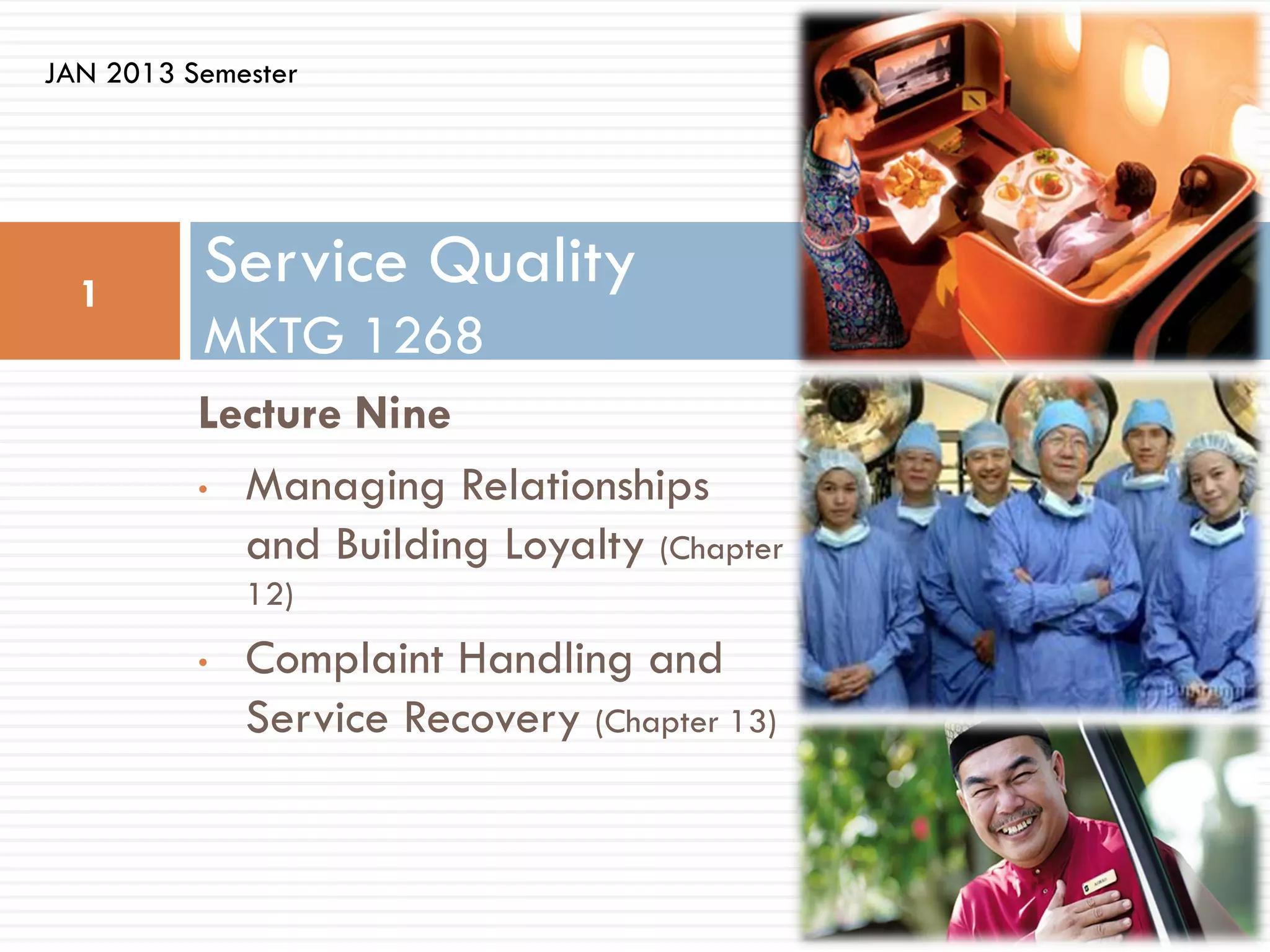
          Service Quality
          MKTG 1268
          Lecture Nine
          • Managing Relationships
            and Building Loyalty (Chapter
              12)
          •   Complaint Handling and
              Service Recovery (Chapter 13)
Overview of Chapter 12
2


       The Search for Customer Loyalty
       The Wheel of Loyalty
       Building a Foundation for Loyalty
       Strategies for Developing Loyalty Bonds with
        Customers
       Strategies for Reducing Customers Defections
       CRM: Customer Relationship Management
        Systems
       What a Comprehensive CRM Strategy
        Includes
3


 THE SEARCH FOR
CUSTOMER LOYALTY
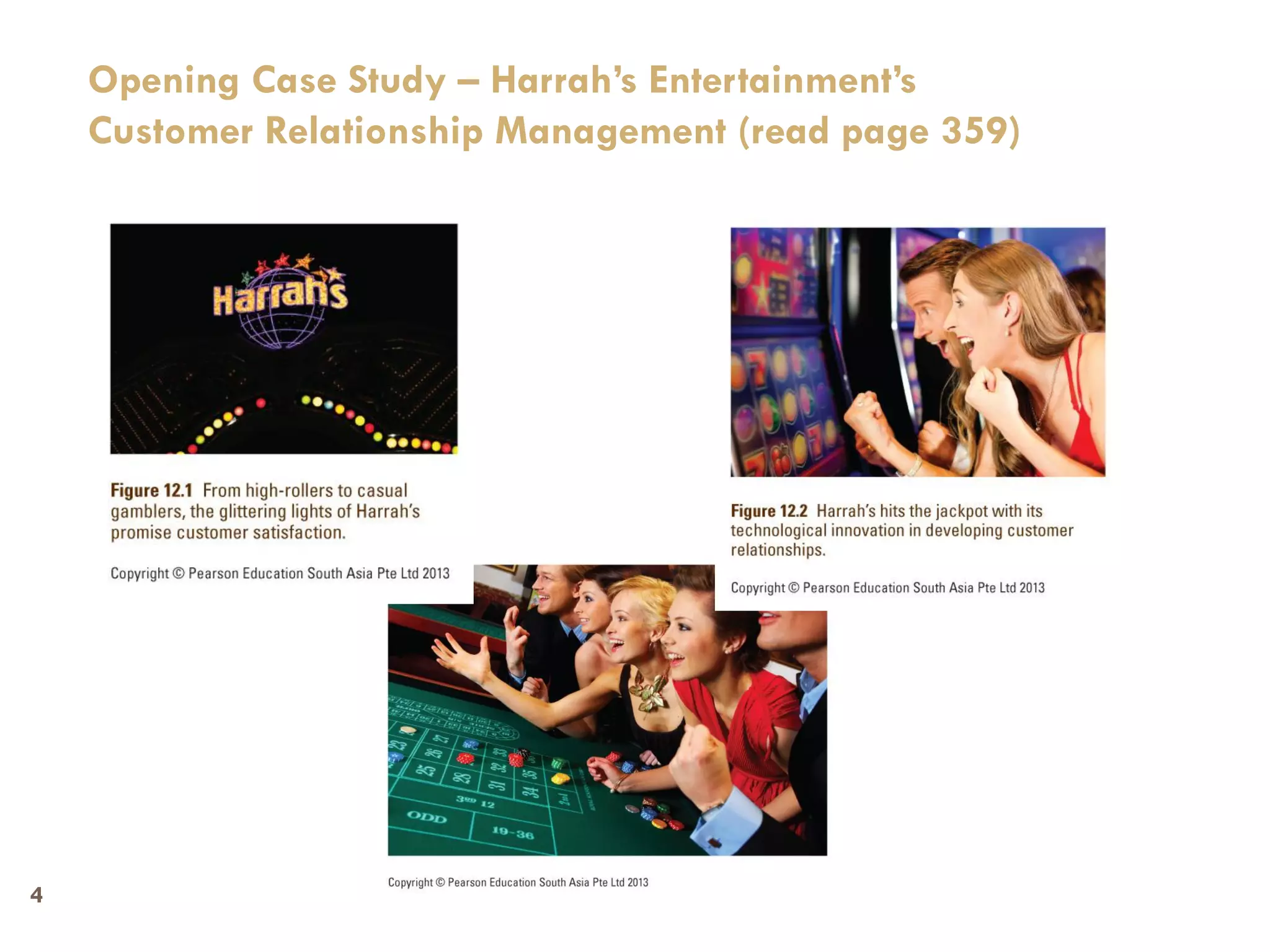
Opening Case Study – Harrah’s Entertainment’s
    Customer Relationship Management (read page 359)


4
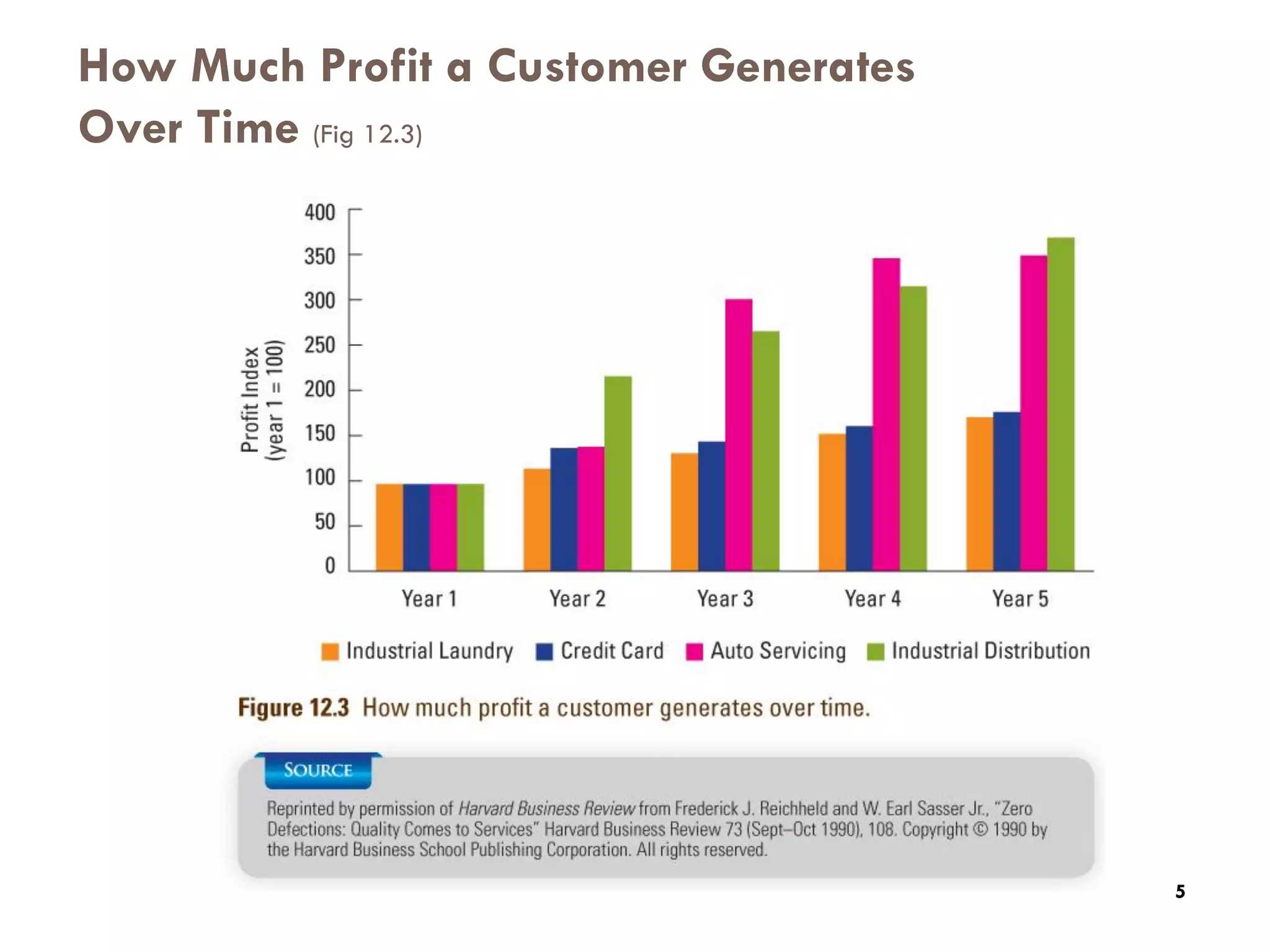
How Much Profit a Customer Generates
    Over Time (Fig 12.3)
5


                                           5
Why Is Customer Loyalty Important to A
    Firm’s Profitability?
6

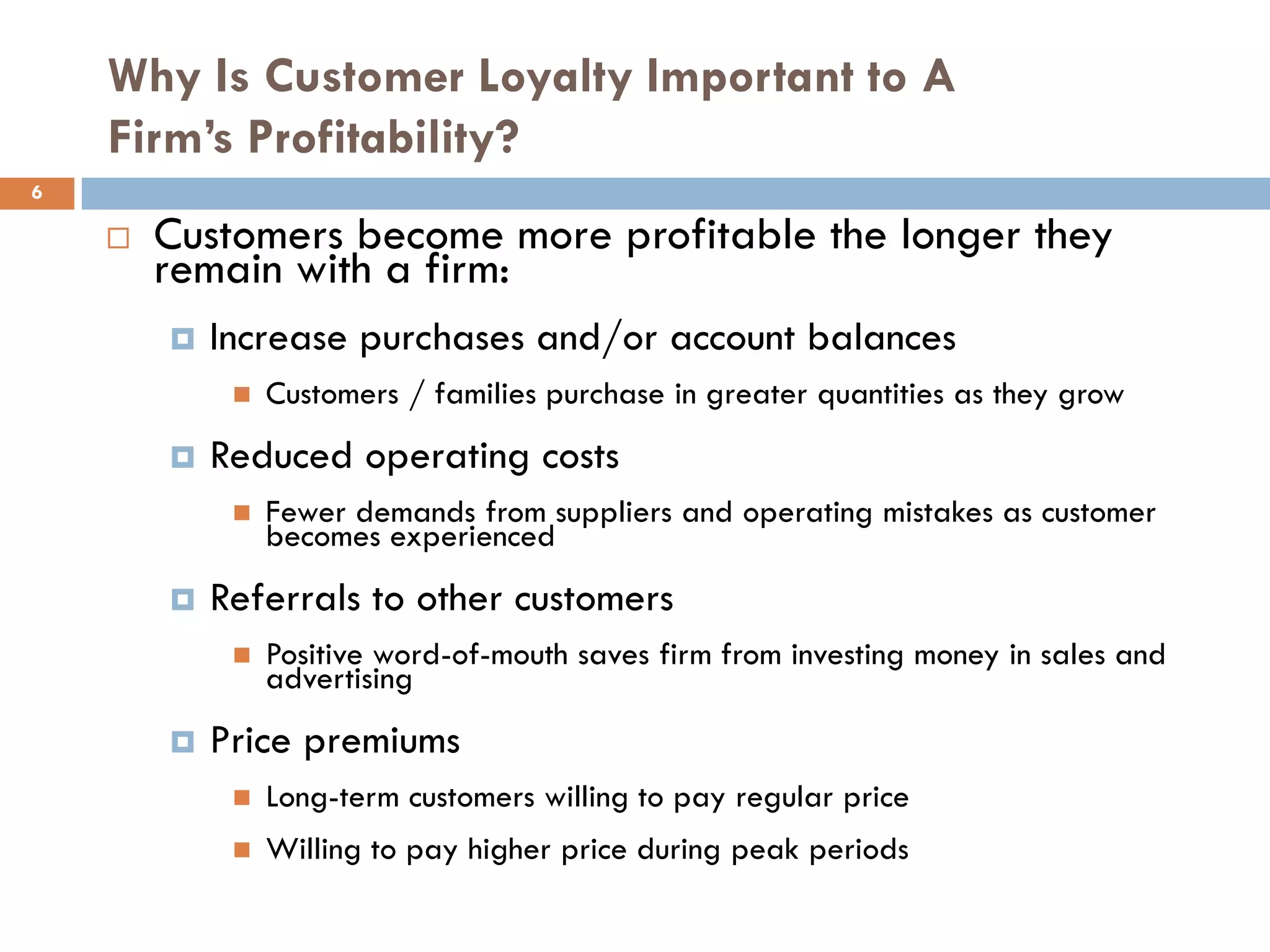
       Customers become more profitable the longer they
        remain with a firm:
           Increase purchases and/or account balances
                Customers / families purchase in greater quantities as they grow
           Reduced operating costs
                Fewer demands from suppliers and operating mistakes as customer
                 becomes experienced
           Referrals to other customers
                Positive word-of-mouth saves firm from investing money in sales and
                 advertising
           Price premiums
                Long-term customers willing to pay regular price
                Willing to pay higher price during peak periods
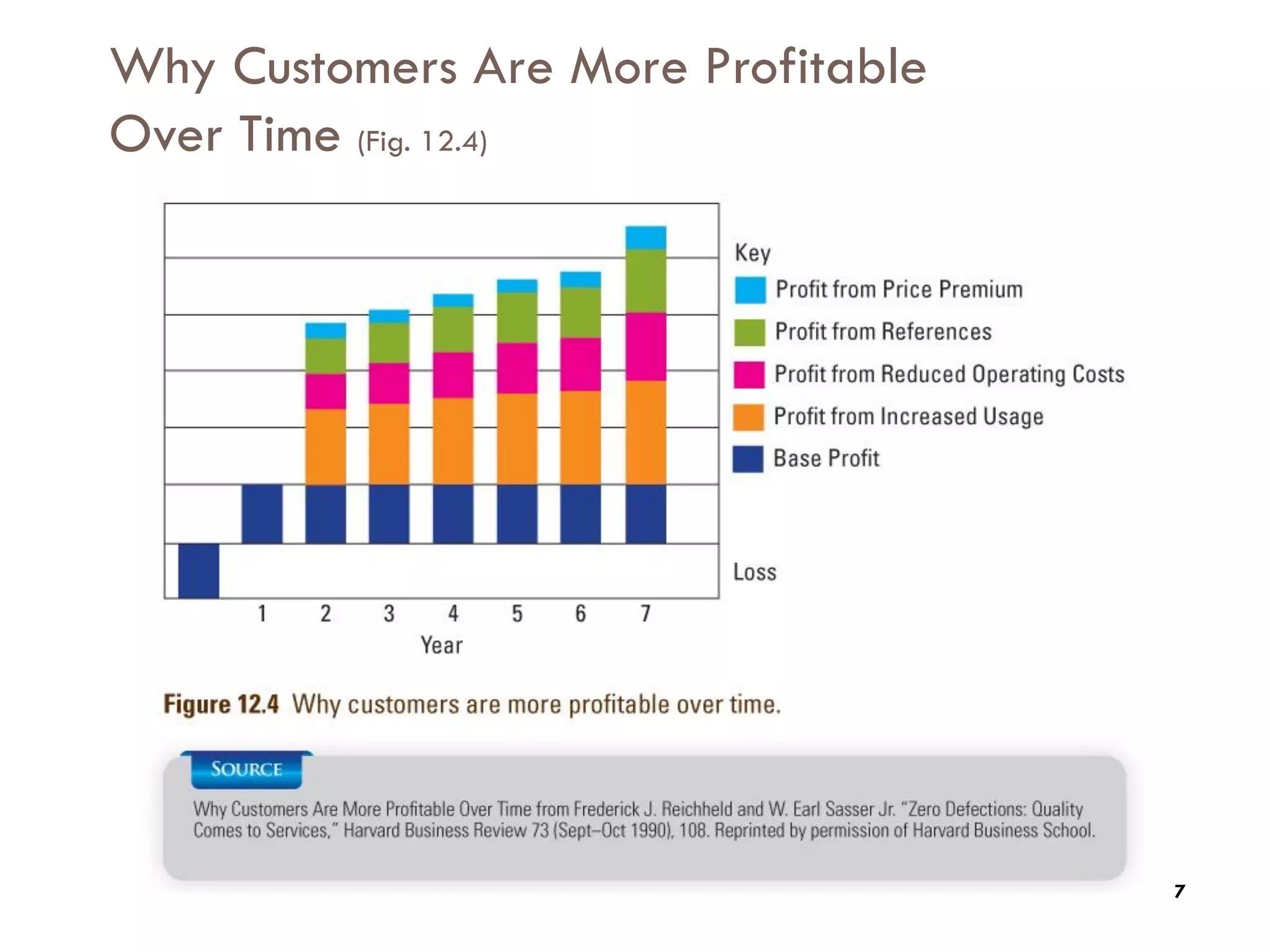
Why Customers Are More Profitable
    Over Time (Fig. 12.4)
7


                                        7
Assessing the Value of a Loyal Customer

    •   Must not assume that loyal customers are always
        more profitable than those making one-time
        transactions
           Large customers may expect price discounts in return for
            loyalty
           Revenues don‘t necessarily increase with time for all types
            of customers
    •   Tasks:
           Determine costs and revenues for customers from different
            market segments at different points in their customer
            lifecycles
           Predict future profitability
8           © Pearson Education South Asia Pte Ltd 2013. All rights reserved
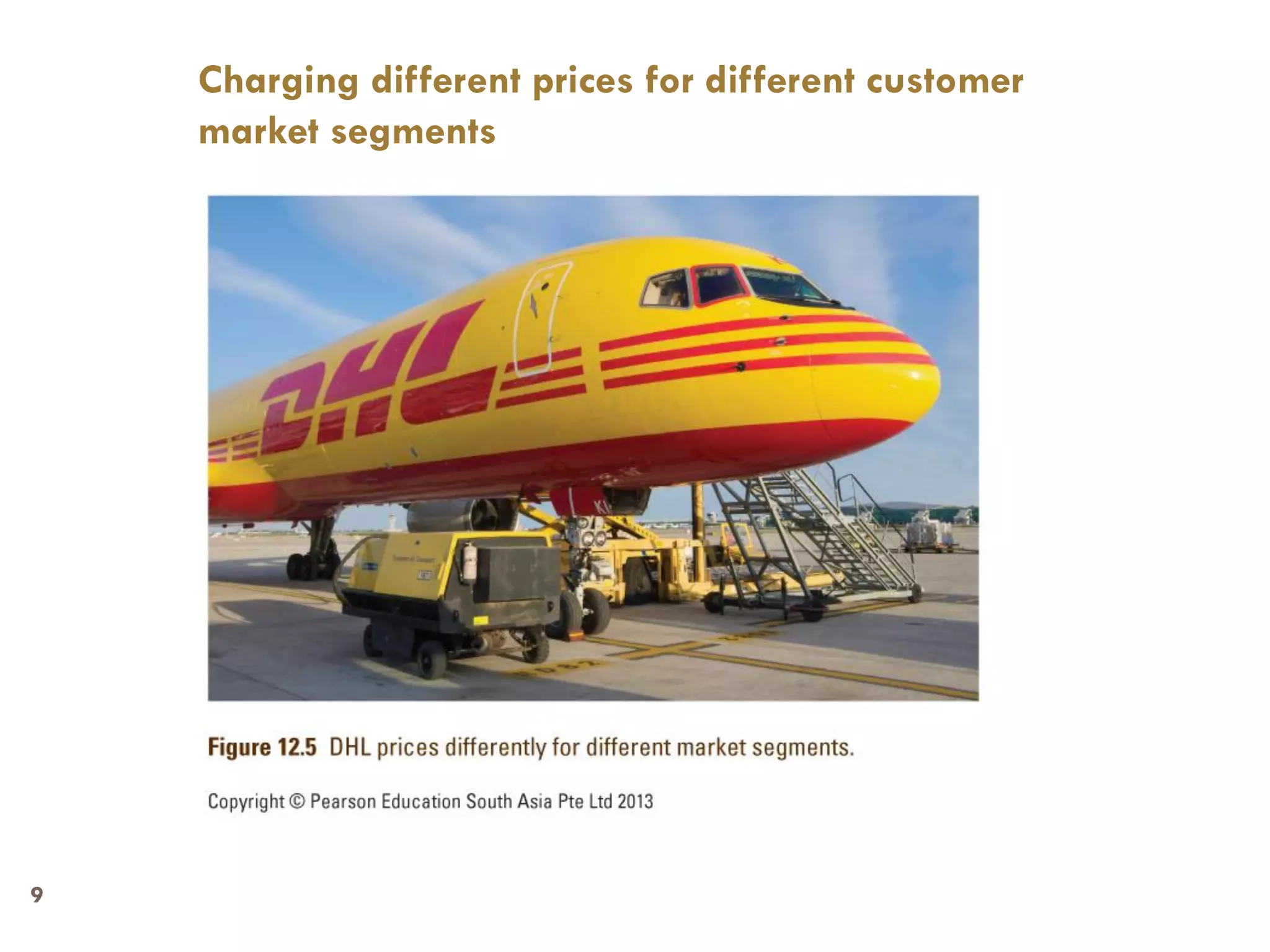
Charging different prices for different customer
    market segments


9
Measuring Customer Equity:
         Lifetime Value of Each Customer
10


        Value of referrals
          Percentage of customers influenced by other customers

          Other marketing activities that drew the firm to an
           individual‘s attention
        Net Present Value
          Sum anticipated annual values (future profits)

          Suitably discounted each year into the future


                                See Worksheet on page 363 of
                                the text
Why are Customers Loyal? (1)
     (Service Insights 12.1)
11


          Customers stay loyal when we create value for them
          Value can be created for customers through
             Confidence benefits

                   Confidence      in correct performance
                   Ability    to trust the provider
                   Lower      anxiety when purchasing
                   Knowing      what to expect and receive
Why are Customers Loyal? (2)
     (Service Insights 12.1)
12


           Social      benefits

                Mutualrecognition and friendship between
             service provider and customer
           Special treatment

                Better    price

                Discounts       not available to most customer

                Extra    services

                Higher        priority when there is a wait
The Wheel of Loyalty
13


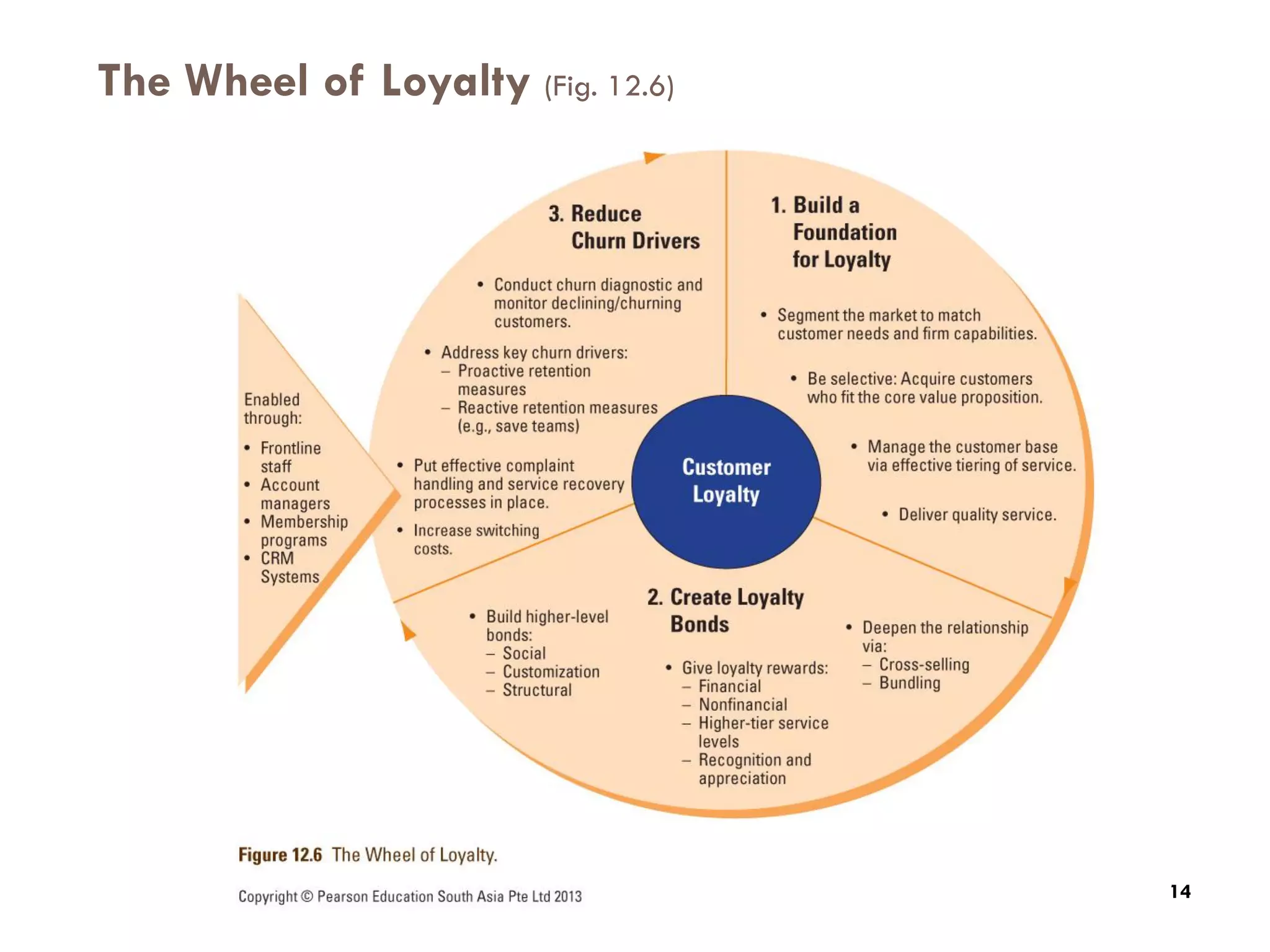
     The Wheel of loyalty (Figure 12.6) shows that arriving
     at customer loyalty involves 3 components:

        Building a foundation for loyalty
        Creating loyalty bonds
        Reducing churn drivers

        The rest of the chapter is organized around these 3
         components.
The Wheel of Loyalty (Fig. 12.6)

14


                                        14
Targeting the Right Customers and
     Searching for Value, Not Volume
15

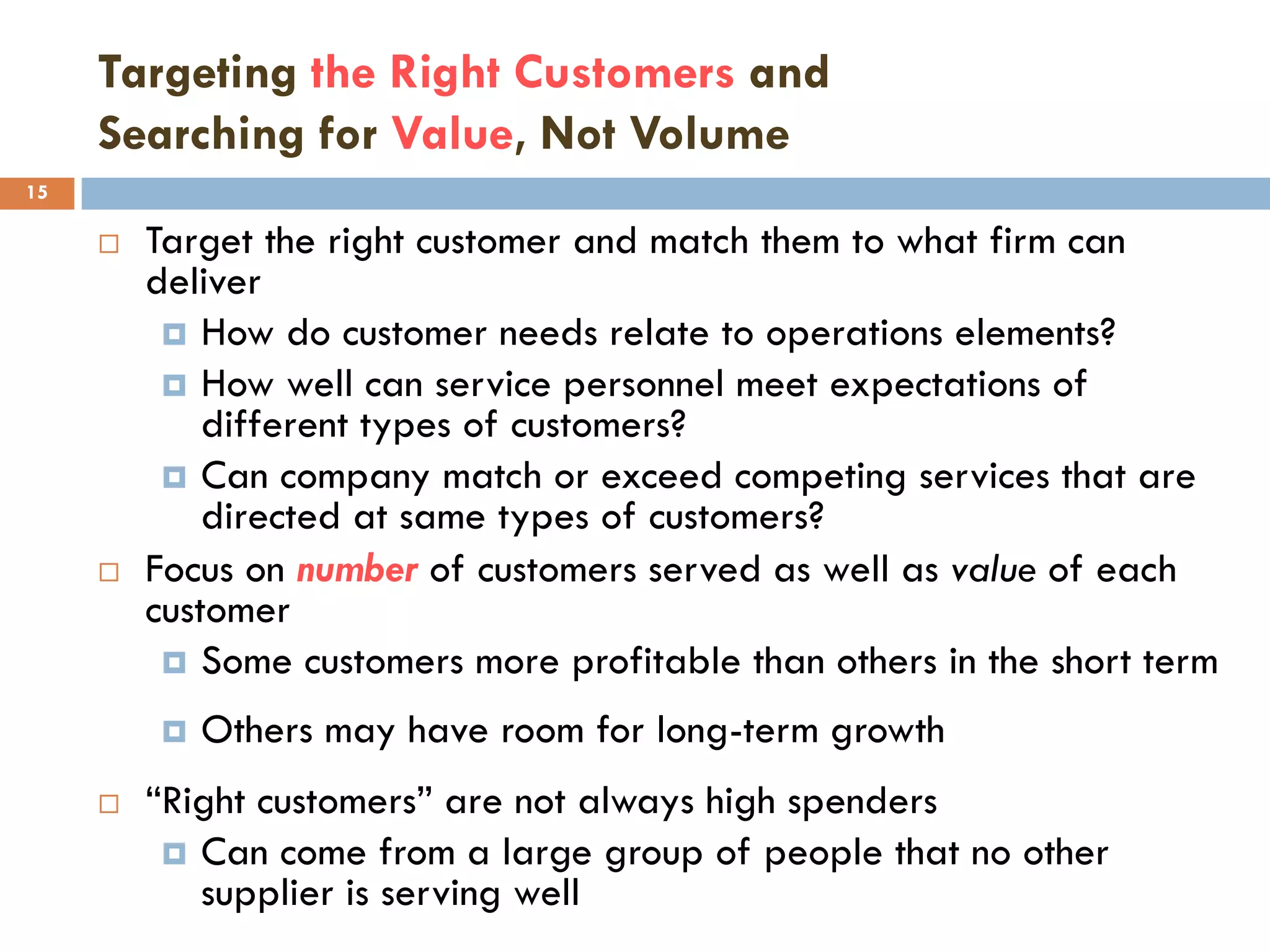
        Target the right customer and match them to what firm can
         deliver
           How do customer needs relate to operations elements?
           How well can service personnel meet expectations of
             different types of customers?
           Can company match or exceed competing services that are
             directed at same types of customers?
        Focus on number of customers served as well as value of each
         customer
           Some customers more profitable than others in the short term

            Others may have room for long-term growth
        ―Right customers‖ are not always high spenders
           Can come from a large group of people that no other
            supplier is serving well
Targeting the Right Customers and
     Searching for Value, Not Volume
16


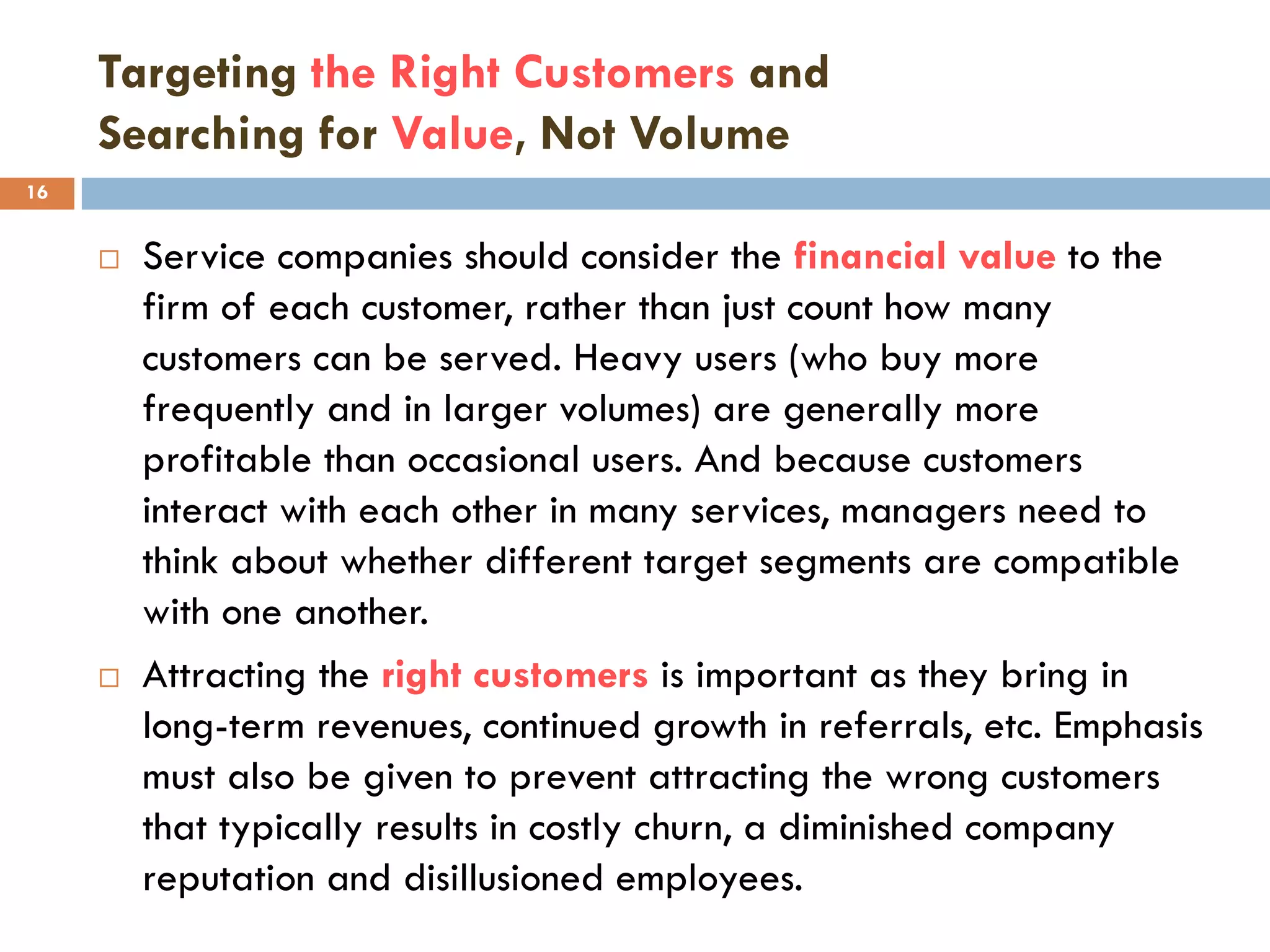
        Service companies should consider the financial value to the
         firm of each customer, rather than just count how many
         customers can be served. Heavy users (who buy more
         frequently and in larger volumes) are generally more
         profitable than occasional users. And because customers
         interact with each other in many services, managers need to
         think about whether different target segments are compatible
         with one another.
        Attracting the right customers is important as they bring in
         long-term revenues, continued growth in referrals, etc. Emphasis
         must also be given to prevent attracting the wrong customers
         that typically results in costly churn, a diminished company
         reputation and disillusioned employees.
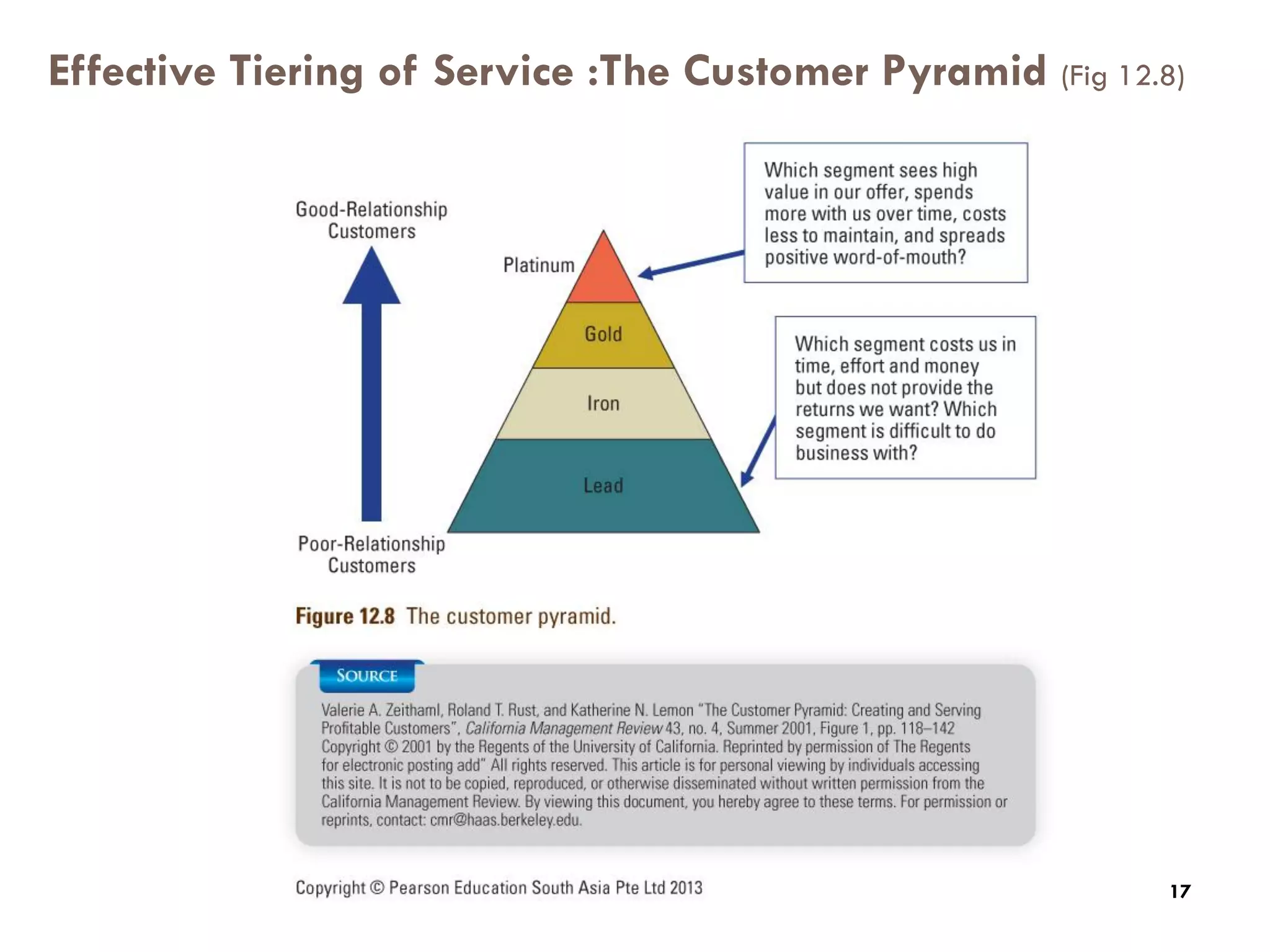
Effective Tiering of Service :The Customer Pyramid (Fig 12.8)

17


                                                             17
Effective Tiering of Service :The Customer Pyramid
     (Fig 12.8)

18

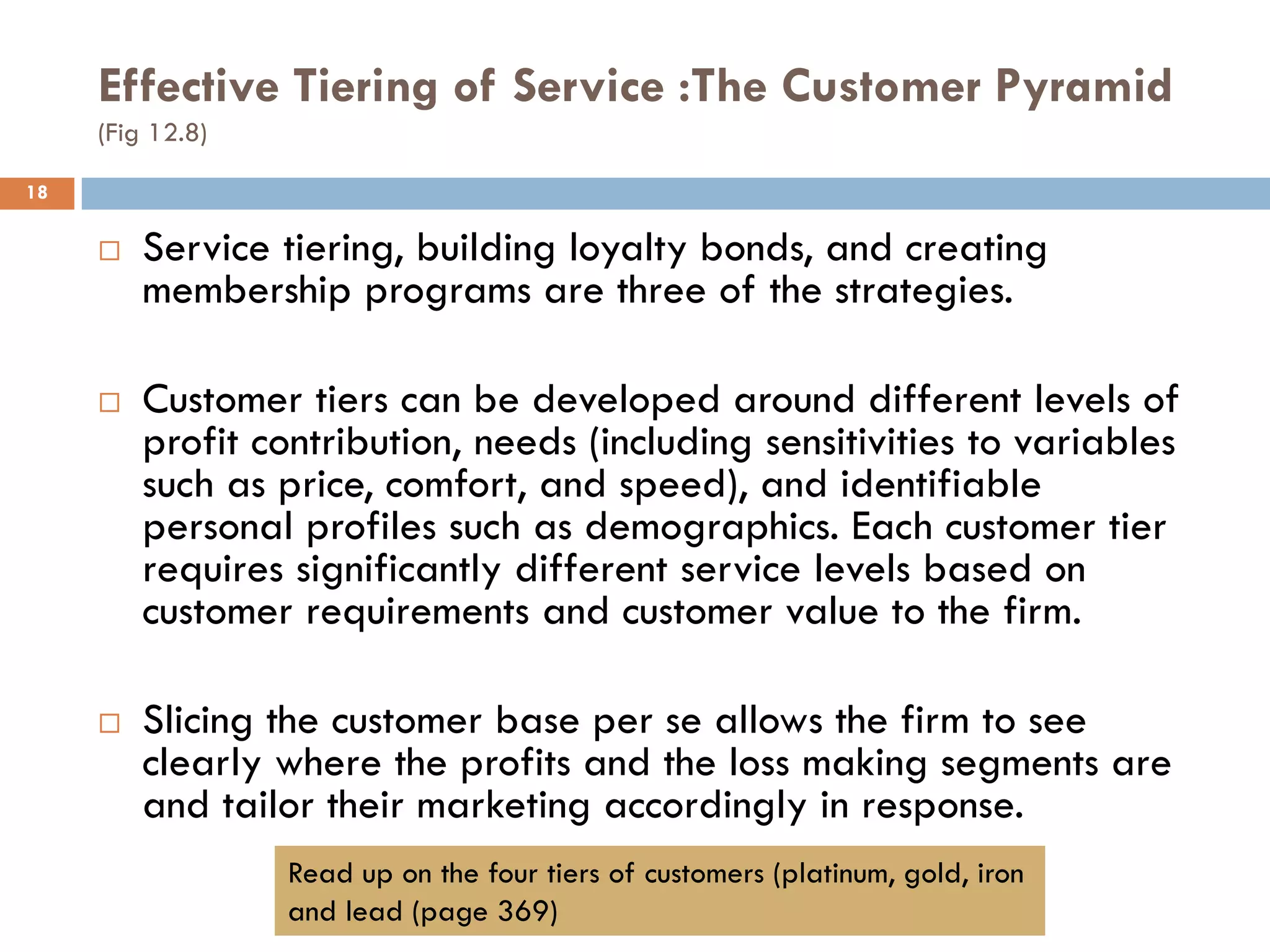
        Service tiering, building loyalty bonds, and creating
         membership programs are three of the strategies.

        Customer tiers can be developed around different levels of
         profit contribution, needs (including sensitivities to variables
         such as price, comfort, and speed), and identifiable
         personal profiles such as demographics. Each customer tier
         requires significantly different service levels based on
         customer requirements and customer value to the firm.

        Slicing the customer base per se allows the firm to see
         clearly where the profits and the loss making segments are
         and tailor their marketing accordingly in response.
                  Read up on the four tiers of customers (platinum, gold, iron
                  and lead (page 369)
Relationship between Satisfaction and Loyalty
19


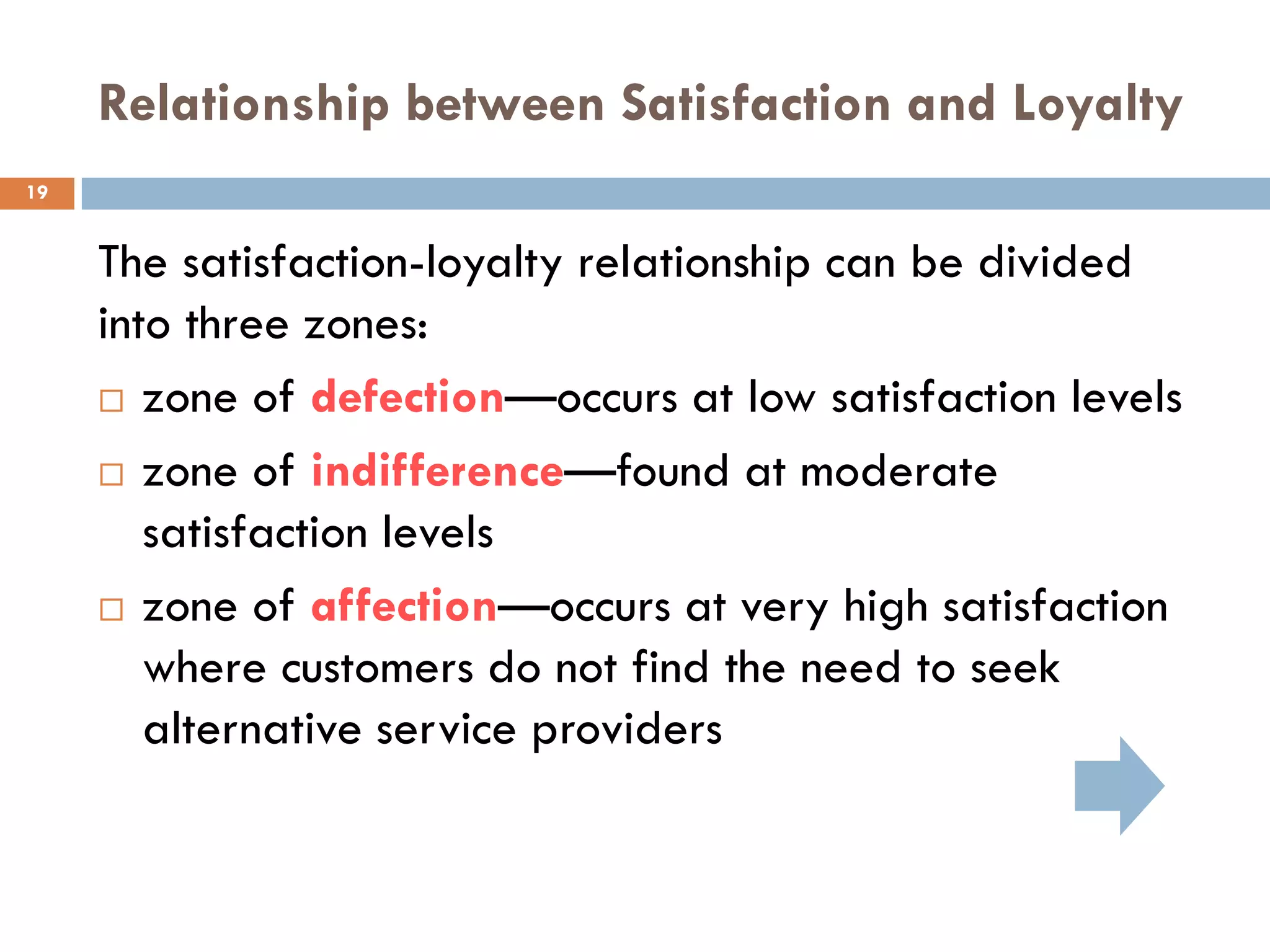
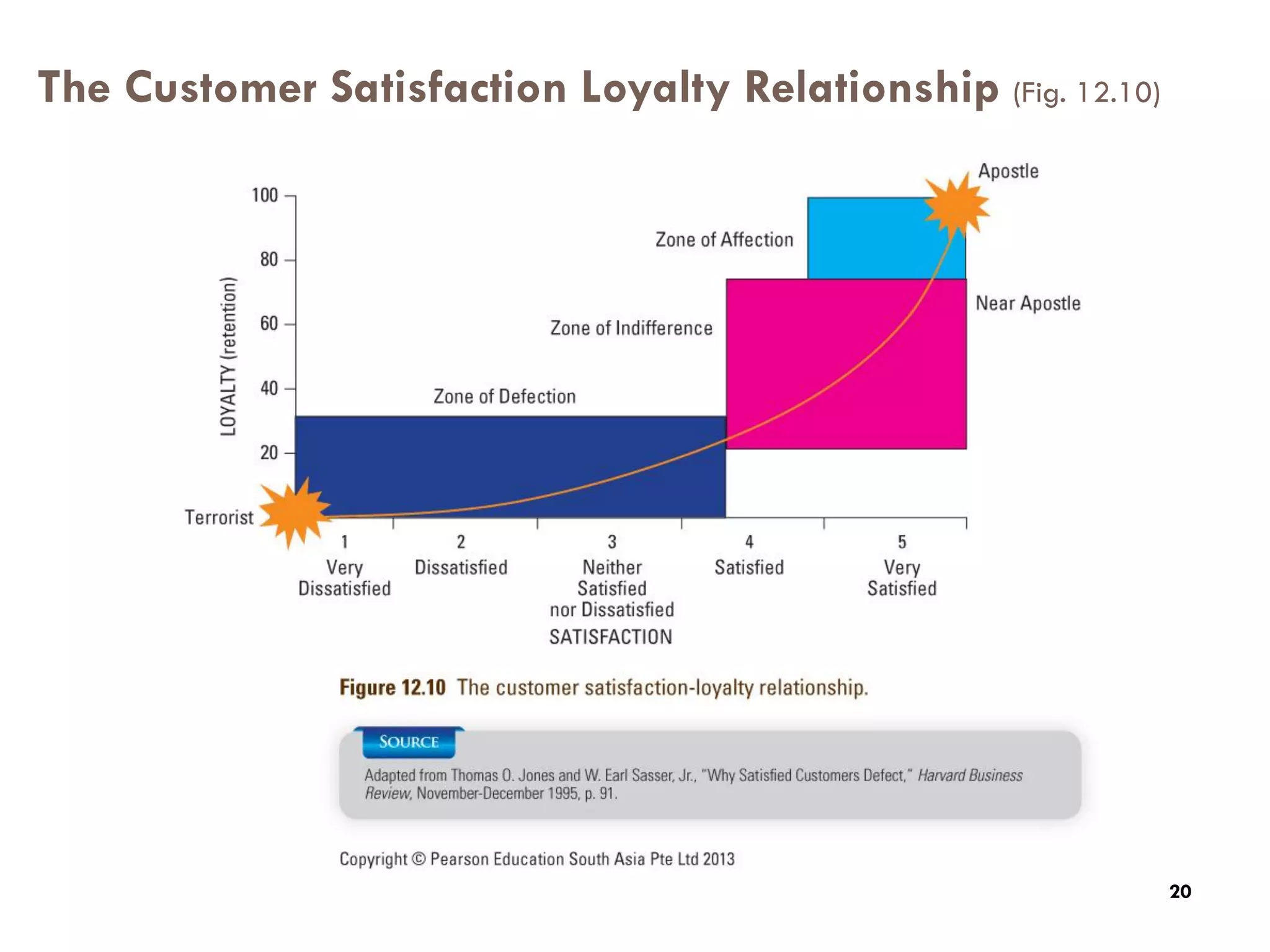
     The satisfaction-loyalty relationship can be divided
     into three zones:
      zone of defection—occurs at low satisfaction levels

      zone of indifference—found at moderate

        satisfaction levels
      zone of affection—occurs at very high satisfaction

        where customers do not find the need to seek
        alternative service providers
The Customer Satisfaction Loyalty Relationship (Fig. 12.10)
20


                                                               20
Strategies for Developing Loyalty Bonds with
     Customers (1)
21


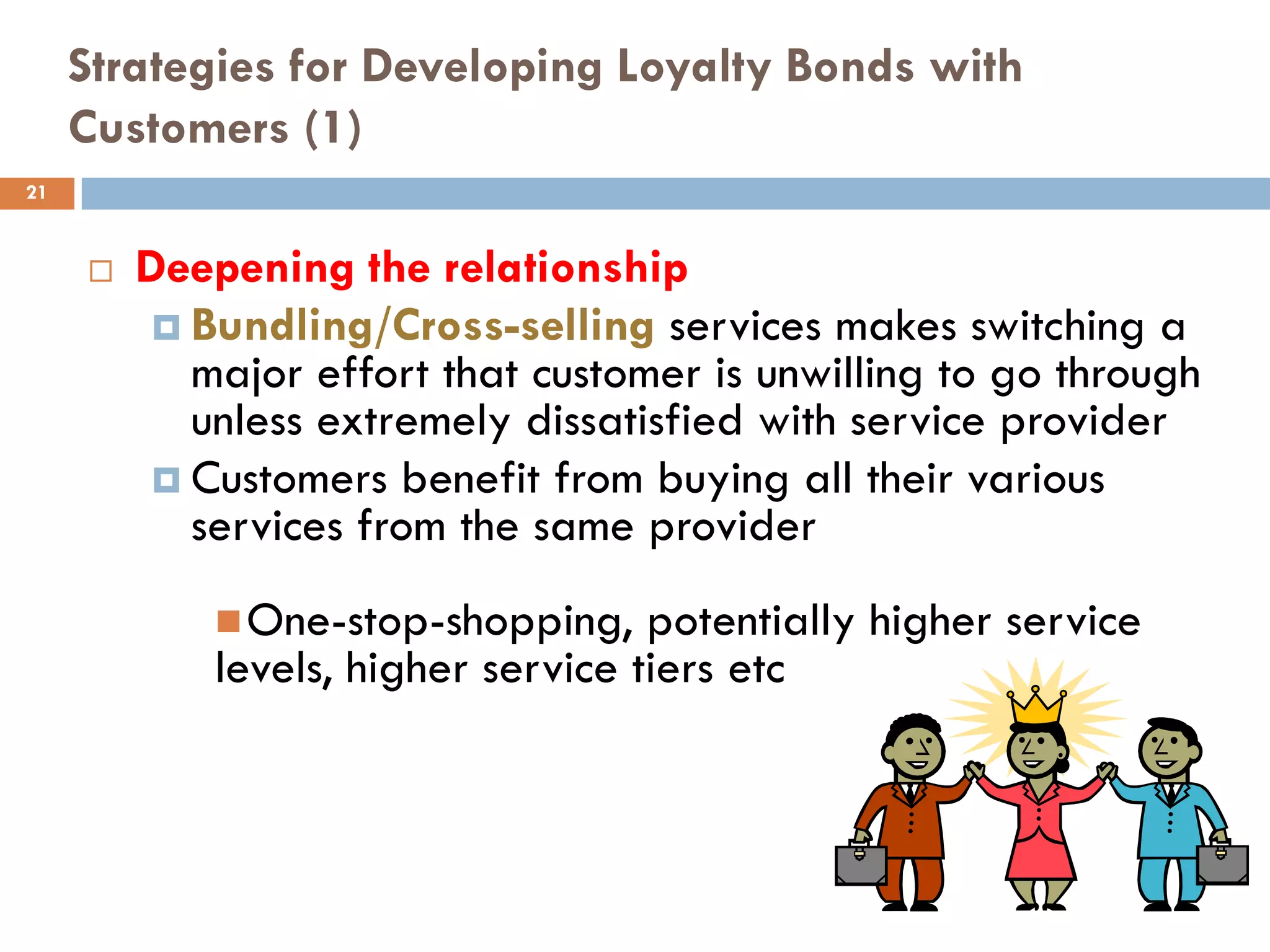
        Deepening the relationship
           Bundling/Cross-selling services makes switching a
            major effort that customer is unwilling to go through
            unless extremely dissatisfied with service provider
           Customers benefit from buying all their various
            services from the same provider
              One-stop-shopping,    potentially higher service
             levels, higher service tiers etc
Strategies for Developing Loyalty Bonds
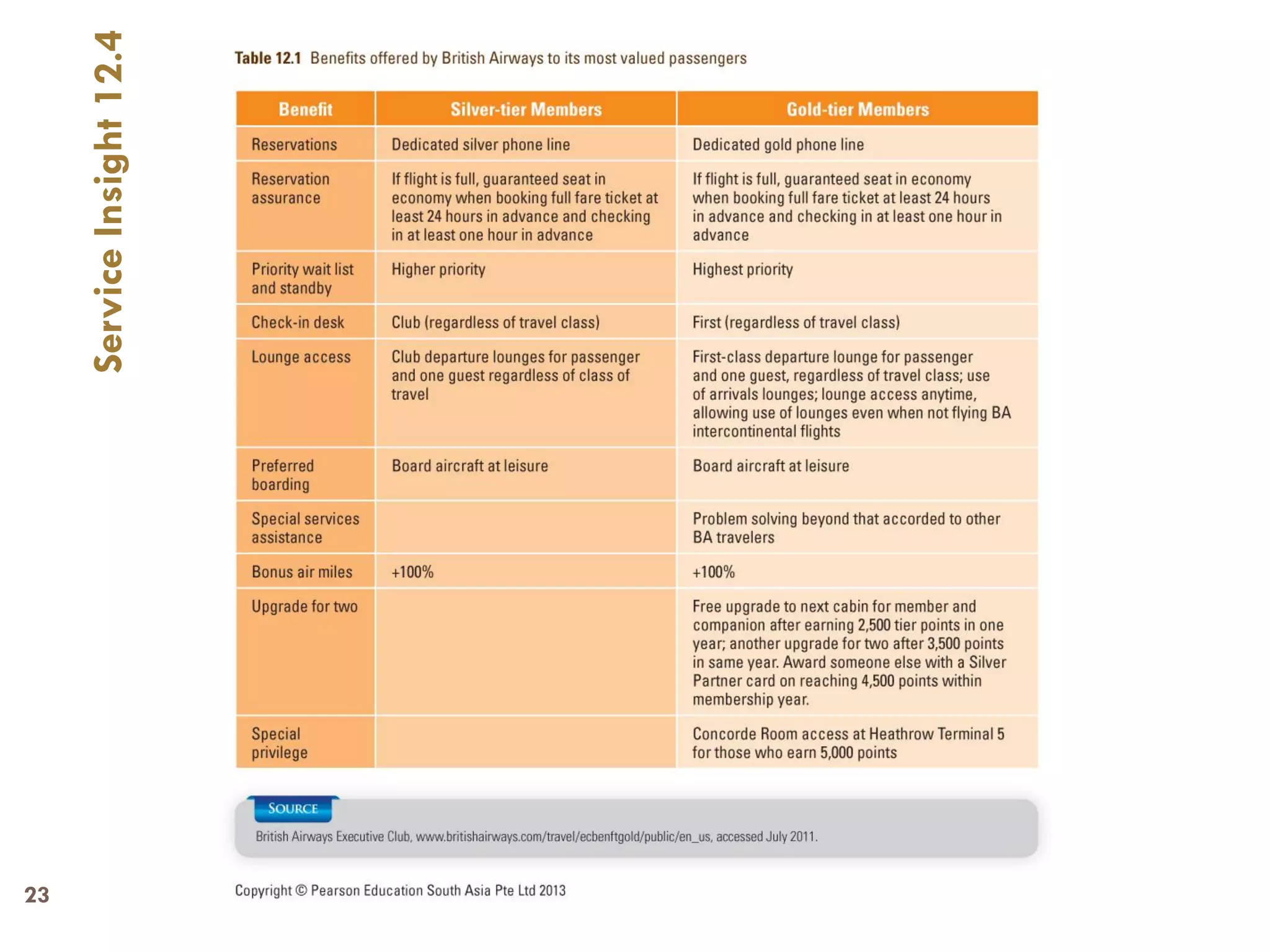
     with Customers (2)         See example of rewards used by British
                                                Airways in Service Insights 12.4 on page
22
                                                375 of the text (see Table 12.1)
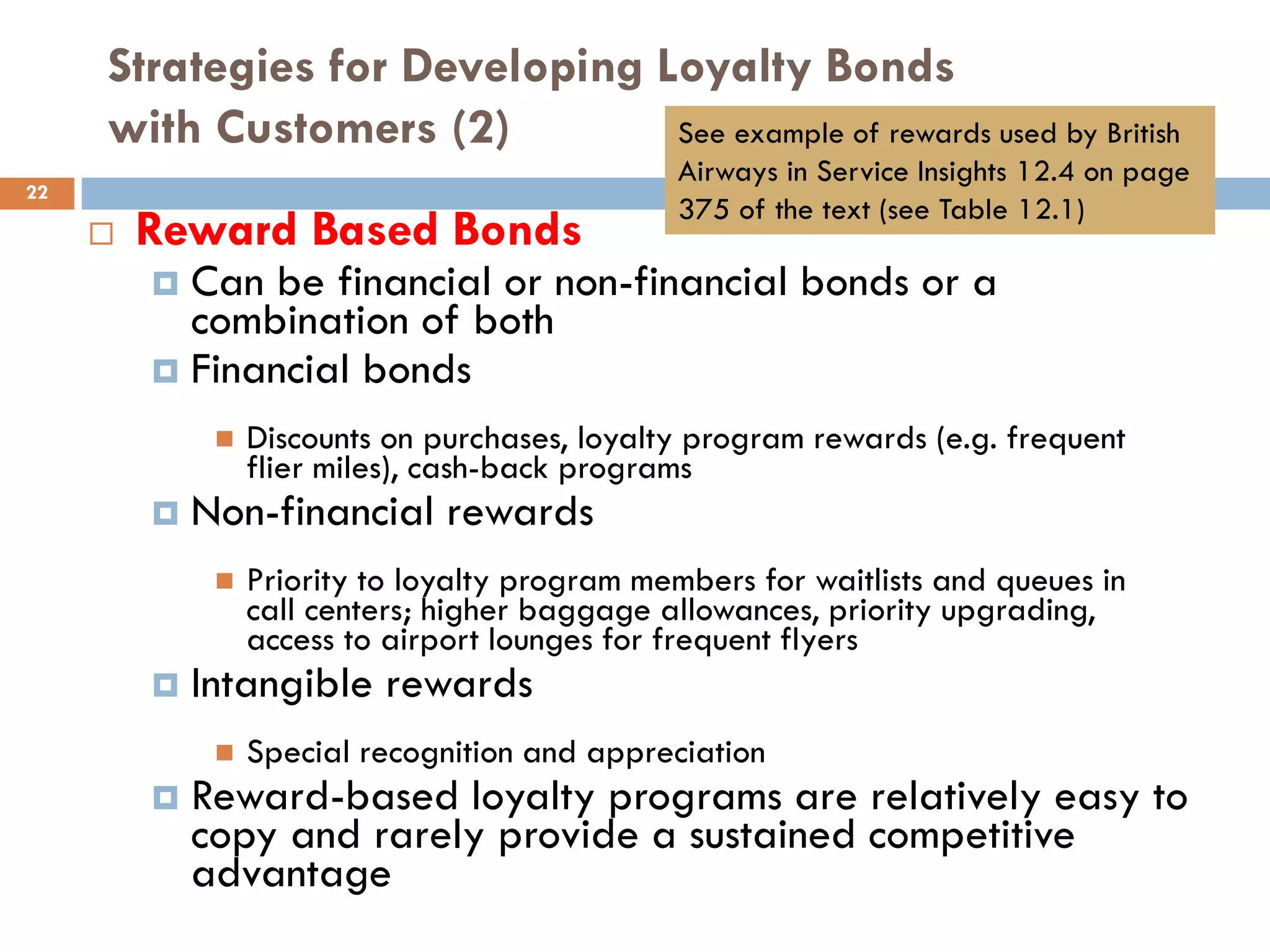
        Reward Based Bonds
          Can be financial or non-financial bonds or a
           combination of both
          Financial bonds

                 Discounts on purchases, loyalty program rewards (e.g. frequent
                  flier miles), cash-back programs
            Non-financial rewards
                 Priority to loyalty program members for waitlists and queues in
                  call centers; higher baggage allowances, priority upgrading,
                  access to airport lounges for frequent flyers
            Intangible rewards
                 Special recognition and appreciation
            Reward-based loyalty programs are relatively easy to
             copy and rarely provide a sustained competitive
             advantage
23
     Service Insight 12.4
Strategies for Developing Loyalty Bonds
     with Customers (3)
24


        Social Bonds
          Based on personal relationships between providers
           and customers
          Harder to and takes a longer time to build, but also
           harder to imitate and thus, better chance of
           retention in the long term
        Customization Bonds
            Customized service for loyal customers
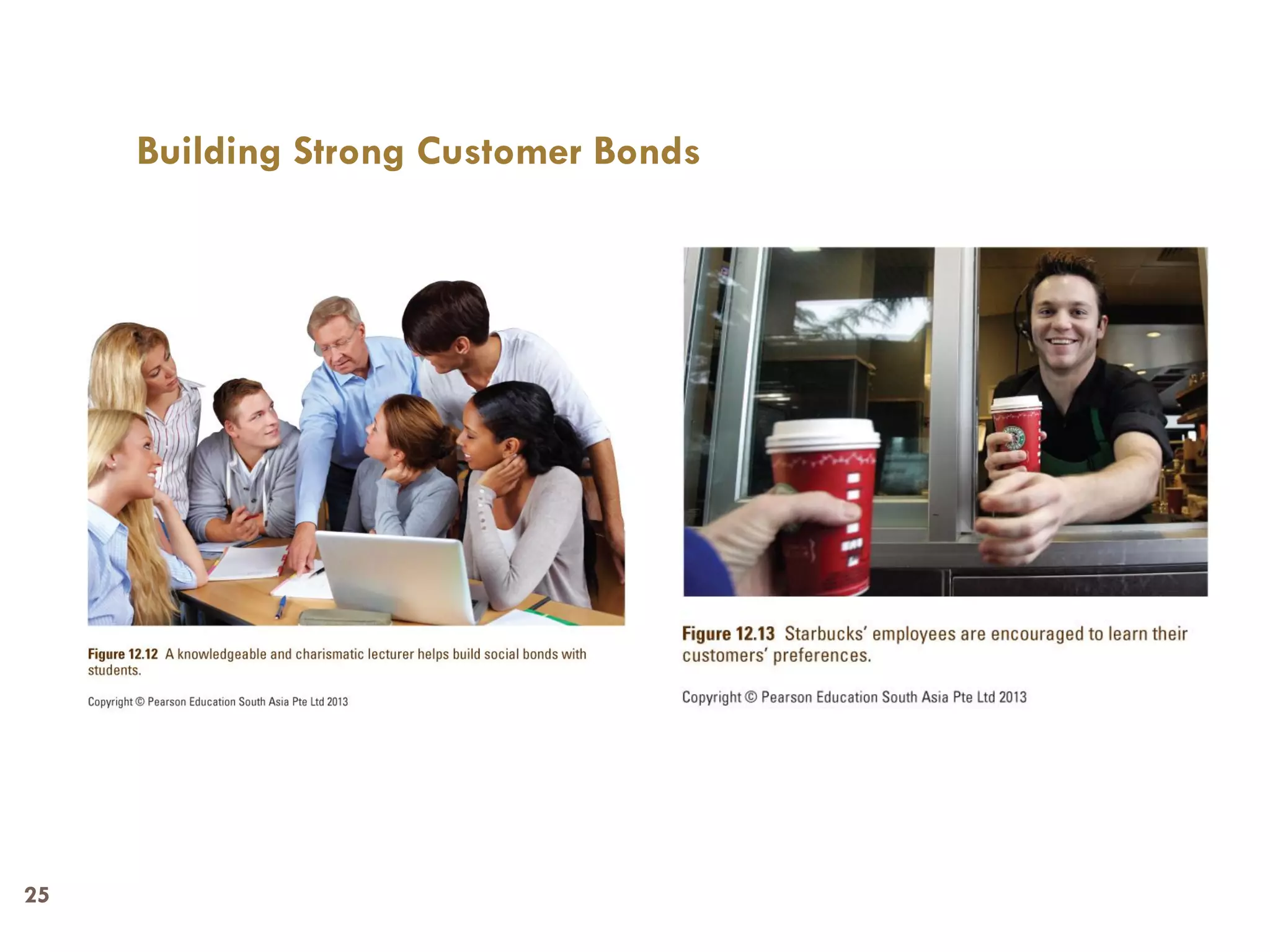
               e.g.   Starbucks
            Customers may find it hard to adjust to another
             service provider who cannot customize service
Building Strong Customer Bonds


25
Strategies for Developing Loyalty Bonds
     with Customers (4)
26


        Structural Bonds
          Mostly seen in B2B settings
          Align customers way of doing things with supplier‘s own
           processes
                 Joint investments in projects and sharing of information,
                  processes and equipment.
            Can be seen in B2C environment too
               Airlines - SMS check-in, SMS email alerts for flight arrival   and
              departure times
            Difficult for competition to draw customers away when
             they have integrated their way of doing things with
             existing supplier
Analyze Customer Defections and Monitor
     Declining Accounts
27


        Understand reasons for customer switching
        Churn Diagnostics common in mobile phone
         industry
           Analysis of data warehouse information on
            churned and declining customers
           Exit interviews:

             Ask a short set of questions when
            customer cancels account; in-depth
            interviews of former customers by third
            party agency
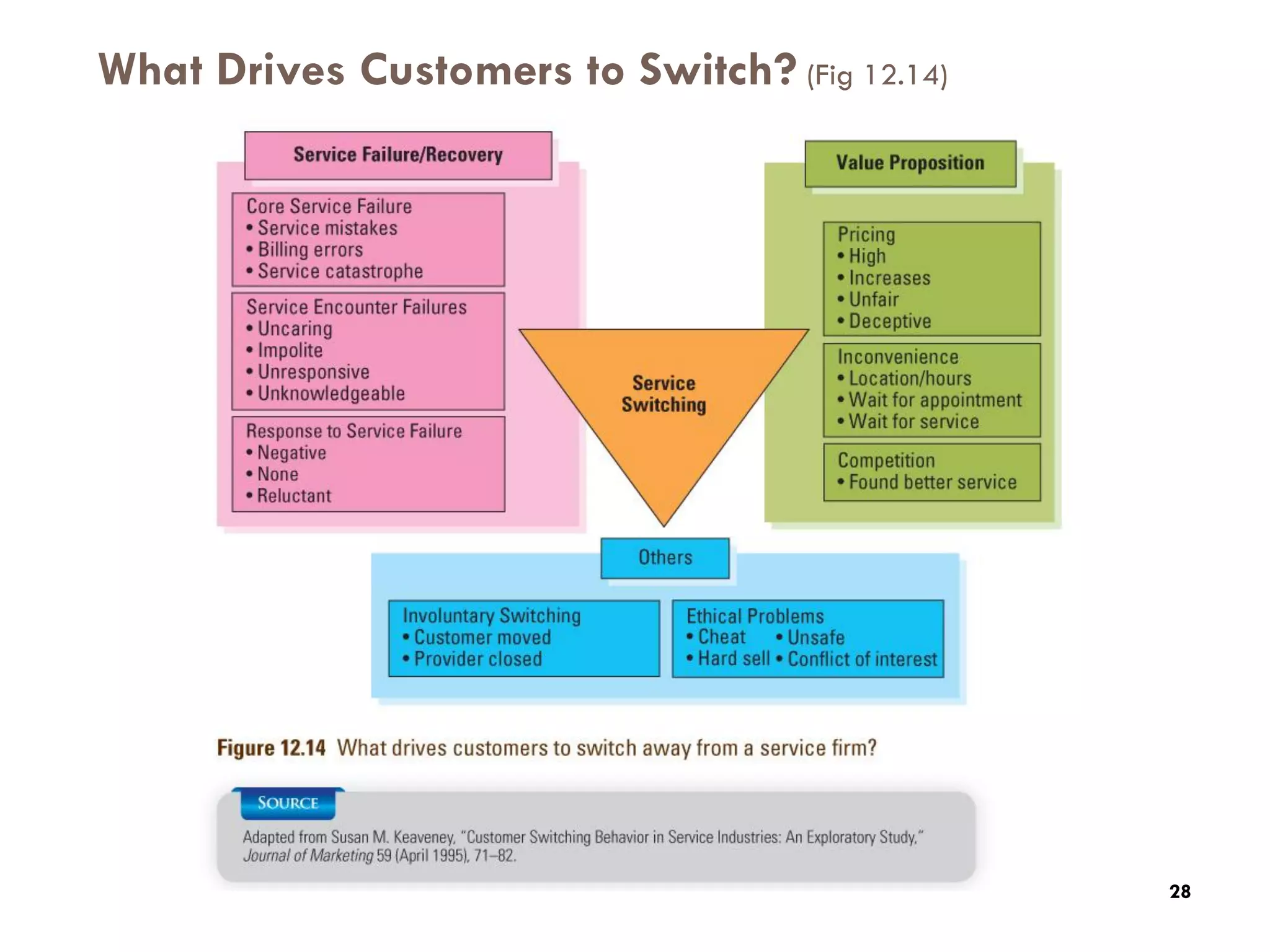
What Drives Customers to Switch? (Fig 12.14)

28


                                                    28
Address Key Churn Drivers

   Deliver quality service
   Reduce inconvenience and non-monetary costs
   Have fair and transparent pricing
   Industry specific drivers
       Cellular phone industry: handset replacement a common
        reason for subscribers discontinuing services – offer handset
        replacement programs
   Take active steps to retain customers
       Save teams: specially trained call center staff to deal with
        customers who want to cancel their accounts
       Be careful about how save teams are rewarded (see Service
        Insights 12.5)                                              29
Other Ways to Reduce Churn
30


        Implement Effective Complaint Handling
         and Service Recovery Procedures
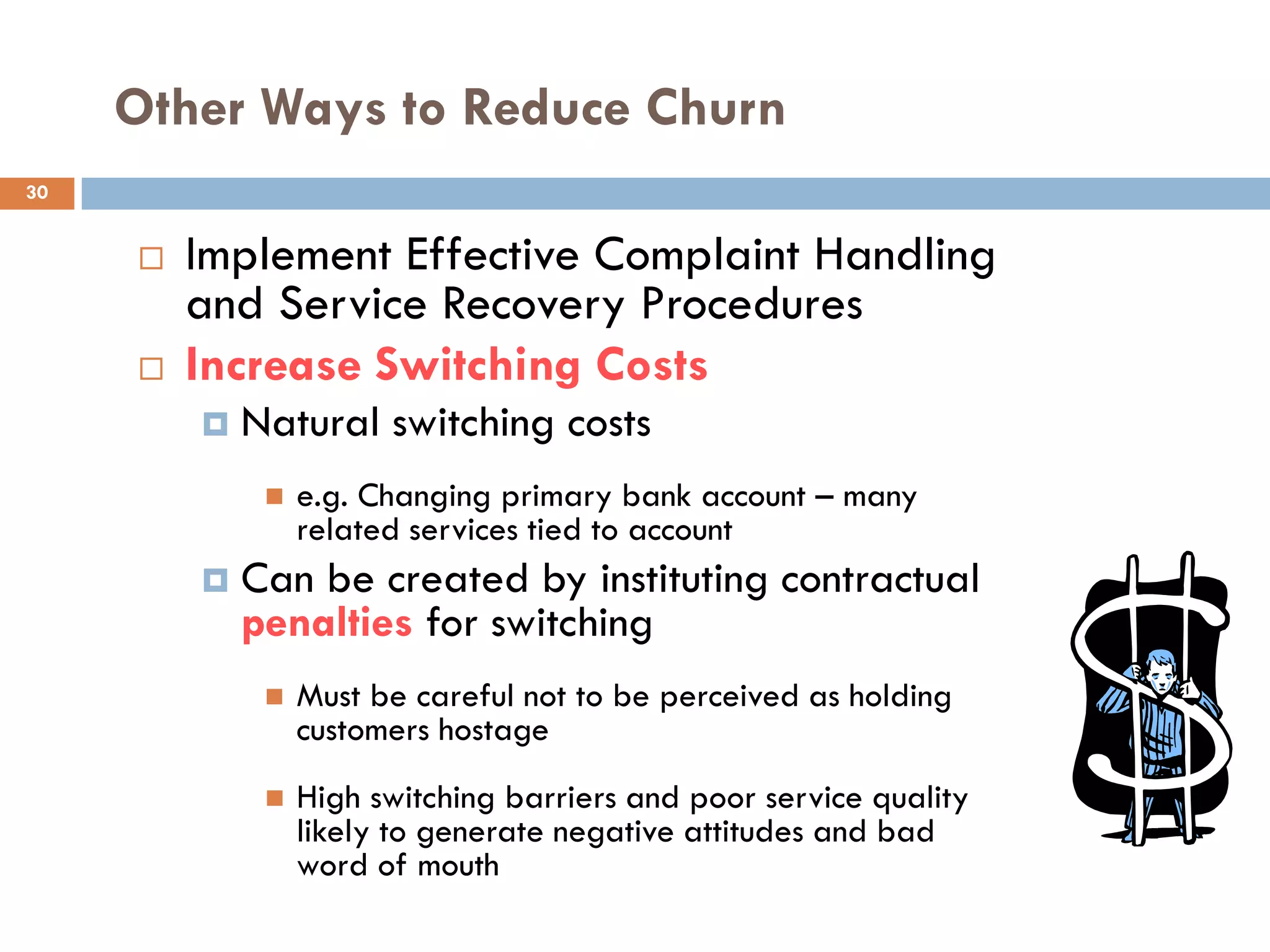
        Increase Switching Costs
            Natural switching costs
                 e.g. Changing primary bank account – many
                  related services tied to account
            Can be created by instituting contractual
             penalties for switching
                 Must be careful not to be perceived as holding
                  customers hostage
                 High switching barriers and poor service quality
                  likely to generate negative attitudes and bad
                  word of mouth
31


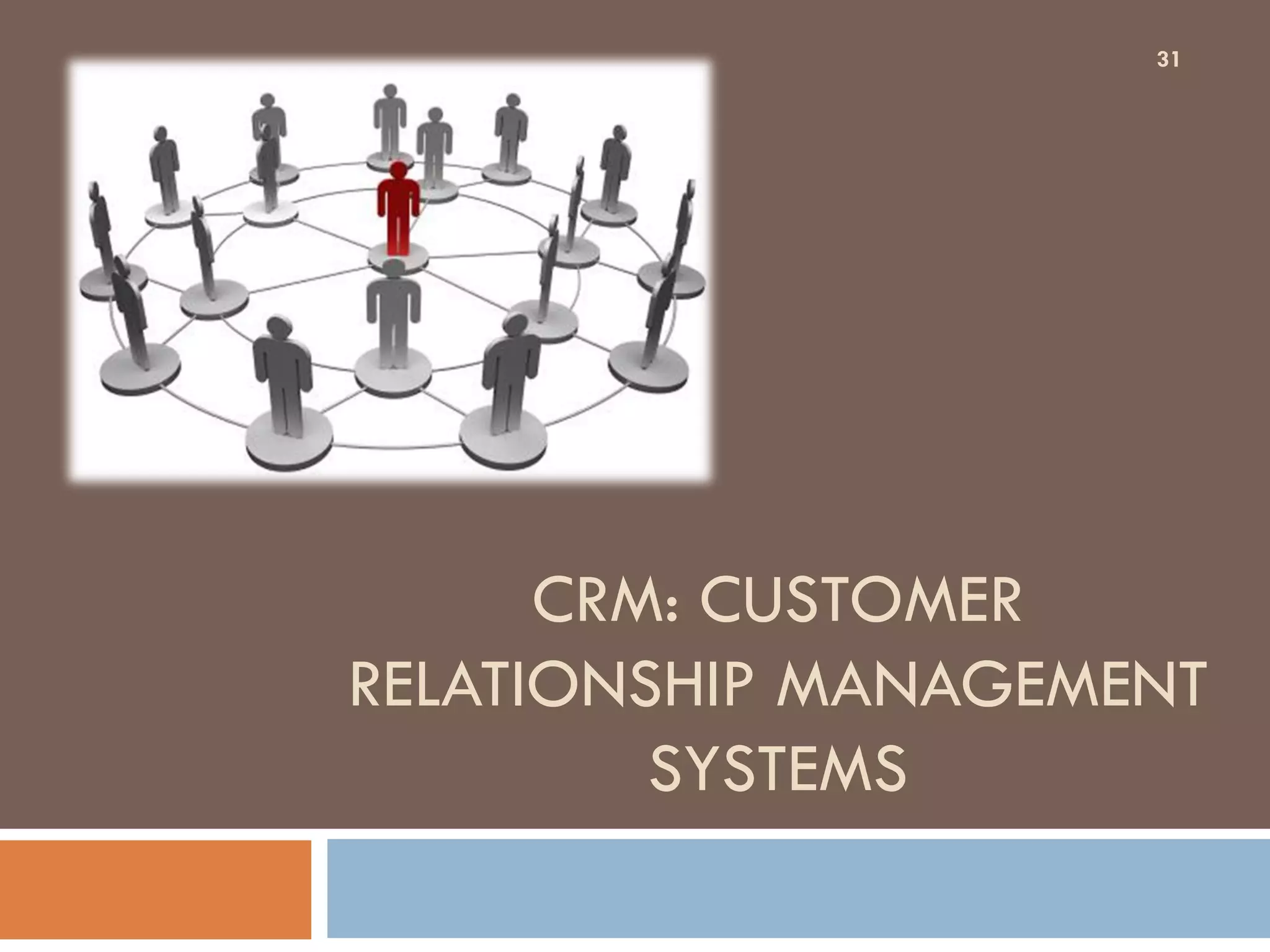
      CRM: CUSTOMER
RELATIONSHIP MANAGEMENT
         SYSTEMS
Common Objectives Of CRM Systems (1)
32


        Customer perspective
          Unified customer interface that delivers
           customization and personalization
          Vast service improvement and increase customer
           value
        Company perspective
          Better segment, tier customer base and target
           promotion
          Implement churn alert systems if customers are in
           danger of defecting
Common Applications Of CRM Systems (1)
     (Service Insights 12.6)
33

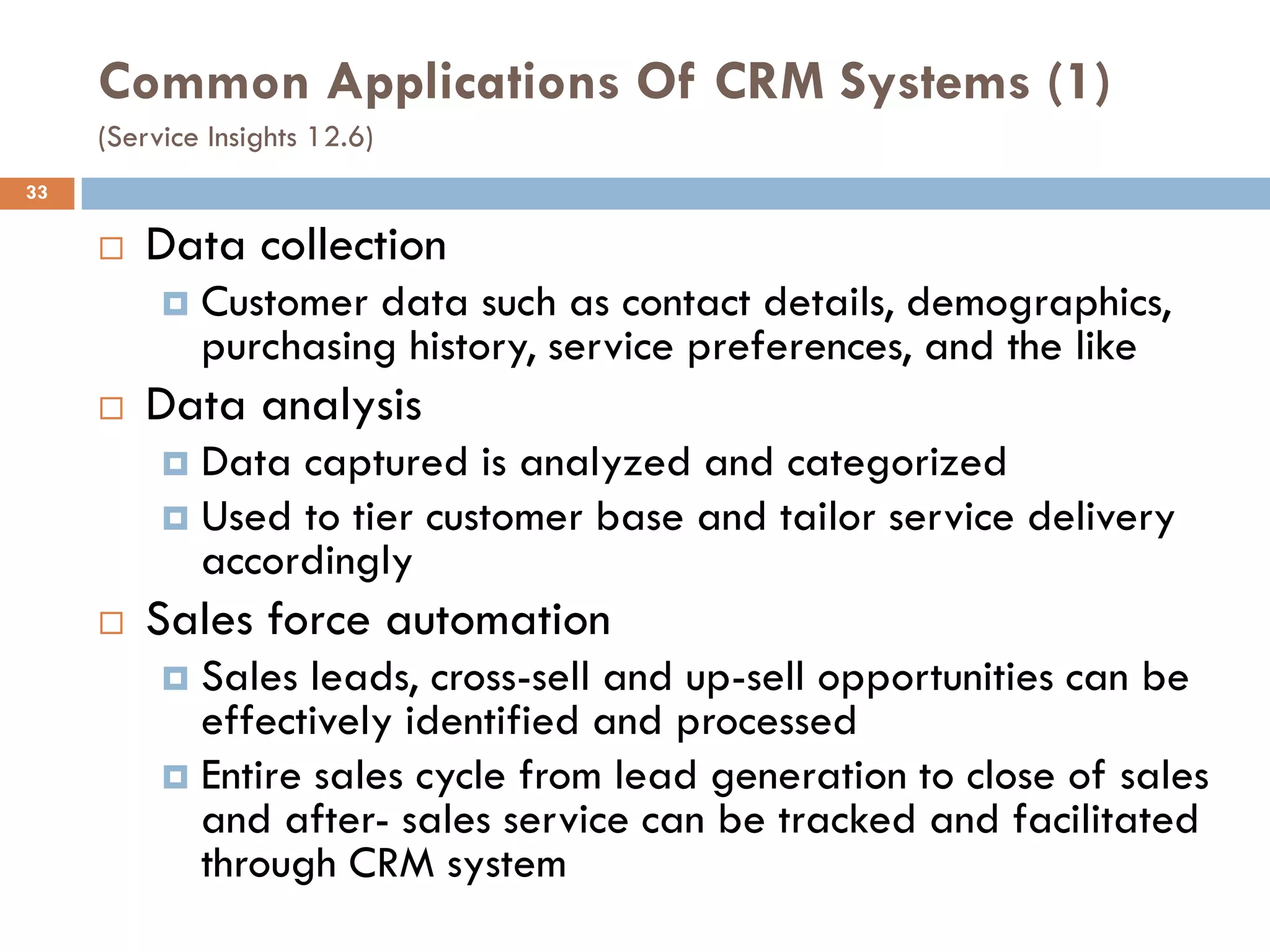
        Data collection
             Customer data such as contact details, demographics,
              purchasing history, service preferences, and the like
        Data analysis
           Data captured is analyzed and categorized
           Used to tier customer base and tailor service delivery
            accordingly
        Sales force automation
           Sales leads, cross-sell and up-sell opportunities can be
            effectively identified and processed
           Entire sales cycle from lead generation to close of sales
            and after- sales service can be tracked and facilitated
            through CRM system
Common Objectives Of CRM Systems (2)
     (Service Insights 12.6)
34


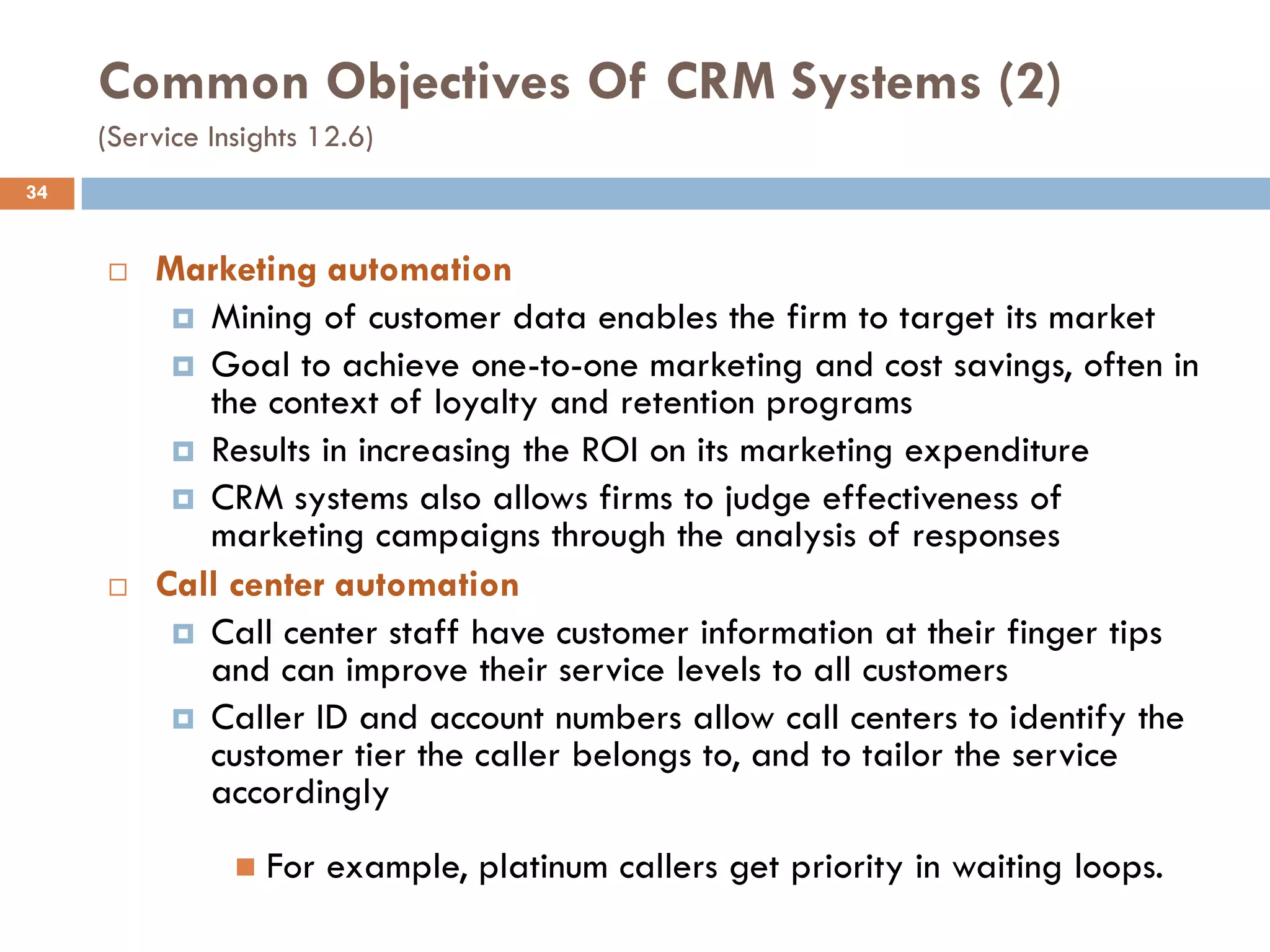
        Marketing automation
           Mining of customer data enables the firm to target its market
           Goal to achieve one-to-one marketing and cost savings, often in
            the context of loyalty and retention programs
           Results in increasing the ROI on its marketing expenditure
           CRM systems also allows firms to judge effectiveness of
            marketing campaigns through the analysis of responses
        Call center automation
           Call center staff have customer information at their finger tips
            and can improve their service levels to all customers
           Caller ID and account numbers allow call centers to identify the
            customer tier the caller belongs to, and to tailor the service
            accordingly
                   For example, platinum callers get priority in waiting loops.
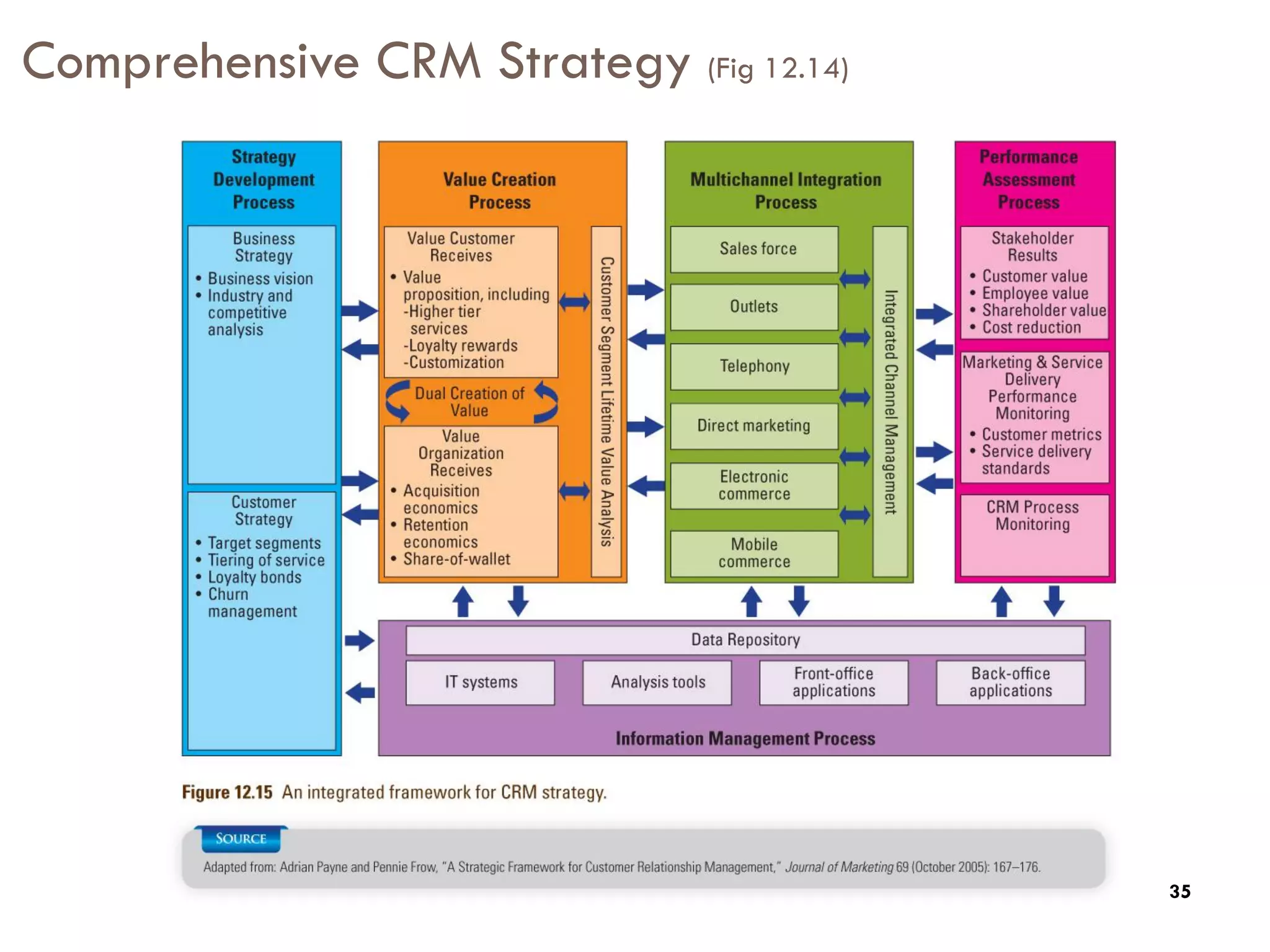
Comprehensive CRM Strategy (Fig 12.14)


                                         35
What a Comprehensive CRM Strategy Includes
 Integrated Framework for CRM Strategy
 Development


                                               Strategy Development
                                                       •   Assessment of business strategy
                                                       •   Business strategy guides
                                                           development of customer strategy


36 © Pearson Education South Asia Pte Ltd 2013. All rights reserved
What a Comprehensive CRM Strategy Includes
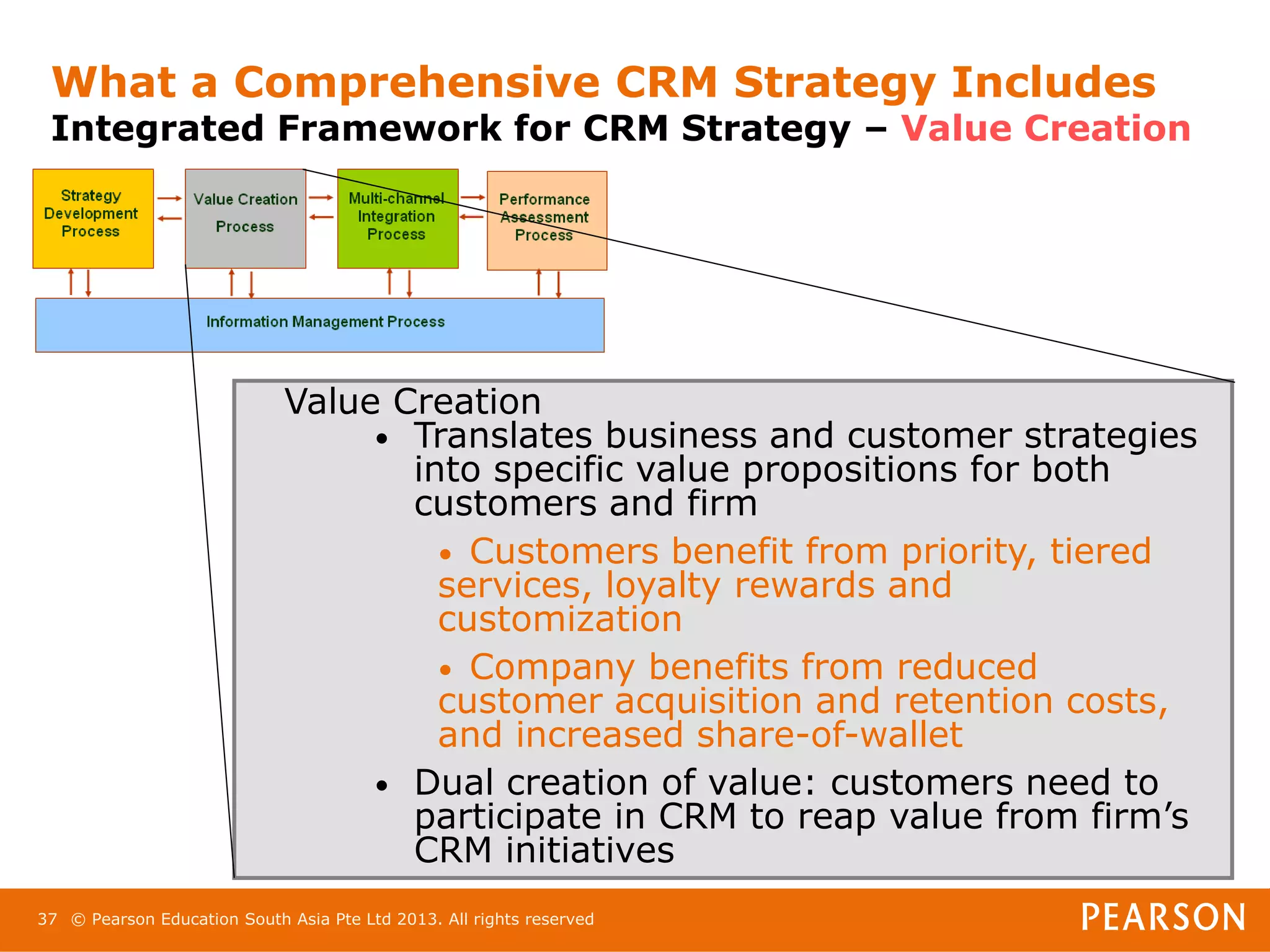
 Integrated Framework for CRM Strategy – Value Creation


                             Value Creation
                                  • Translates business and customer strategies
                                    into specific value propositions for both
                                    customers and firm
                                      • Customers benefit from priority, tiered
                                      services, loyalty rewards and
                                      customization
                                      • Company benefits from reduced
                                      customer acquisition and retention costs,
                                      and increased share-of-wallet
                                  • Dual creation of value: customers need to
                                    participate in CRM to reap value from firm’s
                                    CRM initiatives
37 © Pearson Education South Asia Pte Ltd 2013. All rights reserved
What a Comprehensive CRM Strategy Includes
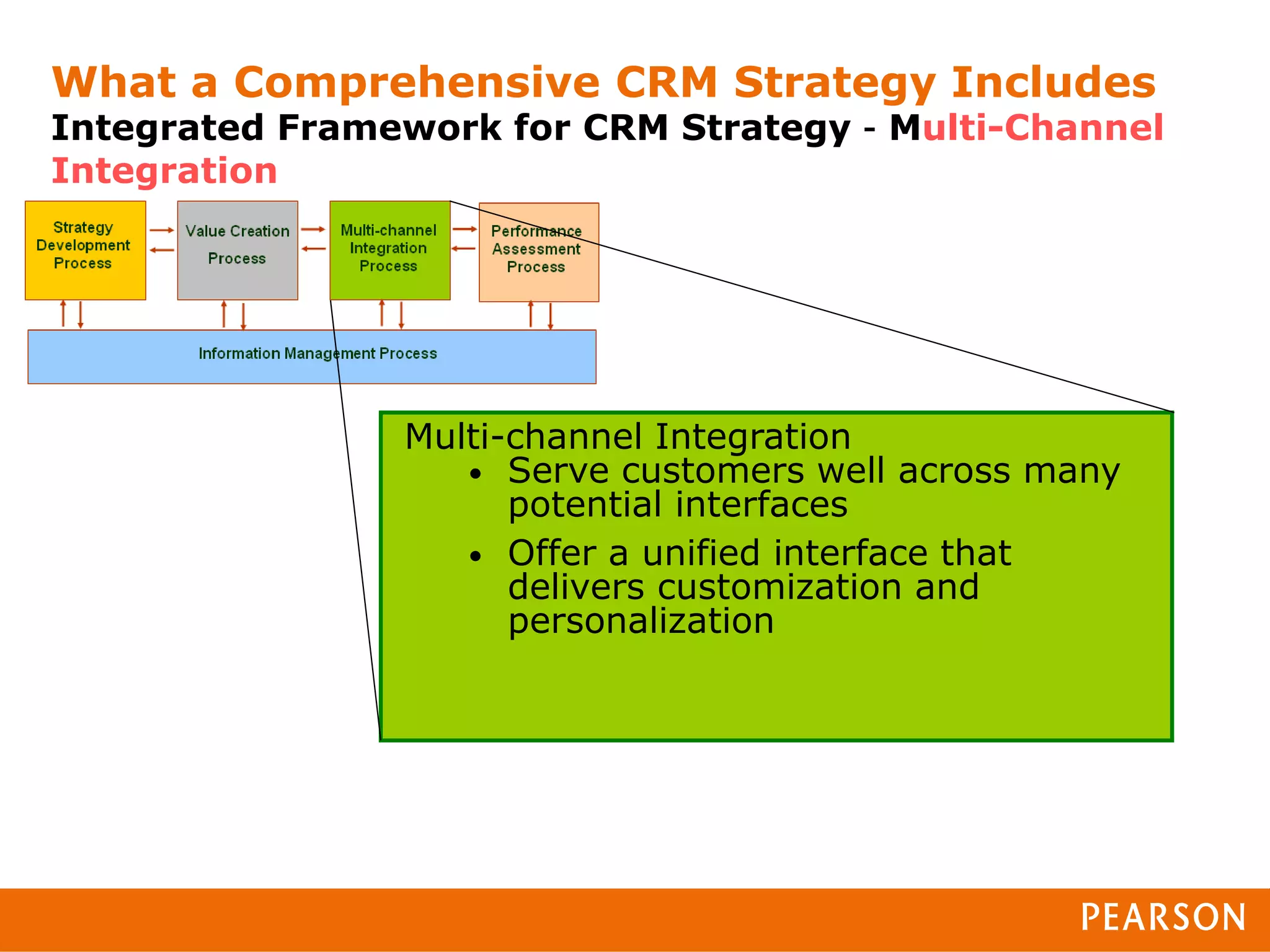
Integrated Framework for CRM Strategy – Multi-Channel
Integration


                Multi-channel Integration
                   • Serve customers well across many
                      potential interfaces
                   • Offer a unified interface that
                      delivers customization and
                      personalization
What a Comprehensive CRM Strategy Includes
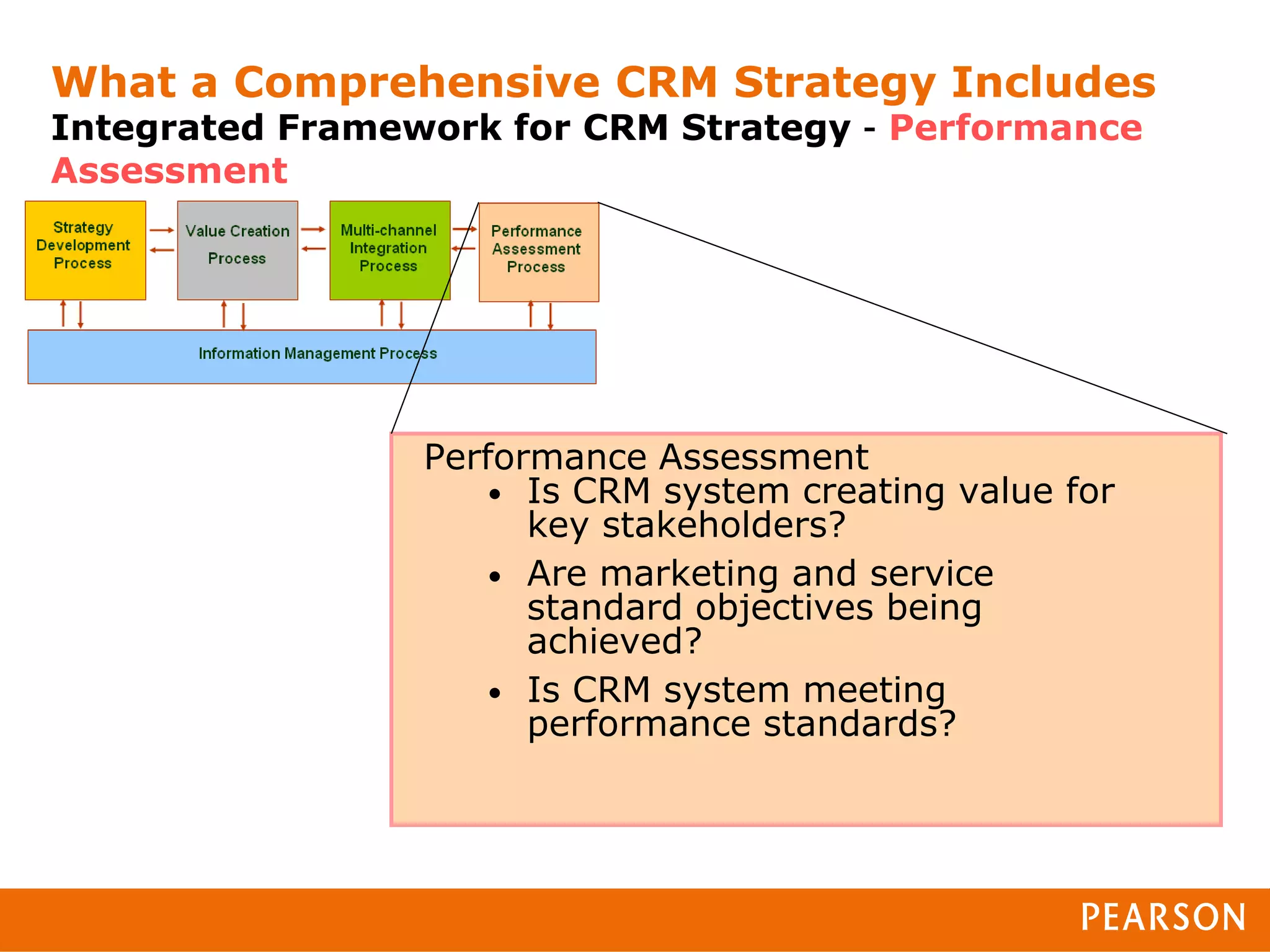
Integrated Framework for CRM Strategy – Performance
Assessment


                 Performance Assessment
                    • Is CRM system creating value for
                       key stakeholders?
                    • Are marketing and service
                       standard objectives being
                       achieved?
                    • Is CRM system meeting
                       performance standards?
What a Comprehensive CRM Strategy Includes
Integrated Framework for CRM Strategy – Information
Management


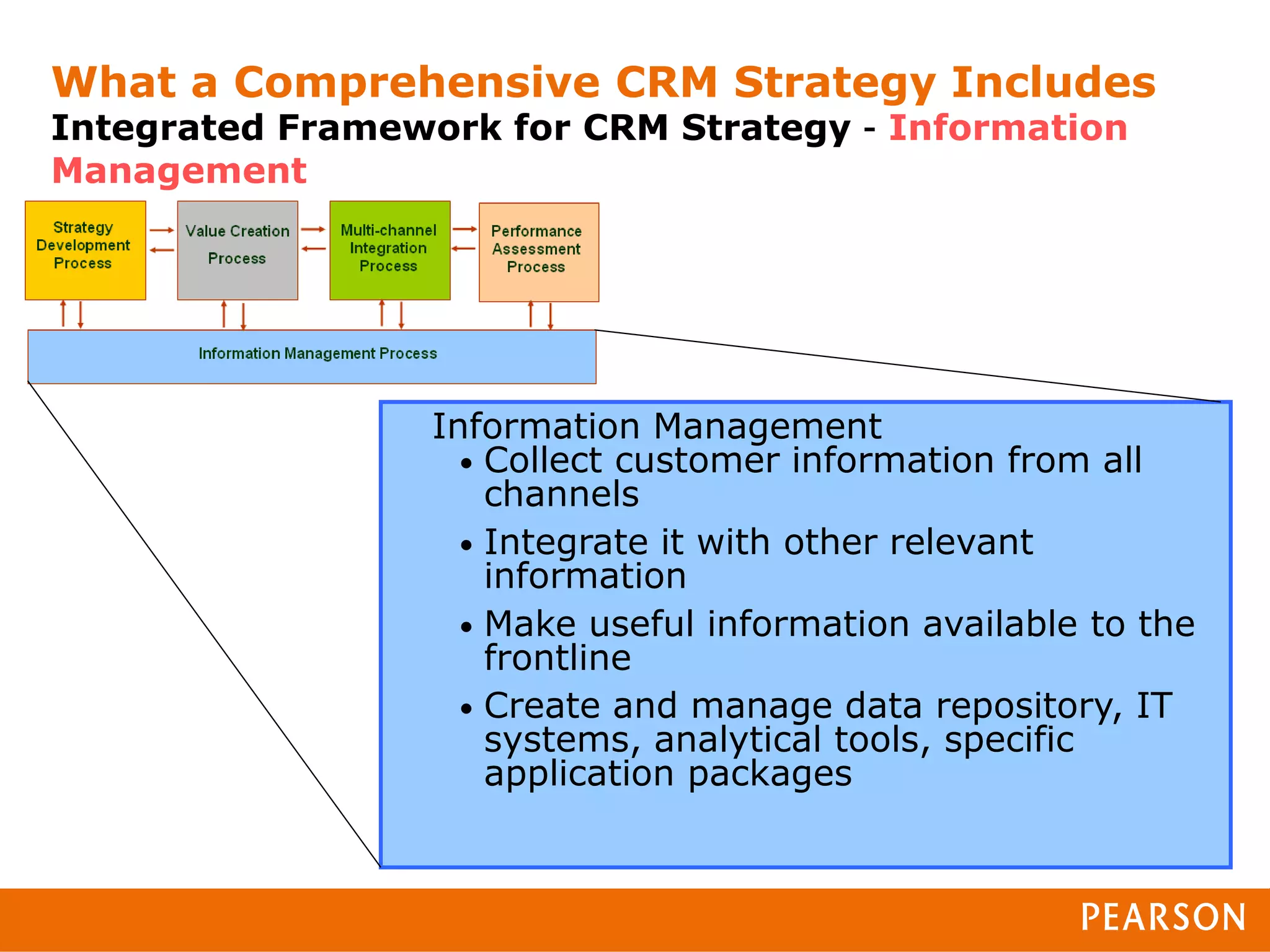
                  Information Management
                    • Collect customer information from all
                      channels
                    • Integrate it with other relevant
                      information
                    • Make useful information available to the
                      frontline
                    • Create and manage data repository, IT
                      systems, analytical tools, specific
                      application packages
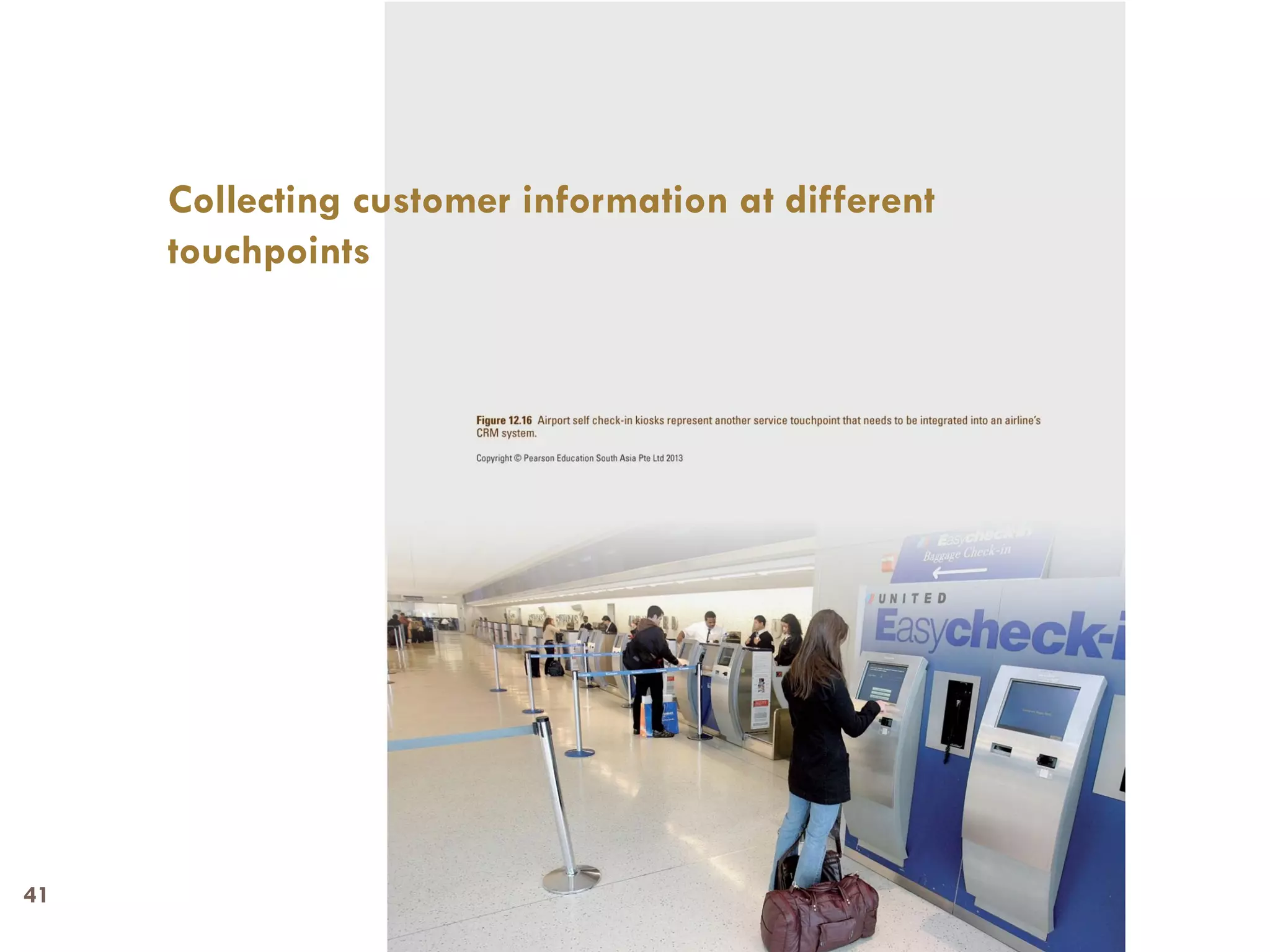
Collecting customer information at different
     touchpoints


41
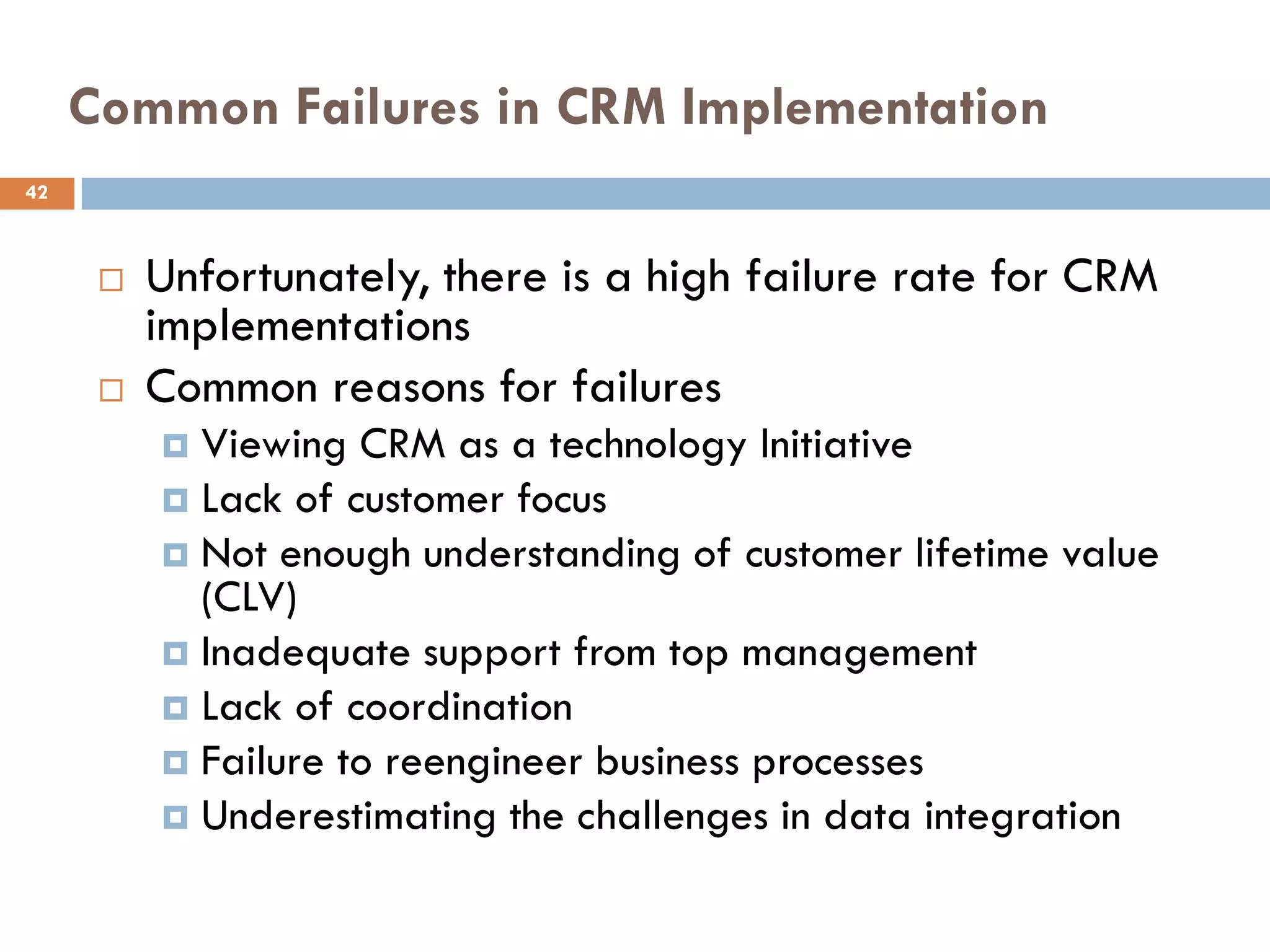
Common Failures in CRM Implementation
42


         Unfortunately, there is a high failure rate for CRM
          implementations
         Common reasons for failures
           Viewing CRM as a technology Initiative
           Lack of customer focus
           Not enough understanding of customer lifetime value
            (CLV)
           Inadequate support from top management
           Lack of coordination
           Failure to reengineer business processes
           Underestimating the challenges in data integration
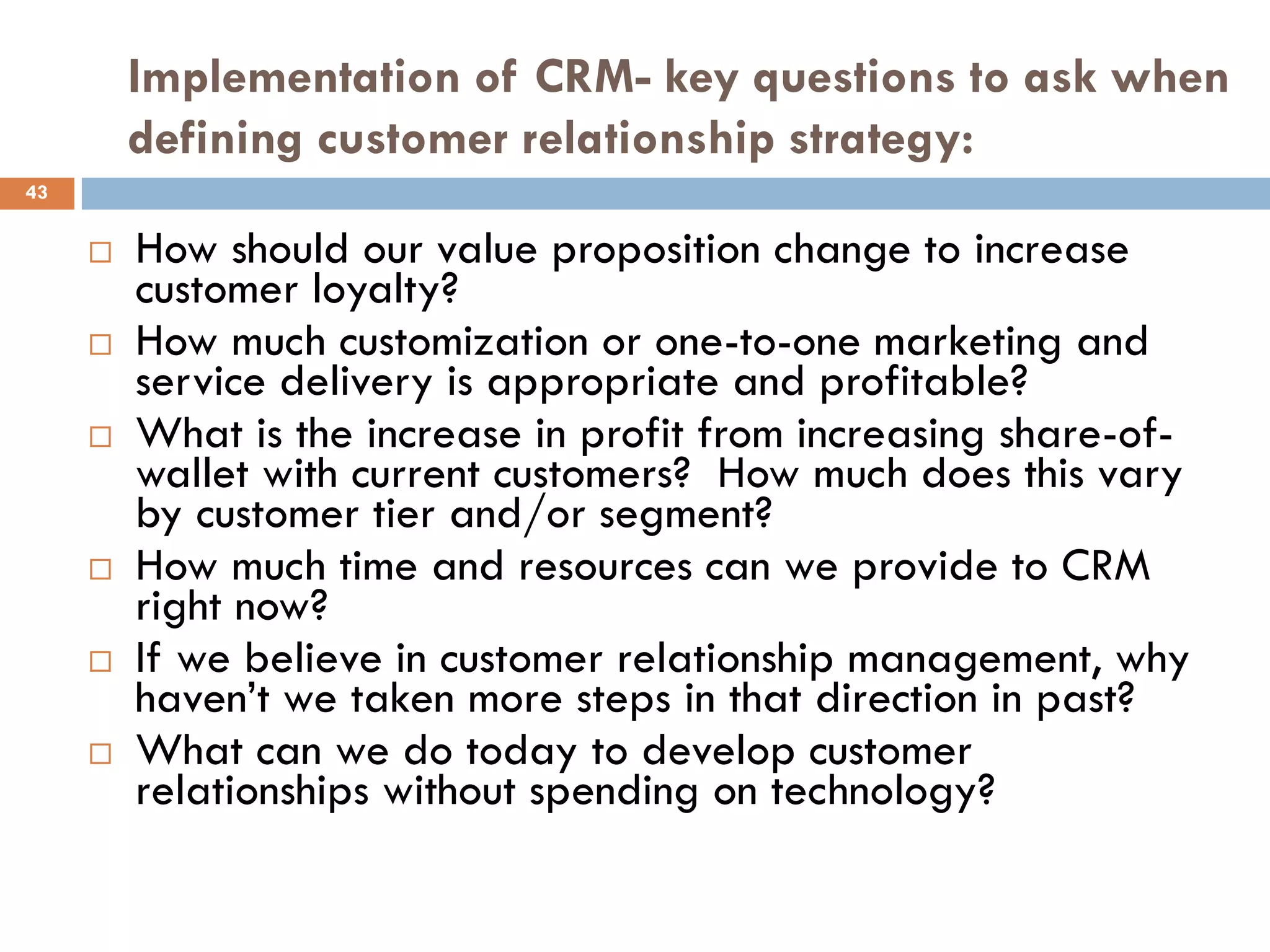
Implementation of CRM- key questions to ask when
         defining customer relationship strategy:
43


        How should our value proposition change to increase
         customer loyalty?
        How much customization or one-to-one marketing and
         service delivery is appropriate and profitable?
        What is the increase in profit from increasing share-of-
         wallet with current customers? How much does this vary
         by customer tier and/or segment?
        How much time and resources can we provide to CRM
         right now?
        If we believe in customer relationship management, why
         haven‘t we taken more steps in that direction in past?
        What can we do today to develop customer
         relationships without spending on technology?
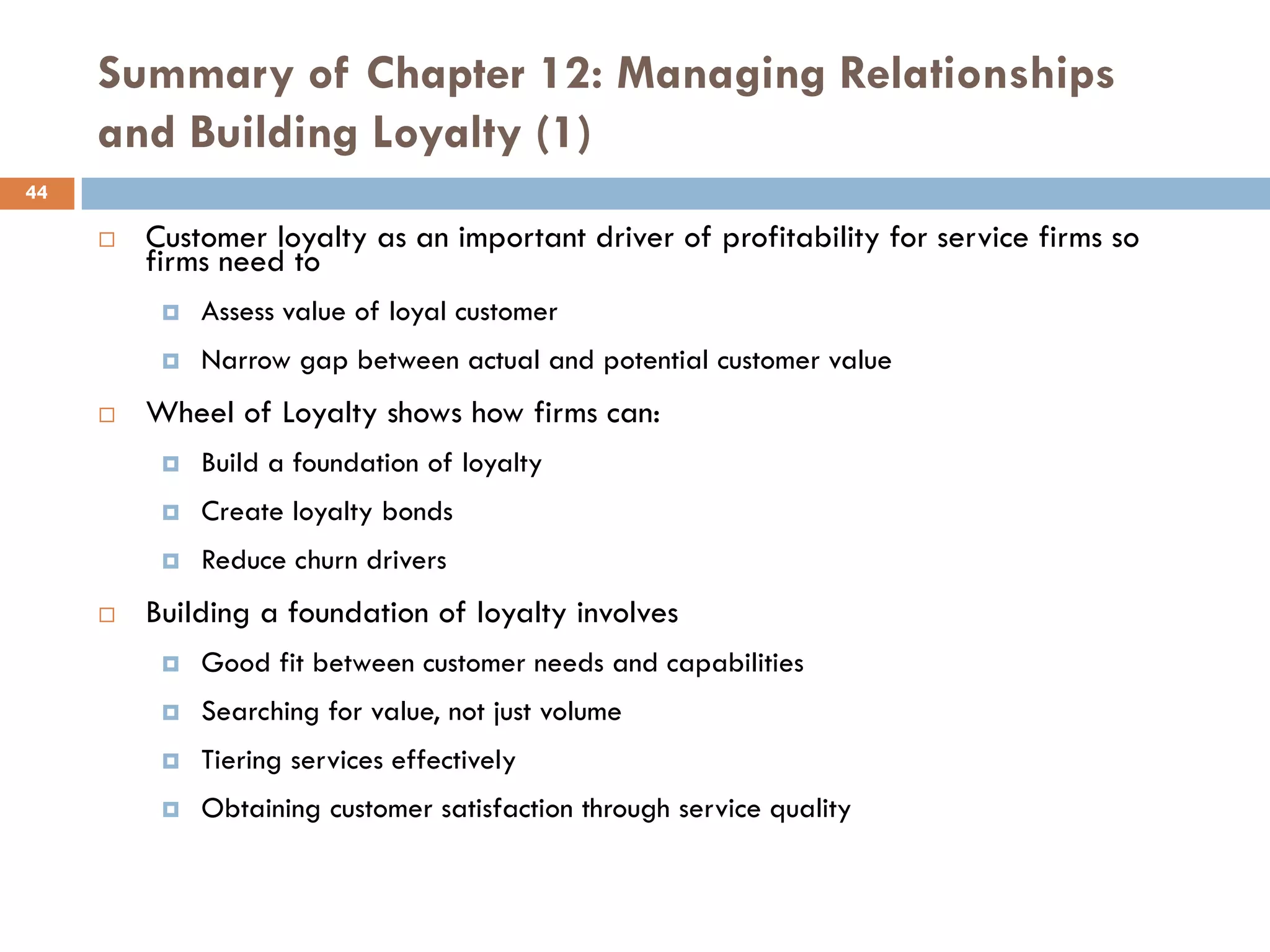
Summary of Chapter 12: Managing Relationships
     and Building Loyalty (1)
44

        Customer loyalty as an important driver of profitability for service firms so
         firms need to
             Assess value of loyal customer
             Narrow gap between actual and potential customer value
        Wheel of Loyalty shows how firms can:
             Build a foundation of loyalty
             Create loyalty bonds
             Reduce churn drivers
        Building a foundation of loyalty involves
             Good fit between customer needs and capabilities
             Searching for value, not just volume
             Tiering services effectively
             Obtaining customer satisfaction through service quality
Summary of Chapter 12: Managing Relationships
     and Building Loyalty (2)
45

        Customer loyalty bonds include
           Reward-based bonds
           Social bonds
           Customization bonds
           Structural bonds
        Strategies for reducing customer defections include
            Analyzing customer defections and monitoring declining
             accounts
            Addressing key churn drivers
            Implementing effective complaint-handling and service
             recovery procedures
            Increasing switching costs
Summary of Chapter 12: Managing Relationships
     And Building Loyalty (3)
46

        Customer relationship management (CRM) is a whole process
         by which relations with customers are built and maintained.
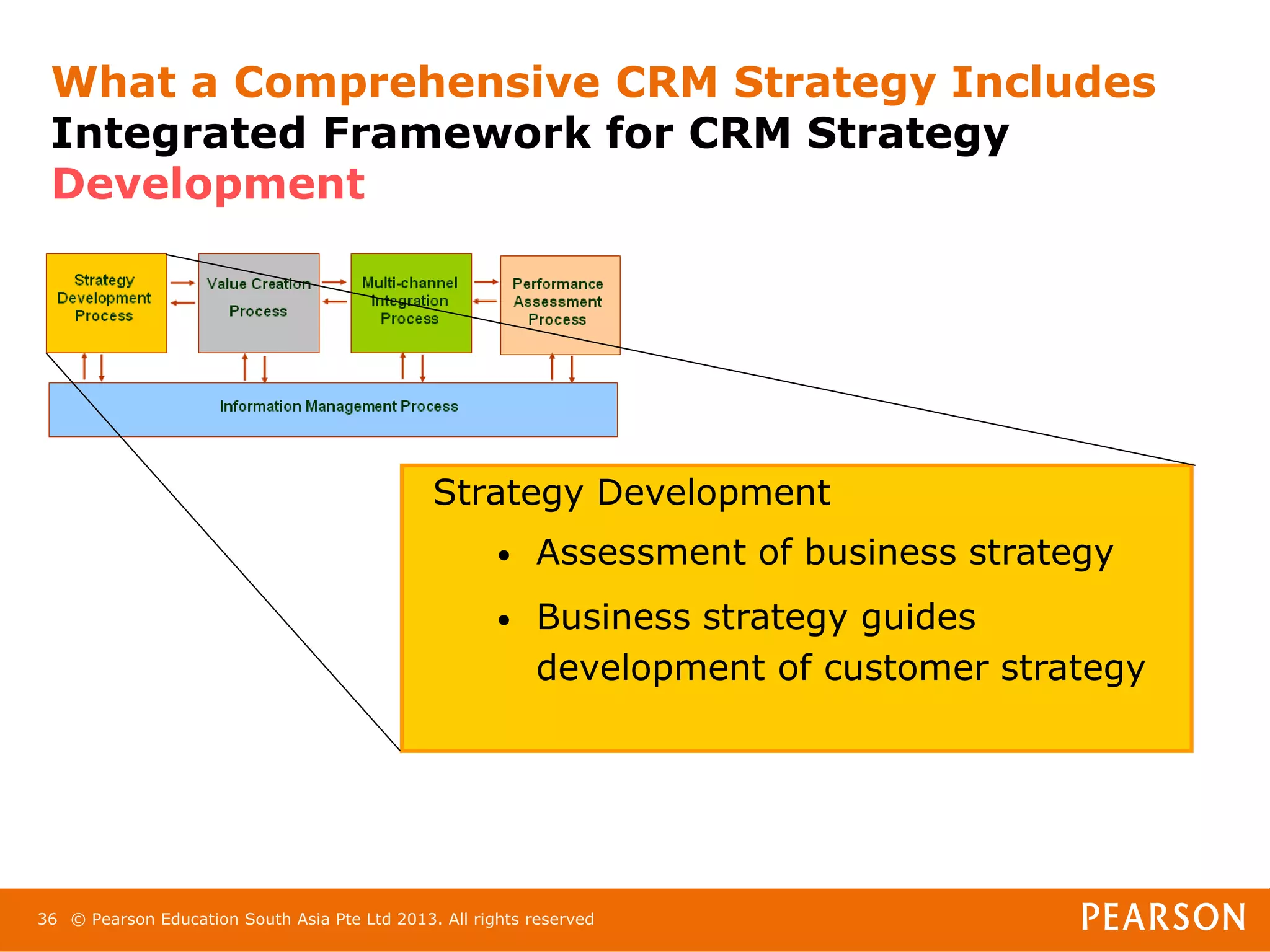
        An integrated CRM system includes
           Strategy development process
           Value creation process
           Multichannel integration process
           Performance assessment process
        Cresting a successful CRM program requires understanding
         common failures in CRM implementation and knowing how to
         get it right
Overview of Chapter 13
47


        Customer Complaining Behavior
        Customer Responses to Effective Service
         Recovery
        Principles of Effective Service Recovery
         Systems
        Service Guarantees
        Discouraging Abuse and Opportunistic
         Customer Behavior
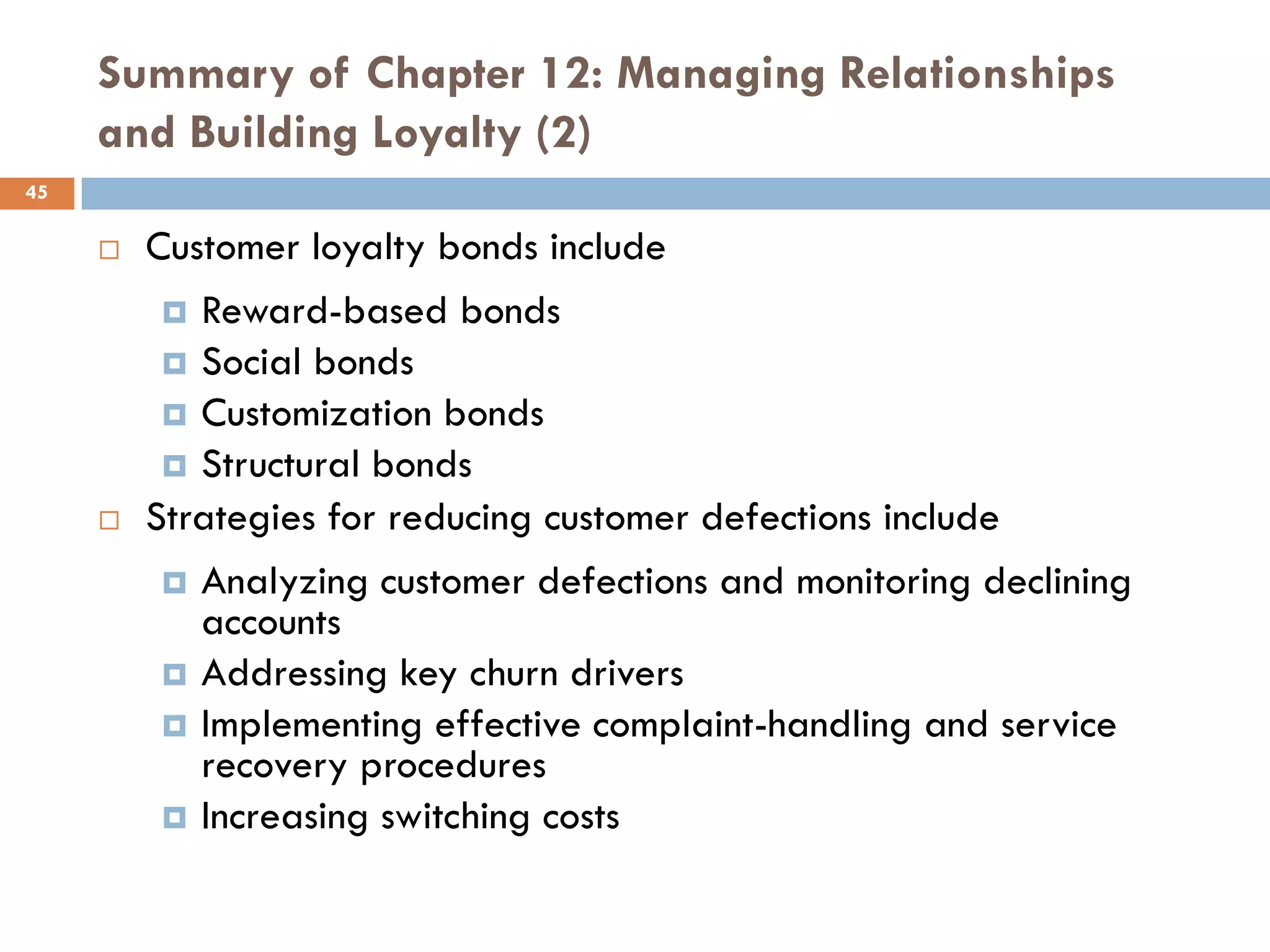
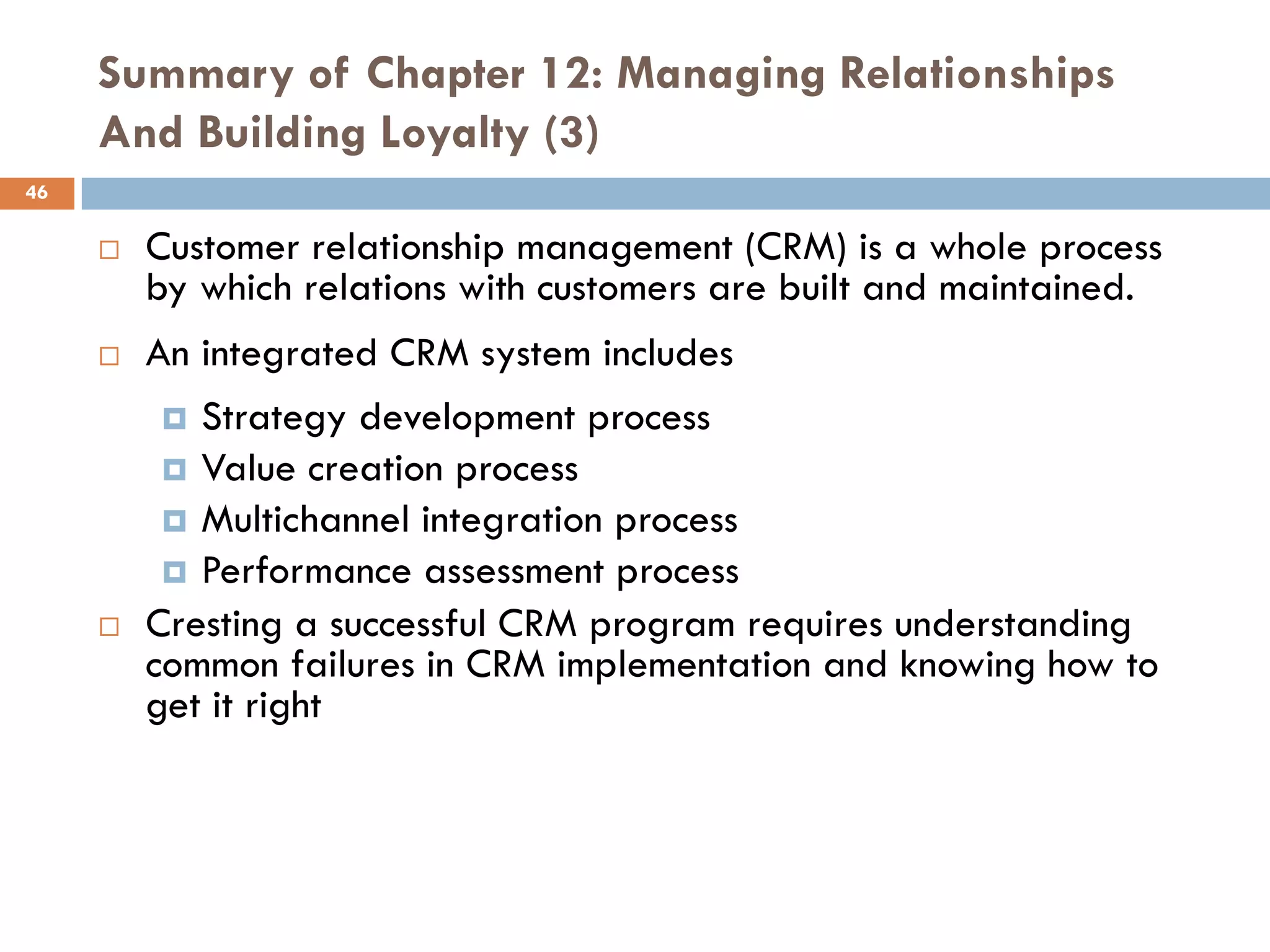
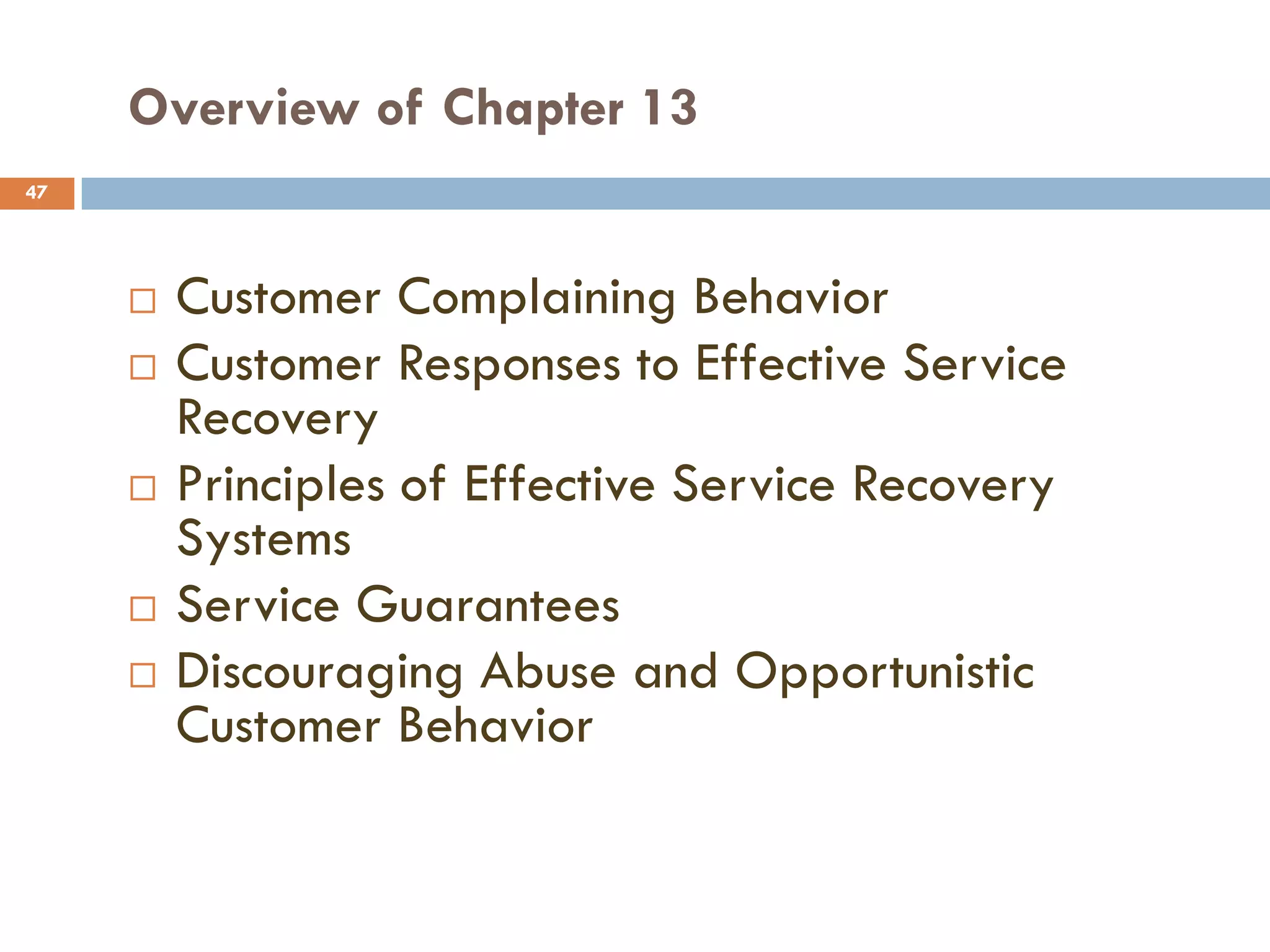
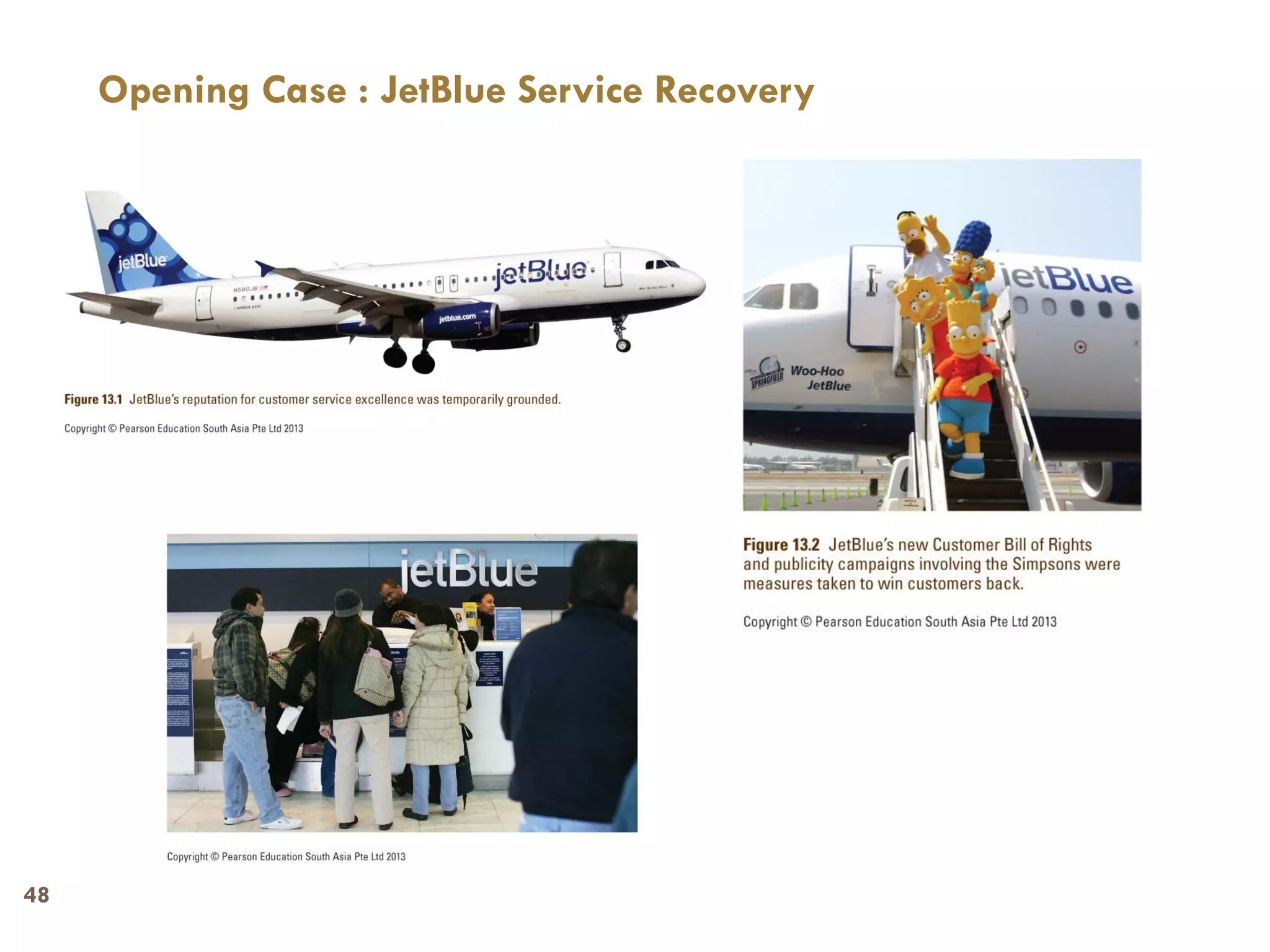
Opening Case : JetBlue Service Recovery


48
49


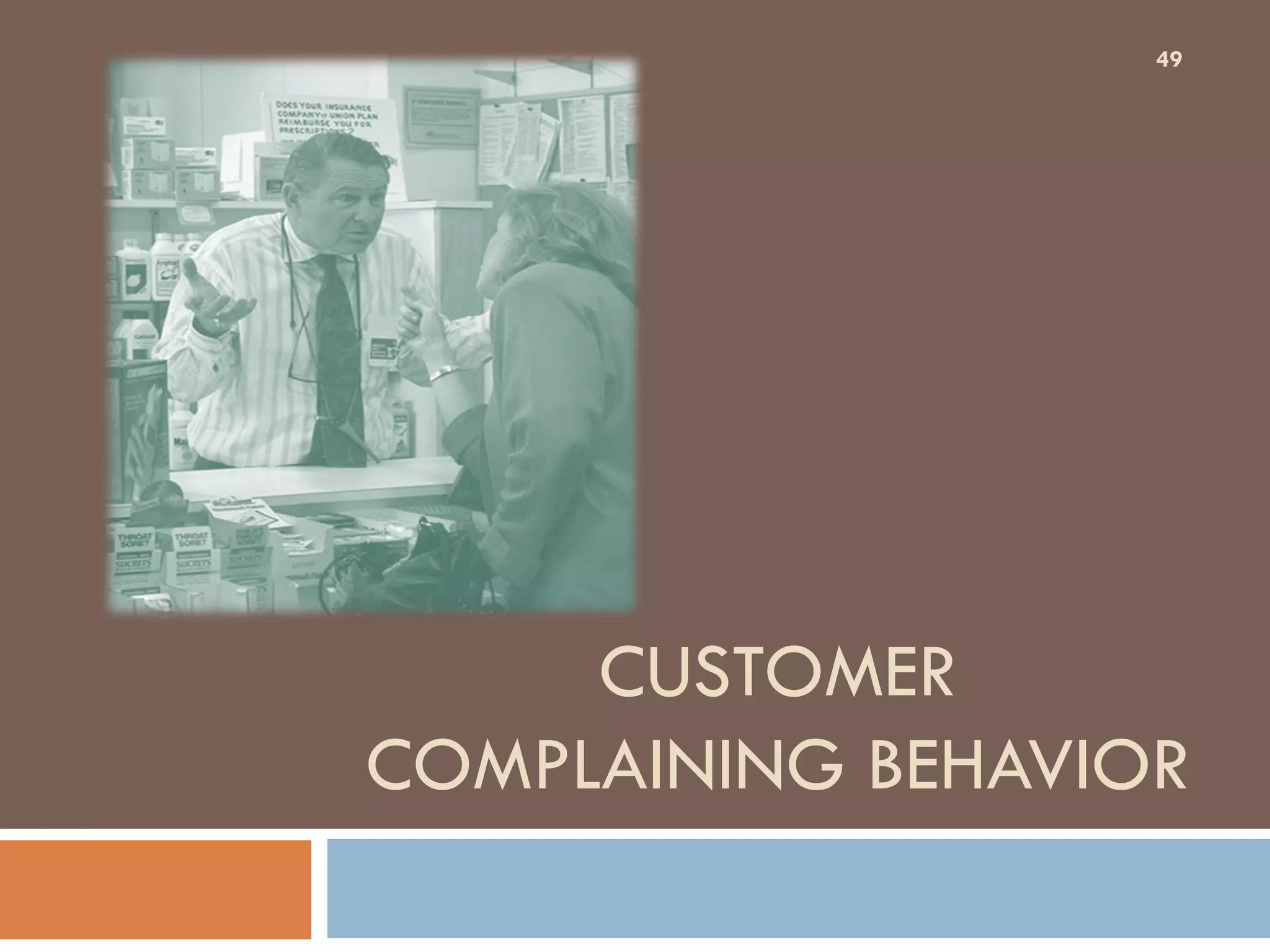
     CUSTOMER
COMPLAINING BEHAVIOR
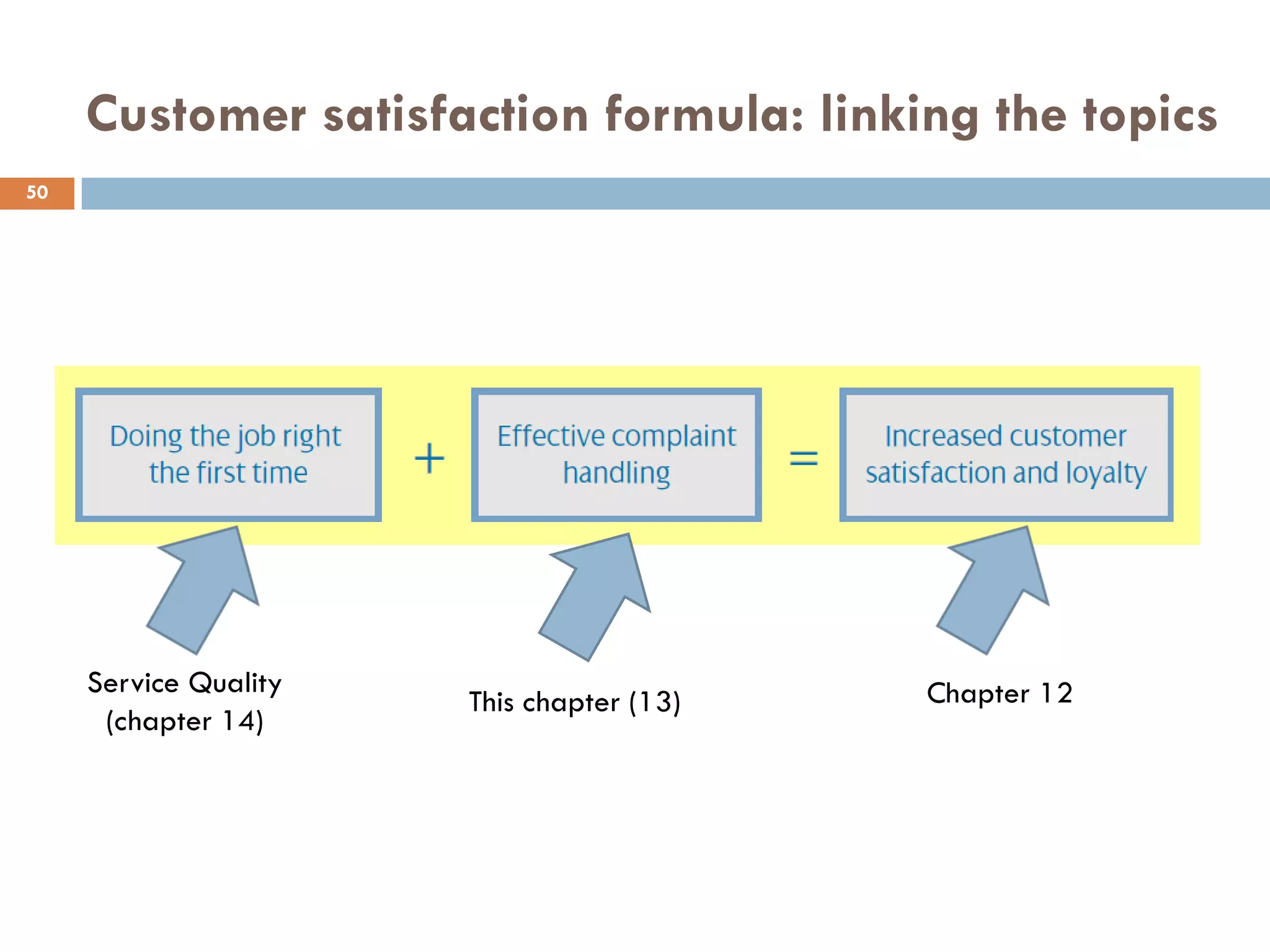
Customer satisfaction formula: linking the topics
50


     Service Quality                       Chapter 12
                       This chapter (13)
      (chapter 14)
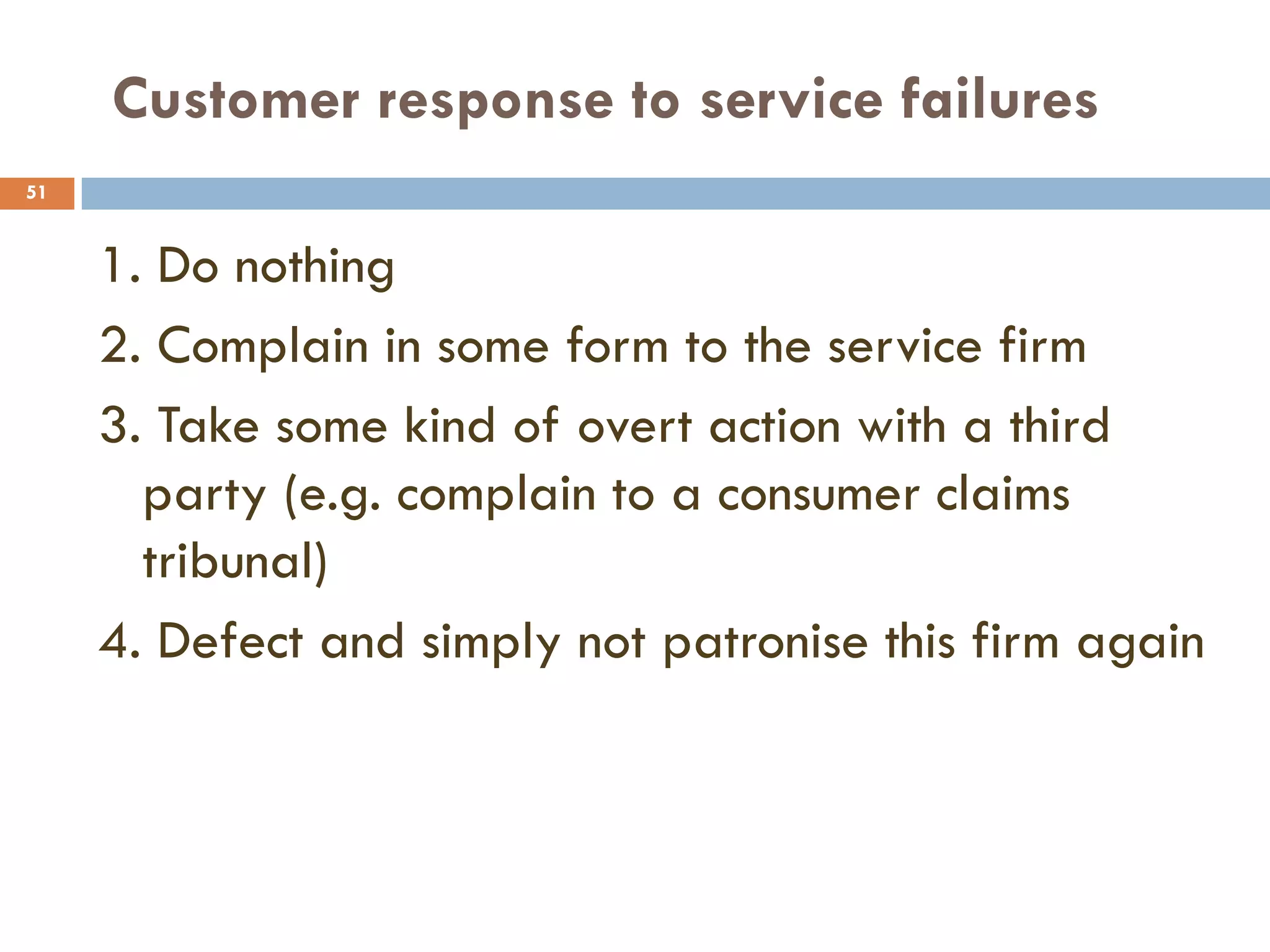
Customer response to service failures
51


     1. Do nothing
     2. Complain in some form to the service firm
     3. Take some kind of overt action with a third
       party (e.g. complain to a consumer claims
       tribunal)
     4. Defect and simply not patronise this firm again
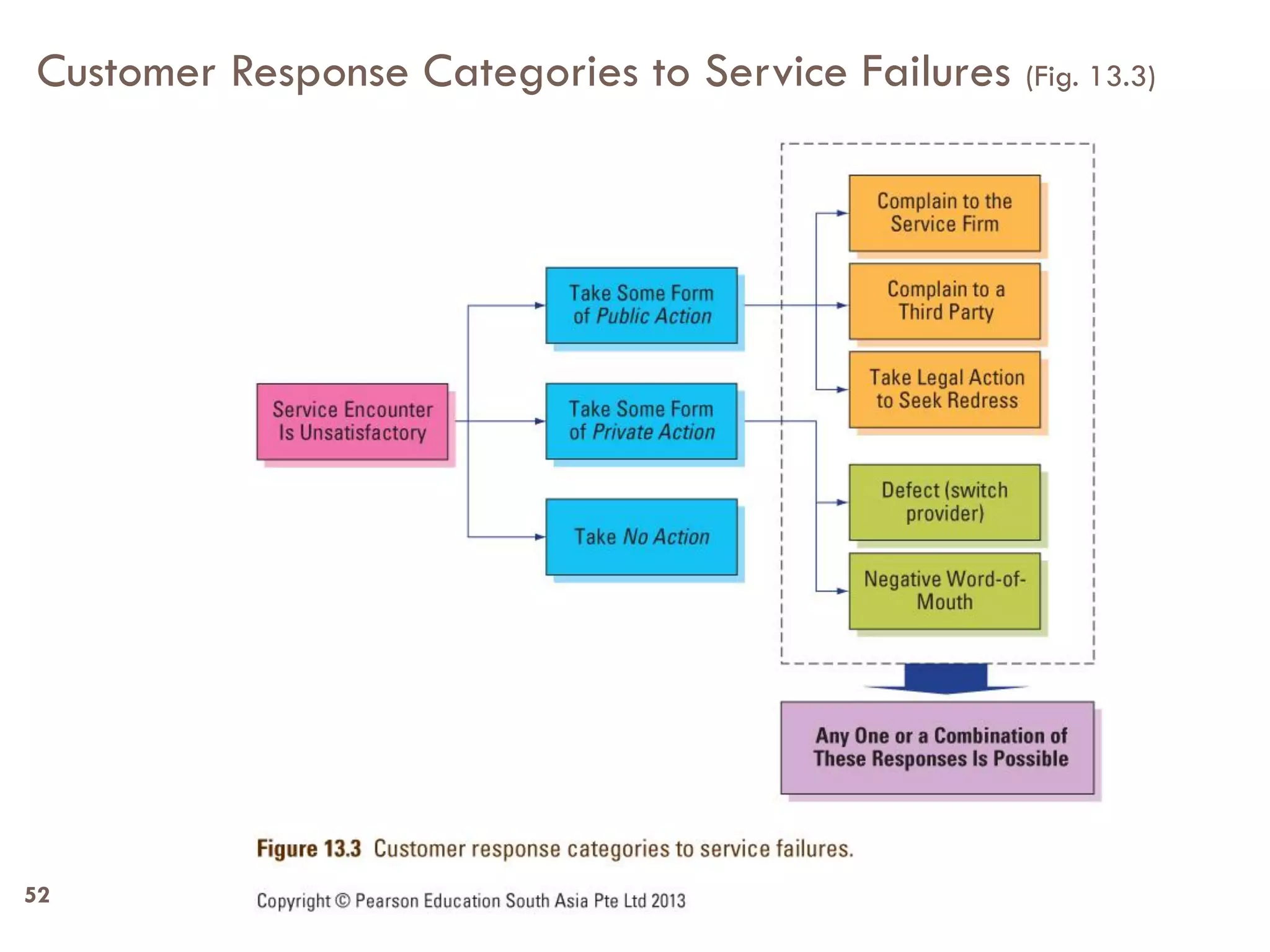
Customer Response Categories to Service Failures (Fig. 13.3)


52
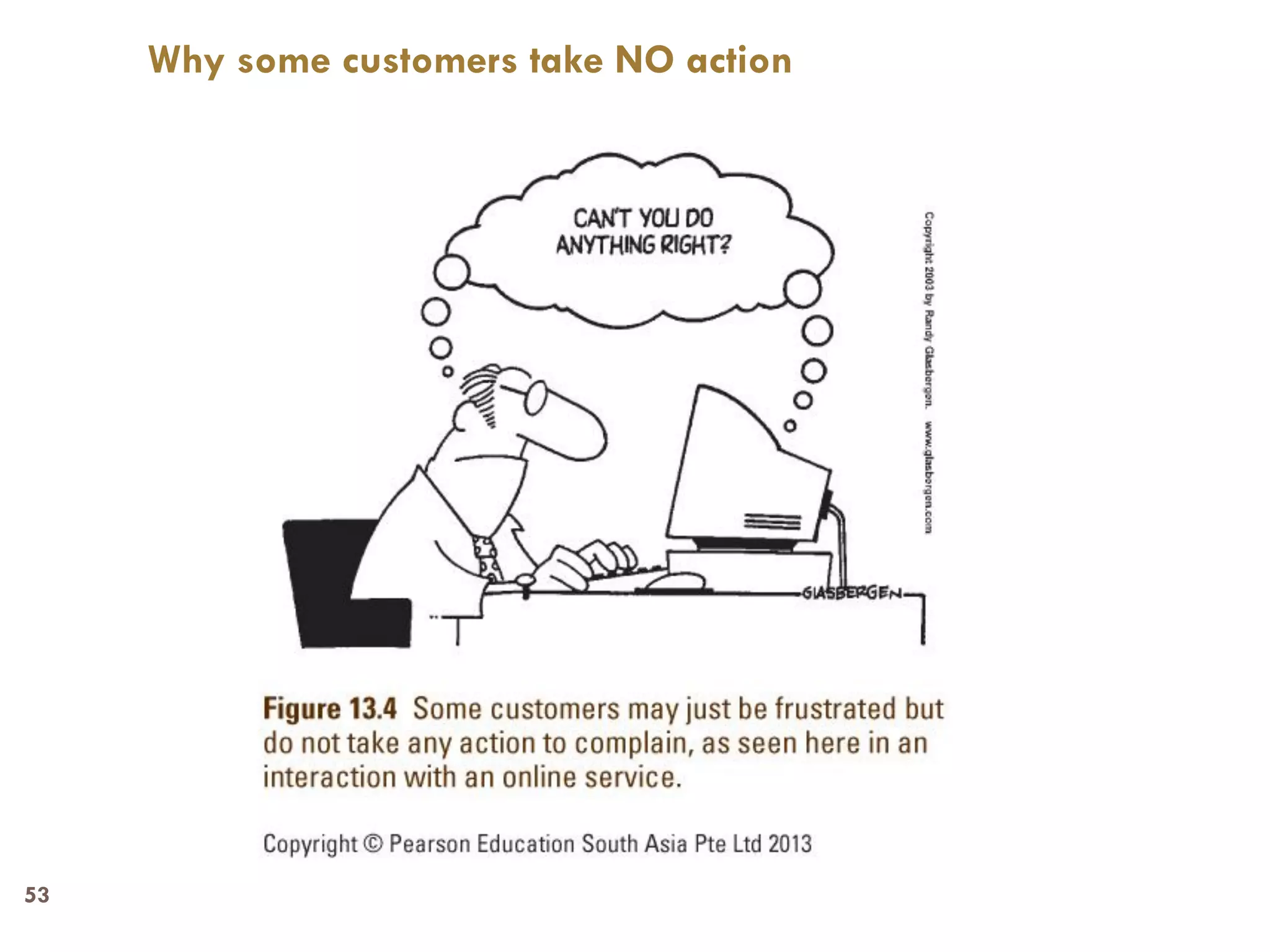
Why some customers take NO action


53
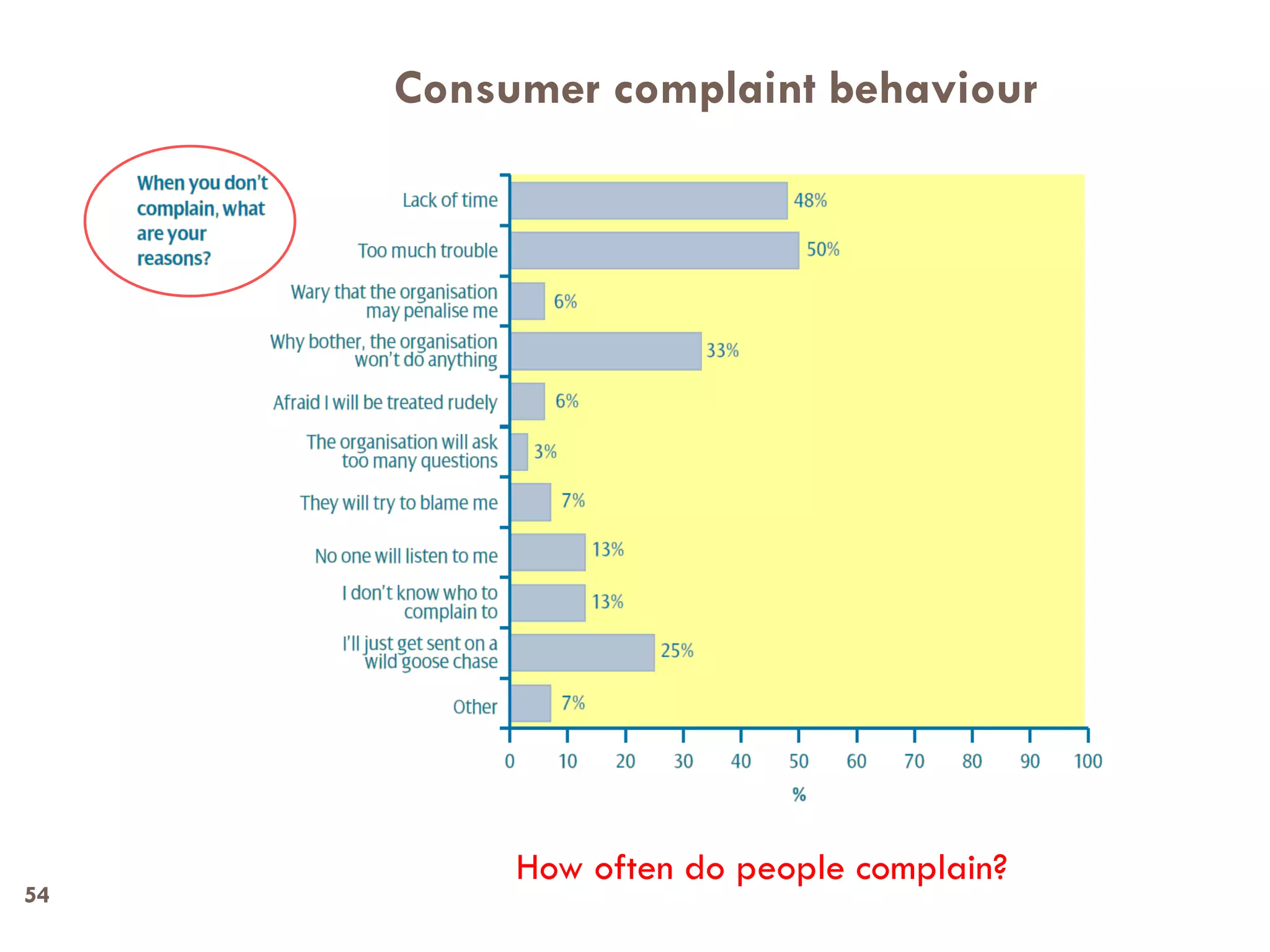
Consumer complaint behaviour


          How often do people complain?
54
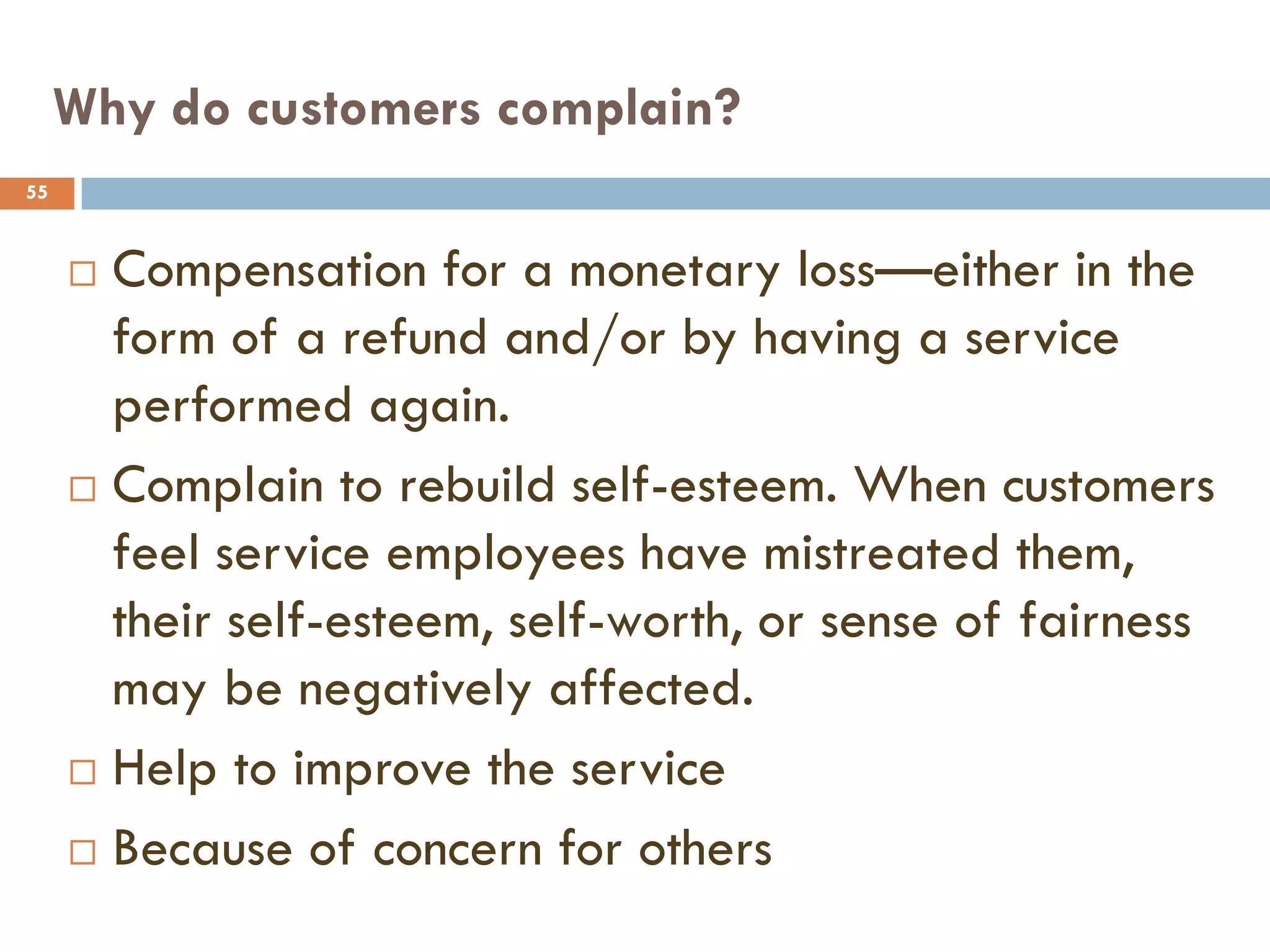
Why do customers complain?
55


      Compensation for a monetary loss—either in the
       form of a refund and/or by having a service
       performed again.
      Complain to rebuild self-esteem. When customers

       feel service employees have mistreated them,
       their self-esteem, self-worth, or sense of fairness
       may be negatively affected.
      Help to improve the service

      Because of concern for others
Key issues to investigate regarding customer
     complaining behavior:
56


      What proportion of unhappy customers
       complain?
      Why don‘t unhappy customers complain?
      Who is most likely to complain?
      Where do customers complain?
Why unhappy customers often don’t complain:
57


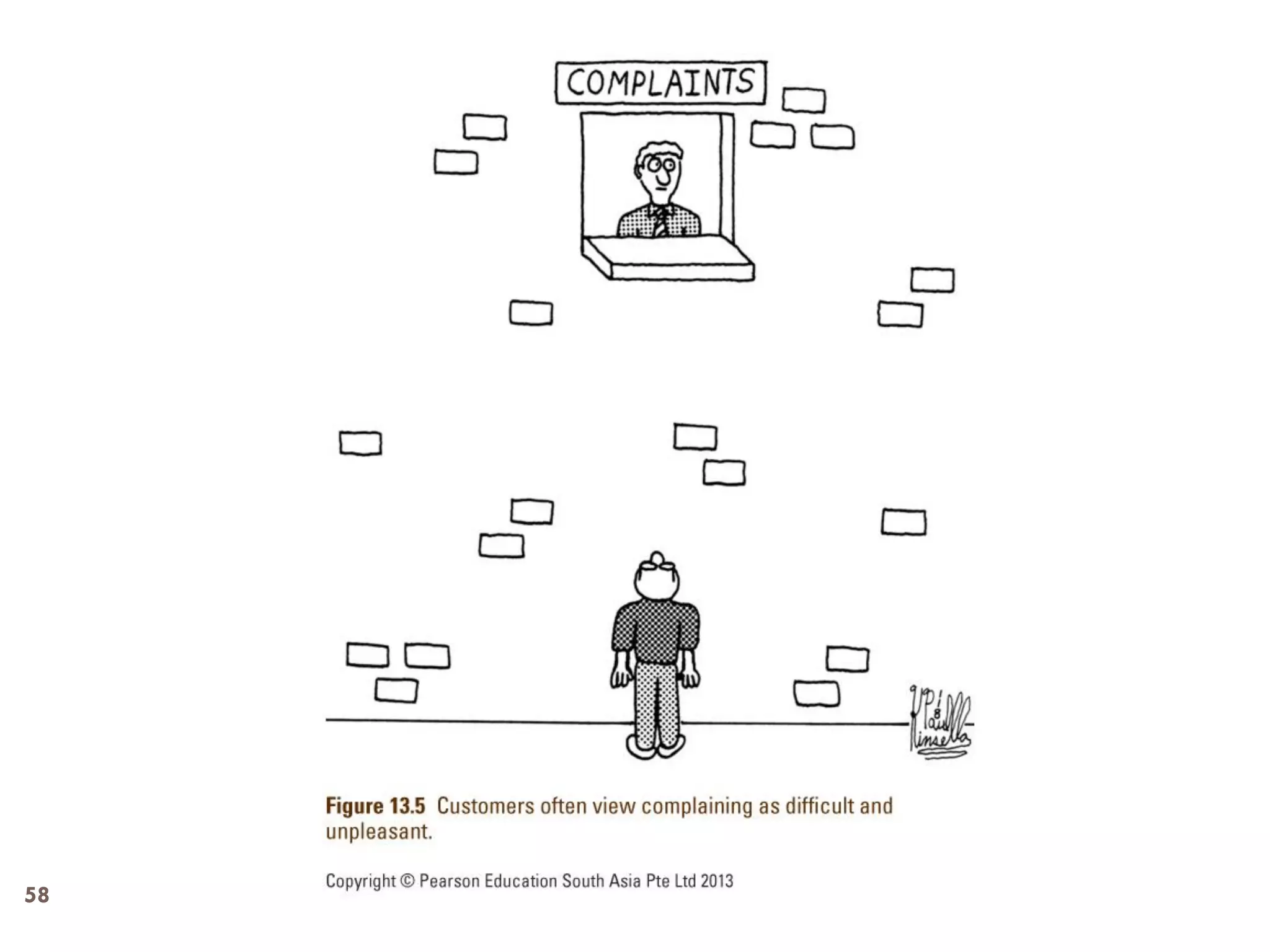
         Customers usually give the following three reasons for
         not complaining: (1) they don‘t think it‘s worth their time
         and/or effort; (2) they don‘t believe the service
         provider will be concerned about their problem and/or
         resolve it; or (3) they don‘t know where to go and what
         to do.
        Cultural and social norms may also affect complaining
         behavior. In some European and Asian countries,
         customers feel awkward or embarrassed about making
         a complaint. Social norms may discourage criticisms of
         professional service providers, because they are viewed
         as experts in their fields
58
What do customers expect once they have made a
     complaint?
59


        Once a complaint is made, customers expect to be
         adequately compensated in a fair manner.
        The firm is expected to assume responsibility in having
         a convenient and responsive recovery process. Not only
         must the employees of the firm be able to explain and
         resolve the failure, they have to come across as genuine,
         honest, and polite throughout.
        Lastly, the compensation given has to cover the losses
         incurred by the customer both in terms of actually
         monetary loss and other potential cost incurred as a
         result of the failure (e.g., time, effort).
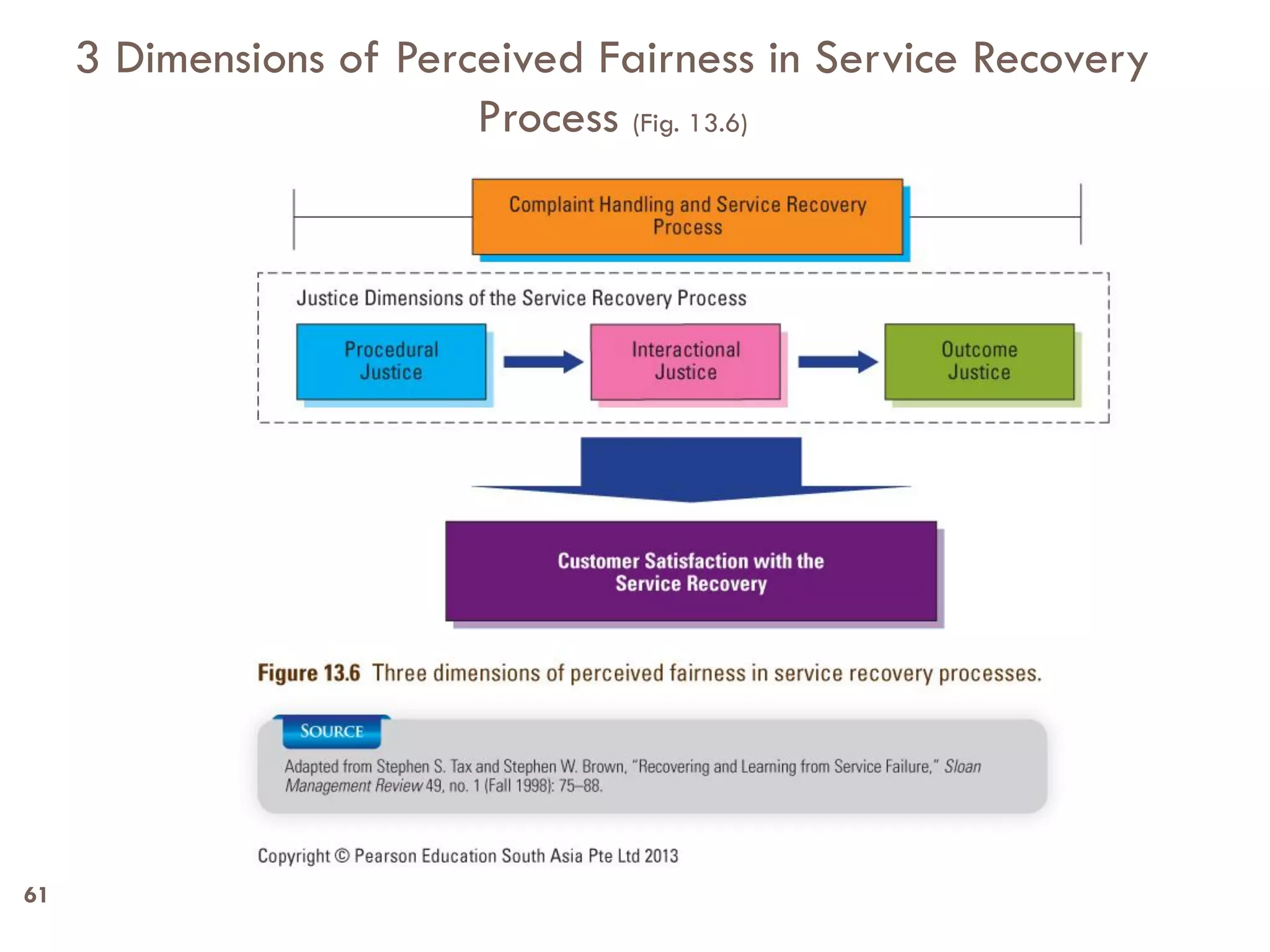
The types of ‘justices’ (see page 342 and Figure
     13.7)
60


        Procedural justice
          Concerns  policies and rules that customer has to go
           through in order to seek service recovery
        Interactional justice
          Dealing with employees of the firm; their behaviors
           towards the aggrieved customer
        Outcome justice
          Compensation   received by the customer
3 Dimensions of Perceived Fairness in Service Recovery
                         Process (Fig. 13.6)


61
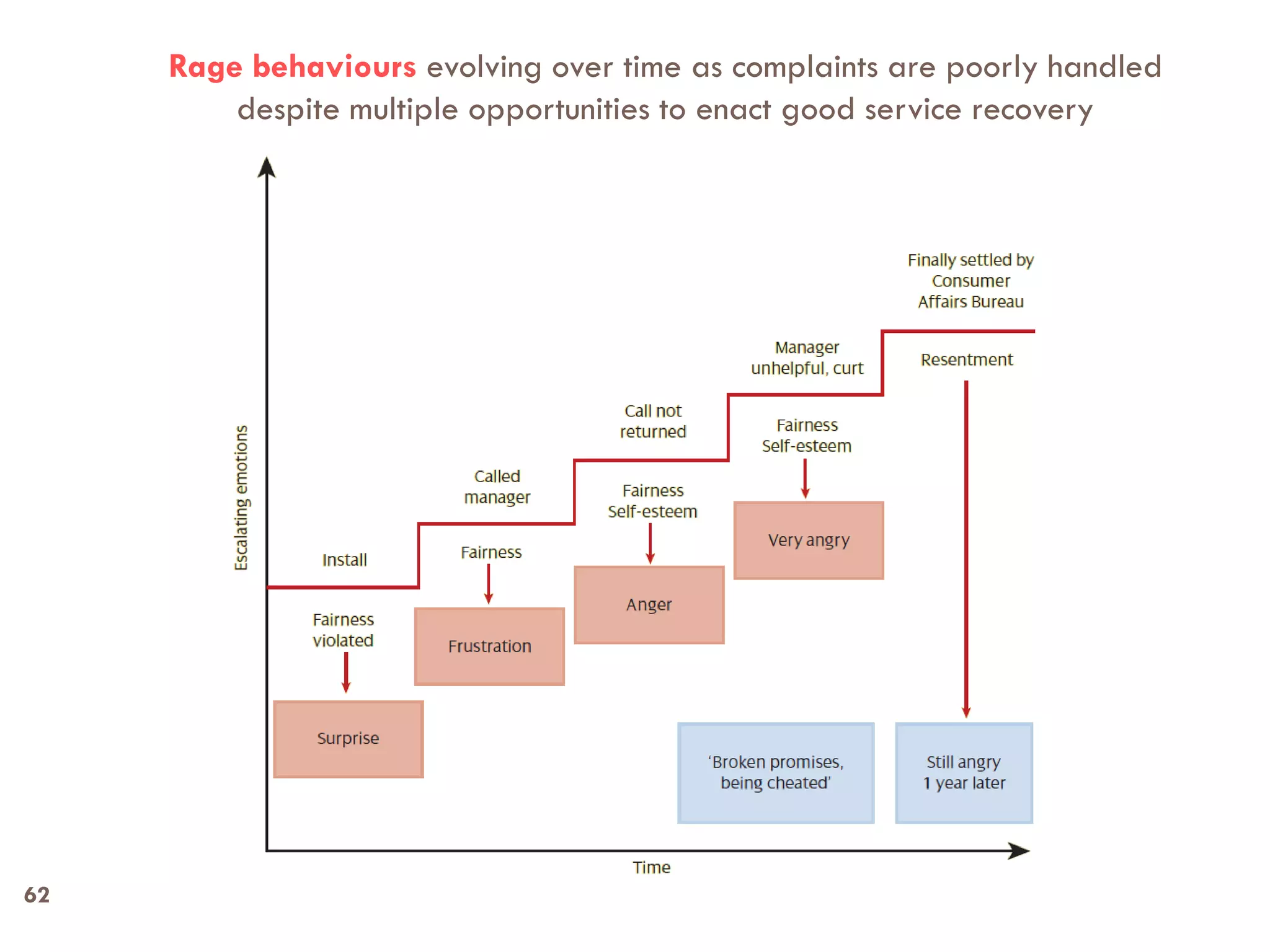
Rage behaviours evolving over time as complaints are poorly handled
         despite multiple opportunities to enact good service recovery


62
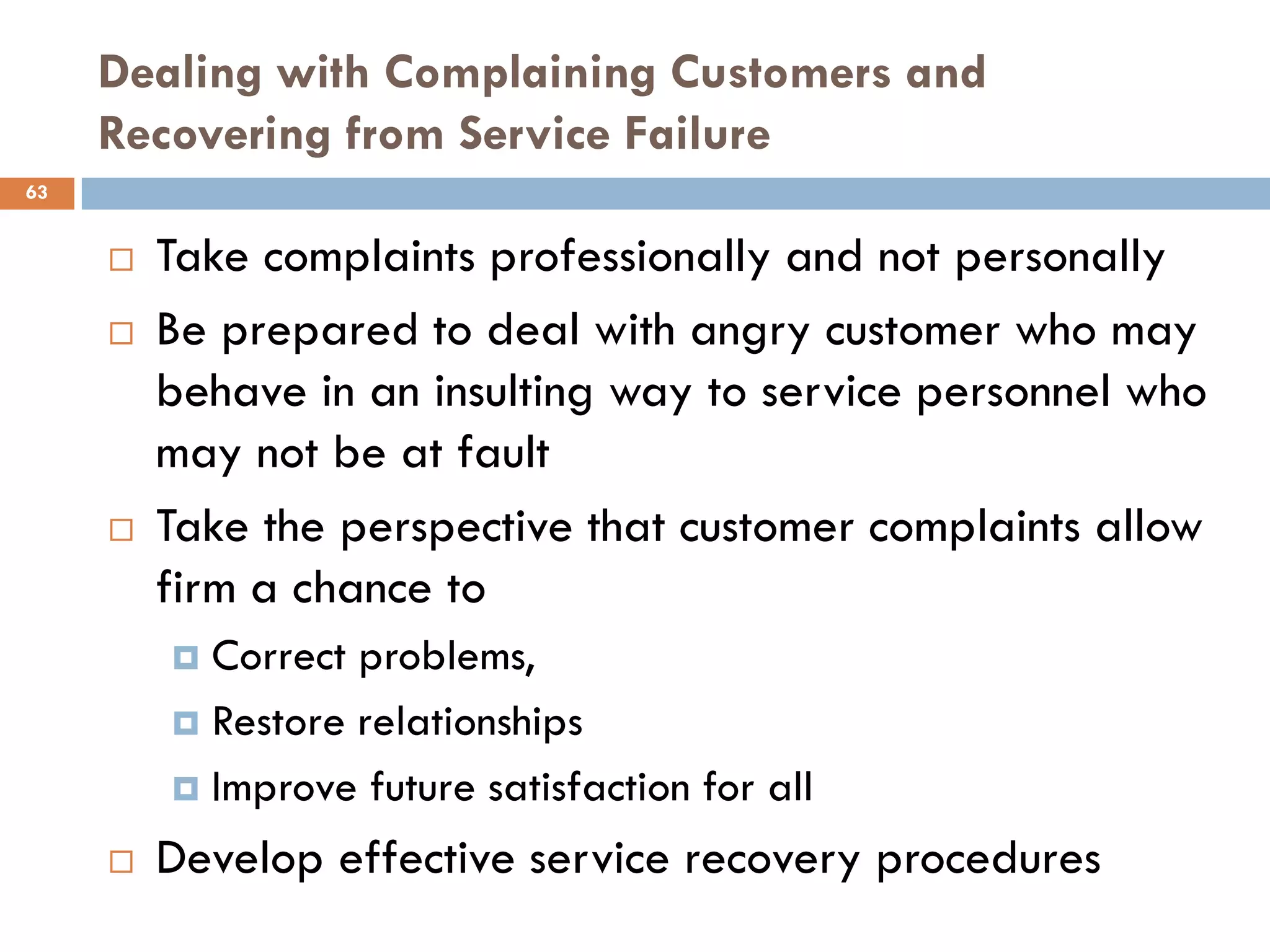
Dealing with Complaining Customers and
     Recovering from Service Failure
63


        Take complaints professionally and not personally
        Be prepared to deal with angry customer who may
         behave in an insulting way to service personnel who
         may not be at fault
        Take the perspective that customer complaints allow
         firm a chance to
          Correct problems,
          Restore relationships

          Improve future satisfaction for all

        Develop effective service recovery procedures
Service recovery
64


     Service recovery involves actions taken
      by the organisation to put things right
       for the customer following a service
         (core or supplementary) failure.
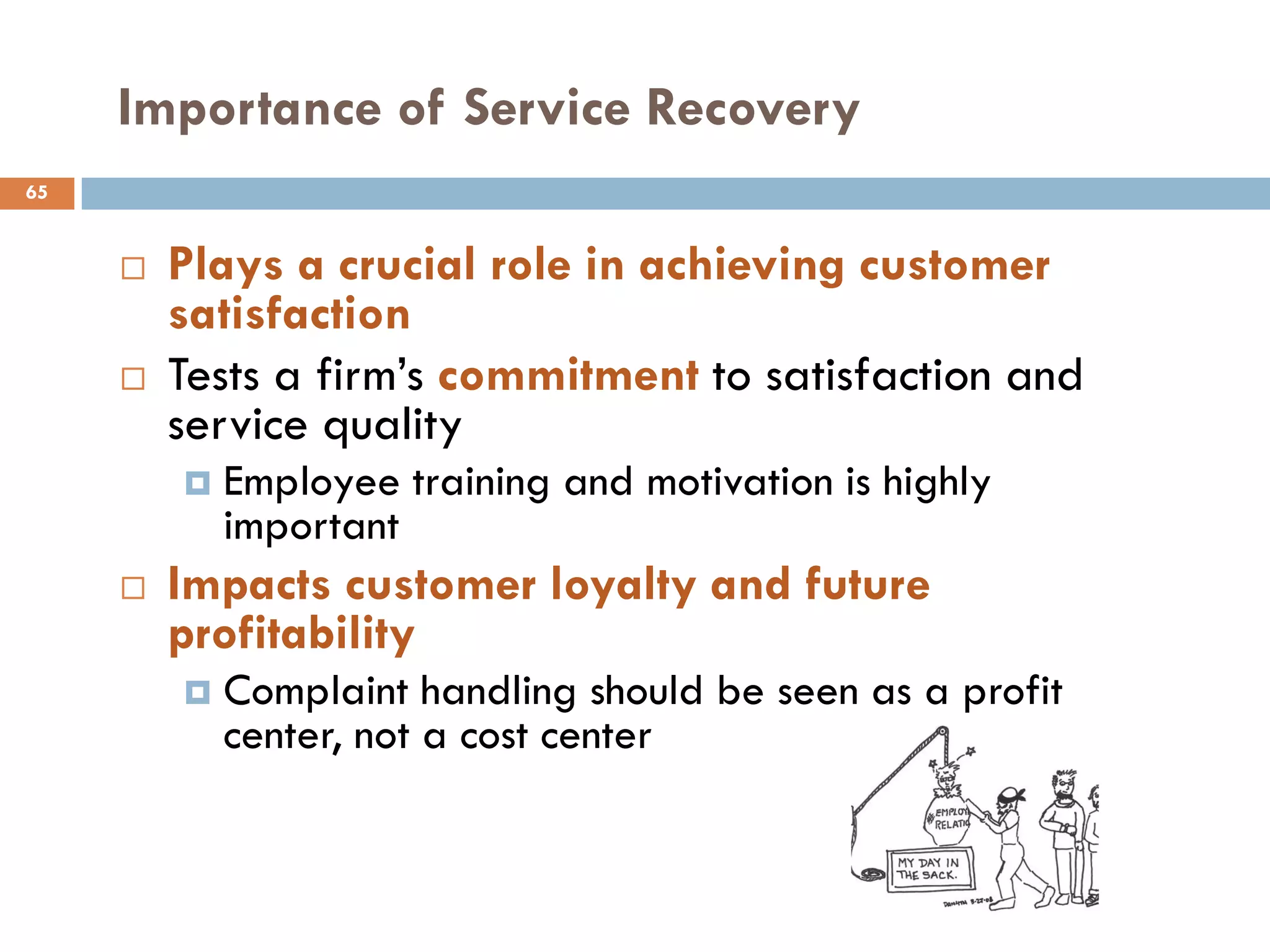
Importance of Service Recovery
65


        Plays a crucial role in achieving customer
         satisfaction
        Tests a firm‘s commitment to satisfaction and
         service quality
            Employee training and motivation is highly
             important
        Impacts customer loyalty and future
         profitability
            Complaint handling should be seen as a profit
             center, not a cost center
The Service Recovery Paradox
66

        Customers who experience a service failure that is
         satisfactorily resolved may be more likely to make
         future purchases than customers without problems
         (Note: not all research supports this paradox)
        If second service failure occurs, the paradox
         disappears—customers‘ expectations have been
         raised and they become disillusioned
        Severity and ―recoverability‖ of failure (e.g.,
         spoiled wedding photos) may limit firm‘s ability to
         delight customer with recovery efforts
        Best strategy: Do it right the first time
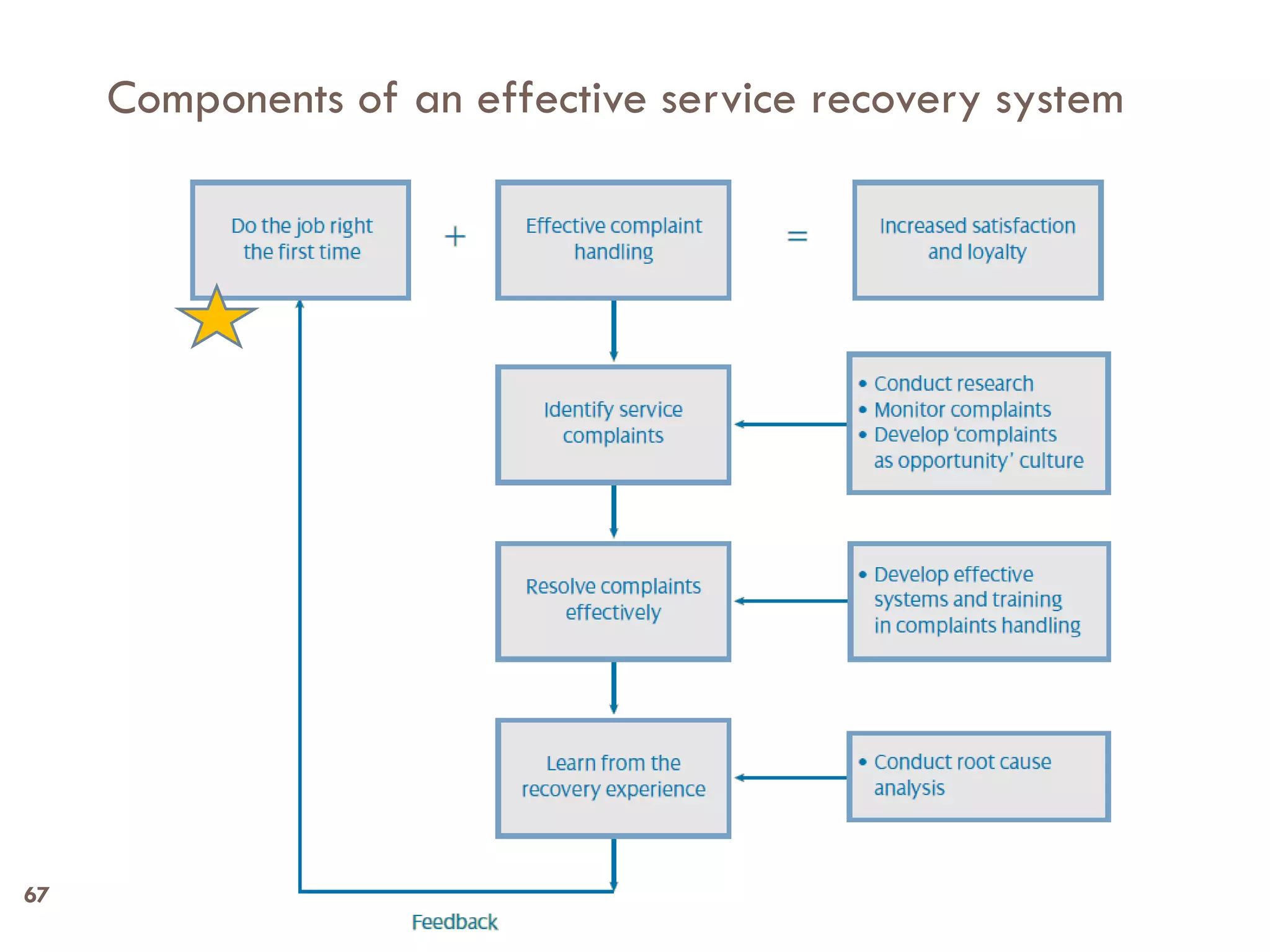
Components of an effective service recovery system


67
Principles of effective service recovery systems
68

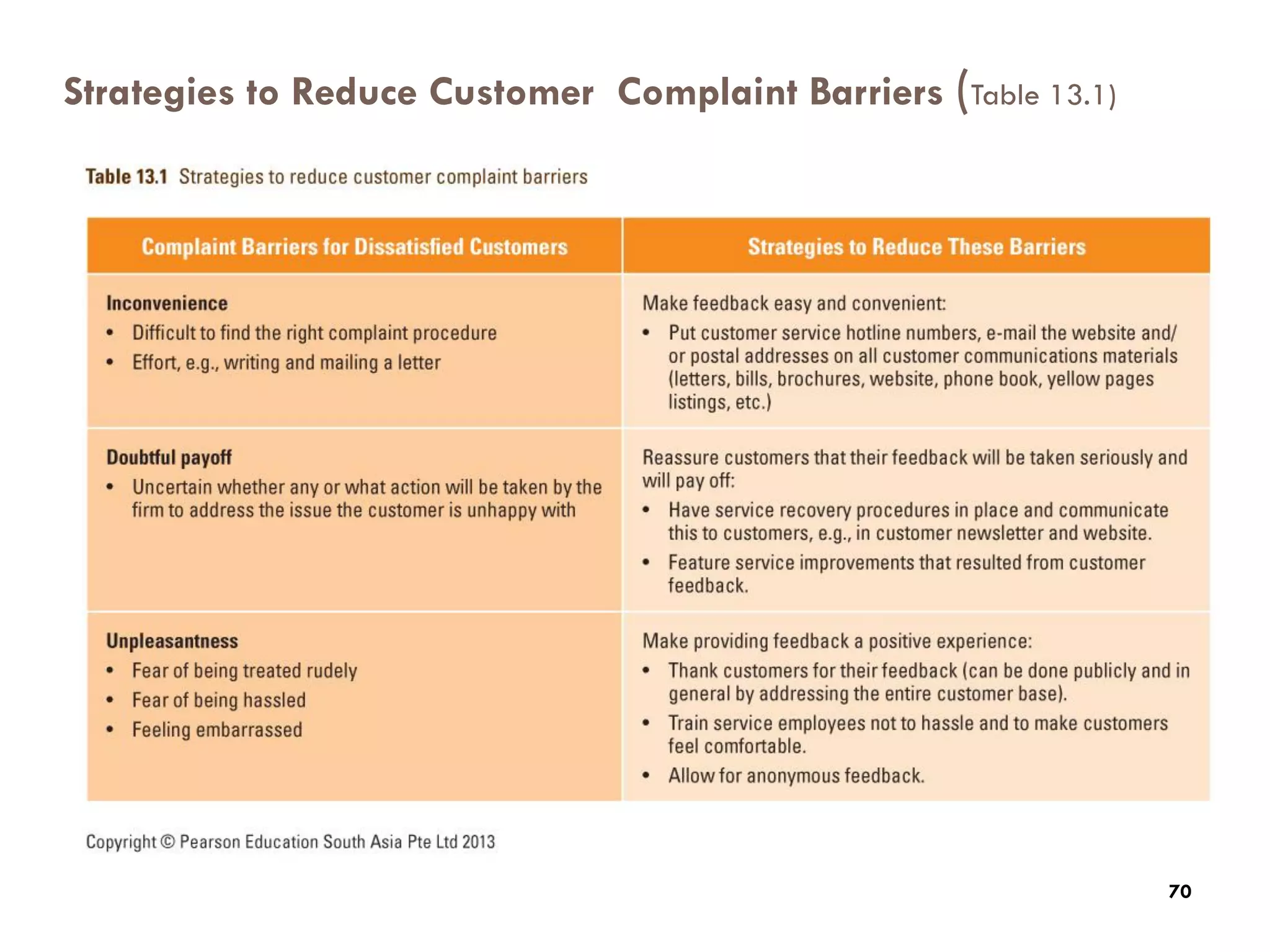
        Table 13.1 recommends some strategies companies can
         adopt to reduce customer complaint barriers. The activities
         suggested have three main objectives;
        (1) Making feedback easy and convenient—make feedback
         tools easily accessible to customers,
        (2) reassuring customers that their feedback would taken
         seriously and acted upon—publish feedback from customers
         and subsequent actions in company newsletters/publications,
         and
        (3) make the feedback process a positive experience for the
         customers—training frontline staff to make customers feel
         comfortable giving feedback; thanking customers for
         feedback.
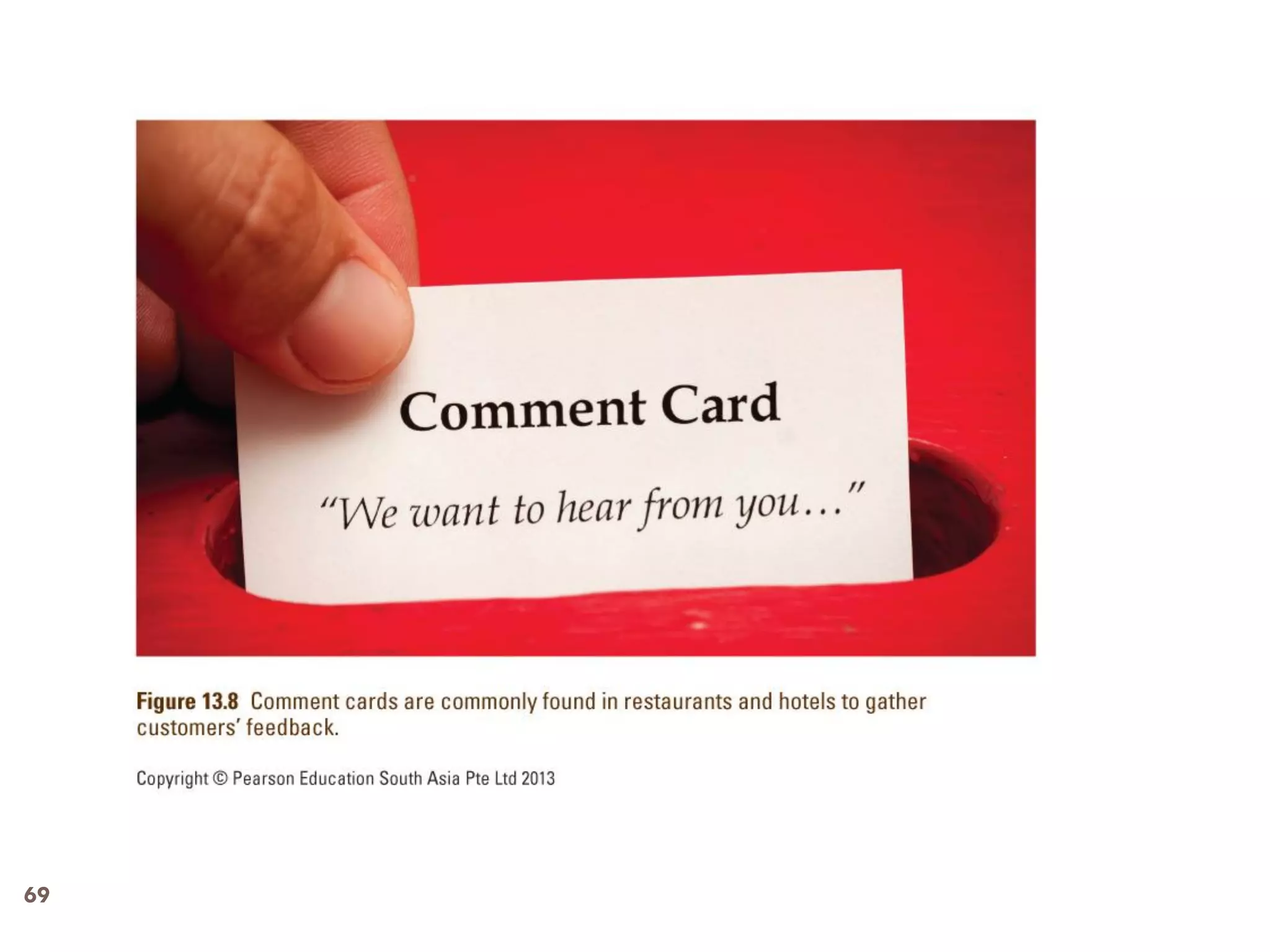
69
Strategies to Reduce Customer Complaint Barriers (Table 13.1)

70


                                                                     70
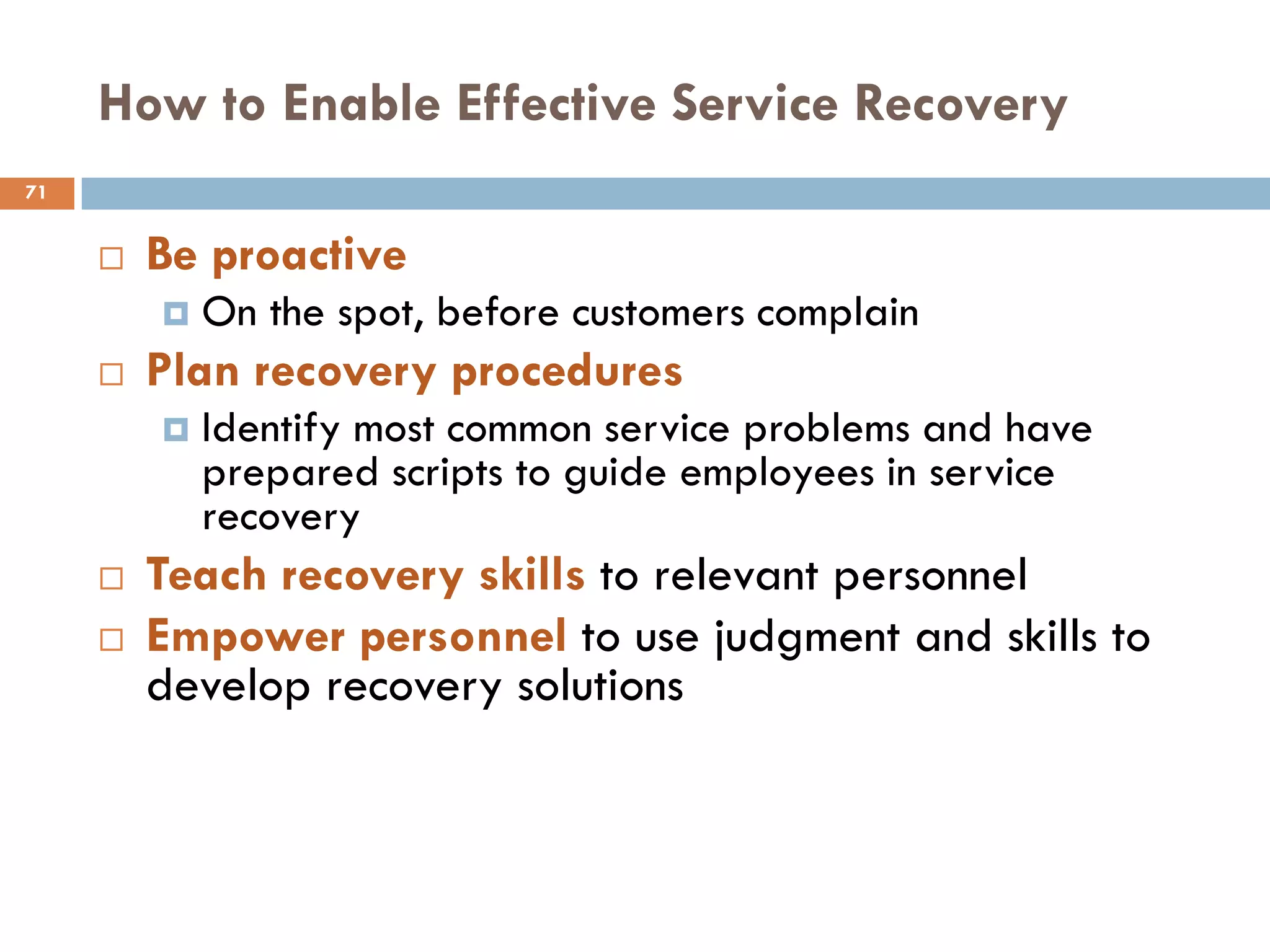
How to Enable Effective Service Recovery
71


        Be proactive
            On the spot, before customers complain
        Plan recovery procedures
            Identify most common service problems and have
             prepared scripts to guide employees in service
             recovery
        Teach recovery skills to relevant personnel
        Empower personnel to use judgment and skills to
         develop recovery solutions
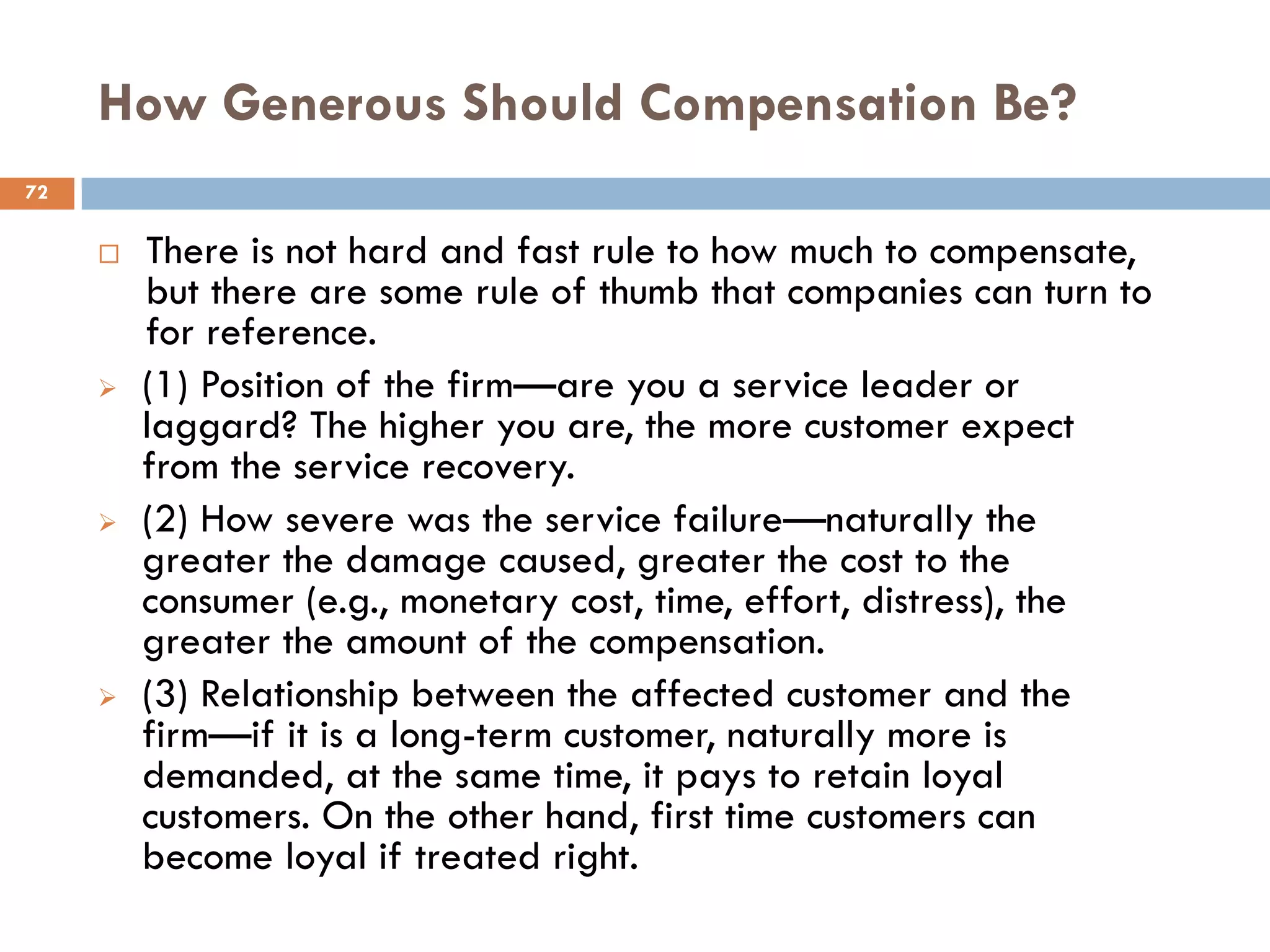
How Generous Should Compensation Be?
72


        There is not hard and fast rule to how much to compensate,
         but there are some rule of thumb that companies can turn to
         for reference.
        (1) Position of the firm—are you a service leader or
         laggard? The higher you are, the more customer expect
         from the service recovery.
        (2) How severe was the service failure—naturally the
         greater the damage caused, greater the cost to the
         consumer (e.g., monetary cost, time, effort, distress), the
         greater the amount of the compensation.
        (3) Relationship between the affected customer and the
         firm—if it is a long-term customer, naturally more is
         demanded, at the same time, it pays to retain loyal
         customers. On the other hand, first time customers can
         become loyal if treated right.
How Generous Should Compensation Be?
     (‘rule-of-thumb’)
73


        The rule-of-thumb for recovery policies should be that
         customers should be compensated with ‗well-dosed
         generosity.‘
        On the one hand, the firm cannot be perceived as
         stingy and calculating, and on the other hand, it should
         not be seen as overcompensating.
        Overcompensation does not only fail to increase
         satisfaction much further beyond a recovery perceived
         as fair, it also may give the wrong incentives to the
         wrong customers (jaycustomers?) to complain too much.
Service Insights 13.2 : guidelines companies can use to handle
     complaining customers and recover from a service failure (read page 406)

74

       1.    Act fast
       2.    Acknowledge the customer‘s feelings
       3.    Don‘t argue with the customer
       4.    Empathize with the customer
       5.    Clarify the truth and sort out the cause
       6.    Give customers the benefit of doubt
       7.    Propose the steps needed to solve the problem
       8.    Keep customers informed of progress
       9.    Consider compensations
       10.   Continue to regain customer goodwill
       11.   Self-check the system and improve it
The Power of Service Guarantees
75


     •   Force firms to focus on what customers want
     •   Set clear standards
     •   Require systems to get & act on customer
         feedback
     •   Force organizations to understand why they fail
         and to overcome potential fail points
     •   Reduce risks of purchase and build loyalty
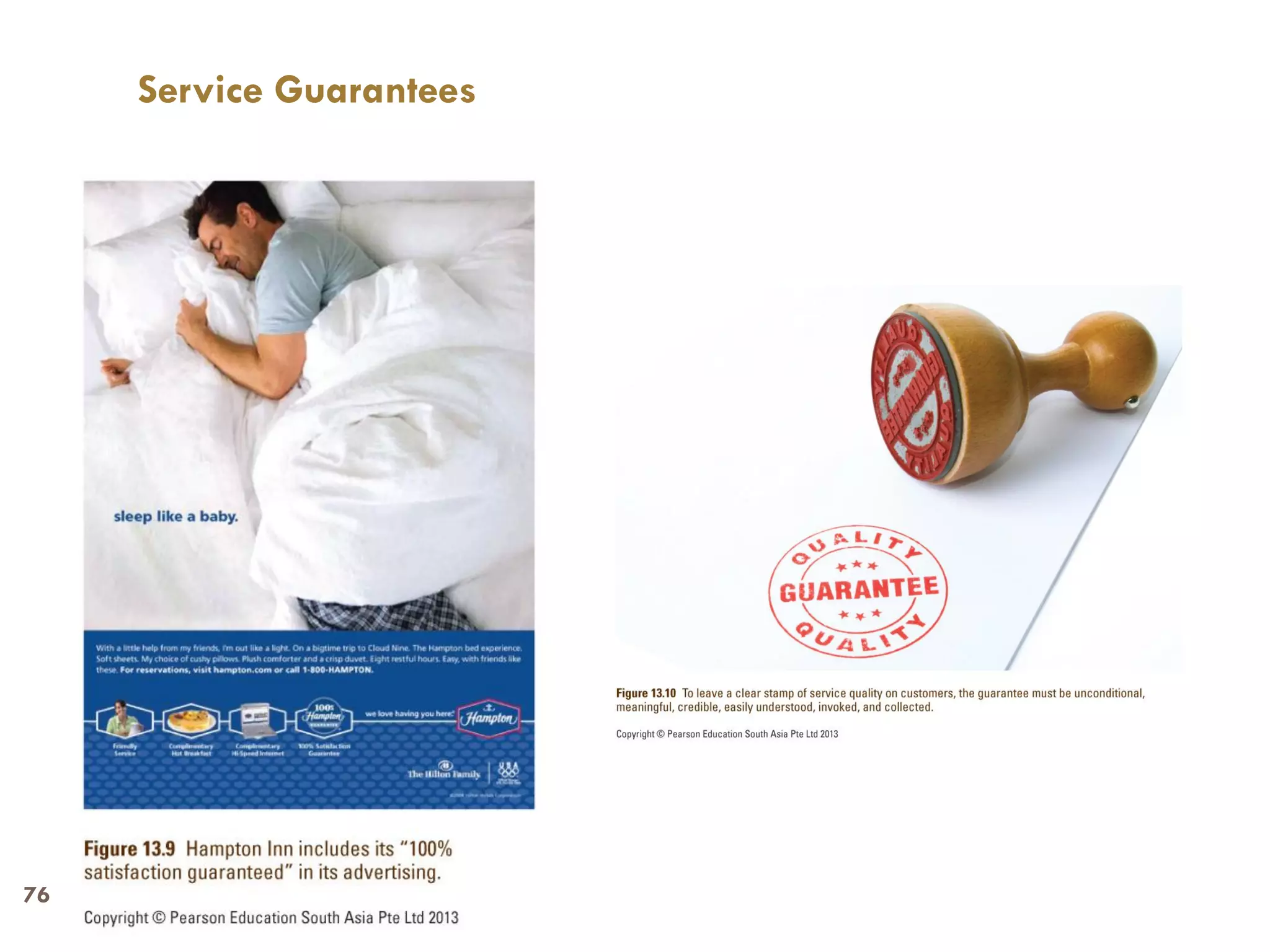
Service Guarantees


76
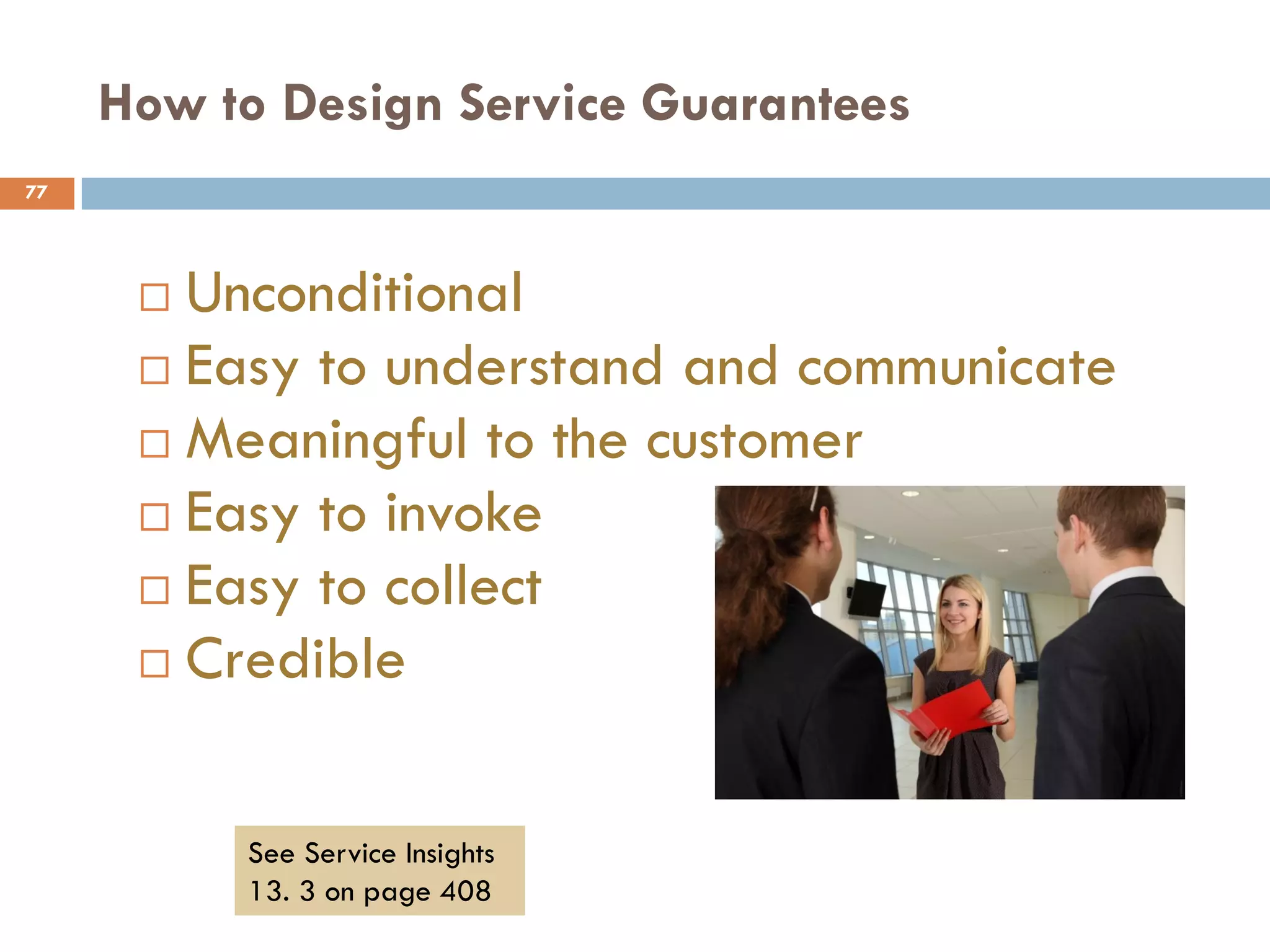
How to Design Service Guarantees
77


       Unconditional
       Easy to understand and communicate
       Meaningful to the customer
       Easy to invoke
       Easy to collect
       Credible


          See Service Insights
          13. 3 on page 408
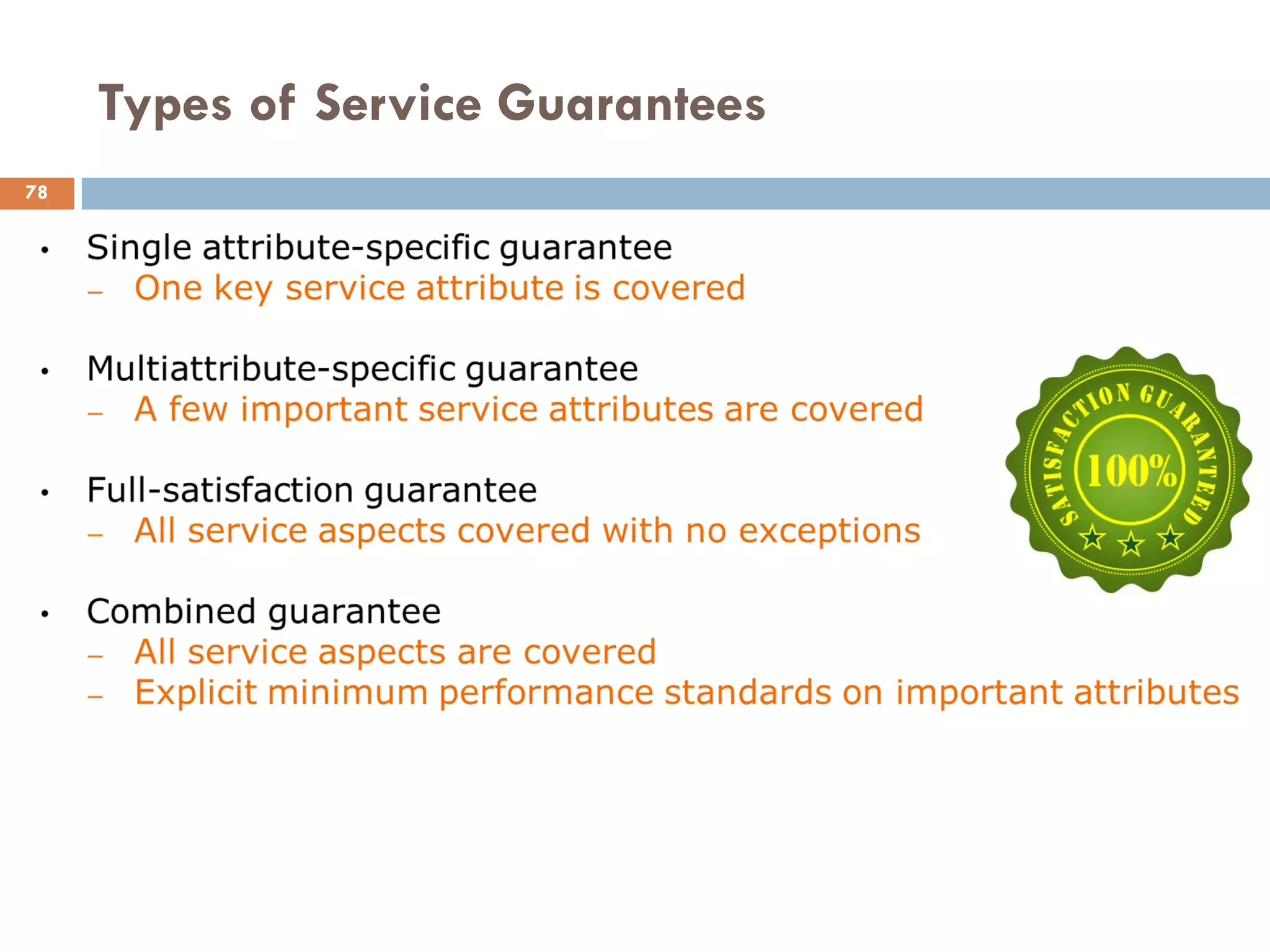
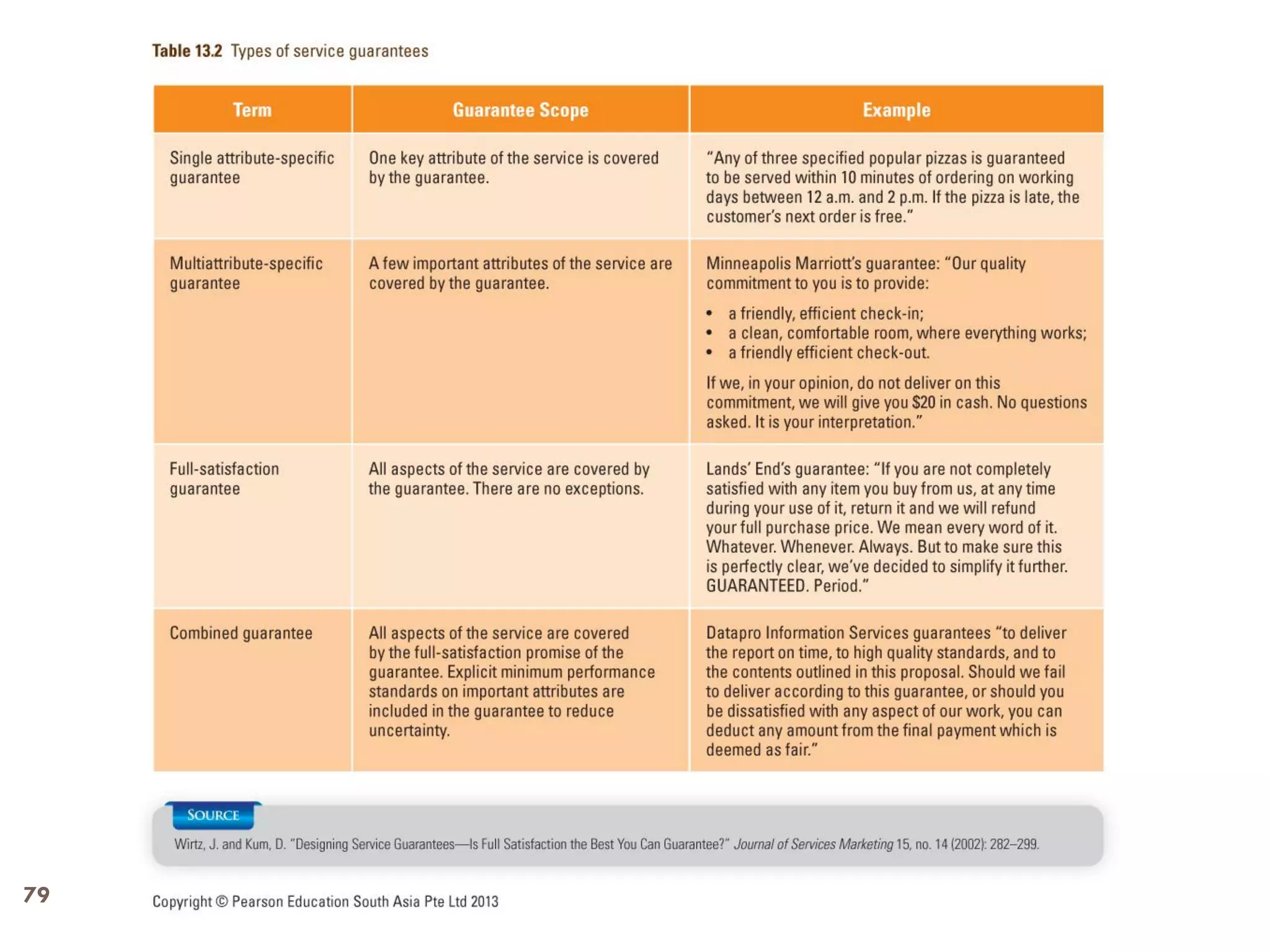
Types of Service Guarantees
78
79
Is it Always Suitable to Introduce a Guarantee?
80


         It is not appropriate to introduce guarantees when:
            Companies have a strong reputation for service
              excellence
            Company does not have good quality level
            Quality cannot be controlled because of
              external forces
            Consumers see little financial, personal or
              physiological risk associated with the purchase
Discouraging Abuse and Opportunistic Customer
Behavior

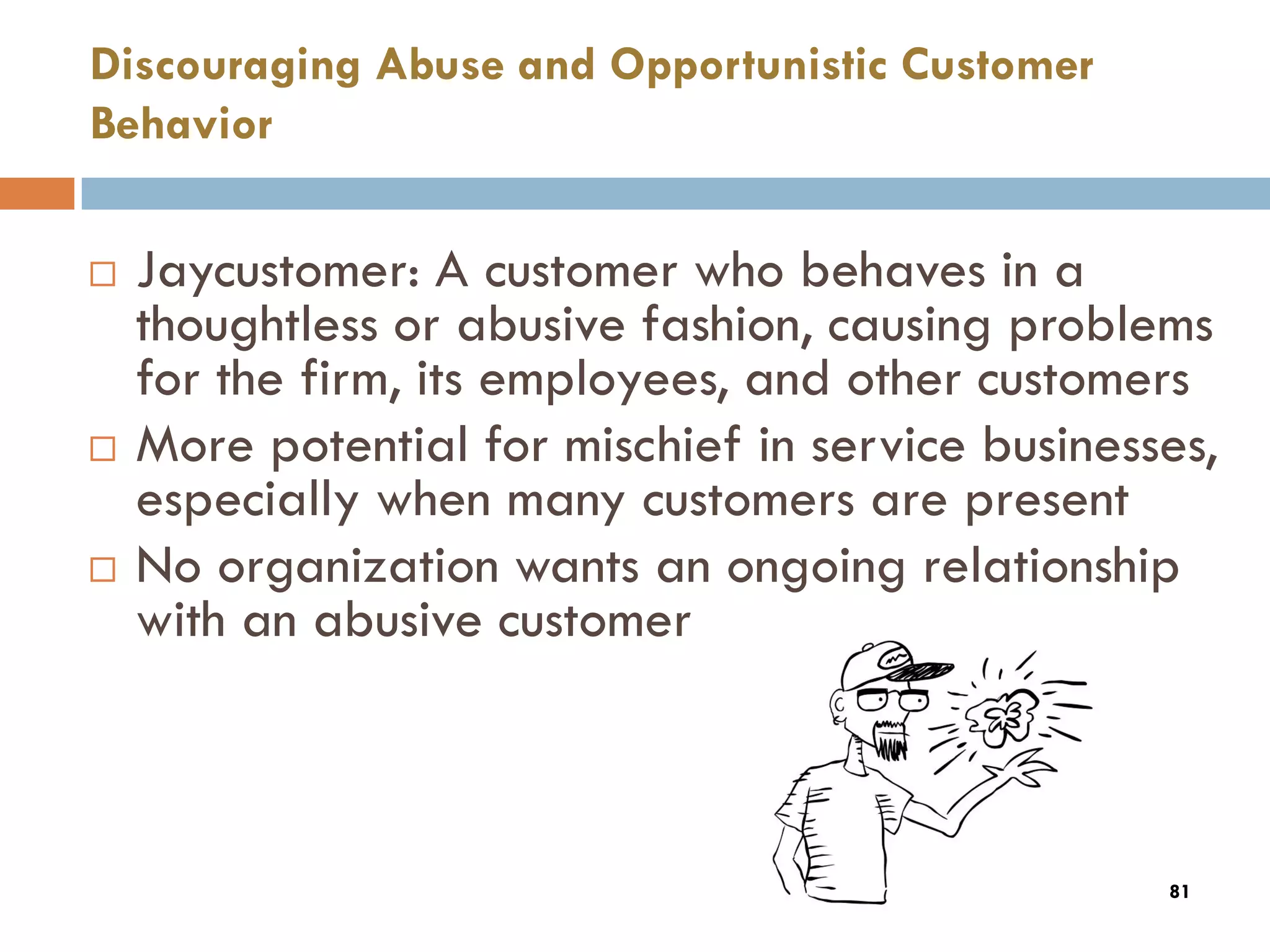
   Jaycustomer: A customer who behaves in a
    thoughtless or abusive fashion, causing problems
    for the firm, its employees, and other customers
   More potential for mischief in service businesses,
    especially when many customers are present
   No organization wants an ongoing relationship
    with an abusive customer


                                                   81
Seven Types of Jaycustomers: (1)
     The Cheat and Thief
82


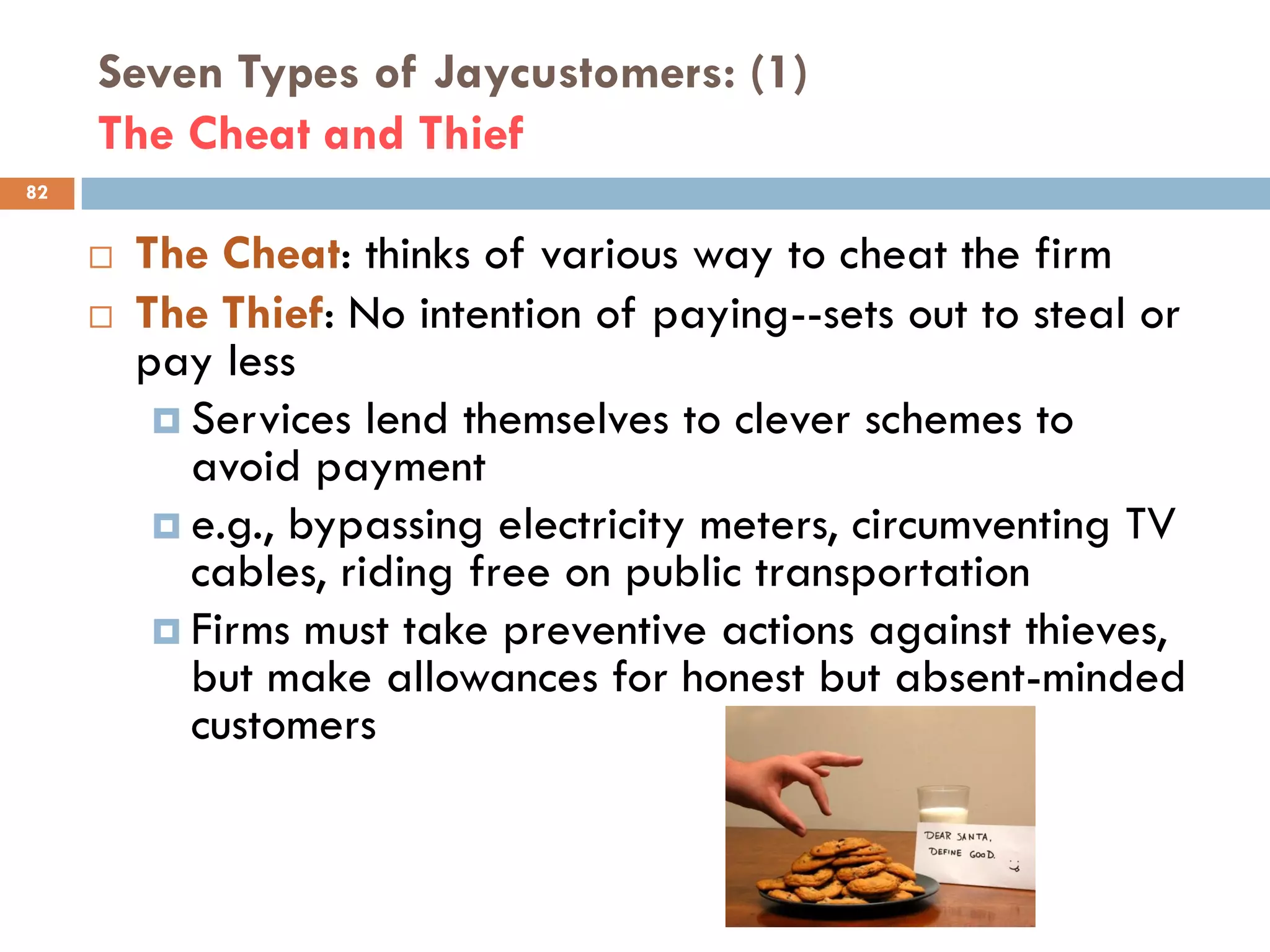
        The Cheat: thinks of various way to cheat the firm
        The Thief: No intention of paying--sets out to steal or
         pay less
           Services lend themselves to clever schemes to
            avoid payment
           e.g., bypassing electricity meters, circumventing TV
            cables, riding free on public transportation
           Firms must take preventive actions against thieves,
            but make allowances for honest but absent-minded
            customers
Seven Types of Jaycustomers: (2)
     The Rulebreaker
83

        Many services need to establish rules to guide
         customers safely through the service encounter
        Government agencies may impose rules for health
         and safety reasons
        Some rules protect other customers from dangerous
         behavior
           e.g. ski patrollers issue warnings to reckless skiers
            by attaching orange stickers on their lift tickets
        Ensure company rules are necessary, not should not
         be too much or inflexible
Seven Types of Jaycustomers: (3)
     The Belligerent
84


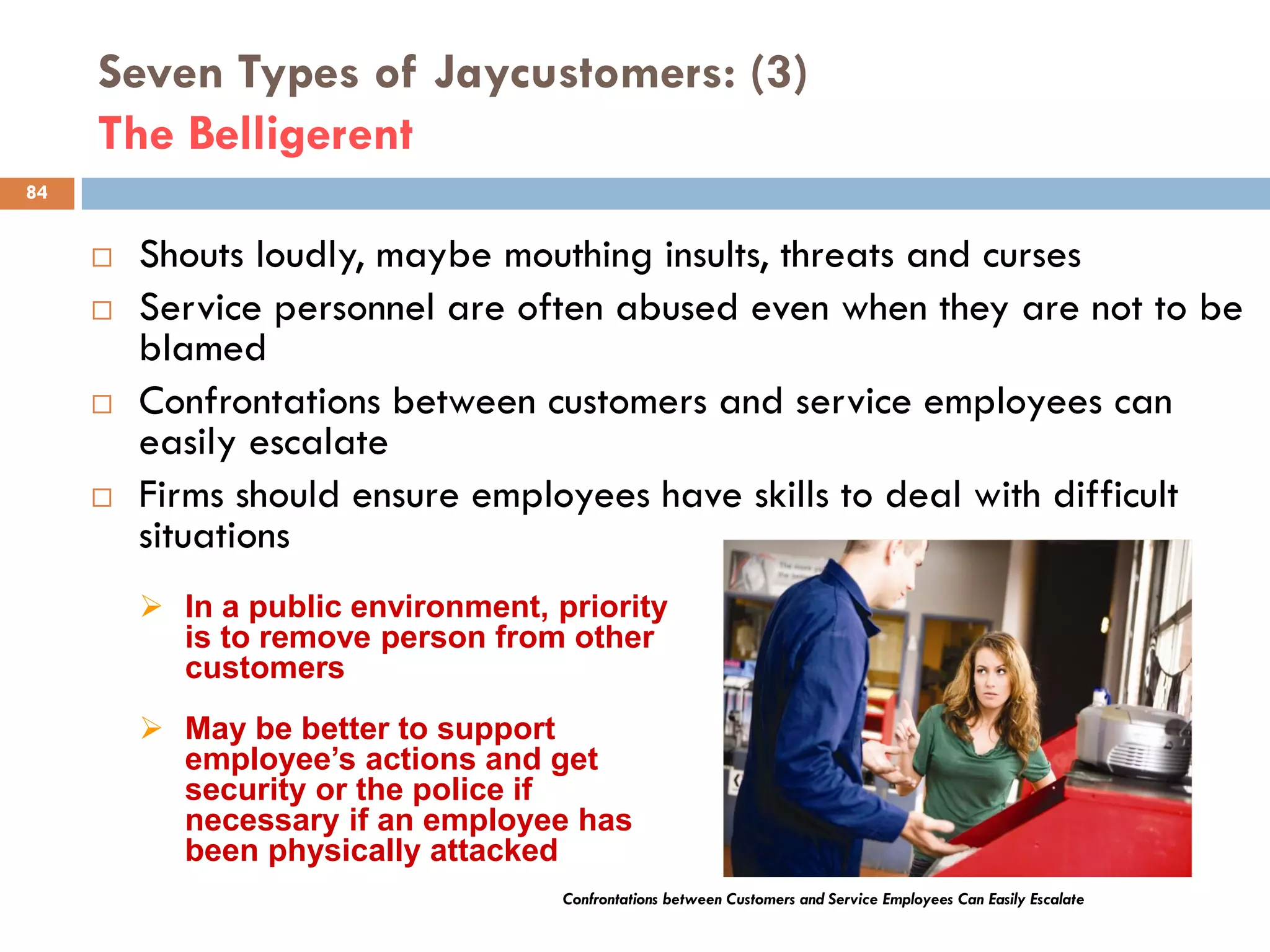
        Shouts loudly, maybe mouthing insults, threats and curses
        Service personnel are often abused even when they are not to be
         blamed
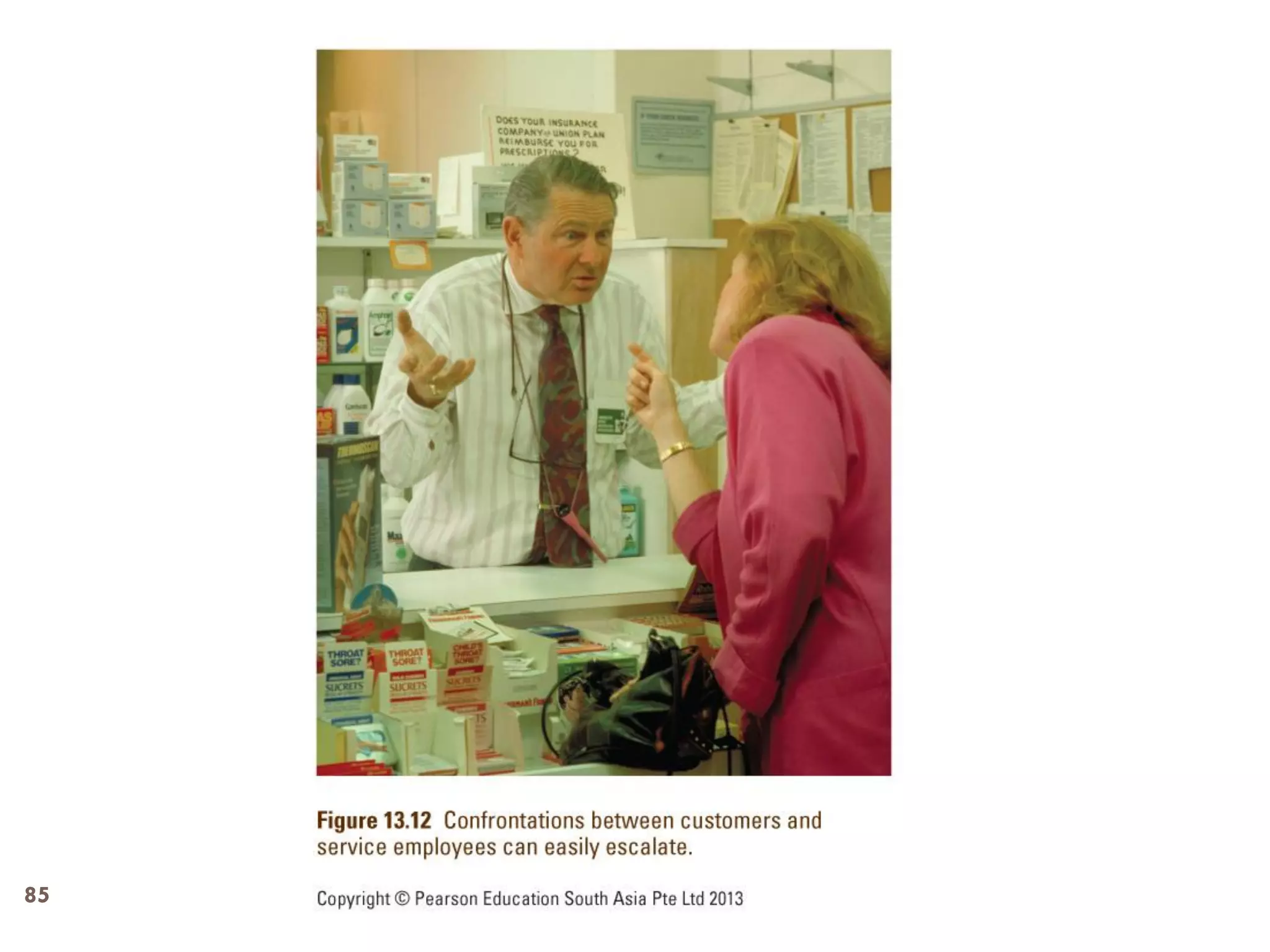
        Confrontations between customers and service employees can
         easily escalate
        Firms should ensure employees have skills to deal with difficult
         situations
          In a public environment, priority
           is to remove person from other
           customers
          May be better to support
           employee’s actions and get
           security or the police if
           necessary if an employee has
           been physically attacked
                                     Confrontations between Customers and Service Employees Can Easily Escalate
85
Seven Types Of Jaycustomers: (4)
     Family Feuders And Vandals
86


        Family Feuders: People who get into arguments with
         other customers – often members of their own family
        The Vandal:
           Service vandalism includes pouring soft drinks into
            bank cash machines; slashing bus seats, breaking
            hotel furniture
           Bored and drunk young people are a common
            source of vandalism
           Unhappy customers who feel mistreated by service
            providers take revenge
           Prevention is the best cure
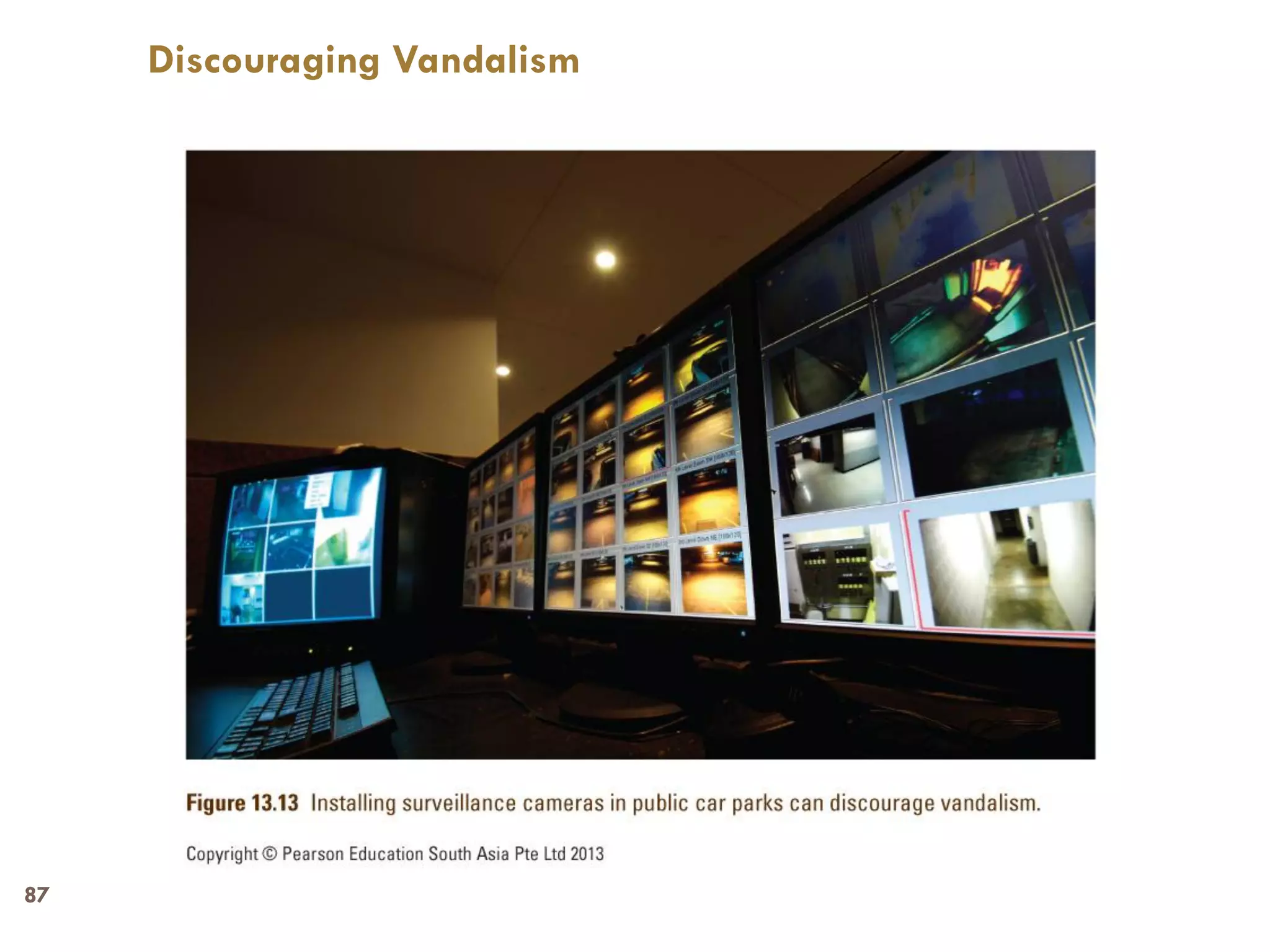
Discouraging Vandalism


87
Seven Types Of Jaycustomers: (5)
     The Deadbeat
88


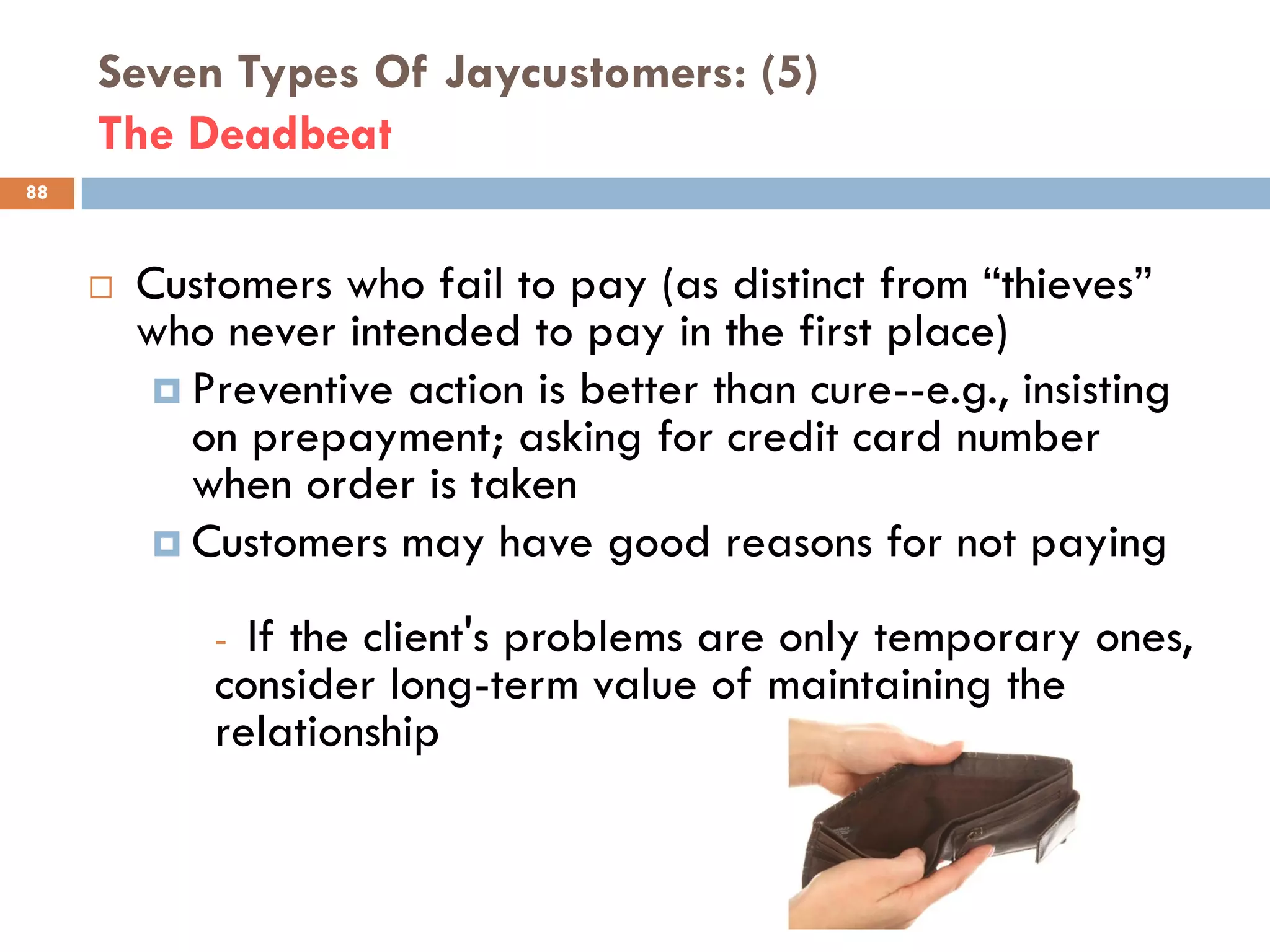
        Customers who fail to pay (as distinct from ―thieves‖
         who never intended to pay in the first place)
           Preventive action is better than cure--e.g., insisting
            on prepayment; asking for credit card number
            when order is taken
           Customers may have good reasons for not paying

             - If the client's problems are only temporary ones,
             consider long-term value of maintaining the
             relationship
Consequences of Dysfunctional Customer Behavior
89


        Employees:
          Mood  or temper negatively affected
          Long-term psychological damage

          Staff morale will fall, affecting productivity

        Other Customers:
          Positive – rally to support an employee who is perceived to
           be abused
          Negative – Contagious bad behavior might escalate the
           situation
Dealing with Customer Fraud
90


        If in doubt, believe the customer
        Keep a database of how often customers invoke service
         guarantees or of payments made for service failure
        Insights from research on guarantee cheating:
           Amount of a guarantee payout had no effect on
             customer cheating
           Repeat-purchase intention reduced cheating intent
           Customers are reluctant to cheat if service quality is
             high (rather than just satisfactory)
Dealing with Customer Fraud
91


        Managerial implications:
          Firms can benefit from offering 100 percent money-
           back guarantees
          Guarantees should be offered to regular customers as
           part of membership program since regular customers
           are unlikely to cheat
          Excellent service firms have less to worry about than
           average providers
Summary of Chapter 13 –Service
     Recovery and Customer Feedback (1)
92


        When customers are dissatisfied, they can
           Take some form of public action
           Take some form of private action
           Take no action
        To understand customer responses to service failures, some
         questions to ask are
           Why do customers complain?
           What proportion of unhappy customers complain?
           Why don‘t unhappy customer complain?
           Who is most likely to complain?
           Where do customers complain?
           What do customers expect once they have made a
            complaint?
Summary of Chapter 13 –Service
     Recovery and Customer Feedback (2)
93


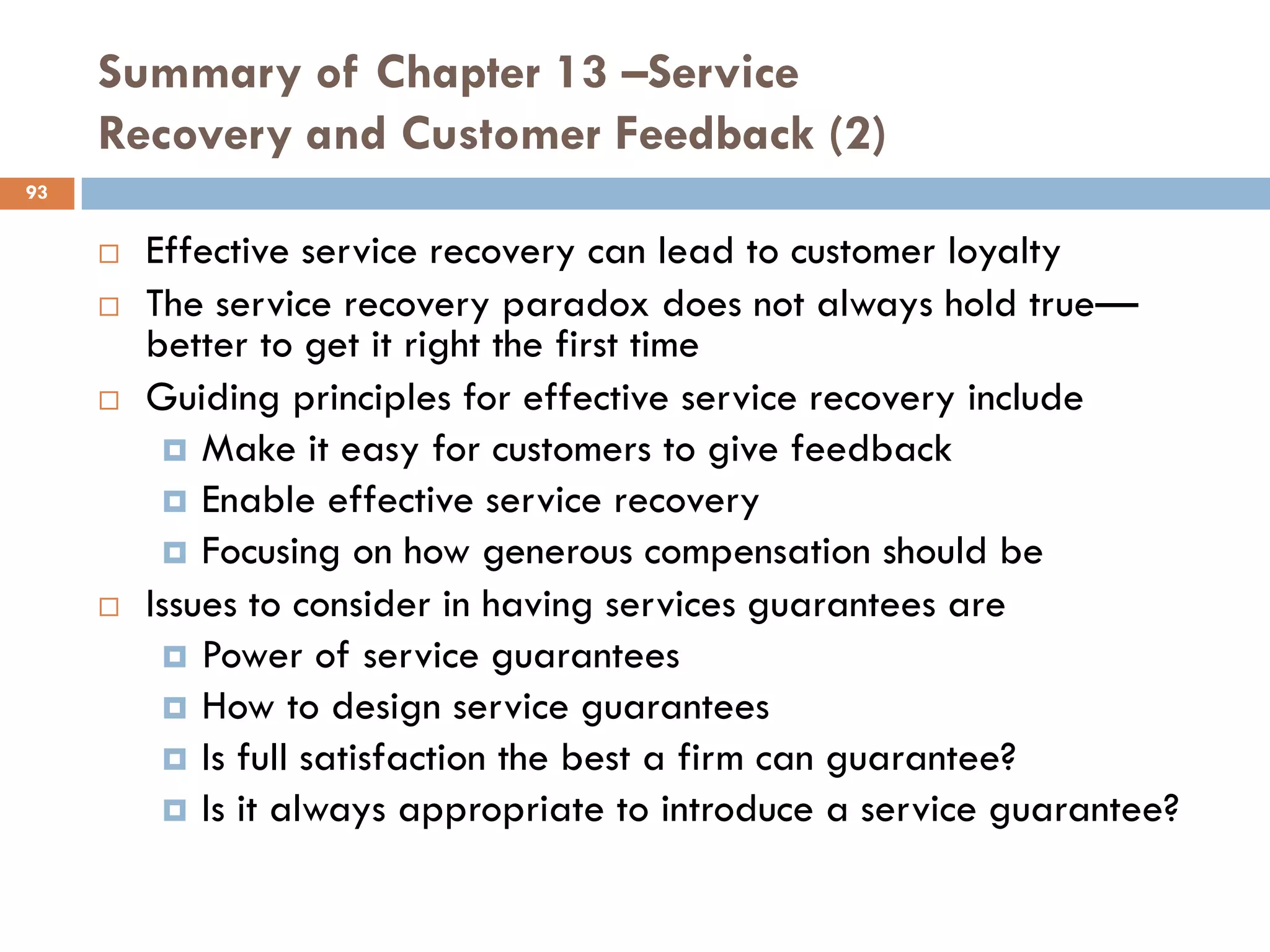
        Effective service recovery can lead to customer loyalty
        The service recovery paradox does not always hold true—
         better to get it right the first time
        Guiding principles for effective service recovery include
           Make it easy for customers to give feedback
           Enable effective service recovery
           Focusing on how generous compensation should be
        Issues to consider in having services guarantees are
           Power of service guarantees
           How to design service guarantees
           Is full satisfaction the best a firm can guarantee?
           Is it always appropriate to introduce a service guarantee?
Summary of Chapter 13 –Service
     Recovery and Customer Feedback (3)
94


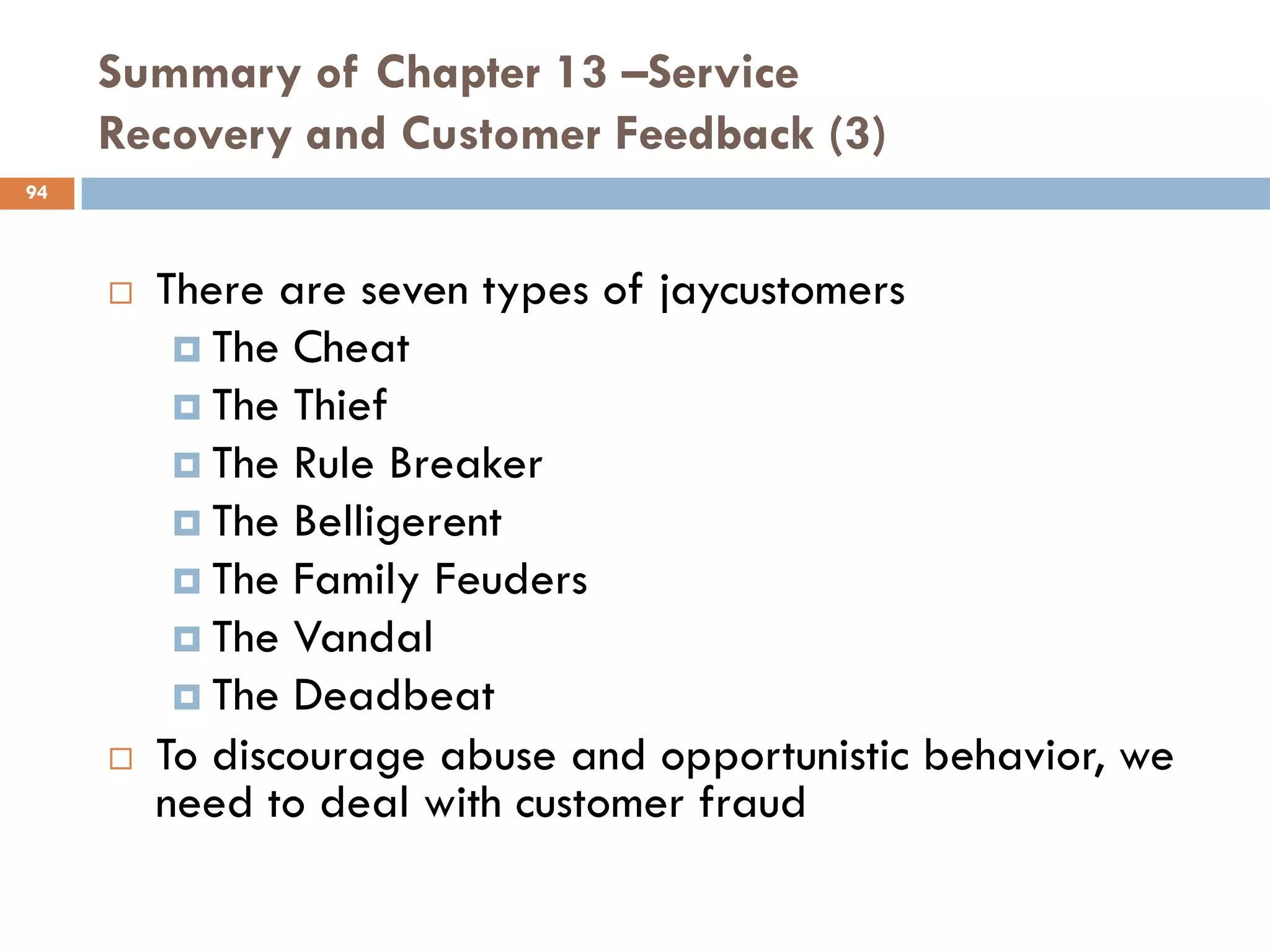
        There are seven types of jaycustomers
           The Cheat
           The Thief
           The Rule Breaker
           The Belligerent
           The Family Feuders
           The Vandal
           The Deadbeat
        To discourage abuse and opportunistic behavior, we
         need to deal with customer fraud
Practice Exam Question
95


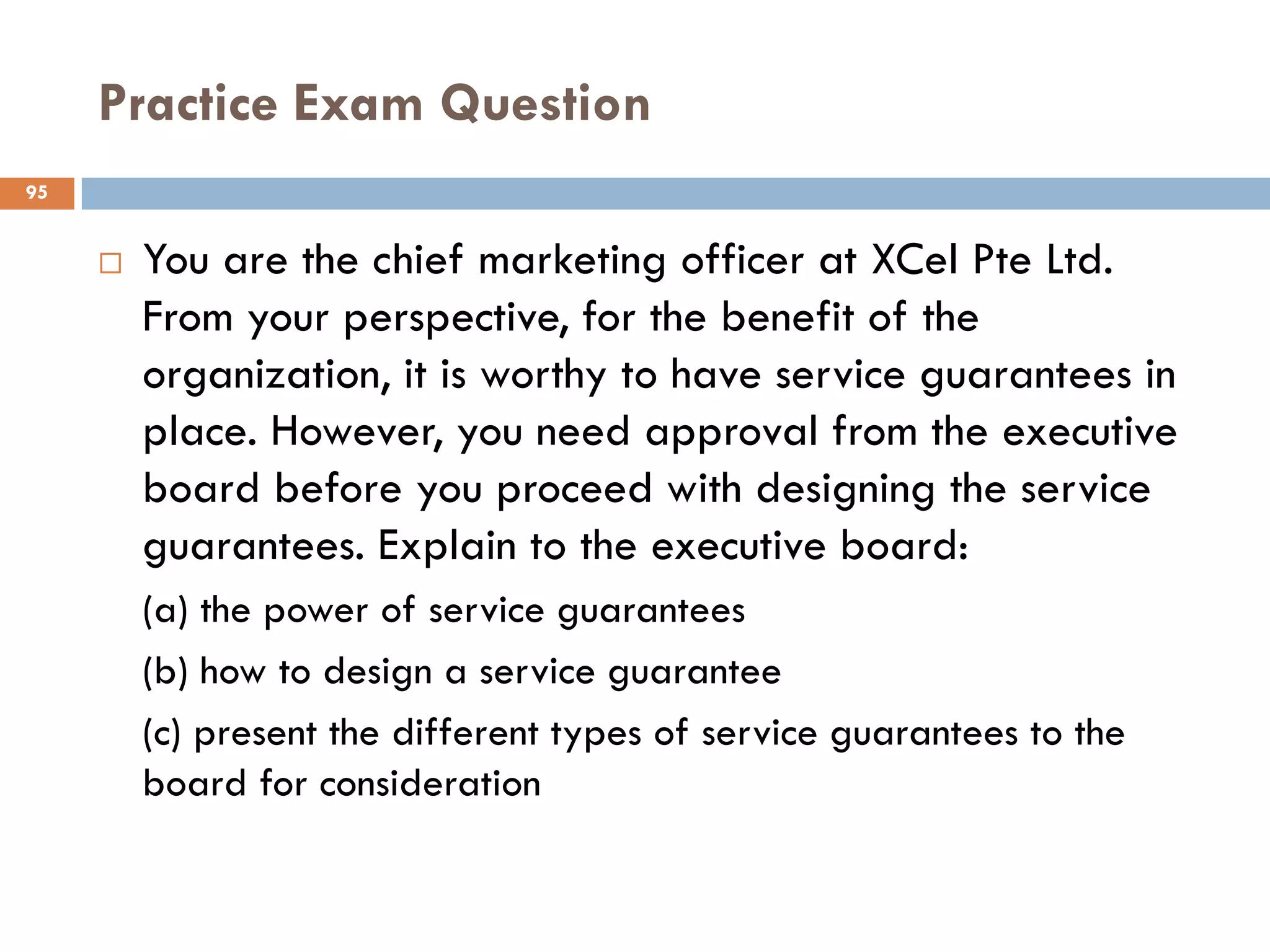
        You are the chief marketing officer at XCel Pte Ltd.
         From your perspective, for the benefit of the
         organization, it is worthy to have service guarantees in
         place. However, you need approval from the executive
         board before you proceed with designing the service
         guarantees. Explain to the executive board:
         (a) the power of service guarantees
         (b) how to design a service guarantee
         (c) present the different types of service guarantees to the
         board for consideration
Practice Examination Questions
96


        The implementation of profitable service strategies
         can include building relationships and customer
         loyalty as well as putting effective complaint
         handling/service recovery processes in place.
         Describe the various strategies for building customer
         loyalty (10 marks) and complaint handling/service
         recovery (10 marks)
Practice Examination Question
97


        As a graduate who has undertaken and successfully
         completed the MKTG 1268 Service Quality course,
         and a potential manager and owner of your own
         service business, you know the importance of
         building customer loyalty for the long-term success
         of your business, as well as good service recovery
         strategies when ‗things go wrong‘. Recall and list the
         key theories and concepts you have learnt that are
         important to building customer loyalty and
         implementing good service recovery, and give
         examples of how these may be implemented.
Practice Examination Question:
98


        Research suggests that many dissatisfied
         customers never complain but simply defect to
         a competitor. What are the management
         implications of this finding and how might
         managers try to minimise such defections?
Practice Examination Question:
99


        Using the most appropriate theory/conceptual
         model taught in this course, explain why a
         customer may be ‗satisfied‘ with consistently
         poor levels of service (quality) they experience
         from the same service provider.
Practice Exam Question
100


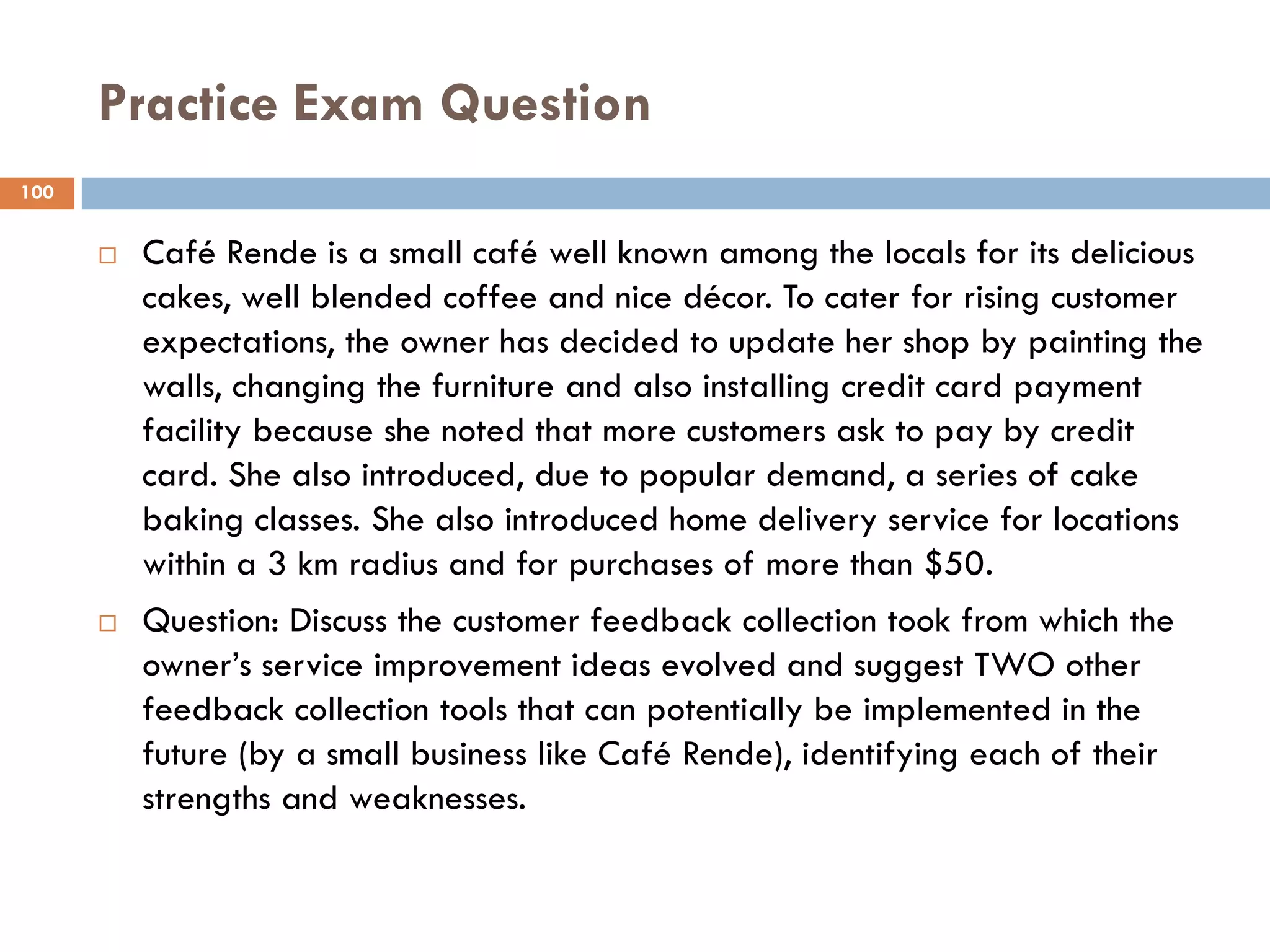
         Café Rende is a small café well known among the locals for its delicious
          cakes, well blended coffee and nice décor. To cater for rising customer
          expectations, the owner has decided to update her shop by painting the
          walls, changing the furniture and also installing credit card payment
          facility because she noted that more customers ask to pay by credit
          card. She also introduced, due to popular demand, a series of cake
          baking classes. She also introduced home delivery service for locations
          within a 3 km radius and for purchases of more than $50.
         Question: Discuss the customer feedback collection took from which the
          owner‘s service improvement ideas evolved and suggest TWO other
          feedback collection tools that can potentially be implemented in the
          future (by a small business like Café Rende), identifying each of their
          strengths and weaknesses.

SQ Lecture Nine -Building Relationships & Service Recovery (Chapters 12 and 13)

  • 1.
    JAN 2013 Semester 1 Service Quality MKTG 1268 Lecture Nine • Managing Relationships and Building Loyalty (Chapter 12) • Complaint Handling and Service Recovery (Chapter 13)
  • 2.
    Overview of Chapter12 2  The Search for Customer Loyalty  The Wheel of Loyalty  Building a Foundation for Loyalty  Strategies for Developing Loyalty Bonds with Customers  Strategies for Reducing Customers Defections  CRM: Customer Relationship Management Systems  What a Comprehensive CRM Strategy Includes
  • 3.
    3 THE SEARCHFOR CUSTOMER LOYALTY
  • 4.
    Opening Case Study– Harrah’s Entertainment’s Customer Relationship Management (read page 359) 4
  • 5.
    How Much Profita Customer Generates Over Time (Fig 12.3) 5 5
  • 6.
    Why Is CustomerLoyalty Important to A Firm’s Profitability? 6  Customers become more profitable the longer they remain with a firm:  Increase purchases and/or account balances  Customers / families purchase in greater quantities as they grow  Reduced operating costs  Fewer demands from suppliers and operating mistakes as customer becomes experienced  Referrals to other customers  Positive word-of-mouth saves firm from investing money in sales and advertising  Price premiums  Long-term customers willing to pay regular price  Willing to pay higher price during peak periods
  • 7.
    Why Customers AreMore Profitable Over Time (Fig. 12.4) 7 7
  • 8.
    Assessing the Valueof a Loyal Customer • Must not assume that loyal customers are always more profitable than those making one-time transactions  Large customers may expect price discounts in return for loyalty  Revenues don‘t necessarily increase with time for all types of customers • Tasks:  Determine costs and revenues for customers from different market segments at different points in their customer lifecycles  Predict future profitability 8 © Pearson Education South Asia Pte Ltd 2013. All rights reserved
  • 9.
    Charging different pricesfor different customer market segments 9
  • 10.
    Measuring Customer Equity: Lifetime Value of Each Customer 10  Value of referrals  Percentage of customers influenced by other customers  Other marketing activities that drew the firm to an individual‘s attention  Net Present Value  Sum anticipated annual values (future profits)  Suitably discounted each year into the future See Worksheet on page 363 of the text
  • 11.
    Why are CustomersLoyal? (1) (Service Insights 12.1) 11  Customers stay loyal when we create value for them  Value can be created for customers through  Confidence benefits  Confidence in correct performance  Ability to trust the provider  Lower anxiety when purchasing  Knowing what to expect and receive
  • 12.
    Why are CustomersLoyal? (2) (Service Insights 12.1) 12  Social benefits  Mutualrecognition and friendship between service provider and customer  Special treatment  Better price  Discounts not available to most customer  Extra services  Higher priority when there is a wait
  • 13.
    The Wheel ofLoyalty 13 The Wheel of loyalty (Figure 12.6) shows that arriving at customer loyalty involves 3 components:  Building a foundation for loyalty  Creating loyalty bonds  Reducing churn drivers  The rest of the chapter is organized around these 3 components.
  • 14.
    The Wheel ofLoyalty (Fig. 12.6) 14 14
  • 15.
    Targeting the RightCustomers and Searching for Value, Not Volume 15  Target the right customer and match them to what firm can deliver  How do customer needs relate to operations elements?  How well can service personnel meet expectations of different types of customers?  Can company match or exceed competing services that are directed at same types of customers?  Focus on number of customers served as well as value of each customer  Some customers more profitable than others in the short term  Others may have room for long-term growth  ―Right customers‖ are not always high spenders  Can come from a large group of people that no other supplier is serving well
  • 16.
    Targeting the RightCustomers and Searching for Value, Not Volume 16  Service companies should consider the financial value to the firm of each customer, rather than just count how many customers can be served. Heavy users (who buy more frequently and in larger volumes) are generally more profitable than occasional users. And because customers interact with each other in many services, managers need to think about whether different target segments are compatible with one another.  Attracting the right customers is important as they bring in long-term revenues, continued growth in referrals, etc. Emphasis must also be given to prevent attracting the wrong customers that typically results in costly churn, a diminished company reputation and disillusioned employees.
  • 17.
    Effective Tiering ofService :The Customer Pyramid (Fig 12.8) 17 17
  • 18.
    Effective Tiering ofService :The Customer Pyramid (Fig 12.8) 18  Service tiering, building loyalty bonds, and creating membership programs are three of the strategies.  Customer tiers can be developed around different levels of profit contribution, needs (including sensitivities to variables such as price, comfort, and speed), and identifiable personal profiles such as demographics. Each customer tier requires significantly different service levels based on customer requirements and customer value to the firm.  Slicing the customer base per se allows the firm to see clearly where the profits and the loss making segments are and tailor their marketing accordingly in response. Read up on the four tiers of customers (platinum, gold, iron and lead (page 369)
  • 19.
    Relationship between Satisfactionand Loyalty 19 The satisfaction-loyalty relationship can be divided into three zones:  zone of defection—occurs at low satisfaction levels  zone of indifference—found at moderate satisfaction levels  zone of affection—occurs at very high satisfaction where customers do not find the need to seek alternative service providers
  • 20.
    The Customer SatisfactionLoyalty Relationship (Fig. 12.10) 20 20
  • 21.
    Strategies for DevelopingLoyalty Bonds with Customers (1) 21  Deepening the relationship  Bundling/Cross-selling services makes switching a major effort that customer is unwilling to go through unless extremely dissatisfied with service provider  Customers benefit from buying all their various services from the same provider  One-stop-shopping, potentially higher service levels, higher service tiers etc
  • 22.
    Strategies for DevelopingLoyalty Bonds with Customers (2) See example of rewards used by British Airways in Service Insights 12.4 on page 22 375 of the text (see Table 12.1)  Reward Based Bonds  Can be financial or non-financial bonds or a combination of both  Financial bonds  Discounts on purchases, loyalty program rewards (e.g. frequent flier miles), cash-back programs  Non-financial rewards  Priority to loyalty program members for waitlists and queues in call centers; higher baggage allowances, priority upgrading, access to airport lounges for frequent flyers  Intangible rewards  Special recognition and appreciation  Reward-based loyalty programs are relatively easy to copy and rarely provide a sustained competitive advantage
  • 23.
    23 Service Insight 12.4
  • 24.
    Strategies for DevelopingLoyalty Bonds with Customers (3) 24  Social Bonds  Based on personal relationships between providers and customers  Harder to and takes a longer time to build, but also harder to imitate and thus, better chance of retention in the long term  Customization Bonds  Customized service for loyal customers  e.g. Starbucks  Customers may find it hard to adjust to another service provider who cannot customize service
  • 25.
  • 26.
    Strategies for DevelopingLoyalty Bonds with Customers (4) 26  Structural Bonds  Mostly seen in B2B settings  Align customers way of doing things with supplier‘s own processes  Joint investments in projects and sharing of information, processes and equipment.  Can be seen in B2C environment too  Airlines - SMS check-in, SMS email alerts for flight arrival and departure times  Difficult for competition to draw customers away when they have integrated their way of doing things with existing supplier
  • 27.
    Analyze Customer Defectionsand Monitor Declining Accounts 27  Understand reasons for customer switching  Churn Diagnostics common in mobile phone industry  Analysis of data warehouse information on churned and declining customers  Exit interviews:  Ask a short set of questions when customer cancels account; in-depth interviews of former customers by third party agency
  • 28.
    What Drives Customersto Switch? (Fig 12.14) 28 28
  • 29.
    Address Key ChurnDrivers  Deliver quality service  Reduce inconvenience and non-monetary costs  Have fair and transparent pricing  Industry specific drivers  Cellular phone industry: handset replacement a common reason for subscribers discontinuing services – offer handset replacement programs  Take active steps to retain customers  Save teams: specially trained call center staff to deal with customers who want to cancel their accounts  Be careful about how save teams are rewarded (see Service Insights 12.5) 29
  • 30.
    Other Ways toReduce Churn 30  Implement Effective Complaint Handling and Service Recovery Procedures  Increase Switching Costs  Natural switching costs  e.g. Changing primary bank account – many related services tied to account  Can be created by instituting contractual penalties for switching  Must be careful not to be perceived as holding customers hostage  High switching barriers and poor service quality likely to generate negative attitudes and bad word of mouth
  • 31.
    31 CRM: CUSTOMER RELATIONSHIP MANAGEMENT SYSTEMS
  • 32.
    Common Objectives OfCRM Systems (1) 32  Customer perspective  Unified customer interface that delivers customization and personalization  Vast service improvement and increase customer value  Company perspective  Better segment, tier customer base and target promotion  Implement churn alert systems if customers are in danger of defecting
  • 33.
    Common Applications OfCRM Systems (1) (Service Insights 12.6) 33  Data collection  Customer data such as contact details, demographics, purchasing history, service preferences, and the like  Data analysis  Data captured is analyzed and categorized  Used to tier customer base and tailor service delivery accordingly  Sales force automation  Sales leads, cross-sell and up-sell opportunities can be effectively identified and processed  Entire sales cycle from lead generation to close of sales and after- sales service can be tracked and facilitated through CRM system
  • 34.
    Common Objectives OfCRM Systems (2) (Service Insights 12.6) 34  Marketing automation  Mining of customer data enables the firm to target its market  Goal to achieve one-to-one marketing and cost savings, often in the context of loyalty and retention programs  Results in increasing the ROI on its marketing expenditure  CRM systems also allows firms to judge effectiveness of marketing campaigns through the analysis of responses  Call center automation  Call center staff have customer information at their finger tips and can improve their service levels to all customers  Caller ID and account numbers allow call centers to identify the customer tier the caller belongs to, and to tailor the service accordingly  For example, platinum callers get priority in waiting loops.
  • 35.
  • 36.
    What a ComprehensiveCRM Strategy Includes Integrated Framework for CRM Strategy Development Strategy Development • Assessment of business strategy • Business strategy guides development of customer strategy 36 © Pearson Education South Asia Pte Ltd 2013. All rights reserved
  • 37.
    What a ComprehensiveCRM Strategy Includes Integrated Framework for CRM Strategy – Value Creation Value Creation • Translates business and customer strategies into specific value propositions for both customers and firm • Customers benefit from priority, tiered services, loyalty rewards and customization • Company benefits from reduced customer acquisition and retention costs, and increased share-of-wallet • Dual creation of value: customers need to participate in CRM to reap value from firm’s CRM initiatives 37 © Pearson Education South Asia Pte Ltd 2013. All rights reserved
  • 38.
    What a ComprehensiveCRM Strategy Includes Integrated Framework for CRM Strategy – Multi-Channel Integration Multi-channel Integration • Serve customers well across many potential interfaces • Offer a unified interface that delivers customization and personalization
  • 39.
    What a ComprehensiveCRM Strategy Includes Integrated Framework for CRM Strategy – Performance Assessment Performance Assessment • Is CRM system creating value for key stakeholders? • Are marketing and service standard objectives being achieved? • Is CRM system meeting performance standards?
  • 40.
    What a ComprehensiveCRM Strategy Includes Integrated Framework for CRM Strategy – Information Management Information Management • Collect customer information from all channels • Integrate it with other relevant information • Make useful information available to the frontline • Create and manage data repository, IT systems, analytical tools, specific application packages
  • 41.
    Collecting customer informationat different touchpoints 41
  • 42.
    Common Failures inCRM Implementation 42  Unfortunately, there is a high failure rate for CRM implementations  Common reasons for failures  Viewing CRM as a technology Initiative  Lack of customer focus  Not enough understanding of customer lifetime value (CLV)  Inadequate support from top management  Lack of coordination  Failure to reengineer business processes  Underestimating the challenges in data integration
  • 43.
    Implementation of CRM-key questions to ask when defining customer relationship strategy: 43  How should our value proposition change to increase customer loyalty?  How much customization or one-to-one marketing and service delivery is appropriate and profitable?  What is the increase in profit from increasing share-of- wallet with current customers? How much does this vary by customer tier and/or segment?  How much time and resources can we provide to CRM right now?  If we believe in customer relationship management, why haven‘t we taken more steps in that direction in past?  What can we do today to develop customer relationships without spending on technology?
  • 44.
    Summary of Chapter12: Managing Relationships and Building Loyalty (1) 44  Customer loyalty as an important driver of profitability for service firms so firms need to  Assess value of loyal customer  Narrow gap between actual and potential customer value  Wheel of Loyalty shows how firms can:  Build a foundation of loyalty  Create loyalty bonds  Reduce churn drivers  Building a foundation of loyalty involves  Good fit between customer needs and capabilities  Searching for value, not just volume  Tiering services effectively  Obtaining customer satisfaction through service quality
  • 45.
    Summary of Chapter12: Managing Relationships and Building Loyalty (2) 45  Customer loyalty bonds include  Reward-based bonds  Social bonds  Customization bonds  Structural bonds  Strategies for reducing customer defections include  Analyzing customer defections and monitoring declining accounts  Addressing key churn drivers  Implementing effective complaint-handling and service recovery procedures  Increasing switching costs
  • 46.
    Summary of Chapter12: Managing Relationships And Building Loyalty (3) 46  Customer relationship management (CRM) is a whole process by which relations with customers are built and maintained.  An integrated CRM system includes  Strategy development process  Value creation process  Multichannel integration process  Performance assessment process  Cresting a successful CRM program requires understanding common failures in CRM implementation and knowing how to get it right
  • 47.
    Overview of Chapter13 47  Customer Complaining Behavior  Customer Responses to Effective Service Recovery  Principles of Effective Service Recovery Systems  Service Guarantees  Discouraging Abuse and Opportunistic Customer Behavior
  • 48.
    Opening Case :JetBlue Service Recovery 48
  • 49.
    49 CUSTOMER COMPLAINING BEHAVIOR
  • 50.
    Customer satisfaction formula:linking the topics 50 Service Quality Chapter 12 This chapter (13) (chapter 14)
  • 51.
    Customer response toservice failures 51 1. Do nothing 2. Complain in some form to the service firm 3. Take some kind of overt action with a third party (e.g. complain to a consumer claims tribunal) 4. Defect and simply not patronise this firm again
  • 52.
    Customer Response Categoriesto Service Failures (Fig. 13.3) 52
  • 53.
    Why some customerstake NO action 53
  • 54.
    Consumer complaint behaviour How often do people complain? 54
  • 55.
    Why do customerscomplain? 55  Compensation for a monetary loss—either in the form of a refund and/or by having a service performed again.  Complain to rebuild self-esteem. When customers feel service employees have mistreated them, their self-esteem, self-worth, or sense of fairness may be negatively affected.  Help to improve the service  Because of concern for others
  • 56.
    Key issues toinvestigate regarding customer complaining behavior: 56  What proportion of unhappy customers complain?  Why don‘t unhappy customers complain?  Who is most likely to complain?  Where do customers complain?
  • 57.
    Why unhappy customersoften don’t complain: 57  Customers usually give the following three reasons for not complaining: (1) they don‘t think it‘s worth their time and/or effort; (2) they don‘t believe the service provider will be concerned about their problem and/or resolve it; or (3) they don‘t know where to go and what to do.  Cultural and social norms may also affect complaining behavior. In some European and Asian countries, customers feel awkward or embarrassed about making a complaint. Social norms may discourage criticisms of professional service providers, because they are viewed as experts in their fields
  • 58.
  • 59.
    What do customersexpect once they have made a complaint? 59  Once a complaint is made, customers expect to be adequately compensated in a fair manner.  The firm is expected to assume responsibility in having a convenient and responsive recovery process. Not only must the employees of the firm be able to explain and resolve the failure, they have to come across as genuine, honest, and polite throughout.  Lastly, the compensation given has to cover the losses incurred by the customer both in terms of actually monetary loss and other potential cost incurred as a result of the failure (e.g., time, effort).
  • 60.
    The types of‘justices’ (see page 342 and Figure 13.7) 60  Procedural justice  Concerns policies and rules that customer has to go through in order to seek service recovery  Interactional justice  Dealing with employees of the firm; their behaviors towards the aggrieved customer  Outcome justice  Compensation received by the customer
  • 61.
    3 Dimensions ofPerceived Fairness in Service Recovery Process (Fig. 13.6) 61
  • 62.
    Rage behaviours evolvingover time as complaints are poorly handled despite multiple opportunities to enact good service recovery 62
  • 63.
    Dealing with ComplainingCustomers and Recovering from Service Failure 63  Take complaints professionally and not personally  Be prepared to deal with angry customer who may behave in an insulting way to service personnel who may not be at fault  Take the perspective that customer complaints allow firm a chance to  Correct problems,  Restore relationships  Improve future satisfaction for all  Develop effective service recovery procedures
  • 64.
    Service recovery 64 Service recovery involves actions taken by the organisation to put things right for the customer following a service (core or supplementary) failure.
  • 65.
    Importance of ServiceRecovery 65  Plays a crucial role in achieving customer satisfaction  Tests a firm‘s commitment to satisfaction and service quality  Employee training and motivation is highly important  Impacts customer loyalty and future profitability  Complaint handling should be seen as a profit center, not a cost center
  • 66.
    The Service RecoveryParadox 66  Customers who experience a service failure that is satisfactorily resolved may be more likely to make future purchases than customers without problems (Note: not all research supports this paradox)  If second service failure occurs, the paradox disappears—customers‘ expectations have been raised and they become disillusioned  Severity and ―recoverability‖ of failure (e.g., spoiled wedding photos) may limit firm‘s ability to delight customer with recovery efforts  Best strategy: Do it right the first time
  • 67.
    Components of aneffective service recovery system 67
  • 68.
    Principles of effectiveservice recovery systems 68  Table 13.1 recommends some strategies companies can adopt to reduce customer complaint barriers. The activities suggested have three main objectives;  (1) Making feedback easy and convenient—make feedback tools easily accessible to customers,  (2) reassuring customers that their feedback would taken seriously and acted upon—publish feedback from customers and subsequent actions in company newsletters/publications, and  (3) make the feedback process a positive experience for the customers—training frontline staff to make customers feel comfortable giving feedback; thanking customers for feedback.
  • 69.
  • 70.
    Strategies to ReduceCustomer Complaint Barriers (Table 13.1) 70 70
  • 71.
    How to EnableEffective Service Recovery 71  Be proactive  On the spot, before customers complain  Plan recovery procedures  Identify most common service problems and have prepared scripts to guide employees in service recovery  Teach recovery skills to relevant personnel  Empower personnel to use judgment and skills to develop recovery solutions
  • 72.
    How Generous ShouldCompensation Be? 72  There is not hard and fast rule to how much to compensate, but there are some rule of thumb that companies can turn to for reference.  (1) Position of the firm—are you a service leader or laggard? The higher you are, the more customer expect from the service recovery.  (2) How severe was the service failure—naturally the greater the damage caused, greater the cost to the consumer (e.g., monetary cost, time, effort, distress), the greater the amount of the compensation.  (3) Relationship between the affected customer and the firm—if it is a long-term customer, naturally more is demanded, at the same time, it pays to retain loyal customers. On the other hand, first time customers can become loyal if treated right.
  • 73.
    How Generous ShouldCompensation Be? (‘rule-of-thumb’) 73  The rule-of-thumb for recovery policies should be that customers should be compensated with ‗well-dosed generosity.‘  On the one hand, the firm cannot be perceived as stingy and calculating, and on the other hand, it should not be seen as overcompensating.  Overcompensation does not only fail to increase satisfaction much further beyond a recovery perceived as fair, it also may give the wrong incentives to the wrong customers (jaycustomers?) to complain too much.
  • 74.
    Service Insights 13.2: guidelines companies can use to handle complaining customers and recover from a service failure (read page 406) 74 1. Act fast 2. Acknowledge the customer‘s feelings 3. Don‘t argue with the customer 4. Empathize with the customer 5. Clarify the truth and sort out the cause 6. Give customers the benefit of doubt 7. Propose the steps needed to solve the problem 8. Keep customers informed of progress 9. Consider compensations 10. Continue to regain customer goodwill 11. Self-check the system and improve it
  • 75.
    The Power ofService Guarantees 75 • Force firms to focus on what customers want • Set clear standards • Require systems to get & act on customer feedback • Force organizations to understand why they fail and to overcome potential fail points • Reduce risks of purchase and build loyalty
  • 76.
  • 77.
    How to DesignService Guarantees 77  Unconditional  Easy to understand and communicate  Meaningful to the customer  Easy to invoke  Easy to collect  Credible See Service Insights 13. 3 on page 408
  • 78.
    Types of ServiceGuarantees 78
  • 79.
  • 80.
    Is it AlwaysSuitable to Introduce a Guarantee? 80  It is not appropriate to introduce guarantees when:  Companies have a strong reputation for service excellence  Company does not have good quality level  Quality cannot be controlled because of external forces  Consumers see little financial, personal or physiological risk associated with the purchase
  • 81.
    Discouraging Abuse andOpportunistic Customer Behavior  Jaycustomer: A customer who behaves in a thoughtless or abusive fashion, causing problems for the firm, its employees, and other customers  More potential for mischief in service businesses, especially when many customers are present  No organization wants an ongoing relationship with an abusive customer 81
  • 82.
    Seven Types ofJaycustomers: (1) The Cheat and Thief 82  The Cheat: thinks of various way to cheat the firm  The Thief: No intention of paying--sets out to steal or pay less  Services lend themselves to clever schemes to avoid payment  e.g., bypassing electricity meters, circumventing TV cables, riding free on public transportation  Firms must take preventive actions against thieves, but make allowances for honest but absent-minded customers
  • 83.
    Seven Types ofJaycustomers: (2) The Rulebreaker 83  Many services need to establish rules to guide customers safely through the service encounter  Government agencies may impose rules for health and safety reasons  Some rules protect other customers from dangerous behavior  e.g. ski patrollers issue warnings to reckless skiers by attaching orange stickers on their lift tickets  Ensure company rules are necessary, not should not be too much or inflexible
  • 84.
    Seven Types ofJaycustomers: (3) The Belligerent 84  Shouts loudly, maybe mouthing insults, threats and curses  Service personnel are often abused even when they are not to be blamed  Confrontations between customers and service employees can easily escalate  Firms should ensure employees have skills to deal with difficult situations  In a public environment, priority is to remove person from other customers  May be better to support employee’s actions and get security or the police if necessary if an employee has been physically attacked Confrontations between Customers and Service Employees Can Easily Escalate
  • 85.
  • 86.
    Seven Types OfJaycustomers: (4) Family Feuders And Vandals 86  Family Feuders: People who get into arguments with other customers – often members of their own family  The Vandal:  Service vandalism includes pouring soft drinks into bank cash machines; slashing bus seats, breaking hotel furniture  Bored and drunk young people are a common source of vandalism  Unhappy customers who feel mistreated by service providers take revenge  Prevention is the best cure
  • 87.
  • 88.
    Seven Types OfJaycustomers: (5) The Deadbeat 88  Customers who fail to pay (as distinct from ―thieves‖ who never intended to pay in the first place)  Preventive action is better than cure--e.g., insisting on prepayment; asking for credit card number when order is taken  Customers may have good reasons for not paying - If the client's problems are only temporary ones, consider long-term value of maintaining the relationship
  • 89.
    Consequences of DysfunctionalCustomer Behavior 89  Employees:  Mood or temper negatively affected  Long-term psychological damage  Staff morale will fall, affecting productivity  Other Customers:  Positive – rally to support an employee who is perceived to be abused  Negative – Contagious bad behavior might escalate the situation
  • 90.
    Dealing with CustomerFraud 90  If in doubt, believe the customer  Keep a database of how often customers invoke service guarantees or of payments made for service failure  Insights from research on guarantee cheating:  Amount of a guarantee payout had no effect on customer cheating  Repeat-purchase intention reduced cheating intent  Customers are reluctant to cheat if service quality is high (rather than just satisfactory)
  • 91.
    Dealing with CustomerFraud 91  Managerial implications:  Firms can benefit from offering 100 percent money- back guarantees  Guarantees should be offered to regular customers as part of membership program since regular customers are unlikely to cheat  Excellent service firms have less to worry about than average providers
  • 92.
    Summary of Chapter13 –Service Recovery and Customer Feedback (1) 92  When customers are dissatisfied, they can  Take some form of public action  Take some form of private action  Take no action  To understand customer responses to service failures, some questions to ask are  Why do customers complain?  What proportion of unhappy customers complain?  Why don‘t unhappy customer complain?  Who is most likely to complain?  Where do customers complain?  What do customers expect once they have made a complaint?
  • 93.
    Summary of Chapter13 –Service Recovery and Customer Feedback (2) 93  Effective service recovery can lead to customer loyalty  The service recovery paradox does not always hold true— better to get it right the first time  Guiding principles for effective service recovery include  Make it easy for customers to give feedback  Enable effective service recovery  Focusing on how generous compensation should be  Issues to consider in having services guarantees are  Power of service guarantees  How to design service guarantees  Is full satisfaction the best a firm can guarantee?  Is it always appropriate to introduce a service guarantee?
  • 94.
    Summary of Chapter13 –Service Recovery and Customer Feedback (3) 94  There are seven types of jaycustomers  The Cheat  The Thief  The Rule Breaker  The Belligerent  The Family Feuders  The Vandal  The Deadbeat  To discourage abuse and opportunistic behavior, we need to deal with customer fraud
  • 95.
    Practice Exam Question 95  You are the chief marketing officer at XCel Pte Ltd. From your perspective, for the benefit of the organization, it is worthy to have service guarantees in place. However, you need approval from the executive board before you proceed with designing the service guarantees. Explain to the executive board: (a) the power of service guarantees (b) how to design a service guarantee (c) present the different types of service guarantees to the board for consideration
  • 96.
    Practice Examination Questions 96  The implementation of profitable service strategies can include building relationships and customer loyalty as well as putting effective complaint handling/service recovery processes in place. Describe the various strategies for building customer loyalty (10 marks) and complaint handling/service recovery (10 marks)
  • 97.
    Practice Examination Question 97  As a graduate who has undertaken and successfully completed the MKTG 1268 Service Quality course, and a potential manager and owner of your own service business, you know the importance of building customer loyalty for the long-term success of your business, as well as good service recovery strategies when ‗things go wrong‘. Recall and list the key theories and concepts you have learnt that are important to building customer loyalty and implementing good service recovery, and give examples of how these may be implemented.
  • 98.
    Practice Examination Question: 98  Research suggests that many dissatisfied customers never complain but simply defect to a competitor. What are the management implications of this finding and how might managers try to minimise such defections?
  • 99.
    Practice Examination Question: 99  Using the most appropriate theory/conceptual model taught in this course, explain why a customer may be ‗satisfied‘ with consistently poor levels of service (quality) they experience from the same service provider.
  • 100.
    Practice Exam Question 100  Café Rende is a small café well known among the locals for its delicious cakes, well blended coffee and nice décor. To cater for rising customer expectations, the owner has decided to update her shop by painting the walls, changing the furniture and also installing credit card payment facility because she noted that more customers ask to pay by credit card. She also introduced, due to popular demand, a series of cake baking classes. She also introduced home delivery service for locations within a 3 km radius and for purchases of more than $50.  Question: Discuss the customer feedback collection took from which the owner‘s service improvement ideas evolved and suggest TWO other feedback collection tools that can potentially be implemented in the future (by a small business like Café Rende), identifying each of their strengths and weaknesses.