Spring
Spring Overview
 “Lightweight Container”
 Very loosely coupled
 Components widely reusable and separately
packaged
 Created by Rod Johnson
 Based on “Expert one-on-one J2EE Design and
Development”
 Currently on version 1.1.1
Why Use Spring?
 Wiring of components (Dependency Injection)
 Promotes/simplifies decoupling, design to interfaces, TDD
 Declarative programming without J2EE
 Easily configured aspects, esp. transaction support
 Simplify use of popular technologies
 Abstractions insulate application from specifics, eliminate
redundant code, and handle common error conditions
 Underlying technology specifics still accessible (closures)
Why Use Spring?
 Conversion of checked exceptions to
unchecked
 (Or is this a reason not to use it?)
 Not an all-or-nothing solution
 Extremely modular and flexible
 Well designed
 Easy to extend
 Many reusable classes
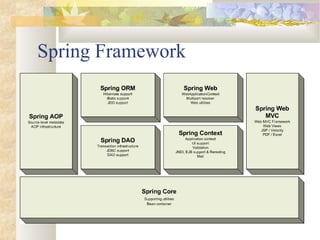
Spring Framework
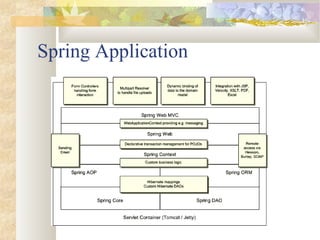
Spring Application
Spring Dependency Injection
 Inversion of Control (IoC)
 “Hollywood Principle”
 Don't call me, I'll call you
 “Container” resolves (injects) dependencies of
components by setting implementation object (push)
 As opposed to component instantiating or Service
Locator pattern where component locates
implementation (pull)
 Martin Fowler calls Dependency Injection
Dependency Injection Variants
 Variations on dependency injection
 Interface based (Avalon)
 Constructor-based (PicoContainer, Spring)
 Setter-based (Spring)
 BeanFactory provides configuration framework to
initialize and “wire” JavaBeans
 org.springframework.beans and
org.springframework.context
 Typically use the XmlBeanFactory, employing XML
configuration files
Dependency Injection (cont'd)
 BeanFactory configured components need have
no Spring dependencies
 Simple JavaBeans
 Beans are singletons by default
 Properties may be simple values or references to
other beans
 Built-in support for defining Lists, Maps, Sets,
and Properties collection types.
 Custom PropertyEditors may be defined to
convert string values to other, arbitrary types.
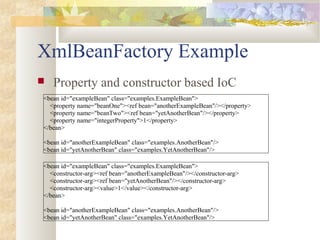
XmlBeanFactory Example
 Property and constructor based IoC
<bean id="exampleBean" class="examples.ExampleBean">
<property name="beanOne"><ref bean="anotherExampleBean"/></property>
<property name="beanTwo"><ref bean="yetAnotherBean"/></property>
<property name="integerProperty">1</property>
</bean>
<bean id="anotherExampleBean" class="examples.AnotherBean"/>
<bean id="yetAnotherBean" class="examples.YetAnotherBean"/>
<bean id="exampleBean" class="examples.ExampleBean">
<constructor-arg><ref bean="anotherExampleBean"/></constructor-arg>
<constructor-arg><ref bean="yetAnotherBean"/></constructor-arg>
<constructor-arg><value>1</value></constructor-arg>
</bean>
<bean id="anotherExampleBean" class="examples.AnotherBean"/>
<bean id="yetAnotherBean" class="examples.YetAnotherBean"/>
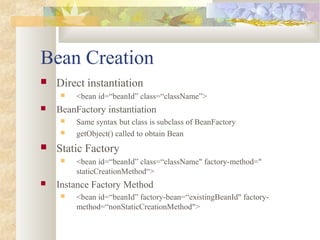
Bean Creation
 Direct instantiation
 <bean id=“beanId” class=“className”>
 BeanFactory instantiation
 Same syntax but class is subclass of BeanFactory
 getObject() called to obtain Bean
 Static Factory
 <bean id=“beanId” class=“className" factory-method="
staticCreationMethod“>
 Instance Factory Method
 <bean id=“beanId” factory-bean=“existingBeanId" factory-
method=“nonStaticCreationMethod">
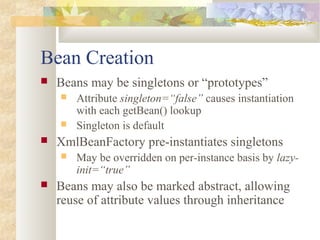
Bean Creation
 Beans may be singletons or “prototypes”
 Attribute singleton=“false” causes instantiation
with each getBean() lookup
 Singleton is default
 XmlBeanFactory pre-instantiates singletons
 May be overridden on per-instance basis by lazy-
init=“true”
 Beans may also be marked abstract, allowing
reuse of attribute values through inheritance
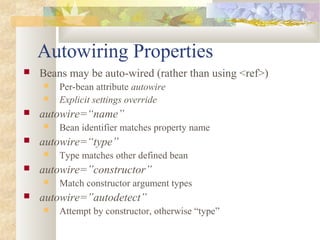
Autowiring Properties
 Beans may be auto-wired (rather than using <ref>)
 Per-bean attribute autowire
 Explicit settings override
 autowire=“name”
 Bean identifier matches property name
 autowire=“type”
 Type matches other defined bean
 autowire=”constructor”
 Match constructor argument types
 autowire=”autodetect”
 Attempt by constructor, otherwise “type”
Dependency Checking
 Ensures properties are defined
 Per-bean attribute dependency-check
 None required by default
 Verifies autowiring succeeded
 “simple”
 all but collaborators
 “object”
 collaborators only
 “all”
 Collaborators, primitive types, and collections
Lifecycle Customization
 Can define init method called after properties set
 init-method=”<method-name>”
 Can define destroy method as shutdown hook
 destroy-method=”<method-name>”
 May alternatively implement InitializingBean
and/or DisposableBean
 At cost of Spring dependency
BeanFactory Miscellany
 BeanFactoryAware interface provides BeanFactory for
bean
 setBeanFactory(BeanFactory)
 BeanNameAware interface provides bean name
 setBeanName(String)
 FactoryBean for beans which are themselves factories
 Object getObject()
 Boolean isSingleton()
 Class getObjectType()
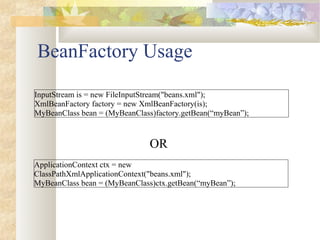
BeanFactory Usage
InputStream is = new FileInputStream("beans.xml");
XmlBeanFactory factory = new XmlBeanFactory(is);
MyBeanClass bean = (MyBeanClass)factory.getBean(“myBean”);
ApplicationContext ctx = new
ClassPathXmlApplicationContext("beans.xml");
MyBeanClass bean = (MyBeanClass)ctx.getBean(“myBean”);
OR
ApplicationContext
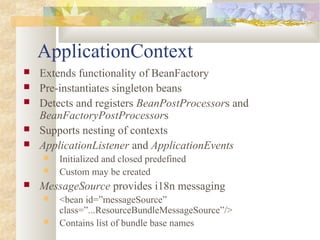
 Extends functionality of BeanFactory
 Pre-instantiates singleton beans
 Detects and registers BeanPostProcessors and
BeanFactoryPostProcessors
 Supports nesting of contexts
 ApplicationListener and ApplicationEvents
 Initialized and closed predefined
 Custom may be created
 MessageSource provides i18n messaging
 <bean id=”messageSource”
class=”...ResourceBundleMessageSource”/>
 Contains list of bundle base names
Web Initialization
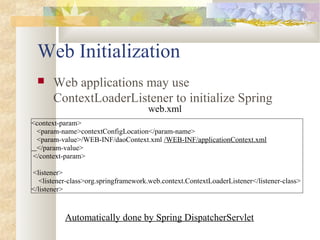
 Web applications may use
ContextLoaderListener to initialize Spring
<context-param>
<param-name>contextConfigLocation</param-name>
<param-value>/WEB-INF/daoContext.xml /WEB-INF/applicationContext.xml
</param-value>
</context-param>
<listener>
<listener-class>org.springframework.web.context.ContextLoaderListener</listener-class>
</listener>
web.xml
Automatically done by Spring DispatcherServlet
Specialized Beans
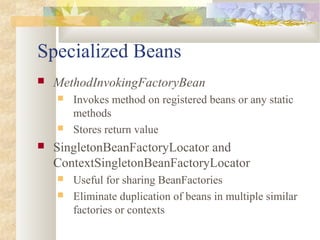
 MethodInvokingFactoryBean
 Invokes method on registered beans or any static
methods
 Stores return value
 SingletonBeanFactoryLocator and
ContextSingletonBeanFactoryLocator
 Useful for sharing BeanFactories
 Eliminate duplication of beans in multiple similar
factories or contexts
ApplicationContext customization
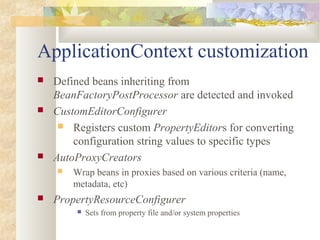
 Defined beans inheriting from
BeanFactoryPostProcessor are detected and invoked
 CustomEditorConfigurer
 Registers custom PropertyEditors for converting
configuration string values to specific types
 AutoProxyCreators
 Wrap beans in proxies based on various criteria (name,
metadata, etc)
 PropertyResourceConfigurer
 Sets from property file and/or system properties
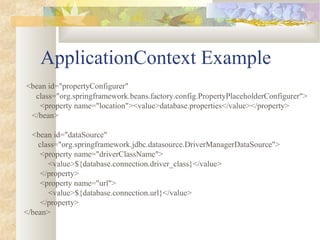
ApplicationContext Example
<bean id="propertyConfigurer"
class="org.springframework.beans.factory.config.PropertyPlaceholderConfigurer">
<property name="location"><value>database.properties</value></property>
</bean>
<bean id="dataSource"
class="org.springframework.jdbc.datasource.DriverManagerDataSource">
<property name="driverClassName">
<value>${database.connection.driver_class}</value>
</property>
<property name="url">
<value>${database.connection.url}</value>
</property>
</bean>
Spring AOP
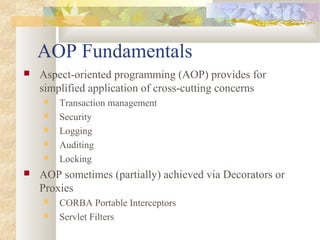
AOP Fundamentals
 Aspect-oriented programming (AOP) provides for
simplified application of cross-cutting concerns
 Transaction management
 Security
 Logging
 Auditing
 Locking
 AOP sometimes (partially) achieved via Decorators or
Proxies
 CORBA Portable Interceptors
 Servlet Filters
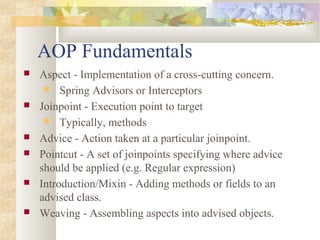
AOP Fundamentals
 Aspect - Implementation of a cross-cutting concern.
 Spring Advisors or Interceptors
 Joinpoint - Execution point to target
 Typically, methods
 Advice - Action taken at a particular joinpoint.
 Pointcut - A set of joinpoints specifying where advice
should be applied (e.g. Regular expression)
 Introduction/Mixin - Adding methods or fields to an
advised class.
 Weaving - Assembling aspects into advised objects.
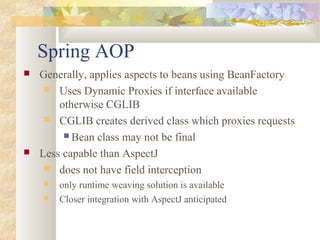
Spring AOP
 Generally, applies aspects to beans using BeanFactory
 Uses Dynamic Proxies if interface available
otherwise CGLIB
 CGLIB creates derived class which proxies requests
 Bean class may not be final
 Less capable than AspectJ
 does not have field interception
 only runtime weaving solution is available
 Closer integration with AspectJ anticipated
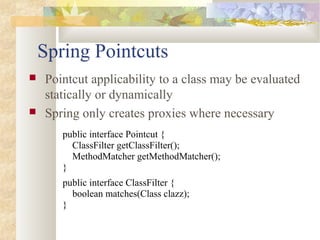
Spring Pointcuts
 Pointcut applicability to a class may be evaluated
statically or dynamically
 Spring only creates proxies where necessary
public interface Pointcut {
ClassFilter getClassFilter();
MethodMatcher getMethodMatcher();
}
public interface ClassFilter {
boolean matches(Class clazz);
}
Pointcuts (cont'd)
public interface MethodMatcher {
boolean matches(Method m, Class targetClass);
boolean isRuntime();
boolean matches(Method m, Class targetClass, Object[] args);
}
 Pointcut may be statically or dynamically
evaluated based on isRuntime()
 Abstract class StaticMethodMatcherPointcut
requires override of 1st
method only
Only called if isRuntime() == true
Pointcuts (cont'd)
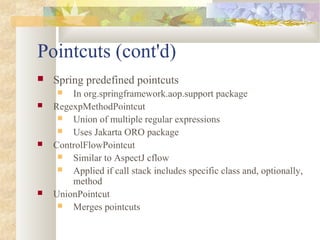
 Spring predefined pointcuts
 In org.springframework.aop.support package
 RegexpMethodPointcut
 Union of multiple regular expressions
 Uses Jakarta ORO package
 ControlFlowPointcut
 Similar to AspectJ cflow
 Applied if call stack includes specific class and, optionally,
method
 UnionPointcut
 Merges pointcuts
Spring Advice
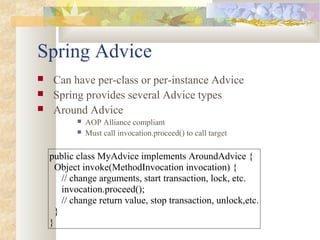
 Can have per-class or per-instance Advice
 Spring provides several Advice types
 Around Advice
 AOP Alliance compliant
 Must call invocation.proceed() to call target
public class MyAdvice implements AroundAdvice {
Object invoke(MethodInvocation invocation) {
// change arguments, start transaction, lock, etc.
invocation.proceed();
// change return value, stop transaction, unlock,etc.
}
}
Spring Advice
 MethodBeforeAdvice
 void before(Method m, Object[] args, Object target)
 Cannot alter return type
 ThrowsAdvice
 Marker interface
 Implementors define methods of form:
 afterThrowing([Method], [args], [target], subclassOfThrowable)
 AfterReturningAdvice
 void afterReturning(Object returnValue, Method, m,
Object[] args, Object target)
 Cannot modify return value
Spring Advice
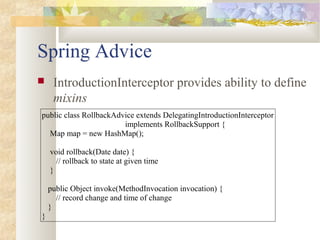
 IntroductionInterceptor provides ability to define
mixins
public class RollbackAdvice extends DelegatingIntroductionInterceptor
implements RollbackSupport {
Map map = new HashMap();
void rollback(Date date) {
// rollback to state at given time
}
public Object invoke(MethodInvocation invocation) {
// record change and time of change
}
}
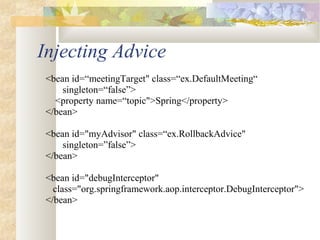
Injecting Advice
<bean id=“meetingTarget" class=“ex.DefaultMeeting“
singleton=“false”>
<property name=“topic">Spring</property>
</bean>
<bean id="myAdvisor" class=“ex.RollbackAdvice"
singleton=”false”>
</bean>
<bean id="debugInterceptor"
class="org.springframework.aop.interceptor.DebugInterceptor">
</bean>
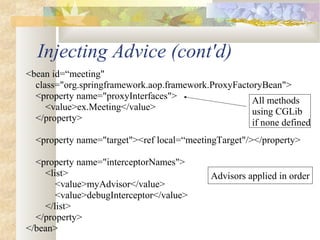
Injecting Advice (cont'd)
<bean id=“meeting"
class="org.springframework.aop.framework.ProxyFactoryBean">
<property name="proxyInterfaces">
<value>ex.Meeting</value>
</property>
<property name="target"><ref local=“meetingTarget"/></property>
<property name="interceptorNames">
<list>
<value>myAdvisor</value>
<value>debugInterceptor</value>
</list>
</property>
</bean>
Advisors applied in order
All methods
using CGLib
if none defined
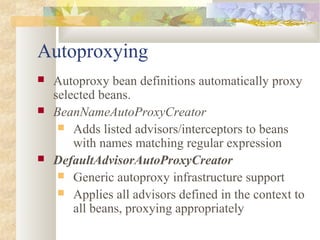
Autoproxying
 Autoproxy bean definitions automatically proxy
selected beans.
 BeanNameAutoProxyCreator
 Adds listed advisors/interceptors to beans
with names matching regular expression
 DefaultAdvisorAutoProxyCreator
 Generic autoproxy infrastructure support
 Applies all advisors defined in the context to
all beans, proxying appropriately
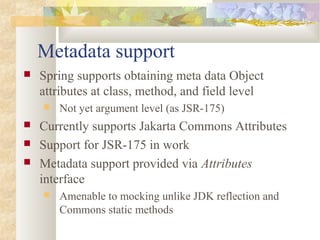
Metadata support
 Spring supports obtaining meta data Object
attributes at class, method, and field level
 Not yet argument level (as JSR-175)
 Currently supports Jakarta Commons Attributes
 Support for JSR-175 in work
 Metadata support provided via Attributes
interface
 Amenable to mocking unlike JDK reflection and
Commons static methods
Metadata autoproxying
 Configuration of autoproxying based on metadata
attributes simplifies configuration
 Define custom attribute class
 Define Advisor with pointcut based on custom attribute
 Add Advisor in ApplicationContext with autoproxy
 Examples
 Transaction Attributes
 Security Attributes
 Pooling
 Mapping of controllers to URLs
Transactions
AOP Transactions
 Spring provides AOP support for declarative
transactions
 Delegates to a PlatformTransactionManager
instance
 DataSourceTransactionManager
 HibernateTransactionManager
 JdoTransactionManager
 JtaTransactionManager
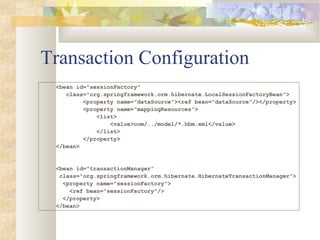
Transaction Configuration
<bean id="sessionFactory"
class="org.springframework.orm.hibernate.LocalSessionFactoryBean">
<property name="dataSource"><ref bean="dataSource"/></property>
<property name="mappingResources">
<list>
<value>com/../model/*.hbm.xml</value>
</list>
</property>
</bean>
<bean id="transactionManager”
class="org.springframework.orm.hibernate.HibernateTransactionManager">
<property name="sessionFactory">
<ref bean="sessionFactory"/>
</property>
</bean>
Declarative Transactions
 Declarative transactional support can be added to
any bean by using TransactionProxyFactoryBean
 Similar to EJB, transaction attributes may be
defined on a per-method basis
 Also allows definition of pre- and post-
interceptors (e.g. for security)
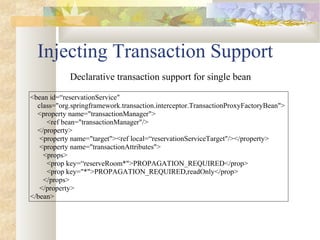
Injecting Transaction Support
<bean id=“reservationService"
class="org.springframework.transaction.interceptor.TransactionProxyFactoryBean">
<property name="transactionManager">
<ref bean="transactionManager"/>
</property>
<property name="target"><ref local=“reservationServiceTarget"/></property>
<property name="transactionAttributes">
<props>
<prop key=“reserveRoom*">PROPAGATION_REQUIRED</prop>
<prop key="*">PROPAGATION_REQUIRED,readOnly</prop>
</props>
</property>
</bean>
Declarative transaction support for single bean
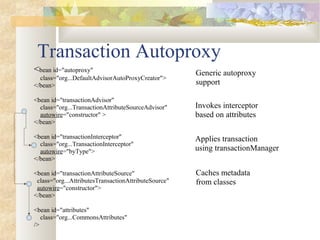
Transaction Autoproxy
<bean id="autoproxy"
class="org...DefaultAdvisorAutoProxyCreator">
</bean>
<bean id="transactionAdvisor"
class="org...TransactionAttributeSourceAdvisor"
autowire="constructor" >
</bean>
<bean id="transactionInterceptor"
class="org...TransactionInterceptor"
autowire="byType">
</bean>
<bean id="transactionAttributeSource"
class="org...AttributesTransactionAttributeSource"
autowire="constructor">
</bean>
<bean id="attributes"
class="org...CommonsAttributes"
/>
Caches metadata
from classes
Generic autoproxy
support
Applies transaction
using transactionManager
Invokes interceptor
based on attributes
Data Access
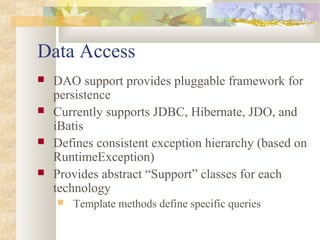
Data Access
 DAO support provides pluggable framework for
persistence
 Currently supports JDBC, Hibernate, JDO, and
iBatis
 Defines consistent exception hierarchy (based on
RuntimeException)
 Provides abstract “Support” classes for each
technology
 Template methods define specific queries
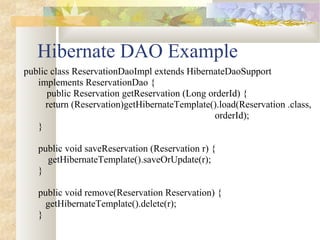
Hibernate DAO Example
public class ReservationDaoImpl extends HibernateDaoSupport
implements ReservationDao {
public Reservation getReservation (Long orderId) {
return (Reservation)getHibernateTemplate().load(Reservation .class,
orderId);
}
public void saveReservation (Reservation r) {
getHibernateTemplate().saveOrUpdate(r);
}
public void remove(Reservation Reservation) {
getHibernateTemplate().delete(r);
}
Hibernate DAO (cont’d)
public Reservation[] findReservations(Room room) {
List list = getHibernateTemplate().find(
"from Reservation reservation “ +
“ where reservation.resource =? “ +
“ order by reservation.start",
instrument);
return (Reservation[]) list.toArray(new Reservation[list.size()]);
Hibernate DAO (cont’d)
public Reservation[] findReservations(final DateRange range) {
final HibernateTemplate template = getHibernateTemplate();
List list = (List) template.execute(new HibernateCallback() {
public Object doInHibernate(Session session) {
Query query = session.createQuery(
"from Reservation r “ +
“ where r.start > :rangeStart and r.start < :rangeEnd “);
query.setDate("rangeStart", range.getStartDate()
query.setDate("rangeEnd", range.getEndDate())
return query.list();
}
});
return (Reservation[]) list.toArray(new Reservation[list.size()]);
}
}
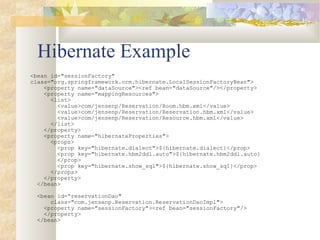
Hibernate Example
<bean id="sessionFactory"
class="org.springframework.orm.hibernate.LocalSessionFactoryBean">
<property name="dataSource"><ref bean="dataSource"/></property>
<property name="mappingResources">
<list>
<value>com/jensenp/Reservation/Room.hbm.xml</value>
<value>com/jensenp/Reservation/Reservation.hbm.xml</value>
<value>com/jensenp/Reservation/Resource.hbm.xml</value>
</list>
</property>
<property name="hibernateProperties">
<props>
<prop key="hibernate.dialect">${hibernate.dialect}</prop>
<prop key="hibernate.hbm2ddl.auto">${hibernate.hbm2ddl.auto}
</prop>
<prop key="hibernate.show_sql">${hibernate.show_sql}</prop>
</props>
</property>
</bean>
<bean id=“reservationDao"
class="com.jensenp.Reservation.ReservationDaoImpl">
<property name="sessionFactory"><ref bean="sessionFactory"/>
</property>
</bean>
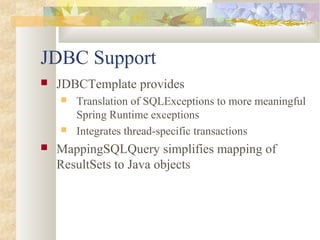
JDBC Support
 JDBCTemplate provides
 Translation of SQLExceptions to more meaningful
Spring Runtime exceptions
 Integrates thread-specific transactions
 MappingSQLQuery simplifies mapping of
ResultSets to Java objects
Web Framework
DispatcherServlet
 The DispatcherServlet is the Spring Front
Controller
 Initializes WebApplicationContext
 Uses /WEB-INF/[servlet-name]-servlet.xml by
default
 WebApplicationContext is bound into
ServletContext
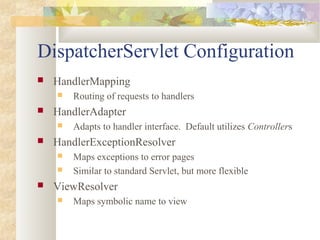
DispatcherServlet Configuration
 HandlerMapping
 Routing of requests to handlers
 HandlerAdapter
 Adapts to handler interface. Default utilizes Controllers
 HandlerExceptionResolver
 Maps exceptions to error pages
 Similar to standard Servlet, but more flexible
 ViewResolver
 Maps symbolic name to view
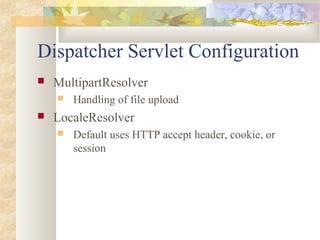
Dispatcher Servlet Configuration
 MultipartResolver
 Handling of file upload
 LocaleResolver
 Default uses HTTP accept header, cookie, or
session
Controllers
 Controller interface defines one method
 ModelAndView handleRequest(HttpServletRequest
req, HttpServletResponse resp) throws Exception
 ModelAndView consists of a view identifier and
a Map of model data
Controller Implementations
 CommandControllers bind parameters to data
objects
 AbstractCommandController
 AbstractFormController
 SimpleFormController
 WizardFormController
Spring talk111204
Spring talk111204
Spring talk111204
Spring talk111204
Spring talk111204
Spring talk111204
Spring talk111204
Spring talk111204
Spring talk111204
Spring talk111204

Spring talk111204

  • 1.
  • 2.
    Spring Overview  “LightweightContainer”  Very loosely coupled  Components widely reusable and separately packaged  Created by Rod Johnson  Based on “Expert one-on-one J2EE Design and Development”  Currently on version 1.1.1
  • 3.
    Why Use Spring? Wiring of components (Dependency Injection)  Promotes/simplifies decoupling, design to interfaces, TDD  Declarative programming without J2EE  Easily configured aspects, esp. transaction support  Simplify use of popular technologies  Abstractions insulate application from specifics, eliminate redundant code, and handle common error conditions  Underlying technology specifics still accessible (closures)
  • 4.
    Why Use Spring? Conversion of checked exceptions to unchecked  (Or is this a reason not to use it?)  Not an all-or-nothing solution  Extremely modular and flexible  Well designed  Easy to extend  Many reusable classes
  • 5.
  • 6.
  • 7.
    Spring Dependency Injection Inversion of Control (IoC)  “Hollywood Principle”  Don't call me, I'll call you  “Container” resolves (injects) dependencies of components by setting implementation object (push)  As opposed to component instantiating or Service Locator pattern where component locates implementation (pull)  Martin Fowler calls Dependency Injection
  • 8.
    Dependency Injection Variants Variations on dependency injection  Interface based (Avalon)  Constructor-based (PicoContainer, Spring)  Setter-based (Spring)  BeanFactory provides configuration framework to initialize and “wire” JavaBeans  org.springframework.beans and org.springframework.context  Typically use the XmlBeanFactory, employing XML configuration files
  • 9.
    Dependency Injection (cont'd) BeanFactory configured components need have no Spring dependencies  Simple JavaBeans  Beans are singletons by default  Properties may be simple values or references to other beans  Built-in support for defining Lists, Maps, Sets, and Properties collection types.  Custom PropertyEditors may be defined to convert string values to other, arbitrary types.
  • 10.
    XmlBeanFactory Example  Propertyand constructor based IoC <bean id="exampleBean" class="examples.ExampleBean"> <property name="beanOne"><ref bean="anotherExampleBean"/></property> <property name="beanTwo"><ref bean="yetAnotherBean"/></property> <property name="integerProperty">1</property> </bean> <bean id="anotherExampleBean" class="examples.AnotherBean"/> <bean id="yetAnotherBean" class="examples.YetAnotherBean"/> <bean id="exampleBean" class="examples.ExampleBean"> <constructor-arg><ref bean="anotherExampleBean"/></constructor-arg> <constructor-arg><ref bean="yetAnotherBean"/></constructor-arg> <constructor-arg><value>1</value></constructor-arg> </bean> <bean id="anotherExampleBean" class="examples.AnotherBean"/> <bean id="yetAnotherBean" class="examples.YetAnotherBean"/>
  • 11.
    Bean Creation  Directinstantiation  <bean id=“beanId” class=“className”>  BeanFactory instantiation  Same syntax but class is subclass of BeanFactory  getObject() called to obtain Bean  Static Factory  <bean id=“beanId” class=“className" factory-method=" staticCreationMethod“>  Instance Factory Method  <bean id=“beanId” factory-bean=“existingBeanId" factory- method=“nonStaticCreationMethod">
  • 12.
    Bean Creation  Beansmay be singletons or “prototypes”  Attribute singleton=“false” causes instantiation with each getBean() lookup  Singleton is default  XmlBeanFactory pre-instantiates singletons  May be overridden on per-instance basis by lazy- init=“true”  Beans may also be marked abstract, allowing reuse of attribute values through inheritance
  • 13.
    Autowiring Properties  Beansmay be auto-wired (rather than using <ref>)  Per-bean attribute autowire  Explicit settings override  autowire=“name”  Bean identifier matches property name  autowire=“type”  Type matches other defined bean  autowire=”constructor”  Match constructor argument types  autowire=”autodetect”  Attempt by constructor, otherwise “type”
  • 14.
    Dependency Checking  Ensuresproperties are defined  Per-bean attribute dependency-check  None required by default  Verifies autowiring succeeded  “simple”  all but collaborators  “object”  collaborators only  “all”  Collaborators, primitive types, and collections
  • 15.
    Lifecycle Customization  Candefine init method called after properties set  init-method=”<method-name>”  Can define destroy method as shutdown hook  destroy-method=”<method-name>”  May alternatively implement InitializingBean and/or DisposableBean  At cost of Spring dependency
  • 16.
    BeanFactory Miscellany  BeanFactoryAwareinterface provides BeanFactory for bean  setBeanFactory(BeanFactory)  BeanNameAware interface provides bean name  setBeanName(String)  FactoryBean for beans which are themselves factories  Object getObject()  Boolean isSingleton()  Class getObjectType()
  • 17.
    BeanFactory Usage InputStream is= new FileInputStream("beans.xml"); XmlBeanFactory factory = new XmlBeanFactory(is); MyBeanClass bean = (MyBeanClass)factory.getBean(“myBean”); ApplicationContext ctx = new ClassPathXmlApplicationContext("beans.xml"); MyBeanClass bean = (MyBeanClass)ctx.getBean(“myBean”); OR
  • 18.
    ApplicationContext  Extends functionalityof BeanFactory  Pre-instantiates singleton beans  Detects and registers BeanPostProcessors and BeanFactoryPostProcessors  Supports nesting of contexts  ApplicationListener and ApplicationEvents  Initialized and closed predefined  Custom may be created  MessageSource provides i18n messaging  <bean id=”messageSource” class=”...ResourceBundleMessageSource”/>  Contains list of bundle base names
  • 19.
    Web Initialization  Webapplications may use ContextLoaderListener to initialize Spring <context-param> <param-name>contextConfigLocation</param-name> <param-value>/WEB-INF/daoContext.xml /WEB-INF/applicationContext.xml </param-value> </context-param> <listener> <listener-class>org.springframework.web.context.ContextLoaderListener</listener-class> </listener> web.xml Automatically done by Spring DispatcherServlet
  • 20.
    Specialized Beans  MethodInvokingFactoryBean Invokes method on registered beans or any static methods  Stores return value  SingletonBeanFactoryLocator and ContextSingletonBeanFactoryLocator  Useful for sharing BeanFactories  Eliminate duplication of beans in multiple similar factories or contexts
  • 21.
    ApplicationContext customization  Definedbeans inheriting from BeanFactoryPostProcessor are detected and invoked  CustomEditorConfigurer  Registers custom PropertyEditors for converting configuration string values to specific types  AutoProxyCreators  Wrap beans in proxies based on various criteria (name, metadata, etc)  PropertyResourceConfigurer  Sets from property file and/or system properties
  • 22.
    ApplicationContext Example <bean id="propertyConfigurer" class="org.springframework.beans.factory.config.PropertyPlaceholderConfigurer"> <propertyname="location"><value>database.properties</value></property> </bean> <bean id="dataSource" class="org.springframework.jdbc.datasource.DriverManagerDataSource"> <property name="driverClassName"> <value>${database.connection.driver_class}</value> </property> <property name="url"> <value>${database.connection.url}</value> </property> </bean>
  • 23.
  • 24.
    AOP Fundamentals  Aspect-orientedprogramming (AOP) provides for simplified application of cross-cutting concerns  Transaction management  Security  Logging  Auditing  Locking  AOP sometimes (partially) achieved via Decorators or Proxies  CORBA Portable Interceptors  Servlet Filters
  • 25.
    AOP Fundamentals  Aspect- Implementation of a cross-cutting concern.  Spring Advisors or Interceptors  Joinpoint - Execution point to target  Typically, methods  Advice - Action taken at a particular joinpoint.  Pointcut - A set of joinpoints specifying where advice should be applied (e.g. Regular expression)  Introduction/Mixin - Adding methods or fields to an advised class.  Weaving - Assembling aspects into advised objects.
  • 26.
    Spring AOP  Generally,applies aspects to beans using BeanFactory  Uses Dynamic Proxies if interface available otherwise CGLIB  CGLIB creates derived class which proxies requests  Bean class may not be final  Less capable than AspectJ  does not have field interception  only runtime weaving solution is available  Closer integration with AspectJ anticipated
  • 27.
    Spring Pointcuts  Pointcutapplicability to a class may be evaluated statically or dynamically  Spring only creates proxies where necessary public interface Pointcut { ClassFilter getClassFilter(); MethodMatcher getMethodMatcher(); } public interface ClassFilter { boolean matches(Class clazz); }
  • 28.
    Pointcuts (cont'd) public interfaceMethodMatcher { boolean matches(Method m, Class targetClass); boolean isRuntime(); boolean matches(Method m, Class targetClass, Object[] args); }  Pointcut may be statically or dynamically evaluated based on isRuntime()  Abstract class StaticMethodMatcherPointcut requires override of 1st method only Only called if isRuntime() == true
  • 29.
    Pointcuts (cont'd)  Springpredefined pointcuts  In org.springframework.aop.support package  RegexpMethodPointcut  Union of multiple regular expressions  Uses Jakarta ORO package  ControlFlowPointcut  Similar to AspectJ cflow  Applied if call stack includes specific class and, optionally, method  UnionPointcut  Merges pointcuts
  • 30.
    Spring Advice  Canhave per-class or per-instance Advice  Spring provides several Advice types  Around Advice  AOP Alliance compliant  Must call invocation.proceed() to call target public class MyAdvice implements AroundAdvice { Object invoke(MethodInvocation invocation) { // change arguments, start transaction, lock, etc. invocation.proceed(); // change return value, stop transaction, unlock,etc. } }
  • 31.
    Spring Advice  MethodBeforeAdvice void before(Method m, Object[] args, Object target)  Cannot alter return type  ThrowsAdvice  Marker interface  Implementors define methods of form:  afterThrowing([Method], [args], [target], subclassOfThrowable)  AfterReturningAdvice  void afterReturning(Object returnValue, Method, m, Object[] args, Object target)  Cannot modify return value
  • 32.
    Spring Advice  IntroductionInterceptorprovides ability to define mixins public class RollbackAdvice extends DelegatingIntroductionInterceptor implements RollbackSupport { Map map = new HashMap(); void rollback(Date date) { // rollback to state at given time } public Object invoke(MethodInvocation invocation) { // record change and time of change } }
  • 33.
    Injecting Advice <bean id=“meetingTarget"class=“ex.DefaultMeeting“ singleton=“false”> <property name=“topic">Spring</property> </bean> <bean id="myAdvisor" class=“ex.RollbackAdvice" singleton=”false”> </bean> <bean id="debugInterceptor" class="org.springframework.aop.interceptor.DebugInterceptor"> </bean>
  • 34.
    Injecting Advice (cont'd) <beanid=“meeting" class="org.springframework.aop.framework.ProxyFactoryBean"> <property name="proxyInterfaces"> <value>ex.Meeting</value> </property> <property name="target"><ref local=“meetingTarget"/></property> <property name="interceptorNames"> <list> <value>myAdvisor</value> <value>debugInterceptor</value> </list> </property> </bean> Advisors applied in order All methods using CGLib if none defined
  • 35.
    Autoproxying  Autoproxy beandefinitions automatically proxy selected beans.  BeanNameAutoProxyCreator  Adds listed advisors/interceptors to beans with names matching regular expression  DefaultAdvisorAutoProxyCreator  Generic autoproxy infrastructure support  Applies all advisors defined in the context to all beans, proxying appropriately
  • 36.
    Metadata support  Springsupports obtaining meta data Object attributes at class, method, and field level  Not yet argument level (as JSR-175)  Currently supports Jakarta Commons Attributes  Support for JSR-175 in work  Metadata support provided via Attributes interface  Amenable to mocking unlike JDK reflection and Commons static methods
  • 37.
    Metadata autoproxying  Configurationof autoproxying based on metadata attributes simplifies configuration  Define custom attribute class  Define Advisor with pointcut based on custom attribute  Add Advisor in ApplicationContext with autoproxy  Examples  Transaction Attributes  Security Attributes  Pooling  Mapping of controllers to URLs
  • 38.
  • 39.
    AOP Transactions  Springprovides AOP support for declarative transactions  Delegates to a PlatformTransactionManager instance  DataSourceTransactionManager  HibernateTransactionManager  JdoTransactionManager  JtaTransactionManager
  • 40.
    Transaction Configuration <bean id="sessionFactory" class="org.springframework.orm.hibernate.LocalSessionFactoryBean"> <propertyname="dataSource"><ref bean="dataSource"/></property> <property name="mappingResources"> <list> <value>com/../model/*.hbm.xml</value> </list> </property> </bean> <bean id="transactionManager” class="org.springframework.orm.hibernate.HibernateTransactionManager"> <property name="sessionFactory"> <ref bean="sessionFactory"/> </property> </bean>
  • 41.
    Declarative Transactions  Declarativetransactional support can be added to any bean by using TransactionProxyFactoryBean  Similar to EJB, transaction attributes may be defined on a per-method basis  Also allows definition of pre- and post- interceptors (e.g. for security)
  • 42.
    Injecting Transaction Support <beanid=“reservationService" class="org.springframework.transaction.interceptor.TransactionProxyFactoryBean"> <property name="transactionManager"> <ref bean="transactionManager"/> </property> <property name="target"><ref local=“reservationServiceTarget"/></property> <property name="transactionAttributes"> <props> <prop key=“reserveRoom*">PROPAGATION_REQUIRED</prop> <prop key="*">PROPAGATION_REQUIRED,readOnly</prop> </props> </property> </bean> Declarative transaction support for single bean
  • 43.
    Transaction Autoproxy <bean id="autoproxy" class="org...DefaultAdvisorAutoProxyCreator"> </bean> <beanid="transactionAdvisor" class="org...TransactionAttributeSourceAdvisor" autowire="constructor" > </bean> <bean id="transactionInterceptor" class="org...TransactionInterceptor" autowire="byType"> </bean> <bean id="transactionAttributeSource" class="org...AttributesTransactionAttributeSource" autowire="constructor"> </bean> <bean id="attributes" class="org...CommonsAttributes" /> Caches metadata from classes Generic autoproxy support Applies transaction using transactionManager Invokes interceptor based on attributes
  • 44.
  • 45.
    Data Access  DAOsupport provides pluggable framework for persistence  Currently supports JDBC, Hibernate, JDO, and iBatis  Defines consistent exception hierarchy (based on RuntimeException)  Provides abstract “Support” classes for each technology  Template methods define specific queries
  • 46.
    Hibernate DAO Example publicclass ReservationDaoImpl extends HibernateDaoSupport implements ReservationDao { public Reservation getReservation (Long orderId) { return (Reservation)getHibernateTemplate().load(Reservation .class, orderId); } public void saveReservation (Reservation r) { getHibernateTemplate().saveOrUpdate(r); } public void remove(Reservation Reservation) { getHibernateTemplate().delete(r); }
  • 47.
    Hibernate DAO (cont’d) publicReservation[] findReservations(Room room) { List list = getHibernateTemplate().find( "from Reservation reservation “ + “ where reservation.resource =? “ + “ order by reservation.start", instrument); return (Reservation[]) list.toArray(new Reservation[list.size()]);
  • 48.
    Hibernate DAO (cont’d) publicReservation[] findReservations(final DateRange range) { final HibernateTemplate template = getHibernateTemplate(); List list = (List) template.execute(new HibernateCallback() { public Object doInHibernate(Session session) { Query query = session.createQuery( "from Reservation r “ + “ where r.start > :rangeStart and r.start < :rangeEnd “); query.setDate("rangeStart", range.getStartDate() query.setDate("rangeEnd", range.getEndDate()) return query.list(); } }); return (Reservation[]) list.toArray(new Reservation[list.size()]); } }
  • 49.
    Hibernate Example <bean id="sessionFactory" class="org.springframework.orm.hibernate.LocalSessionFactoryBean"> <propertyname="dataSource"><ref bean="dataSource"/></property> <property name="mappingResources"> <list> <value>com/jensenp/Reservation/Room.hbm.xml</value> <value>com/jensenp/Reservation/Reservation.hbm.xml</value> <value>com/jensenp/Reservation/Resource.hbm.xml</value> </list> </property> <property name="hibernateProperties"> <props> <prop key="hibernate.dialect">${hibernate.dialect}</prop> <prop key="hibernate.hbm2ddl.auto">${hibernate.hbm2ddl.auto} </prop> <prop key="hibernate.show_sql">${hibernate.show_sql}</prop> </props> </property> </bean> <bean id=“reservationDao" class="com.jensenp.Reservation.ReservationDaoImpl"> <property name="sessionFactory"><ref bean="sessionFactory"/> </property> </bean>
  • 50.
    JDBC Support  JDBCTemplateprovides  Translation of SQLExceptions to more meaningful Spring Runtime exceptions  Integrates thread-specific transactions  MappingSQLQuery simplifies mapping of ResultSets to Java objects
  • 51.
  • 52.
    DispatcherServlet  The DispatcherServletis the Spring Front Controller  Initializes WebApplicationContext  Uses /WEB-INF/[servlet-name]-servlet.xml by default  WebApplicationContext is bound into ServletContext
  • 53.
    DispatcherServlet Configuration  HandlerMapping Routing of requests to handlers  HandlerAdapter  Adapts to handler interface. Default utilizes Controllers  HandlerExceptionResolver  Maps exceptions to error pages  Similar to standard Servlet, but more flexible  ViewResolver  Maps symbolic name to view
  • 54.
    Dispatcher Servlet Configuration MultipartResolver  Handling of file upload  LocaleResolver  Default uses HTTP accept header, cookie, or session
  • 55.
    Controllers  Controller interfacedefines one method  ModelAndView handleRequest(HttpServletRequest req, HttpServletResponse resp) throws Exception  ModelAndView consists of a view identifier and a Map of model data
  • 56.
    Controller Implementations  CommandControllersbind parameters to data objects  AbstractCommandController  AbstractFormController  SimpleFormController  WizardFormController

Editor's Notes

  • #47 Template closures JDBC support also provided