Spring RabbitMQ
Martin Toshev
Who am I
Software consultant (CoffeeCupConsulting)
BG JUG board member (http://jug.bg)
OpenJDK and Oracle RDBMS enthusiast
Twitter: @martin_fmi
2
3
Work in progress …
4
Agenda
• Messaging Basics
• RabbitMQ Overview
• Spring RabbitMQ
5
Messaging
• Messaging provides a mechanism for loosely-coupled
integration of systems
• The central unit of processing in a message is a message
which typically contains a body and a header
6
Use cases
• Log aggregation between systems
• Event propagation between systems
• Offloading long-running tasks to worker nodes
• many others …
7
Messaging protocols
• Messaging solutions implement different protocols for
transferring of messages such as AMQP, XMPP, MQTT,
STOMP and others
• The variety of protocols imply vendor lock-in
8
Messaging protocols comparison
AMQP MQTT XMPP STOMP
goal replacement of proprietary
protocols
messaging for resource-
constrained devices
instant messaging,
adopted for wider use
Message-oriented
middleware
format binary binary XML-based text-based
API divided into classes
(> 40 methods in RabbitMQ)
simple (5 basic operations with
2-3 packet types for each)
different XML items
with multiple types
~ 10 basic
commands
reliability publisher/subscriber
acknowledgements,
transactions
acknowledgements Acknowledgments and
resumptions (XEP-198)
Subscriber
acknowledgements
and transactions
security SASL, TLS/SSL no built-in TLS/SSL,
header authentication
SASL, TLS/SSL depending on
message broker
extensibility extension points none extensible depending on
message broker
9
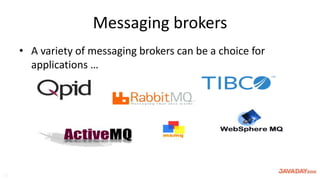
Messaging brokers
• A variety of messaging brokers can be a choice for
applications …
10
Common characteristics
• secure message transfer, authentication and
authorization of messaging endpoints
• message routing and persistence
• broker subscriptions
11
RabbitMQ
• An open source message broker written in Erlang
• Implements the AMQP Protocol (Advanced Message
Queueing Protocol)
• Has a pluggable architecture and provides extension for
other protocols such as HTTP, STOMP and MQTT
12
RabbitMQ users
• JP Morgan (financial operations)
• Nasa (nebula computing)
• Google (event processing)
• Soundcloud (dashboard updates)
• Nokia (real-time traffic maps)
13
AMQP
• AMQP is a binary protocol that aims to standardize
middleware communication
• Derives its origins from the financial industry
• Defines multiple connection channels inside a single TCP
connection
14
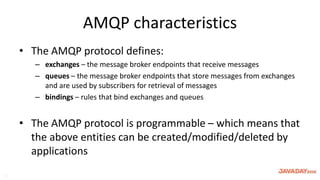
AMQP characteristics
• The AMQP protocol defines:
– exchanges – the message broker endpoints that receive messages
– queues – the message broker endpoints that store messages from exchanges
and are used by subscribers for retrieval of messages
– bindings – rules that bind exchanges and queues
• The AMQP protocol is programmable – which means that
the above entities can be created/modified/deleted by
applications
15
Message handling
• Each message can be published with a routing key
• Each binding between an exchange and a queue has a
binding key
• Routing of messages is determined based on matching
between the routing and binding keys
16
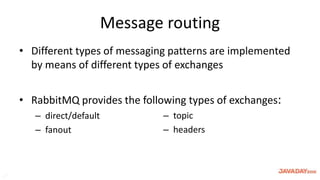
Message routing
• Different types of messaging patterns are implemented
by means of different types of exchanges
• RabbitMQ provides the following types of exchanges:
– direct/default
– fanout
– topic
– headers
17
Default exchange
Publisher
Subscriber
Subscriber
Subscriber
Publisher
chat
log
general
error
warning
exchange=“”
key=“general”
payload=“XYZ”
(AMQP
default)
(AMQP default) is a system exchange
default exchange: suitable for point-to-point
communication between endpoints
18
Direct exchange
Publisher
Subscriber
Subscriber
Subscriber
Publisher
chat
log
general
error
warning
b_general
exchange=“chat”
key=“b_general”
payload=“XYZ”
(AMQP
default)
chat is defined as a direct exchange upon creation
direct exchange: suitable for point-to-point
communication between endpoints
19
Fanout exchange
Publisher
Subscriber
Subscriber
Subscriber
Publisher
chat
log
general
error
warning
exchange=“log”
key=“”
payload=“XYZ”
(AMQP
default)
log is defined as a fanout exchange upon creation
fanout exchange: suitable for broadcast type
of communication between endpoints
20
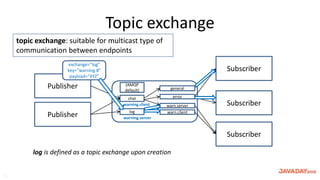
Topic exchange
Publisher
Subscriber
Subscriber
Subscriber
Publisher
chat
log
general
error
warn.server
exchange=“log”
key=“warning.#”
payload=“XYZ”
(AMQP
default)
log is defined as a topic exchange upon creation
warn.client
warning.server
warning.client
topic exchange: suitable for multicast type of
communication between endpoints
21
RabbitMQ clustering
• Default clustering mechanism provides scalability in
terms of queues rather than high availability
• Mirrored queues are an extension to the default
clustering mechanism that can be used to establish high
availability at the broker level
22
RabbitMQ Overview
(demo)
23
Spring RabbitMQ
• The Spring Framework provides support for RabbitMQ
by means of:
– The Spring AMQP framework
– The Spring Integration framework
– The Spring XD framework
24
Spring AMQP
• Provides RabbitMQ utilities such as:
– the RabbitAdmin class for automatically declaring queues, exchanges and
bindings
– Listener containers for asynchronous processing of inbound messages
– the RabbitTemplate class for sending and receiving messages
25
Spring AMQP usage
• Utilities of the Spring AMQP framework can be used
either directly in Java or preconfigured in the Spring
configuration
26
RabbitAdmin
(plain Java)
CachingConnectionFactory factory = new
CachingConnectionFactory("localhost");
Queue queue = new Queue("sample-queue");
TopicExchange exchange =
new TopicExchange("sample-topic-exchange");
RabbitAdmin admin = new RabbitAdmin(factory);
admin.declareQueue(queue);
admin.declareExchange(exchange);
admin.declareBinding(BindingBuilder.bind(queue).to(exchange)
.with("sample-key"));
factory.destroy();
27
Container listener
(plain Java)
CachingConnectionFactory factory =
new CachingConnectionFactory(
"localhost");
SimpleMessageListenerContainer container =
new SimpleMessageListenerContainer(factory);
Object listener = new Object() {
public void handleMessage(String message) { … }};
MessageListenerAdapter adapter = new
MessageListenerAdapter(listener);
container.setMessageListener(adapter);
container.setQueueNames("sample-queue");
container.start();
28
RabbitTemplate
(plain Java)
CachingConnectionFactory factory =
new CachingConnectionFactory("localhost");
RabbitTemplate template =
new RabbitTemplate(factory);
template.convertAndSend("", "sample-queue",
"sample-queue test message!");
29
Spring-based configuration
• All of the above examples can be configured using Spring
configuration
• Cleaner and decouples RabbitMQ configuration for the
business logic
30
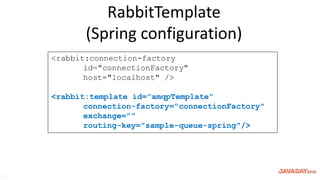
RabbitTemplate
(Spring configuration)
<rabbit:connection-factory
id="connectionFactory"
host="localhost" />
<rabbit:template id="amqpTemplate"
connection-factory="connectionFactory"
exchange=""
routing-key="sample-queue-spring"/>
31
Container listener
(Spring configuration)
<rabbit:listener-container
connection-factory="connectionFactory">
<rabbit:listener ref="springListener"
method="receiveMessage"
queue-names="sample-queue-spring" />
</rabbit:listener-container>
<bean id="springListener"
class=“ua.org.javaday.rabbitmq.spring.ListenerSpringExample"/>
32
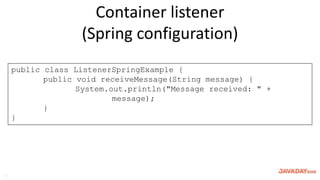
Container listener
(Spring configuration)
public class ListenerSpringExample {
public void receiveMessage(String message) {
System.out.println("Message received: " +
message);
}
}
33
Container listener
(Spring annotations)
public class ListenerSpringExample {
@RabbitListener(queues = "sample-queue-spring")
public void receiveMessage(String message) {
System.out.println("Message received: " +
message);
}
}
34
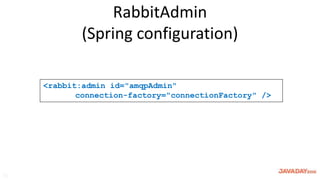
RabbitAdmin
(Spring configuration)
<rabbit:admin id="amqpAdmin"
connection-factory="connectionFactory" />
35
Spring Boot
• If you don’t want to use xml-based configuration you can
use Spring Boot …
36
Spring Boot
@SpringBootApplication
public class AppConfiguration {
@Bean
public ConnectionFactory connectionFactory() {
CachingConnectionFactory connectionFactory =
new CachingConnectionFactory("localhost");
return connectionFactory;
}
@Bean
public AmqpAdmin amqpAdmin() {
return new RabbitAdmin(connectionFactory());
}
}
37
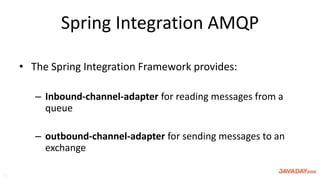
Spring Integration AMQP
• The Spring Integration Framework provides:
– Inbound-channel-adapter for reading messages from a
queue
– outbound-channel-adapter for sending messages to an
exchange
38
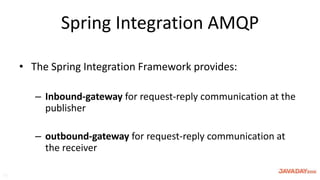
Spring Integration AMQP
• The Spring Integration Framework provides:
– Inbound-gateway for request-reply communication at the
publisher
– outbound-gateway for request-reply communication at
the receiver
39
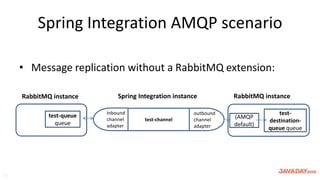
Spring Integration AMQP scenario
• Message replication without a RabbitMQ extension:
test-channel
test-
destination-
queue queue
(AMQP
default)
test-queue
queue
Inbound
channel
adapter
outbound
channel
adapter
Spring Integration instance RabbitMQ instanceRabbitMQ instance
40
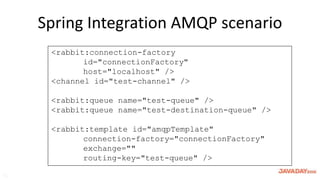
Spring Integration AMQP scenario
<rabbit:connection-factory
id="connectionFactory"
host="localhost" />
<channel id="test-channel" />
<rabbit:queue name="test-queue" />
<rabbit:queue name="test-destination-queue" />
<rabbit:template id="amqpTemplate"
connection-factory="connectionFactory"
exchange=""
routing-key="test-queue" />
41
Spring Integration AMQP scenario
<amqp:inbound-channel-adapter
channel="test-channel"
queue-names="test-queue"
connection-factory="connectionFactory" />
<amqp:outbound-channel-adapter
channel="test-channel"
exchange-name=""
routing-key="test-destination-queue"
amqp-template="amqpTemplate" />
42
Yet another scenario
milk distributor app
online shop
(milk, bread, apples, rabbits …)
bread distributor app
apples distributor app
rabbits distributor app
customer
order processing system
Implementation
milk-queue
(AMQP
default)
RabbitMQ instance
Spring Integration instance
44
apple-queuetest
channel
milk-adapter
bread-queue
rabbit-queue
order
producer
order
router
milk
channel
bread-adapter
break
channel
apple-adapter
apple
channel
rabbit-adapterrabbit
channel
Spring RabbitMQ
(demo)
45
Summary
• The Spring Framework provides convenient utilities and
adapters for integrating with RabbitMQ
• Favor them over the RabbitMQ Java library in
Spring-based applications
46
Thank you !
Q&A
47
demos: https://github.com/martinfmi/spring_rabbitmq_samples
References
48
AMQP 0.9.1 specification
https://www.rabbitmq.com/resources/specs/amqp0-9-1.pdf
AMQP list of users
http://www.amqp.org/about/examples
RabbitMQ documentation
http://www.rabbitmq.com/documentation.html
References
49
Choosing Your Messaging Protocol: AMQP, MQTT, or STOMP
http://blogs.vmware.com/vfabric/2013/02/choosing-your-
messaging-protocol-amqp-mqtt-or-stomp.html
Spring AMQP reference
http://docs.spring.io/spring-amqp/reference/html/
Spring Integration AMQP
http://docs.spring.io/spring-integration/reference/html/amqp.html

Spring RabbitMQ

Editor's Notes

  • #15 * In the financial industry processing of large volumes of financial data between different systems is a classic use case of messaging * The AMQP protocol defines multiple connection channels inside a single TCP connection in order to remove the overhead of opening a large number of TCP connections to the message broker * Mention about RabbitMQ Users
  • #23 RabbitMQ provides clustering support that allows new RabbitMQ nodes to be added on the fly Clustering by default does not guarantee that message loss may not occur