
Spring Framework 5: Hidden Gems
By Juergen Hoeller
@springjuergen
1
Unless otherwise indicated, these slides are © 2013 -2017 Piv otal Software, Inc. and licensed under a
Creative Commons Attribution-NonCommercial license: http://creativecommons.org/licenses/by-nc/3.0/
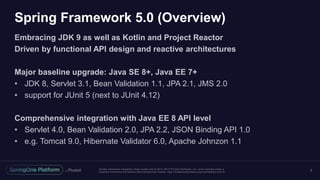
Spring Framework 5.0 (Overview)
Embracing JDK 9 as well as Kotlin and Project Reactor
Driven by functional API design and reactive architectures
Major baseline upgrade: Java SE 8+, Java EE 7+
• JDK 8, Servlet 3.1, Bean Validation 1.1, JPA 2.1, JMS 2.0
• support for JUnit 5 (next to JUnit 4.12)
Comprehensive integration with Java EE 8 API level
• Servlet 4.0, Bean Validation 2.0, JPA 2.2, JSON Binding API 1.0
• e.g. Tomcat 9.0, Hibernate Validator 6.0, Apache Johnzon 1.1
2
Unless otherwise indicated, these slides are © 2013 -2017 Piv otal Software, Inc. and licensed under a
Creative Commons Attribution-NonCommercial license: http://creativecommons.org/licenses/by-nc/3.0/
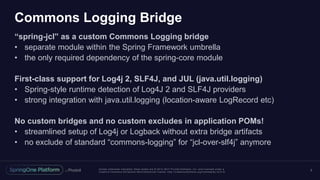
Commons Logging Bridge
“spring-jcl” as a custom Commons Logging bridge
• separate module within the Spring Framework umbrella
• the only required dependency of the spring-core module
First-class support for Log4j 2, SLF4J, and JUL (java.util.logging)
• Spring-style runtime detection of Log4J 2 and SLF4J providers
• strong integration with java.util.logging (location-aware LogRecord etc)
No custom bridges and no custom excludes in application POMs!
• streamlined setup of Log4j or Logback without extra bridge artifacts
• no exclude of standard “commons-logging” for “jcl-over-slf4j” anymore
3
Unless otherwise indicated, these slides are © 2013 -2017 Piv otal Software, Inc. and licensed under a
Creative Commons Attribution-NonCommercial license: http://creativecommons.org/licenses/by-nc/3.0/
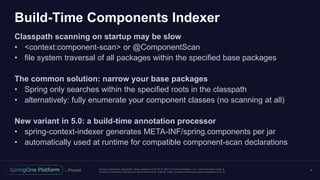
Build-Time Components Indexer
Classpath scanning on startup may be slow
• <context:component-scan> or @ComponentScan
• file system traversal of all packages within the specified base packages
The common solution: narrow your base packages
• Spring only searches within the specified roots in the classpath
• alternatively: fully enumerate your component classes (no scanning at all)
New variant in 5.0: a build-time annotation processor
• spring-context-indexer generates META-INF/spring.components per jar
• automatically used at runtime for compatible component-scan declarations
4
Unless otherwise indicated, these slides are © 2013 -2017 Piv otal Software, Inc. and licensed under a
Creative Commons Attribution-NonCommercial license: http://creativecommons.org/licenses/by-nc/3.0/
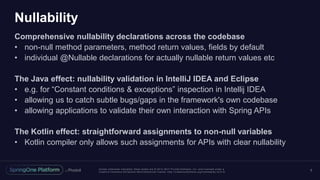
Nullability
Comprehensive nullability declarations across the codebase
• non-null method parameters, method return values, fields by default
• individual @Nullable declarations for actually nullable return values etc
The Java effect: nullability validation in IntelliJ IDEA and Eclipse
• e.g. for “Constant conditions & exceptions” inspection in Intellij IDEA
• allowing us to catch subtle bugs/gaps in the framework's own codebase
• allowing applications to validate their own interaction with Spring APIs
The Kotlin effect: straightforward assignments to non-null variables
• Kotlin compiler only allows such assignments for APIs with clear nullability
5
Unless otherwise indicated, these slides are © 2013 -2017 Piv otal Software, Inc. and licensed under a
Creative Commons Attribution-NonCommercial license: http://creativecommons.org/licenses/by-nc/3.0/
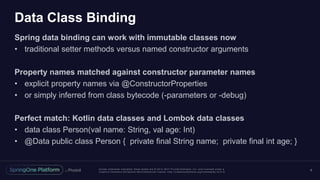
Data Class Binding
Spring data binding can work with immutable classes now
• traditional setter methods versus named constructor arguments
Property names matched against constructor parameter names
• explicit property names via @ConstructorProperties
• or simply inferred from class bytecode (-parameters or -debug)
Perfect match: Kotlin data classes and Lombok data classes
• data class Person(val name: String, val age: Int)
• @Data public class Person { private final String name; private final int age; }
6
Unless otherwise indicated, these slides are © 2013 -2017 Piv otal Software, Inc. and licensed under a
Creative Commons Attribution-NonCommercial license: http://creativecommons.org/licenses/by-nc/3.0/
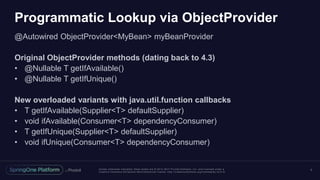
Programmatic Lookup via ObjectProvider
@Autowired ObjectProvider<MyBean> myBeanProvider
Original ObjectProvider methods (dating back to 4.3)
• @Nullable T getIfAvailable()
• @Nullable T getIfUnique()
New overloaded variants with java.util.function callbacks
• T getIfAvailable(Supplier<T> defaultSupplier)
• void ifAvailable(Consumer<T> dependencyConsumer)
• T getIfUnique(Supplier<T> defaultSupplier)
• void ifUnique(Consumer<T> dependencyConsumer)
7
Unless otherwise indicated, these slides are © 2013 -2017 Piv otal Software, Inc. and licensed under a
Creative Commons Attribution-NonCommercial license: http://creativecommons.org/licenses/by-nc/3.0/
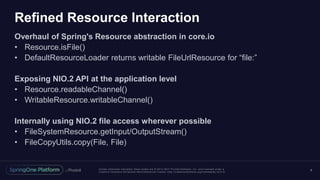
Refined Resource Interaction
Overhaul of Spring's Resource abstraction in core.io
• Resource.isFile()
• DefaultResourceLoader returns writable FileUrlResource for “file:”
Exposing NIO.2 API at the application level
• Resource.readableChannel()
• WritableResource.writableChannel()
Internally using NIO.2 file access wherever possible
• FileSystemResource.getInput/OutputStream()
• FileCopyUtils.copy(File, File)
8
Unless otherwise indicated, these slides are © 2013 -2017 Piv otal Software, Inc. and licensed under a
Creative Commons Attribution-NonCommercial license: http://creativecommons.org/licenses/by-nc/3.0/
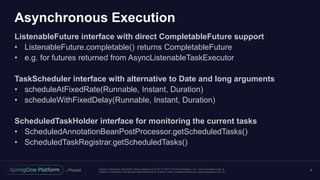
Asynchronous Execution
ListenableFuture interface with direct CompletableFuture support
• ListenableFuture.completable() returns CompletableFuture
• e.g. for futures returned from AsyncListenableTaskExecutor
TaskScheduler interface with alternative to Date and long arguments
• scheduleAtFixedRate(Runnable, Instant, Duration)
• scheduleWithFixedDelay(Runnable, Instant, Duration)
ScheduledTaskHolder interface for monitoring the current tasks
• ScheduledAnnotationBeanPostProcessor.getScheduledTasks()
• ScheduledTaskRegistrar.getScheduledTasks()
9
Learn More. Stay Connected.
Coming up: Spring Framework 5.0.3
Stay tuned for Spring Framework 5.1 next year…
10
#springone@s1p

Spring Framework 5.0: Hidden Gems

  • 1.
    Spring Framework 5:Hidden Gems By Juergen Hoeller @springjuergen 1
  • 2.
    Unless otherwise indicated,these slides are © 2013 -2017 Piv otal Software, Inc. and licensed under a Creative Commons Attribution-NonCommercial license: http://creativecommons.org/licenses/by-nc/3.0/ Spring Framework 5.0 (Overview) Embracing JDK 9 as well as Kotlin and Project Reactor Driven by functional API design and reactive architectures Major baseline upgrade: Java SE 8+, Java EE 7+ • JDK 8, Servlet 3.1, Bean Validation 1.1, JPA 2.1, JMS 2.0 • support for JUnit 5 (next to JUnit 4.12) Comprehensive integration with Java EE 8 API level • Servlet 4.0, Bean Validation 2.0, JPA 2.2, JSON Binding API 1.0 • e.g. Tomcat 9.0, Hibernate Validator 6.0, Apache Johnzon 1.1 2
  • 3.
    Unless otherwise indicated,these slides are © 2013 -2017 Piv otal Software, Inc. and licensed under a Creative Commons Attribution-NonCommercial license: http://creativecommons.org/licenses/by-nc/3.0/ Commons Logging Bridge “spring-jcl” as a custom Commons Logging bridge • separate module within the Spring Framework umbrella • the only required dependency of the spring-core module First-class support for Log4j 2, SLF4J, and JUL (java.util.logging) • Spring-style runtime detection of Log4J 2 and SLF4J providers • strong integration with java.util.logging (location-aware LogRecord etc) No custom bridges and no custom excludes in application POMs! • streamlined setup of Log4j or Logback without extra bridge artifacts • no exclude of standard “commons-logging” for “jcl-over-slf4j” anymore 3
  • 4.
    Unless otherwise indicated,these slides are © 2013 -2017 Piv otal Software, Inc. and licensed under a Creative Commons Attribution-NonCommercial license: http://creativecommons.org/licenses/by-nc/3.0/ Build-Time Components Indexer Classpath scanning on startup may be slow • <context:component-scan> or @ComponentScan • file system traversal of all packages within the specified base packages The common solution: narrow your base packages • Spring only searches within the specified roots in the classpath • alternatively: fully enumerate your component classes (no scanning at all) New variant in 5.0: a build-time annotation processor • spring-context-indexer generates META-INF/spring.components per jar • automatically used at runtime for compatible component-scan declarations 4
  • 5.
    Unless otherwise indicated,these slides are © 2013 -2017 Piv otal Software, Inc. and licensed under a Creative Commons Attribution-NonCommercial license: http://creativecommons.org/licenses/by-nc/3.0/ Nullability Comprehensive nullability declarations across the codebase • non-null method parameters, method return values, fields by default • individual @Nullable declarations for actually nullable return values etc The Java effect: nullability validation in IntelliJ IDEA and Eclipse • e.g. for “Constant conditions & exceptions” inspection in Intellij IDEA • allowing us to catch subtle bugs/gaps in the framework's own codebase • allowing applications to validate their own interaction with Spring APIs The Kotlin effect: straightforward assignments to non-null variables • Kotlin compiler only allows such assignments for APIs with clear nullability 5
  • 6.
    Unless otherwise indicated,these slides are © 2013 -2017 Piv otal Software, Inc. and licensed under a Creative Commons Attribution-NonCommercial license: http://creativecommons.org/licenses/by-nc/3.0/ Data Class Binding Spring data binding can work with immutable classes now • traditional setter methods versus named constructor arguments Property names matched against constructor parameter names • explicit property names via @ConstructorProperties • or simply inferred from class bytecode (-parameters or -debug) Perfect match: Kotlin data classes and Lombok data classes • data class Person(val name: String, val age: Int) • @Data public class Person { private final String name; private final int age; } 6
  • 7.
    Unless otherwise indicated,these slides are © 2013 -2017 Piv otal Software, Inc. and licensed under a Creative Commons Attribution-NonCommercial license: http://creativecommons.org/licenses/by-nc/3.0/ Programmatic Lookup via ObjectProvider @Autowired ObjectProvider<MyBean> myBeanProvider Original ObjectProvider methods (dating back to 4.3) • @Nullable T getIfAvailable() • @Nullable T getIfUnique() New overloaded variants with java.util.function callbacks • T getIfAvailable(Supplier<T> defaultSupplier) • void ifAvailable(Consumer<T> dependencyConsumer) • T getIfUnique(Supplier<T> defaultSupplier) • void ifUnique(Consumer<T> dependencyConsumer) 7
  • 8.
    Unless otherwise indicated,these slides are © 2013 -2017 Piv otal Software, Inc. and licensed under a Creative Commons Attribution-NonCommercial license: http://creativecommons.org/licenses/by-nc/3.0/ Refined Resource Interaction Overhaul of Spring's Resource abstraction in core.io • Resource.isFile() • DefaultResourceLoader returns writable FileUrlResource for “file:” Exposing NIO.2 API at the application level • Resource.readableChannel() • WritableResource.writableChannel() Internally using NIO.2 file access wherever possible • FileSystemResource.getInput/OutputStream() • FileCopyUtils.copy(File, File) 8
  • 9.
    Unless otherwise indicated,these slides are © 2013 -2017 Piv otal Software, Inc. and licensed under a Creative Commons Attribution-NonCommercial license: http://creativecommons.org/licenses/by-nc/3.0/ Asynchronous Execution ListenableFuture interface with direct CompletableFuture support • ListenableFuture.completable() returns CompletableFuture • e.g. for futures returned from AsyncListenableTaskExecutor TaskScheduler interface with alternative to Date and long arguments • scheduleAtFixedRate(Runnable, Instant, Duration) • scheduleWithFixedDelay(Runnable, Instant, Duration) ScheduledTaskHolder interface for monitoring the current tasks • ScheduledAnnotationBeanPostProcessor.getScheduledTasks() • ScheduledTaskRegistrar.getScheduledTasks() 9
  • 10.
    Learn More. StayConnected. Coming up: Spring Framework 5.0.3 Stay tuned for Spring Framework 5.1 next year… 10 #springone@s1p