Eberhard Wolff
Architecture and Technology Manager
adesso AG, Germany

Spring und Scala
About me
•    Eberhard Wolff
•    Architecture & Technology Manager at adesso
•    adesso is a leading IT consultancy in Germany
•    Speaker
•    Author (e.g. first German Spring book)
•    Blog: http://ewolff.com
•    Twitter: @ewolff
•    http://slideshare.com/ewolff
•    eberhard.wolff@adesso.de
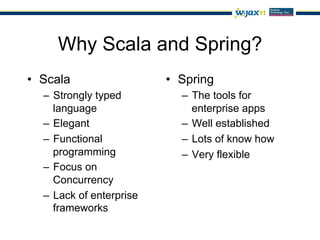
Why Scala and Spring?
•  Scala                  •  Spring
  –  Strongly typed          –  The tools for
     language                   enterprise apps
  –  Elegant                 –  Well established
  –  Functional              –  Lots of know how
     programming             –  Very flexible
  –  Focus on
     Concurrency
  –  Lack of enterprise
     frameworks
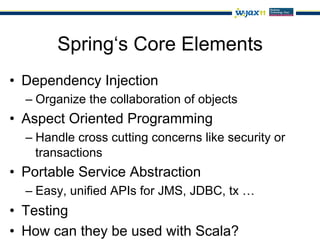
Spring‘s Core Elements
•  Dependency Injection
  –  Organize the collaboration of objects
•  Aspect Oriented Programming
  –  Handle cross cutting concerns like security or
     transactions
•  Portable Service Abstraction
  –  Easy, unified APIs for JMS, JDBC, tx …
•  Testing
•  How can they be used with Scala?
DEPENDENCY INJECTION
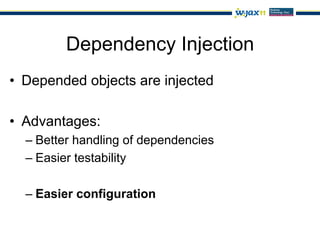
Dependency Injection
•  Depended objects are injected

•  Advantages:
  –  Better handling of dependencies
  –  Easier testability

  –  Easier configuration
Dependency Injection
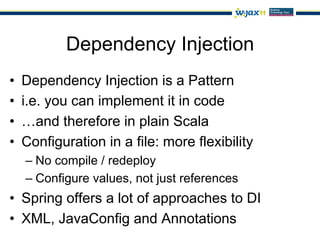
•    Dependency Injection is a Pattern
•    i.e. you can implement it in code
•    …and therefore in plain Scala
•    Configuration in a file: more flexibility
     –  No compile / redeploy
     –  Configure values, not just references
•  Spring offers a lot of approaches to DI
•  XML, JavaConfig and Annotations
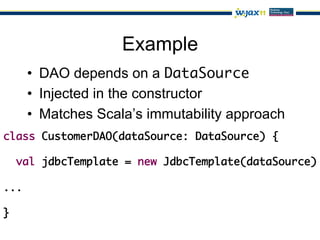
Example
   •  DAO depends on a DataSource	
   •  Injected in the constructor
   •  Matches Scala’s immutability approach
class CustomerDAO(dataSource: DataSource) {	
   	
   val jdbcTemplate = new JdbcTemplate(dataSource)	
	
...	
	
}
On Singletons
•  Scala introduces objects as Singletons
•  Example uses Scala classes
•  Spring needs to do the creation so
   Dependency Injection can be done
•  Might consider @Configurable but that
   adds AspectJ Load Time Weaving…
•  More flexibility concerning scopes
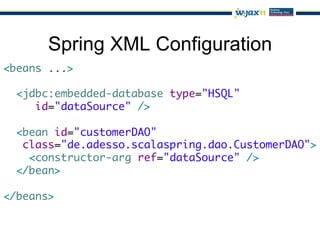
Spring XML Configuration
<beans ...>	
	
  <jdbc:embedded-database type="HSQL"	
     id="dataSource" />	
	
  <bean id="customerDAO" 	
   class="de.adesso.scalaspring.dao.CustomerDAO">	
    <constructor-arg ref="dataSource" />	
  </bean>	
	
</beans>
Spring XML Configuration
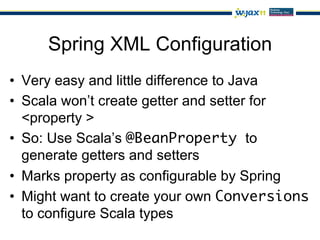
•  Very easy and little difference to Java
•  Scala won’t create getter and setter for
   <property >
•  So: Use Scala’s @BeanProperty to
   generate getters and setters
•  Marks property as configurable by Spring
•  Might want to create your own Conversions
   to configure Scala types
Spring XML & Scala Collections
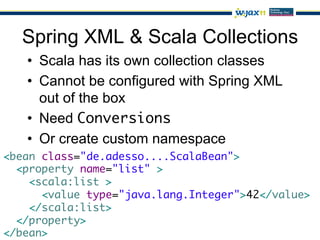
   •  Scala has its own collection classes
   •  Cannot be configured with Spring XML
      out of the box
   •  Need Conversions
   •  Or create custom namespace
<bean class="de.adesso....ScalaBean">	
  <property name="list" >	
    <scala:list >	
      <value type="java.lang.Integer">42</value>	
    </scala:list>	
  </property>	
</bean>
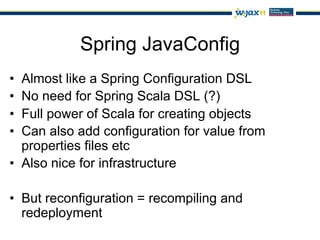
Spring JavaConfig
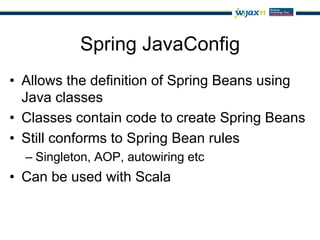
•  Allows the definition of Spring Beans using
   Java classes
•  Classes contain code to create Spring Beans
•  Still conforms to Spring Bean rules
  –  Singleton, AOP, autowiring etc
•  Can be used with Scala
Spring JavaConfig with Scala
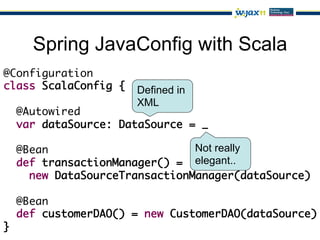
@Configuration	
class ScalaConfig {	 Defined in
	                    XML
  @Autowired	
  var dataSource: DataSource = _	
	
  @Bean	                        Not really
  def transactionManager() =	 elegant..
    new DataSourceTransactionManager(dataSource)	
	
  @Bean	
  def customerDAO() = new CustomerDAO(dataSource)	
}
Spring JavaConfig
•  Almost like a Spring Configuration DSL
•  No need for Spring Scala DSL (?)
•  Full power of Scala for creating objects
•  Can also add configuration for value from
   properties files etc
•  Also nice for infrastructure

•  But reconfiguration = recompiling and
   redeployment
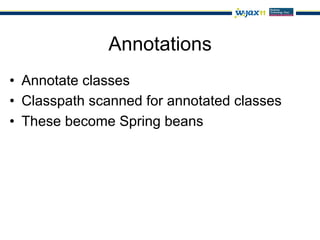
Annotations
•  Annotate classes
•  Classpath scanned for annotated classes
•  These become Spring beans
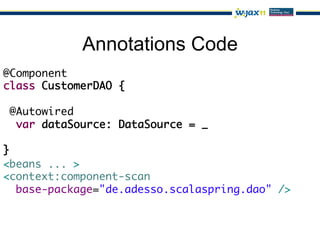
Annotations Code
@Component	
class CustomerDAO {	
	
  @Autowired	
   var dataSource: DataSource = _ 	
	
}
<beans ... >	
<context:component-scan	
   base-package="de.adesso.scalaspring.dao" />
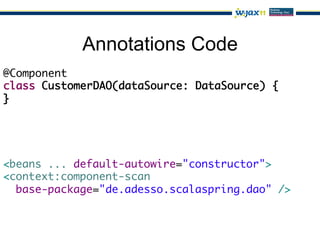
Annotations Code
@Component	
class CustomerDAO(dataSource: DataSource) {	
}


<beans ... default-autowire="constructor">	
<context:component-scan	
  base-package="de.adesso.scalaspring.dao" />
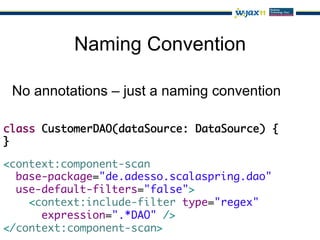
Naming Convention

 No annotations – just a naming convention

class CustomerDAO(dataSource: DataSource) {	
}

<context:component-scan	
  base-package="de.adesso.scalaspring.dao"	
  use-default-filters="false">	
    <context:include-filter type="regex"	
      expression=".*DAO" />	
</context:component-scan>
SERVICE ABSTRACTION
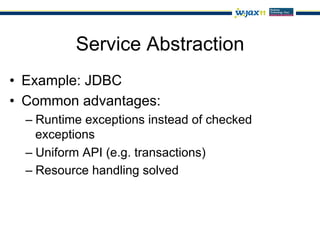
Service Abstraction
•  Example: JDBC
•  Common advantages:
  –  Runtime exceptions instead of checked
     exceptions
  –  Uniform API (e.g. transactions)
  –  Resource handling solved
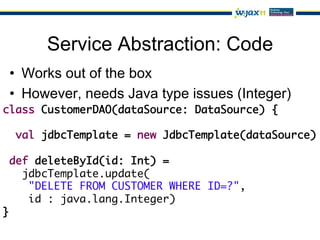
Service Abstraction: Code
 •  Works out of the box
 •  However, needs Java type issues (Integer)
class CustomerDAO(dataSource: DataSource) {	
   	
   val jdbcTemplate = new JdbcTemplate(dataSource)	
	
  def deleteById(id: Int) =	
     jdbcTemplate.update(	
      "DELETE FROM CUSTOMER WHERE ID=?",	
      id : java.lang.Integer)	
}
More Complex
•    How can one access a ResultSet?
•    Resource handled by JDBC
•    Cannot return it – it has to be closed
•    Solution: callback
•    …and inner class
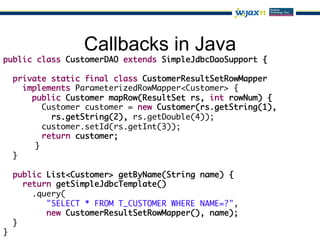
Callbacks in Java
public class CustomerDAO extends SimpleJdbcDaoSupport {	
	
   private static final class CustomerResultSetRowMapper	
      implements ParameterizedRowMapper<Customer> {	
        public Customer mapRow(ResultSet rs, int rowNum) {	
          Customer customer = new Customer(rs.getString(1),	
             rs.getString(2), rs.getDouble(4));	
          customer.setId(rs.getInt(3));	
          return customer;	
        	}	
   }	
	
   public List<Customer> getByName(String name) {	
      return getSimpleJdbcTemplate()	
        .query(	
            "SELECT * FROM T_CUSTOMER WHERE NAME=?",	
            new CustomerResultSetRowMapper(), name);	
   }	
}
Callbacks in Scala
•  Callbacks are really functions
•  Called on each row

•  Use template with Scala function?
Callback in Scala
def findById(id: Int): Option[Customer] = {	
  val result: Buffer[Customer] =	
   jdbcTemplate.query(	
     "SELECT * FROM CUSTOMER C WHERE C.ID=?",	
      (rs: ResultSet) => {	
        Customer(rs.getInt(1), rs.getString(2),	
         rs.getString(3), rs.getDouble(4))	
      } : RowMapper[Customer]	
      ,id : java.lang.Integer)	
    result.headOption	
}

•  Why can the function be converted in a
   RowMapper?
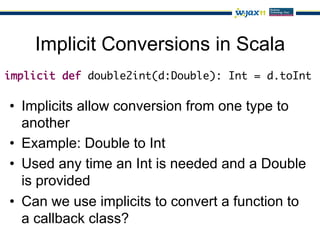
Implicit Conversions in Scala
implicit def double2int(d:Double): Int = d.toInt	

•  Implicits allow conversion from one type to
   another
•  Example: Double to Int
•  Used any time an Int is needed and a Double
   is provided
•  Can we use implicits to convert a function to
   a callback class?
Implicit for Function to Callback
•  Converts a function into a callback object
•  Transparently behind the scenes

implicit def rowMapperImplicit[T](	
  func: (ResultSet) => T) = {	
     new RowMapper[T] {	
       def mapRow(rs: ResultSet, rowNum: Int) 	
         = func(rs)	
  }	
}
Some Problems
•  Scala value types and collections must be
   converted to Java objects (i.e. Int to Integer)
•  null instead of Option[T]
•  classOf[T] instead of plain type

•  Wrapper would be more natural but more
   effort
ASPECT ORIENTED
PROGRAMMING
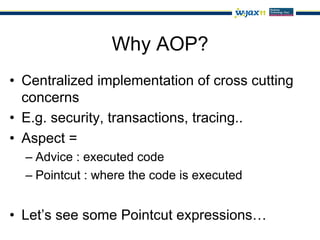
Why AOP?
•  Centralized implementation of cross cutting
   concerns
•  E.g. security, transactions, tracing..
•  Aspect =
  –  Advice : executed code
  –  Pointcut : where the code is executed


•  Let’s see some Pointcut expressions…
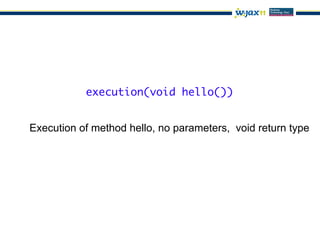
execution(void hello())


Execution of method hello, no parameters, void return type
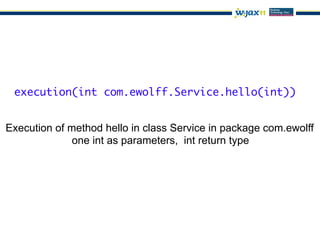
execution(int com.ewolff.Service.hello(int))


Execution of method hello in class Service in package com.ewolff
              one int as parameters, int return type
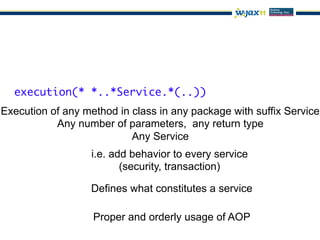
execution(* *..*Service.*(..))
Execution of any method in class in any package with suffix Service
           Any number of parameters, any return type
                           Any Service
                   i.e. add behavior to every service
                          (security, transaction)

                  Defines what constitutes a service

                   Proper and orderly usage of AOP
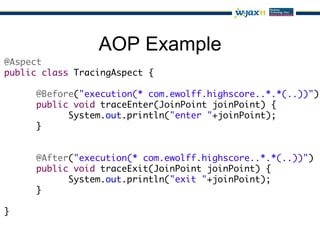
AOP Example
@Aspect	
public class TracingAspect {	
	
     	@Before("execution(* com.ewolff.highscore..*.*(..))")	
     	public void traceEnter(JoinPoint joinPoint) {	
     	     	System.out.println("enter "+joinPoint);	
     	}	
     		
	
     	@After("execution(* com.ewolff.highscore..*.*(..))")	
     	public void traceExit(JoinPoint joinPoint) {	
     	     	System.out.println("exit "+joinPoint);	
     	}	
	
}
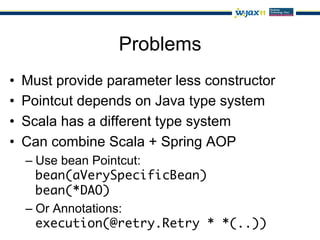
Problems
•    Must provide parameter less constructor
•    Pointcut depends on Java type system
•    Scala has a different type system
•    Can combine Scala + Spring AOP
     –  Use bean Pointcut:
        bean(aVerySpecificBean)

        bean(*DAO)	
     –  Or Annotations:
        execution(@retry.Retry * *(..))
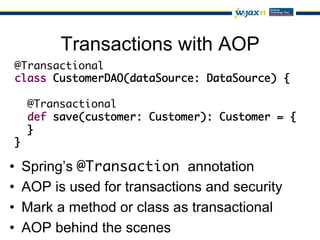
Transactions with AOP
 @Transactional	
 class CustomerDAO(dataSource: DataSource) {	

     @Transactional	
     def save(customer: Customer): Customer = {	
     }	
 }

•    Spring’s @Transaction annotation
•    AOP is used for transactions and security
•    Mark a method or class as transactional
•    AOP behind the scenes
AOP and Scala: 2nd Thought
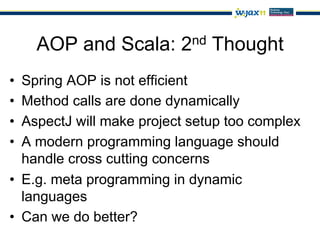
•  Spring AOP is not efficient
•  Method calls are done dynamically
•  AspectJ will make project setup too complex
•  A modern programming language should
   handle cross cutting concerns
•  E.g. meta programming in dynamic
   languages
•  Can we do better?
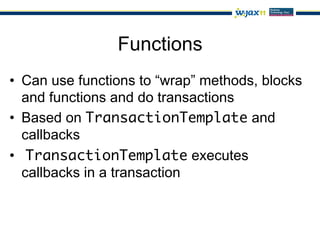
Functions
•  Can use functions to “wrap” methods, blocks
   and functions and do transactions
•  Based on TransactionTemplate and
   callbacks
•  TransactionTemplate executes
   callbacks in a transaction
Code
implicit def txCallbackImplicit[T](func: => T)…	
	
	
•  Again implicit
•  Converts a function with return type T to a
   TransactionCallback	
•  Now we need to call the
   TransactionTemplate to provide the
   transaction
•  A function will take the transaction configuration
   and call the passed in function
Code     1st parameter:
                              transaction configuration
def transactional[T]	
( propagation: Propagation = Propagation.REQUIRED,
  …)	2nd parameter: function
(func: => T): T = 	
{	
   val txAttribute = 	
    new TransactionAttributeWithRollbackRules(	
      propagation,…)	
   val txTemplate =	
    new TransactionTemplate(txManager,txAttribute)	
   txTemplate.execute(func)	
}
            Call TransactionTemplate with function
            (converted to TransactionCallback) and
            configuration
Usage
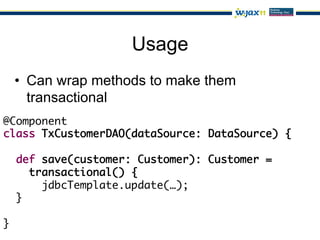
 •  Can wrap methods to make them
    transactional
@Component	
class TxCustomerDAO(dataSource: DataSource) {	
  	
  def save(customer: Customer): Customer =	
     transactional() {	
       jdbcTemplate.update(…);	
  }	
	
}
Usage
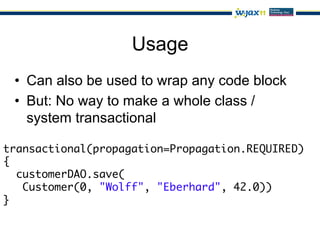
 •  Can also be used to wrap any code block
 •  But: No way to make a whole class /
    system transactional

transactional(propagation=Propagation.REQUIRED)	
{	
   customerDAO.save(	
    Customer(0, "Wolff", "Eberhard", 42.0))	
}
TESTING
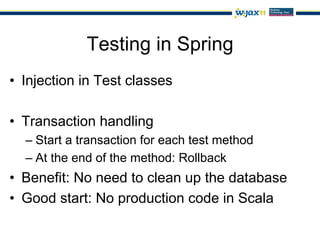
Testing in Spring
•  Injection in Test classes

•  Transaction handling
  –  Start a transaction for each test method
  –  At the end of the method: Rollback
•  Benefit: No need to clean up the database
•  Good start: No production code in Scala
Testing with JUnit 4, Spring and
               Scala
@RunWith(classOf[SpringJUnit4ClassRunner])	
@Transactional	
@ContextConfiguration(	
Array("/spring/scalaSpringConfig.xml"))	
class CustomerDAOTest extends Config {	
   @Autowired	
   var customerDAO : CustomerDAO = null	
   @Test	
   def testSaveDelete() {	
     val numberOfCustomersBefore =	
       customerDAO.count()	
   …}	
}
SUM UP
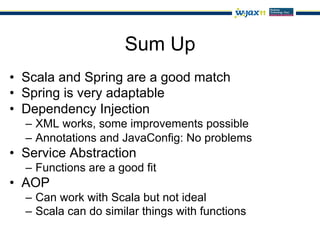
Sum Up
•  Scala and Spring are a good match
•  Spring is very adaptable
•  Dependency Injection
  –  XML works, some improvements possible
  –  Annotations and JavaConfig: No problems
•  Service Abstraction
  –  Functions are a good fit
•  AOP
  –  Can work with Scala but not ideal
  –  Scala can do similar things with functions
Potential Improvements
•  Dependency Injection
  –  Support for Scala collections mostly done
  –  Support for Scala properties (no @BeanProperty)
  –  Support for Scala Objects aka Singletons
  –  Conversions for all basic Scala types
  –  Spring configuration DSL (?)
•  Service Abstraction
  –  Provide implicits for non-JDBC callbacks
Potential Improvements
•  AOP
  –  Provide functions for all common aspects besides
     transaction


•  Testing
  –  Support Scala test frameworks
  –  http://www.cakesolutions.org/specs2-spring.html
Links
•  https://github.com/ewolff/scala-spring
•  Request for Scala version of Spring (only 16 votes)
   https://jira.springsource.org/browse/SPR-7876
•  Scala and AspectJ: Approaching modularization of crosscutting
   functionalities
   http://days2011.scala-lang.org/sites/days2011/files/52.%20AspectJ.pdf
•  Sample for Spring Security and Scala
    https://github.com/tekul/scalasec
•  Spring Integration Scala DSL
   https://github.com/SpringSource/spring-integration-scala
•  (German) Thesis about Scala & Lift vs. Java EE:
   http://www.slideshare.net/adessoAG/vergleich-des-scala-
   webframeworks-lift-mit-dem-java-ee-programmiermodell
•  (German) Thesis about Scala, JSF and Hibernate:
   http://www.slideshare.net/bvonkalm/thesis-5821628
Wir suchen Sie als
Ø    Software-Architekt (m/w)
Ø    Projektleiter (m/w)
Ø    Senior Software Engineer (m/w)


Ø    Kommen Sie zum Stand und gewinnen Sie ein iPad 2!

  jobs@adesso.de
  www.AAAjobs.de

Scala and Spring

  • 1.
    Eberhard Wolff Architecture andTechnology Manager adesso AG, Germany Spring und Scala
  • 2.
    About me •  Eberhard Wolff •  Architecture & Technology Manager at adesso •  adesso is a leading IT consultancy in Germany •  Speaker •  Author (e.g. first German Spring book) •  Blog: http://ewolff.com •  Twitter: @ewolff •  http://slideshare.com/ewolff •  eberhard.wolff@adesso.de
  • 3.
    Why Scala andSpring? •  Scala •  Spring –  Strongly typed –  The tools for language enterprise apps –  Elegant –  Well established –  Functional –  Lots of know how programming –  Very flexible –  Focus on Concurrency –  Lack of enterprise frameworks
  • 4.
    Spring‘s Core Elements • Dependency Injection –  Organize the collaboration of objects •  Aspect Oriented Programming –  Handle cross cutting concerns like security or transactions •  Portable Service Abstraction –  Easy, unified APIs for JMS, JDBC, tx … •  Testing •  How can they be used with Scala?
  • 5.
  • 6.
    Dependency Injection •  Dependedobjects are injected •  Advantages: –  Better handling of dependencies –  Easier testability –  Easier configuration
  • 7.
    Dependency Injection •  Dependency Injection is a Pattern •  i.e. you can implement it in code •  …and therefore in plain Scala •  Configuration in a file: more flexibility –  No compile / redeploy –  Configure values, not just references •  Spring offers a lot of approaches to DI •  XML, JavaConfig and Annotations
  • 8.
    Example •  DAO depends on a DataSource •  Injected in the constructor •  Matches Scala’s immutability approach class CustomerDAO(dataSource: DataSource) { val jdbcTemplate = new JdbcTemplate(dataSource) ... }
  • 9.
    On Singletons •  Scalaintroduces objects as Singletons •  Example uses Scala classes •  Spring needs to do the creation so Dependency Injection can be done •  Might consider @Configurable but that adds AspectJ Load Time Weaving… •  More flexibility concerning scopes
  • 10.
    Spring XML Configuration <beans...> <jdbc:embedded-database type="HSQL" id="dataSource" /> <bean id="customerDAO" class="de.adesso.scalaspring.dao.CustomerDAO"> <constructor-arg ref="dataSource" /> </bean> </beans>
  • 11.
    Spring XML Configuration • Very easy and little difference to Java •  Scala won’t create getter and setter for <property > •  So: Use Scala’s @BeanProperty to generate getters and setters •  Marks property as configurable by Spring •  Might want to create your own Conversions to configure Scala types
  • 12.
    Spring XML &Scala Collections •  Scala has its own collection classes •  Cannot be configured with Spring XML out of the box •  Need Conversions •  Or create custom namespace <bean class="de.adesso....ScalaBean"> <property name="list" > <scala:list > <value type="java.lang.Integer">42</value> </scala:list> </property> </bean>
  • 13.
    Spring JavaConfig •  Allowsthe definition of Spring Beans using Java classes •  Classes contain code to create Spring Beans •  Still conforms to Spring Bean rules –  Singleton, AOP, autowiring etc •  Can be used with Scala
  • 14.
    Spring JavaConfig withScala @Configuration class ScalaConfig { Defined in XML @Autowired var dataSource: DataSource = _ @Bean Not really def transactionManager() = elegant.. new DataSourceTransactionManager(dataSource) @Bean def customerDAO() = new CustomerDAO(dataSource) }
  • 15.
    Spring JavaConfig •  Almostlike a Spring Configuration DSL •  No need for Spring Scala DSL (?) •  Full power of Scala for creating objects •  Can also add configuration for value from properties files etc •  Also nice for infrastructure •  But reconfiguration = recompiling and redeployment
  • 16.
    Annotations •  Annotate classes • Classpath scanned for annotated classes •  These become Spring beans
  • 17.
    Annotations Code @Component class CustomerDAO{ @Autowired var dataSource: DataSource = _ } <beans ... > <context:component-scan base-package="de.adesso.scalaspring.dao" />
  • 18.
    Annotations Code @Component class CustomerDAO(dataSource:DataSource) { } <beans ... default-autowire="constructor"> <context:component-scan base-package="de.adesso.scalaspring.dao" />
  • 19.
    Naming Convention Noannotations – just a naming convention class CustomerDAO(dataSource: DataSource) { } <context:component-scan base-package="de.adesso.scalaspring.dao" use-default-filters="false"> <context:include-filter type="regex" expression=".*DAO" /> </context:component-scan>
  • 20.
  • 21.
    Service Abstraction •  Example:JDBC •  Common advantages: –  Runtime exceptions instead of checked exceptions –  Uniform API (e.g. transactions) –  Resource handling solved
  • 22.
    Service Abstraction: Code •  Works out of the box •  However, needs Java type issues (Integer) class CustomerDAO(dataSource: DataSource) { val jdbcTemplate = new JdbcTemplate(dataSource) def deleteById(id: Int) = jdbcTemplate.update( "DELETE FROM CUSTOMER WHERE ID=?", id : java.lang.Integer) }
  • 23.
    More Complex •  How can one access a ResultSet? •  Resource handled by JDBC •  Cannot return it – it has to be closed •  Solution: callback •  …and inner class
  • 24.
    Callbacks in Java publicclass CustomerDAO extends SimpleJdbcDaoSupport { private static final class CustomerResultSetRowMapper implements ParameterizedRowMapper<Customer> { public Customer mapRow(ResultSet rs, int rowNum) { Customer customer = new Customer(rs.getString(1), rs.getString(2), rs.getDouble(4)); customer.setId(rs.getInt(3)); return customer; } } public List<Customer> getByName(String name) { return getSimpleJdbcTemplate() .query( "SELECT * FROM T_CUSTOMER WHERE NAME=?", new CustomerResultSetRowMapper(), name); } }
  • 25.
    Callbacks in Scala • Callbacks are really functions •  Called on each row •  Use template with Scala function?
  • 26.
    Callback in Scala deffindById(id: Int): Option[Customer] = { val result: Buffer[Customer] = jdbcTemplate.query( "SELECT * FROM CUSTOMER C WHERE C.ID=?", (rs: ResultSet) => { Customer(rs.getInt(1), rs.getString(2), rs.getString(3), rs.getDouble(4)) } : RowMapper[Customer] ,id : java.lang.Integer) result.headOption } •  Why can the function be converted in a RowMapper?
  • 27.
    Implicit Conversions inScala implicit def double2int(d:Double): Int = d.toInt •  Implicits allow conversion from one type to another •  Example: Double to Int •  Used any time an Int is needed and a Double is provided •  Can we use implicits to convert a function to a callback class?
  • 28.
    Implicit for Functionto Callback •  Converts a function into a callback object •  Transparently behind the scenes implicit def rowMapperImplicit[T]( func: (ResultSet) => T) = { new RowMapper[T] { def mapRow(rs: ResultSet, rowNum: Int) = func(rs) } }
  • 29.
    Some Problems •  Scalavalue types and collections must be converted to Java objects (i.e. Int to Integer) •  null instead of Option[T] •  classOf[T] instead of plain type •  Wrapper would be more natural but more effort
  • 30.
  • 31.
    Why AOP? •  Centralizedimplementation of cross cutting concerns •  E.g. security, transactions, tracing.. •  Aspect = –  Advice : executed code –  Pointcut : where the code is executed •  Let’s see some Pointcut expressions…
  • 32.
    execution(void hello()) Execution ofmethod hello, no parameters, void return type
  • 33.
    execution(int com.ewolff.Service.hello(int)) Execution ofmethod hello in class Service in package com.ewolff one int as parameters, int return type
  • 34.
    execution(* *..*Service.*(..)) Execution ofany method in class in any package with suffix Service Any number of parameters, any return type Any Service i.e. add behavior to every service (security, transaction) Defines what constitutes a service Proper and orderly usage of AOP
  • 35.
    AOP Example @Aspect public classTracingAspect { @Before("execution(* com.ewolff.highscore..*.*(..))") public void traceEnter(JoinPoint joinPoint) { System.out.println("enter "+joinPoint); } @After("execution(* com.ewolff.highscore..*.*(..))") public void traceExit(JoinPoint joinPoint) { System.out.println("exit "+joinPoint); } }
  • 36.
    Problems •  Must provide parameter less constructor •  Pointcut depends on Java type system •  Scala has a different type system •  Can combine Scala + Spring AOP –  Use bean Pointcut: bean(aVerySpecificBean)
 bean(*DAO) –  Or Annotations: execution(@retry.Retry * *(..))
  • 37.
    Transactions with AOP @Transactional class CustomerDAO(dataSource: DataSource) { @Transactional def save(customer: Customer): Customer = { } } •  Spring’s @Transaction annotation •  AOP is used for transactions and security •  Mark a method or class as transactional •  AOP behind the scenes
  • 38.
    AOP and Scala:2nd Thought •  Spring AOP is not efficient •  Method calls are done dynamically •  AspectJ will make project setup too complex •  A modern programming language should handle cross cutting concerns •  E.g. meta programming in dynamic languages •  Can we do better?
  • 39.
    Functions •  Can usefunctions to “wrap” methods, blocks and functions and do transactions •  Based on TransactionTemplate and callbacks •  TransactionTemplate executes callbacks in a transaction
  • 40.
    Code implicit def txCallbackImplicit[T](func:=> T)… •  Again implicit •  Converts a function with return type T to a TransactionCallback •  Now we need to call the TransactionTemplate to provide the transaction •  A function will take the transaction configuration and call the passed in function
  • 41.
    Code 1st parameter: transaction configuration def transactional[T] ( propagation: Propagation = Propagation.REQUIRED, …) 2nd parameter: function (func: => T): T = { val txAttribute = new TransactionAttributeWithRollbackRules( propagation,…) val txTemplate = new TransactionTemplate(txManager,txAttribute) txTemplate.execute(func) } Call TransactionTemplate with function (converted to TransactionCallback) and configuration
  • 42.
    Usage •  Canwrap methods to make them transactional @Component class TxCustomerDAO(dataSource: DataSource) { def save(customer: Customer): Customer = transactional() { jdbcTemplate.update(…); } }
  • 43.
    Usage •  Canalso be used to wrap any code block •  But: No way to make a whole class / system transactional transactional(propagation=Propagation.REQUIRED) { customerDAO.save( Customer(0, "Wolff", "Eberhard", 42.0)) }
  • 44.
  • 45.
    Testing in Spring • Injection in Test classes •  Transaction handling –  Start a transaction for each test method –  At the end of the method: Rollback •  Benefit: No need to clean up the database •  Good start: No production code in Scala
  • 46.
    Testing with JUnit4, Spring and Scala @RunWith(classOf[SpringJUnit4ClassRunner]) @Transactional @ContextConfiguration( Array("/spring/scalaSpringConfig.xml")) class CustomerDAOTest extends Config { @Autowired var customerDAO : CustomerDAO = null @Test def testSaveDelete() { val numberOfCustomersBefore = customerDAO.count() …} }
  • 47.
  • 48.
    Sum Up •  Scalaand Spring are a good match •  Spring is very adaptable •  Dependency Injection –  XML works, some improvements possible –  Annotations and JavaConfig: No problems •  Service Abstraction –  Functions are a good fit •  AOP –  Can work with Scala but not ideal –  Scala can do similar things with functions
  • 49.
    Potential Improvements •  DependencyInjection –  Support for Scala collections mostly done –  Support for Scala properties (no @BeanProperty) –  Support for Scala Objects aka Singletons –  Conversions for all basic Scala types –  Spring configuration DSL (?) •  Service Abstraction –  Provide implicits for non-JDBC callbacks
  • 50.
    Potential Improvements •  AOP –  Provide functions for all common aspects besides transaction •  Testing –  Support Scala test frameworks –  http://www.cakesolutions.org/specs2-spring.html
  • 51.
    Links •  https://github.com/ewolff/scala-spring •  Requestfor Scala version of Spring (only 16 votes) https://jira.springsource.org/browse/SPR-7876 •  Scala and AspectJ: Approaching modularization of crosscutting functionalities http://days2011.scala-lang.org/sites/days2011/files/52.%20AspectJ.pdf •  Sample for Spring Security and Scala https://github.com/tekul/scalasec •  Spring Integration Scala DSL https://github.com/SpringSource/spring-integration-scala •  (German) Thesis about Scala & Lift vs. Java EE: http://www.slideshare.net/adessoAG/vergleich-des-scala- webframeworks-lift-mit-dem-java-ee-programmiermodell •  (German) Thesis about Scala, JSF and Hibernate: http://www.slideshare.net/bvonkalm/thesis-5821628
  • 52.
    Wir suchen Sieals Ø  Software-Architekt (m/w) Ø  Projektleiter (m/w) Ø  Senior Software Engineer (m/w) Ø  Kommen Sie zum Stand und gewinnen Sie ein iPad 2! jobs@adesso.de www.AAAjobs.de