Spray Vs. Lotion: The Effect
of Sunblock on UVA and
UVB
F. Allaire, A. Suenobu, L. Wells
PHYS 399 Summer ’09
Ultraviolet Radiation
 Ultraviolet (UV) ultraviolet light is the light just
  past the wavelength of the color violet on the
  electromagnetic spectrum
 UVA frequency ranges 400 - 320 nm


 UVB frequency ranges 320 - 290 nm


 UVC frequency ranges 290 - 100 nm (these
  waves are absorbed completely by oxygen and
  the ozone layer)
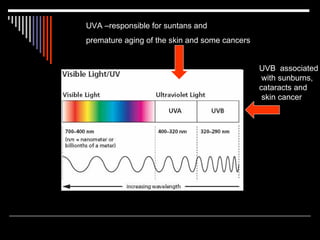
UVA –responsible for suntans and
premature aging of the skin and some cancers


                                               UVB associated
                                                with sunburns,
                                               cataracts and
                                                skin cancer
Why should we care about
UVA or UVB radiation?


 Premature aging of the skin
 Damaging the skin’s cellular DNA
 Various forms of skin cancer
 Eye damage including cataracts
 Reddening of the skin and sunburn
Protective measures
 Wear clothing with
 Use sunglasses
 Seek shade
 Wear hats
 SPF - Sun Protection Factor
 The Skin Cancer Foundation maintains
 that SPF’s of 15 or higher are necessary
 for adequate protection.
Purpose
 We know that sunscreen does protect.
  The purpose of this experiment is to
  determine if there is a difference in
  effectiveness of protection from UVA and
  UVB radiation between lotion or clear
  spray-on sunblock.
Hypothesis
 We predict that the lotion would provide
  more protection than a clear spray-on
  sunblock of the same SPF value.
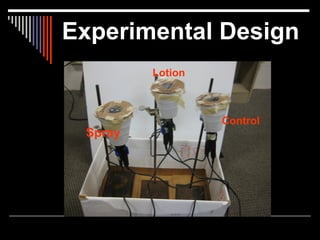
Experimental Design
 Independent variable: Lotion / Spray-
  on Sunblock
 Dependent variable: UVA, UVB
  penetration (mW/m2)
 Constants: Time of day, amount of
  sunblock, length of time, SPF, brand,
  multiple trials using same procedure for
  each trial,
 Control: Clear plastic –no sunblock
Experimental Design
         Lotion


                  Control
 Spray
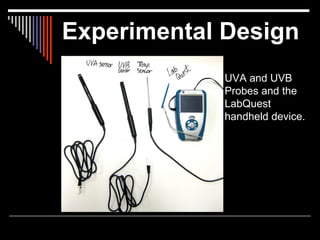
Experimental Design
             UVA and UVB
             Probes and the
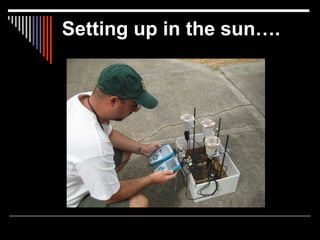
             LabQuest
             handheld device.
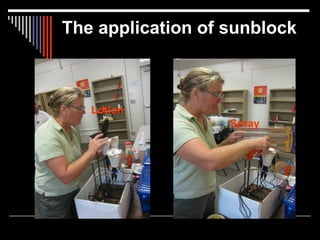
The application of sunblock


   Lotion
                   Spray
Setting up in the sun….
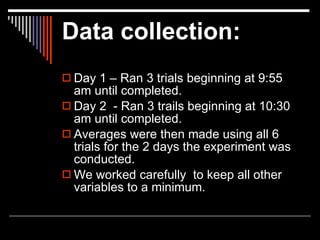
Data collection:
 Day 1 – Ran 3 trials beginning at 9:55
  am until completed.
 Day 2 - Ran 3 trails beginning at 10:30
  am until completed.
 Averages were then made using all 6
  trials for the 2 days the experiment was
  conducted.
 We worked carefully to keep all other
  variables to a minimum.
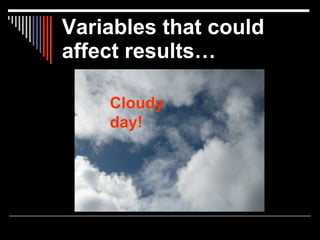
Variables that could
affect results…

    Cloudy
    day!
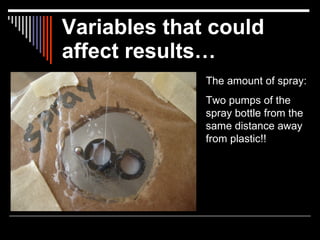
Variables that could
affect results…
              The amount of spray:
              Two pumps of the
              spray bottle from the
              same distance away
              from plastic!!
Variables that could
affect results…
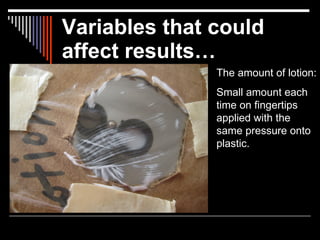
               The amount of lotion:
               Small amount each
               time on fingertips
               applied with the
               same pressure onto
               plastic.
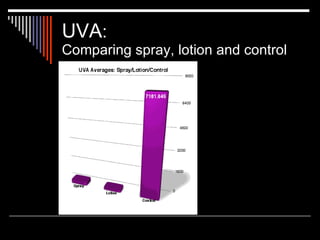
UVA:
Comparing spray, lotion and control
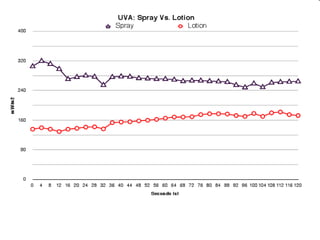
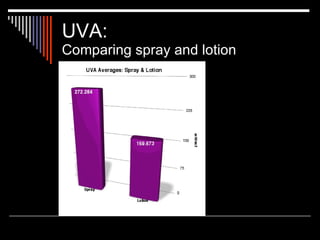
UVA:
Comparing spray and lotion
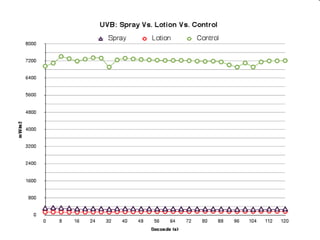
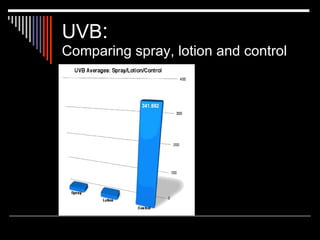
UVB:
Comparing spray, lotion and control
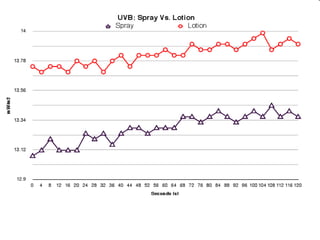
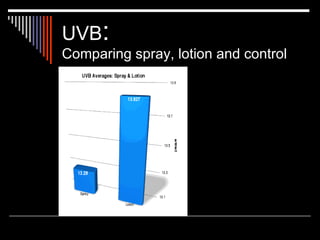
UVB:
Comparing spray, lotion and control
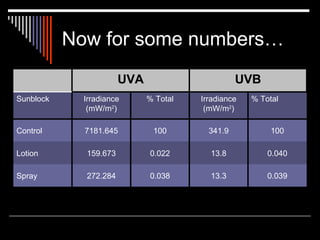
Now for some numbers…
                       UVA                       UVB
Sunblock     Irradiance      % Total   Irradiance   % Total
              (mW/m2)                   (mW/m2)

Control      7181.645         100        341.9           100

Lotion       159.673         0.022       13.8           0.040

Spray        272.284         0.038       13.3           0.039
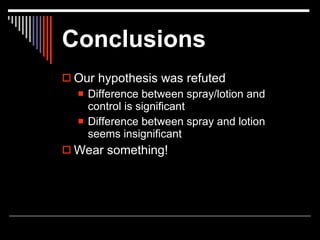
Conclusions
 Our hypothesis was refuted
     Difference between spray/lotion and
      control is significant
     Difference between spray and lotion
      seems insignificant
 Wear something!
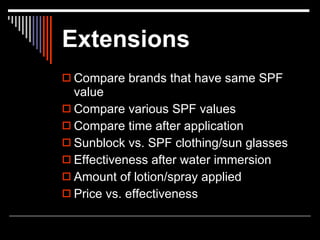
Extensions
 Compare brands that have same SPF
  value
 Compare various SPF values
 Compare time after application
 Sunblock vs. SPF clothing/sun glasses
 Effectiveness after water immersion
 Amount of lotion/spray applied
 Price vs. effectiveness
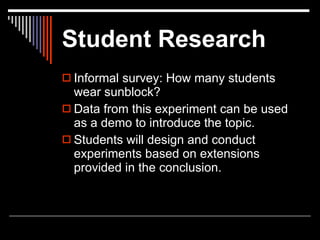
Student Research
 Informal survey: How many students
  wear sunblock?
 Data from this experiment can be used
  as a demo to introduce the topic.
 Students will design and conduct
  experiments based on extensions
  provided in the conclusion.

Spray Vs Lotion V3.0

  • 1.
    Spray Vs. Lotion:The Effect of Sunblock on UVA and UVB F. Allaire, A. Suenobu, L. Wells PHYS 399 Summer ’09
  • 3.
    Ultraviolet Radiation  Ultraviolet(UV) ultraviolet light is the light just past the wavelength of the color violet on the electromagnetic spectrum  UVA frequency ranges 400 - 320 nm  UVB frequency ranges 320 - 290 nm  UVC frequency ranges 290 - 100 nm (these waves are absorbed completely by oxygen and the ozone layer)
  • 4.
    UVA –responsible forsuntans and premature aging of the skin and some cancers UVB associated with sunburns, cataracts and skin cancer
  • 5.
    Why should wecare about UVA or UVB radiation?  Premature aging of the skin  Damaging the skin’s cellular DNA  Various forms of skin cancer  Eye damage including cataracts  Reddening of the skin and sunburn
  • 6.
    Protective measures  Wearclothing with  Use sunglasses  Seek shade  Wear hats  SPF - Sun Protection Factor The Skin Cancer Foundation maintains that SPF’s of 15 or higher are necessary for adequate protection.
  • 7.
    Purpose  We knowthat sunscreen does protect. The purpose of this experiment is to determine if there is a difference in effectiveness of protection from UVA and UVB radiation between lotion or clear spray-on sunblock.
  • 8.
    Hypothesis  We predictthat the lotion would provide more protection than a clear spray-on sunblock of the same SPF value.
  • 9.
    Experimental Design  Independentvariable: Lotion / Spray- on Sunblock  Dependent variable: UVA, UVB penetration (mW/m2)  Constants: Time of day, amount of sunblock, length of time, SPF, brand, multiple trials using same procedure for each trial,  Control: Clear plastic –no sunblock
  • 10.
    Experimental Design Lotion Control Spray
  • 11.
    Experimental Design UVA and UVB Probes and the LabQuest handheld device.
  • 12.
    The application ofsunblock Lotion Spray
  • 13.
    Setting up inthe sun….
  • 14.
    Data collection:  Day1 – Ran 3 trials beginning at 9:55 am until completed.  Day 2 - Ran 3 trails beginning at 10:30 am until completed.  Averages were then made using all 6 trials for the 2 days the experiment was conducted.  We worked carefully to keep all other variables to a minimum.
  • 15.
    Variables that could affectresults… Cloudy day!
  • 16.
    Variables that could affectresults… The amount of spray: Two pumps of the spray bottle from the same distance away from plastic!!
  • 17.
    Variables that could affectresults… The amount of lotion: Small amount each time on fingertips applied with the same pressure onto plastic.
  • 21.
  • 22.
  • 23.
  • 24.
  • 25.
    Now for somenumbers… UVA UVB Sunblock Irradiance % Total Irradiance % Total (mW/m2) (mW/m2) Control 7181.645 100 341.9 100 Lotion 159.673 0.022 13.8 0.040 Spray 272.284 0.038 13.3 0.039
  • 26.
    Conclusions  Our hypothesiswas refuted  Difference between spray/lotion and control is significant  Difference between spray and lotion seems insignificant  Wear something!
  • 27.
    Extensions  Compare brandsthat have same SPF value  Compare various SPF values  Compare time after application  Sunblock vs. SPF clothing/sun glasses  Effectiveness after water immersion  Amount of lotion/spray applied  Price vs. effectiveness
  • 28.
    Student Research  Informalsurvey: How many students wear sunblock?  Data from this experiment can be used as a demo to introduce the topic.  Students will design and conduct experiments based on extensions provided in the conclusion.