Assistive Technology
           and
High Incidence Disabilities


                    Karen Janowski
                   Simmons College
            2nd weekend SPND 456
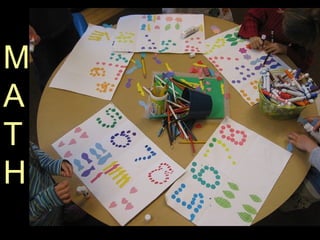
M
A
T
H
http://www.flickr.com/photos/maisonbisson/201844037/
5-8% of students are
identified as having
 Math disabilities
Where is the
   Breakdown?
                http://www.flickr.com/photos/doviende/403
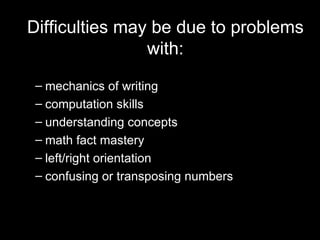
Difficulties may be due to problems
                with:
 – mechanics of writing
 – computation skills
 – understanding concepts
 – math fact mastery
 – left/right orientation
 – confusing or transposing numbers
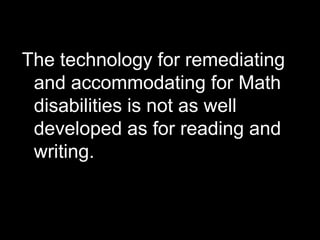
The technology for remediating
 and accommodating for Math
 disabilities is not as well
 developed as for reading and
 writing.

may see math disabilities in
 combination with reading
   disabilities or ADHD
Where is the breakdown?


Where is the
   Breakdown?
   http://farm4.staticflickr.com/3405/3270428419_5e15d6653f_z.jpg
Difficulties may be due
      to problems with:


Math Calculations – typically
 due to memory or cognitive
 difficulties
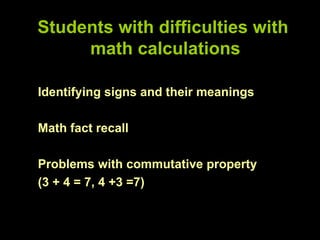
Students with difficulties with
     math calculations

Identifying signs and their meanings

Math fact recall

Problems with commutative property
(3 + 4 = 7, 4 +3 =7)
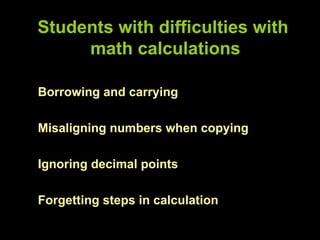
Students with difficulties with
     math calculations

Borrowing and carrying

Misaligning numbers when copying

Ignoring decimal points

Forgetting steps in calculation
Students with learning disabilities
    with math word problems
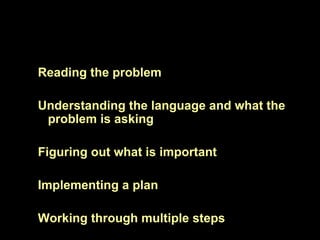
Reading the problem

Understanding the language and what the
 problem is asking

Figuring out what is important

Implementing a plan

Working through multiple steps
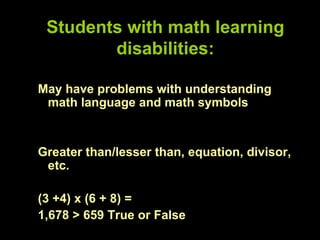
Students with math learning
        disabilities:

May have problems with understanding
 math language and math symbols


Greater than/lesser than, equation, divisor,
 etc.
(3 +4) x (6 + 8) =
1,678 > 659 True or False
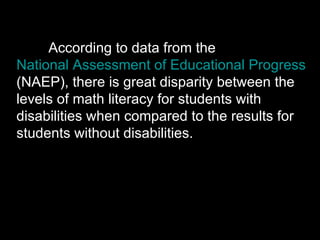
According to data from the
National Assessment of Educational Progress
(NAEP), there is great disparity between the
levels of math literacy for students with
disabilities when compared to the results for
students without disabilities.
Accessible Math Resources
Design Science

Universal Design for Math Learning:
Bridging the Technology and Policy Divide

Math Accessibility as Public Policy:
Why it Matters to Students with Disabilities
Where is the breakdown?


Where is the
   Breakdown?
   http://farm4.staticflickr.com/3405/3270428419_5e15d6653f_z.jpg
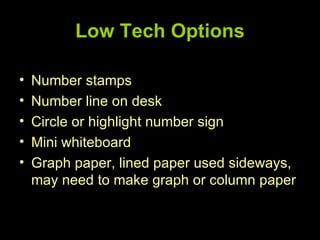
Low Tech Options

•   Number stamps
•   Number line on desk
•   Circle or highlight number sign
•   Mini whiteboard
•   Graph paper, lined paper used sideways,
    may need to make graph or column paper
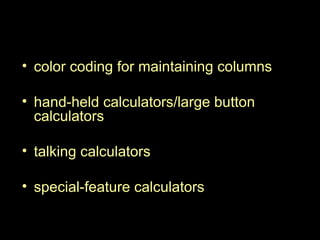
• color coding for maintaining columns

• hand-held calculators/large button
  calculators

• talking calculators

• special-feature calculators
Assistive Technology
       for Math

     Digitized textbooks
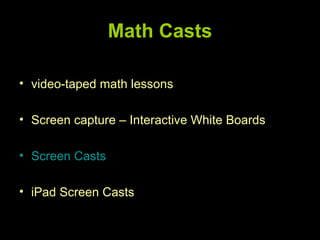
Math Casts

• video-taped math lessons

• Screen capture – Interactive White Boards

• Screen Casts

• iPad Screen Casts
Dicussion about
  Screencasts
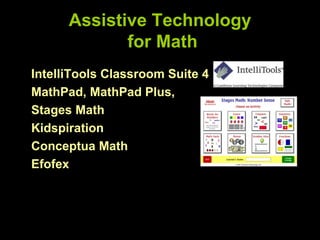
Assistive Technology
             for Math
IntelliTools Classroom Suite 4
MathPad, MathPad Plus,
Stages Math
Kidspiration
Conceptua Math
Efofex
Explore
Tech Matrix
Assistive Technology for
             Math
Free Online Tools

Udltechtoolkit.wikispaces.com
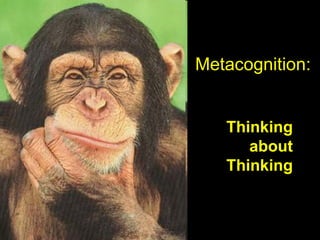
Metacognition:


   Thinking
      about
   Thinking
Executive Function (EF)


involves activating,
orchestrating, monitoring,
evaluating and adapting different
strategies to accomplish different
tasks.
It’s all about the Plan
Develop a PLAN of action
Maintain/Monitor the PLAN
Evaluate the PLAN
Plan
Plan
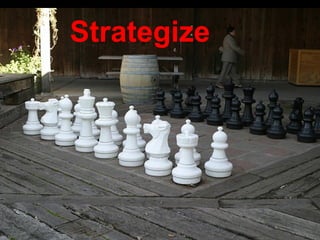
Strategize
Pl an B
Reflect
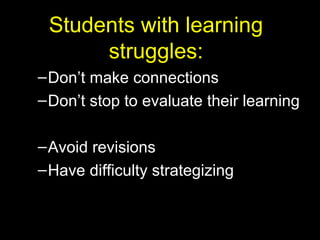
Students with learning
      struggles:
– Don’t make connections
– Don’t stop to evaluate their learning

– Avoid revisions
– Have difficulty strategizing
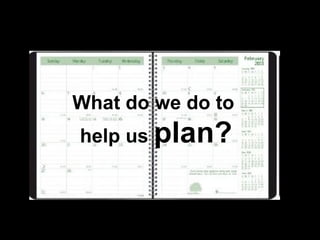
What do we do to
help us plan?
Teach
Strategies
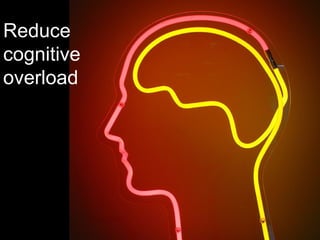
Reduce
cognitive
overload
Paperless


     What Does that Look like?
Promote
Independ
           Flexible,
ence
           Easy to
           Use
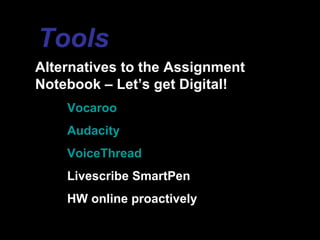
Tools
Alternatives to the Assignment
Notebook – Let’s get Digital!
    Vocaroo
    Audacity
    VoiceThread
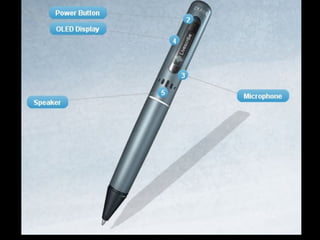
    Livescribe SmartPen
    HW online proactively
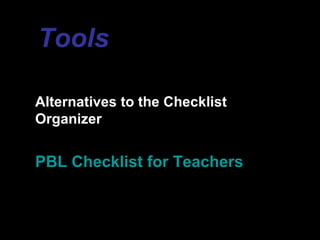
Tools

Alternatives to the Checklist
Organizer


PBL Checklist for Teachers
Tools

Alternatives

bit.ly/ATIAEF2
KEYS TO MEMORY
Repetition
      Importance of Use of:
                     Color
                 Graphics

          Teach in context
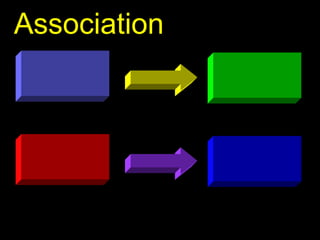
Association
Assistive
  Technology
  for
  Remembering
   and for
  Organization


http://img2.allposters.com/images/PTGPOD/327820b-FB.jpg
What do we do to help us
remember?
Where is the breakdown?


Where is the
   Breakdown?
   http://farm4.staticflickr.com/3405/3270428419_5e15d6653f_z.jpg
LOW TECH OPTIONS
Highlighters
index cards, post-it notes
color-coding
graph paper
beepers/buzzers

talking watches

timers
headphones or earplugs to shut out
 distractions

iPod/smartphones - allow the user to verbally
 store and retrieve information, use camera
 features
•   Visual Schedules
•   Visual Cues
•   Verbal Cues (“This is really imp.”)
•   Cell phones - to do or Did I? list with alarm
Calendar Tools
APPS
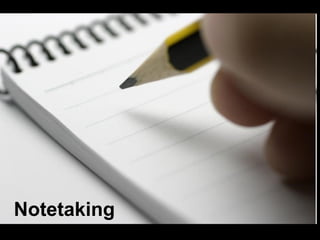
Notetaking
What do we do to help us
with notetaking?
•   Carbonless paper
•   Peer’s notes
•   Copies from teacher
•   Structured Outline to be filled out by
    student
• Two-column Templates in Word
• Student Historian summarizes on class
  blog or wiki
• Podcasting
• SmartBoard files
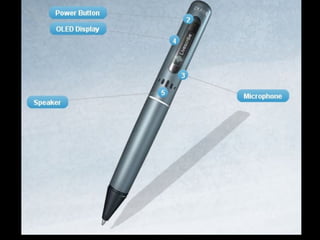
• Smart Pen
• Apps
What do we do to help us
      study?
• Inspiration – Collapse/expand

• Outline View in Microsoft

• Flash card sites/apps
Assistive Technology for
             Math
Free Online Tools

udltechtoolkit.wikispaces.com
newtonassistivetech.wikispaces.com
Explore
AT Assessment
Three Components


Information Gathering
Decision Making
Trial Use
IMPLEMENTATION
AT Assessment Guide
What have
  we learned?
Final Project
Evaluation


Final Thoughts?
To Infinity and beyond……….

Spnd 456 second weekend simmons 2012 math ef assessment