
GUIDED BY, SUBMITTED BY,
Mrs.RAFEEKHA M.J. ANCY RAJU
ASST.PROFESSOR S7 EC A
ECE DEPARTMENT ROLL NO:4
22-08-2014 1
 INTRODUCTION
 SPINTRONICS
 TOPOLOGICAL INSULATOR
 SMB6
 KONDO EFFECT
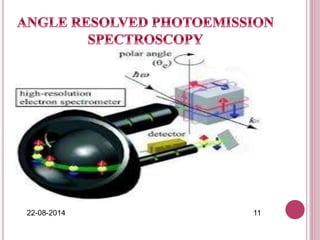
 ANGLE RESOLVED PHOTOEMISSION
SPECTROSCOPY
 ADVANTAGES
 DISADVANTAGES
 APPLICATIONS
 FUTURE SCOPE
 CONCLUSION
 REFERENCES
22-08-2014 2
 The discovery of new materials with novel
properties is one of the most fascinating aspects of
physics.
 Such findings lead to new research area in
spintronics
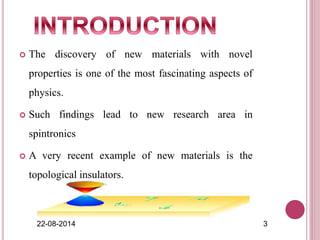
 A very recent example of new materials is the
topological insulators.
22-08-2014 3
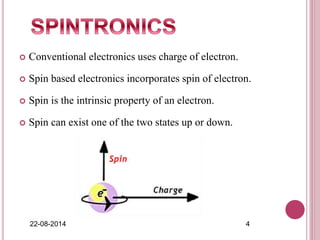
 Conventional electronics uses charge of electron.
 Spin based electronics incorporates spin of electron.
 Spin is the intrinsic property of an electron.
 Spin can exist one of the two states up or down.
22-08-2014 4
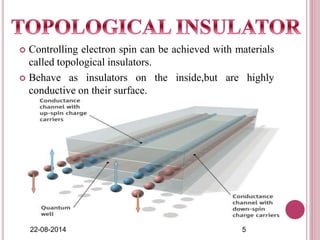
 Controlling electron spin can be achieved with materials
called topological insulators.
 Behave as insulators on the inside,but are highly
conductive on their surface.
22-08-2014 5
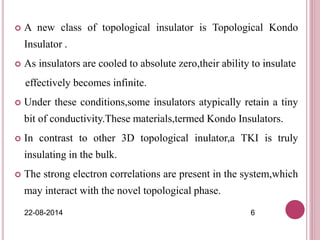
 A new class of topological insulator is Topological Kondo
Insulator .
 As insulators are cooled to absolute zero,their ability to insulate
effectively becomes infinite.
 Under these conditions,some insulators atypically retain a tiny
bit of conductivity.These materials,termed Kondo Insulators.
 In contrast to other 3D topological inulator,a TKI is truly
insulating in the bulk.
 The strong electron correlations are present in the system,which
may interact with the novel topological phase.
22-08-2014 6
22-08-2014 7
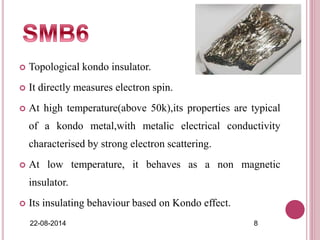
 Topological kondo insulator.
 It directly measures electron spin.
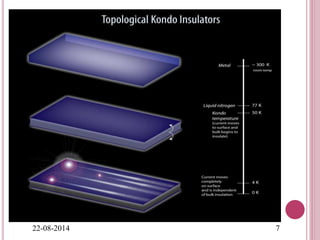
 At high temperature(above 50k),its properties are typical
of a kondo metal,with metalic electrical conductivity
characterised by strong electron scattering.
 At low temperature, it behaves as a non magnetic
insulator.
 Its insulating behaviour based on Kondo effect.
22-08-2014 8
 Scattering of conduction electrons in a metal due to magnetic
impurities resulting a charateristics change in resistivity with
temperature.
 The effect arises from the interaction between a single
magnetic atom such as cobalt,and the many electrons in an
otherwise non-magnetic metal.
22-08-2014 9
 Such an impurity typically has an intrinsic spin that
interact with the electron.
 It prevents the flow of electrons from being
destroyed by irrgularities in the metal structure
 Making SmB6 a very robust and efficient
topological ‘kondo insulator.
22-08-2014 10
22-08-2014 11
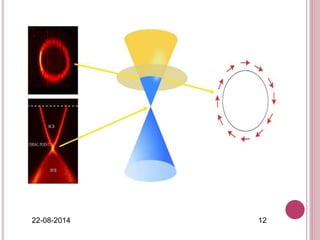
22-08-2014 12
 Can control electron spin.
 Increasing memory storage capacity.
 Increasing processing power.
 Consume less power.
22-08-2014 1 3
 Manufacturing and implementing topological insulator
materials has been limited.
22-08-2014 14
 Ultra low power electronics and spintronics devices.
 Optoelectronic applications.
 Memory storage and magnetic sensor applications.
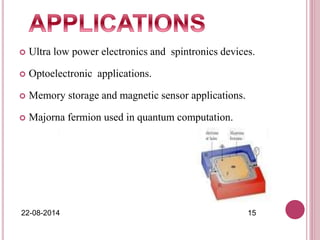
 Majorna fermion used in quantum computation.
22-08-2014 15
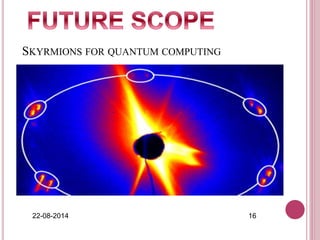
SKYRMIONS FOR QUANTUM COMPUTING
22-08-2014 16
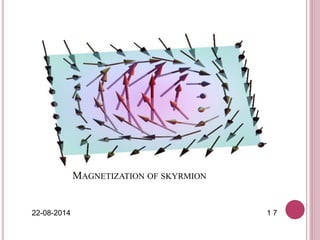
MAGNETIZATION OF SKYRMION
22-08-2014 1 7
 The research on today on the topological insulators
materials.
 It is the best mechanism for creating ever smaller and
faster devices.
 It offers an exciting stepping –stone into the a new era of
technologies.
22-08-2014 1 8
 Nature Communication 30 July 2014 Ecole Polytechnique,
Federale de Lausanne.
 Josh Schaefferkotter,Introduction of spintronics(2007).
 Ando.Y ,Topological insulator materials(2013).
 M Z Hasen and C L Kane (2010) Colloqium:topological
Insulators.
 J E Moore (2010), The birth of Topological insulator
22-08-2014 19
Topological spintronics

Topological spintronics

  • 2.
    GUIDED BY, SUBMITTEDBY, Mrs.RAFEEKHA M.J. ANCY RAJU ASST.PROFESSOR S7 EC A ECE DEPARTMENT ROLL NO:4 22-08-2014 1
  • 3.
     INTRODUCTION  SPINTRONICS TOPOLOGICAL INSULATOR  SMB6  KONDO EFFECT  ANGLE RESOLVED PHOTOEMISSION SPECTROSCOPY  ADVANTAGES  DISADVANTAGES  APPLICATIONS  FUTURE SCOPE  CONCLUSION  REFERENCES 22-08-2014 2
  • 4.
     The discoveryof new materials with novel properties is one of the most fascinating aspects of physics.  Such findings lead to new research area in spintronics  A very recent example of new materials is the topological insulators. 22-08-2014 3
  • 5.
     Conventional electronicsuses charge of electron.  Spin based electronics incorporates spin of electron.  Spin is the intrinsic property of an electron.  Spin can exist one of the two states up or down. 22-08-2014 4
  • 6.
     Controlling electronspin can be achieved with materials called topological insulators.  Behave as insulators on the inside,but are highly conductive on their surface. 22-08-2014 5
  • 7.
     A newclass of topological insulator is Topological Kondo Insulator .  As insulators are cooled to absolute zero,their ability to insulate effectively becomes infinite.  Under these conditions,some insulators atypically retain a tiny bit of conductivity.These materials,termed Kondo Insulators.  In contrast to other 3D topological inulator,a TKI is truly insulating in the bulk.  The strong electron correlations are present in the system,which may interact with the novel topological phase. 22-08-2014 6
  • 8.
  • 9.
     Topological kondoinsulator.  It directly measures electron spin.  At high temperature(above 50k),its properties are typical of a kondo metal,with metalic electrical conductivity characterised by strong electron scattering.  At low temperature, it behaves as a non magnetic insulator.  Its insulating behaviour based on Kondo effect. 22-08-2014 8
  • 10.
     Scattering ofconduction electrons in a metal due to magnetic impurities resulting a charateristics change in resistivity with temperature.  The effect arises from the interaction between a single magnetic atom such as cobalt,and the many electrons in an otherwise non-magnetic metal. 22-08-2014 9
  • 11.
     Such animpurity typically has an intrinsic spin that interact with the electron.  It prevents the flow of electrons from being destroyed by irrgularities in the metal structure  Making SmB6 a very robust and efficient topological ‘kondo insulator. 22-08-2014 10
  • 12.
  • 13.
  • 14.
     Can controlelectron spin.  Increasing memory storage capacity.  Increasing processing power.  Consume less power. 22-08-2014 1 3
  • 15.
     Manufacturing andimplementing topological insulator materials has been limited. 22-08-2014 14
  • 16.
     Ultra lowpower electronics and spintronics devices.  Optoelectronic applications.  Memory storage and magnetic sensor applications.  Majorna fermion used in quantum computation. 22-08-2014 15
  • 17.
    SKYRMIONS FOR QUANTUMCOMPUTING 22-08-2014 16
  • 18.
  • 19.
     The researchon today on the topological insulators materials.  It is the best mechanism for creating ever smaller and faster devices.  It offers an exciting stepping –stone into the a new era of technologies. 22-08-2014 1 8
  • 20.
     Nature Communication30 July 2014 Ecole Polytechnique, Federale de Lausanne.  Josh Schaefferkotter,Introduction of spintronics(2007).  Ando.Y ,Topological insulator materials(2013).  M Z Hasen and C L Kane (2010) Colloqium:topological Insulators.  J E Moore (2010), The birth of Topological insulator 22-08-2014 19