Spinal versus General Anesthesia in
Cesarean Section
A comparative study
BY
Reema sareb Akram abo Agaga Marwa alkarbash Essra ayad
Supervised by Dr . Ryadh Edriss Belkhiria
**Acknowledgement**
• We would like to express our gratitude for
everyone who helped us during the graduation
project.
• supervisor Dr.Ryadh Edriss
• Dr. Kawthar Aboukraa
And
• the head of department Dr Fatma Lashkham
• The members of the jury
• To all our doctors ,friends and especially our
families
Introduction
• Definition Cesarean section:
• Abdominal delivery/major surgery(1).
• intervention for preventing maternal and
neonatal mortality,and morbidity(8).
• associated with several complications (4).
• an increase in C-section rates of up to 60%
(5,6,7)
HISTORY :
• 1885 Corning - First attempt with epidural
cocaine
• 1901 use of cocaine as an epidural agent for
humans and dogs Alternative to general
anesthesia
• 1921 Pagis - First lumbar anesthesia for surgery
• 1947 Lidocaine commercially available
• 1979 Cousins - Epidural opioids provide
analgesia
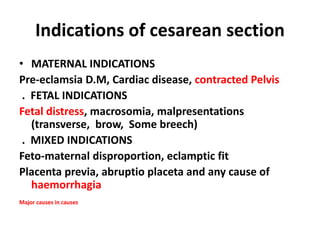
Indications of cesarean section
• MATERNAL INDICATIONS
Pre-eclamsia D.M, Cardiac disease, contracted Pelvis
. FETAL INDICATIONS
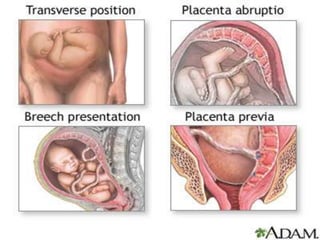
Fetal distress, macrosomia, malpresentations
(transverse, brow, Some breech)
. MIXED INDICATIONS
Feto-maternal disproportion, eclamptic fit
Placenta previa, abruptio placeta and any cause of
haemorrhagia
Major causes in causes
Contraindication of cesarean section
• No absolute Contraindication( C/I) of
cesarean section
• Relative C/I:
• fetal death or severe malformations with
possible vaginal delivery
• situations in risk with general anesthesia
Choice of procedure:
• The anesthesiologist has the
master decision in the choice
between general anesthesia or
spinal block, according to the
choice of the patient.
Choice’
• The anesthesiologist must choose
the safest and most comfortable
method for the mother, and the
least depressant process for the
newborn (72)
Aim of the study
• compare the advantages &
disadvantages and complication of
general versus spinal anesthesia in
Cesarean section and try to find out
the best procedure in relationship
with the indication
Advantage
• Anesthetic methods used during
cesarean section have advantages
and disadvantages to both mothers
and neonates, and may result in
short- and long-term neonatal
effects.
Advantage general
• 1. Speed of induction
• 2. Reliability
• 3. Reproducibility
• 4. Controllability
• 5. Avoidance of hypotension (75).
Advantage general
• RAPIDTY: Extreme emergencies: situations where
there is necessity to end the pregnancy or deliver
the baby immediately as during eclamptic fit,
great heamorrhage or shocked patient……….
• Adequat analgesia
• Muscle relaxation
• less associated hypotension
• Situation when spinal puncture is
contraindicated: spine malformation, infection
hypotension……
Advantage spinal
• 1. Simplicity of technique
• 2. Speed of induction (in contrast to an
epidural block)
• 3. Reliability
• 4. Minimal fetal exposure to the drug(s)
• 5. An awake parturient
• 6. Minimization of the hazards of aspiration
(78).
Advantage spinal
• No potential problems as during GA
may occur including pulmonary
aspiration of gastric content, failed
intubation, maternal
hyperventilation, neonatal
depression, maternal awareness and
uterine atony
disadvantages of general anesthesia
• 1. maternal aspiration
• 2. Problems of airway management
• 3. Narcotization of the newborn
• 4. Maternal awareness during light
general anesthesia (81).
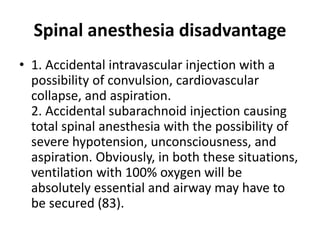
Spinal anesthesia disadvantage
• 1. Accidental intravascular injection with a
possibility of convulsion, cardiovascular
collapse, and aspiration.
2. Accidental subarachnoid injection causing
total spinal anesthesia with the possibility of
severe hypotension, unconsciousness, and
aspiration. Obviously, in both these situations,
ventilation with 100% oxygen will be
absolutely essential and airway may have to
be secured (83).
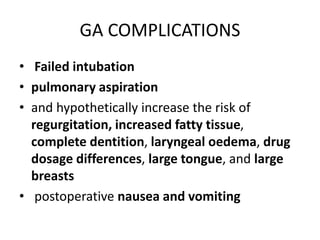
GA COMPLICATIONS
• Failed intubation
• pulmonary aspiration
• and hypothetically increase the risk of
regurgitation, increased fatty tissue,
complete dentition, laryngeal oedema, drug
dosage differences, large tongue, and large
breasts
• postoperative nausea and vomiting
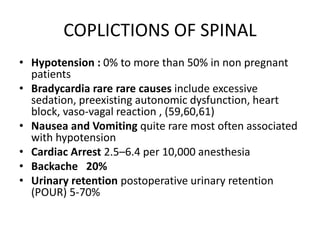
COPLICTIONS OF SPINAL
• Hypotension : 0% to more than 50% in non pregnant
patients
• Bradycardia rare rare causes include excessive
sedation, preexisting autonomic dysfunction, heart
block, vaso-vagal reaction , (59,60,61)
• Nausea and Vomiting quite rare most often associated
with hypotension
• Cardiac Arrest 2.5–6.4 per 10,000 anesthesia
• Backache 20%
• Urinary retention postoperative urinary retention
(POUR) 5-70%
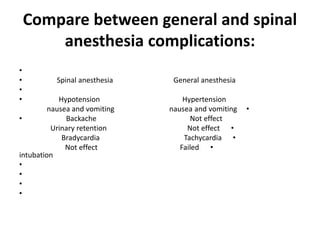
Compare between general and spinal
anesthesia complications:
•
• Spinal anesthesia General anesthesia
•
• Hypotension Hypertension
•nausea and vomiting nausea and vomiting
• Backache Not effect
•Urinary retention Not effect
•Bradycardia Tachycardia
•Not effect Failed
intubation
•
•
•
•
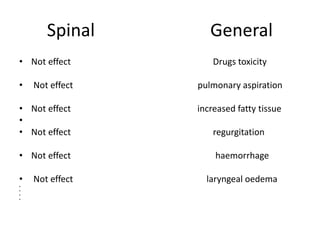
Spinal General
• Not effect Drugs toxicity
• Not effect pulmonary aspiration
• Not effect increased fatty tissue
•
• Not effect regurgitation
• Not effect haemorrhage
• Not effect laryngeal oedema
•
•
•
•
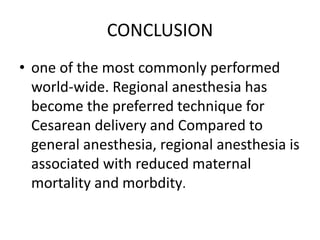
CONCLUSION
• one of the most commonly performed
world-wide. Regional anesthesia has
become the preferred technique for
Cesarean delivery and Compared to
general anesthesia, regional anesthesia is
associated with reduced maternal
mortality and morbdity.
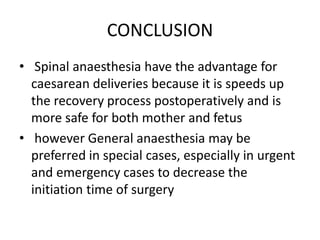
CONCLUSION
• Spinal anaesthesia have the advantage for
caesarean deliveries because it is speeds up
the recovery process postoperatively and is
more safe for both mother and fetus
• however General anaesthesia may be
preferred in special cases, especially in urgent
and emergency cases to decrease the
initiation time of surgery
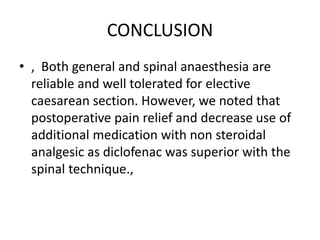
CONCLUSION
• , Both general and spinal anaesthesia are
reliable and well tolerated for elective
caesarean section. However, we noted that
postoperative pain relief and decrease use of
additional medication with non steroidal
analgesic as diclofenac was superior with the
spinal technique.,
CONCLUSION
• . We have the opinion that spinal anesthesia is
superior to general anesthesia in terms of
fetal wellbeing
• . Furthermore, with regard to pregnancies
with fetal problems, we consider that it would
be more appropriate to prefer the method of
spinal anesthesia by taking first minute Apgar
scores into account
CONCLUSION OF THE CONCLUSION
• spinal anesthesia the anesthetic method-of-
choice for cesarean sections. Subarachnoid
block (SAB) is considered simpler and safer
than other techniques of anaesthesia for
caesarean delivery and is, therefore, the
technique of choice of most
anaesthesiologists.
Recommendation for future study
• Recommend Research about
modern technique and less
complication in spinal anesthesia
and recommend patient chose
spinal technique .
THANK YOU

Spinal versus general anesthesia in cesarean section

  • 1.
    Spinal versus GeneralAnesthesia in Cesarean Section A comparative study BY Reema sareb Akram abo Agaga Marwa alkarbash Essra ayad Supervised by Dr . Ryadh Edriss Belkhiria
  • 2.
    **Acknowledgement** • We wouldlike to express our gratitude for everyone who helped us during the graduation project. • supervisor Dr.Ryadh Edriss • Dr. Kawthar Aboukraa And • the head of department Dr Fatma Lashkham • The members of the jury • To all our doctors ,friends and especially our families
  • 3.
    Introduction • Definition Cesareansection: • Abdominal delivery/major surgery(1). • intervention for preventing maternal and neonatal mortality,and morbidity(8). • associated with several complications (4). • an increase in C-section rates of up to 60% (5,6,7)
  • 5.
    HISTORY : • 1885Corning - First attempt with epidural cocaine • 1901 use of cocaine as an epidural agent for humans and dogs Alternative to general anesthesia • 1921 Pagis - First lumbar anesthesia for surgery • 1947 Lidocaine commercially available • 1979 Cousins - Epidural opioids provide analgesia
  • 6.
    Indications of cesareansection • MATERNAL INDICATIONS Pre-eclamsia D.M, Cardiac disease, contracted Pelvis . FETAL INDICATIONS Fetal distress, macrosomia, malpresentations (transverse, brow, Some breech) . MIXED INDICATIONS Feto-maternal disproportion, eclamptic fit Placenta previa, abruptio placeta and any cause of haemorrhagia Major causes in causes
  • 8.
    Contraindication of cesareansection • No absolute Contraindication( C/I) of cesarean section • Relative C/I: • fetal death or severe malformations with possible vaginal delivery • situations in risk with general anesthesia
  • 9.
    Choice of procedure: •The anesthesiologist has the master decision in the choice between general anesthesia or spinal block, according to the choice of the patient.
  • 10.
    Choice’ • The anesthesiologistmust choose the safest and most comfortable method for the mother, and the least depressant process for the newborn (72)
  • 11.
    Aim of thestudy • compare the advantages & disadvantages and complication of general versus spinal anesthesia in Cesarean section and try to find out the best procedure in relationship with the indication
  • 12.
    Advantage • Anesthetic methodsused during cesarean section have advantages and disadvantages to both mothers and neonates, and may result in short- and long-term neonatal effects.
  • 13.
    Advantage general • 1.Speed of induction • 2. Reliability • 3. Reproducibility • 4. Controllability • 5. Avoidance of hypotension (75).
  • 14.
    Advantage general • RAPIDTY:Extreme emergencies: situations where there is necessity to end the pregnancy or deliver the baby immediately as during eclamptic fit, great heamorrhage or shocked patient………. • Adequat analgesia • Muscle relaxation • less associated hypotension • Situation when spinal puncture is contraindicated: spine malformation, infection hypotension……
  • 15.
    Advantage spinal • 1.Simplicity of technique • 2. Speed of induction (in contrast to an epidural block) • 3. Reliability • 4. Minimal fetal exposure to the drug(s) • 5. An awake parturient • 6. Minimization of the hazards of aspiration (78).
  • 16.
    Advantage spinal • Nopotential problems as during GA may occur including pulmonary aspiration of gastric content, failed intubation, maternal hyperventilation, neonatal depression, maternal awareness and uterine atony
  • 17.
    disadvantages of generalanesthesia • 1. maternal aspiration • 2. Problems of airway management • 3. Narcotization of the newborn • 4. Maternal awareness during light general anesthesia (81).
  • 18.
    Spinal anesthesia disadvantage •1. Accidental intravascular injection with a possibility of convulsion, cardiovascular collapse, and aspiration. 2. Accidental subarachnoid injection causing total spinal anesthesia with the possibility of severe hypotension, unconsciousness, and aspiration. Obviously, in both these situations, ventilation with 100% oxygen will be absolutely essential and airway may have to be secured (83).
  • 19.
    GA COMPLICATIONS • Failedintubation • pulmonary aspiration • and hypothetically increase the risk of regurgitation, increased fatty tissue, complete dentition, laryngeal oedema, drug dosage differences, large tongue, and large breasts • postoperative nausea and vomiting
  • 20.
    COPLICTIONS OF SPINAL •Hypotension : 0% to more than 50% in non pregnant patients • Bradycardia rare rare causes include excessive sedation, preexisting autonomic dysfunction, heart block, vaso-vagal reaction , (59,60,61) • Nausea and Vomiting quite rare most often associated with hypotension • Cardiac Arrest 2.5–6.4 per 10,000 anesthesia • Backache 20% • Urinary retention postoperative urinary retention (POUR) 5-70%
  • 21.
    Compare between generaland spinal anesthesia complications: • • Spinal anesthesia General anesthesia • • Hypotension Hypertension •nausea and vomiting nausea and vomiting • Backache Not effect •Urinary retention Not effect •Bradycardia Tachycardia •Not effect Failed intubation • • • •
  • 22.
    Spinal General • Noteffect Drugs toxicity • Not effect pulmonary aspiration • Not effect increased fatty tissue • • Not effect regurgitation • Not effect haemorrhage • Not effect laryngeal oedema • • • •
  • 23.
    CONCLUSION • one ofthe most commonly performed world-wide. Regional anesthesia has become the preferred technique for Cesarean delivery and Compared to general anesthesia, regional anesthesia is associated with reduced maternal mortality and morbdity.
  • 24.
    CONCLUSION • Spinal anaesthesiahave the advantage for caesarean deliveries because it is speeds up the recovery process postoperatively and is more safe for both mother and fetus • however General anaesthesia may be preferred in special cases, especially in urgent and emergency cases to decrease the initiation time of surgery
  • 25.
    CONCLUSION • , Bothgeneral and spinal anaesthesia are reliable and well tolerated for elective caesarean section. However, we noted that postoperative pain relief and decrease use of additional medication with non steroidal analgesic as diclofenac was superior with the spinal technique.,
  • 26.
    CONCLUSION • . Wehave the opinion that spinal anesthesia is superior to general anesthesia in terms of fetal wellbeing • . Furthermore, with regard to pregnancies with fetal problems, we consider that it would be more appropriate to prefer the method of spinal anesthesia by taking first minute Apgar scores into account
  • 27.
    CONCLUSION OF THECONCLUSION • spinal anesthesia the anesthetic method-of- choice for cesarean sections. Subarachnoid block (SAB) is considered simpler and safer than other techniques of anaesthesia for caesarean delivery and is, therefore, the technique of choice of most anaesthesiologists.
  • 28.
    Recommendation for futurestudy • Recommend Research about modern technique and less complication in spinal anesthesia and recommend patient chose spinal technique .
  • 29.