Ala’a Fadhel Hassan
Al Mahmoudia G. Hospital
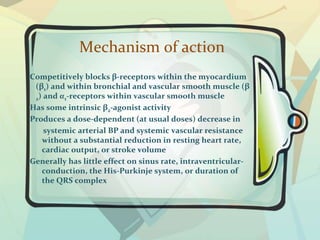
Mechanism of action
Competitively blocks β-receptors within the myocardium
(β1) and within bronchial and vascular smooth muscle (β
2) and α1-receptors within vascular smooth muscle
Has some intrinsic β2-agonist activity
Produces a dose-dependent (at usual doses) decrease in
systemic arterial BP and systemic vascular resistance
without a substantial reduction in resting heart rate,
cardiac output, or stroke volume
Generally has little effect on sinus rate, intraventricular-
conduction, the His-Purkinje system, or duration of
the QRS complex
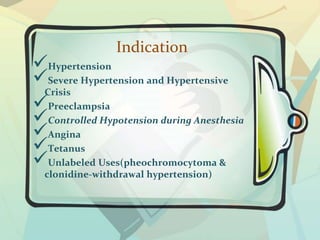
Indication
Hypertension
Severe Hypertension and Hypertensive
Crisis
Preeclampsia
Controlled Hypotension during Anesthesia
Angina
Tetanus
Unlabeled Uses(pheochromocytoma &
clonidine-withdrawal hypertension)
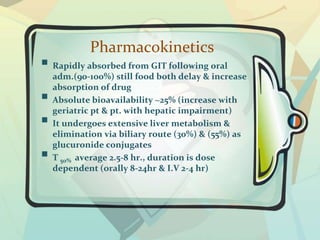
Pharmacokinetics
 Rapidly absorbed from GIT following oral
adm.(90-100%) still food both delay & increase
absorption of drug
 Absolute bioavailability ~25% (increase with
geriatric pt & pt. with hepatic impairment)
 It undergoes extensive liver metabolism &
elimination via biliary route (30%) & (55%) as
glucuronide conjugates
 T 50% average 2.5-8 hr., duration is dose
dependent (orally 8-24hr & I.V 2-4 hr)
Adverse effect
Mentioned adverse effects associated
with
CNS
CVS
GIT & hepatic
Genitourinary tract
 Respiratory tract
Dermatologic
EENT
Contraindications
Bronchial asthma; overt cardiac failure;
greater than first-degree heart block;
cardiogenic shock; severe
bradycardia; conditions associated
with severe and prolonged
hypotension; history of obstructive
airway disease, including asthma;
hypersensitivity to any component of
the product.

Labetalol HCl

  • 1.
    Ala’a Fadhel Hassan AlMahmoudia G. Hospital
  • 2.
    Mechanism of action Competitivelyblocks β-receptors within the myocardium (β1) and within bronchial and vascular smooth muscle (β 2) and α1-receptors within vascular smooth muscle Has some intrinsic β2-agonist activity Produces a dose-dependent (at usual doses) decrease in systemic arterial BP and systemic vascular resistance without a substantial reduction in resting heart rate, cardiac output, or stroke volume Generally has little effect on sinus rate, intraventricular- conduction, the His-Purkinje system, or duration of the QRS complex
  • 3.
    Indication Hypertension Severe Hypertension andHypertensive Crisis Preeclampsia Controlled Hypotension during Anesthesia Angina Tetanus Unlabeled Uses(pheochromocytoma & clonidine-withdrawal hypertension)
  • 4.
    Pharmacokinetics  Rapidly absorbedfrom GIT following oral adm.(90-100%) still food both delay & increase absorption of drug  Absolute bioavailability ~25% (increase with geriatric pt & pt. with hepatic impairment)  It undergoes extensive liver metabolism & elimination via biliary route (30%) & (55%) as glucuronide conjugates  T 50% average 2.5-8 hr., duration is dose dependent (orally 8-24hr & I.V 2-4 hr)
  • 5.
    Adverse effect Mentioned adverseeffects associated with CNS CVS GIT & hepatic Genitourinary tract  Respiratory tract Dermatologic EENT
  • 6.
    Contraindications Bronchial asthma; overtcardiac failure; greater than first-degree heart block; cardiogenic shock; severe bradycardia; conditions associated with severe and prolonged hypotension; history of obstructive airway disease, including asthma; hypersensitivity to any component of the product.