Henry Simonds,
Communications and Buildings
Planet Positive


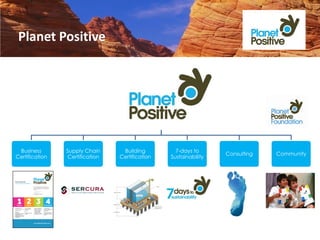
 Business       Supply Chain                Building                                7-days to
                                                                                                   Consulting   Community
Certification   Certification              Certification                          Sustainability


                                                                   Fitout


                                Superstructure

                                                  Operations


                                Substructure
                                                               External Areas /
                                                                Infrastructure


                                Foundations
Planet Positive
Clients & Partners
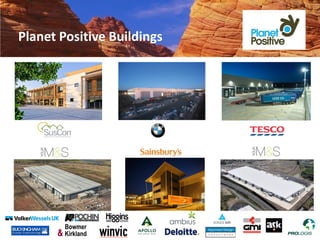
Planet Positive Buildings
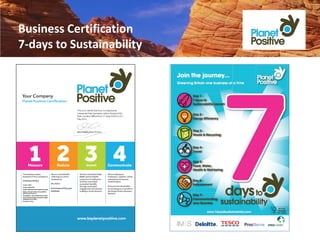
Business Certification
7-days to Sustainability
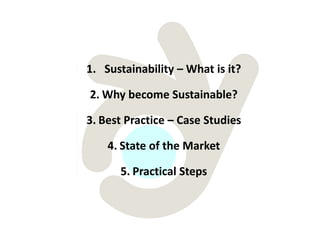
1. Sustainability – What is it?

2. Why become Sustainable?

3. Best Practice – Case Studies

    4. State of the Market

      5. Practical Steps
What is Sustainability?
Sustainability – What is it?


     Sustainable Development is “development
    that meets the needs of the present without
         compromising the ability of future
       generations to meet their own needs”.
             Bruntland Report 1987
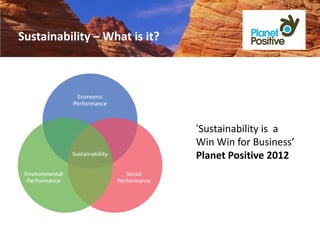
Sustainability – What is it?


                               ‘Sustainability is a
                               Win Win for Business’
                               Planet Positive 2012
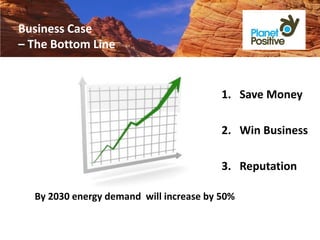
Business Case
– The Bottom Line


                                         1. Save Money

                                         2. Win Business

                                         3. Reputation

  By 2030 energy demand will increase by 50%
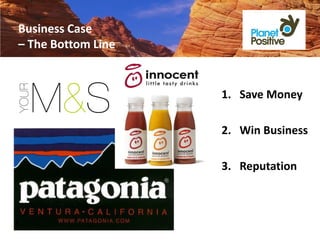
Business Case
– The Bottom Line


                    1. Save Money

                    2. Win Business

                    3. Reputation
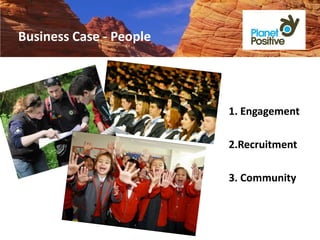
Business Case - People


                         1. Engagement

                         2.Recruitment

                         3. Community
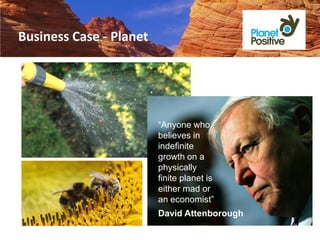
Business Case - Planet


                         “Anyone who
                         believes in
                         indefinite
                         growth on a
                         physically
                         finite planet is
                         either mad or
                         an economist”
                         David Attenborough
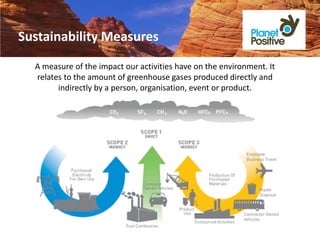
Sustainability Measures
  A measure of the impact our activities have on the environment. It
  relates to the amount of greenhouse gases produced directly and
        indirectly by a person, organisation, event or product.
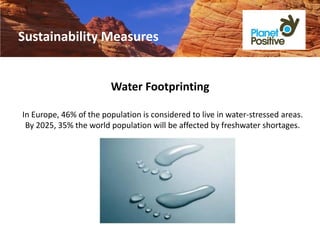
Sustainability Measures


                        Water Footprinting

In Europe, 46% of the population is considered to live in water-stressed areas.
 By 2025, 35% the world population will be affected by freshwater shortages.
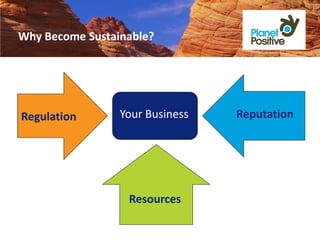
Why Become Sustainable?


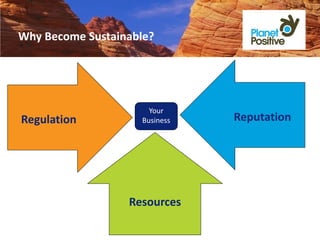
Regulation       Your Business   Reputation


                  Resources
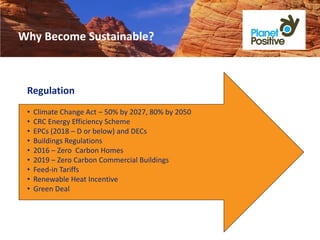
Why Become Sustainable?


 Regulation
 •   Climate Change Act – 50% by 2027, 80% by 2050
 •   CRC Energy Efficiency Scheme
 •   EPCs (2018 – D or below) and DECs
 •   Buildings Regulations
 •   2016 – Zero Carbon Homes
 •   2019 – Zero Carbon Commercial Buildings
 •   Feed-in Tariffs
 •   Renewable Heat Incentive
 •   Green Deal
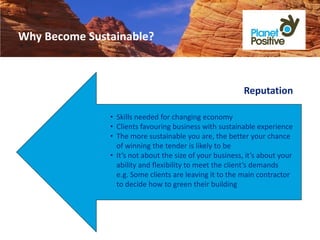
Why Become Sustainable?


                                                          Reputation

               • Skills needed for changing economy
               • Clients favouring business with sustainable experience
               • The more sustainable you are, the better your chance
                 of winning the tender is likely to be
               • It’s not about the size of your business, it’s about your
                 ability and flexibility to meet the client’s demands
                 e.g. Some clients are leaving it to the main contractor
                 to decide how to green their building
Why Become Sustainable?


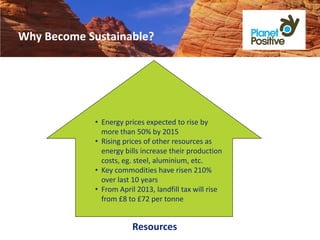
             • Energy prices expected to rise by
               more than 50% by 2015
             • Rising prices of other resources as
               energy bills increase their production
               costs, eg. steel, aluminium, etc.
             • Key commodities have risen 210%
               over last 10 years
             • From April 2013, landfill tax will rise
               from £8 to £72 per tonne


                         Resources
Why Become Sustainable?


                      Your
Regulation          Business   Reputation


                  Resources
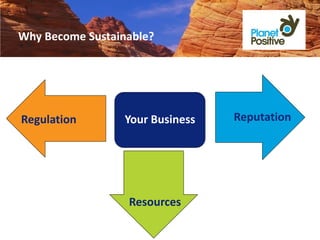
Why Become Sustainable?


Regulation        Your Business   Reputation


                  Resources
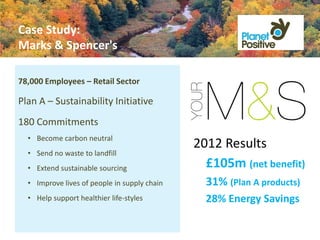
Case Study:
Marks & Spencer's

78,000 Employees – Retail Sector

Plan A – Sustainability Initiative
180 Commitments
  • Become carbon neutral
                                              2012 Results
  • Send no waste to landfill
  • Extend sustainable sourcing                 £105m (net benefit)
  • Improve lives of people in supply chain     31% (Plan A products)
  • Help support healthier life-styles          28% Energy Savings
Case Study:
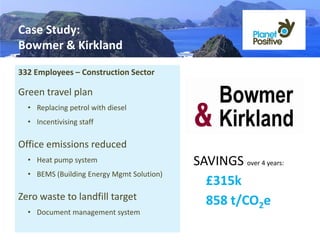
Bowmer & Kirkland
332 Employees – Construction Sector

Green travel plan
  • Replacing petrol with diesel
  • Incentivising staff

Office emissions reduced
  • Heat pump system                       SAVINGS over 4 years:
  • BEMS (Building Energy Mgmt Solution)
                                             £315k
Zero waste to landfill target                858 t/CO2e
  • Document management system
Case Study
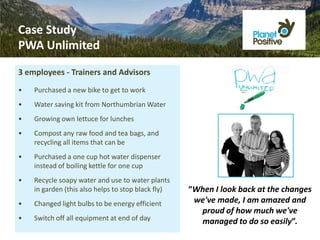
PWA Unlimited
3 employees - Trainers and Advisors
•   Purchased a new bike to get to work
•   Water saving kit from Northumbrian Water
•   Growing own lettuce for lunches
•   Compost any raw food and tea bags, and
    recycling all items that can be
•   Purchased a one cup hot water dispenser
    instead of boiling kettle for one cup
•   Recycle soapy water and use to water plants
    in garden (this also helps to stop black fly)   “When I look back at the changes
•   Changed light bulbs to be energy efficient       we've made, I am amazed and
                                                      proud of how much we've
•   Switch off all equipment at end of day            managed to do so easily”.
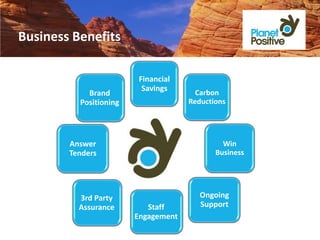
Business Benefits

                         Financial
                          Savings
            Brand                      Carbon
          Positioning                Reductions


        Answer                                Win
        Tenders                             Business


          3rd Party                     Ongoing
          Assurance        Staff        Support
                        Engagement
State of the Market
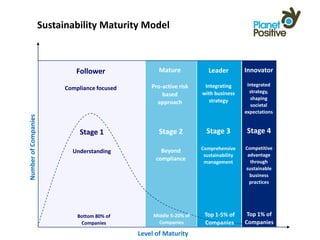
Sustainability Maturity Model


                               Follower                 Mature             Leader         Innovator

                                                     Pro-active risk     Integrating       Integrated
                            Compliance focused
                                                                        with business       strategy,
                                                         based
                                                                           strategy          shaping
                                                       approach                              societal
                                                                                          expectations
Number of Companies


                                 Stage 1                Stage 2           Stage 3          Stage 4

                                                                        Comprehensive     Competitive
                              Understanding              Beyond
                                                                         sustainability    advantage
                                                       compliance                           through
                                                                         management
                                                                                          sustainable
                                                                                            business
                                                                                            practices


                                Bottom 80% of         Middle 5-20% of    Top 1-5% of       Top 1% of
                                 Companies              Companies        Companies        Companies
                                                 Level of Maturity
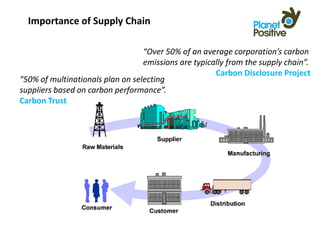
Importance of Supply Chain

                                  “Over 50% of an average corporation’s carbon
                                  emissions are typically from the supply chain”.
                                                      Carbon Disclosure Project
“50% of multinationals plan on selecting
suppliers based on carbon performance”.
Carbon Trust
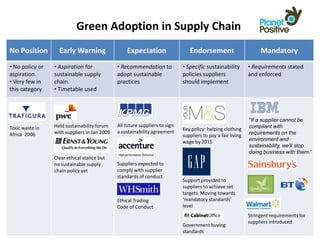
Green Adoption in Supply Chain
No Position        Early Warning                  Expectation                   Endorsement                        Mandatory
• No policy or   • Aspiration for             • Recommendation to            • Specific sustainability        • Requirements stated
aspiration.      sustainable supply           adopt sustainable              policies suppliers               and enforced
• Very few in    chain.                       practices                      should implement
this category    • Timetable used


                                                                                                              “If a supplier cannot be
                 Held sustainability forum    All future suppliers to sign                                    compliant with
Toxic waste in                                                               Key policy: helping clothing
                 with suppliers in Jan 2009   a sustainability agreement                                      requirements on the
Africa 2006                                                                  suppliers to pay a fair living
                                                                             wage by 2015                     environment and
                                                                                                              sustainability, we’ll stop
                                                                                                              doing business with them.”
                 Clear ethical stance but
                 no sustainable supply        Suppliers expected to
                 chain policy yet             comply with supplier
                                              standards of conduct
                                                                             Support provided to
                                                                             suppliers to achieve set
                                                                             targets. Moving towards
                                              Ethical Trading                ‘mandatory standards’
                                              Code of Conduct                level
                                                                                                              Stringent requirements for
                                                                                                              suppliers introduced
                                                                             Government buying
                                                                             standards
Practical Steps
What can you do?
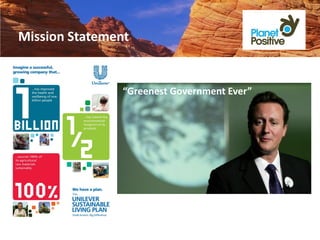
Mission Statement


                “Greenest Government Ever”


                                    www.beplanetpositive.com
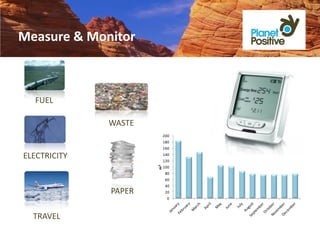
Measure & Monitor


  FUEL

              WASTE
                           200
                           180
                           160

ELECTRICITY           m3
                           140
                           120
                           100
                            80
                            60
                            40
              PAPER         20
                             0


  TRAVEL
Transparent


              “Greenest Government
              Ever”
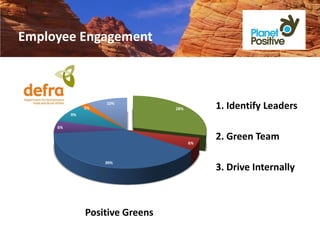
Employee Engagement


               2%
                    10%
                                 28%        1. Identify Leaders
          9%

     6%


                                       6%
                                            2. Green Team

                    39%
                                            3. Drive Internally


               Positive Greens
                                              www.beplanetpositive.com
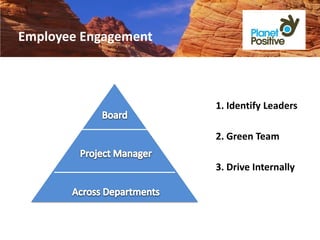
Employee Engagement


                      1. Identify Leaders

                      2. Green Team

                      3. Drive Internally


                        www.beplanetpositive.com
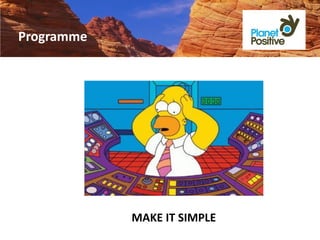
Programme


            MAKE IT SIMPLE
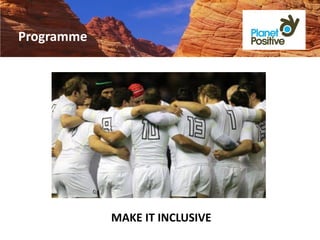
Programme


            MAKE IT INCLUSIVE
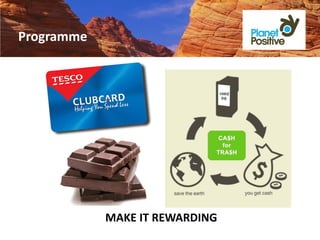
Programme


            MAKE IT REWARDING
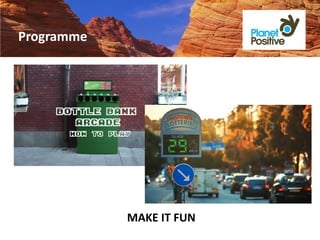
Programme


            MAKE IT FUN
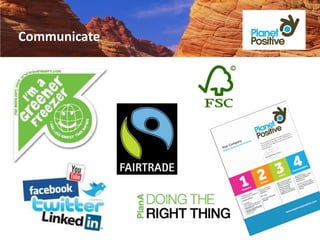
Communicate


          Board

      Project manager


        Green Team
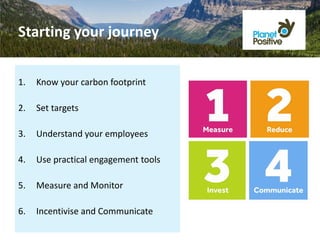
Starting your journey


1.   Know your carbon footprint

2.   Set targets

3.   Understand your employees

4.   Use practical engagement tools

5.   Measure and Monitor

6.   Incentivise and Communicate
www.beplanetpositive.com
020 7953 3170
Henry.Simonds@beplanetpositive.com

                                     © Planet Positive

NESHEP Planet Positive Presentation

  • 1.
  • 2.
    Planet Positive Business Supply Chain Building 7-days to Consulting Community Certification Certification Certification Sustainability Fitout Superstructure Operations Substructure External Areas / Infrastructure Foundations
  • 3.
  • 4.
  • 5.
  • 6.
    1. Sustainability –What is it? 2. Why become Sustainable? 3. Best Practice – Case Studies 4. State of the Market 5. Practical Steps
  • 7.
  • 8.
    Sustainability – Whatis it? Sustainable Development is “development that meets the needs of the present without compromising the ability of future generations to meet their own needs”. Bruntland Report 1987
  • 9.
    Sustainability – Whatis it? ‘Sustainability is a Win Win for Business’ Planet Positive 2012
  • 10.
    Business Case – TheBottom Line 1. Save Money 2. Win Business 3. Reputation By 2030 energy demand will increase by 50%
  • 11.
    Business Case – TheBottom Line 1. Save Money 2. Win Business 3. Reputation
  • 12.
    Business Case -People 1. Engagement 2.Recruitment 3. Community
  • 13.
    Business Case -Planet “Anyone who believes in indefinite growth on a physically finite planet is either mad or an economist” David Attenborough
  • 14.
    Sustainability Measures A measure of the impact our activities have on the environment. It relates to the amount of greenhouse gases produced directly and indirectly by a person, organisation, event or product.
  • 15.
    Sustainability Measures Water Footprinting In Europe, 46% of the population is considered to live in water-stressed areas. By 2025, 35% the world population will be affected by freshwater shortages.
  • 16.
  • 17.
    Why Become Sustainable? Regulation Your Business Reputation Resources
  • 18.
    Why Become Sustainable? Regulation • Climate Change Act – 50% by 2027, 80% by 2050 • CRC Energy Efficiency Scheme • EPCs (2018 – D or below) and DECs • Buildings Regulations • 2016 – Zero Carbon Homes • 2019 – Zero Carbon Commercial Buildings • Feed-in Tariffs • Renewable Heat Incentive • Green Deal
  • 19.
    Why Become Sustainable? Reputation • Skills needed for changing economy • Clients favouring business with sustainable experience • The more sustainable you are, the better your chance of winning the tender is likely to be • It’s not about the size of your business, it’s about your ability and flexibility to meet the client’s demands e.g. Some clients are leaving it to the main contractor to decide how to green their building
  • 20.
    Why Become Sustainable? • Energy prices expected to rise by more than 50% by 2015 • Rising prices of other resources as energy bills increase their production costs, eg. steel, aluminium, etc. • Key commodities have risen 210% over last 10 years • From April 2013, landfill tax will rise from £8 to £72 per tonne Resources
  • 21.
    Why Become Sustainable? Your Regulation Business Reputation Resources
  • 22.
    Why Become Sustainable? Regulation Your Business Reputation Resources
  • 23.
    Case Study: Marks &Spencer's 78,000 Employees – Retail Sector Plan A – Sustainability Initiative 180 Commitments • Become carbon neutral 2012 Results • Send no waste to landfill • Extend sustainable sourcing £105m (net benefit) • Improve lives of people in supply chain 31% (Plan A products) • Help support healthier life-styles 28% Energy Savings
  • 24.
    Case Study: Bowmer &Kirkland 332 Employees – Construction Sector Green travel plan • Replacing petrol with diesel • Incentivising staff Office emissions reduced • Heat pump system SAVINGS over 4 years: • BEMS (Building Energy Mgmt Solution) £315k Zero waste to landfill target 858 t/CO2e • Document management system
  • 25.
    Case Study PWA Unlimited 3employees - Trainers and Advisors • Purchased a new bike to get to work • Water saving kit from Northumbrian Water • Growing own lettuce for lunches • Compost any raw food and tea bags, and recycling all items that can be • Purchased a one cup hot water dispenser instead of boiling kettle for one cup • Recycle soapy water and use to water plants in garden (this also helps to stop black fly) “When I look back at the changes • Changed light bulbs to be energy efficient we've made, I am amazed and proud of how much we've • Switch off all equipment at end of day managed to do so easily”.
  • 26.
    Business Benefits Financial Savings Brand Carbon Positioning Reductions Answer Win Tenders Business 3rd Party Ongoing Assurance Staff Support Engagement
  • 27.
  • 28.
    Sustainability Maturity Model Follower Mature Leader Innovator Pro-active risk Integrating Integrated Compliance focused with business strategy, based strategy shaping approach societal expectations Number of Companies Stage 1 Stage 2 Stage 3 Stage 4 Comprehensive Competitive Understanding Beyond sustainability advantage compliance through management sustainable business practices Bottom 80% of Middle 5-20% of Top 1-5% of Top 1% of Companies Companies Companies Companies Level of Maturity
  • 29.
    Importance of SupplyChain “Over 50% of an average corporation’s carbon emissions are typically from the supply chain”. Carbon Disclosure Project “50% of multinationals plan on selecting suppliers based on carbon performance”. Carbon Trust
  • 30.
    Green Adoption inSupply Chain No Position Early Warning Expectation Endorsement Mandatory • No policy or • Aspiration for • Recommendation to • Specific sustainability • Requirements stated aspiration. sustainable supply adopt sustainable policies suppliers and enforced • Very few in chain. practices should implement this category • Timetable used “If a supplier cannot be Held sustainability forum All future suppliers to sign compliant with Toxic waste in Key policy: helping clothing with suppliers in Jan 2009 a sustainability agreement requirements on the Africa 2006 suppliers to pay a fair living wage by 2015 environment and sustainability, we’ll stop doing business with them.” Clear ethical stance but no sustainable supply Suppliers expected to chain policy yet comply with supplier standards of conduct Support provided to suppliers to achieve set targets. Moving towards Ethical Trading ‘mandatory standards’ Code of Conduct level Stringent requirements for suppliers introduced Government buying standards
  • 31.
  • 32.
    Mission Statement “Greenest Government Ever” www.beplanetpositive.com
  • 33.
    Measure & Monitor FUEL WASTE 200 180 160 ELECTRICITY m3 140 120 100 80 60 40 PAPER 20 0 TRAVEL
  • 34.
    Transparent “Greenest Government Ever”
  • 35.
    Employee Engagement 2% 10% 28% 1. Identify Leaders 9% 6% 6% 2. Green Team 39% 3. Drive Internally Positive Greens www.beplanetpositive.com
  • 36.
    Employee Engagement 1. Identify Leaders 2. Green Team 3. Drive Internally www.beplanetpositive.com
  • 37.
    Programme MAKE IT SIMPLE
  • 38.
    Programme MAKE IT INCLUSIVE
  • 39.
    Programme MAKE IT REWARDING
  • 40.
    Programme MAKE IT FUN
  • 41.
    Communicate Board Project manager Green Team
  • 42.
    Starting your journey 1. Know your carbon footprint 2. Set targets 3. Understand your employees 4. Use practical engagement tools 5. Measure and Monitor 6. Incentivise and Communicate
  • 43.