Speeding Up Linux Disk Encryption
Ignat Korchagin
@ignatkn
@ignatkn
$ whoami
● Performance and security at Cloudflare
● Passionate about security and crypto
● Enjoy low level programming
Encrypting data at rest
@ignatkn
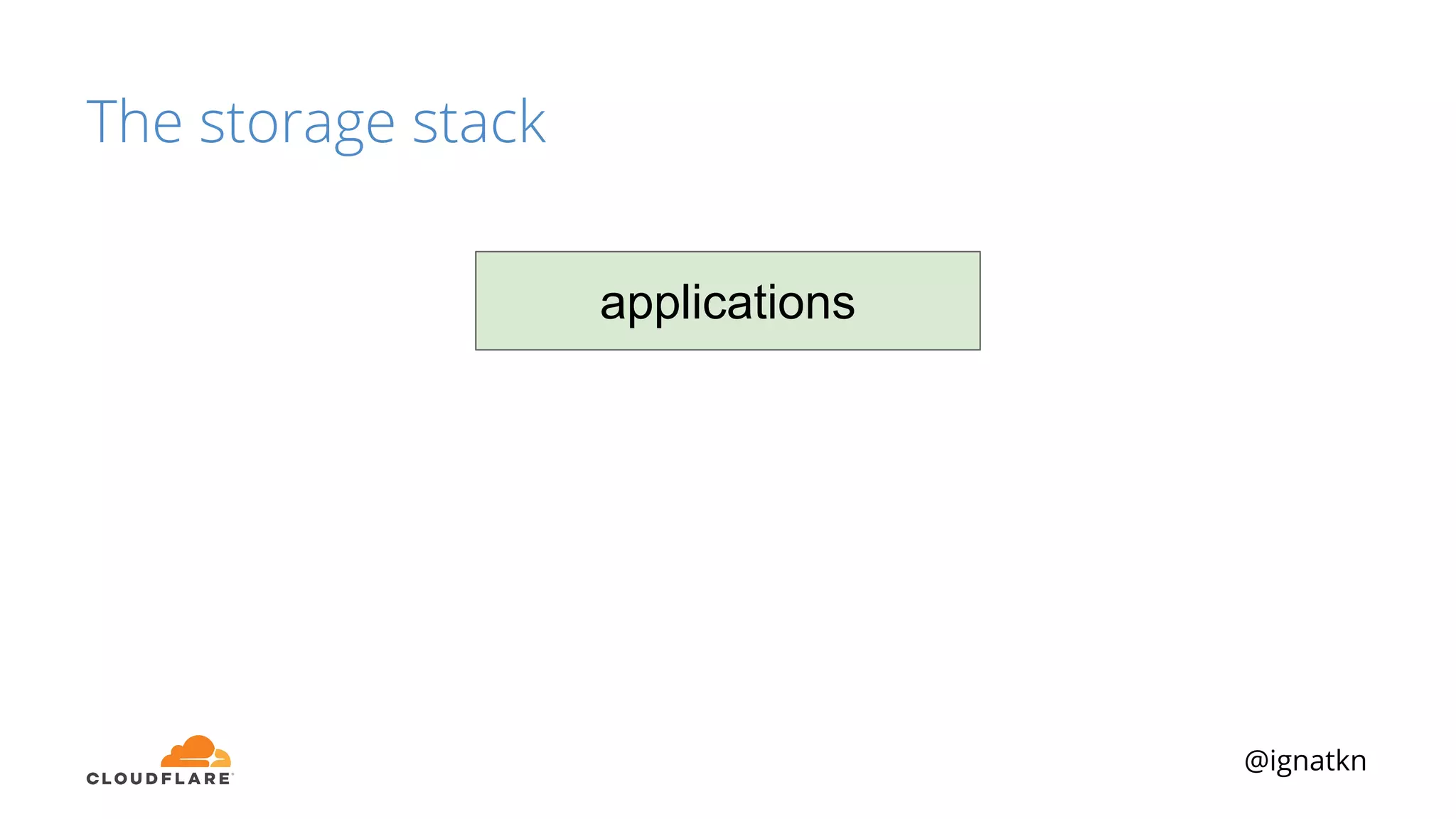
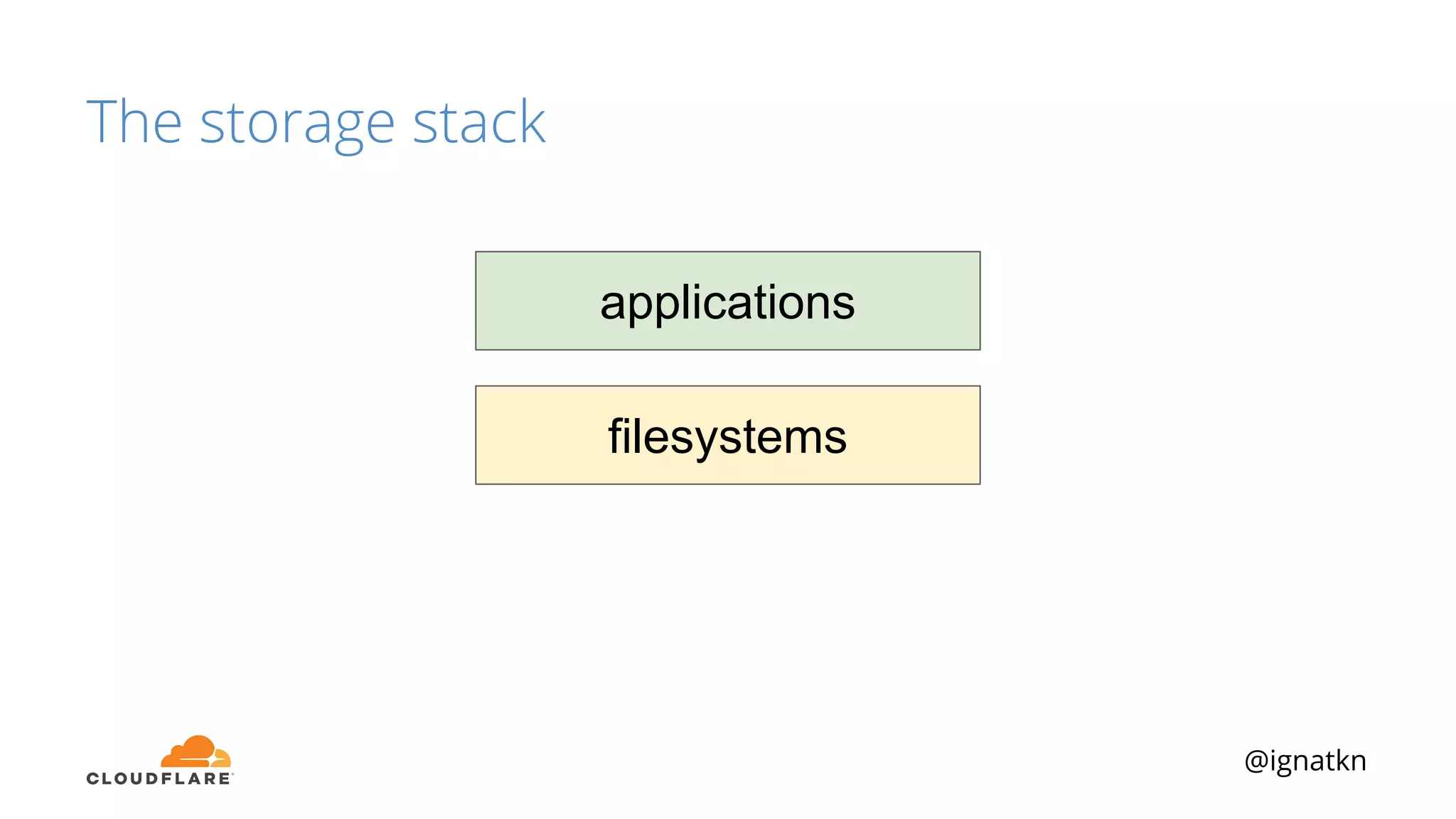
The storage stack
applications
@ignatkn
The storage stack
filesystems
applications
@ignatkn
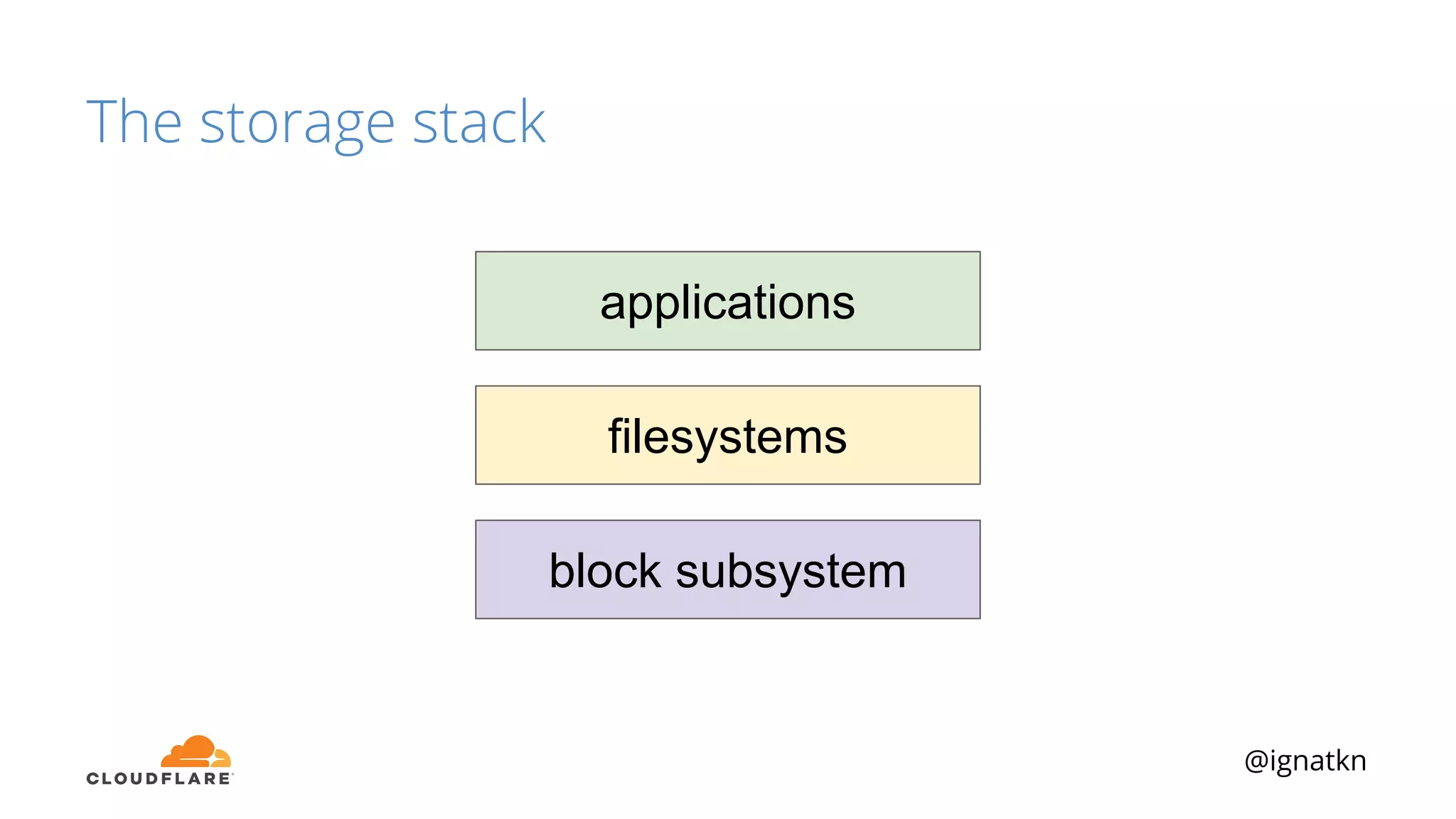
The storage stack
block subsystem
filesystems
applications
@ignatkn
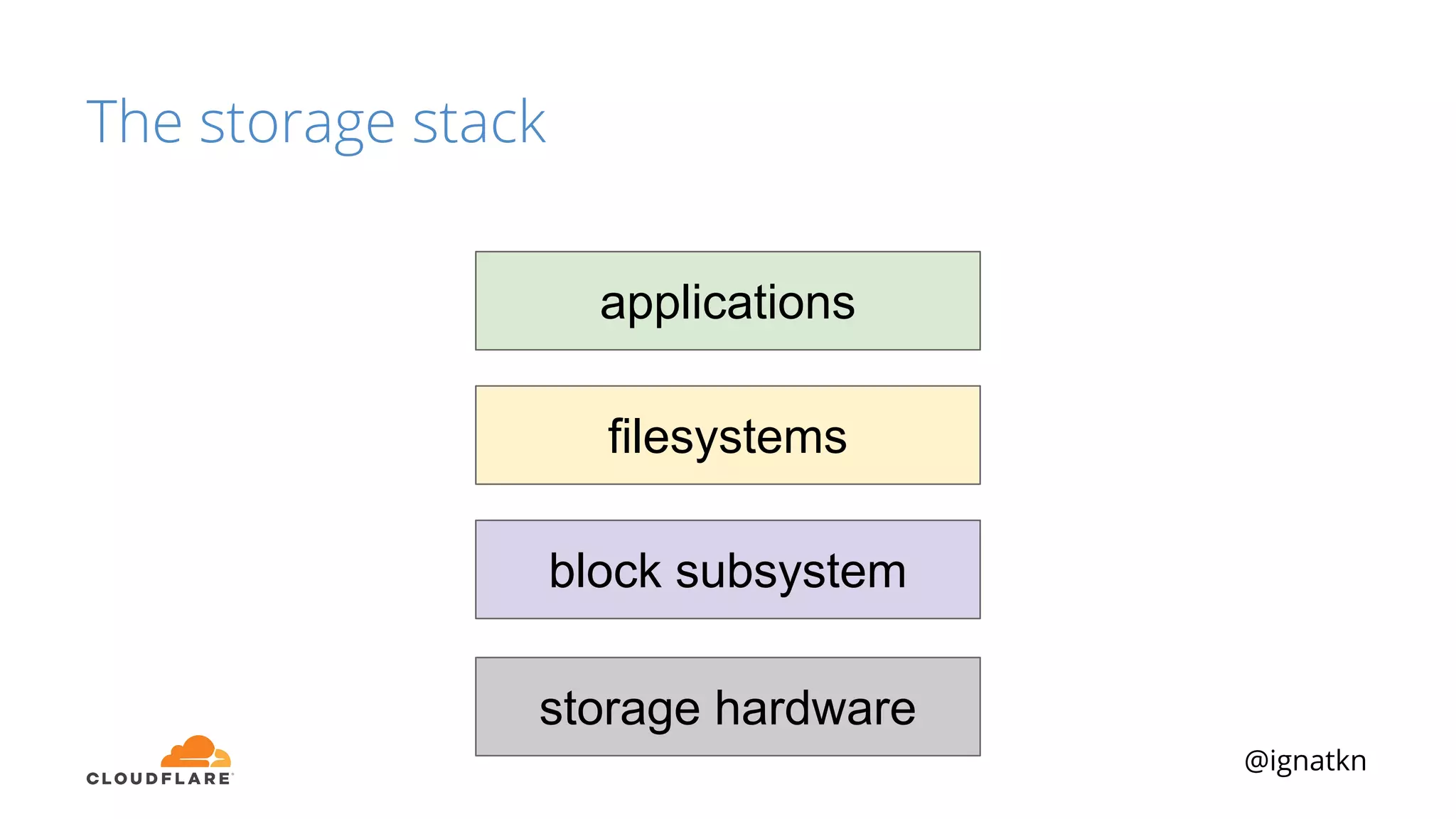
The storage stack
storage hardware
block subsystem
filesystems
applications
@ignatkn
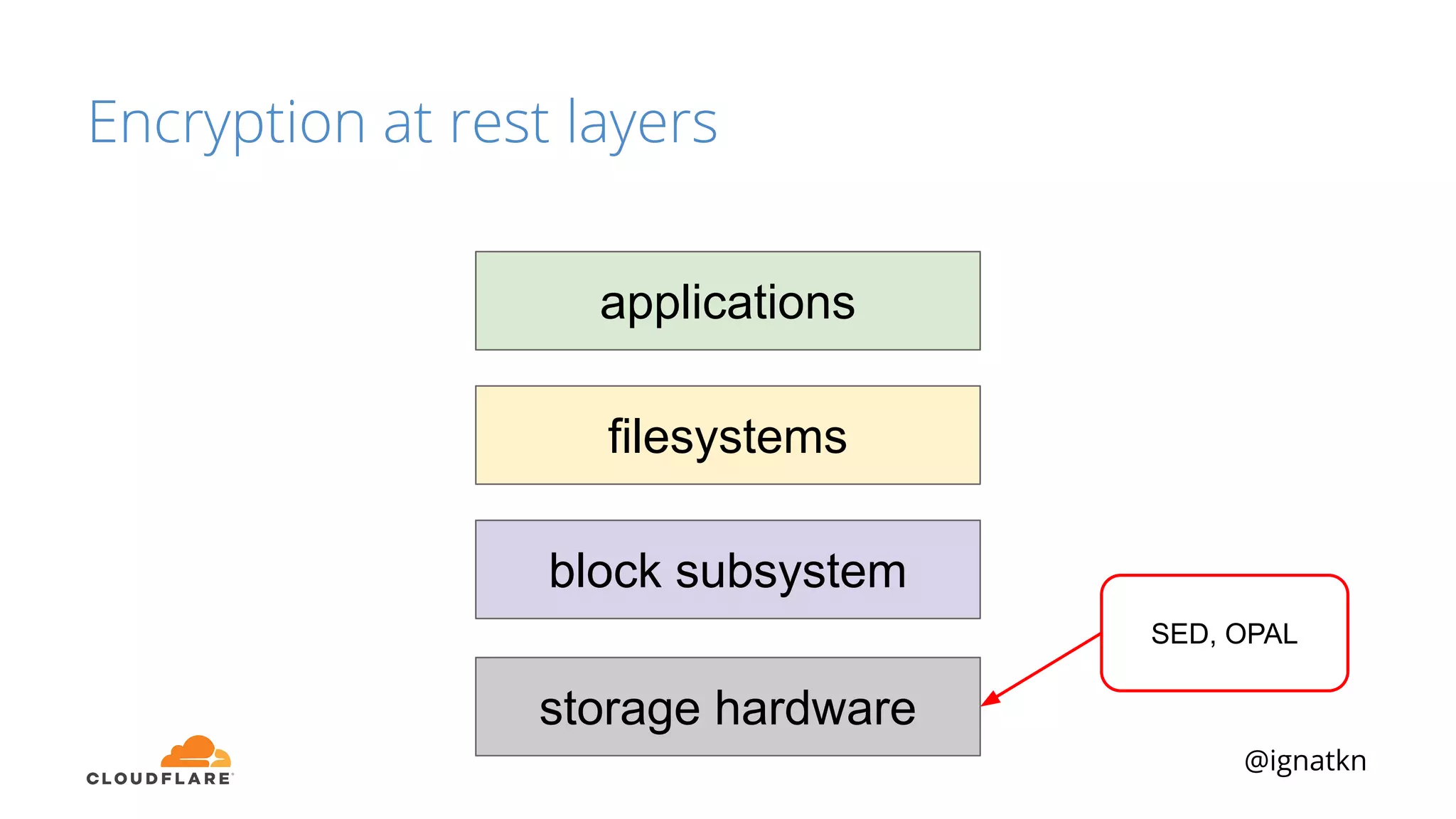
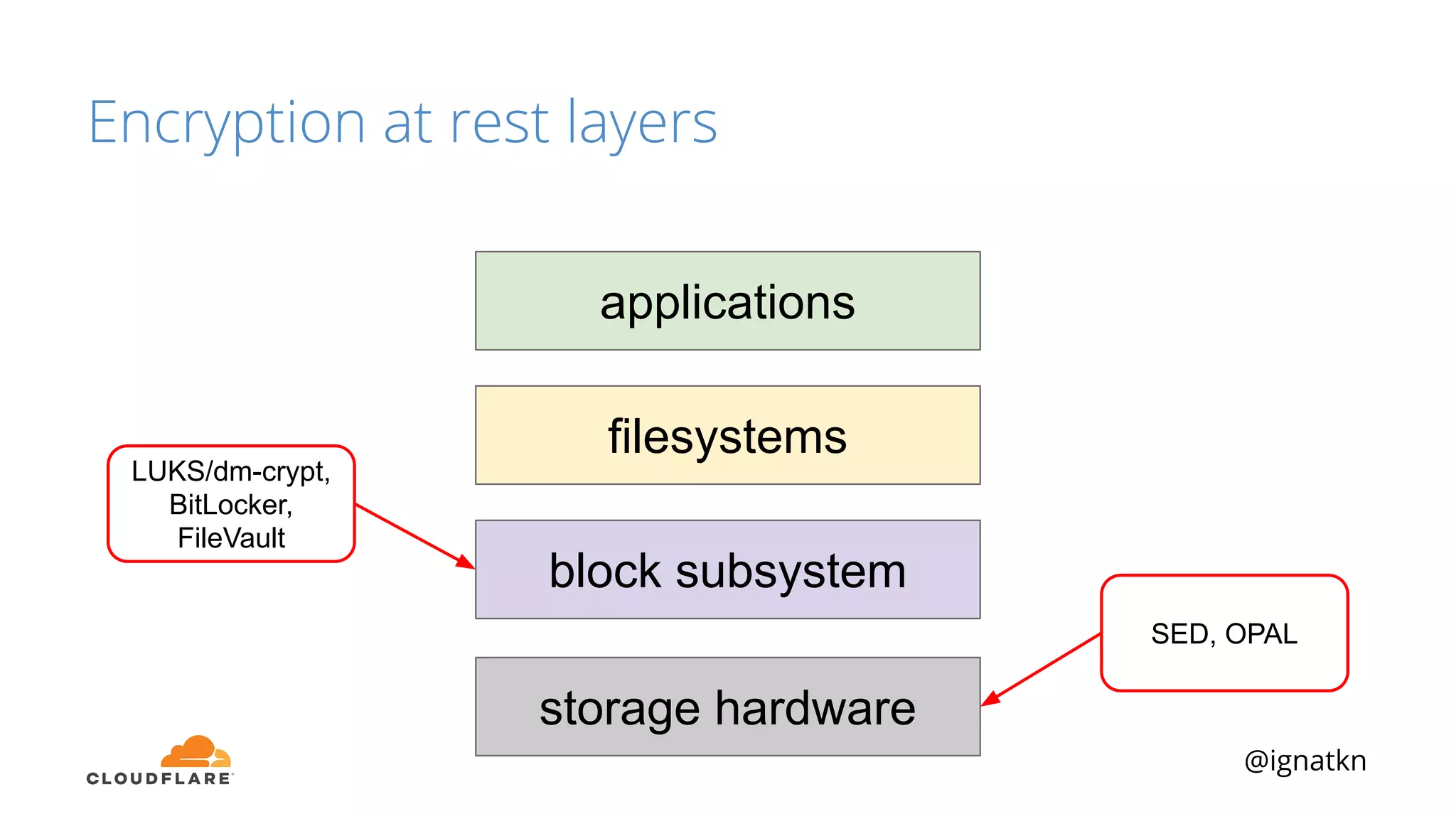
Encryption at rest layers
storage hardware
block subsystem
filesystems
applications
SED, OPAL
@ignatkn
Encryption at rest layers
storage hardware
block subsystem
filesystems
applications
SED, OPAL
LUKS/dm-crypt,
BitLocker,
FileVault
@ignatkn
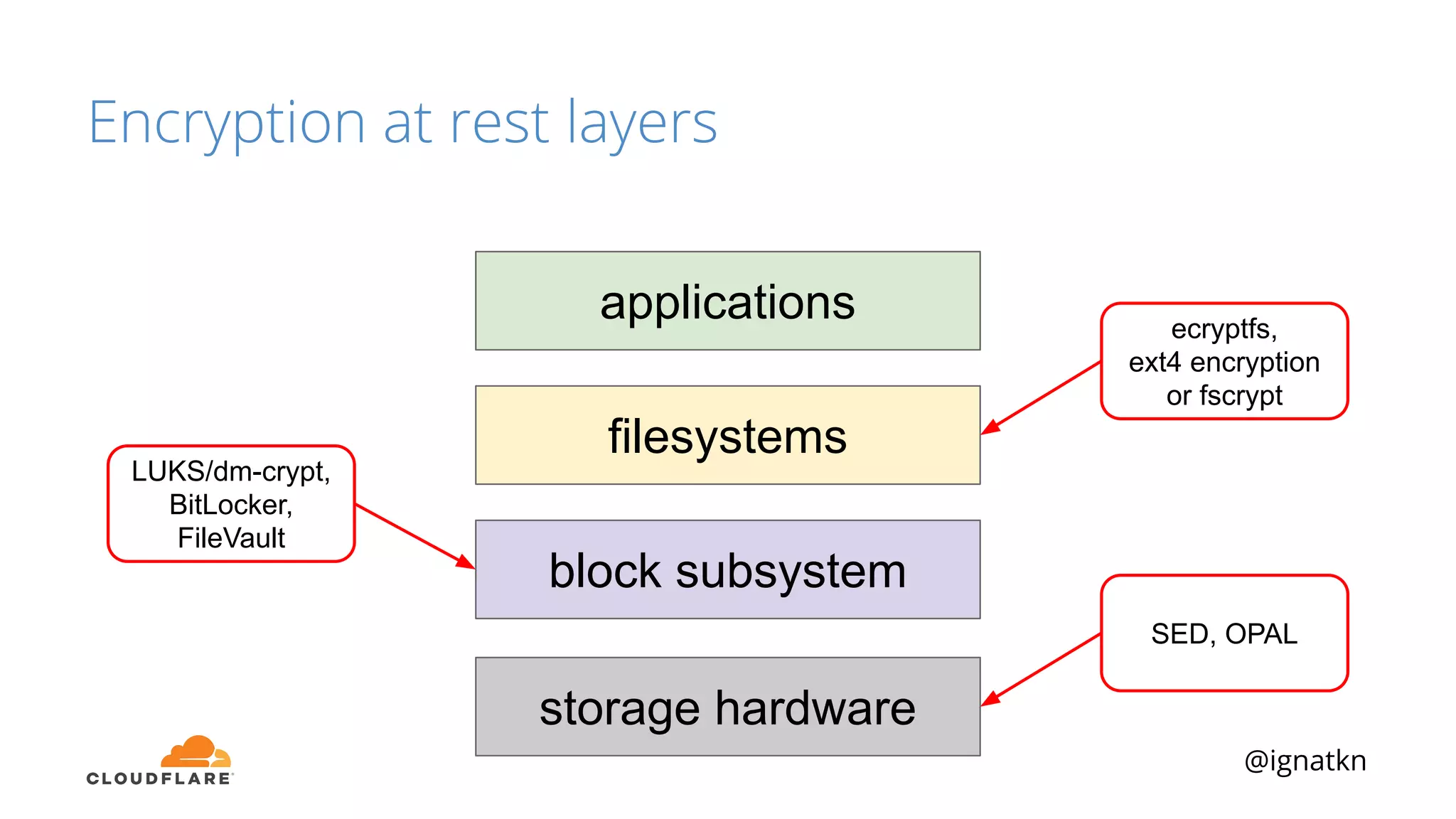
Encryption at rest layers
storage hardware
block subsystem
filesystems
applications
SED, OPAL
LUKS/dm-crypt,
BitLocker,
FileVault
ecryptfs,
ext4 encryption
or fscrypt
@ignatkn
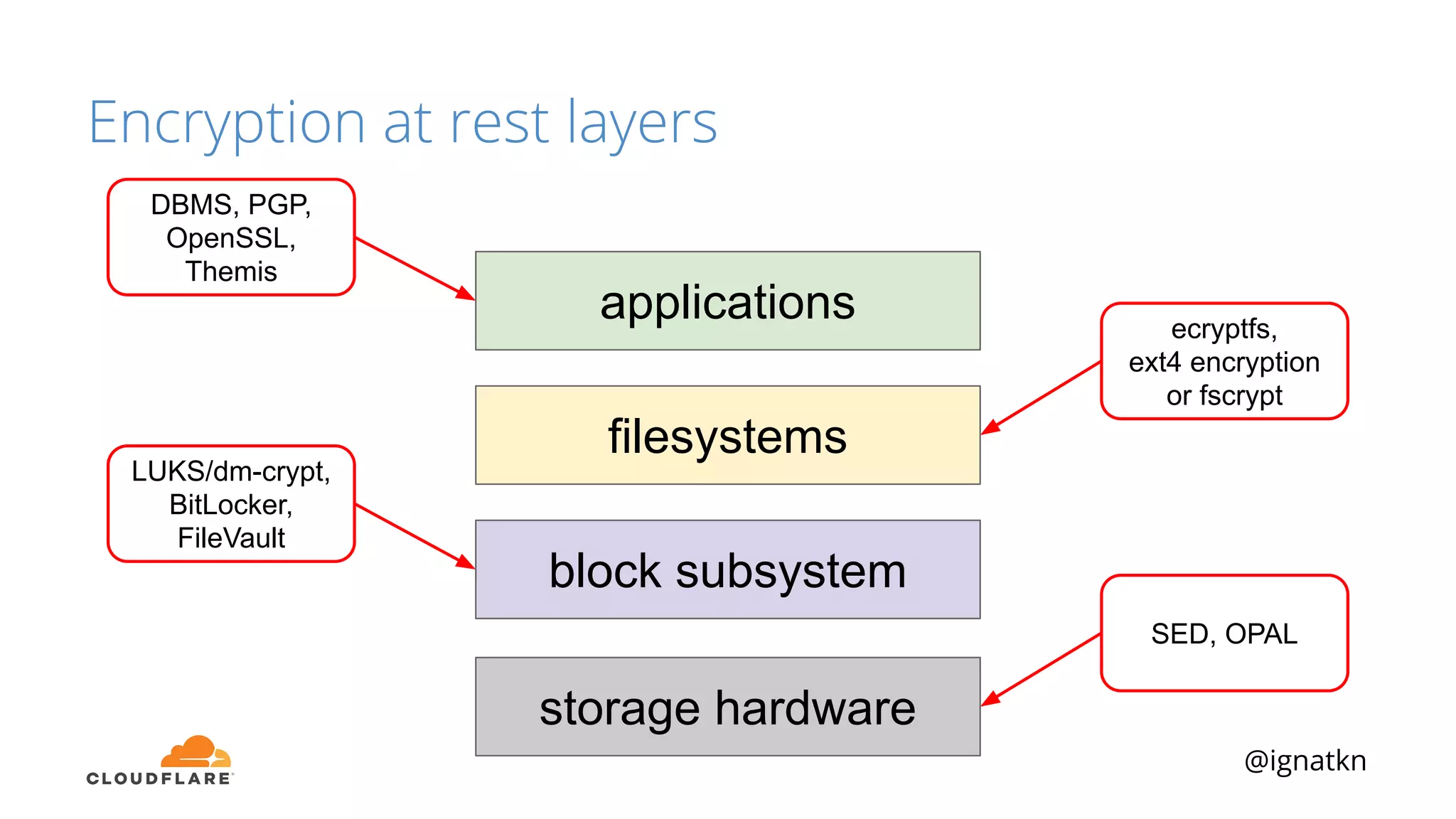
Encryption at rest layers
storage hardware
block subsystem
filesystems
applications
SED, OPAL
LUKS/dm-crypt,
BitLocker,
FileVault
ecryptfs,
ext4 encryption
or fscrypt
DBMS, PGP,
OpenSSL,
Themis
@ignatkn
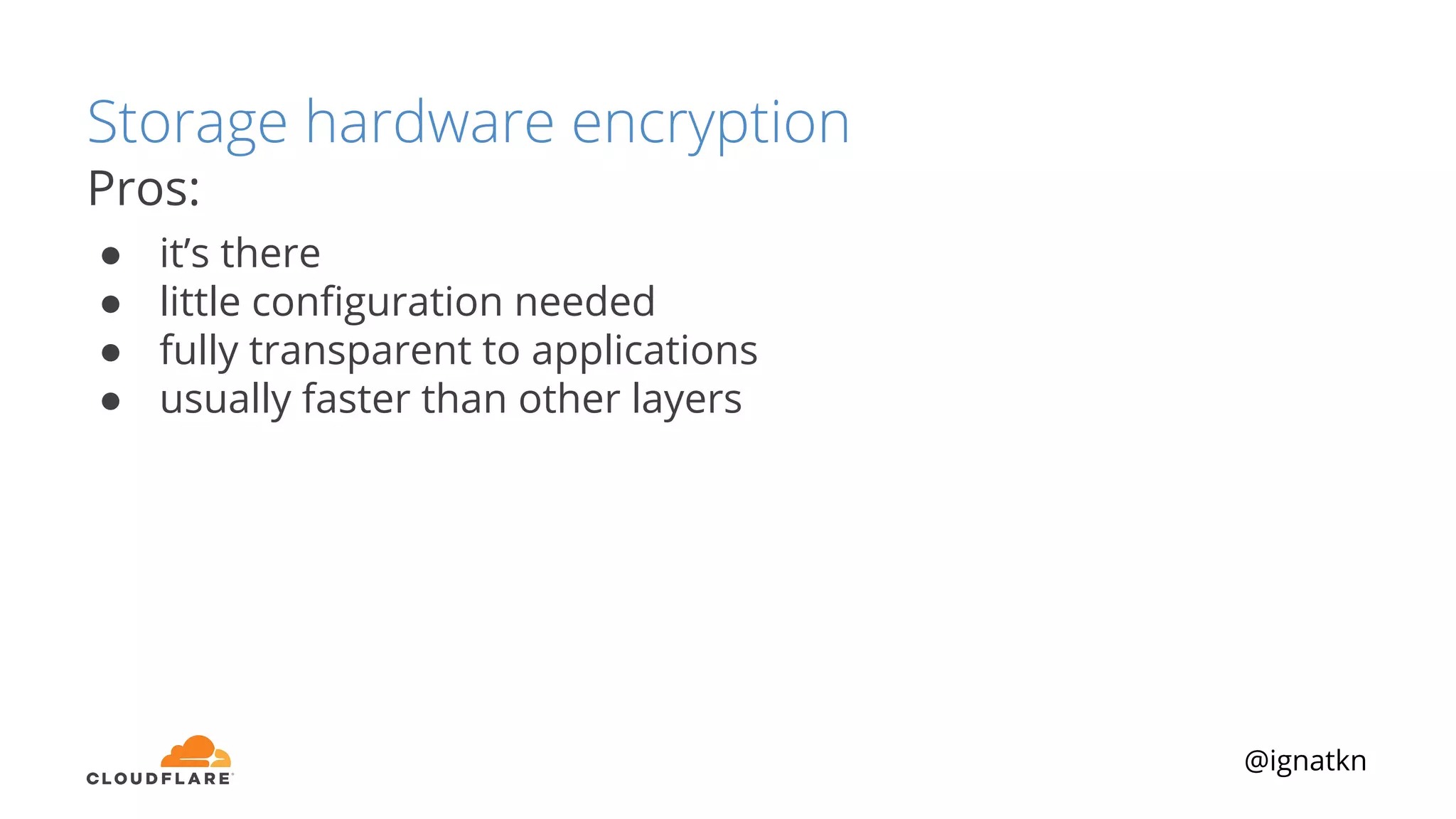
Storage hardware encryption
Pros:
● it’s there
● little configuration needed
● fully transparent to applications
● usually faster than other layers
@ignatkn
Storage hardware encryption
Pros:
● it’s there
● little configuration needed
● fully transparent to applications
● usually faster than other layers
Cons:
● no visibility into the implementation
● no auditability
● sometimes poor security
https://support.microsoft.com/en-us/help/4516071/windows-10-update-kb4516071
@ignatkn
Block layer encryption
Pros:
● little configuration needed
● fully transparent to applications
● open, auditable
@ignatkn
Block layer encryption
Pros:
● little configuration needed
● fully transparent to applications
● open, auditable
Cons:
● requires somewhat specialised crypto
● performance issues
● encryption keys in RAM
@ignatkn
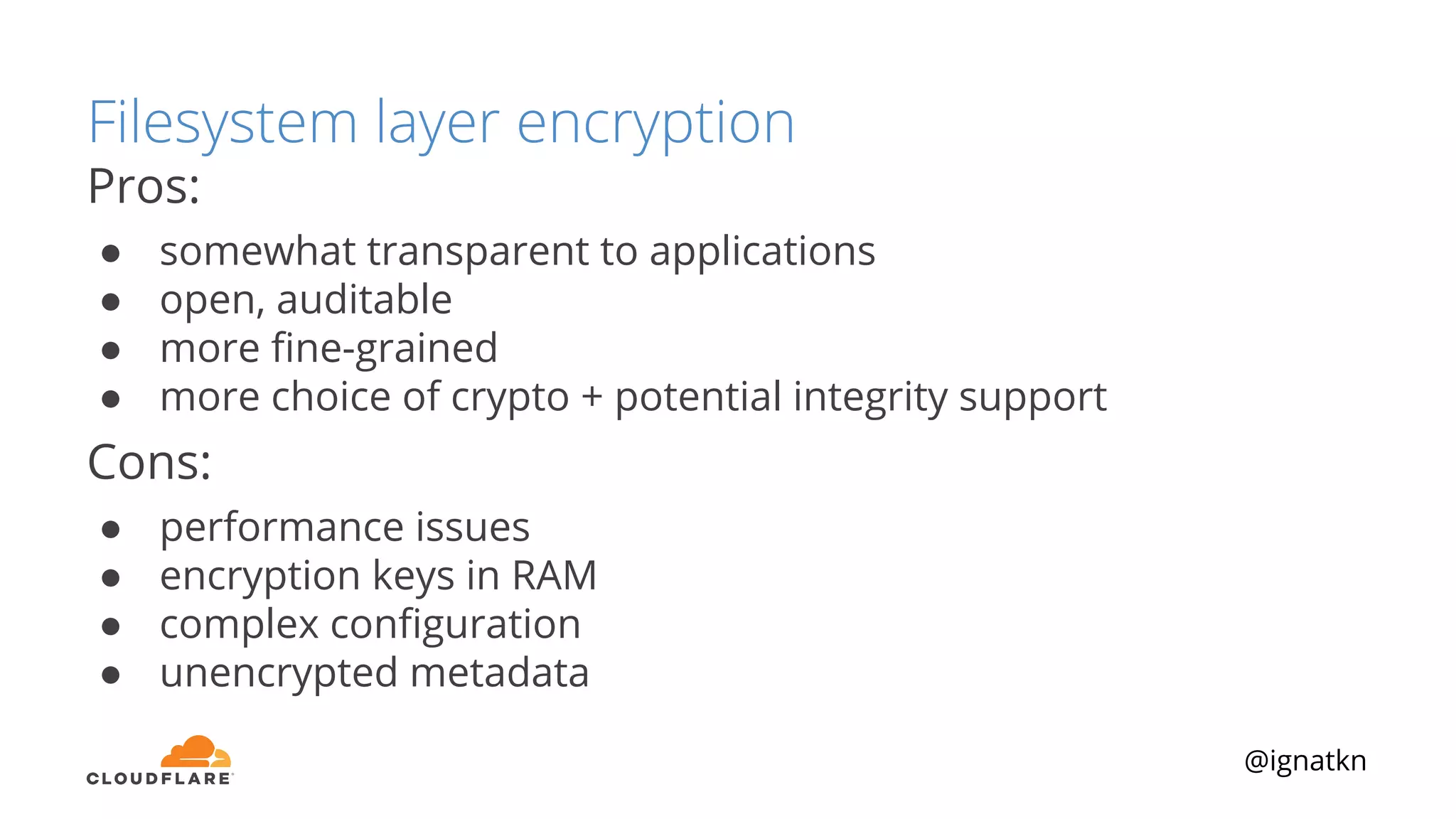
Filesystem layer encryption
Pros:
● somewhat transparent to applications
● open, auditable
● more fine-grained
● more choice of crypto + potential integrity support
@ignatkn
Filesystem layer encryption
Pros:
● somewhat transparent to applications
● open, auditable
● more fine-grained
● more choice of crypto + potential integrity support
Cons:
● performance issues
● encryption keys in RAM
● complex configuration
● unencrypted metadata
@ignatkn
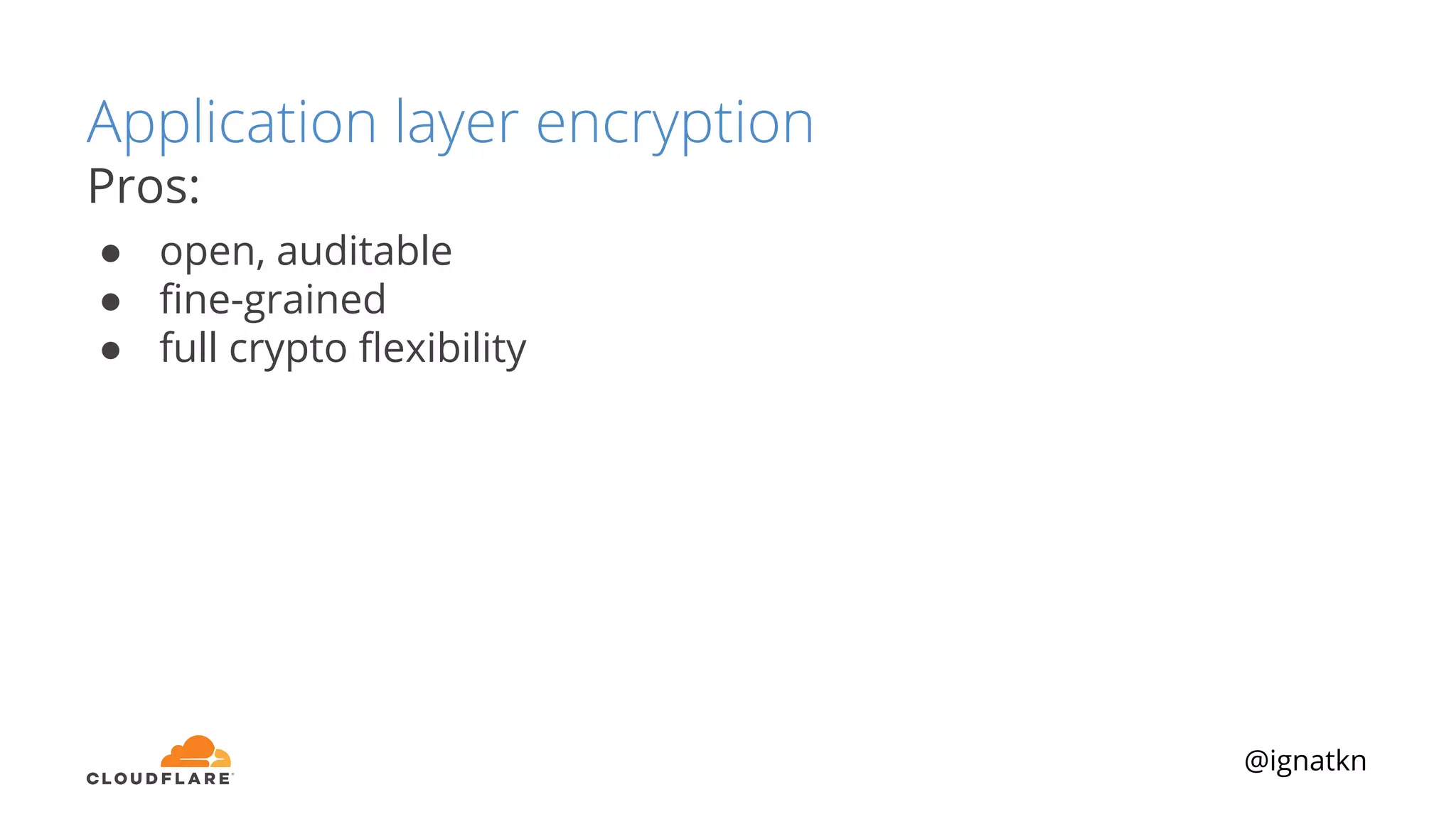
Application layer encryption
Pros:
● open, auditable
● fine-grained
● full crypto flexibility
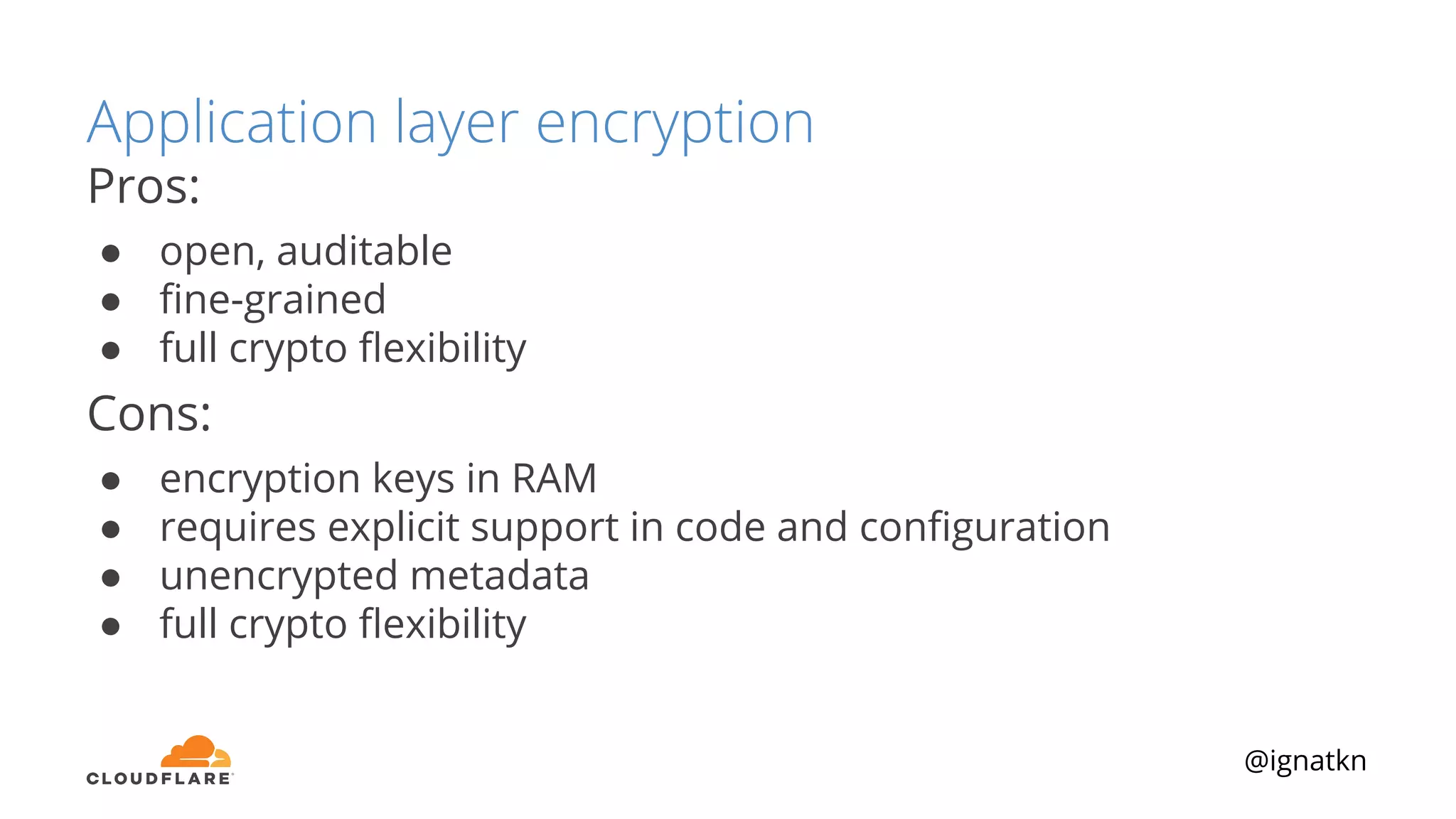
@ignatkn
Application layer encryption
Pros:
● open, auditable
● fine-grained
● full crypto flexibility
Cons:
● encryption keys in RAM
● requires explicit support in code and configuration
● unencrypted metadata
● full crypto flexibility
LUKS/dm-crypt
@ignatkn
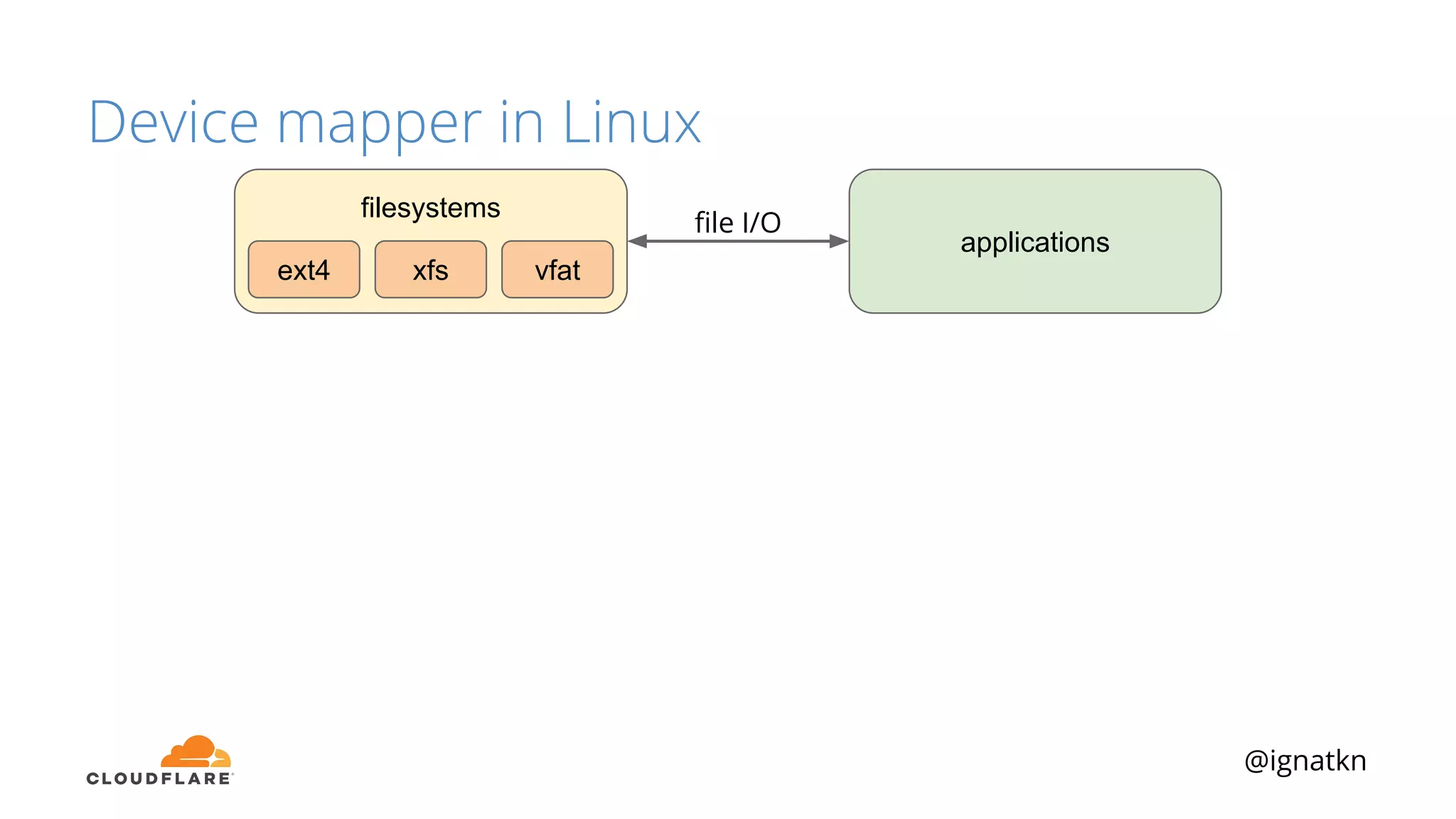
Device mapper in Linux
applications
@ignatkn
Device mapper in Linux
applications
filesystems
xfs vfatext4
file I/O
@ignatkn
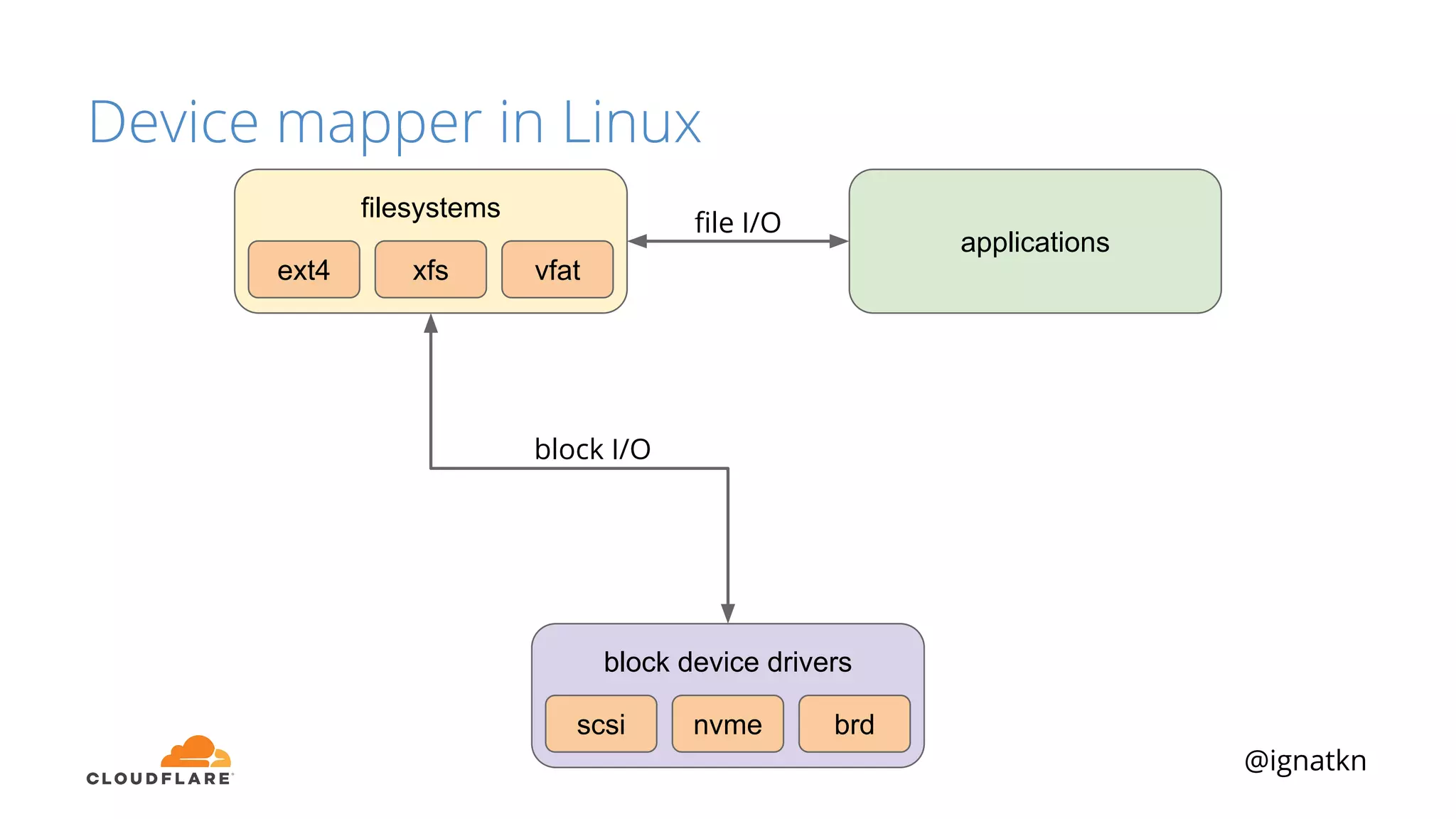
Device mapper in Linux
applications
block device drivers
nvme brdscsi
filesystems
xfs vfatext4
file I/O
block I/O
@ignatkn
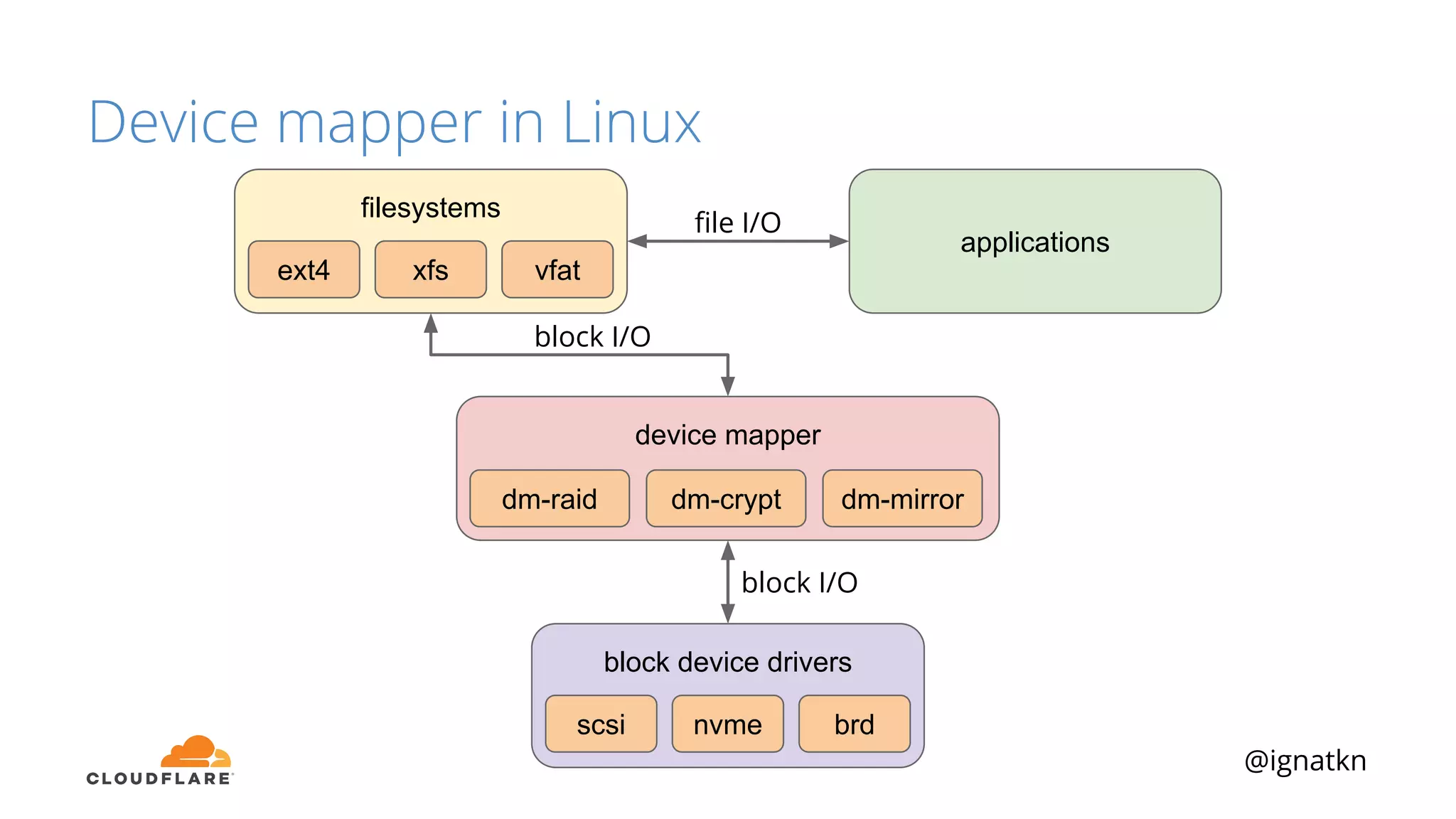
Device mapper in Linux
applications
block device drivers
nvme brdscsi
filesystems
xfs vfatext4
device mapper
dm-crypt dm-mirrordm-raid
file I/O
block I/O
block I/O
@ignatkn
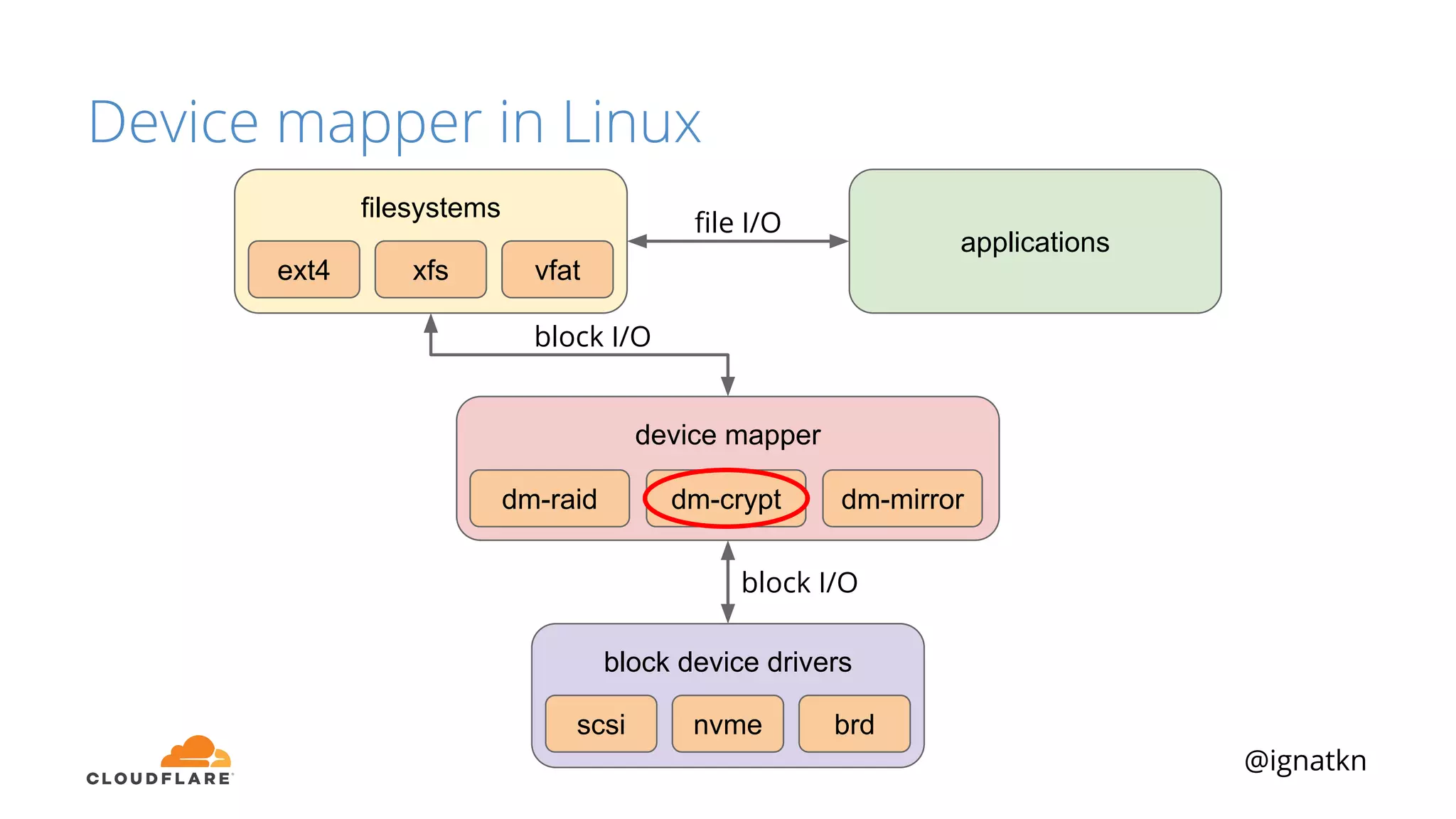
Device mapper in Linux
applications
block device drivers
nvme brdscsi
filesystems
xfs vfatext4
device mapper
dm-crypt dm-mirrordm-raid
file I/O
block I/O
block I/O
@ignatkn
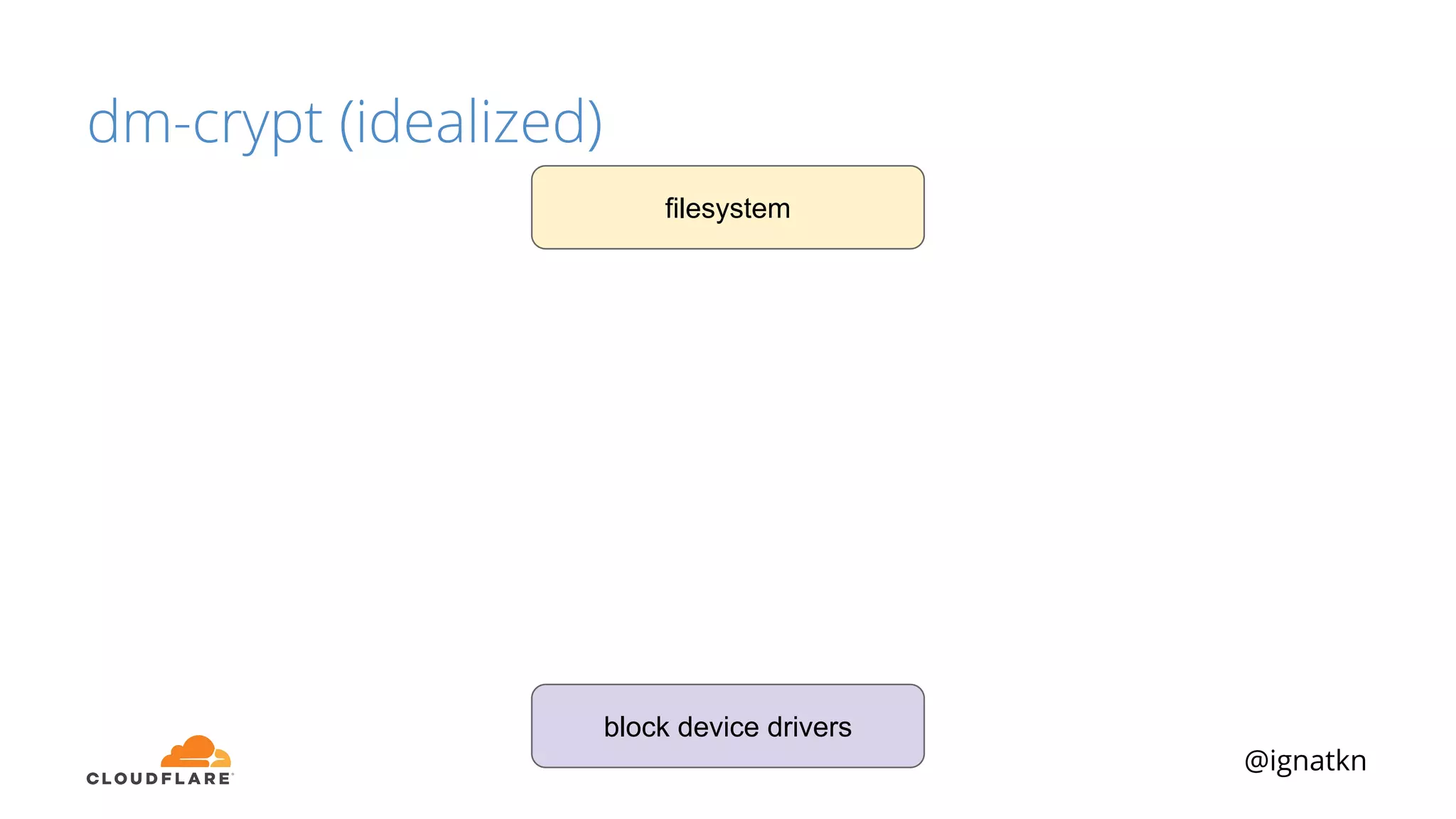
dm-crypt (idealized)
filesystem
block device drivers
@ignatkn
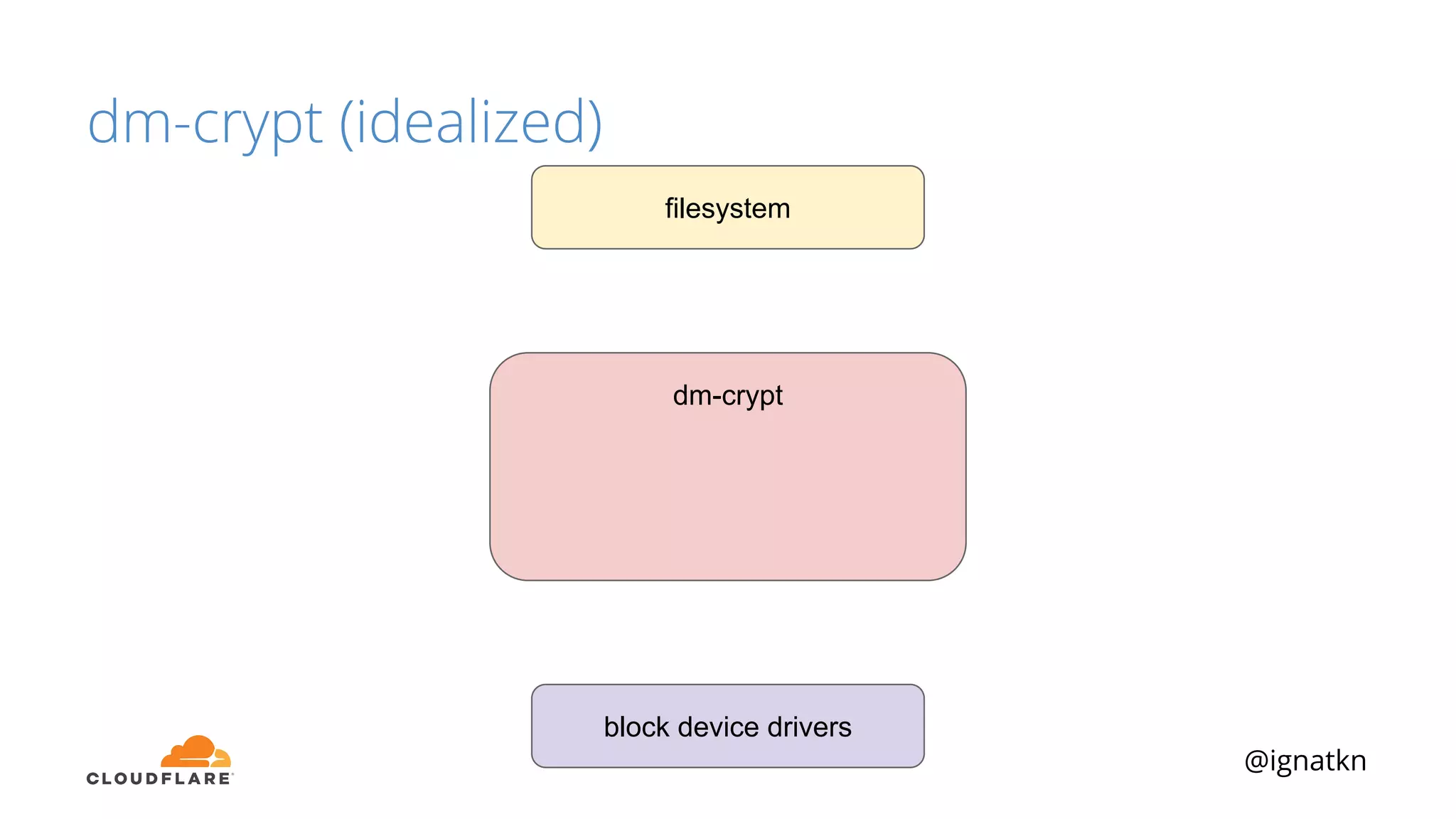
dm-crypt (idealized)
filesystem
dm-crypt
block device drivers
@ignatkn
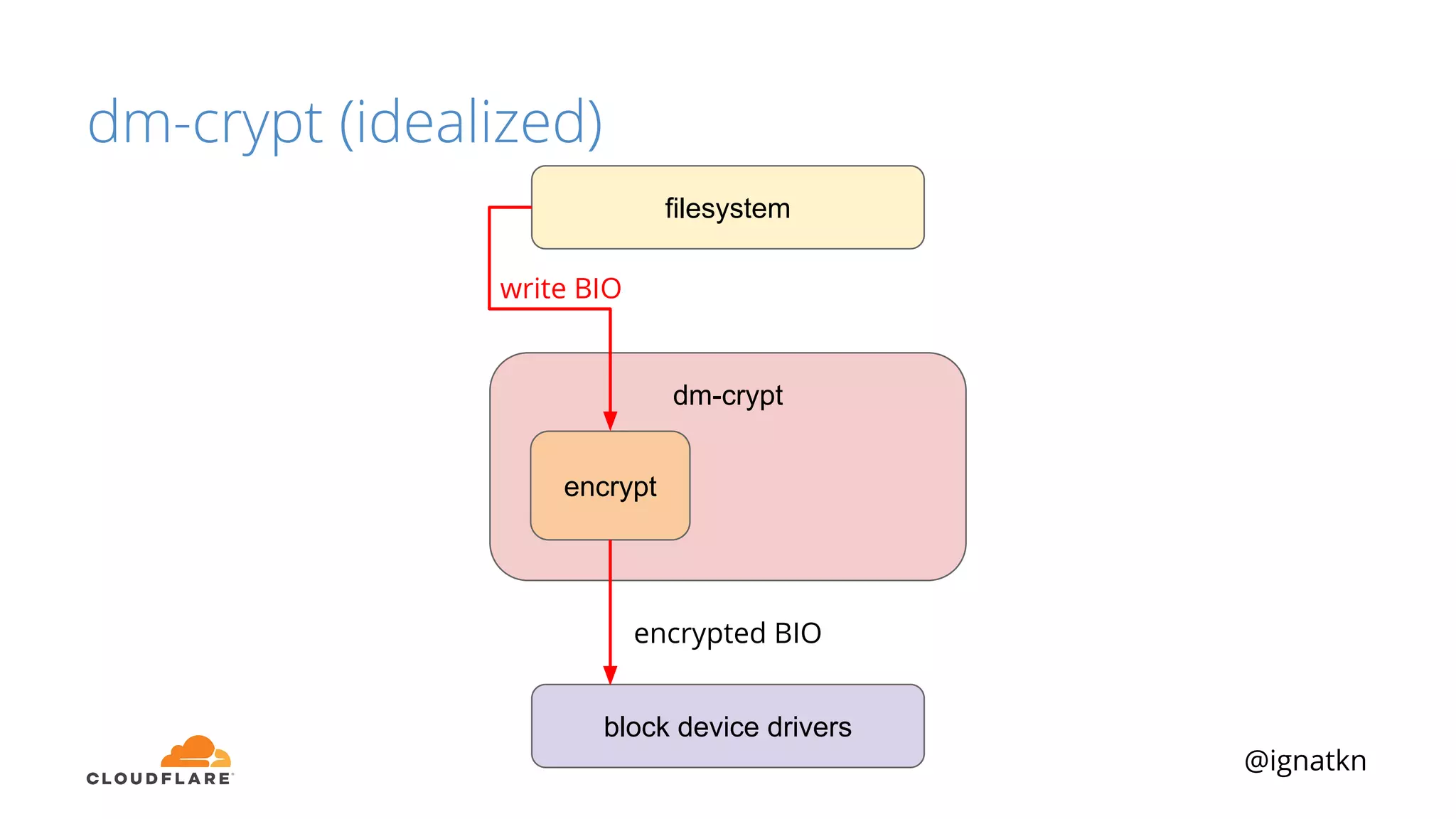
dm-crypt (idealized)
filesystem
dm-crypt
block device drivers
encrypt
write BIO
encrypted BIO
@ignatkn
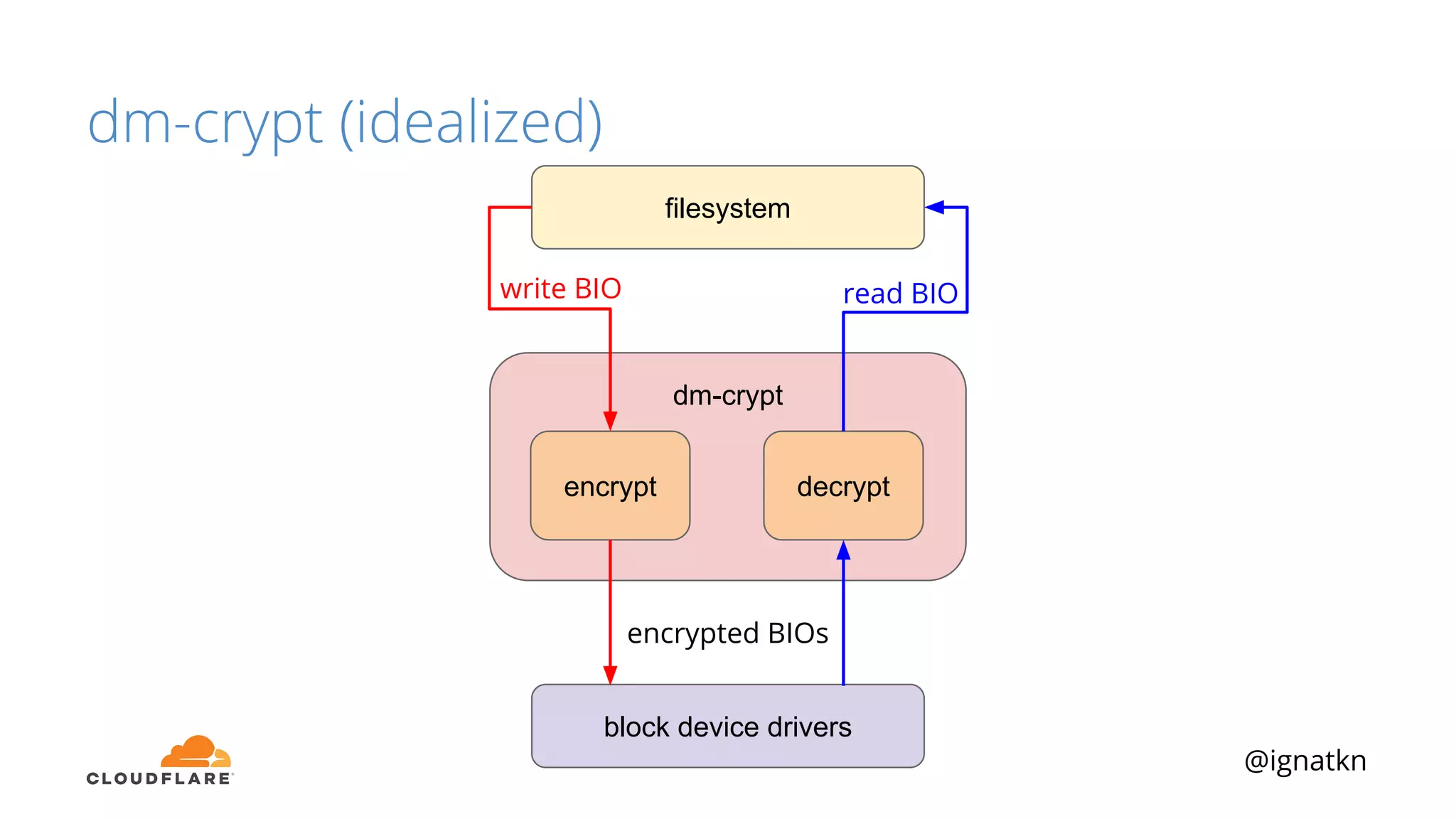
dm-crypt (idealized)
filesystem
dm-crypt
block device drivers
encrypt decrypt
write BIO read BIO
encrypted BIOs
@ignatkn
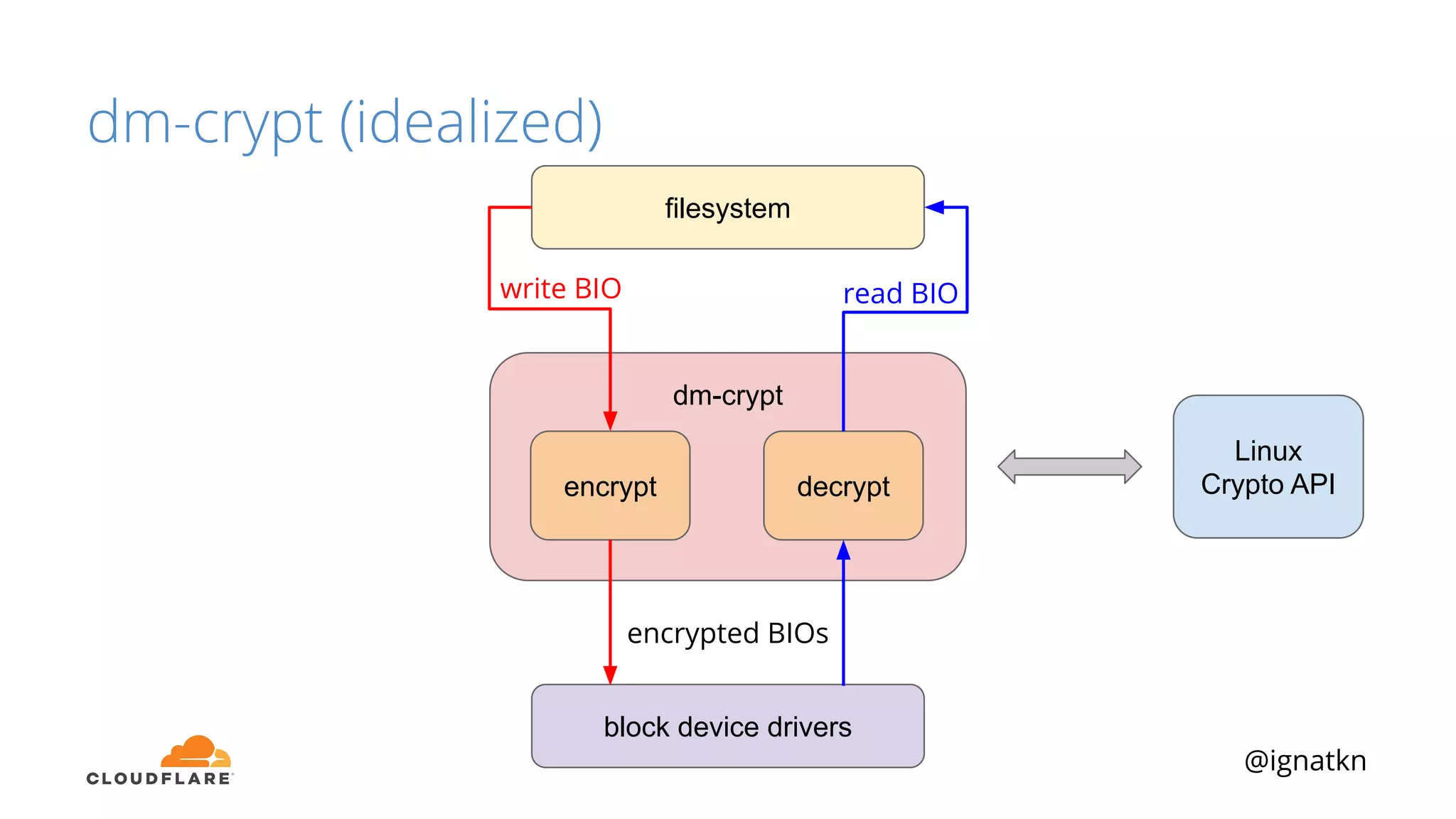
dm-crypt (idealized)
filesystem
dm-crypt
block device drivers
encrypt decrypt
Linux
Crypto API
write BIO read BIO
encrypted BIOs
dm-crypt benchmarking
@ignatkn
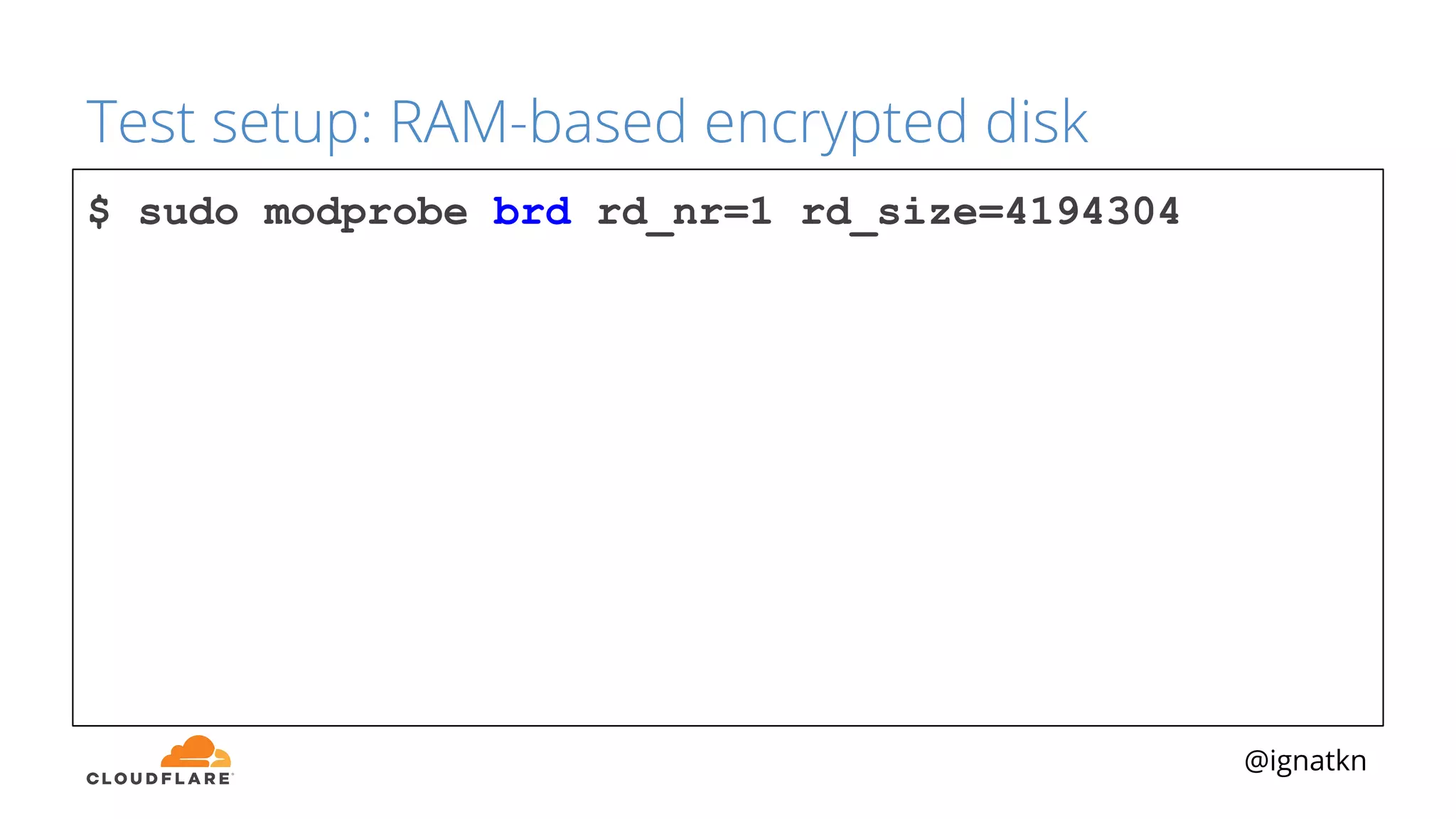
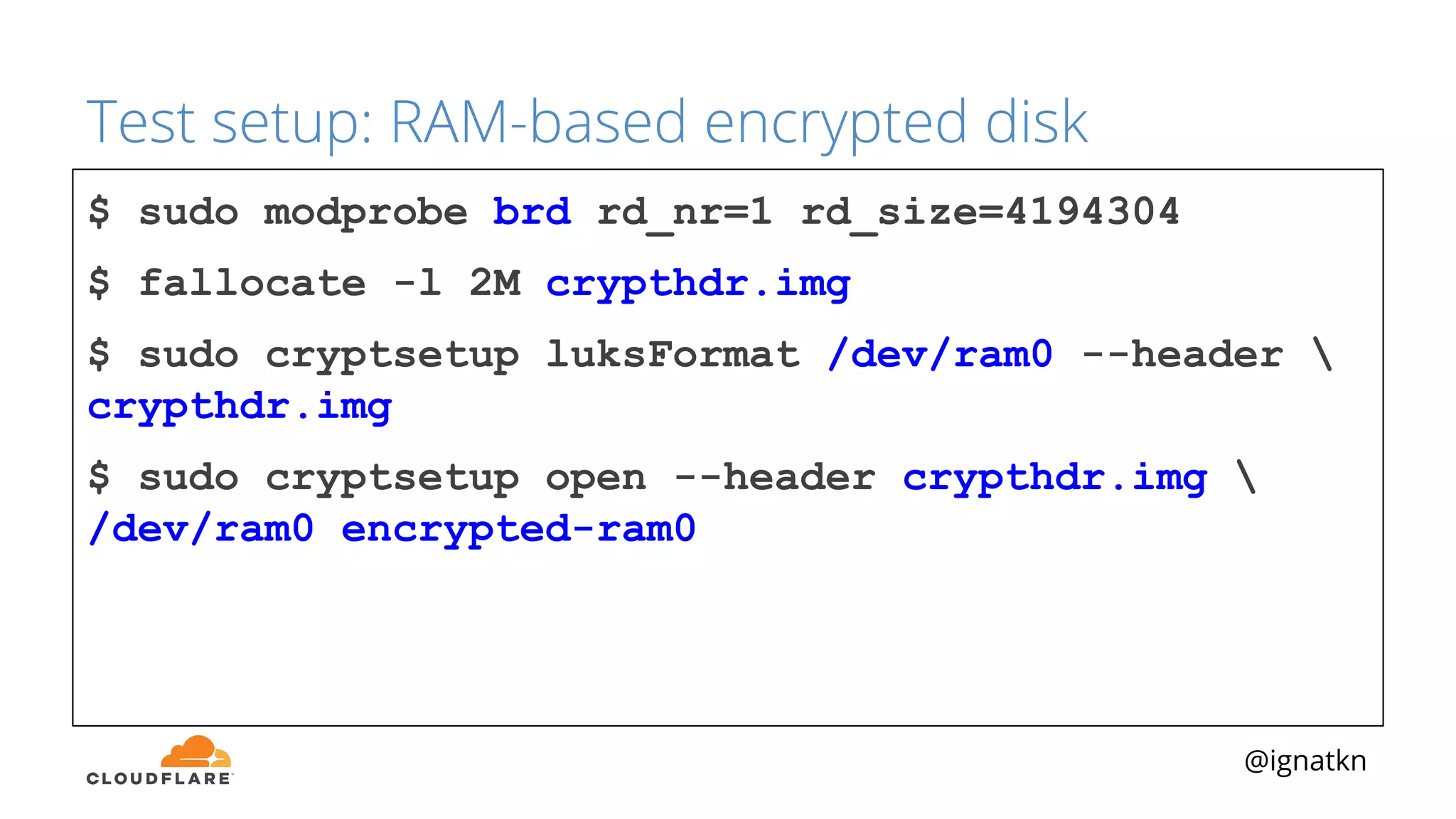
Test setup: RAM-based encrypted disk
$ sudo modprobe brd rd_nr=1 rd_size=4194304
@ignatkn
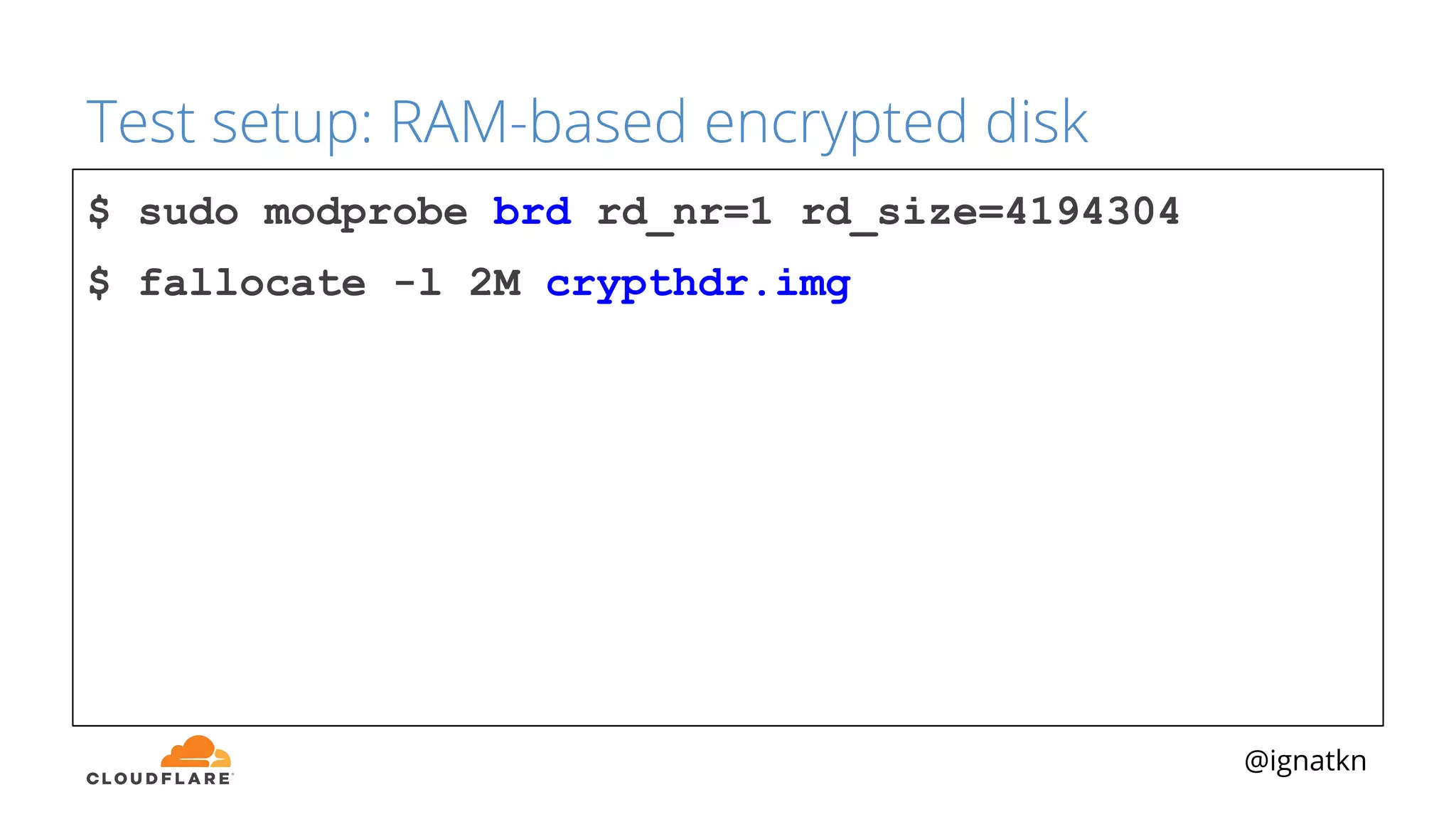
Test setup: RAM-based encrypted disk
$ sudo modprobe brd rd_nr=1 rd_size=4194304
$ fallocate -l 2M crypthdr.img
@ignatkn
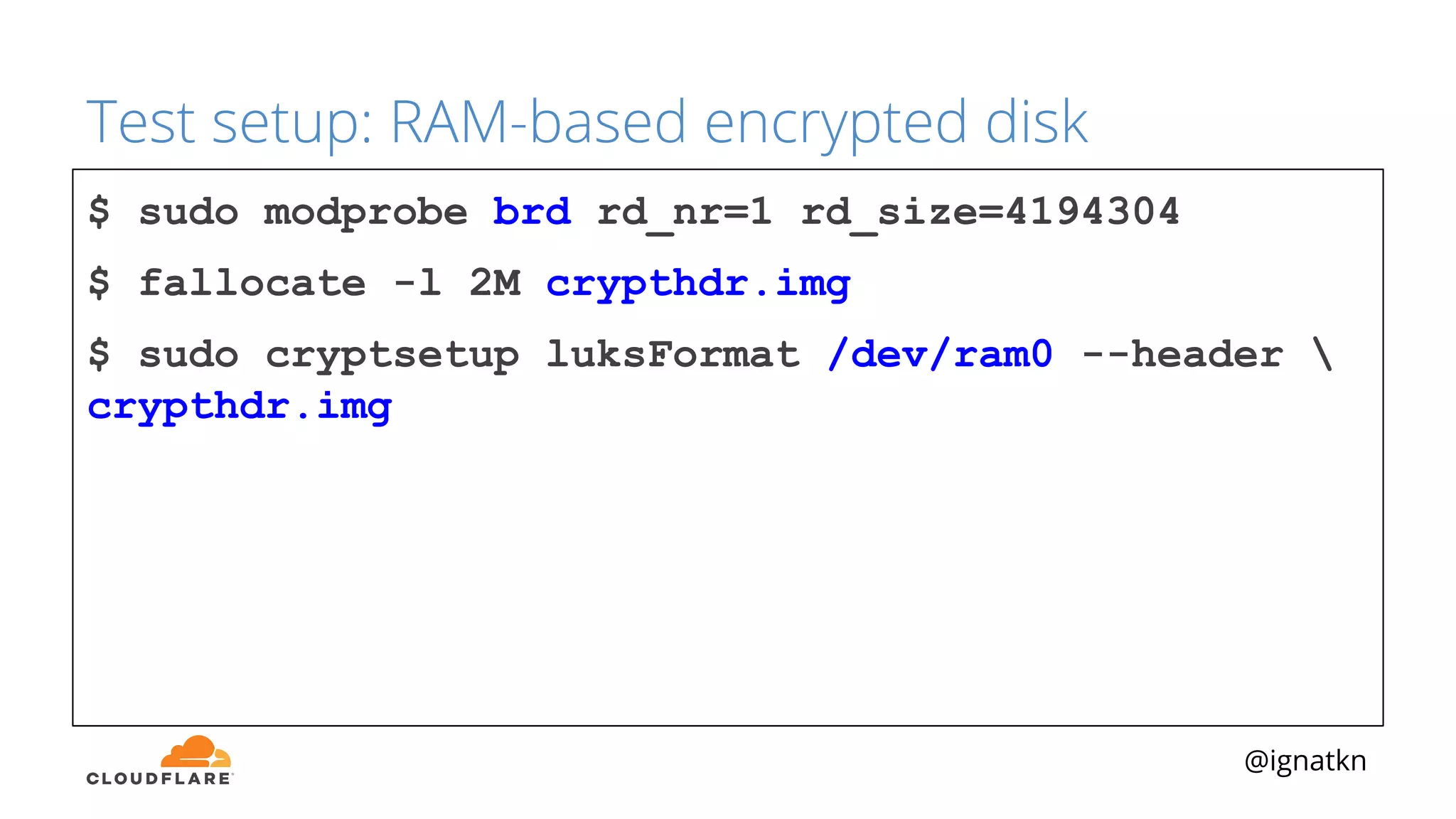
Test setup: RAM-based encrypted disk
$ sudo modprobe brd rd_nr=1 rd_size=4194304
$ fallocate -l 2M crypthdr.img
$ sudo cryptsetup luksFormat /dev/ram0 --header 
crypthdr.img
@ignatkn
Test setup: RAM-based encrypted disk
$ sudo modprobe brd rd_nr=1 rd_size=4194304
$ fallocate -l 2M crypthdr.img
$ sudo cryptsetup luksFormat /dev/ram0 --header 
crypthdr.img
$ sudo cryptsetup open --header crypthdr.img 
/dev/ram0 encrypted-ram0
@ignatkn
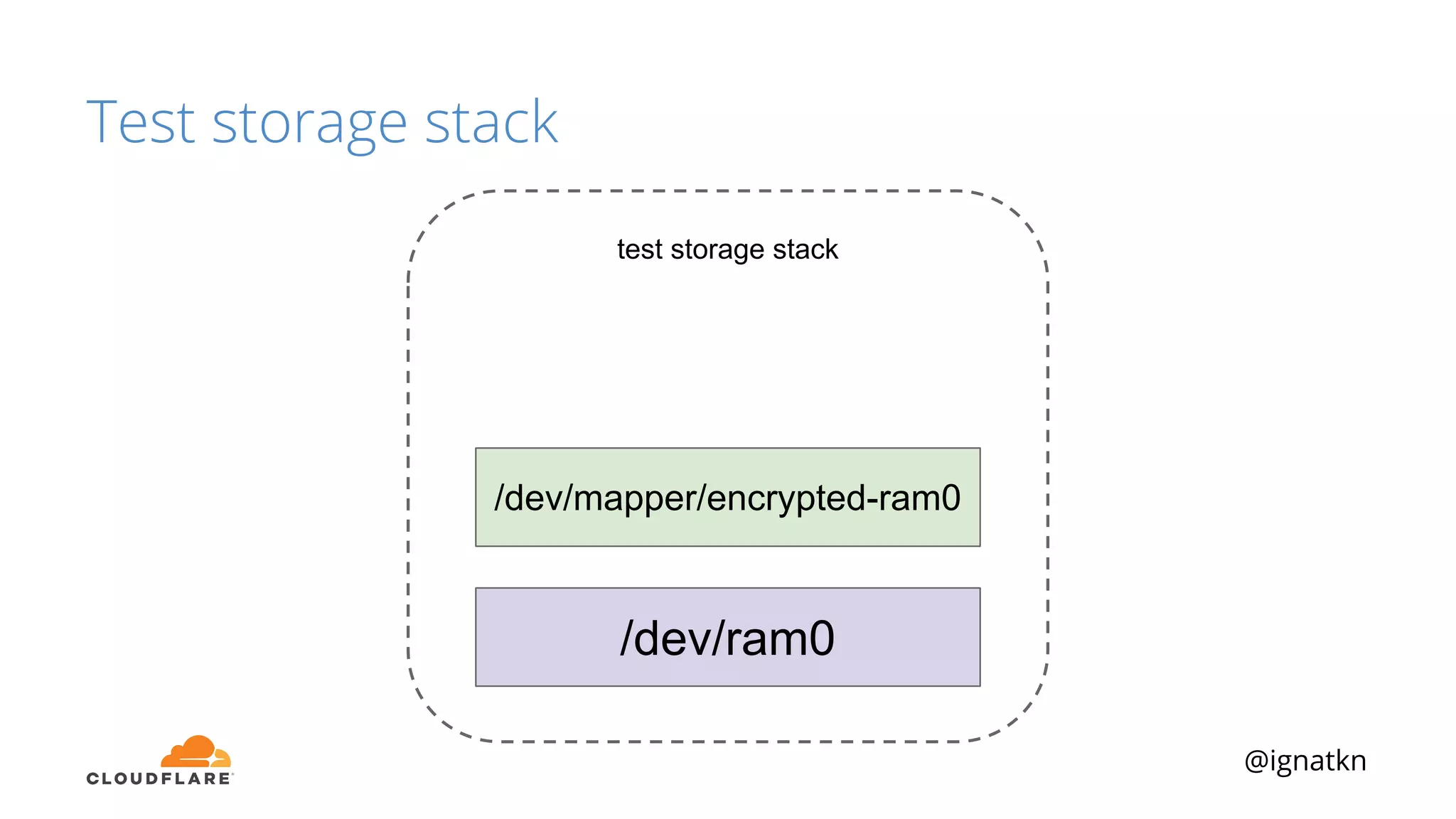
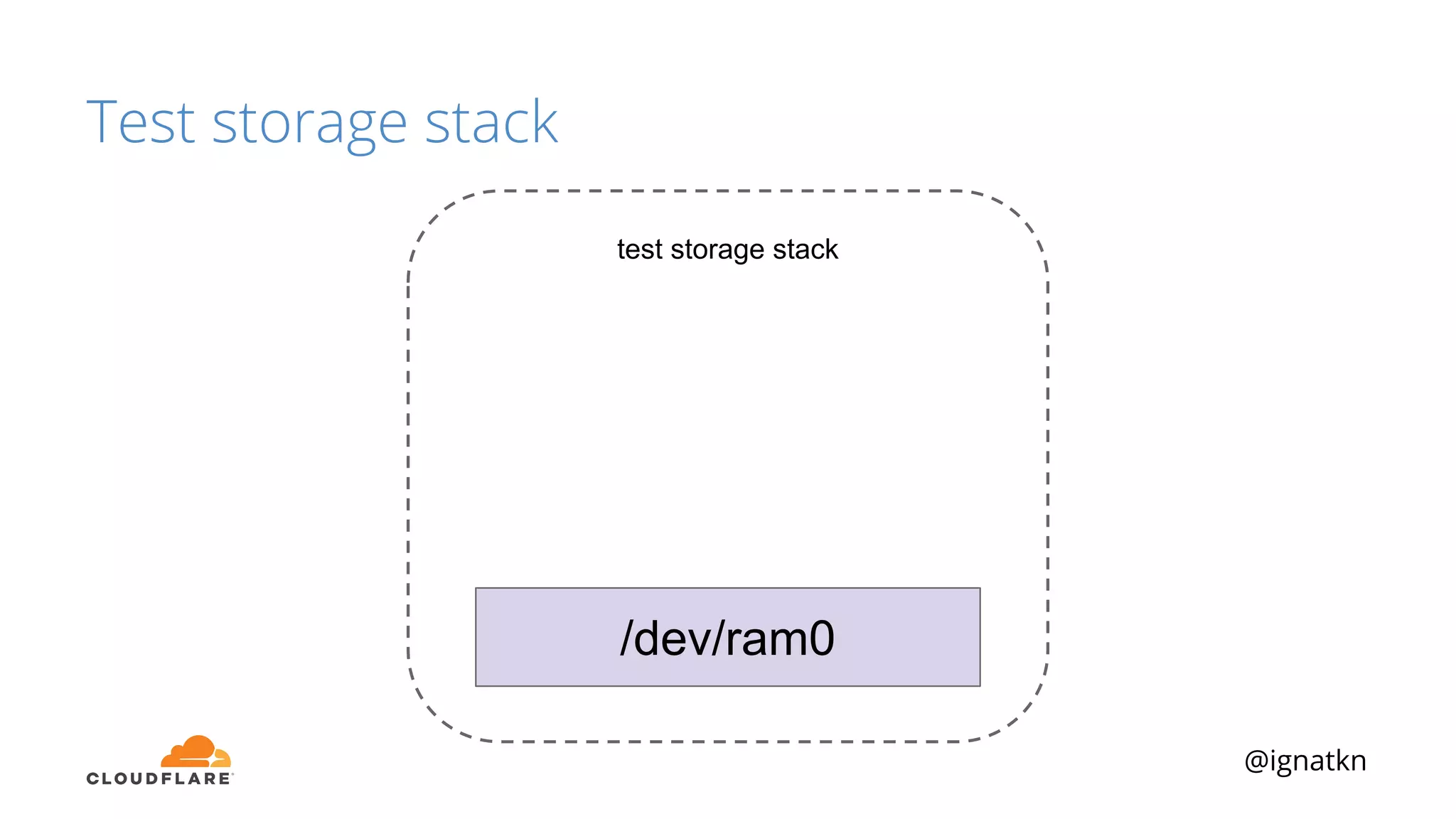
test storage stack
Test storage stack
/dev/ram0
@ignatkn
test storage stack
Test storage stack
/dev/ram0
/dev/mapper/encrypted-ram0
@ignatkn
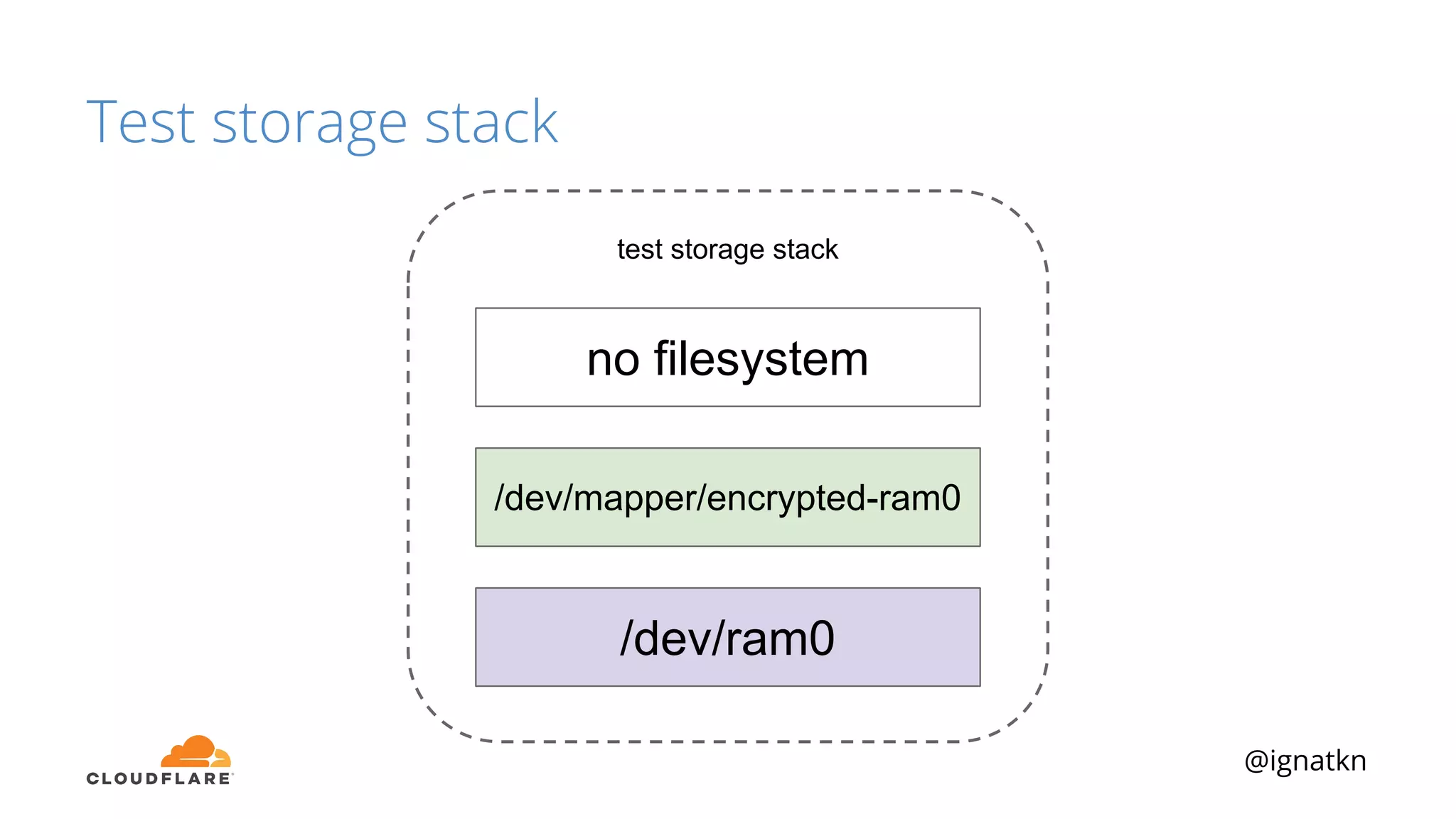
test storage stack
Test storage stack
/dev/ram0
/dev/mapper/encrypted-ram0
no filesystem
@ignatkn
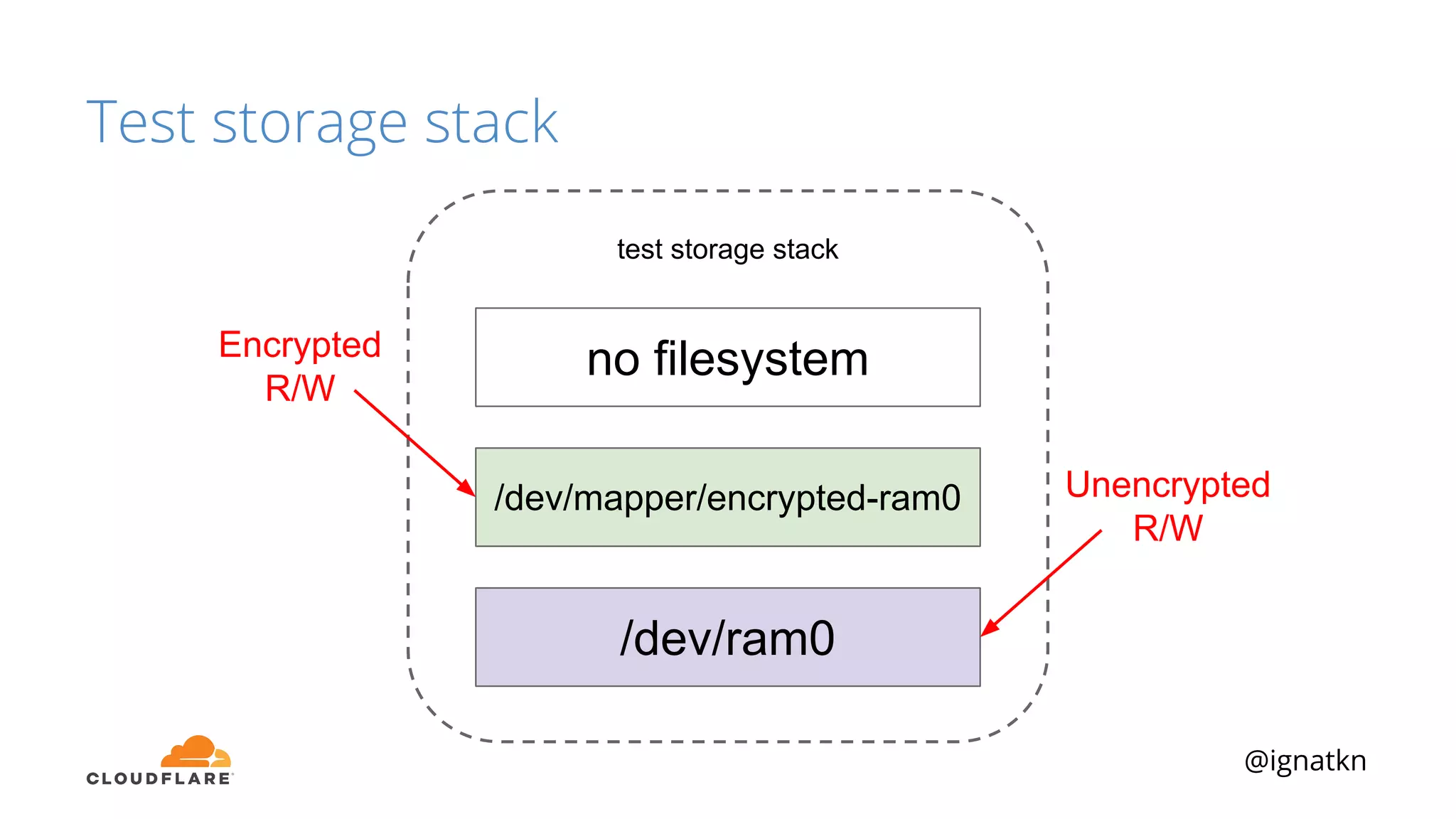
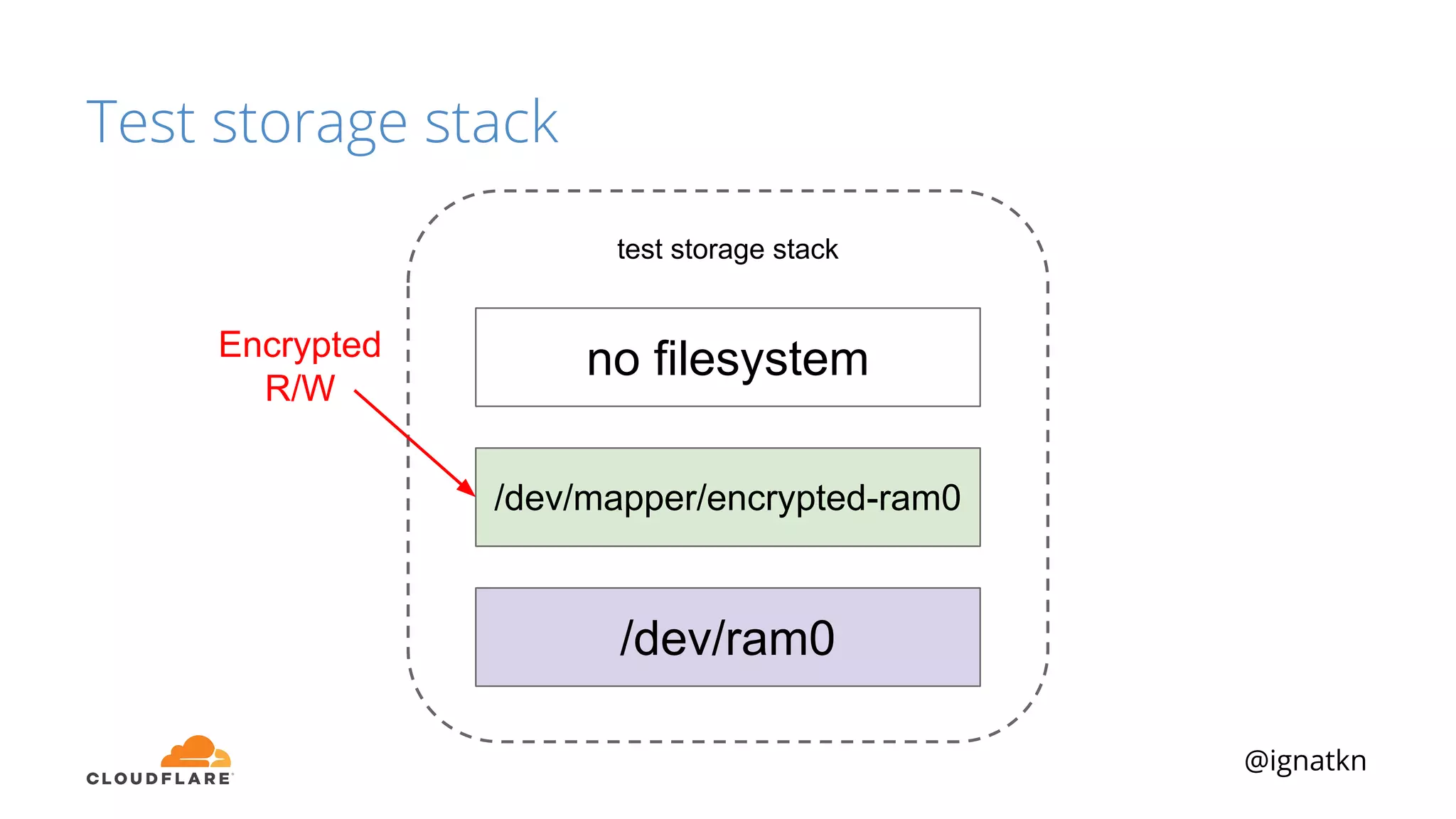
test storage stack
Test storage stack
/dev/ram0
/dev/mapper/encrypted-ram0
no filesystemEncrypted
R/W
@ignatkn
test storage stack
Test storage stack
/dev/ram0
/dev/mapper/encrypted-ram0
no filesystemEncrypted
R/W
Unencrypted
R/W
@ignatkn
Test setup: sequential reads
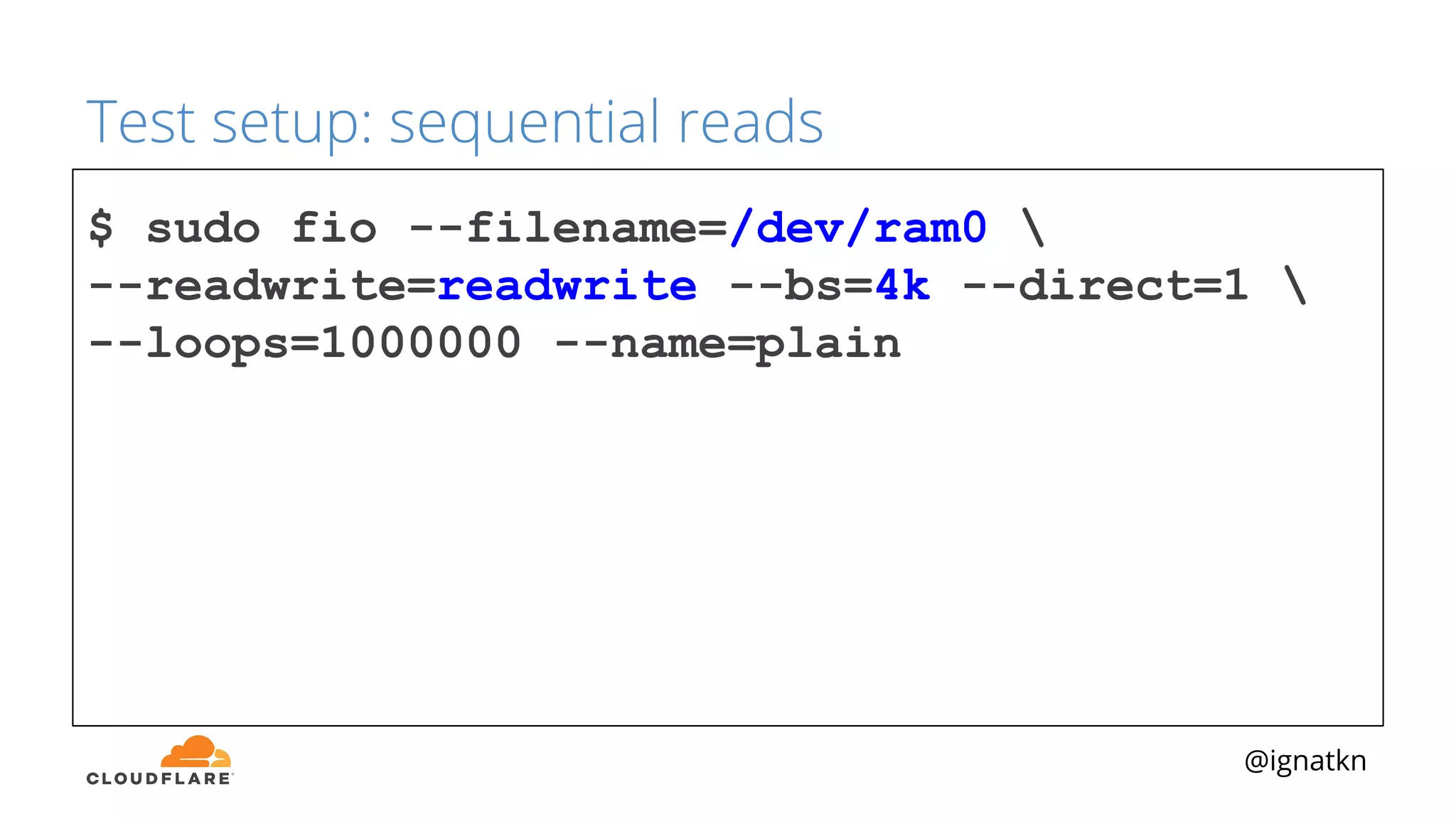
$ sudo fio --filename=/dev/ram0 
--readwrite=readwrite --bs=4k --direct=1 
--loops=1000000 --name=plain
@ignatkn
Test setup: sequential reads
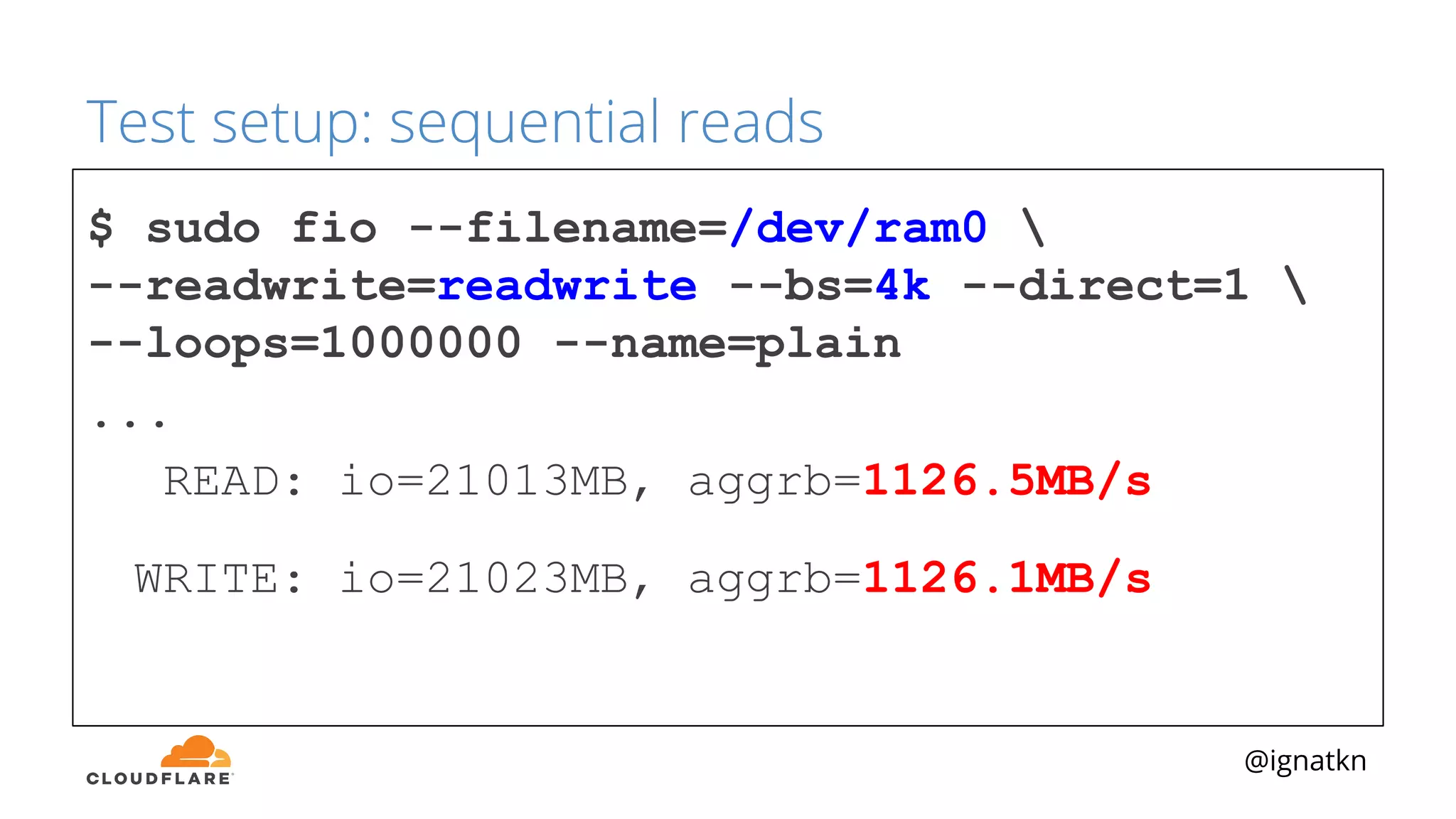
$ sudo fio --filename=/dev/ram0 
--readwrite=readwrite --bs=4k --direct=1 
--loops=1000000 --name=plain
...
READ: io=21013MB, aggrb=1126.5MB/s
WRITE: io=21023MB, aggrb=1126.1MB/s
@ignatkn
Test setup: sequential reads
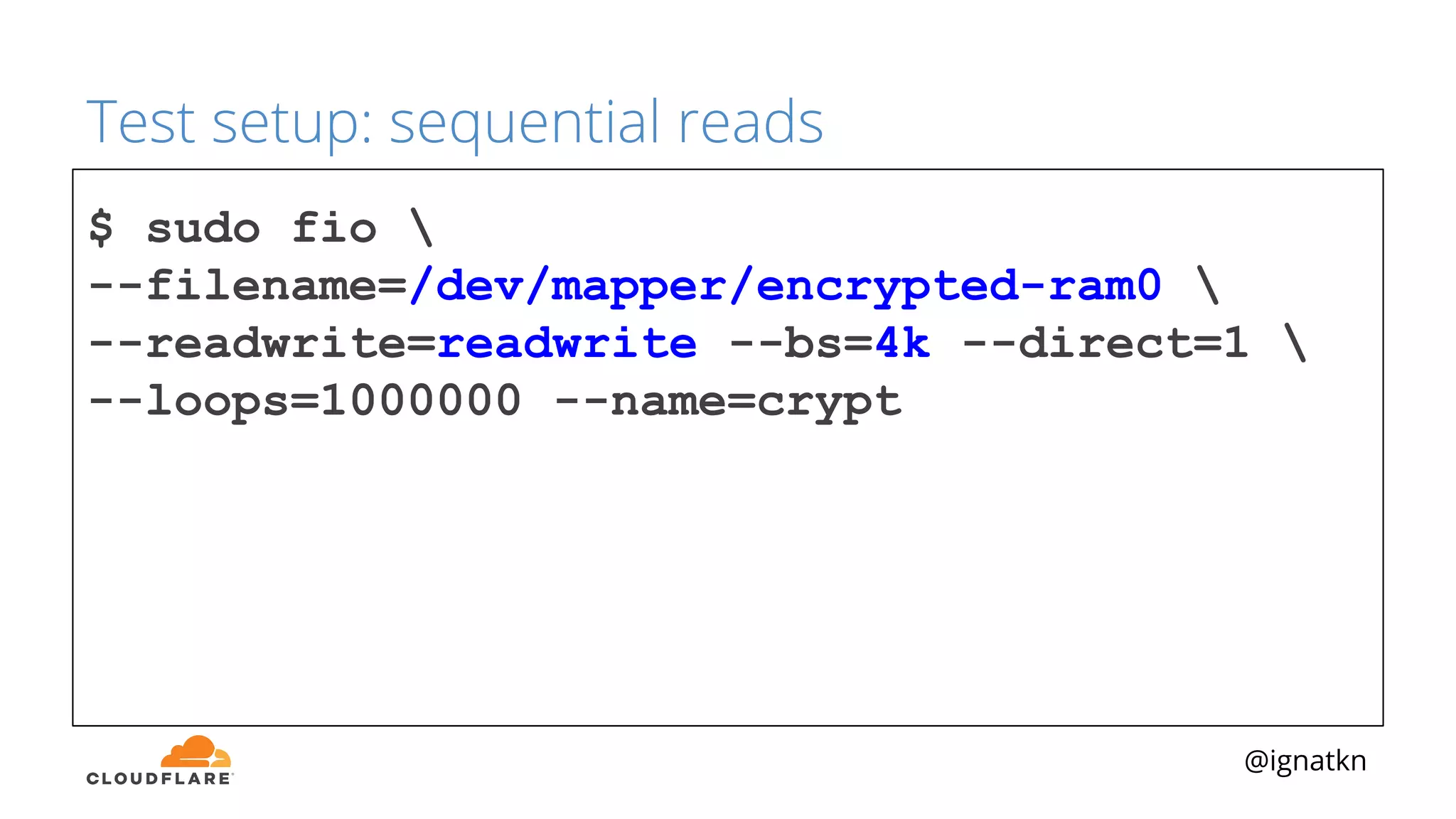
$ sudo fio 
--filename=/dev/mapper/encrypted-ram0 
--readwrite=readwrite --bs=4k --direct=1 
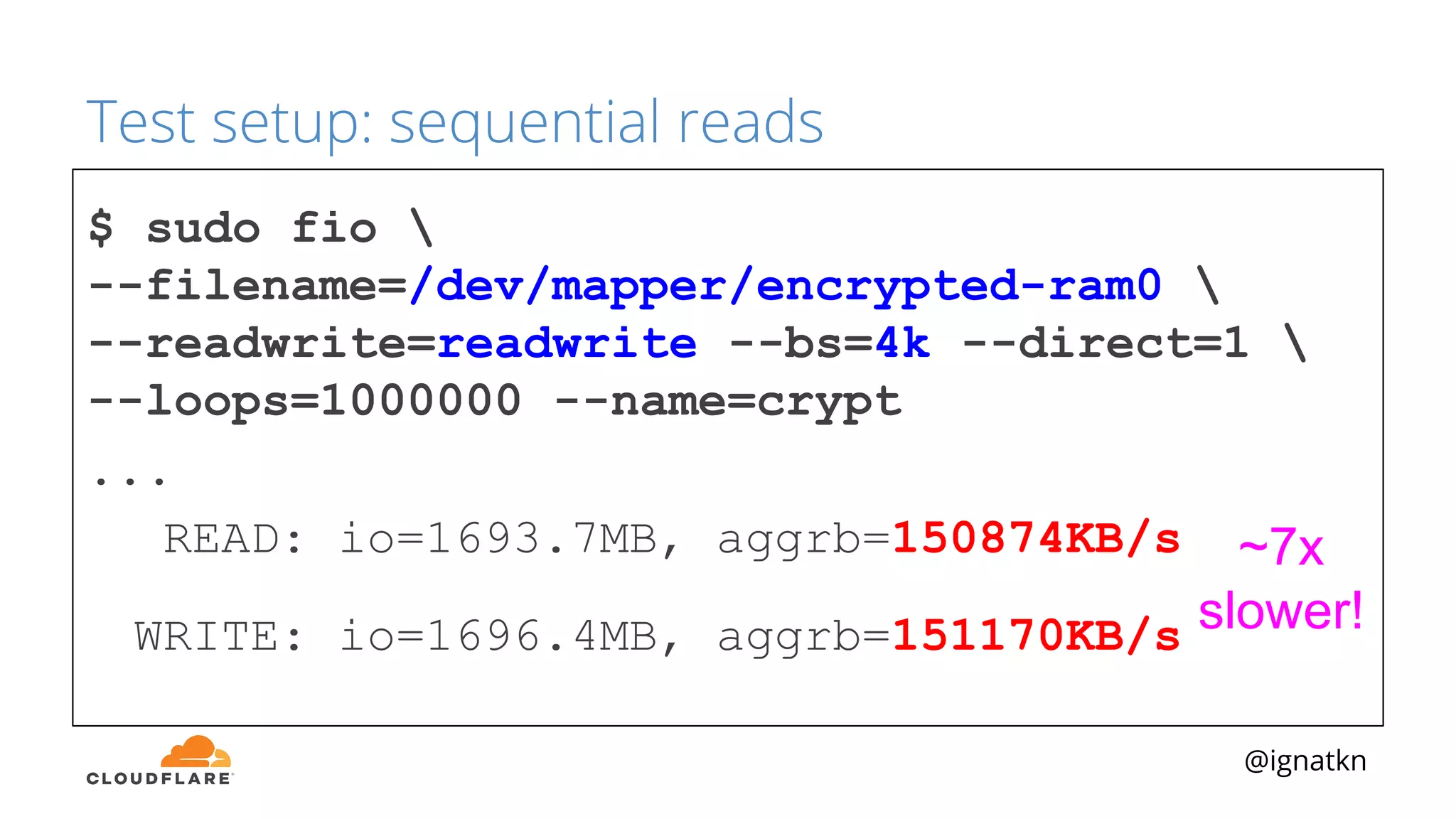
--loops=1000000 --name=crypt
@ignatkn
Test setup: sequential reads
$ sudo fio 
--filename=/dev/mapper/encrypted-ram0 
--readwrite=readwrite --bs=4k --direct=1 
--loops=1000000 --name=crypt
...
READ: io=1693.7MB, aggrb=150874KB/s
WRITE: io=1696.4MB, aggrb=151170KB/s
@ignatkn
Test setup: sequential reads
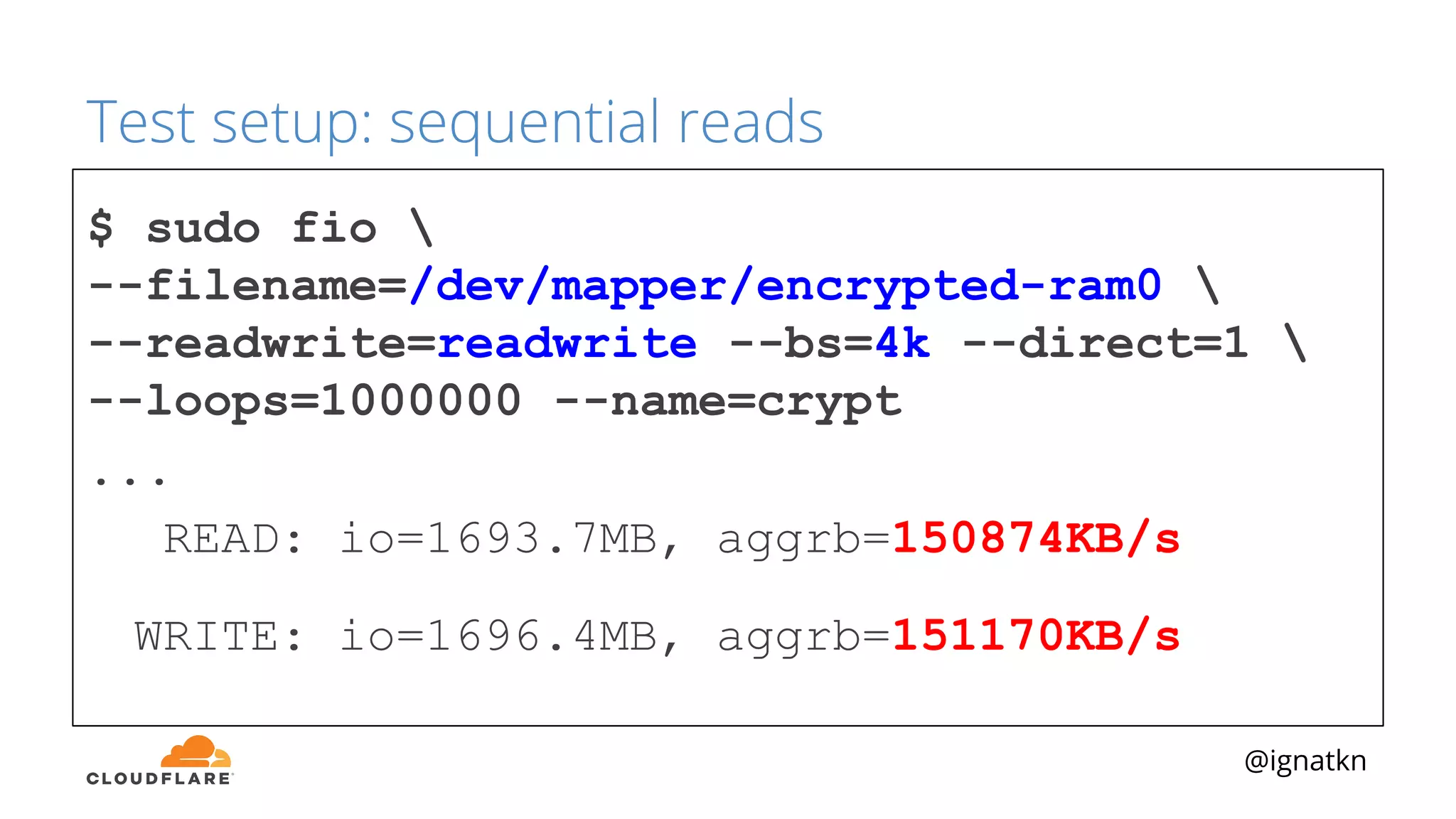
$ sudo fio 
--filename=/dev/mapper/encrypted-ram0 
--readwrite=readwrite --bs=4k --direct=1 
--loops=1000000 --name=crypt
...
READ: io=1693.7MB, aggrb=150874KB/s
WRITE: io=1696.4MB, aggrb=151170KB/s
~7x
slower!
@ignatkn
Test setup: sequential reads
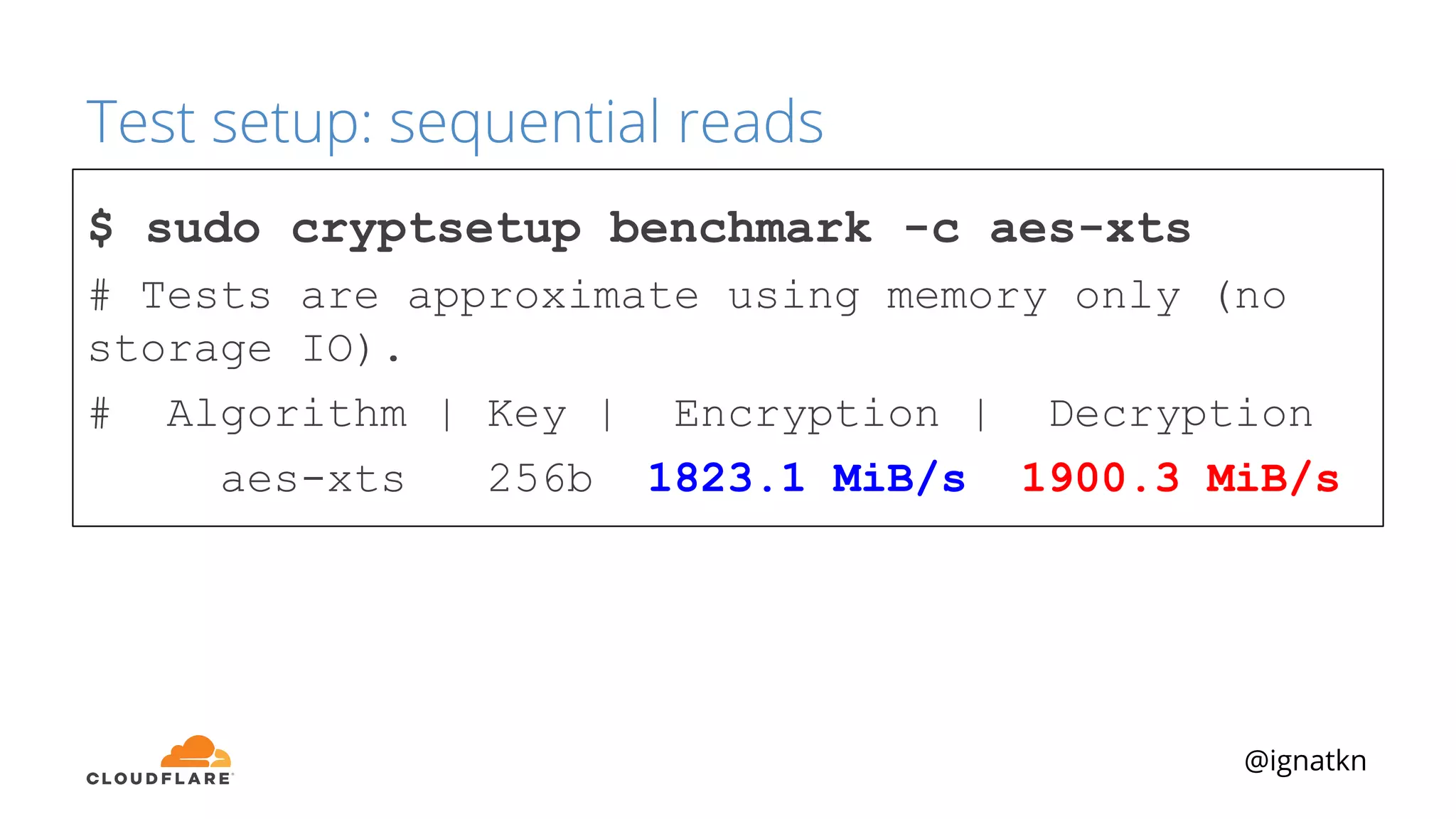
$ sudo cryptsetup benchmark -c aes-xts
# Tests are approximate using memory only (no
storage IO).
# Algorithm | Key | Encryption | Decryption
aes-xts 256b 1823.1 MiB/s 1900.3 MiB/s
@ignatkn
Test setup: sequential reads
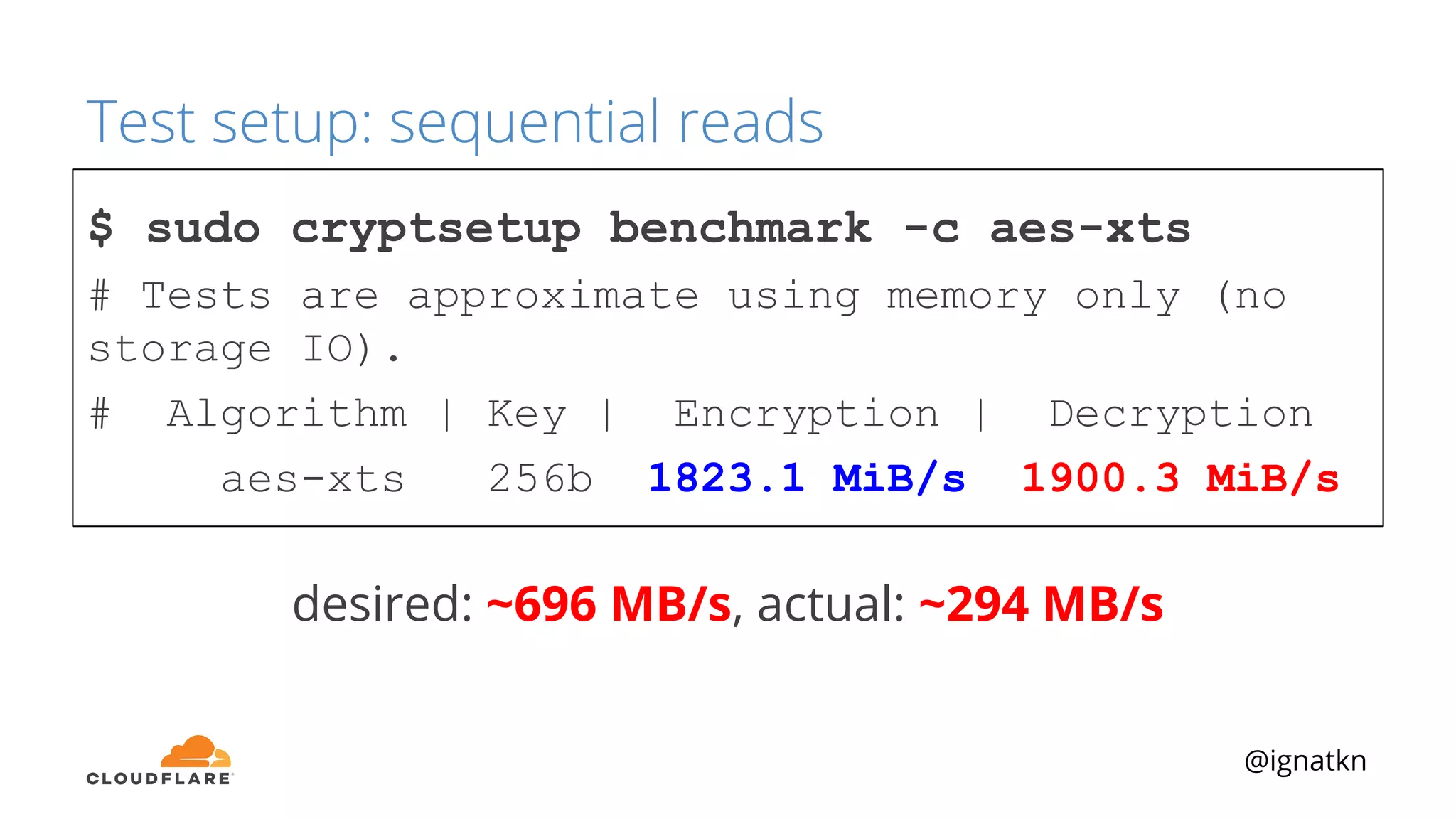
$ sudo cryptsetup benchmark -c aes-xts
# Tests are approximate using memory only (no
storage IO).
# Algorithm | Key | Encryption | Decryption
aes-xts 256b 1823.1 MiB/s 1900.3 MiB/s
desired: ~696 MB/s, actual: ~294 MB/s
@ignatkn
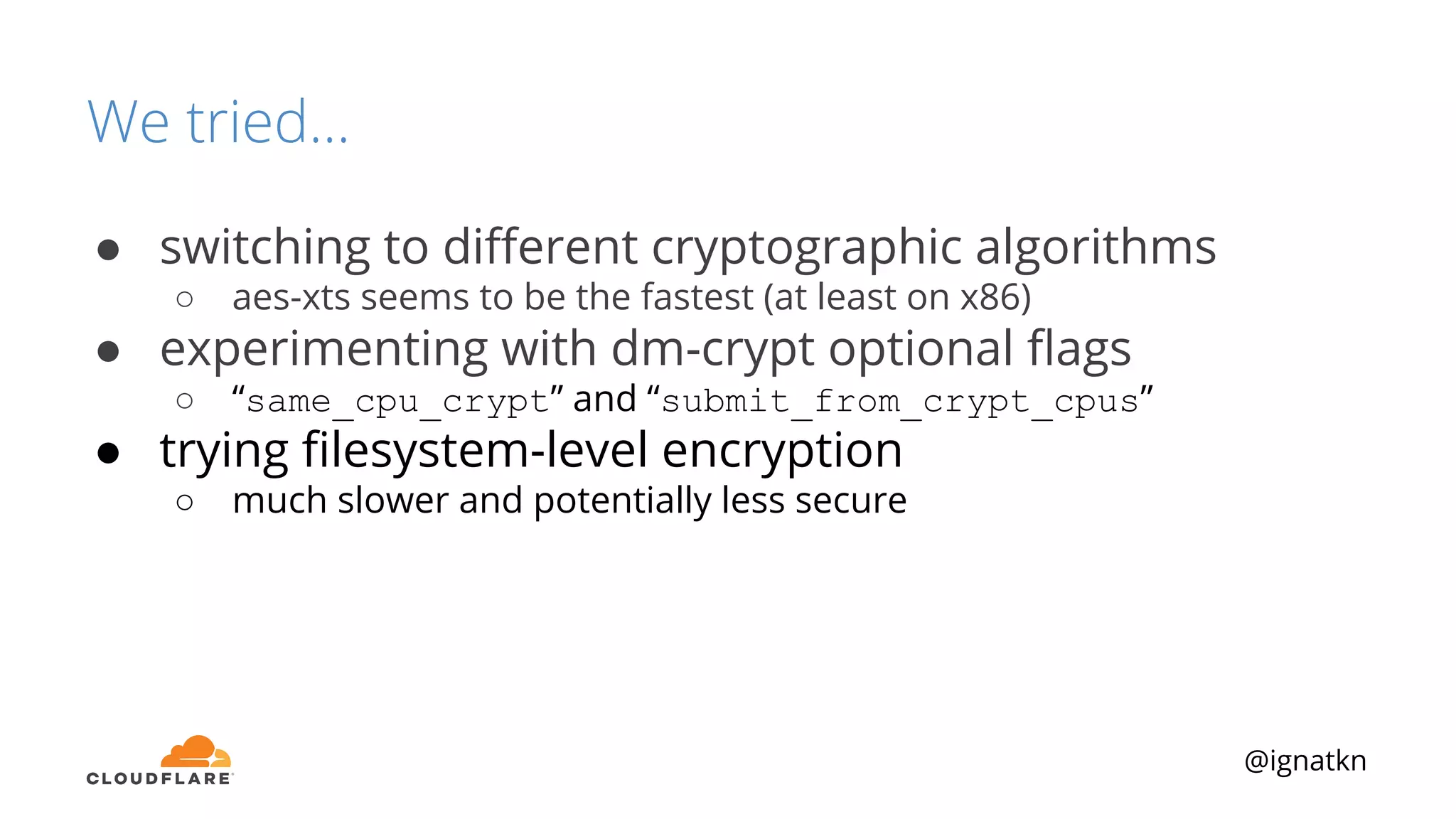
We tried...
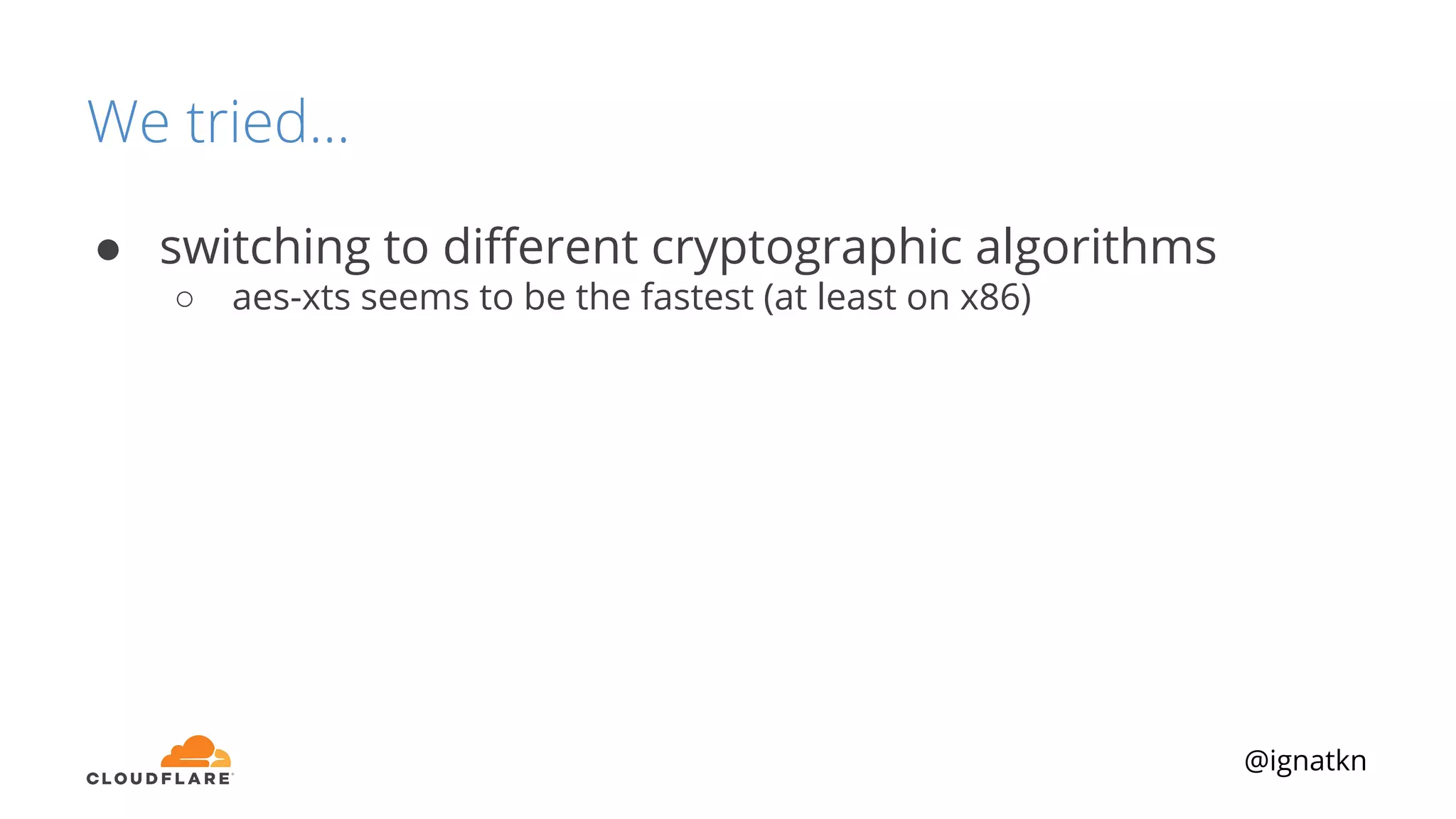
● switching to different cryptographic algorithms
○ aes-xts seems to be the fastest (at least on x86)
@ignatkn
We tried...
● switching to different cryptographic algorithms
○ aes-xts seems to be the fastest (at least on x86)
● experimenting with dm-crypt optional flags
○ “same_cpu_crypt” and “submit_from_crypt_cpus”
@ignatkn
We tried...
● switching to different cryptographic algorithms
○ aes-xts seems to be the fastest (at least on x86)
● experimenting with dm-crypt optional flags
○ “same_cpu_crypt” and “submit_from_crypt_cpus”
● trying filesystem-level encryption
○ much slower and potentially less secure
@ignatkn
Despair
@ignatkn
Ask the community
“If the numbers disturb you, then this is from lack of
understanding on your side. You are probably unaware
that encryption is a heavy-weight operation...“
https://www.spinics.net/lists/dm-crypt/msg07516.html
@ignatkn
But actually...
“Using TLS is very cheap, even at the scale of Cloudflare.
Modern crypto is very fast, with AES-GCM and P256
being great examples.”
https://blog.cloudflare.com/how-expensive-is-crypto-anyway/
@ignatkn
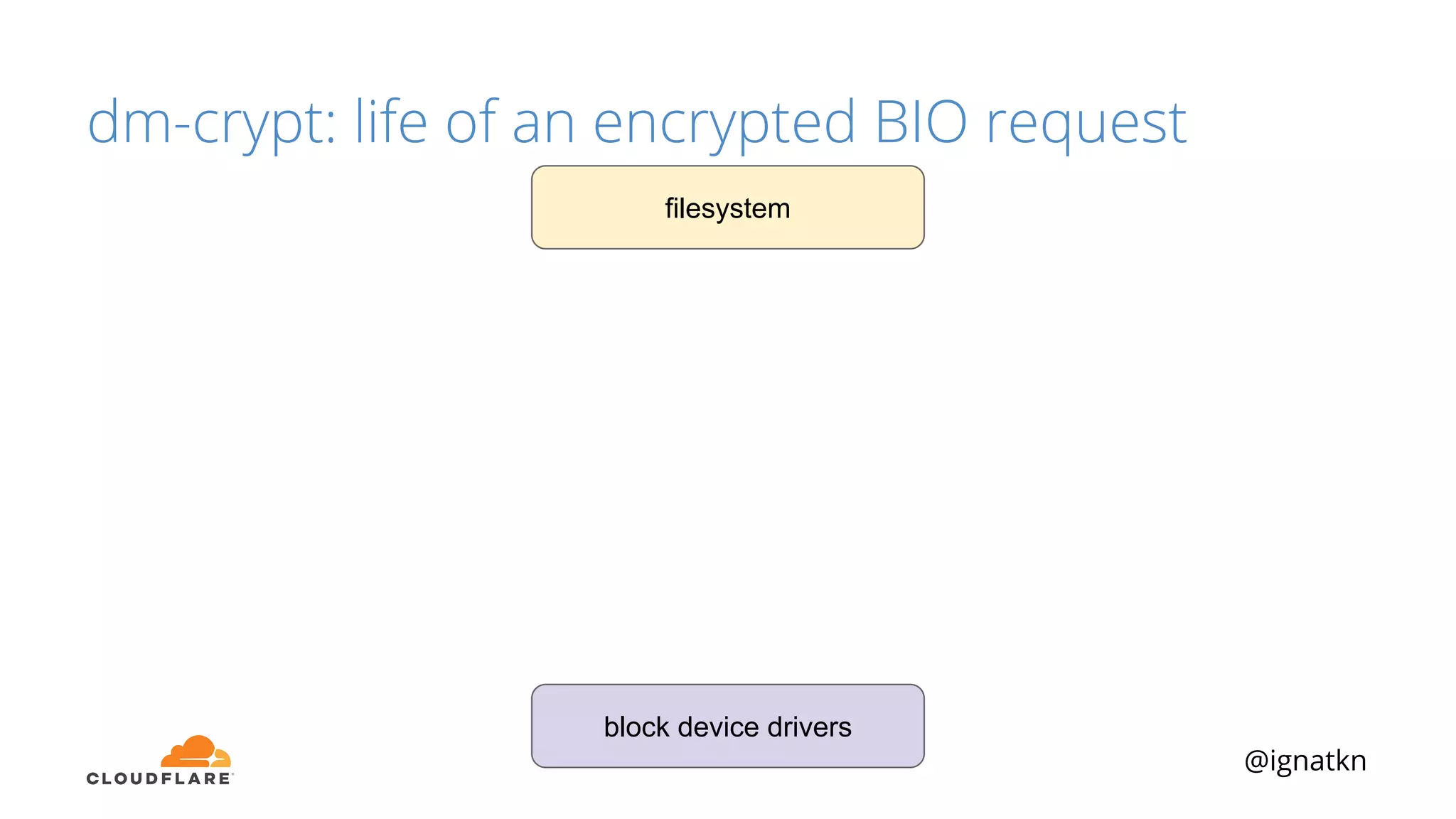
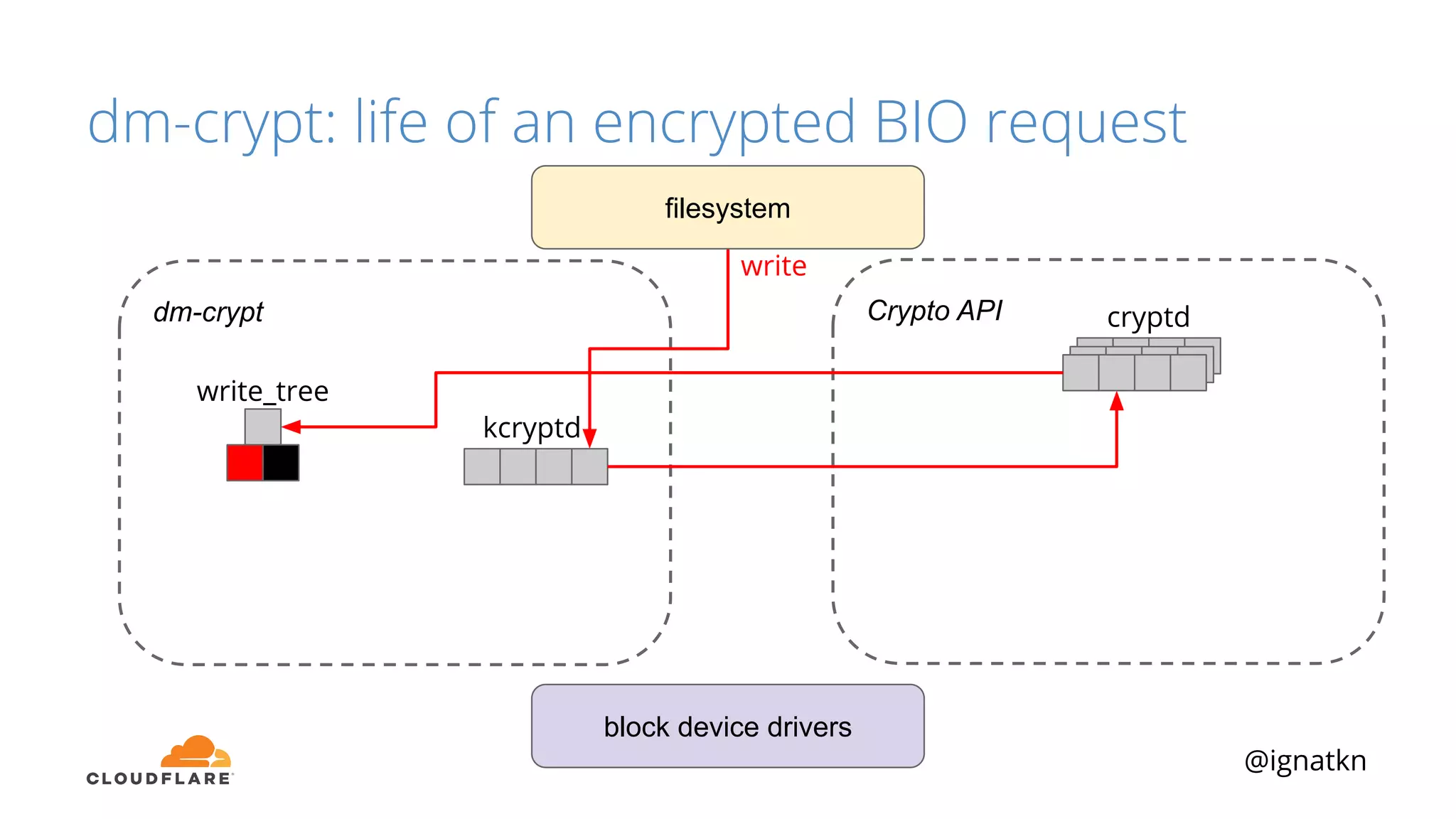
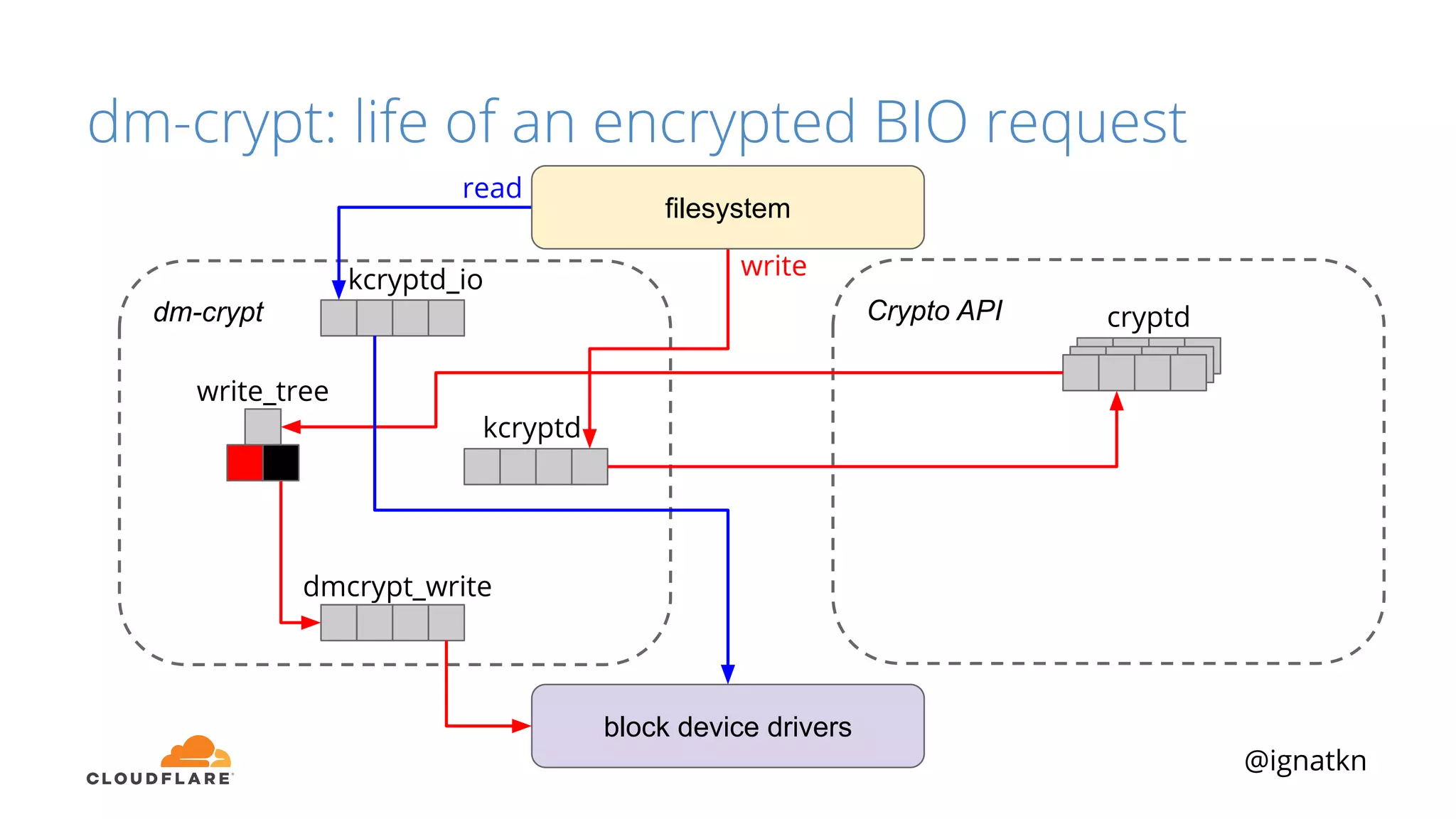
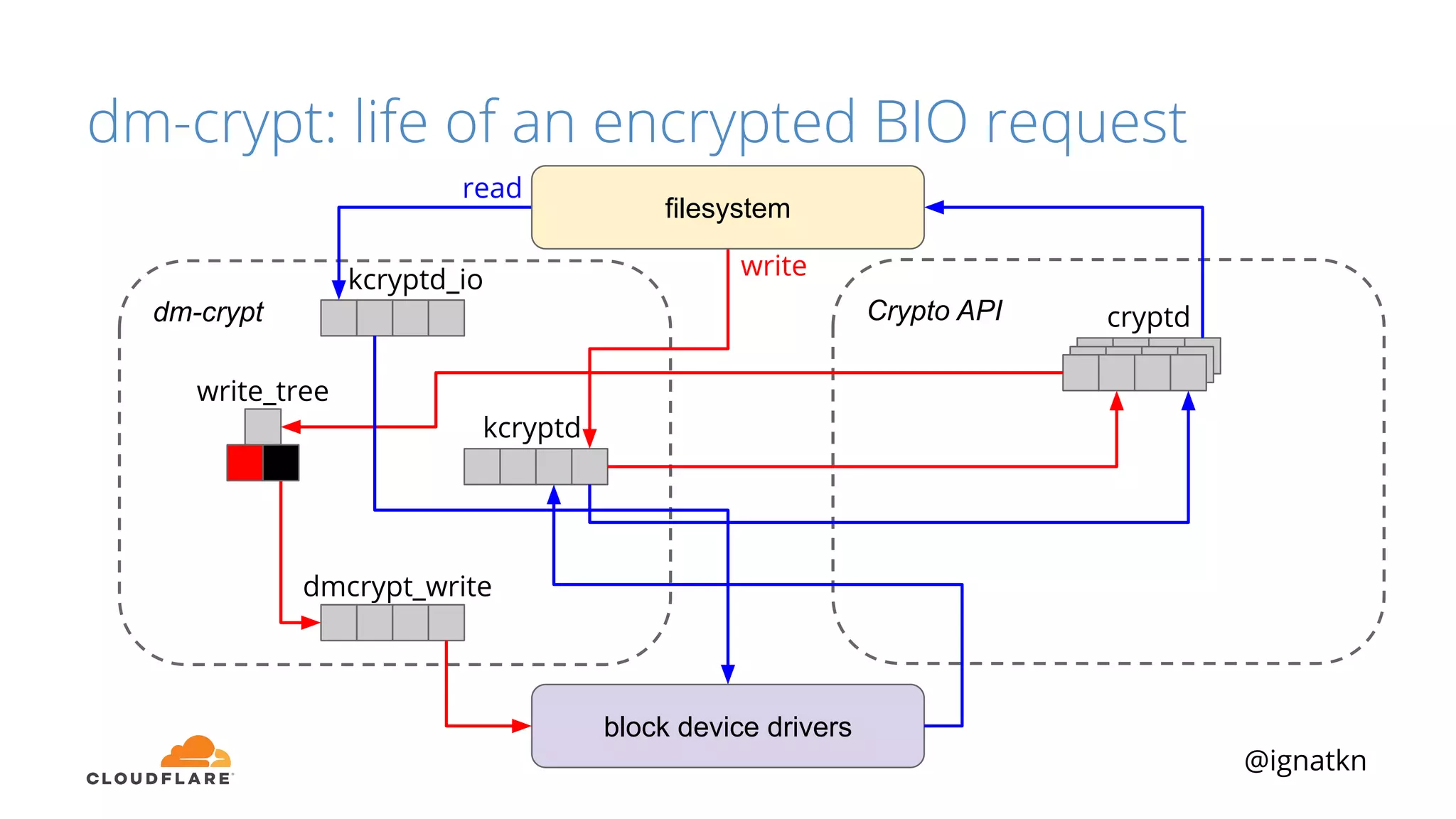
dm-crypt: life of an encrypted BIO request
block device drivers
filesystem
@ignatkn
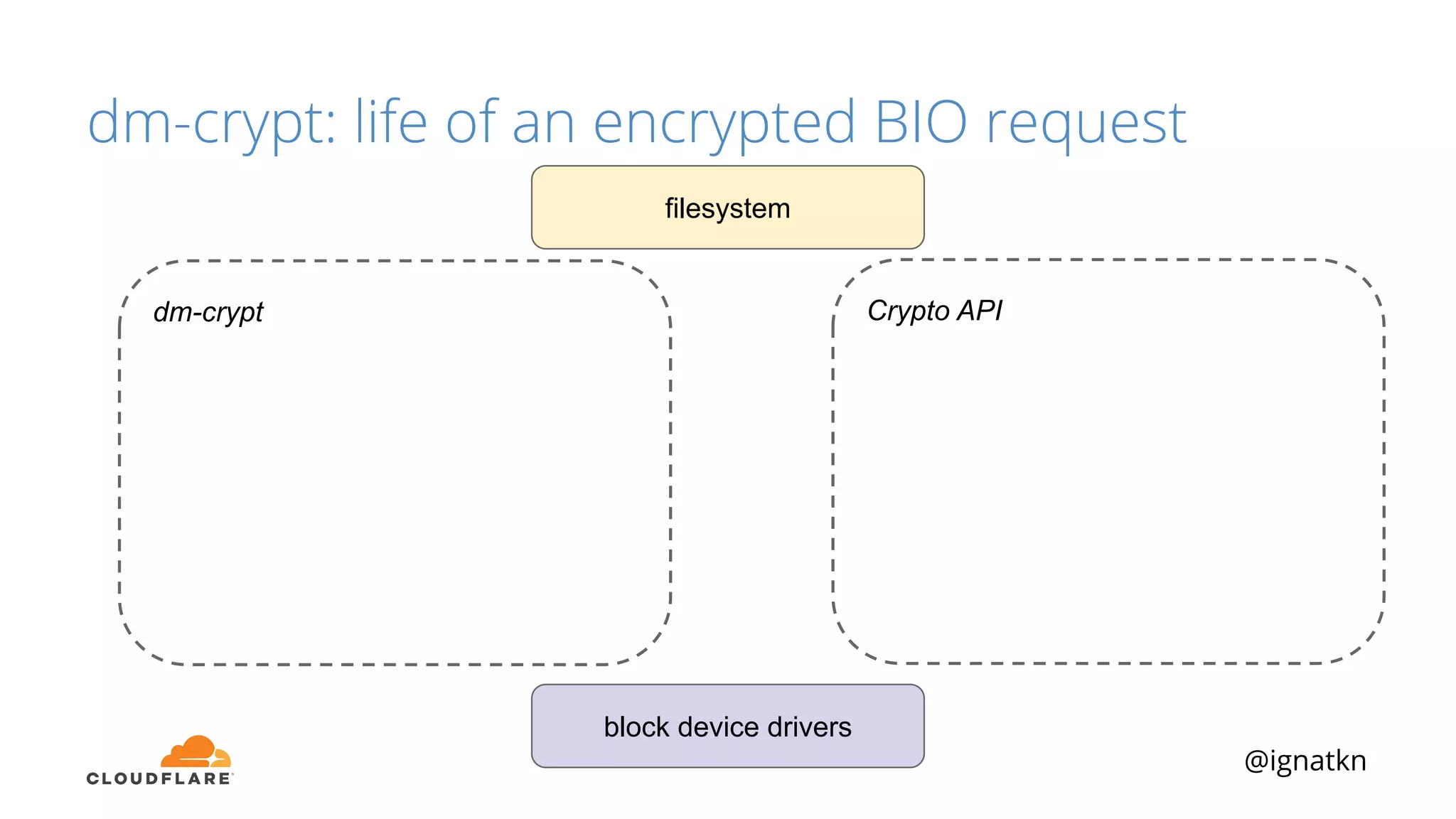
Crypto APIdm-crypt
dm-crypt: life of an encrypted BIO request
block device drivers
filesystem
@ignatkn
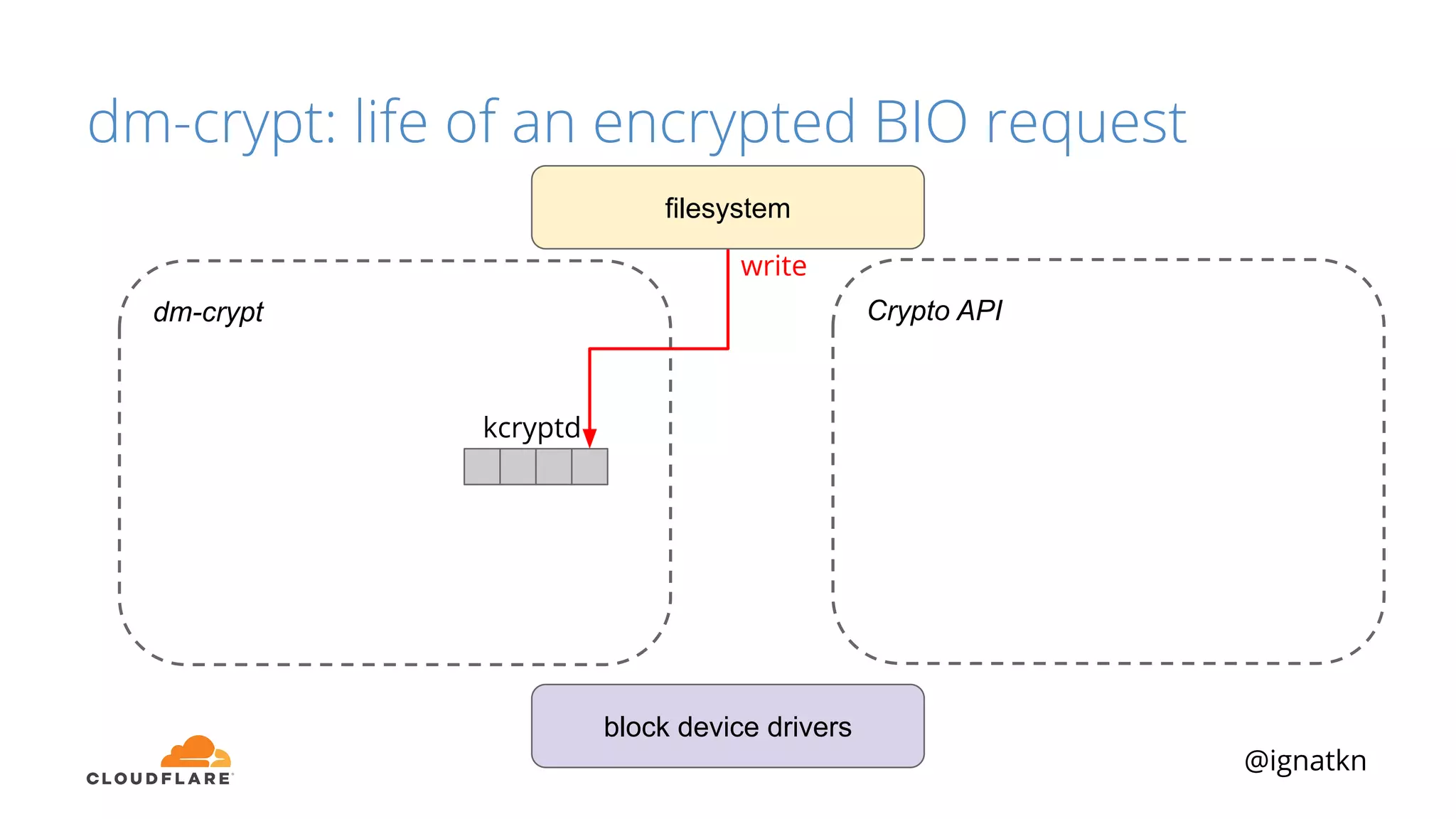
Crypto APIdm-crypt
block device drivers
filesystem
kcryptd
write
dm-crypt: life of an encrypted BIO request
@ignatkn
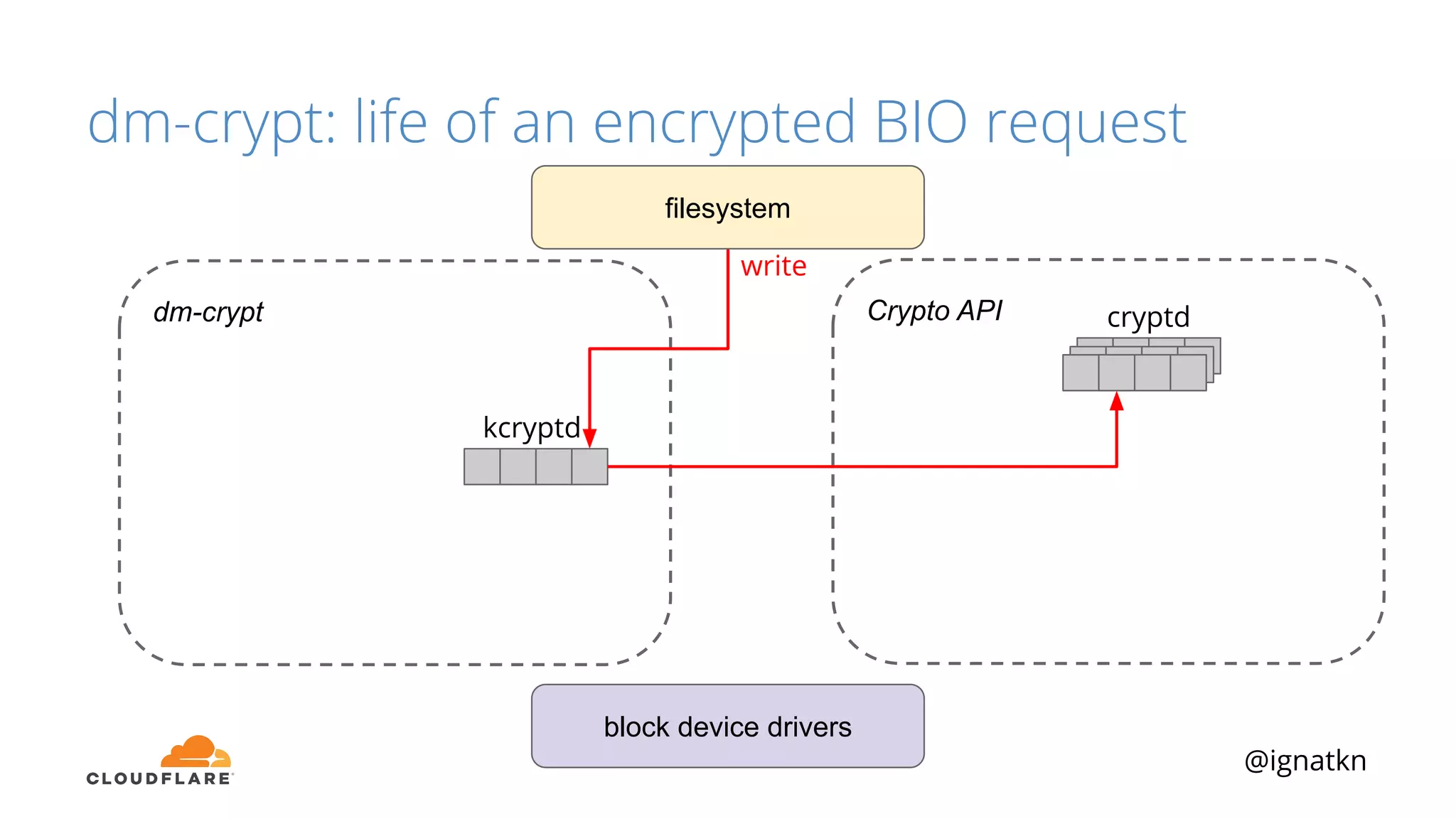
Crypto APIdm-crypt
block device drivers
filesystem
cryptd
kcryptd
write
dm-crypt: life of an encrypted BIO request
@ignatkn
Crypto APIdm-crypt
block device drivers
filesystem
cryptd
kcryptd
write
write_tree
dm-crypt: life of an encrypted BIO request
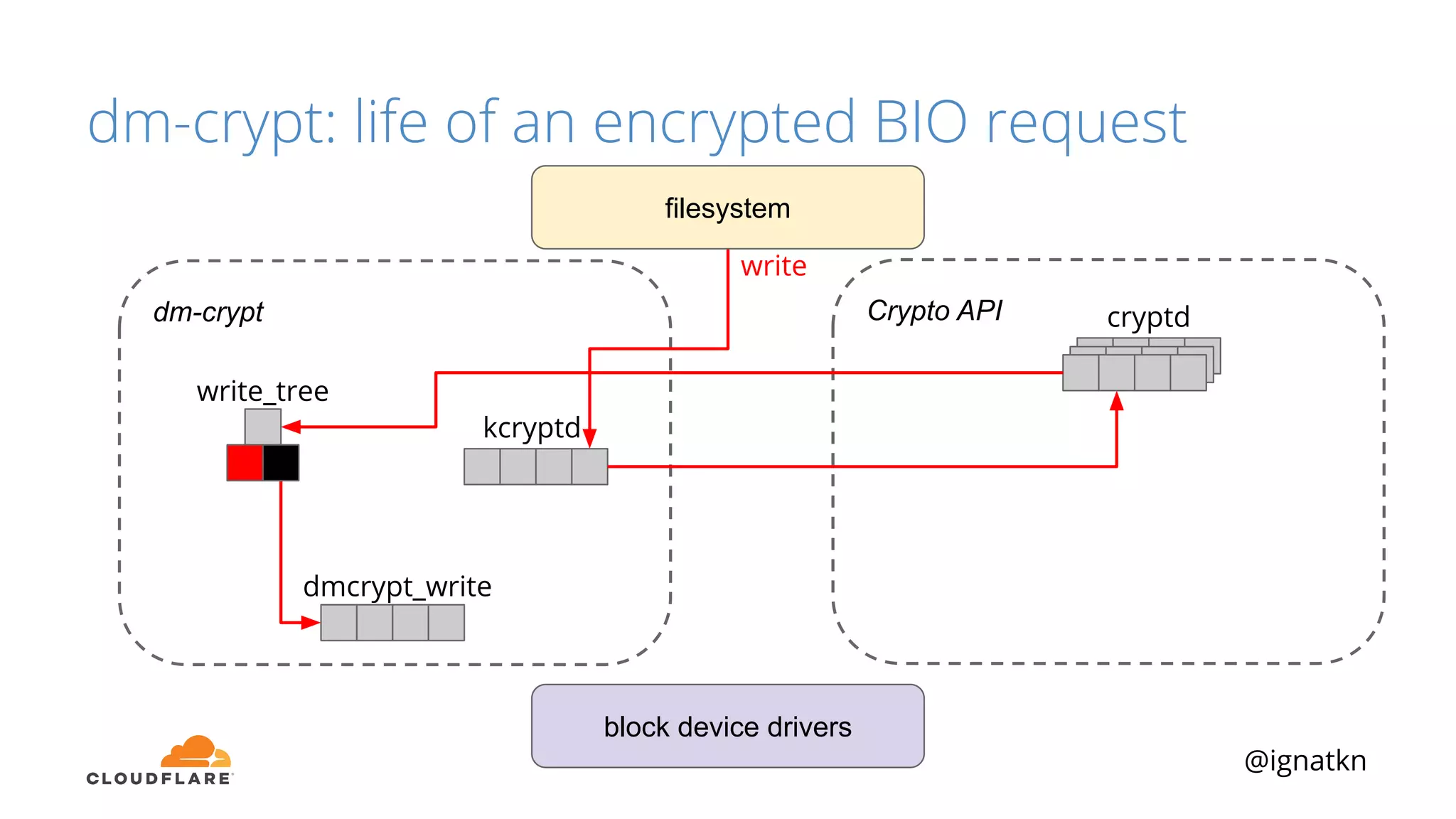
@ignatkn
Crypto APIdm-crypt
block device drivers
filesystem
cryptd
kcryptd
dmcrypt_write
write
write_tree
dm-crypt: life of an encrypted BIO request
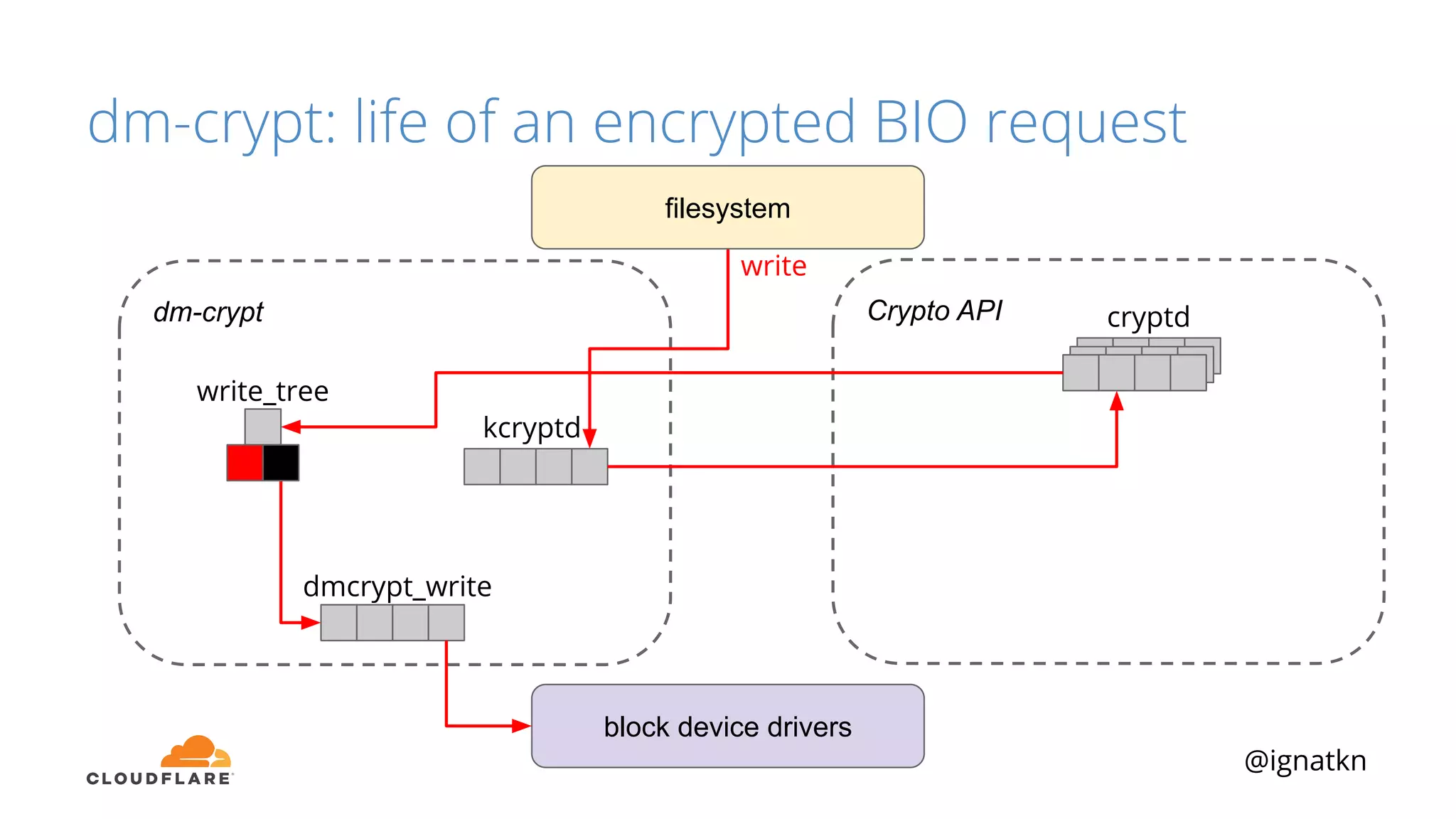
@ignatkn
Crypto APIdm-crypt
block device drivers
filesystem
cryptd
kcryptd
dmcrypt_write
write
write_tree
dm-crypt: life of an encrypted BIO request
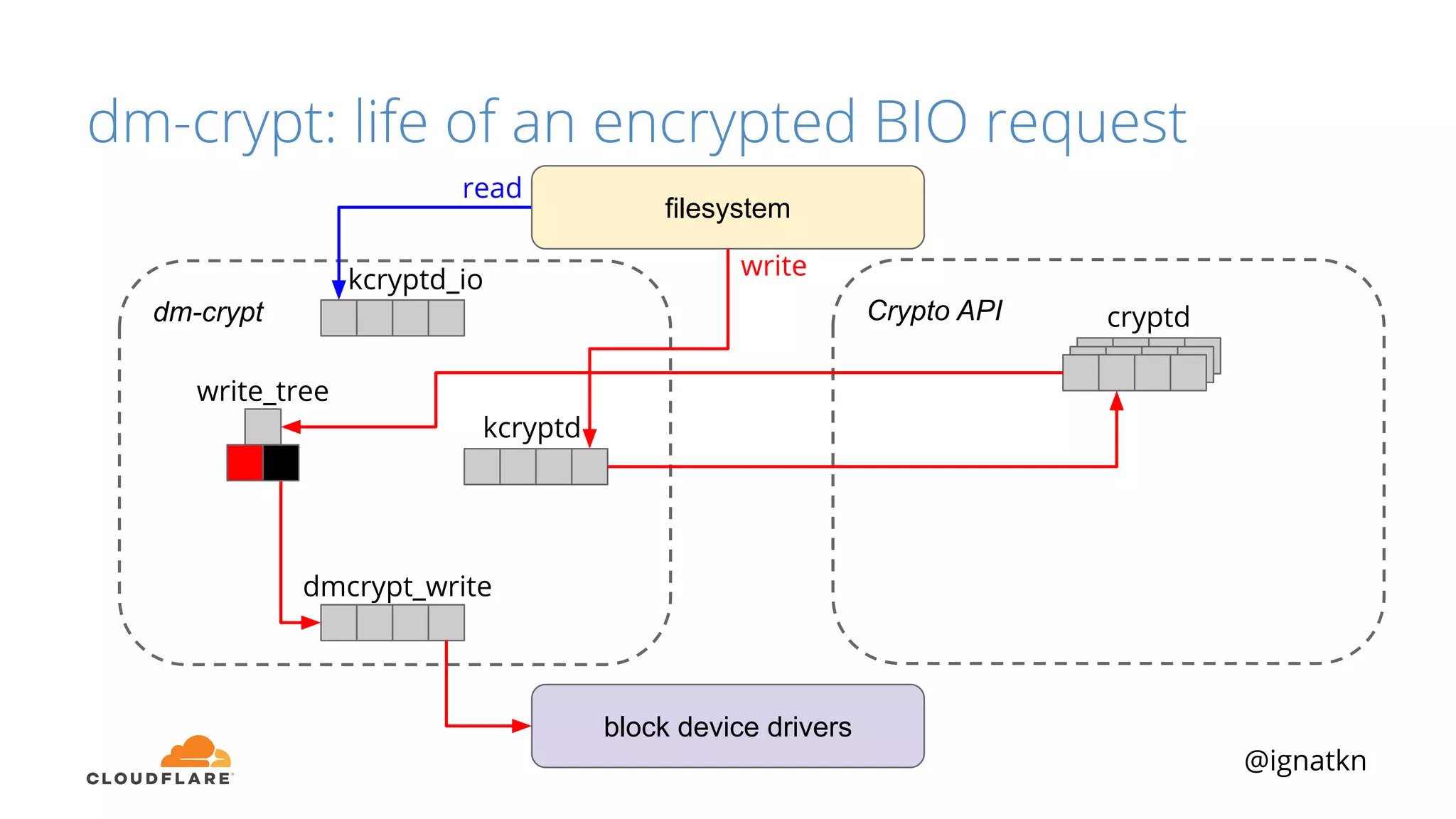
@ignatkn
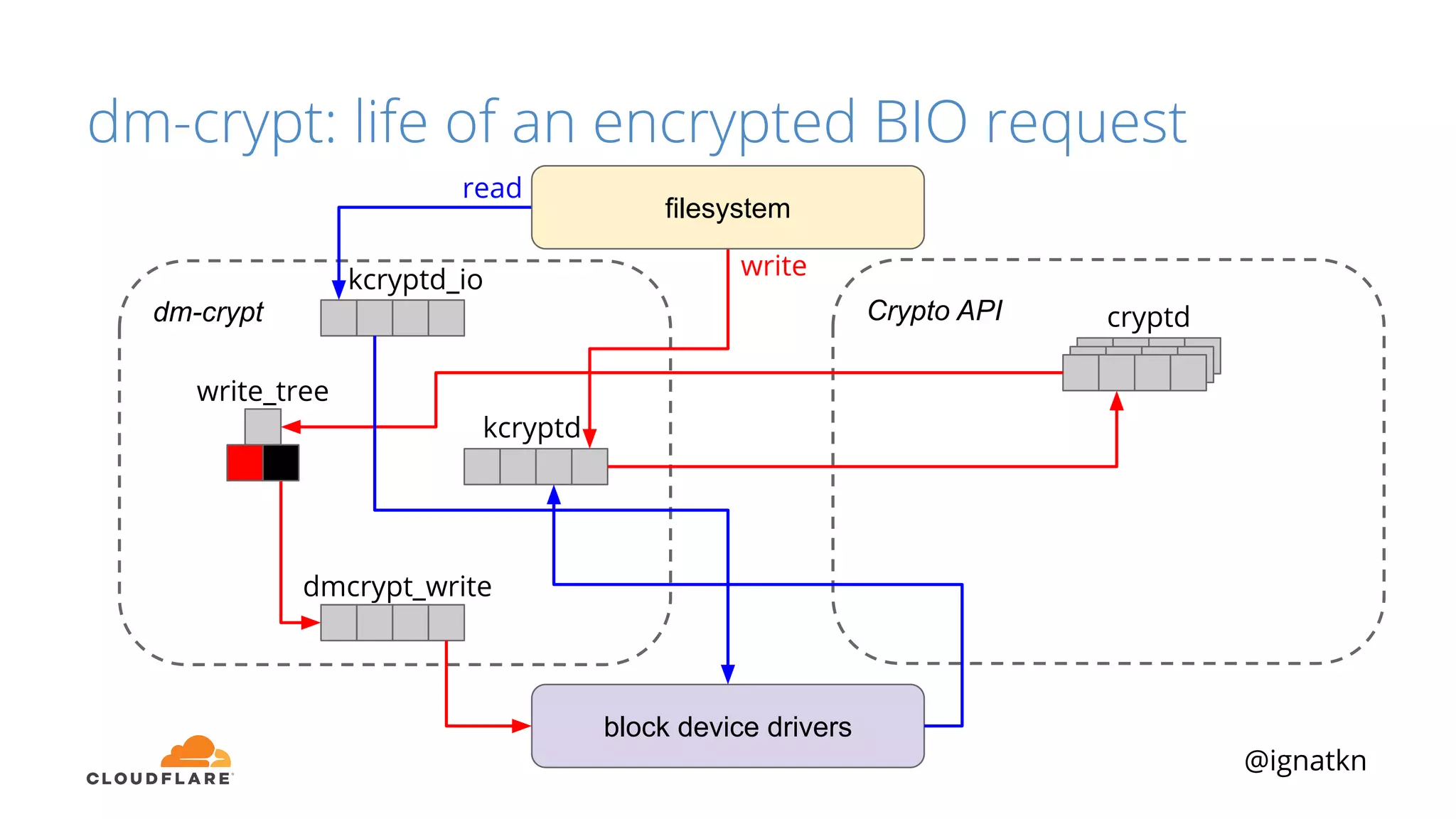
Crypto APIdm-crypt
block device drivers
filesystem
cryptd
kcryptd_io
kcryptd
dmcrypt_write
write
read
write_tree
dm-crypt: life of an encrypted BIO request
@ignatkn
Crypto APIdm-crypt
block device drivers
filesystem
cryptd
kcryptd_io
kcryptd
dmcrypt_write
write
read
write_tree
dm-crypt: life of an encrypted BIO request
@ignatkn
Crypto APIdm-crypt
block device drivers
filesystem
cryptd
kcryptd_io
kcryptd
dmcrypt_write
write
read
write_tree
dm-crypt: life of an encrypted BIO request
@ignatkn
Crypto APIdm-crypt
block device drivers
filesystem
cryptd
kcryptd_io
kcryptd
dmcrypt_write
write
read
write_tree
dm-crypt: life of an encrypted BIO request
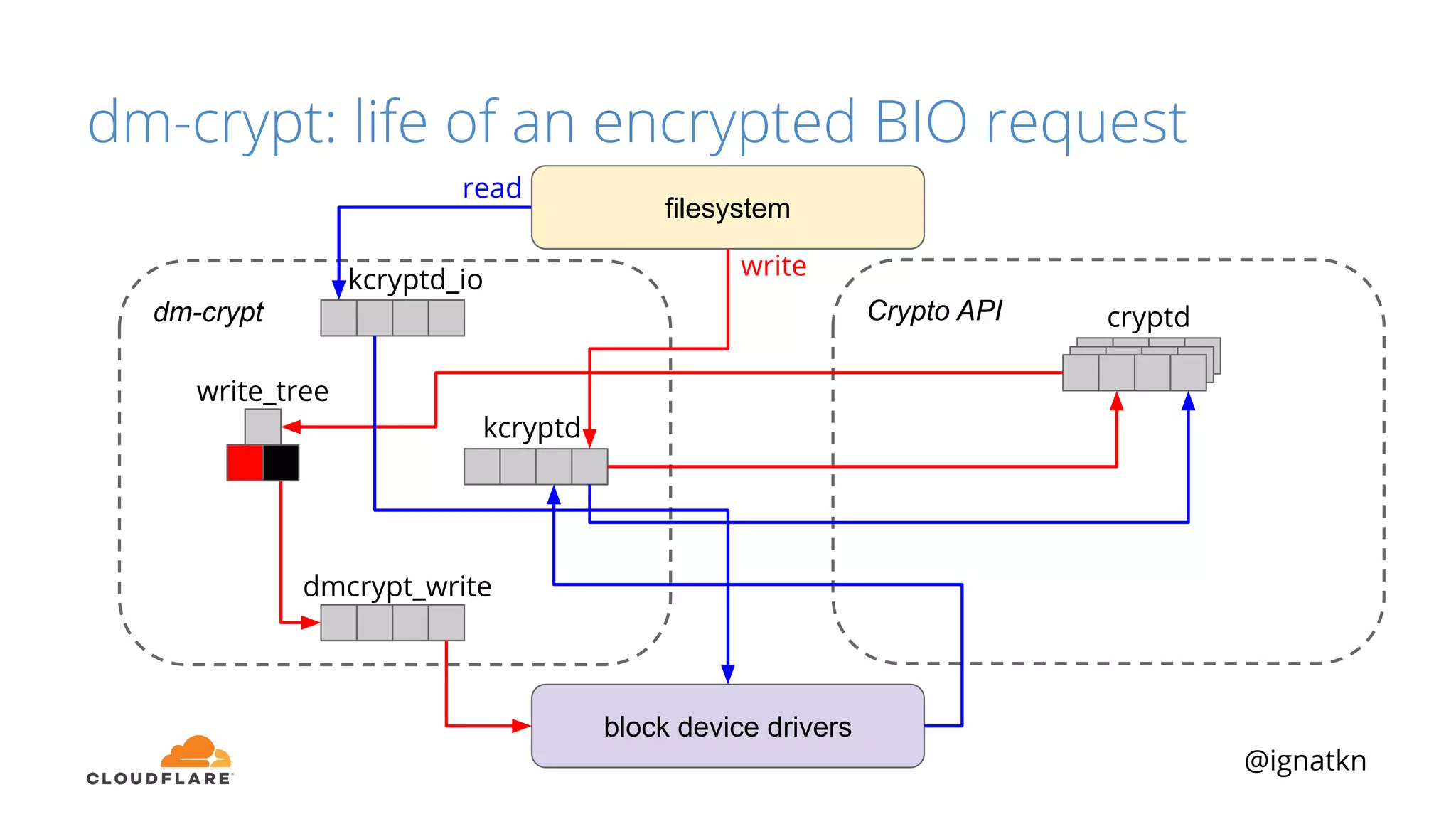
@ignatkn
Crypto APIdm-crypt
block device drivers
filesystem
cryptd
kcryptd_io
kcryptd
dmcrypt_write
write
read
write_tree
dm-crypt: life of an encrypted BIO request
@ignatkn
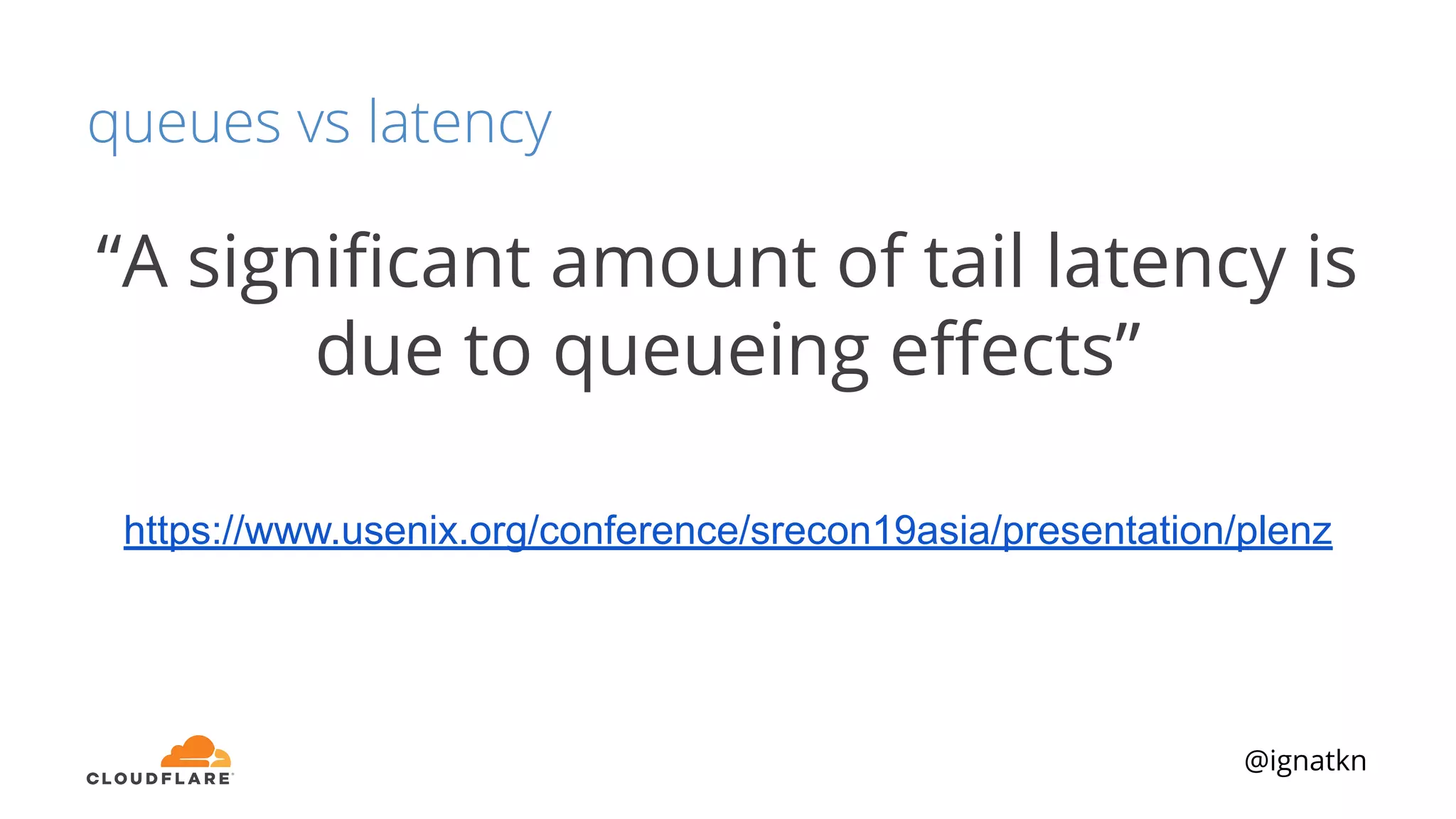
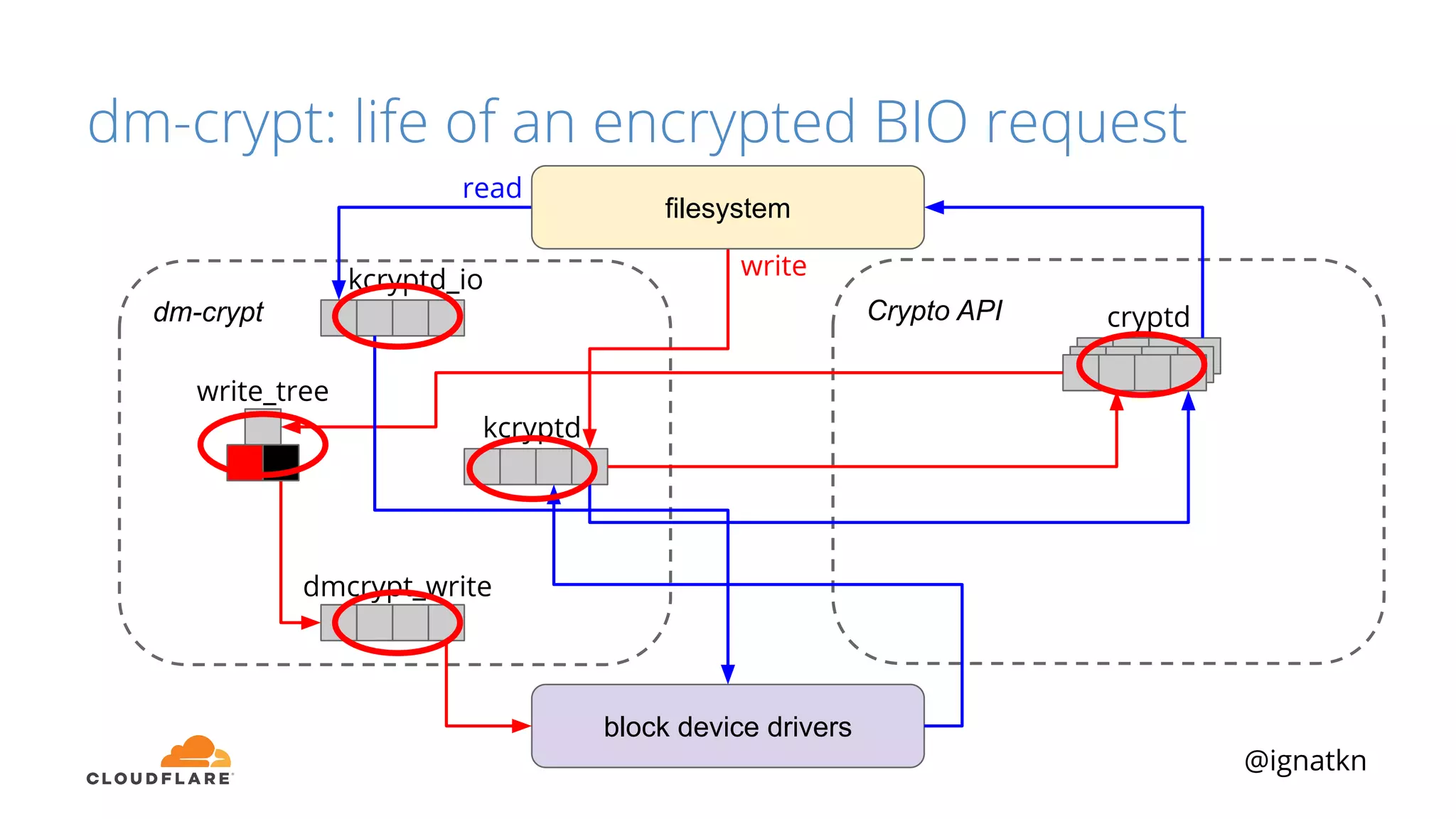
queues vs latency
“A significant amount of tail latency is
due to queueing effects”
https://www.usenix.org/conference/srecon19asia/presentation/plenz
@ignatkn
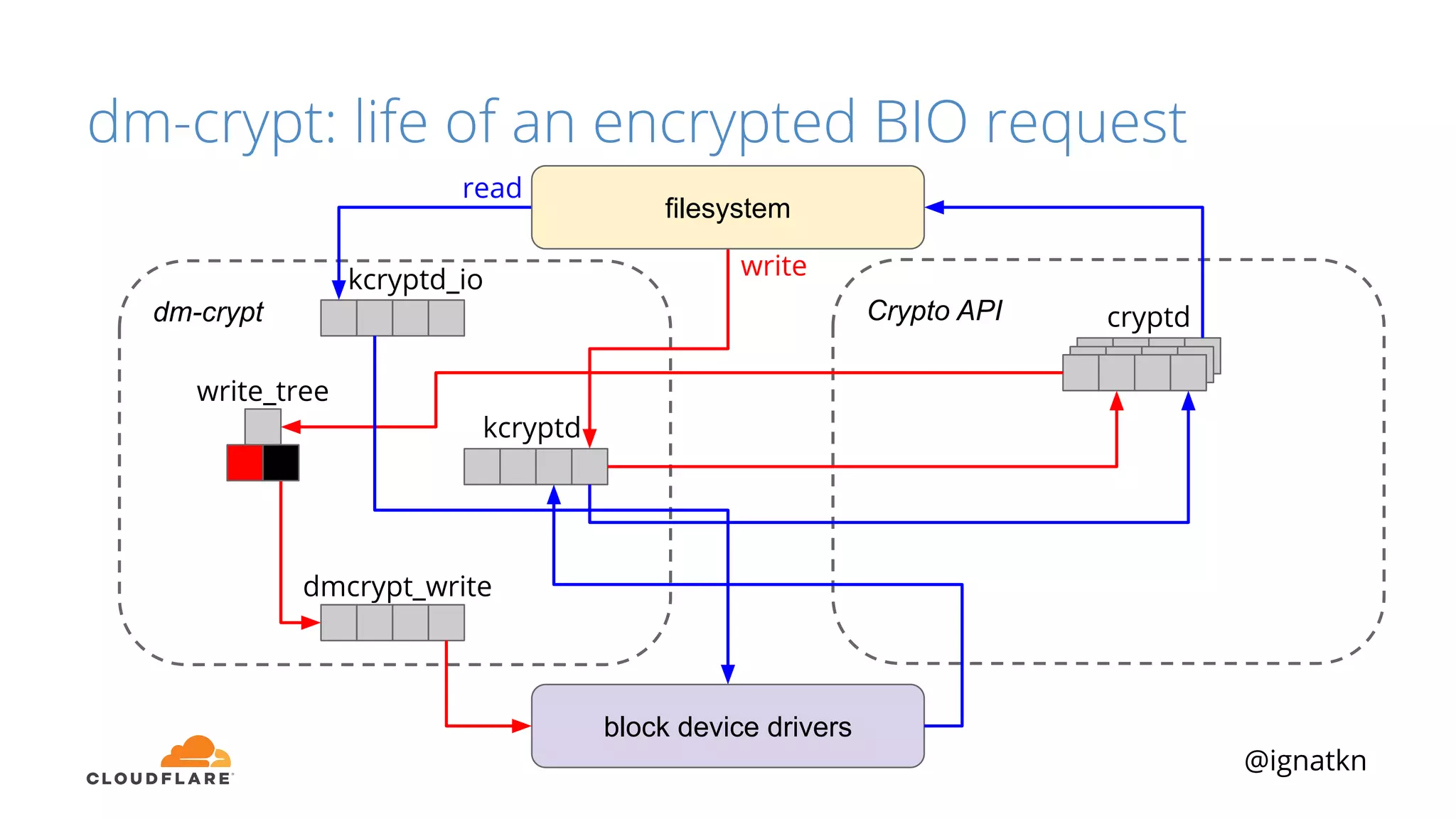
Crypto APIdm-crypt
block device drivers
filesystem
cryptd
kcryptd_io
kcryptd
dmcrypt_write
write
read
write_tree
dm-crypt: life of an encrypted BIO request
@ignatkn
Crypto APIdm-crypt
block device drivers
filesystem
cryptd
kcryptd_io
kcryptd
dmcrypt_write
write
read
write_tree
dm-crypt: life of an encrypted BIO request
@ignatkn
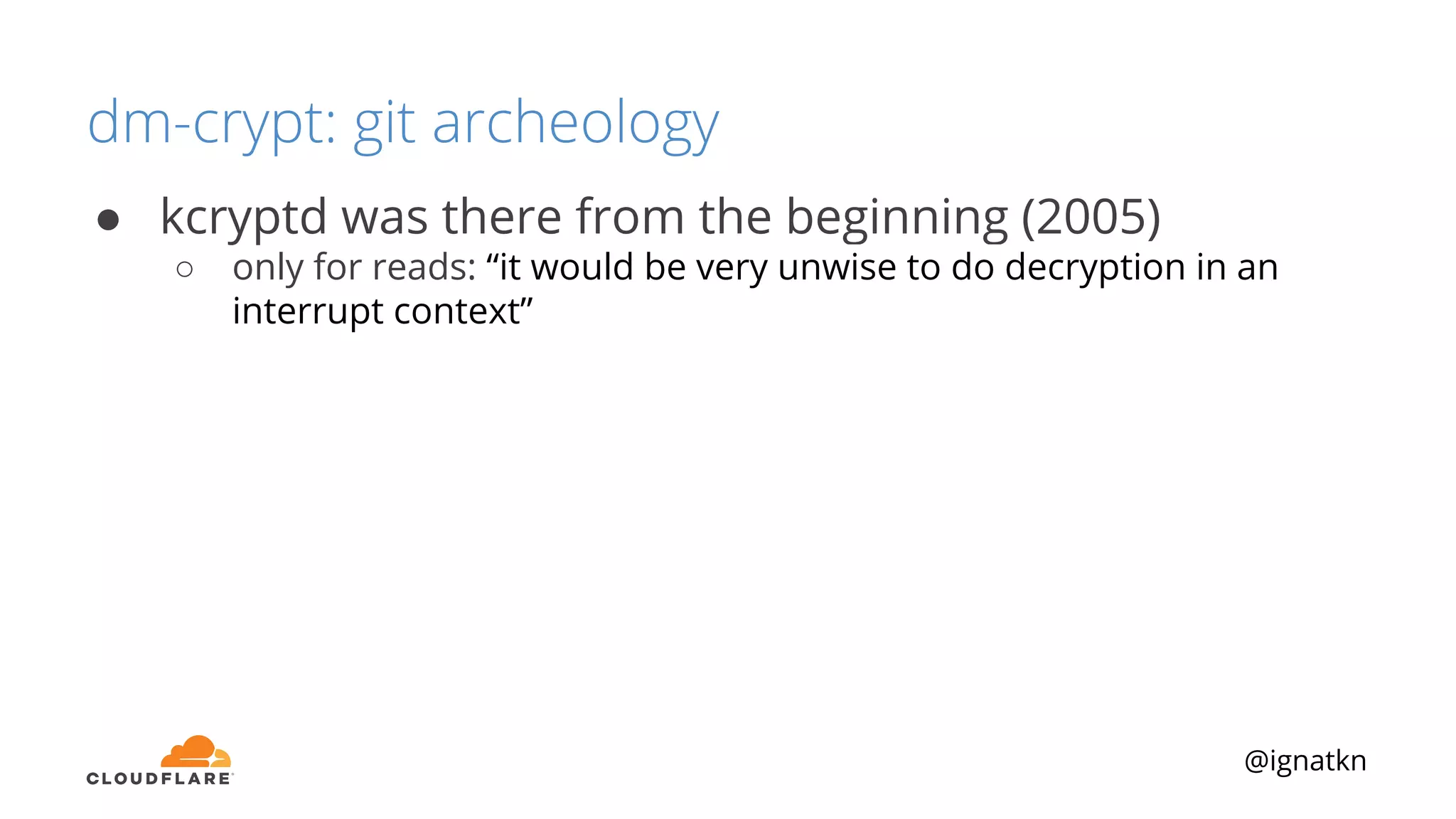
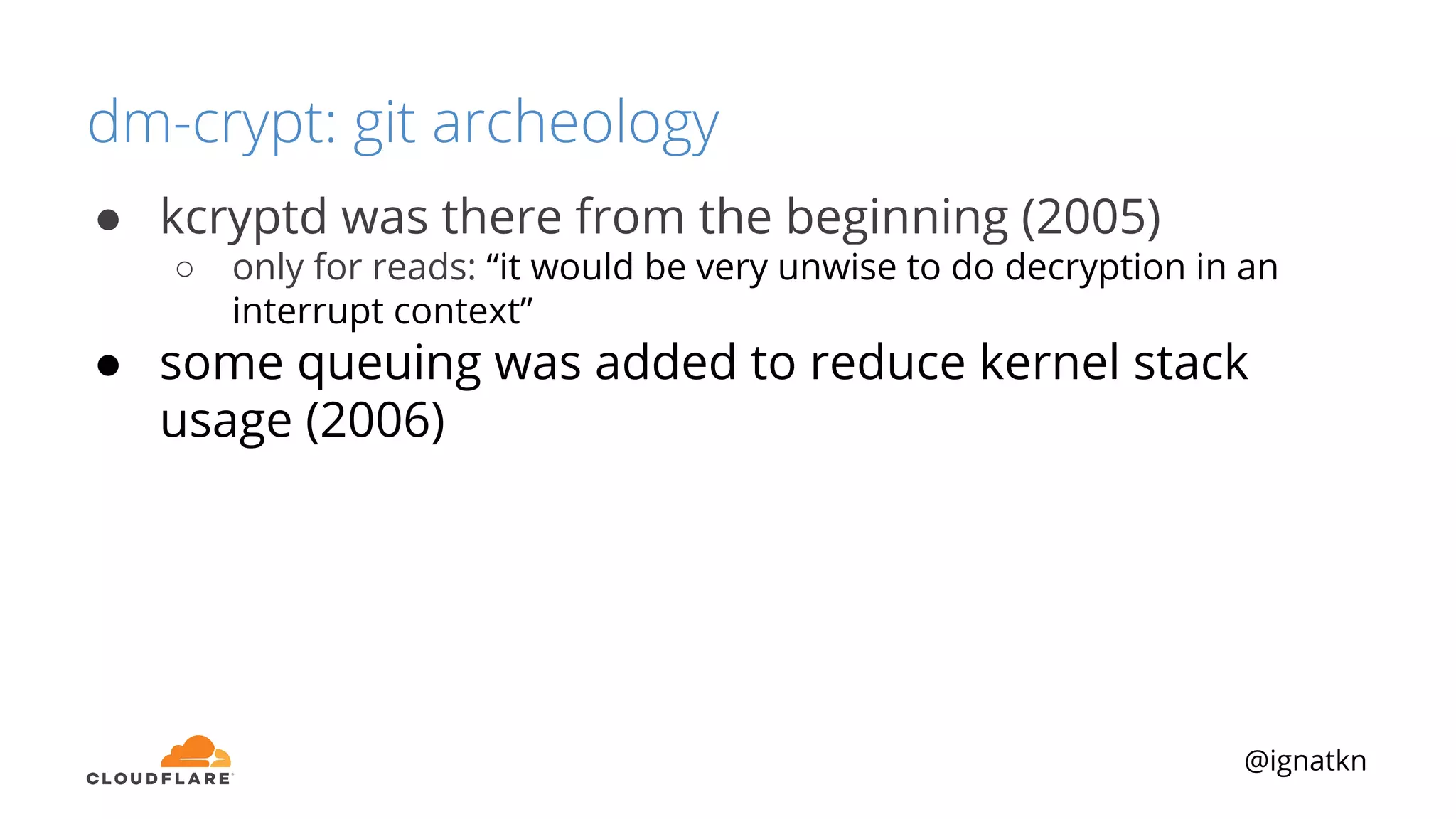
dm-crypt: git archeology
● kcryptd was there from the beginning (2005)
○ only for reads: “it would be very unwise to do decryption in an
interrupt context”
@ignatkn
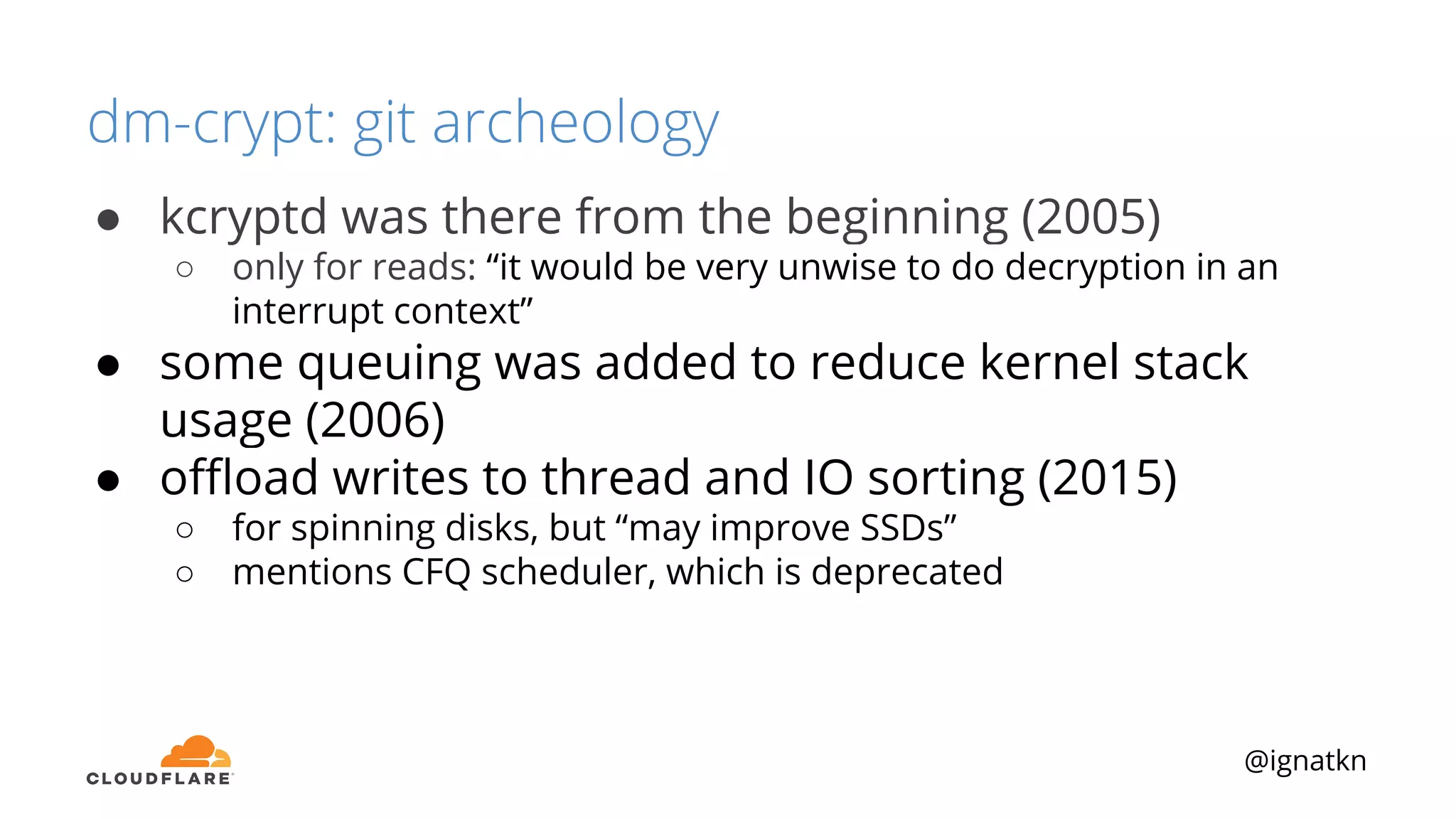
dm-crypt: git archeology
● kcryptd was there from the beginning (2005)
○ only for reads: “it would be very unwise to do decryption in an
interrupt context”
● some queuing was added to reduce kernel stack
usage (2006)
@ignatkn
dm-crypt: git archeology
● kcryptd was there from the beginning (2005)
○ only for reads: “it would be very unwise to do decryption in an
interrupt context”
● some queuing was added to reduce kernel stack
usage (2006)
● offload writes to thread and IO sorting (2015)
○ for spinning disks, but “may improve SSDs”
○ mentions CFQ scheduler, which is deprecated
@ignatkn
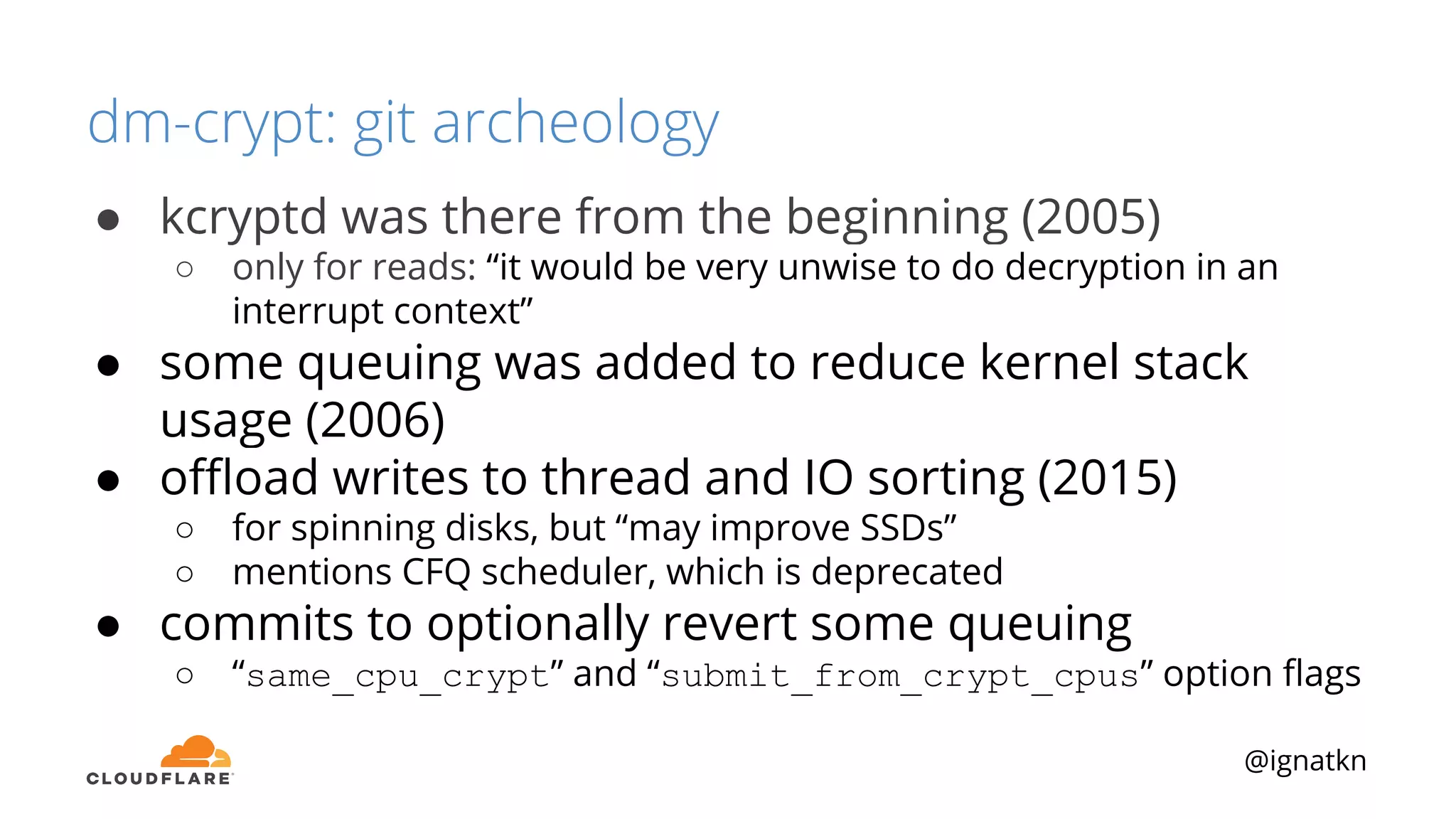
dm-crypt: git archeology
● kcryptd was there from the beginning (2005)
○ only for reads: “it would be very unwise to do decryption in an
interrupt context”
● some queuing was added to reduce kernel stack
usage (2006)
● offload writes to thread and IO sorting (2015)
○ for spinning disks, but “may improve SSDs”
○ mentions CFQ scheduler, which is deprecated
● commits to optionally revert some queuing
○ “same_cpu_crypt” and “submit_from_crypt_cpus” option flags
@ignatkn
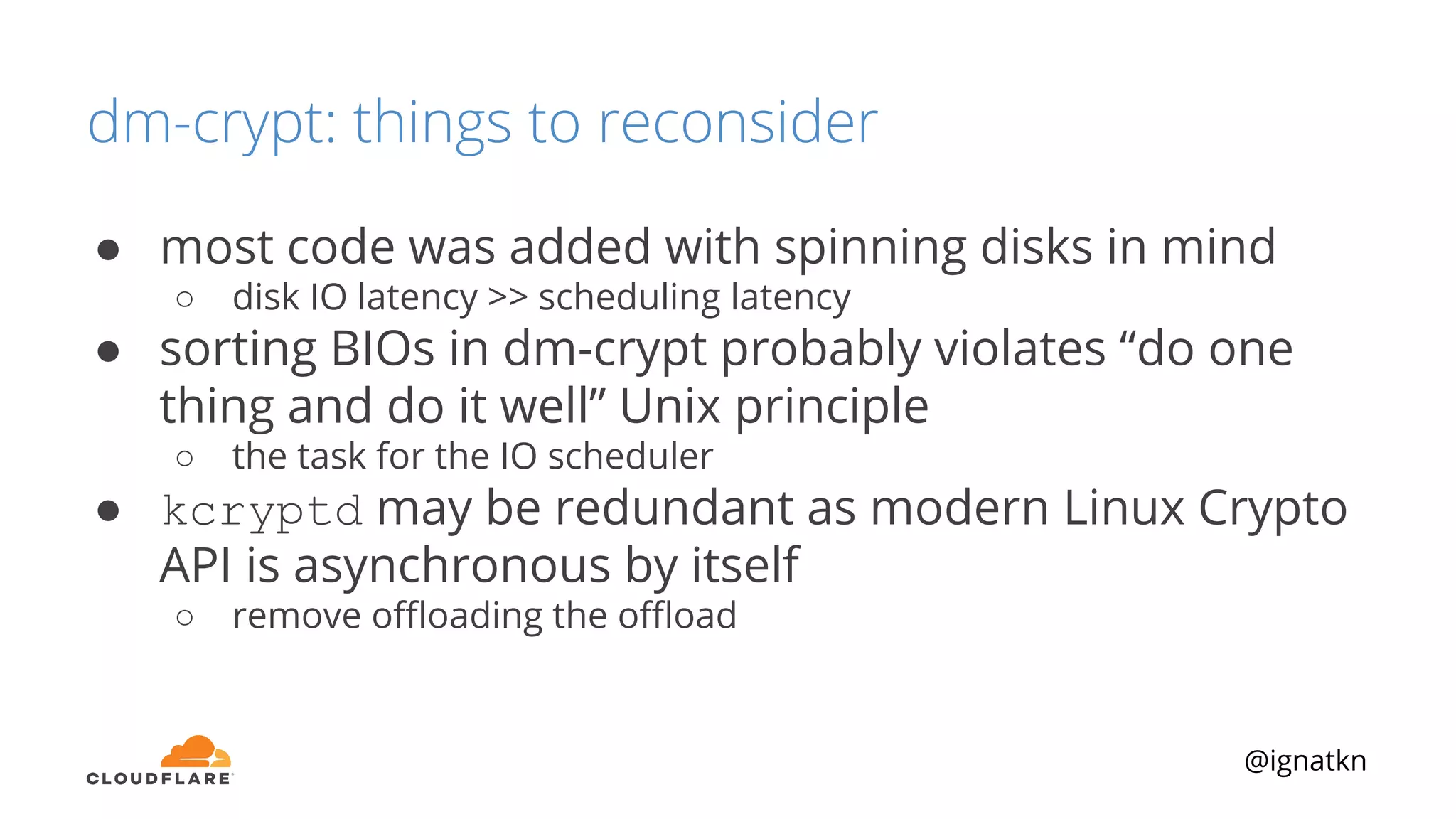
dm-crypt: things to reconsider
● most code was added with spinning disks in mind
○ disk IO latency >> scheduling latency
@ignatkn
dm-crypt: things to reconsider
● most code was added with spinning disks in mind
○ disk IO latency >> scheduling latency
● sorting BIOs in dm-crypt probably violates “do one
thing and do it well” Unix principle
○ the task for the IO scheduler
@ignatkn
dm-crypt: things to reconsider
● most code was added with spinning disks in mind
○ disk IO latency >> scheduling latency
● sorting BIOs in dm-crypt probably violates “do one
thing and do it well” Unix principle
○ the task for the IO scheduler
● kcryptd may be redundant as modern Linux Crypto
API is asynchronous by itself
○ remove offloading the offload
@ignatkn
dm-crypt: cleanup
@ignatkn
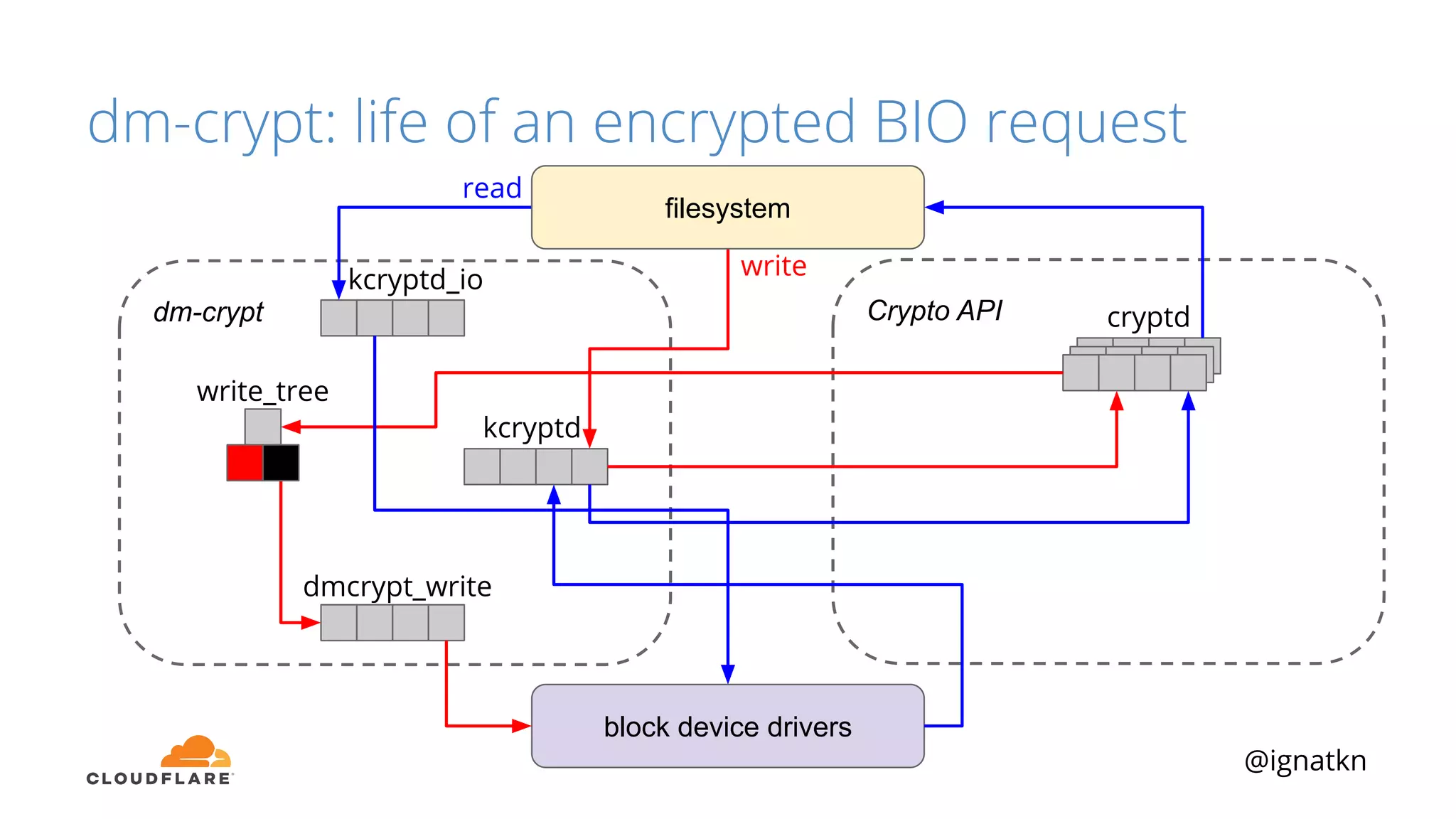
Crypto APIdm-crypt
block device drivers
filesystem
cryptd
kcryptd_io
kcryptd
dmcrypt_write
write
read
write_tree
dm-crypt: life of an encrypted BIO request
@ignatkn
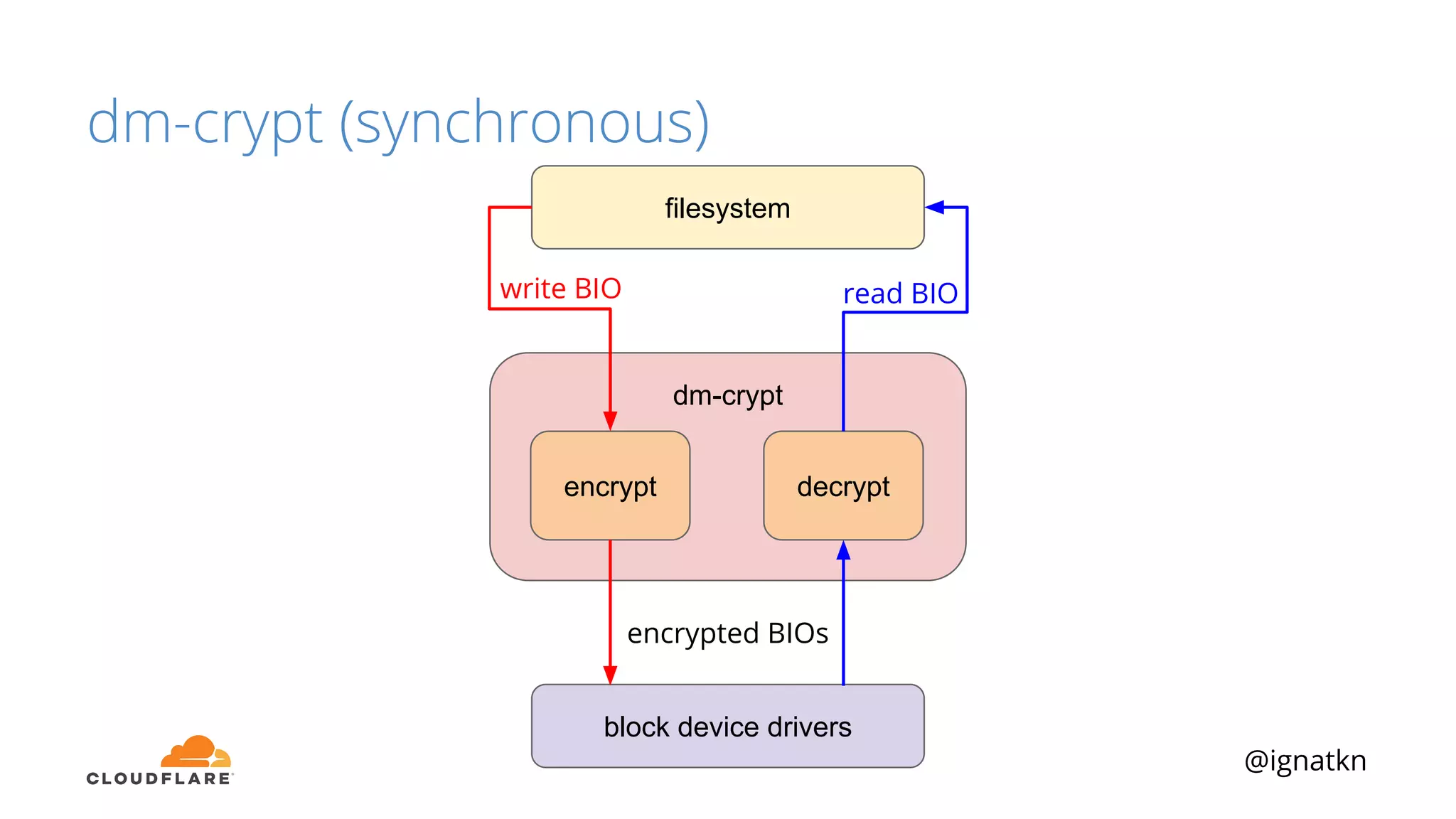
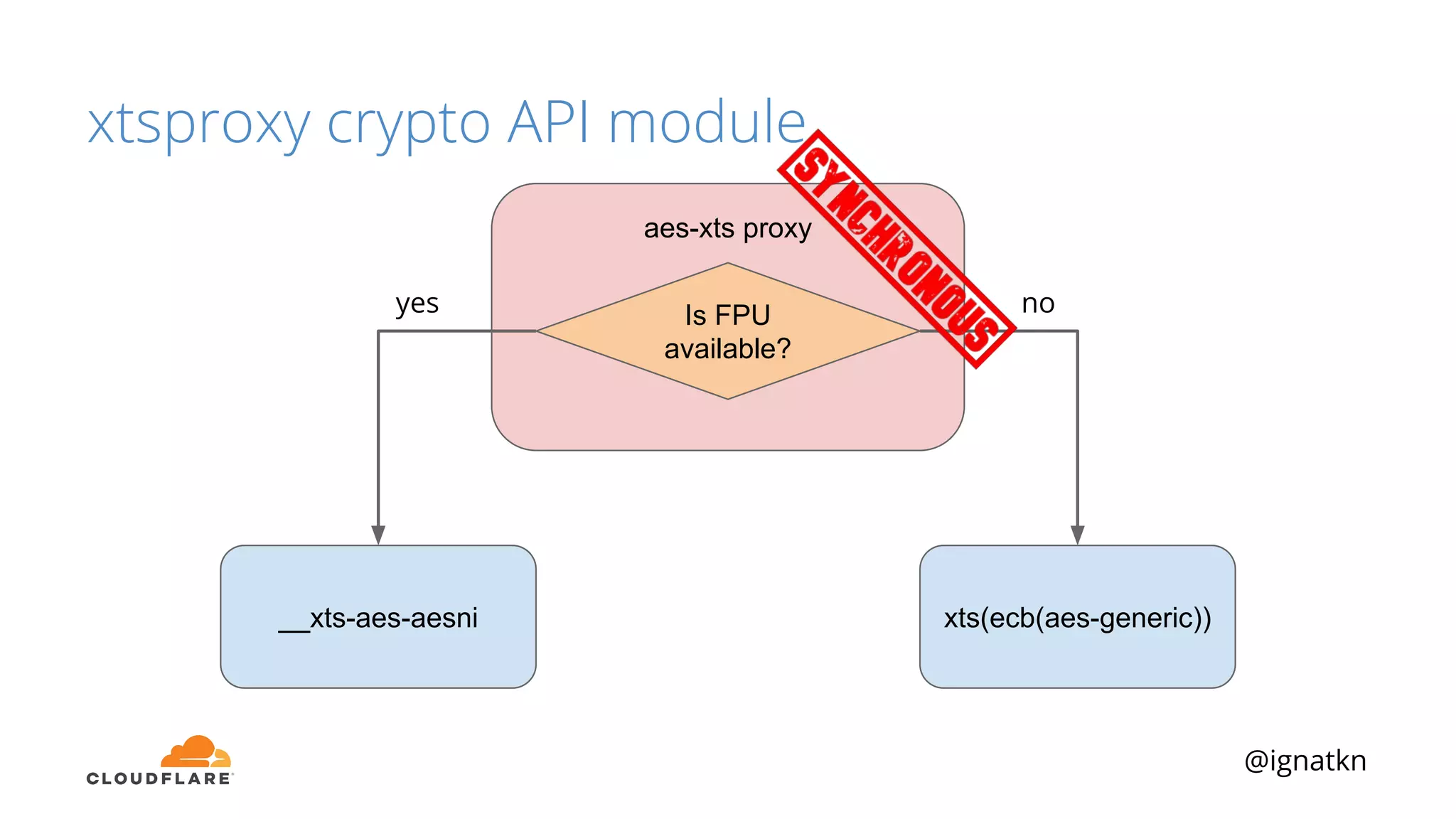
dm-crypt (synchronous)
filesystem
dm-crypt
block device drivers
encrypt decrypt
write BIO read BIO
encrypted BIOs
@ignatkn
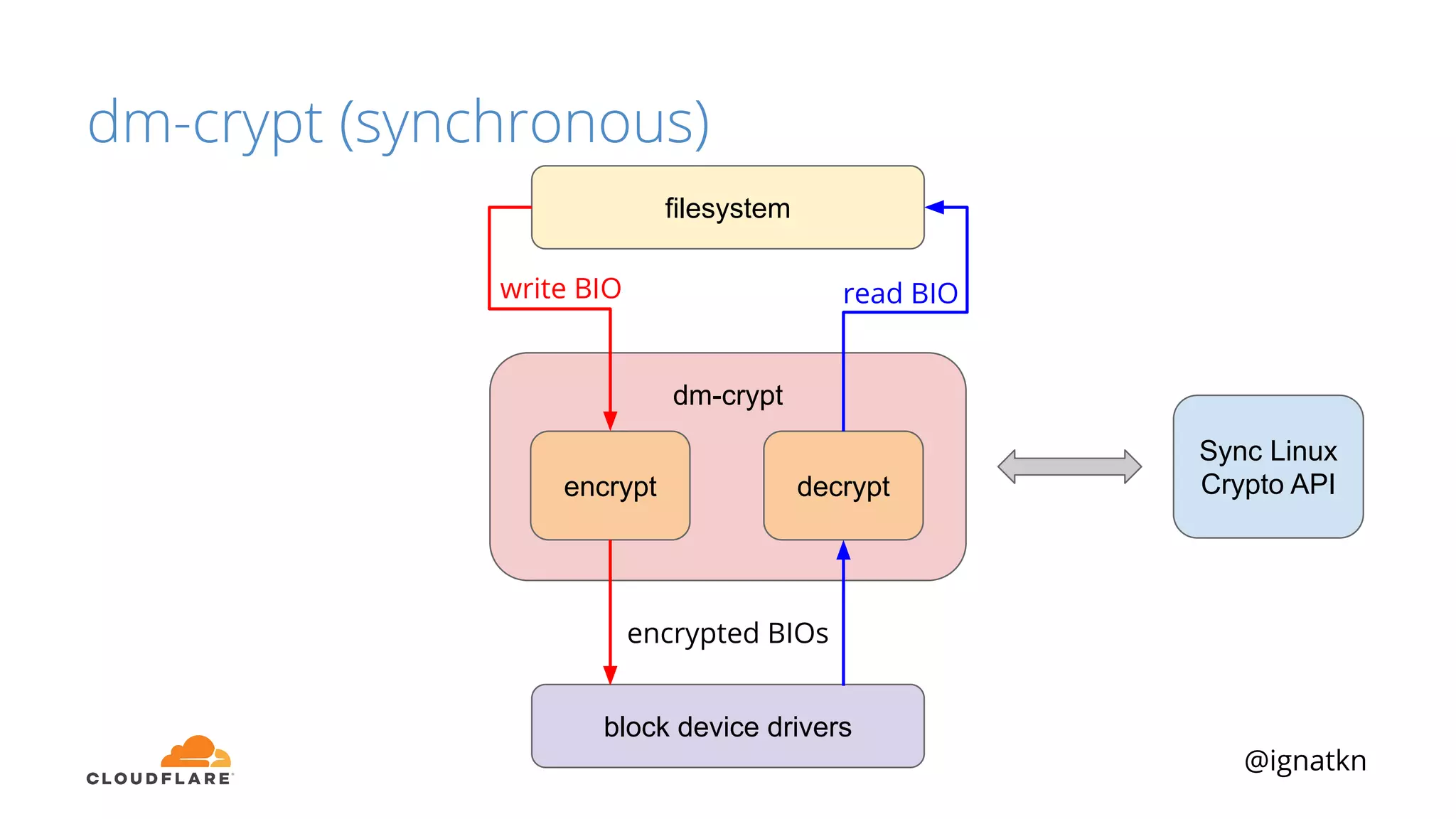
dm-crypt (synchronous)
filesystem
dm-crypt
block device drivers
encrypt decrypt
Sync Linux
Crypto API
write BIO read BIO
encrypted BIOs
@ignatkn
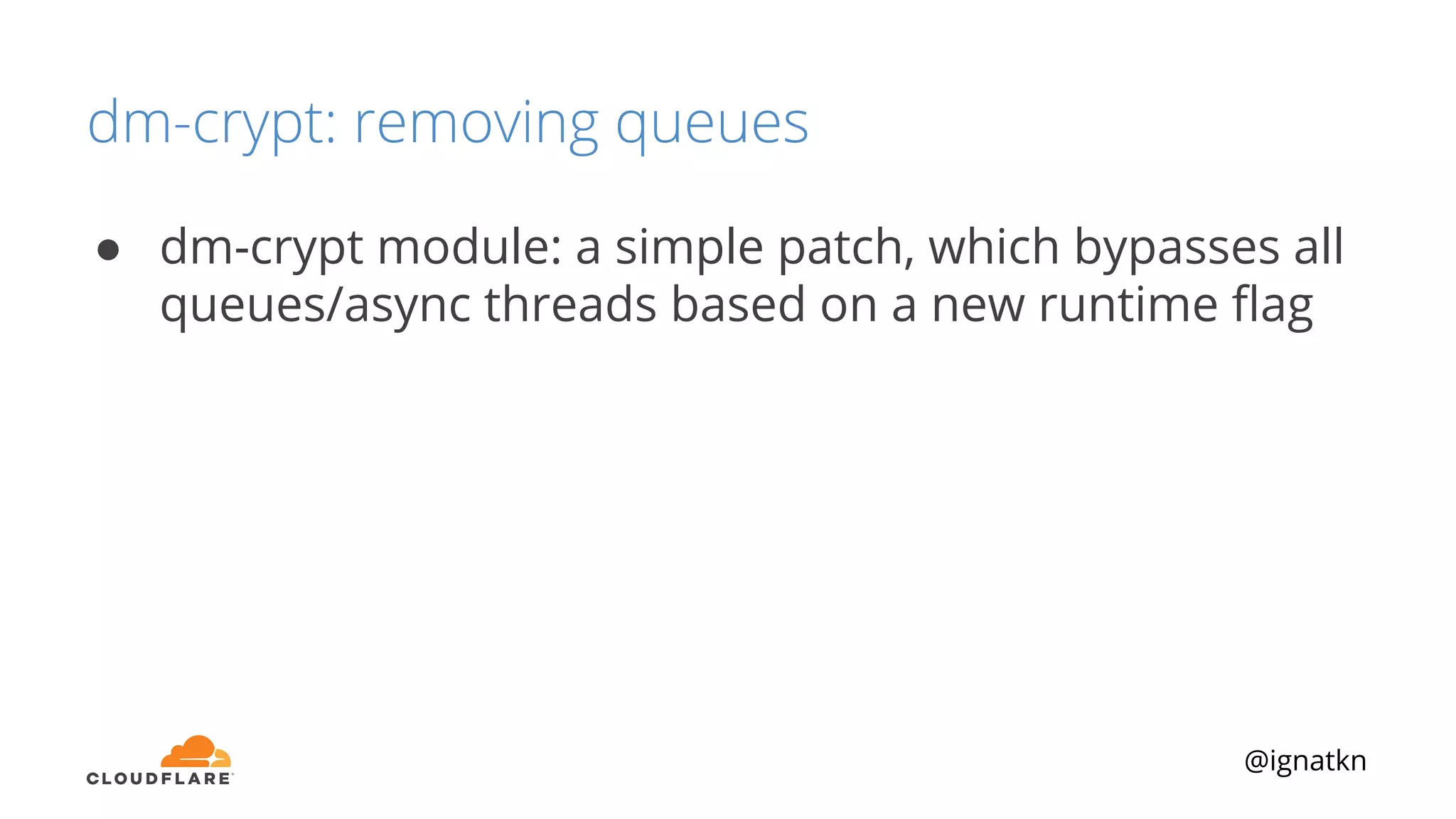
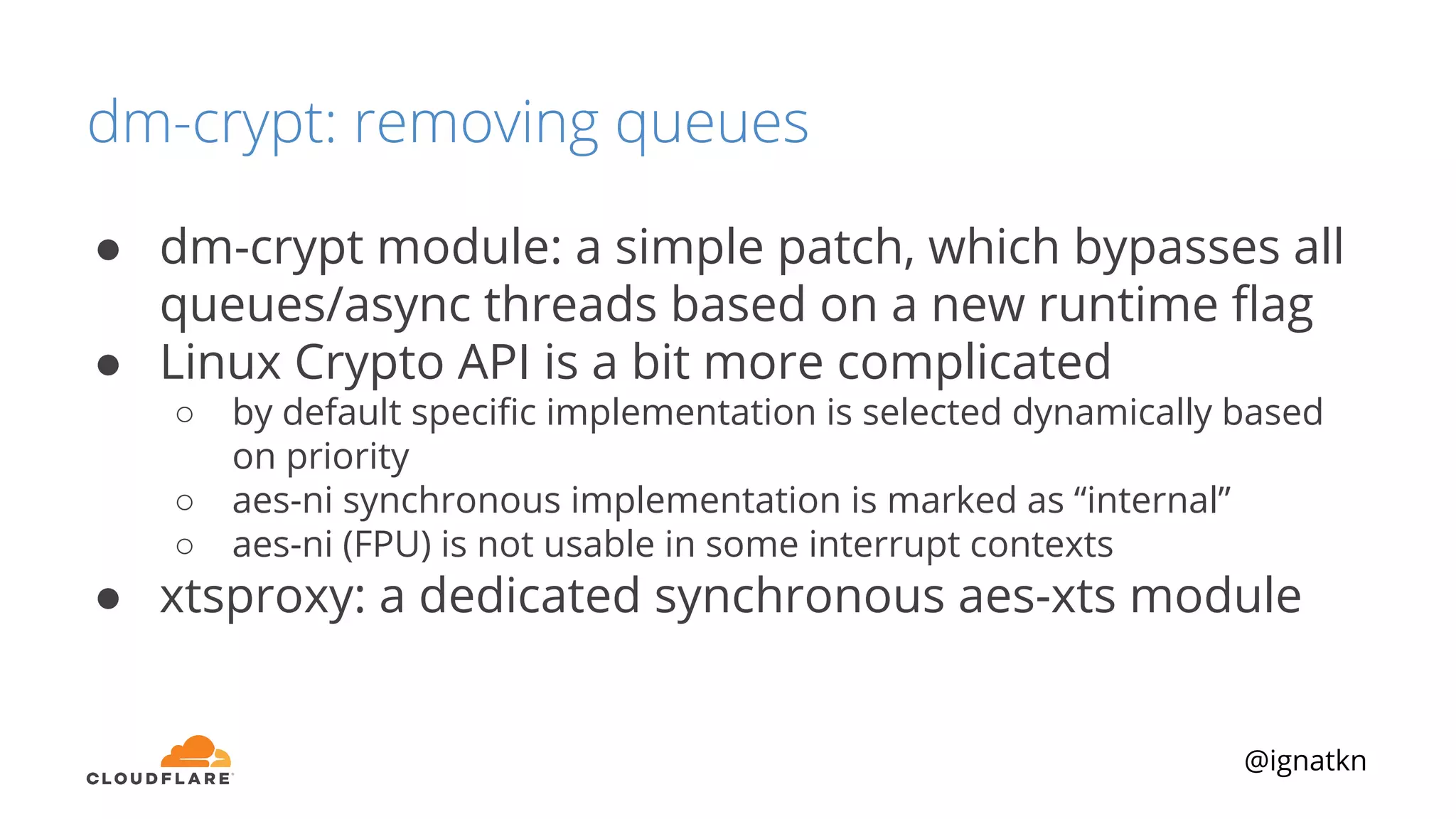
dm-crypt: removing queues
● dm-crypt module: a simple patch, which bypasses all
queues/async threads based on a new runtime flag
@ignatkn
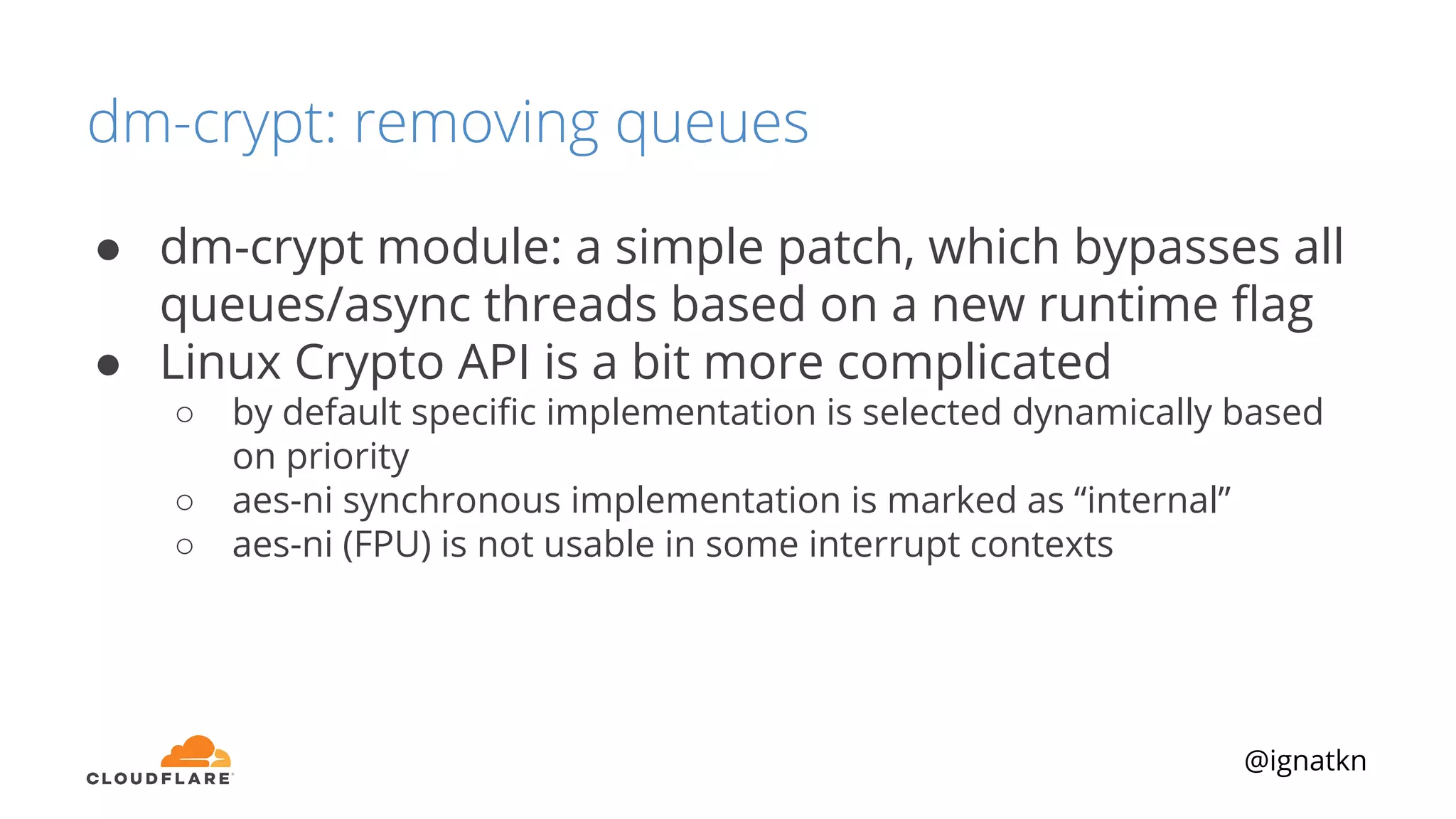
dm-crypt: removing queues
● dm-crypt module: a simple patch, which bypasses all
queues/async threads based on a new runtime flag
● Linux Crypto API is a bit more complicated
○ by default specific implementation is selected dynamically based
on priority
○ aes-ni synchronous implementation is marked as “internal”
○ aes-ni (FPU) is not usable in some interrupt contexts
@ignatkn
dm-crypt: removing queues
● dm-crypt module: a simple patch, which bypasses all
queues/async threads based on a new runtime flag
● Linux Crypto API is a bit more complicated
○ by default specific implementation is selected dynamically based
on priority
○ aes-ni synchronous implementation is marked as “internal”
○ aes-ni (FPU) is not usable in some interrupt contexts
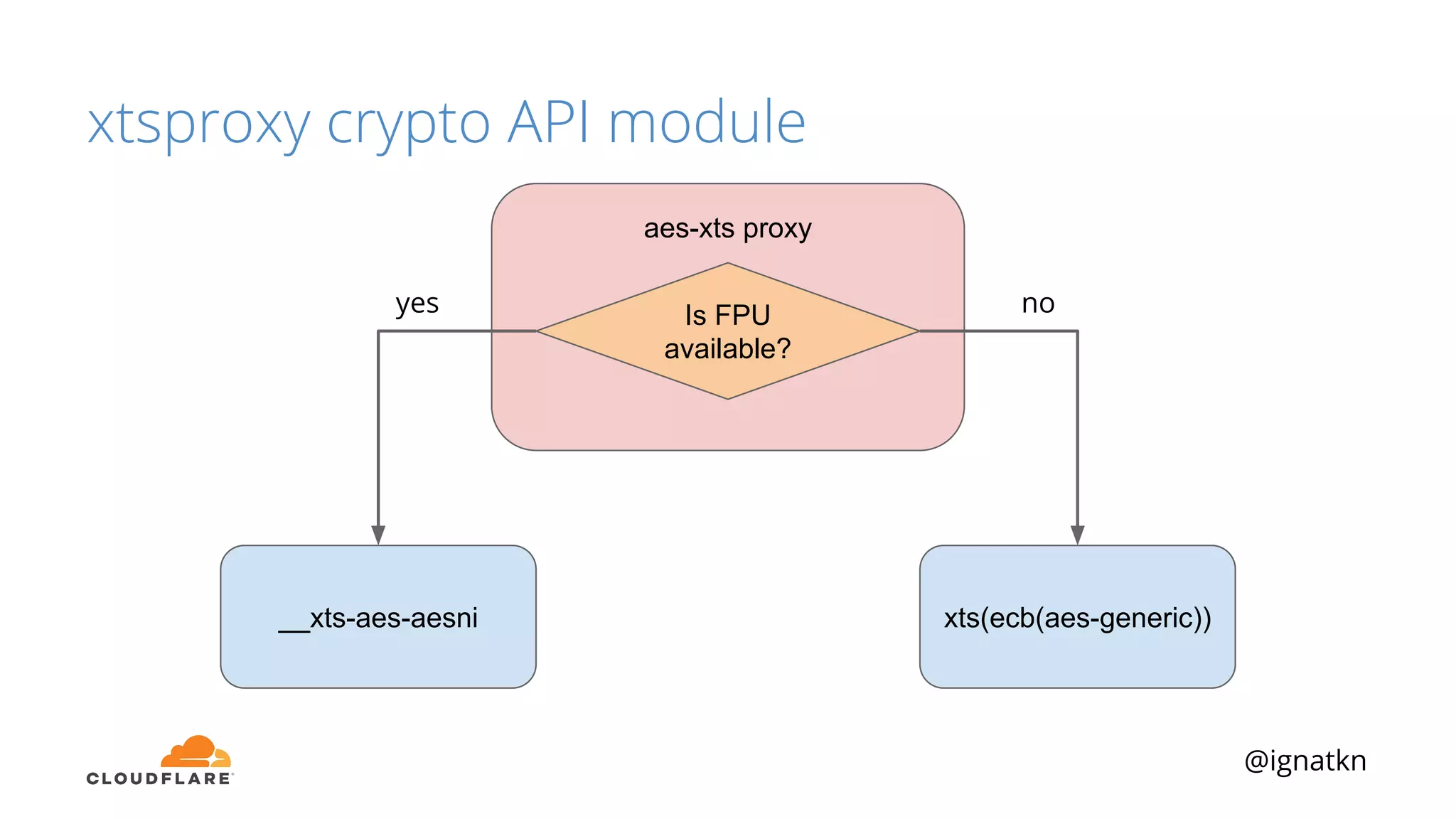
● xtsproxy: a dedicated synchronous aes-xts module
@ignatkn
xtsproxy crypto API module
aes-xts proxy
@ignatkn
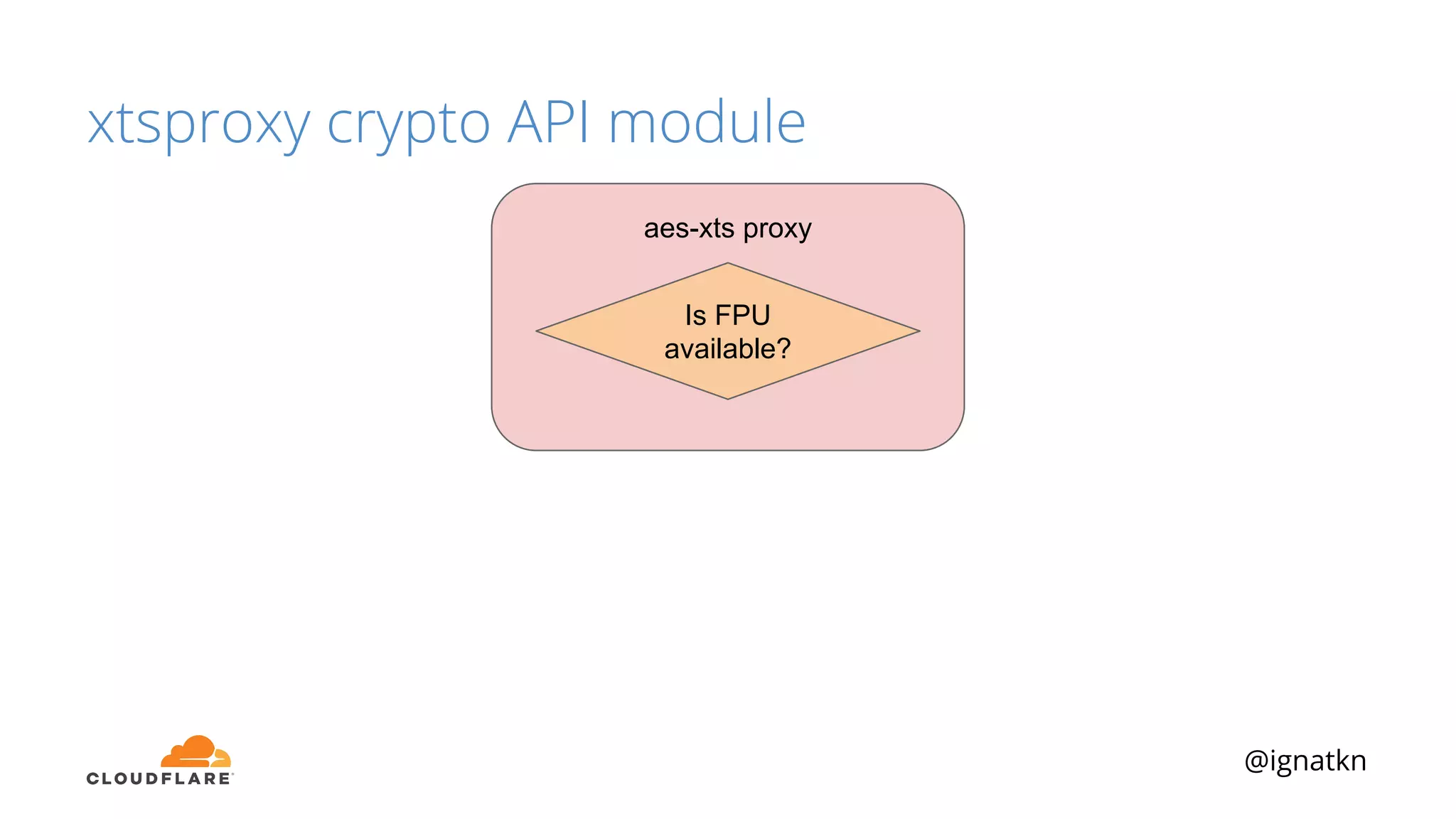
xtsproxy crypto API module
aes-xts proxy
Is FPU
available?
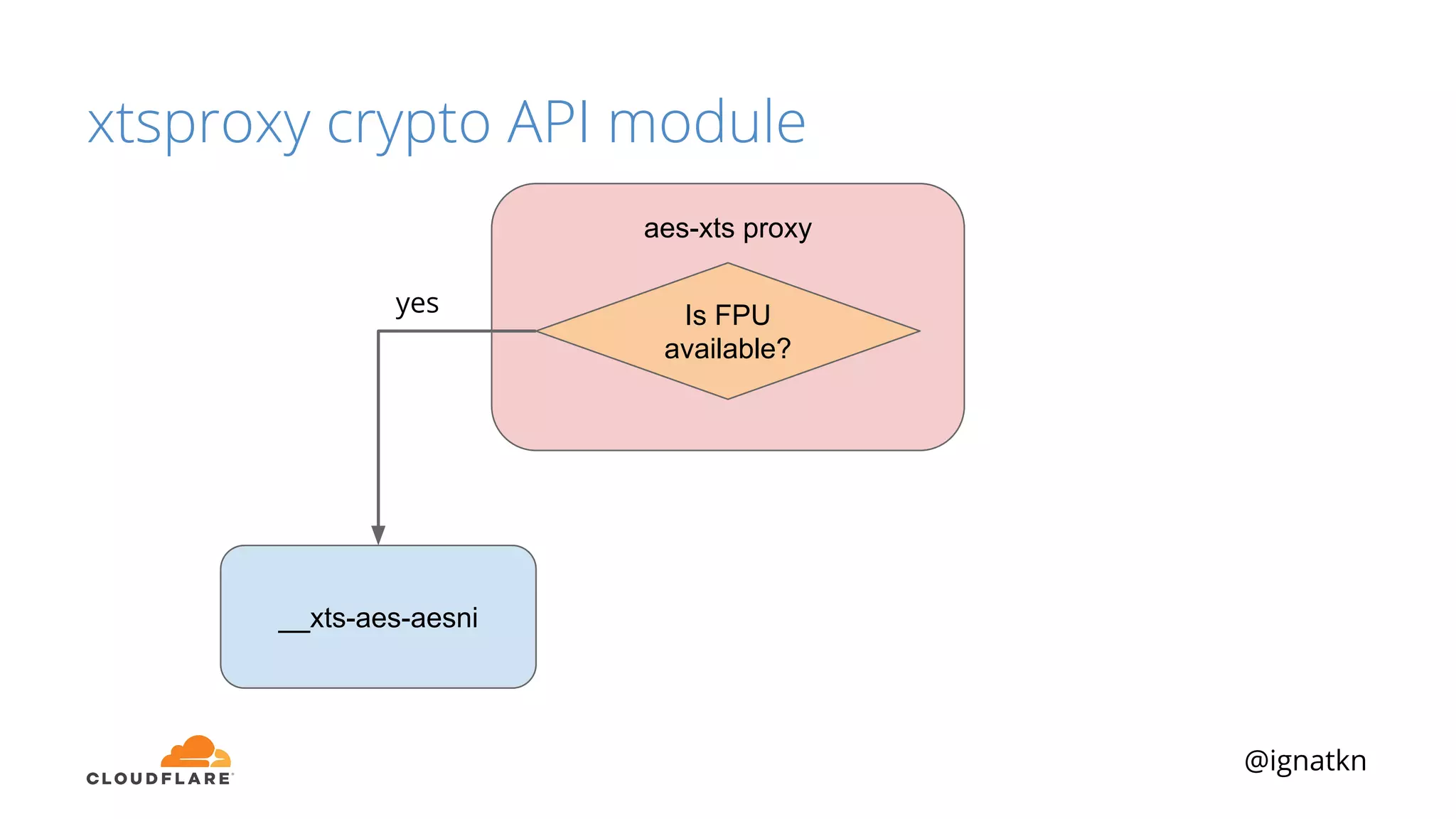
@ignatkn
xtsproxy crypto API module
aes-xts proxy
Is FPU
available?
__xts-aes-aesni
yes
@ignatkn
xtsproxy crypto API module
aes-xts proxy
Is FPU
available?
__xts-aes-aesni xts(ecb(aes-generic))
yes no
@ignatkn
xtsproxy crypto API module
aes-xts proxy
Is FPU
available?
__xts-aes-aesni xts(ecb(aes-generic))
yes no
@ignatkn
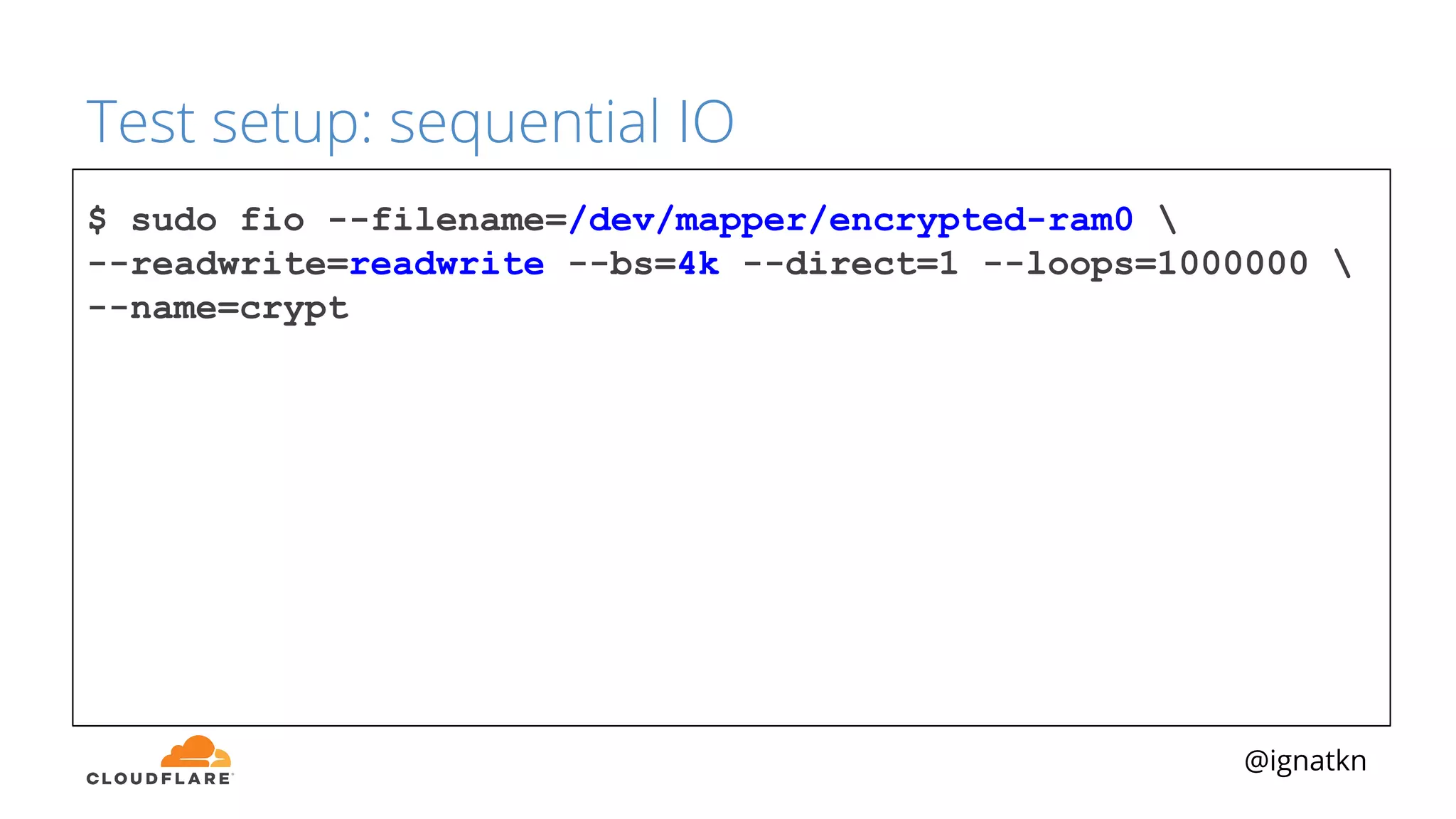
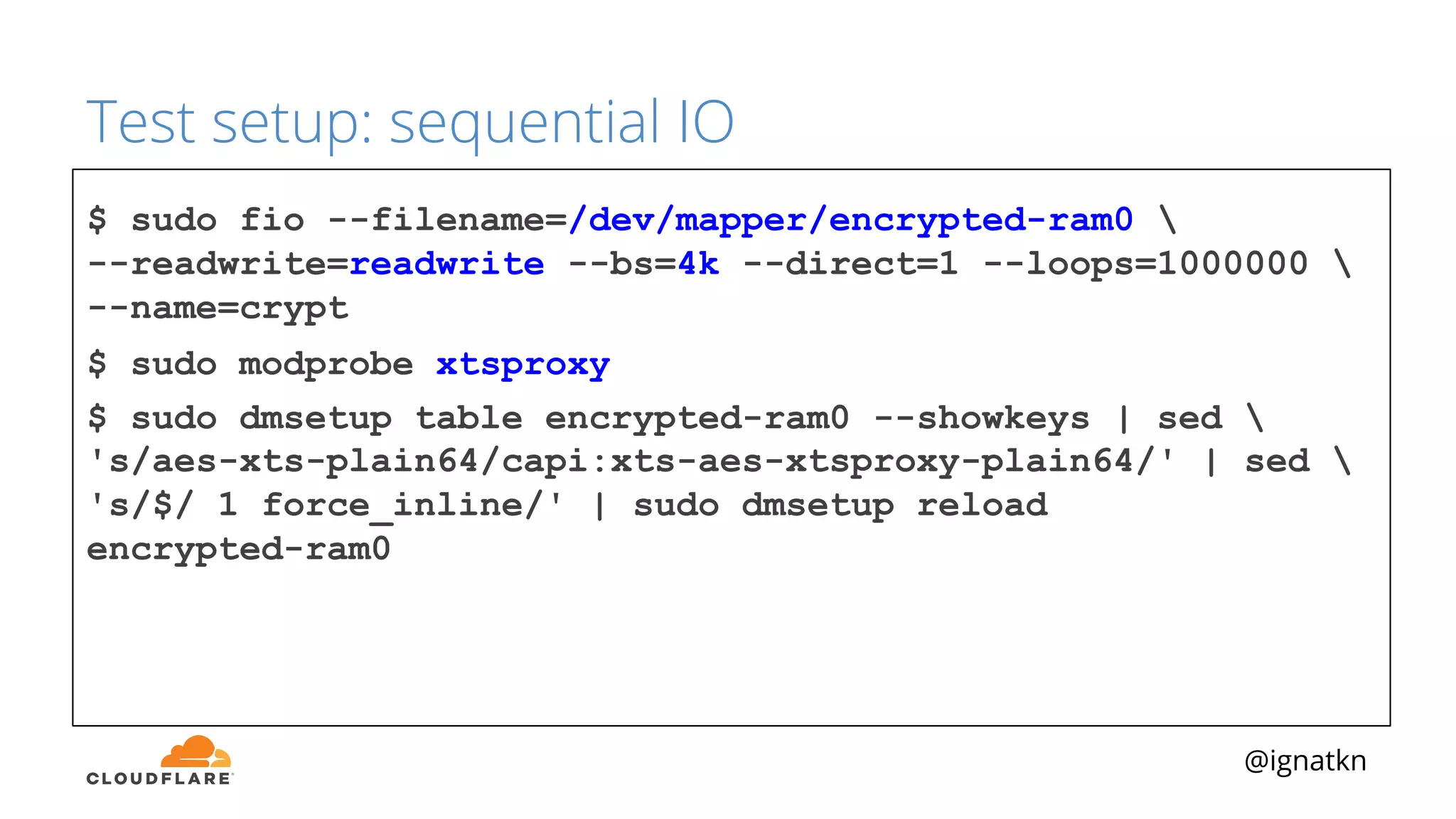
Test setup: sequential IO
$ sudo fio --filename=/dev/mapper/encrypted-ram0 
--readwrite=readwrite --bs=4k --direct=1 --loops=1000000 
--name=crypt
@ignatkn
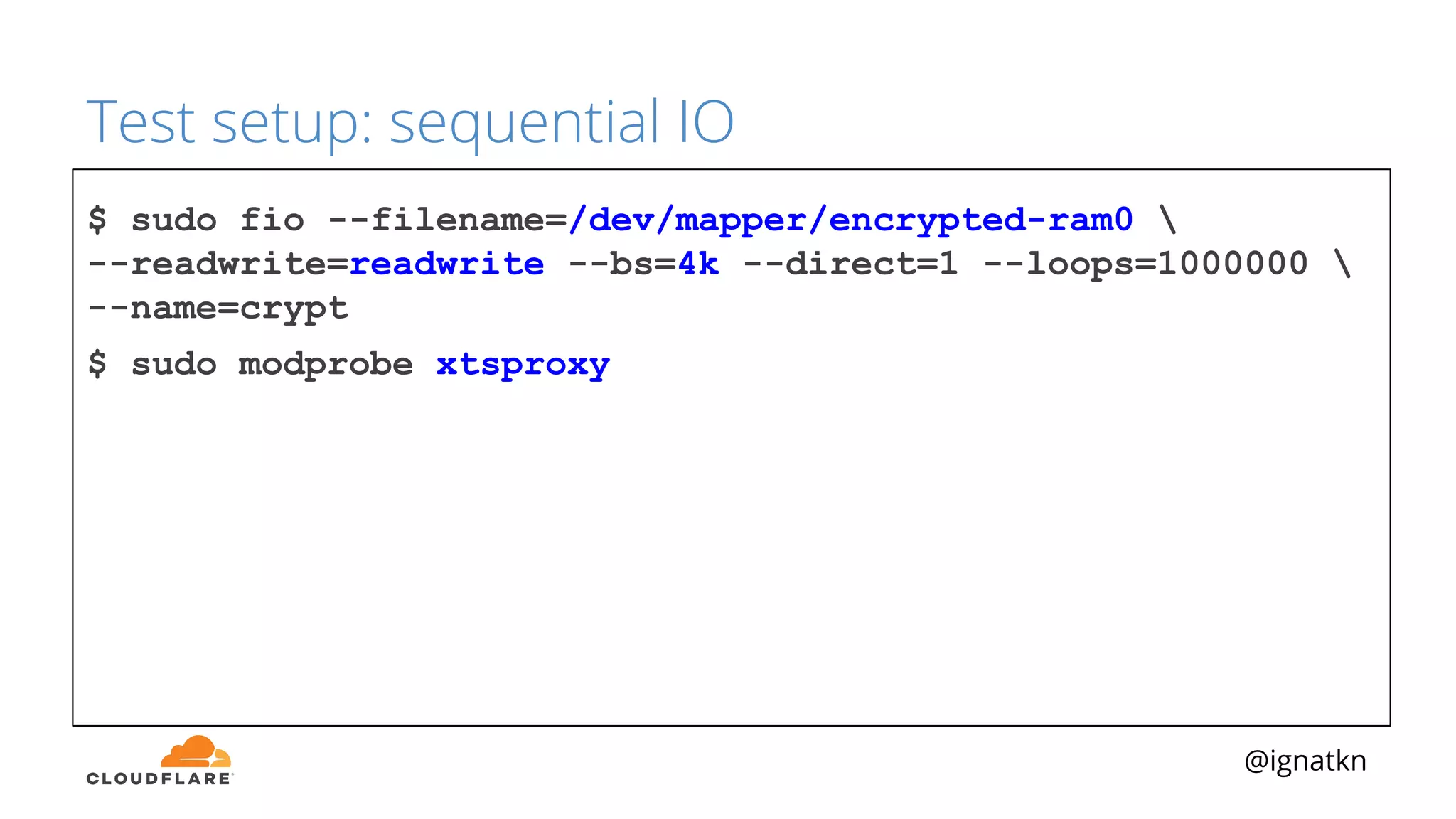
Test setup: sequential IO
$ sudo fio --filename=/dev/mapper/encrypted-ram0 
--readwrite=readwrite --bs=4k --direct=1 --loops=1000000 
--name=crypt
$ sudo modprobe xtsproxy
@ignatkn
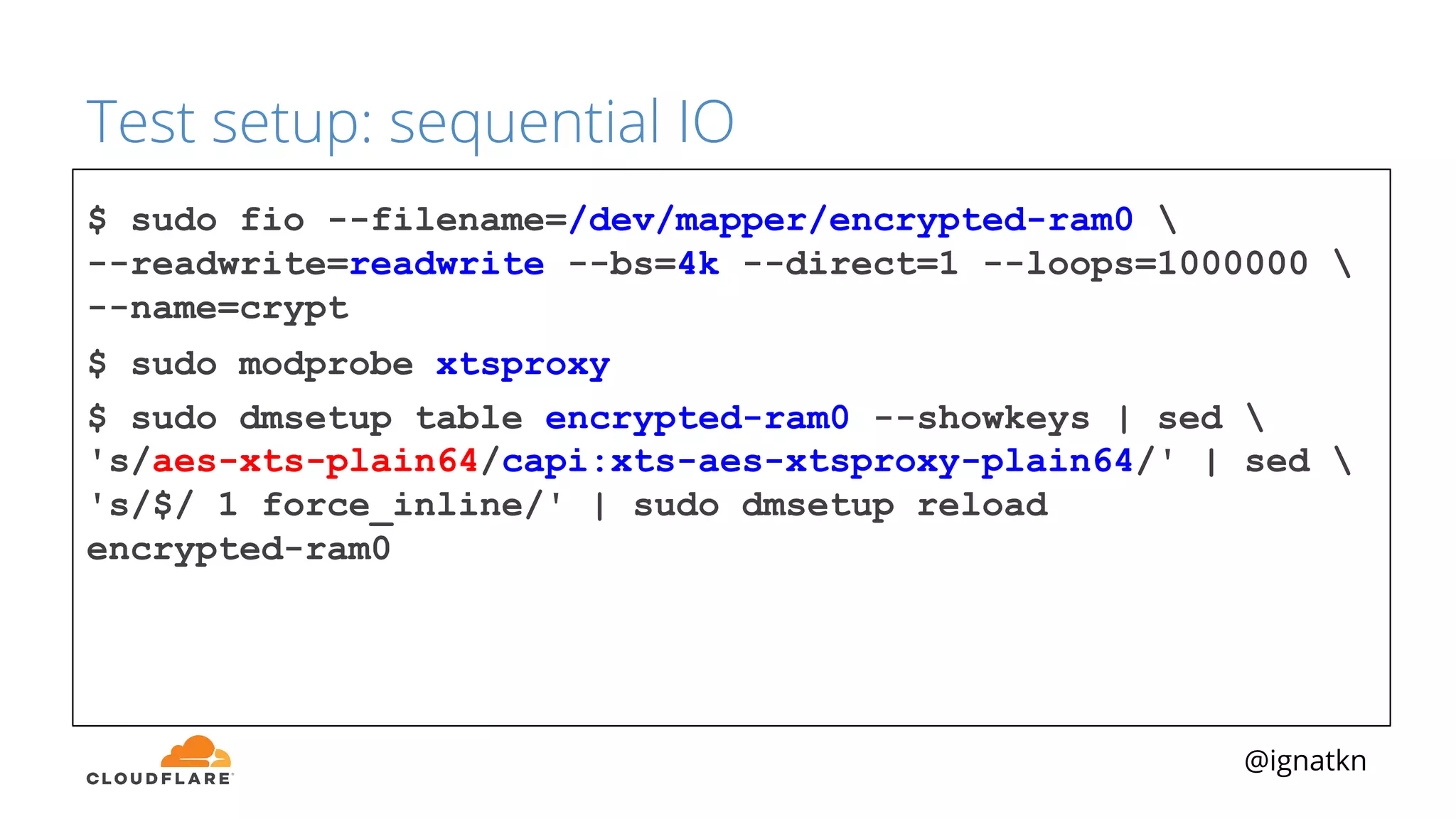
Test setup: sequential IO
$ sudo fio --filename=/dev/mapper/encrypted-ram0 
--readwrite=readwrite --bs=4k --direct=1 --loops=1000000 
--name=crypt
$ sudo modprobe xtsproxy
$ sudo dmsetup table encrypted-ram0 --showkeys | sed 
's/aes-xts-plain64/capi:xts-aes-xtsproxy-plain64/' | sed 
's/$/ 1 force_inline/' | sudo dmsetup reload
encrypted-ram0
@ignatkn
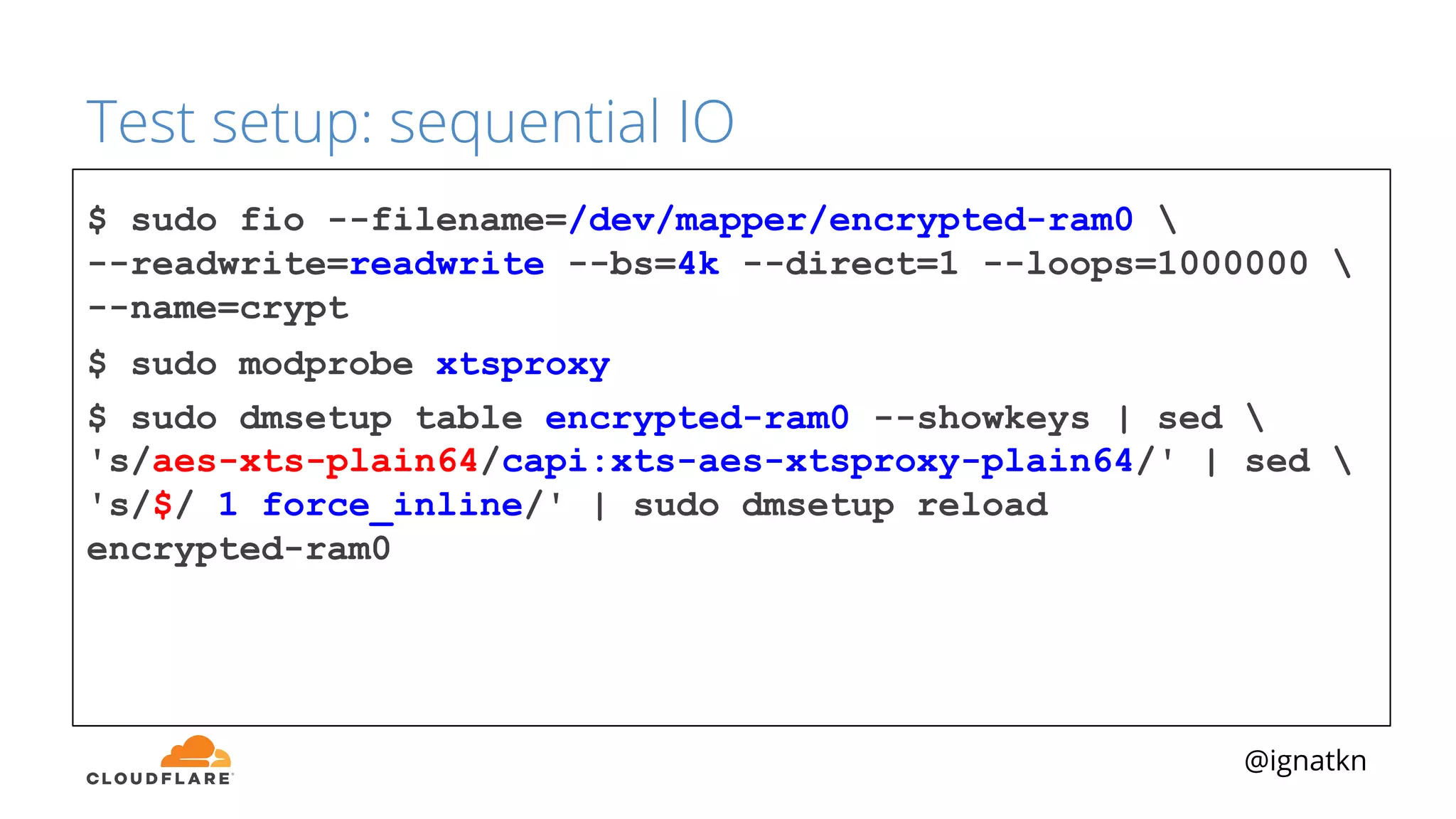
Test setup: sequential IO
$ sudo fio --filename=/dev/mapper/encrypted-ram0 
--readwrite=readwrite --bs=4k --direct=1 --loops=1000000 
--name=crypt
$ sudo modprobe xtsproxy
$ sudo dmsetup table encrypted-ram0 --showkeys | sed 
's/aes-xts-plain64/capi:xts-aes-xtsproxy-plain64/' | sed 
's/$/ 1 force_inline/' | sudo dmsetup reload
encrypted-ram0
@ignatkn
Test setup: sequential IO
$ sudo fio --filename=/dev/mapper/encrypted-ram0 
--readwrite=readwrite --bs=4k --direct=1 --loops=1000000 
--name=crypt
$ sudo modprobe xtsproxy
$ sudo dmsetup table encrypted-ram0 --showkeys | sed 
's/aes-xts-plain64/capi:xts-aes-xtsproxy-plain64/' | sed 
's/$/ 1 force_inline/' | sudo dmsetup reload
encrypted-ram0
@ignatkn
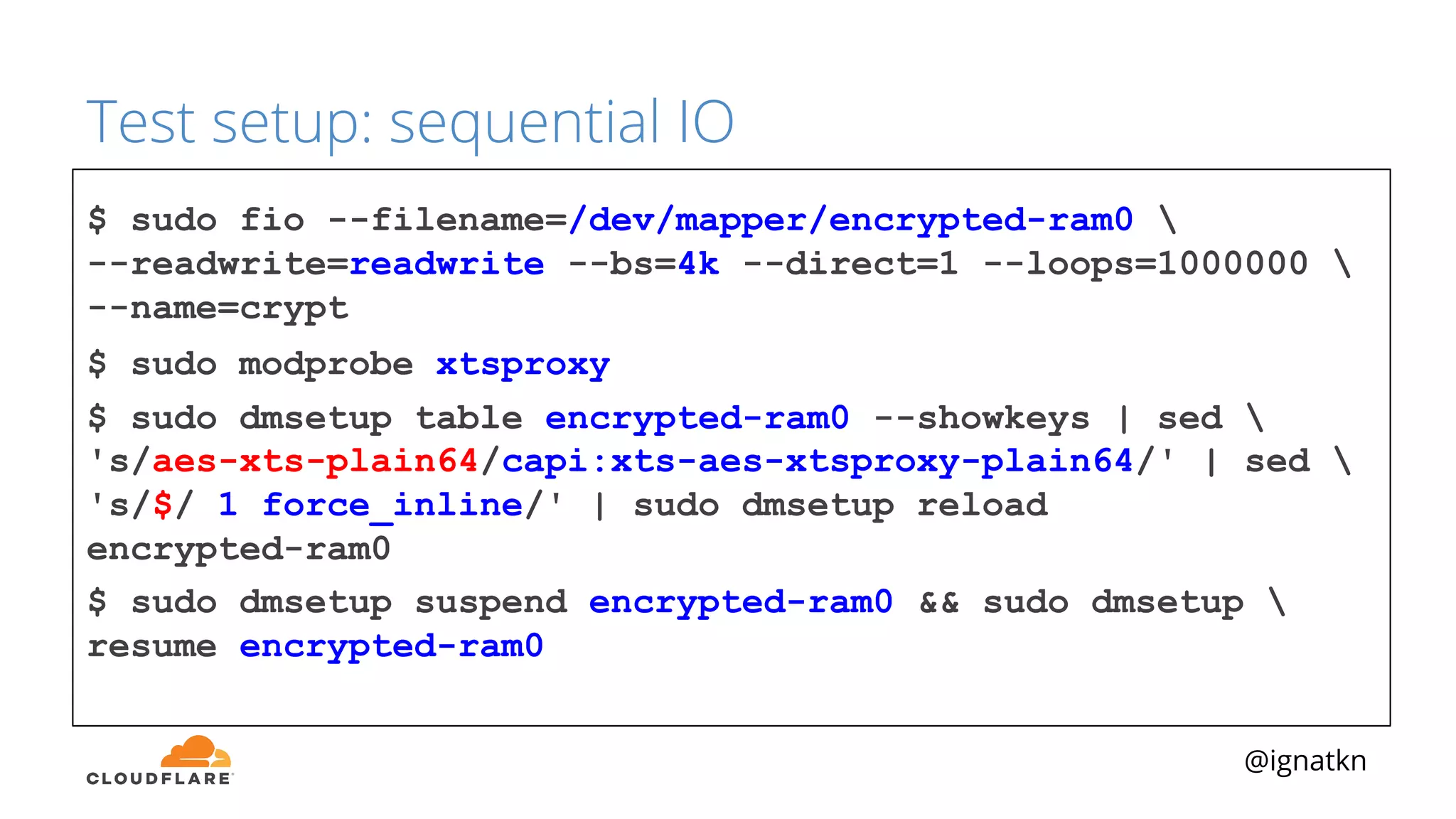
Test setup: sequential IO
$ sudo fio --filename=/dev/mapper/encrypted-ram0 
--readwrite=readwrite --bs=4k --direct=1 --loops=1000000 
--name=crypt
$ sudo modprobe xtsproxy
$ sudo dmsetup table encrypted-ram0 --showkeys | sed 
's/aes-xts-plain64/capi:xts-aes-xtsproxy-plain64/' | sed 
's/$/ 1 force_inline/' | sudo dmsetup reload
encrypted-ram0
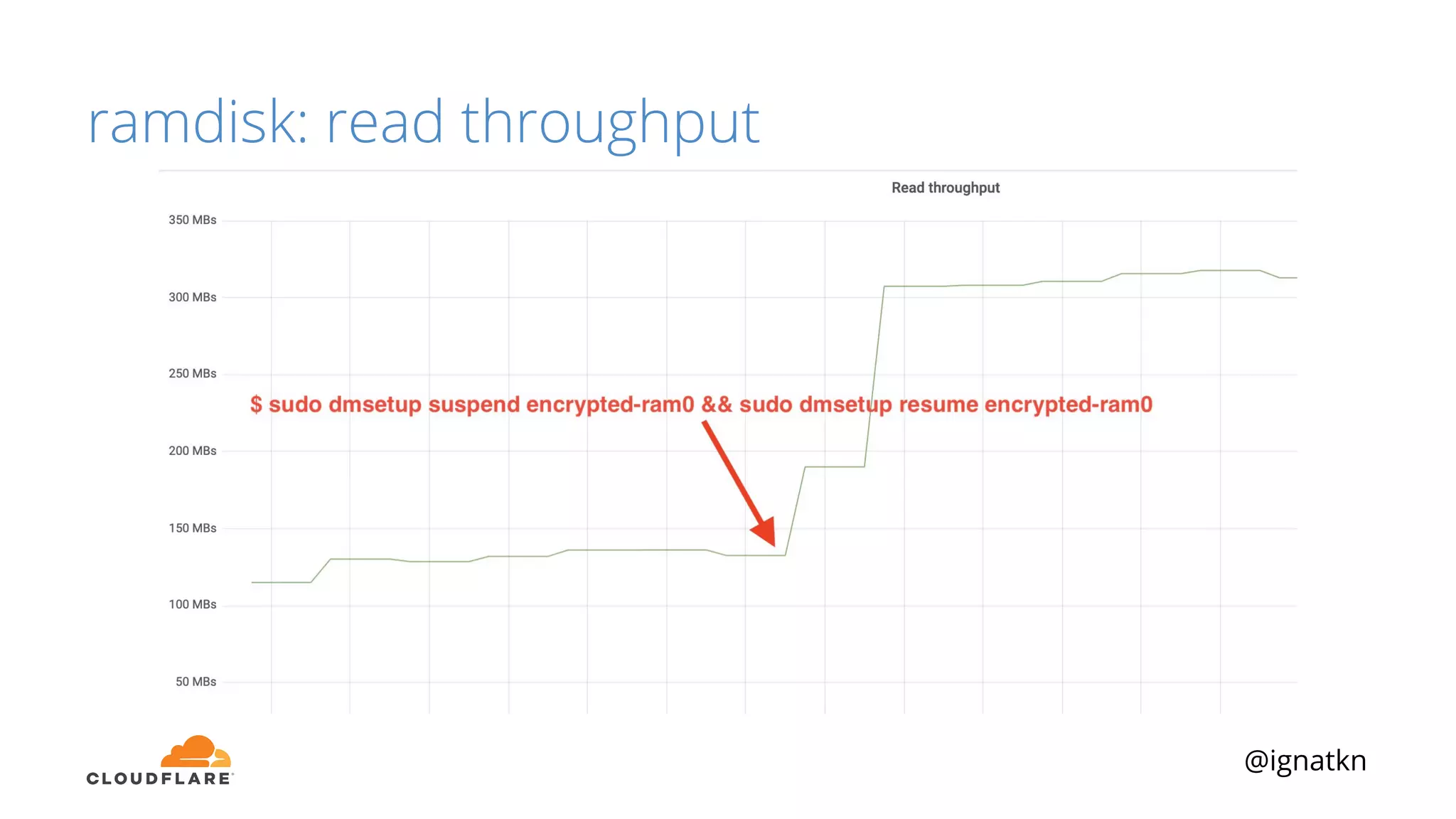
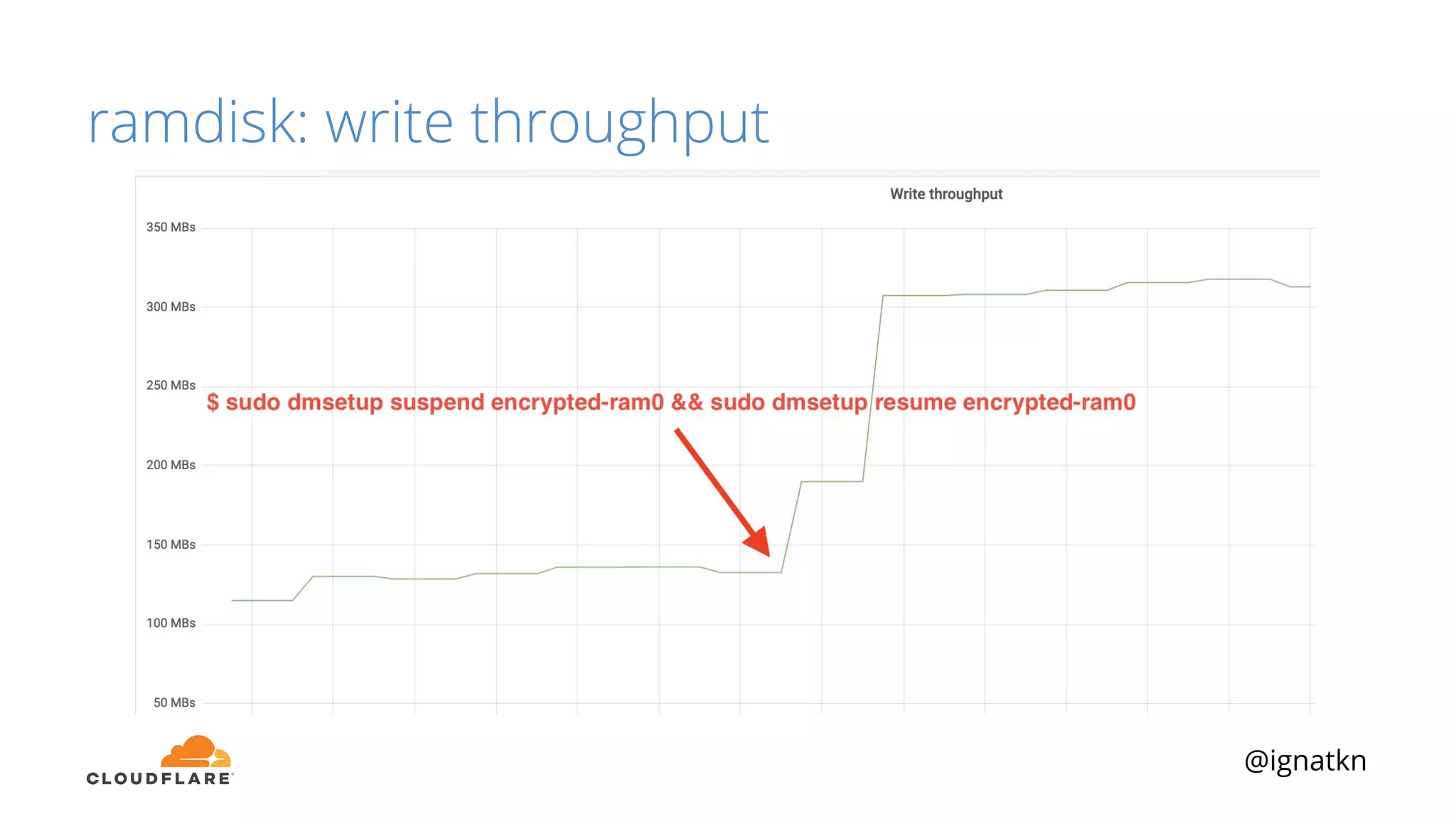
$ sudo dmsetup suspend encrypted-ram0 && sudo dmsetup 
resume encrypted-ram0
@ignatkn
ramdisk: read throughput
@ignatkn
ramdisk: write throughput
@ignatkn
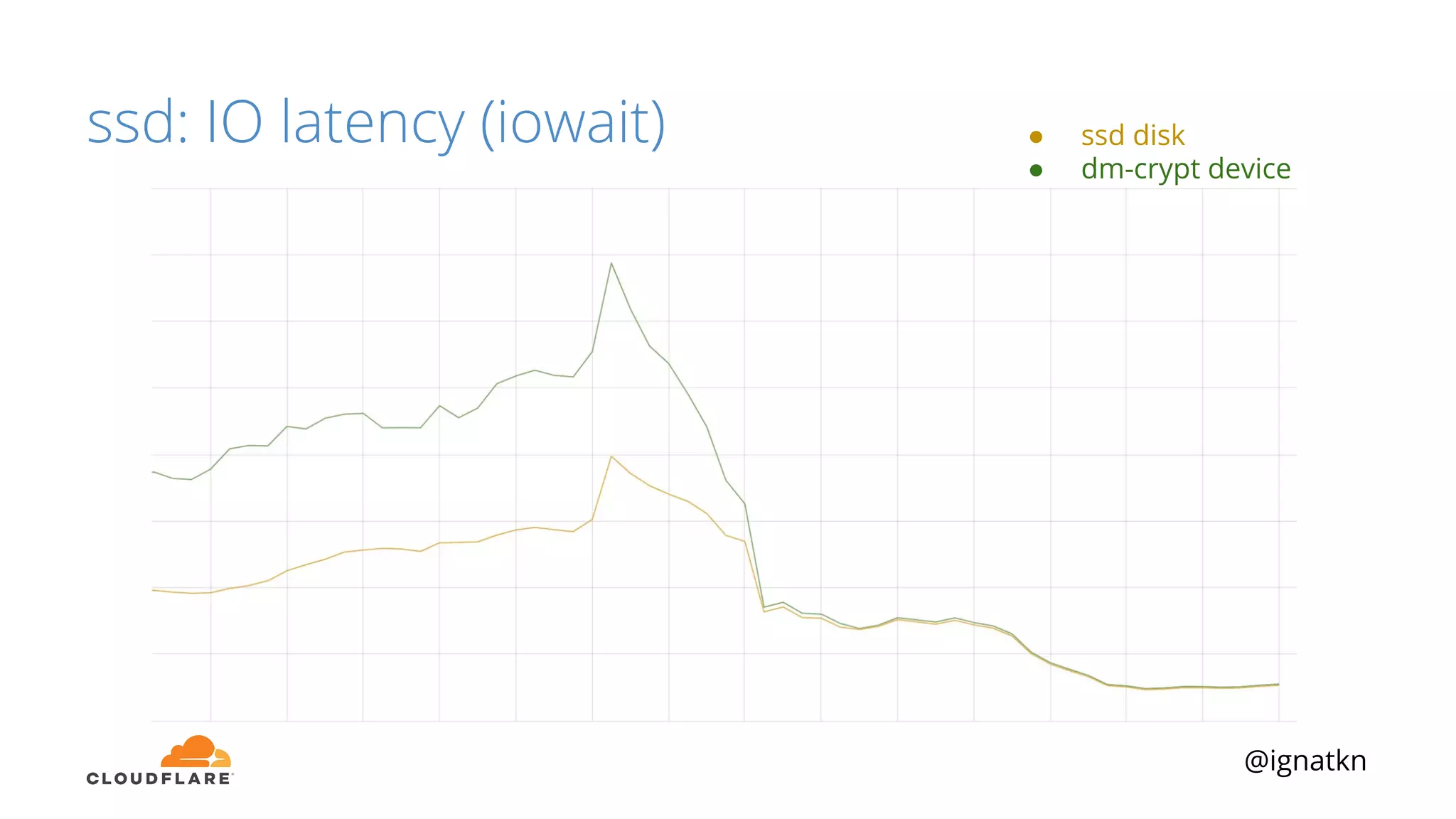
ssd: IO latency (iowait) ● ssd disk
● dm-crypt device
@ignatkn
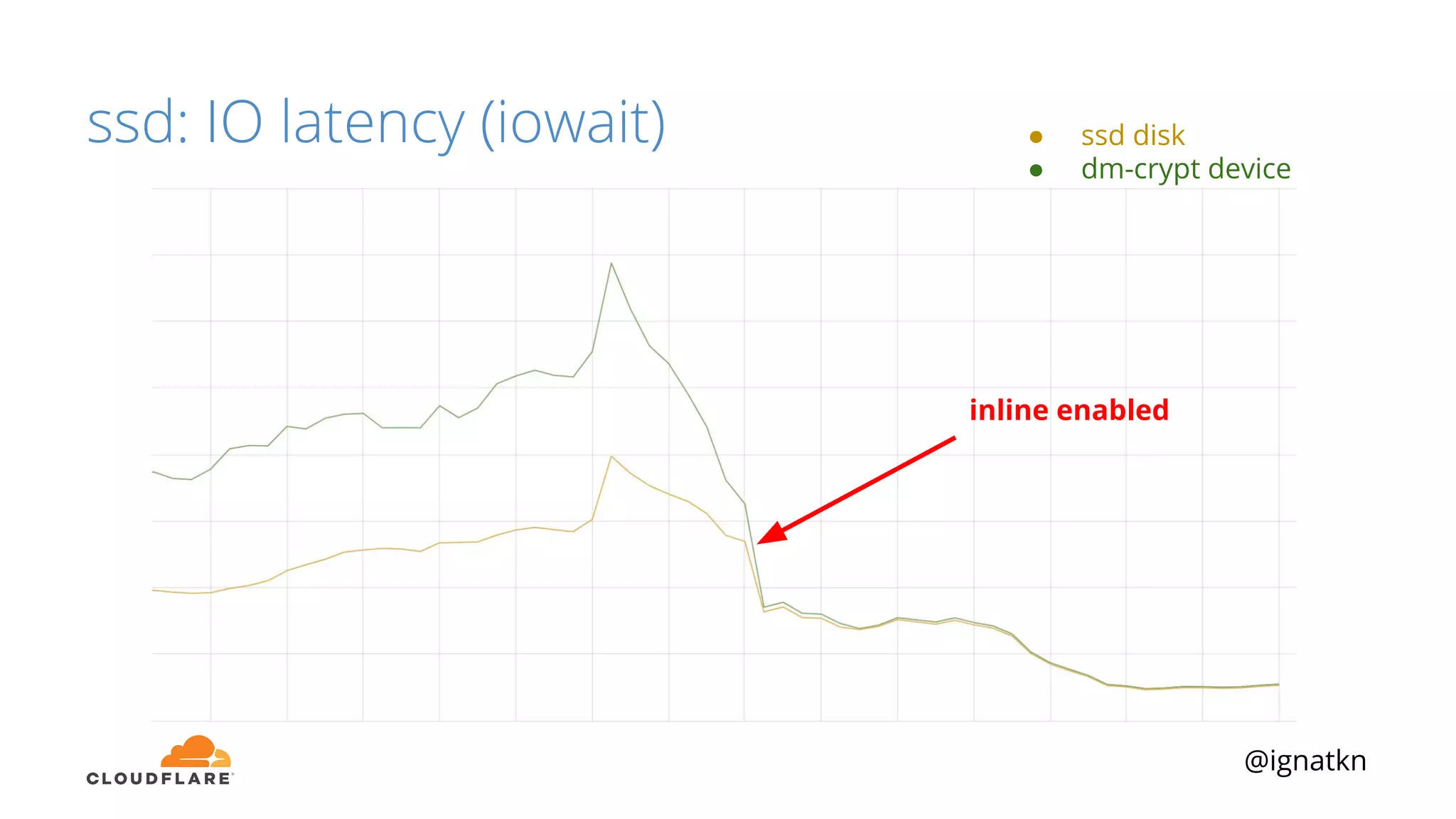
ssd: IO latency (iowait)
inline enabled
● ssd disk
● dm-crypt device
@ignatkn
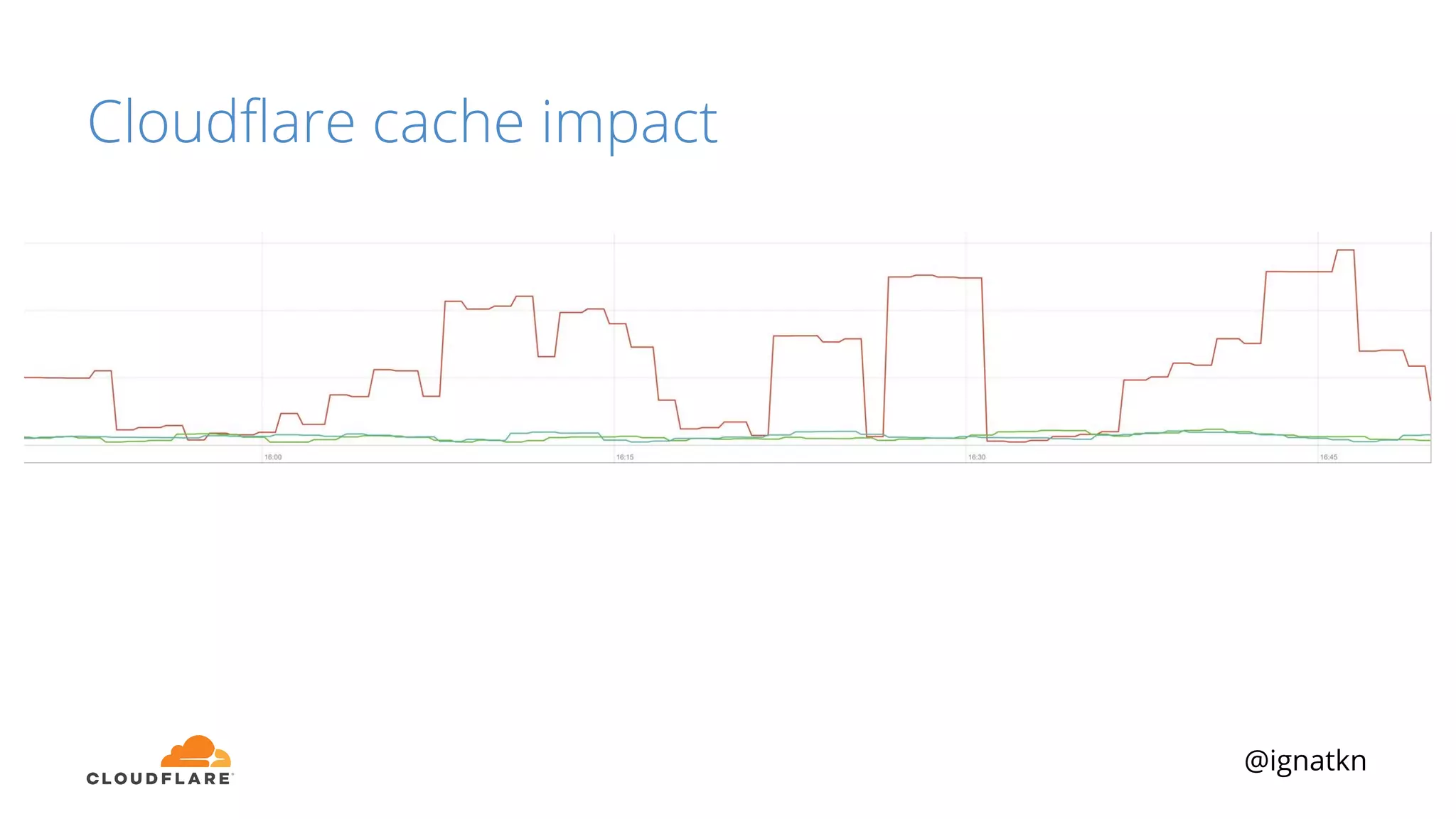
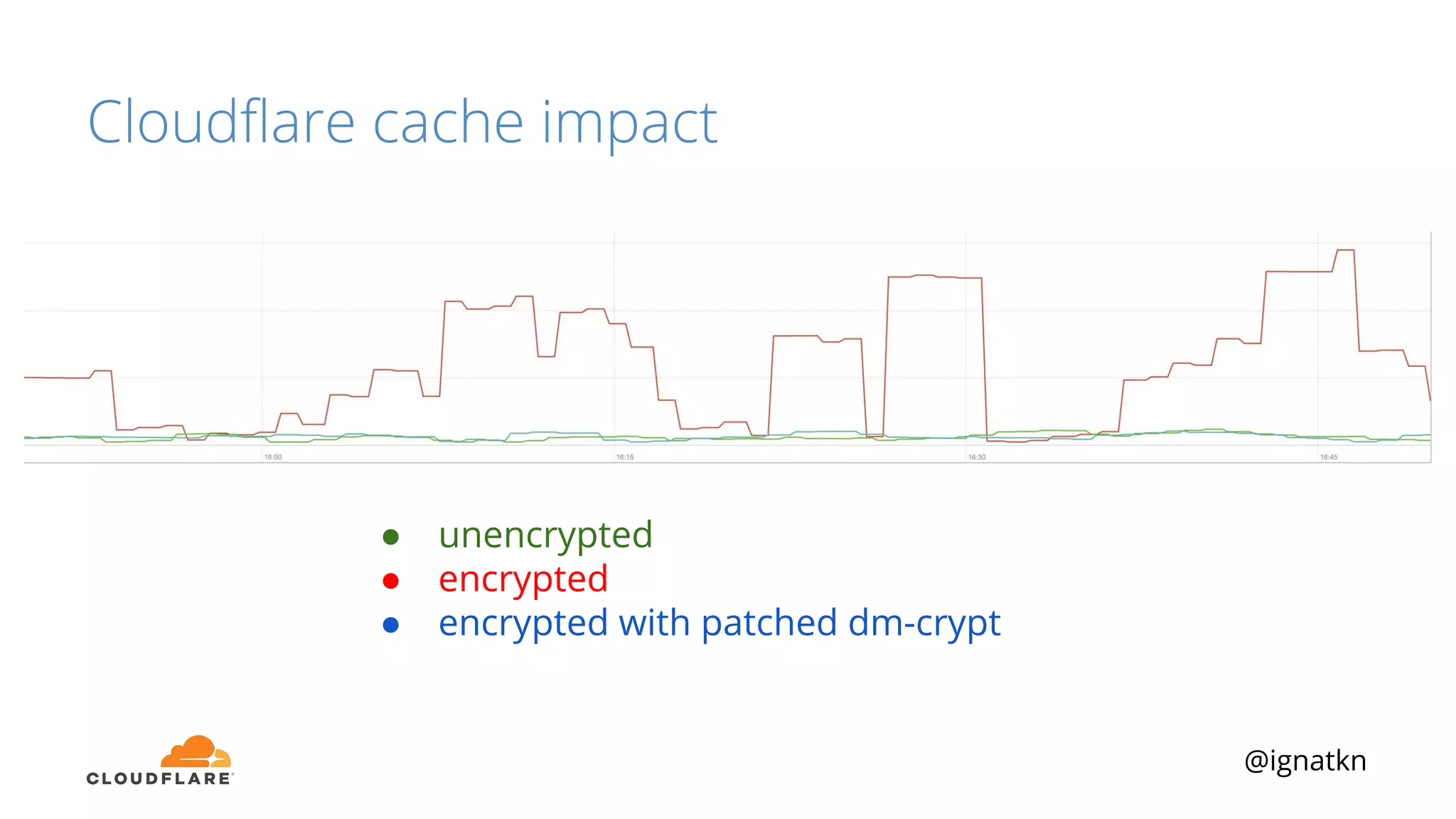
Cloudflare cache impact
@ignatkn
Cloudflare cache impact
● unencrypted
● encrypted
● encrypted with patched dm-crypt
Conclusions
@ignatkn
Conclusions
● a simple patch which may improve dm-crypt
performance by 200%-300%
○ fully compatible with stock Linux dm-crypt
○ can be enabled/disabled in runtime without service disruption
@ignatkn
Conclusions
● a simple patch which may improve dm-crypt
performance by 200%-300%
○ fully compatible with stock Linux dm-crypt
○ can be enabled/disabled in runtime without service disruption
● modern crypto is fast and cheap
○ performance degradation is likely elsewhere
@ignatkn
Conclusions
● a simple patch which may improve dm-crypt
performance by 200%-300%
○ fully compatible with stock Linux dm-crypt
○ can be enabled/disabled in runtime without service disruption
● modern crypto is fast and cheap
○ performance degradation is likely elsewhere
● extra queuing may be harmful on modern low
latency storage
@ignatkn
Caveats and future work
● the patch improves performance on small block
size/high IOPS workloads
○ >2MB block size shows worse performance
@ignatkn
Caveats and future work
● the patch improves performance on small block
size/high IOPS workloads
○ >2MB block size shows worse performance
● the whole setup assumes hardware-accelerated
crypto
○ xtsproxy supports x86 only
@ignatkn
Caveats and future work
● the patch improves performance on small block
size/high IOPS workloads
○ >2MB block size shows worse performance
● the whole setup assumes hardware-accelerated
crypto
○ xtsproxy supports x86 only
● your mileage may vary
○ always measure and compare before deployment
○ let us know the results
@ignatkn
Links
● https://gitlab.com/cryptsetup/cryptsetup
● http://man7.org/linux/man-pages/man8/dmsetup.8.html
● https://blog.cloudflare.com/speeding-up-linux-disk-encryption
● https://github.com/cloudflare/linux
Questions?

stackconf 2020 | Speeding up Linux disk encryption by Ignat Korchagin