DanielStenberg–SVT-January21st
,2020
and streaming!
Daniel Stenberg
@bagderhttps://daniel.haxx.se
Daniel Stenberg
@bagder
Daniel Stenberg
@bagder
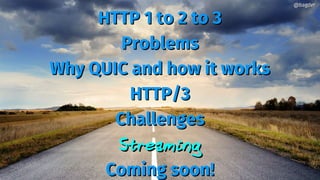
HTTP 1 to 2 to 3HTTP 1 to 2 to 3
ProblemsProblems
Why QUIC and how it worksWhy QUIC and how it works
HTTP/3HTTP/3
ChallengesChallenges
StreamingStreaming
Coming soon!Coming soon!
@bagder@bagder
HTTP started done over TCP
@bagder@bagder
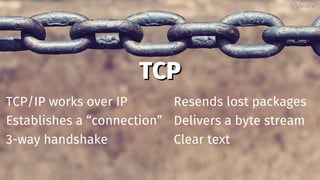
TCPTCP
TCP/IP works over IP
Establishes a “connection”
3-way handshake
Resends lost packages
Delivers a byte stream
Clear text
@bagder@bagder
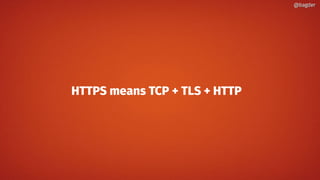
HTTPS means TCP + TLS + HTTP
@bagder@bagder
@bagder@bagder
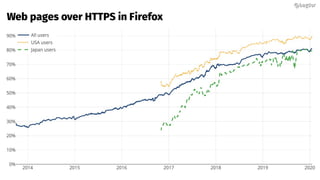
Web pages over HTTPS in Firefox
@bagder@bagder
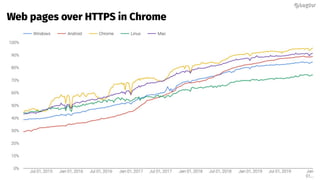
Web pages over HTTPS in Chrome
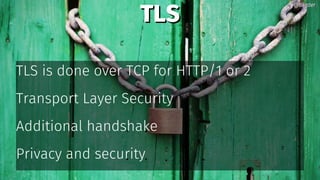
TLSTLS
TLS is done over TCP for HTTP/1 or 2
Transport Layer Security
Additional handshake
Privacy and security
@bagder@bagder
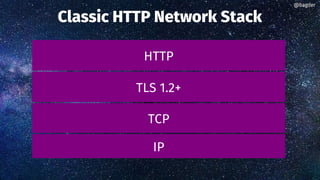
Classic HTTP Network Stack
IP
TCP
TLS 1.2+
HTTP
@bagder@bagder
HTTP over TCP
@bagder@bagder
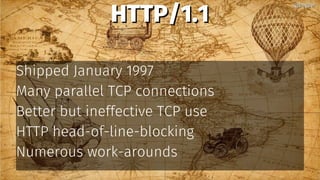
HTTP/1.1HTTP/1.1
Shipped January 1997
Many parallel TCP connections
Better but ineffective TCP use
HTTP head-of-line-blocking
Numerous work-arounds
@bagder@bagder
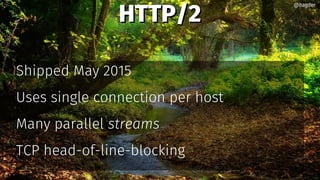
HTTP/2HTTP/2
Shipped May 2015
Uses single connection per host
Many parallel streams
TCP head-of-line-blocking
@bagder@bagder
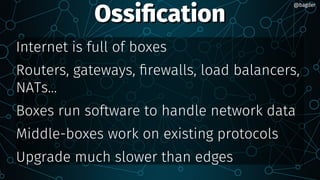
OssificationOssification
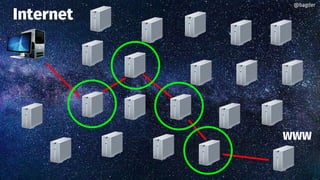
Internet is full of boxes
Routers, gateways, firewalls, load balancers,
NATs...
Boxes run software to handle network data
Middle-boxes work on existing protocols
Upgrade much slower than edges
@bagder@bagder
Internet
WWW
@bagder@bagder
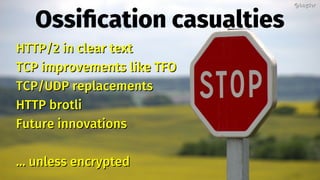
Ossification casualties
HTTP/2 in clear textHTTP/2 in clear text
TCP improvements like TFOTCP improvements like TFO
TCP/UDP replacementsTCP/UDP replacements
HTTP brotliHTTP brotli
Future innovationsFuture innovations
…… unless encryptedunless encrypted
@bagder@bagder
Improvement in spite of ossification
@bagder@bagder
@bagder@bagder
@bagder@bagder
A new transport protocol
@bagder@bagder
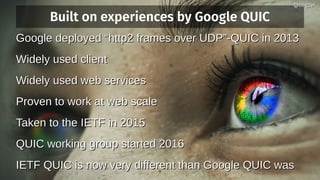
Built on experiences by Google QUIC
Google deployed “http2 frames over UDP”-QUIC in 2013Google deployed “http2 frames over UDP”-QUIC in 2013
Widely used clientWidely used client
Widely used web servicesWidely used web services
Proven to work at web scaleProven to work at web scale
Taken to the IETF in 2015Taken to the IETF in 2015
QUIC working group started 2016QUIC working group started 2016
IETF QUIC is now very different than Google QUIC wasIETF QUIC is now very different than Google QUIC was
@bagder@bagder
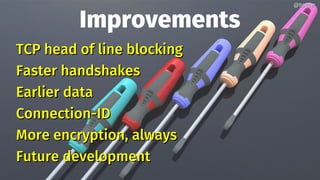
Improvements
TCP head of line blockingTCP head of line blocking
Faster handshakesFaster handshakes
Earlier dataEarlier data
Connection-IDConnection-ID
More encryption, alwaysMore encryption, always
Future developmentFuture development
@bagder@bagder
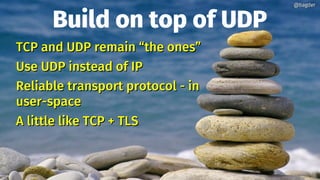
Build on top of UDP
TCP and UDP remain “the ones”TCP and UDP remain “the ones”
Use UDP instead of IPUse UDP instead of IP
Reliable transport protocol - inReliable transport protocol - in
user-spaceuser-space
A little like TCP + TLSA little like TCP + TLS
@bagder@bagder
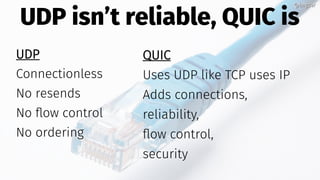
UDP isn’t reliable, QUIC is
UDP
Connectionless
No resends
No flow control
No ordering
@bagder@bagder
QUIC
Uses UDP like TCP uses IP
Adds connections,
reliability,
flow control,
security
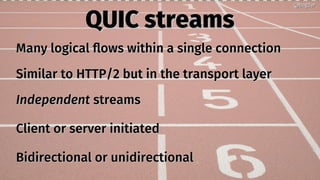
QUIC streamsQUIC streams
Many logical flows within a single connectionMany logical flows within a single connection
Similar to HTTP/2 but in the transport layerSimilar to HTTP/2 but in the transport layer
IndependentIndependent streamsstreams
Client or server initiatedClient or server initiated
Bidirectional or unidirectionalBidirectional or unidirectional
@bagder@bagder
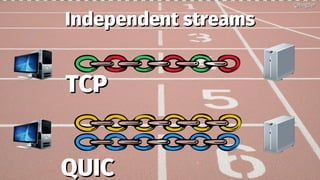
Independent streamsIndependent streams
TCPTCP
QUICQUIC
@bagder@bagder
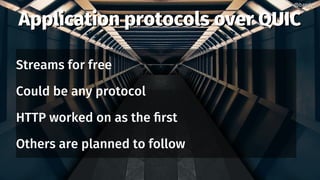
Application protocols over QUICApplication protocols over QUIC
Streams for free
Could be any protocol
HTTP worked on as the first
Others are planned to follow
@bagder@bagder
HTTP/3 = HTTP over QUIC
@bagder@bagder
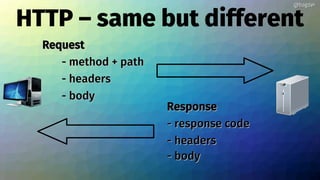
HTTP – same but different
RequestRequest
- method + path- method + path
- headers- headers
- body- body
ResponseResponse
- response code- response code
- headers- headers
- body- body
@bagder@bagder
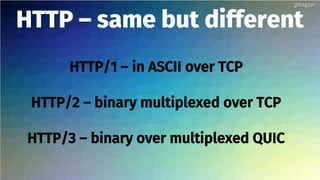
HTTP – same but different
HTTP/1 – in ASCII over TCP
HTTP/2 – binary multiplexed over TCP
HTTP/3 – binary over multiplexed QUIC
@bagder@bagder
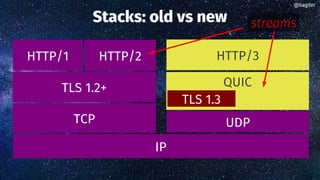
Stacks: old vs new
TCP
TLS 1.2+
HTTP/2
UDP
HTTP/3
QUIC
TLS 1.3
IP
HTTP/1
@bagder@bagder
streams
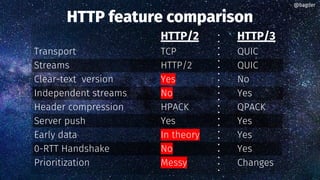
HTTP feature comparison
@bagder@bagder
HTTP/2 HTTP/3
Transport TCP QUIC
Streams HTTP/2 QUIC
Clear-text version Yes No
Independent streams No Yes
Header compression HPACK QPACK
Server push Yes Yes
Early data In theory Yes
0-RTT Handshake No Yes
Prioritization Messy Changes
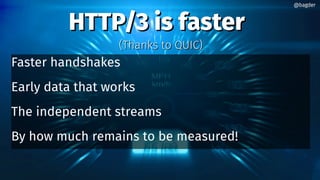
HTTP/3 is fasterHTTP/3 is faster
Faster handshakes
Early data that works
The independent streams
By how much remains to be measured!
@bagder@bagder
(Thanks to QUIC)(Thanks to QUIC)
HTTPS is TCP?
HTTPS:// URLs are everywhereHTTPS:// URLs are everywhere
TCP (and TLS) on TCP port 443TCP (and TLS) on TCP port 443
@bagder@bagder
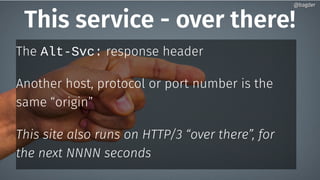
This service - over there!
The Alt-Svc: response header
Another host, protocol or port number is the
same “origin”
This site also runs on HTTP/3 “over there”, for
the next NNNN seconds
@bagder@bagder
Race connection attempts?
Might be faster
Needed occasionally anyway
QUIC connections verify the host cert
HTTPSSVC
@bagder@bagder
Will HTTP/3 deliver?
@bagder@bagder
Eight HTTP/3 challenges
3-7% of QUIC attempts fail
Clients need fall back algorithms
1 2 3 4 5 6 7 8
@bagder@bagder
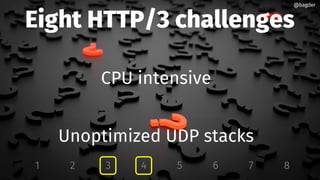
Eight HTTP/3 challenges
CPU intensive
Unoptimized UDP stacks
1 2 3 4 5 6 7 8
@bagder@bagder
Eight HTTP/3 challenges
“Funny” TLS layer
1 2 3 4 5 6 7 8
@bagder@bagder
Eight HTTP/3 challenges
All QUIC stacks are user-land
No standard QUIC API
1 2 3 4 5 6 7 8
@bagder@bagder
Eight HTTP/3 challenges
Lack of tooling
1 2 3 4 5 6 7 8
@bagder@bagder
Ship date
@bagder@bagder
20192020
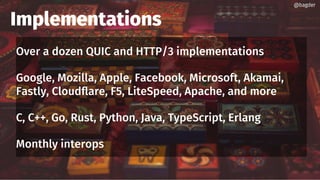
Implementations
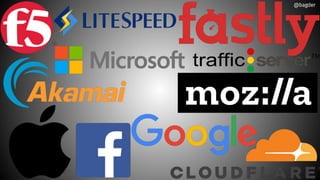
Over a dozen QUIC and HTTP/3 implementations
Google, Mozilla, Apple, Facebook, Microsoft, Akamai,
Fastly, Cloudflare, F5, LiteSpeed, Apache, and more
C, C++, Go, Rust, Python, Java, TypeScript, Erlang
Monthly interops
@bagder@bagder
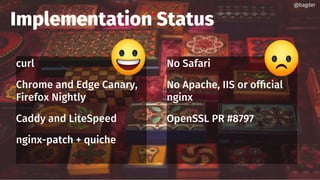
Implementation Status
curl
Chrome and Edge Canary,
Firefox Nightly
Caddy and LiteSpeed
nginx-patch + quiche
@bagder@bagder
No Safari
No Apache, IIS or official
nginx
OpenSSL PR #8797
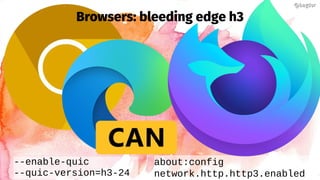
Browsers: bleeding edge h3
--enable-quic
--quic-version=h3-24
@bagder@bagder
about:config
network.http.http3.enabled
@bagder@bagder
streaming!
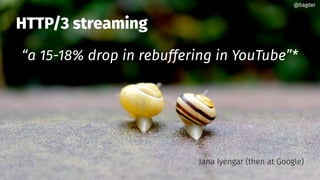
HTTP/3 streaming
“a 15-18% drop in rebuffering in YouTube”*
Jana Iyengar (then at Google)
@bagder@bagder
Why QUIC streams vs [something else]
Sane security story
IETF standard
Proven at web scale
Many implementations
Extensible
Independent streams
@bagder@bagder
More [coming?] over QUIC
DATAGRAM frameDATAGRAM frame
RTP over QUICRTP over QUIC
Partial reliabilityPartial reliability
MultipathMultipath
HTTP over multicast QUICHTTP over multicast QUIC
@bagder@bagder
Alternatives
@bagder@bagder
SRT - Secure Reliable
Transport
RIST - Reliable Internet
Stream Transport
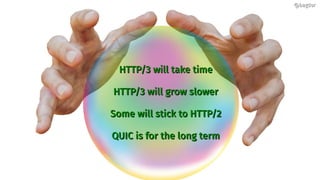
HTTP/3 will take timeHTTP/3 will take time
HTTP/3 will grow slowerHTTP/3 will grow slower
Some will stick to HTTP/2Some will stick to HTTP/2
QUIC is for the long termQUIC is for the long term
@bagder@bagder
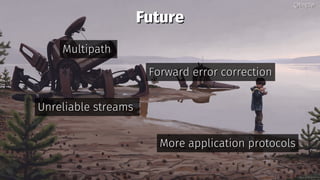
FutureFuture
MultipathMultipath
Forward error correctionForward error correction
Unreliable streamsUnreliable streams
More application protocolsMore application protocols
@bagder@bagder
Websockets?
Not actually a part of HTTP(/3)
RFC 8441 took a long time for HTTP/2
Can probably be updated for HTTP/3
draft-vvv-webtransport-http3-01
Still in progress
@bagder@bagder
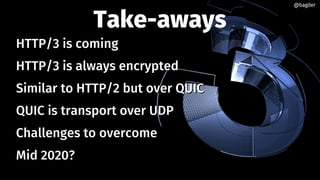
Take-aways
HTTP/3 is comingHTTP/3 is coming
HTTP/3 is always encryptedHTTP/3 is always encrypted
Similar to HTTP/2 but over QUICSimilar to HTTP/2 but over QUIC
QUIC is transport over UDPQUIC is transport over UDP
Challenges to overcomeChallenges to overcome
Mid 2020?Mid 2020?
@bagder@bagder
HTTP/3 Explained
https://daniel.haxx.se/http3-explained
@bagder@bagder
Daniel Stenberg
@bagder
https://daniel.haxx.se/
Thank you!Thank you!
Questions?Questions?
@bagder@bagder
License
This presentation is provided under the Creative Commons Attribution 4.0
International Public License
@bagder@bagder
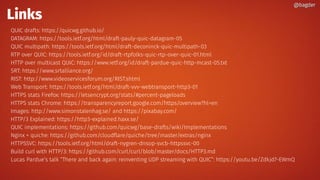
Links
QUIC drafts: https://quicwg.github.io/
DATAGRAM: https://tools.ietf.org/html/draft-pauly-quic-datagram-05
QUIC multipath: https://tools.ietf.org/html/draft-deconinck-quic-multipath-03
RTP over QUIC: https://tools.ietf.org/id/draft-rtpfolks-quic-rtp-over-quic-01.html
HTTP over multicast QUIC: https://www.ietf.org/id/draft-pardue-quic-http-mcast-05.txt
SRT: https://www.srtalliance.org/
RIST: http://www.videoservicesforum.org/RIST.shtml
Web Transport: https://tools.ietf.org/html/draft-vvv-webtransport-http3-01
HTTPS stats Firefox: https://letsencrypt.org/stats/#percent-pageloads
HTTPS stats Chrome: https://transparencyreport.google.com/https/overview?hl=en
Images: http://www.simonstalenhag.se/ and https://pixabay.com/
HTTP/3 Explained: https://http3-explained.haxx.se/
QUIC implementations: https://github.com/quicwg/base-drafts/wiki/Implementations
Nginx + quiche: https://github.com/cloudflare/quiche/tree/master/extras/nginx
HTTPSSVC: https://tools.ietf.org/html/draft-nygren-dnsop-svcb-httpssvc-00
Build curl with HTTP/3: https://github.com/curl/curl/blob/master/docs/HTTP3.md
Lucas Pardue’s talk “There and back again: reinventing UDP streaming with QUIC”: https://youtu.be/Zdkjd7-EWmQ
@bagder@bagder

HTTP/3, QUIC and streaming

  • 1.
  • 2.
  • 3.
  • 4.
  • 5.
    HTTP 1 to2 to 3HTTP 1 to 2 to 3 ProblemsProblems Why QUIC and how it worksWhy QUIC and how it works HTTP/3HTTP/3 ChallengesChallenges StreamingStreaming Coming soon!Coming soon! @bagder@bagder
  • 6.
    HTTP started doneover TCP @bagder@bagder
  • 7.
    TCPTCP TCP/IP works overIP Establishes a “connection” 3-way handshake Resends lost packages Delivers a byte stream Clear text @bagder@bagder
  • 8.
    HTTPS means TCP+ TLS + HTTP @bagder@bagder
  • 9.
  • 10.
  • 11.
    TLSTLS TLS is doneover TCP for HTTP/1 or 2 Transport Layer Security Additional handshake Privacy and security @bagder@bagder
  • 12.
    Classic HTTP NetworkStack IP TCP TLS 1.2+ HTTP @bagder@bagder
  • 13.
  • 14.
    HTTP/1.1HTTP/1.1 Shipped January 1997 Manyparallel TCP connections Better but ineffective TCP use HTTP head-of-line-blocking Numerous work-arounds @bagder@bagder
  • 15.
    HTTP/2HTTP/2 Shipped May 2015 Usessingle connection per host Many parallel streams TCP head-of-line-blocking @bagder@bagder
  • 16.
    OssificationOssification Internet is fullof boxes Routers, gateways, firewalls, load balancers, NATs... Boxes run software to handle network data Middle-boxes work on existing protocols Upgrade much slower than edges @bagder@bagder
  • 17.
  • 18.
    Ossification casualties HTTP/2 inclear textHTTP/2 in clear text TCP improvements like TFOTCP improvements like TFO TCP/UDP replacementsTCP/UDP replacements HTTP brotliHTTP brotli Future innovationsFuture innovations …… unless encryptedunless encrypted @bagder@bagder
  • 19.
    Improvement in spiteof ossification @bagder@bagder
  • 20.
  • 21.
  • 22.
    A new transportprotocol @bagder@bagder
  • 23.
    Built on experiencesby Google QUIC Google deployed “http2 frames over UDP”-QUIC in 2013Google deployed “http2 frames over UDP”-QUIC in 2013 Widely used clientWidely used client Widely used web servicesWidely used web services Proven to work at web scaleProven to work at web scale Taken to the IETF in 2015Taken to the IETF in 2015 QUIC working group started 2016QUIC working group started 2016 IETF QUIC is now very different than Google QUIC wasIETF QUIC is now very different than Google QUIC was @bagder@bagder
  • 24.
    Improvements TCP head ofline blockingTCP head of line blocking Faster handshakesFaster handshakes Earlier dataEarlier data Connection-IDConnection-ID More encryption, alwaysMore encryption, always Future developmentFuture development @bagder@bagder
  • 25.
    Build on topof UDP TCP and UDP remain “the ones”TCP and UDP remain “the ones” Use UDP instead of IPUse UDP instead of IP Reliable transport protocol - inReliable transport protocol - in user-spaceuser-space A little like TCP + TLSA little like TCP + TLS @bagder@bagder
  • 26.
    UDP isn’t reliable,QUIC is UDP Connectionless No resends No flow control No ordering @bagder@bagder QUIC Uses UDP like TCP uses IP Adds connections, reliability, flow control, security
  • 27.
    QUIC streamsQUIC streams Manylogical flows within a single connectionMany logical flows within a single connection Similar to HTTP/2 but in the transport layerSimilar to HTTP/2 but in the transport layer IndependentIndependent streamsstreams Client or server initiatedClient or server initiated Bidirectional or unidirectionalBidirectional or unidirectional @bagder@bagder
  • 28.
  • 29.
    Application protocols overQUICApplication protocols over QUIC Streams for free Could be any protocol HTTP worked on as the first Others are planned to follow @bagder@bagder
  • 30.
    HTTP/3 = HTTPover QUIC @bagder@bagder
  • 31.
    HTTP – samebut different RequestRequest - method + path- method + path - headers- headers - body- body ResponseResponse - response code- response code - headers- headers - body- body @bagder@bagder
  • 32.
    HTTP – samebut different HTTP/1 – in ASCII over TCP HTTP/2 – binary multiplexed over TCP HTTP/3 – binary over multiplexed QUIC @bagder@bagder
  • 33.
    Stacks: old vsnew TCP TLS 1.2+ HTTP/2 UDP HTTP/3 QUIC TLS 1.3 IP HTTP/1 @bagder@bagder streams
  • 34.
    HTTP feature comparison @bagder@bagder HTTP/2HTTP/3 Transport TCP QUIC Streams HTTP/2 QUIC Clear-text version Yes No Independent streams No Yes Header compression HPACK QPACK Server push Yes Yes Early data In theory Yes 0-RTT Handshake No Yes Prioritization Messy Changes
  • 35.
    HTTP/3 is fasterHTTP/3is faster Faster handshakes Early data that works The independent streams By how much remains to be measured! @bagder@bagder (Thanks to QUIC)(Thanks to QUIC)
  • 36.
    HTTPS is TCP? HTTPS://URLs are everywhereHTTPS:// URLs are everywhere TCP (and TLS) on TCP port 443TCP (and TLS) on TCP port 443 @bagder@bagder
  • 37.
    This service -over there! The Alt-Svc: response header Another host, protocol or port number is the same “origin” This site also runs on HTTP/3 “over there”, for the next NNNN seconds @bagder@bagder
  • 38.
    Race connection attempts? Mightbe faster Needed occasionally anyway QUIC connections verify the host cert HTTPSSVC @bagder@bagder
  • 39.
  • 40.
    Eight HTTP/3 challenges 3-7%of QUIC attempts fail Clients need fall back algorithms 1 2 3 4 5 6 7 8 @bagder@bagder
  • 41.
    Eight HTTP/3 challenges CPUintensive Unoptimized UDP stacks 1 2 3 4 5 6 7 8 @bagder@bagder
  • 42.
    Eight HTTP/3 challenges “Funny”TLS layer 1 2 3 4 5 6 7 8 @bagder@bagder
  • 43.
    Eight HTTP/3 challenges AllQUIC stacks are user-land No standard QUIC API 1 2 3 4 5 6 7 8 @bagder@bagder
  • 44.
    Eight HTTP/3 challenges Lackof tooling 1 2 3 4 5 6 7 8 @bagder@bagder
  • 45.
  • 46.
    Implementations Over a dozenQUIC and HTTP/3 implementations Google, Mozilla, Apple, Facebook, Microsoft, Akamai, Fastly, Cloudflare, F5, LiteSpeed, Apache, and more C, C++, Go, Rust, Python, Java, TypeScript, Erlang Monthly interops @bagder@bagder
  • 47.
    Implementation Status curl Chrome andEdge Canary, Firefox Nightly Caddy and LiteSpeed nginx-patch + quiche @bagder@bagder No Safari No Apache, IIS or official nginx OpenSSL PR #8797
  • 48.
    Browsers: bleeding edgeh3 --enable-quic --quic-version=h3-24 @bagder@bagder about:config network.http.http3.enabled
  • 49.
  • 50.
    HTTP/3 streaming “a 15-18%drop in rebuffering in YouTube”* Jana Iyengar (then at Google) @bagder@bagder
  • 51.
    Why QUIC streamsvs [something else] Sane security story IETF standard Proven at web scale Many implementations Extensible Independent streams @bagder@bagder
  • 52.
    More [coming?] overQUIC DATAGRAM frameDATAGRAM frame RTP over QUICRTP over QUIC Partial reliabilityPartial reliability MultipathMultipath HTTP over multicast QUICHTTP over multicast QUIC @bagder@bagder
  • 53.
    Alternatives @bagder@bagder SRT - SecureReliable Transport RIST - Reliable Internet Stream Transport
  • 54.
    HTTP/3 will taketimeHTTP/3 will take time HTTP/3 will grow slowerHTTP/3 will grow slower Some will stick to HTTP/2Some will stick to HTTP/2 QUIC is for the long termQUIC is for the long term @bagder@bagder
  • 55.
    FutureFuture MultipathMultipath Forward error correctionForwarderror correction Unreliable streamsUnreliable streams More application protocolsMore application protocols @bagder@bagder
  • 56.
    Websockets? Not actually apart of HTTP(/3) RFC 8441 took a long time for HTTP/2 Can probably be updated for HTTP/3 draft-vvv-webtransport-http3-01 Still in progress @bagder@bagder
  • 57.
    Take-aways HTTP/3 is comingHTTP/3is coming HTTP/3 is always encryptedHTTP/3 is always encrypted Similar to HTTP/2 but over QUICSimilar to HTTP/2 but over QUIC QUIC is transport over UDPQUIC is transport over UDP Challenges to overcomeChallenges to overcome Mid 2020?Mid 2020? @bagder@bagder
  • 58.
  • 59.
  • 60.
    License This presentation isprovided under the Creative Commons Attribution 4.0 International Public License @bagder@bagder
  • 61.
    Links QUIC drafts: https://quicwg.github.io/ DATAGRAM:https://tools.ietf.org/html/draft-pauly-quic-datagram-05 QUIC multipath: https://tools.ietf.org/html/draft-deconinck-quic-multipath-03 RTP over QUIC: https://tools.ietf.org/id/draft-rtpfolks-quic-rtp-over-quic-01.html HTTP over multicast QUIC: https://www.ietf.org/id/draft-pardue-quic-http-mcast-05.txt SRT: https://www.srtalliance.org/ RIST: http://www.videoservicesforum.org/RIST.shtml Web Transport: https://tools.ietf.org/html/draft-vvv-webtransport-http3-01 HTTPS stats Firefox: https://letsencrypt.org/stats/#percent-pageloads HTTPS stats Chrome: https://transparencyreport.google.com/https/overview?hl=en Images: http://www.simonstalenhag.se/ and https://pixabay.com/ HTTP/3 Explained: https://http3-explained.haxx.se/ QUIC implementations: https://github.com/quicwg/base-drafts/wiki/Implementations Nginx + quiche: https://github.com/cloudflare/quiche/tree/master/extras/nginx HTTPSSVC: https://tools.ietf.org/html/draft-nygren-dnsop-svcb-httpssvc-00 Build curl with HTTP/3: https://github.com/curl/curl/blob/master/docs/HTTP3.md Lucas Pardue’s talk “There and back again: reinventing UDP streaming with QUIC”: https://youtu.be/Zdkjd7-EWmQ @bagder@bagder