The Power of Personal
Relationships
Article by Thomas S. Mawhinney & Laura L. Sagan
Presentation by Ryan Mitchell
First day of school…
 Determines whether how well or how poor a
student will do with you during the school year.
 Creating a positive atmosphere in your classroom
can be beneficial to the child and the teacher.
 If research shows that teachers have an effect on
student achievement, then why would we try to
frighten them on the first day of school?
The Skillful Teacher
 Personal relationship building has been included in
our textbook, The Skillful Teacher.
 That text explains personal relationship building is
simply done through a “variety of ways teachers
have of contacting students’ personal worlds and
the traits of teachers that seem to engender affection
and regard in a relationship.”
 Teachers develop their own “tool box” or “bag of
tricks” that can help foster these relationships.
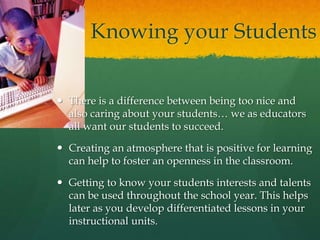
Knowing your Students
 There is a difference between being too nice and
also caring about your students… we as educators
all want our students to succeed.
 Creating an atmosphere that is positive for learning
can help to foster an openness in the classroom.
 Getting to know your students interests and talents
can be used throughout the school year. This helps
later as you develop differentiated lessons in your
instructional units.
“My teacher ‘hates’ me”
 A common phrase heard if a student is not doing
well in a class… clearly this is the thought that
permeates a students mind if they are not feeling
successful in your class.
 An important point to follow is that mistakes can be
made by anyone and it is your job as the educator to
explain this to your student. “You’ve hit a bump in
the road, now we need to continue on the journey.”
 Trying to turn a negative situation into a positive
one is what can help students understand we are
not there to fail them, but to hold high expectations
for their learning.
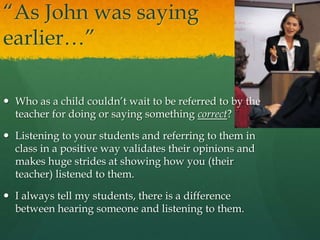
“As John was saying
earlier…”
 Who as a child couldn’t wait to be referred to by the
teacher for doing or saying something correct?
 Listening to your students and referring to them in
class in a positive way validates their opinions and
makes huge strides at showing how you (their
teacher) listened to them.
 I always tell my students, there is a difference
between hearing someone and listening to them.
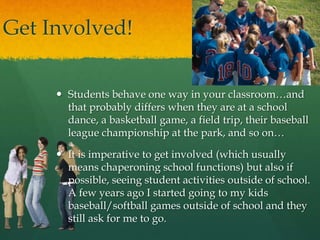
Get Involved!
 Students behave one way in your classroom…and
that probably differs when they are at a school
dance, a basketball game, a field trip, their baseball
league championship at the park, and so on…
 It is imperative to get involved (which usually
means chaperoning school functions) but also if
possible, seeing student activities outside of school.
A few years ago I started going to my kids
baseball/softball games outside of school and they
still ask for me to go.
“Respect, courtesy,
fairness…”
 Qualities that all people should exemplify and are
three qualities referred to in the article that builds
positive relationships between students and their
teacher.
 A good example of a teacher that was mentioned in
the article and also one I can personally relate to
was: “courteous-- always saying please and thank
you, never got mad or raised his voice, used humor
but was not sarcastic, disciplined his students
privately, etc.”
 If our students see us as people, then that can also
improve their own self-awareness in class.
Caring and Humor
 Caring too much or too little is what many teachers
may get hung up on regarding relationship
building.
 Displaying student work or showing praise to a
student can show that we care about their learning
and above all, their overall achievement.
 Humor is vital to a successful classroom…but it
should never be used at the expense of another
student. It creates a warmth in your classroom and
relaxes both students and the teacher.
Closing…
 Personal relationship building is summed up in
“The Power of Personal Relationships” by saying:
 Something you can see and feel
 Something that is coachable
 Something that plays a key role in the teaching act
• So get to know your students and allow them to get
to know you…it could make the difference for just
one child.
Article References…
 PDF Article on BSU
 Mawhinney, Thomas S., and Laura L. Sagan. “The
Power of Personal Relationships.” Phi Delta Kappan
88.6 (2007): 460-464. ERIC. Web 11 July 2015.
 Saphier, J., Haley-Speca, M.A., & Gower R. (2008)
The Skillful teacher: Building your teaching skills.
(6th ed.) Acton, MA: Research for Better Teaching.

SPED505ArticleRelationshipBuilding

  • 1.
    The Power ofPersonal Relationships Article by Thomas S. Mawhinney & Laura L. Sagan Presentation by Ryan Mitchell
  • 2.
    First day ofschool…  Determines whether how well or how poor a student will do with you during the school year.  Creating a positive atmosphere in your classroom can be beneficial to the child and the teacher.  If research shows that teachers have an effect on student achievement, then why would we try to frighten them on the first day of school?
  • 3.
    The Skillful Teacher Personal relationship building has been included in our textbook, The Skillful Teacher.  That text explains personal relationship building is simply done through a “variety of ways teachers have of contacting students’ personal worlds and the traits of teachers that seem to engender affection and regard in a relationship.”  Teachers develop their own “tool box” or “bag of tricks” that can help foster these relationships.
  • 4.
    Knowing your Students There is a difference between being too nice and also caring about your students… we as educators all want our students to succeed.  Creating an atmosphere that is positive for learning can help to foster an openness in the classroom.  Getting to know your students interests and talents can be used throughout the school year. This helps later as you develop differentiated lessons in your instructional units.
  • 5.
    “My teacher ‘hates’me”  A common phrase heard if a student is not doing well in a class… clearly this is the thought that permeates a students mind if they are not feeling successful in your class.  An important point to follow is that mistakes can be made by anyone and it is your job as the educator to explain this to your student. “You’ve hit a bump in the road, now we need to continue on the journey.”  Trying to turn a negative situation into a positive one is what can help students understand we are not there to fail them, but to hold high expectations for their learning.
  • 6.
    “As John wassaying earlier…”  Who as a child couldn’t wait to be referred to by the teacher for doing or saying something correct?  Listening to your students and referring to them in class in a positive way validates their opinions and makes huge strides at showing how you (their teacher) listened to them.  I always tell my students, there is a difference between hearing someone and listening to them.
  • 7.
    Get Involved!  Studentsbehave one way in your classroom…and that probably differs when they are at a school dance, a basketball game, a field trip, their baseball league championship at the park, and so on…  It is imperative to get involved (which usually means chaperoning school functions) but also if possible, seeing student activities outside of school. A few years ago I started going to my kids baseball/softball games outside of school and they still ask for me to go.
  • 8.
    “Respect, courtesy, fairness…”  Qualitiesthat all people should exemplify and are three qualities referred to in the article that builds positive relationships between students and their teacher.  A good example of a teacher that was mentioned in the article and also one I can personally relate to was: “courteous-- always saying please and thank you, never got mad or raised his voice, used humor but was not sarcastic, disciplined his students privately, etc.”  If our students see us as people, then that can also improve their own self-awareness in class.
  • 9.
    Caring and Humor Caring too much or too little is what many teachers may get hung up on regarding relationship building.  Displaying student work or showing praise to a student can show that we care about their learning and above all, their overall achievement.  Humor is vital to a successful classroom…but it should never be used at the expense of another student. It creates a warmth in your classroom and relaxes both students and the teacher.
  • 10.
    Closing…  Personal relationshipbuilding is summed up in “The Power of Personal Relationships” by saying:  Something you can see and feel  Something that is coachable  Something that plays a key role in the teaching act • So get to know your students and allow them to get to know you…it could make the difference for just one child.
  • 11.
    Article References…  PDFArticle on BSU  Mawhinney, Thomas S., and Laura L. Sagan. “The Power of Personal Relationships.” Phi Delta Kappan 88.6 (2007): 460-464. ERIC. Web 11 July 2015.  Saphier, J., Haley-Speca, M.A., & Gower R. (2008) The Skillful teacher: Building your teaching skills. (6th ed.) Acton, MA: Research for Better Teaching.