SPED 1004 Strategies for Teaching Children with Developmental & Behavior Problems Room:  CAI 301 Time:  5:00 - 9:00pm ROBERT M. GOMEZ, MAED-SPED
Today’s Discussion Feedback on the 1 st  Assignment Continuum of Service Placement Options in SPED  Overview of the definition, types, nature, and characteristics of Developmental and Behavior Problems
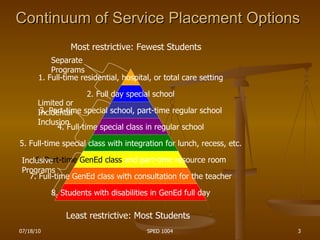
Continuum of Service Placement Options  1. Full-time residential, hospital, or total care setting 2. Full day special school 3. Part-time special school, part-time regular school 4. Full-time special class in regular school 5. Full-time special class with integration for lunch, recess, etc. 6. Part-time GenEd class  and part-time resource   room 7. Full-time GenEd class with consultation for the teacher 8. Students with disabilities in GenEd full day Separate  Programs Limited or Incidental Inclusion Inclusive Programs Most restrictive: Fewest Students Least restrictive: Most Students
Factors to consider in the placement of CSN category of disability; severity of disability; configuration of delivery system;  availability of educational or related services; availability of space; or  administrative convenience.
What is Developmental Disability? An umbrella term used to describe disabilities which impair the usual course of development in childhood.  vary widely, both in severity, and how they affect the individual.  They may affect daily functioning in one or several different areas, such as speech, learning, physical and social functioning, and life skills.
What is Developmental Disability? means a severe, chronic disability of an individual 5 years of age or older that: Is attributable to a mental or physical impairment or combination of mental and physical impairments;  Is manifested before the individual attains age 22;  Is likely to continue indefinitely;  Results in substantial functional limitations in three or more of the following areas of major life activity; (i) Self-care; Receptive and expressive language; Learning; Mobility; Self-direction; Capacity for independent living; and Economic self-sufficiency.
Some types of Developmental Disability Autism  Cerebral palsy  Various genetic and chromosomal disorders (FragileX, FASD, DS) Mental retardation  Spina Bifida
What is Behavior Problem? conditions that are more than just disruptive behavior.  they are related to mental health problems that lead to disruptive behavior, emotional and social problems
2 nd  Assignment

Sped educational placement

  • 1.
    SPED 1004 Strategiesfor Teaching Children with Developmental & Behavior Problems Room: CAI 301 Time: 5:00 - 9:00pm ROBERT M. GOMEZ, MAED-SPED
  • 2.
    Today’s Discussion Feedbackon the 1 st Assignment Continuum of Service Placement Options in SPED Overview of the definition, types, nature, and characteristics of Developmental and Behavior Problems
  • 3.
    Continuum of ServicePlacement Options 1. Full-time residential, hospital, or total care setting 2. Full day special school 3. Part-time special school, part-time regular school 4. Full-time special class in regular school 5. Full-time special class with integration for lunch, recess, etc. 6. Part-time GenEd class and part-time resource room 7. Full-time GenEd class with consultation for the teacher 8. Students with disabilities in GenEd full day Separate Programs Limited or Incidental Inclusion Inclusive Programs Most restrictive: Fewest Students Least restrictive: Most Students
  • 4.
    Factors to considerin the placement of CSN category of disability; severity of disability; configuration of delivery system; availability of educational or related services; availability of space; or administrative convenience.
  • 5.
    What is DevelopmentalDisability? An umbrella term used to describe disabilities which impair the usual course of development in childhood. vary widely, both in severity, and how they affect the individual. They may affect daily functioning in one or several different areas, such as speech, learning, physical and social functioning, and life skills.
  • 6.
    What is DevelopmentalDisability? means a severe, chronic disability of an individual 5 years of age or older that: Is attributable to a mental or physical impairment or combination of mental and physical impairments; Is manifested before the individual attains age 22; Is likely to continue indefinitely; Results in substantial functional limitations in three or more of the following areas of major life activity; (i) Self-care; Receptive and expressive language; Learning; Mobility; Self-direction; Capacity for independent living; and Economic self-sufficiency.
  • 7.
    Some types ofDevelopmental Disability Autism Cerebral palsy Various genetic and chromosomal disorders (FragileX, FASD, DS) Mental retardation Spina Bifida
  • 8.
    What is BehaviorProblem? conditions that are more than just disruptive behavior. they are related to mental health problems that lead to disruptive behavior, emotional and social problems
  • 9.
    2 nd Assignment