Colorimetry: The colorimetry is a technique by which
substance to be analysed in biological material is estimated by
developing colour with suitable reagent, which is compared
with known concentration of substance or standard.
Spectrophotometry – is similar to colorimetry but in this
technique, it extends the range of possible measurements
beyond those that can be determined by the eye alone i.e.,
quantification of colourless compounds by using UV or visible
light.
Spectrophotometry
Spectrophotometer - an instrument that measures the amount
of light absorbed, or the intensity of color at a given
wavelength.
The intensity of color can be given a numerical value by
comparing the amount of light prior to passing it through
the sample and after passing through the sample.
These quantitative measurements of light absorbed are the
Transmittance and the Absorbance.
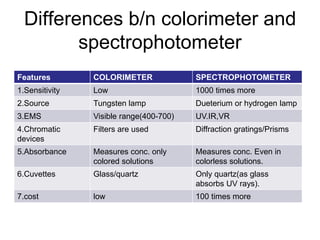
Differences b/n colorimeter and
spectrophotometer
Features COLORIMETER SPECTROPHOTOMETER
1.Sensitivity Low 1000 times more
2.Source Tungsten lamp Dueterium or hydrogen lamp
3.EMS Visible range(400-700) UV.IR,VR
4.Chromatic
devices
Filters are used Diffraction gratings/Prisms
5.Absorbance Measures conc. only
colored solutions
Measures conc. Even in
colorless solutions.
6.Cuvettes Glass/quartz Only quartz(as glass
absorbs UV rays).
7.cost low 100 times more
Advantages of
spectrophotometer
1. Useful for the measurement of
absorbance of coloured as well as
colourless solutions.
2. Works in UV, visible and IR (260- 800nm)
3. Prism or diffraction gratings used instead
of filters.
4. More sensitive,accurate and
sophosticated.
spectrophotometry- tecnique, principle, advantages

spectrophotometry- tecnique, principle, advantages

  • 2.
    Colorimetry: The colorimetryis a technique by which substance to be analysed in biological material is estimated by developing colour with suitable reagent, which is compared with known concentration of substance or standard. Spectrophotometry – is similar to colorimetry but in this technique, it extends the range of possible measurements beyond those that can be determined by the eye alone i.e., quantification of colourless compounds by using UV or visible light.
  • 3.
    Spectrophotometry Spectrophotometer - aninstrument that measures the amount of light absorbed, or the intensity of color at a given wavelength. The intensity of color can be given a numerical value by comparing the amount of light prior to passing it through the sample and after passing through the sample. These quantitative measurements of light absorbed are the Transmittance and the Absorbance.
  • 4.
    Differences b/n colorimeterand spectrophotometer Features COLORIMETER SPECTROPHOTOMETER 1.Sensitivity Low 1000 times more 2.Source Tungsten lamp Dueterium or hydrogen lamp 3.EMS Visible range(400-700) UV.IR,VR 4.Chromatic devices Filters are used Diffraction gratings/Prisms 5.Absorbance Measures conc. only colored solutions Measures conc. Even in colorless solutions. 6.Cuvettes Glass/quartz Only quartz(as glass absorbs UV rays). 7.cost low 100 times more
  • 5.
    Advantages of spectrophotometer 1. Usefulfor the measurement of absorbance of coloured as well as colourless solutions. 2. Works in UV, visible and IR (260- 800nm) 3. Prism or diffraction gratings used instead of filters. 4. More sensitive,accurate and sophosticated.

Editor's Notes