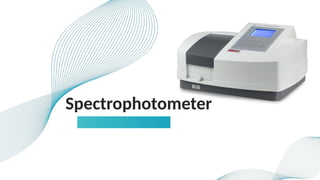
Spectrophotometer
Table Of Content
Purpose of Spectrophotometer
1.1 Topic
Principle of operation
1.2 Topic
Main components of Spectrophotometer
1.3 Topic
Troubleshooting and PPM
1.5 Topic
1.4 Topic
1.1 Medical Purpose of
Spectrophotometer
- A spectrophotometer optically determines the absorbance or transmission of
characteristic wavelengths of radiant energy (light) by a chemical species in
solution.
- Each molecule absorbs light at certain wavelengths in a unique spectral pattern.
- According to the Beer-Lambert law, the amount of light absorbed at these
wavelengths is directly proportional to the concentration of the chemical species
1.1 Medical Purpose of
Spectrophotometer
- A spectrophotometer optically determines the absorbance or transmission of
characteristic wavelengths of radiant energy (light) by a chemical species in
solution.
- Each molecule absorbs light at certain wavelengths in a unique spectral pattern.
- According to the Beer-Lambert law, the amount of light absorbed at these
wavelengths is directly proportional to the concentration of the chemical species
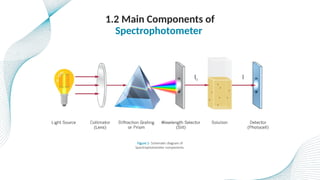
1.2 Main Components of
Spectrophotometer
Figure 1- Schematic diagram of
Spectrophotometer components.
1.2 Main Components of
Spectrophotometer (photodiode array)
The light source is a combination
of a deuterium-discharge lamp for
the ultraviolet (UV) wavelength
range, a tungsten-lamp for the
visible (VIS) , and short wave near
infrared (SWNIR) wavelength
range as shown in Figure 1. [4]
1.Light source
the main purpose of source lens is
to take lights from the lamp and
collimates it, then the collimated
beam will cross through the
sample in the sample chamber.[4]
2. Lens source
A "cell" is a container that holds a
sample, and there are two sorts of
cells: glass and quartz cells. [4]
They also have different shapes based
on the tests and/or concentration of
sample as shown in Figure 2 .[5]
3. Sample cell
Figure 2- Illustration of sample cell types- [5]
Figure 1- Schematic diagram of Agilent 8453
Spectrophotometer components- [4]
Figure 2- Illustration of sample cell types- [5]
1.2 Main Components of
Spectrophotometer (photodiode array)
Wavelength selectors limit the
amount of radiation that a sample
absorbs to a specific wavelength
or a small band of wavelengths.
The Agilent 8453
spectrophotometer System uses
the Grating type as a wavelength
selector as shown in Figure 1.[4]
4.Wavelength
selector
The shutter is operated by
electromechanical means. And
when It opens, it allows light to
flow through the sample to be
measured, and It closes between
sample readings to restrict sample
exposure to light.[4]
5. Shutter
The stray-light filter is a
blocking filter that blocks
50% of the light.[4]
6.Stray light
filter Figure 1- Schematic diagram of Agilent 8453
Spectrophotometer components- [4]
The photo diode array detector is
a multichannel detector that can
measure all wavelengths of
dispersed radiation at the same
time as shown in Figure 1.[6]
7.Photodiode
array
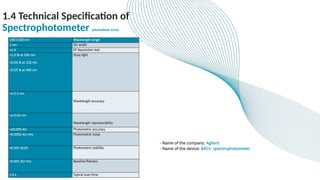
1.4 Technical Specification of
Spectrophotometer (photodiode array)
- Name of the company: Agilent.
- Name of the device: 8453- spectrophotometer.
190-1100 nm Wavelength range
1 nm Slit width
>1.6 EP Resolution test
<1.0 % at 200 nm
<0.05 % at 220 nm
<0.03 % at 340 nm
Stray light
<± 0.5 nm
Wavelength accuracy
<± 0.02 nm
Wavelength reproducibility
<±0.005 AU Photometric accuracy
<0.0002 AU rms Photometric noise
<0.001 AU/h Photometric stability
<0.001 AU rms Baseline flatness
1.5 s Typical scan time
1- Multicell Transport Home
Position Not Found
- Possible Cause : Electronics failed
- Action : Check for defective HOME-
switch, defective multicell
transport cable, defective motor,
or defective spectrophotometer
processor main (SPM) board.[4]
2- Measured Values are Different
to those of Another Instrument
- Possible Cause :Very low sample
concentration
- Action : Increase integration time
to improve signal-to-noise ratio.[4]
1.5 Troubleshooting of
Spectrophotometer (photodiode array)
1.6 PPM ( Planned Preventive
Maintenance)
1- Cleaning the instruments 2- Exchanging the Deuterium or Tungsten Lamp
3- Cleaning the Stray Light Filter 4- Cleaning the Lenses
(once a year or frequently) (once a year or frequently)
[4]
Do you have any questions ?
Thank you for listening
References
[1]- Spectrophotometry- Tip Biosystems. (2021). Retrieved 26 November 2021, from https://
tipbiosystems.com/blog/spectrophotometry/
[2]- Inc, B. (2021). Spectrophotometers for Clinical Laboratories. Retrieved 26 November
2021, from https://www.blockscientific.com/spectrophotometers-for-clinical-laboratories
[3]- Total protein test. (2021). Retrieved 26 November 2021, from https://www.nhs.uk
/conditions/total-protein-test/
[4] Agilent Technologies Deutschland GmbH. (n.d.). Agilent 8453 UV-visible Spectroscopy
System (1st ed., Vol. 1). Unknown. https://mmrc.caltech.edu
/HP%208453/Manuals/8453%20Service%20manual.pdf
[5] 8. Structure of a spectrophotometer (3) : Hitachi High-Tech GLOBAL. (n.d.). Hitachi.
Retrieved November 24, 2021, from https://www.hitachi
hightech.com/global/products/science/tech/ana/uv/basic/course8.html
[6] Deepak. (2015, December 25). UV-VIS Spectrophotometric detectors. Lab-Training.Com.
https://lab-training.com/characteristics-of-uv-is-spectrophotometric-detectors/

Spectrophotometer(Photodiode array ).pptx

  • 1.
  • 2.
    Table Of Content Purposeof Spectrophotometer 1.1 Topic Principle of operation 1.2 Topic Main components of Spectrophotometer 1.3 Topic Troubleshooting and PPM 1.5 Topic 1.4 Topic
  • 3.
    1.1 Medical Purposeof Spectrophotometer - A spectrophotometer optically determines the absorbance or transmission of characteristic wavelengths of radiant energy (light) by a chemical species in solution. - Each molecule absorbs light at certain wavelengths in a unique spectral pattern. - According to the Beer-Lambert law, the amount of light absorbed at these wavelengths is directly proportional to the concentration of the chemical species
  • 4.
    1.1 Medical Purposeof Spectrophotometer - A spectrophotometer optically determines the absorbance or transmission of characteristic wavelengths of radiant energy (light) by a chemical species in solution. - Each molecule absorbs light at certain wavelengths in a unique spectral pattern. - According to the Beer-Lambert law, the amount of light absorbed at these wavelengths is directly proportional to the concentration of the chemical species
  • 5.
    1.2 Main Componentsof Spectrophotometer Figure 1- Schematic diagram of Spectrophotometer components.
  • 6.
    1.2 Main Componentsof Spectrophotometer (photodiode array) The light source is a combination of a deuterium-discharge lamp for the ultraviolet (UV) wavelength range, a tungsten-lamp for the visible (VIS) , and short wave near infrared (SWNIR) wavelength range as shown in Figure 1. [4] 1.Light source the main purpose of source lens is to take lights from the lamp and collimates it, then the collimated beam will cross through the sample in the sample chamber.[4] 2. Lens source A "cell" is a container that holds a sample, and there are two sorts of cells: glass and quartz cells. [4] They also have different shapes based on the tests and/or concentration of sample as shown in Figure 2 .[5] 3. Sample cell Figure 2- Illustration of sample cell types- [5] Figure 1- Schematic diagram of Agilent 8453 Spectrophotometer components- [4] Figure 2- Illustration of sample cell types- [5]
  • 7.
    1.2 Main Componentsof Spectrophotometer (photodiode array) Wavelength selectors limit the amount of radiation that a sample absorbs to a specific wavelength or a small band of wavelengths. The Agilent 8453 spectrophotometer System uses the Grating type as a wavelength selector as shown in Figure 1.[4] 4.Wavelength selector The shutter is operated by electromechanical means. And when It opens, it allows light to flow through the sample to be measured, and It closes between sample readings to restrict sample exposure to light.[4] 5. Shutter The stray-light filter is a blocking filter that blocks 50% of the light.[4] 6.Stray light filter Figure 1- Schematic diagram of Agilent 8453 Spectrophotometer components- [4] The photo diode array detector is a multichannel detector that can measure all wavelengths of dispersed radiation at the same time as shown in Figure 1.[6] 7.Photodiode array
  • 8.
    1.4 Technical Specificationof Spectrophotometer (photodiode array) - Name of the company: Agilent. - Name of the device: 8453- spectrophotometer. 190-1100 nm Wavelength range 1 nm Slit width >1.6 EP Resolution test <1.0 % at 200 nm <0.05 % at 220 nm <0.03 % at 340 nm Stray light <± 0.5 nm Wavelength accuracy <± 0.02 nm Wavelength reproducibility <±0.005 AU Photometric accuracy <0.0002 AU rms Photometric noise <0.001 AU/h Photometric stability <0.001 AU rms Baseline flatness 1.5 s Typical scan time
  • 9.
    1- Multicell TransportHome Position Not Found - Possible Cause : Electronics failed - Action : Check for defective HOME- switch, defective multicell transport cable, defective motor, or defective spectrophotometer processor main (SPM) board.[4] 2- Measured Values are Different to those of Another Instrument - Possible Cause :Very low sample concentration - Action : Increase integration time to improve signal-to-noise ratio.[4] 1.5 Troubleshooting of Spectrophotometer (photodiode array) 1.6 PPM ( Planned Preventive Maintenance) 1- Cleaning the instruments 2- Exchanging the Deuterium or Tungsten Lamp 3- Cleaning the Stray Light Filter 4- Cleaning the Lenses (once a year or frequently) (once a year or frequently) [4]
  • 10.
    Do you haveany questions ? Thank you for listening
  • 11.
    References [1]- Spectrophotometry- TipBiosystems. (2021). Retrieved 26 November 2021, from https:// tipbiosystems.com/blog/spectrophotometry/ [2]- Inc, B. (2021). Spectrophotometers for Clinical Laboratories. Retrieved 26 November 2021, from https://www.blockscientific.com/spectrophotometers-for-clinical-laboratories [3]- Total protein test. (2021). Retrieved 26 November 2021, from https://www.nhs.uk /conditions/total-protein-test/ [4] Agilent Technologies Deutschland GmbH. (n.d.). Agilent 8453 UV-visible Spectroscopy System (1st ed., Vol. 1). Unknown. https://mmrc.caltech.edu /HP%208453/Manuals/8453%20Service%20manual.pdf [5] 8. Structure of a spectrophotometer (3) : Hitachi High-Tech GLOBAL. (n.d.). Hitachi. Retrieved November 24, 2021, from https://www.hitachi hightech.com/global/products/science/tech/ana/uv/basic/course8.html [6] Deepak. (2015, December 25). UV-VIS Spectrophotometric detectors. Lab-Training.Com. https://lab-training.com/characteristics-of-uv-is-spectrophotometric-detectors/