Regina Crawford
 School

systems seek to increase students’
writing achievement on standardized
assessments, so they are able to successfully
move forward to the college classroom or the
21st century workplace. The researcher
suspects that increased achievement can be
reached by the implementation of the new
English language arts Common Core Georgia
Performance Standards (CCGPS). Other
curriculum areas will join forces with language
arts and incorporate writing activities as part
of the curriculum. Questions related to the
impact of this initiative need to be answered
 Is

there a differential impact on writing scores
on standardized tests when the new CCGPS
English language arts standards are
implemented?
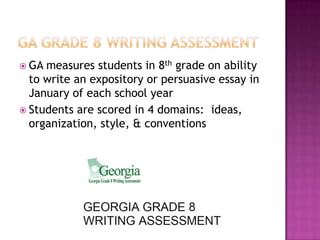
 GA

measures students in 8th grade on ability
to write an expository or persuasive essay in
January of each school year
 Students are scored in 4 domains: ideas,
organization, style, & conventions
8th grade teacher @ E. T. Booth Middle in CCSD
 Administrator approval
 CCSD approval
 PC approval
 IRB approval
 Collected data (non-identifying information)
 Compared 2 similar populations of students in
2012 and 2013
 T-test to compare scores of 2 years
 Mean scores to compare overall scores and
gender scores

 Comparing

2012 and 2013
 T-test score was 0.229070526, which
indicates no significant difference between
the 2 years
 Overall mean decreased by 3 points from
2012 (229) to 2013 (226)
 Decrease in females 2012 (232) to 2013 (230)
 Decrease in males 2012 (226) to 221
 DNM 2012 (2%) 2013 (1.7%)
 M 2012 (86%) 2013 (92%)
 E 2012 (11%) 2013 (6%)
 1st

year of CCGPS implementation
 GA required a minimum number of
compositions. Teachers using more instant
grading programs
 Students are more frequently scored
holistically versus by domains. Less
formative assessments and quality feedback
 Quantity does not always equal quality.
 If a teacher has 120 students he/she is
grading 2,880 essays per year (does not
include research connections or routine
writings)

Specialist research presentation

  • 1.
  • 2.
     School systems seekto increase students’ writing achievement on standardized assessments, so they are able to successfully move forward to the college classroom or the 21st century workplace. The researcher suspects that increased achievement can be reached by the implementation of the new English language arts Common Core Georgia Performance Standards (CCGPS). Other curriculum areas will join forces with language arts and incorporate writing activities as part of the curriculum. Questions related to the impact of this initiative need to be answered
  • 3.
     Is there adifferential impact on writing scores on standardized tests when the new CCGPS English language arts standards are implemented?
  • 4.
     GA measures studentsin 8th grade on ability to write an expository or persuasive essay in January of each school year  Students are scored in 4 domains: ideas, organization, style, & conventions
  • 5.
    8th grade teacher@ E. T. Booth Middle in CCSD  Administrator approval  CCSD approval  PC approval  IRB approval  Collected data (non-identifying information)  Compared 2 similar populations of students in 2012 and 2013  T-test to compare scores of 2 years  Mean scores to compare overall scores and gender scores 
  • 6.
     Comparing 2012 and2013  T-test score was 0.229070526, which indicates no significant difference between the 2 years  Overall mean decreased by 3 points from 2012 (229) to 2013 (226)  Decrease in females 2012 (232) to 2013 (230)  Decrease in males 2012 (226) to 221  DNM 2012 (2%) 2013 (1.7%)  M 2012 (86%) 2013 (92%)  E 2012 (11%) 2013 (6%)
  • 7.
     1st year ofCCGPS implementation  GA required a minimum number of compositions. Teachers using more instant grading programs  Students are more frequently scored holistically versus by domains. Less formative assessments and quality feedback  Quantity does not always equal quality.  If a teacher has 120 students he/she is grading 2,880 essays per year (does not include research connections or routine writings)