10 AERA Professional Norms for High-Stakes Testing Programs: What conditions do you believe North Carolina fails to meet with its current testing program (2007, pages 176-182)? Nichols, Sharon L. & Berliner, David C. (2007). Collateral Damage: How High-Stakes Testing Corrupts America’s Schools. Cambridge, MA: Harvard Education Press.
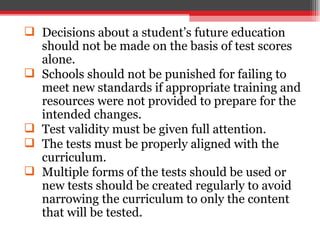
Decisions about a student’s future education should not be made on the basis of test scores alone. Schools should not be punished for failing to meet new standards if appropriate training and resources were not provided to prepare for the intended changes. Test validity must be given full attention. The tests must be properly aligned with the curriculum. Multiple forms of the tests should be used or new tests should be created regularly to avoid narrowing the curriculum to only the content that will be tested.
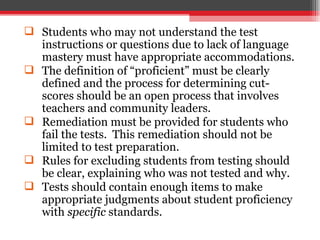
Students who may not understand the test instructions or questions due to lack of language mastery must have appropriate accommodations.  The definition of “proficient” must be clearly defined and the process for determining cut-scores should be an open process that involves teachers and community leaders. Remediation must be provided for students who fail the tests.  This remediation should not be limited to test preparation. Rules for excluding students from testing should be clear, explaining who was not tested and why. Tests should contain enough items to make appropriate judgments about student proficiency with  specific  standards.

Aera

  • 1.
    10 AERA ProfessionalNorms for High-Stakes Testing Programs: What conditions do you believe North Carolina fails to meet with its current testing program (2007, pages 176-182)? Nichols, Sharon L. & Berliner, David C. (2007). Collateral Damage: How High-Stakes Testing Corrupts America’s Schools. Cambridge, MA: Harvard Education Press.
  • 2.
    Decisions about astudent’s future education should not be made on the basis of test scores alone. Schools should not be punished for failing to meet new standards if appropriate training and resources were not provided to prepare for the intended changes. Test validity must be given full attention. The tests must be properly aligned with the curriculum. Multiple forms of the tests should be used or new tests should be created regularly to avoid narrowing the curriculum to only the content that will be tested.
  • 3.
    Students who maynot understand the test instructions or questions due to lack of language mastery must have appropriate accommodations. The definition of “proficient” must be clearly defined and the process for determining cut-scores should be an open process that involves teachers and community leaders. Remediation must be provided for students who fail the tests. This remediation should not be limited to test preparation. Rules for excluding students from testing should be clear, explaining who was not tested and why. Tests should contain enough items to make appropriate judgments about student proficiency with specific standards.