Special Needs Planning First Thursday Workshop April 2, 2009
The Need 51.2 million with disabilities  13-16% families children with special needs (2002 census) Autism — 1 in 150 births; 1-1.5 million (Autism Society of America)
Support Programs Entitlement programs Social Security Medicare Means-tested programs SSI (Supplemental Security Income) Medicaid
Challenges Provide for all of family without jeopardizing special needs beneficiary’s eligibility Supplement government benefits and enhance quality of life for special needs beneficiary Treat family equitably
Challenges Ensure sufficient funds are available to continue care of special needs beneficiary after death of parent(s) Provide proper supervision and management of assets for special needs beneficiary
Mistakes Direct distribution Disinheriting Relying on other family members  Failing to protect privacy and dignity of special needs child Choosing the wrong professional advisor for help
Direct Distribution Entitlement programs very limited Needs-based programs  Direct distribution leaves beneficiary ineligible Inheritance must be spent down before re-qualifying
Disinheriting Attempt to protect government benefits Government benefits provide minimal levels of support Special needs child relies on parents more than the other kids do Short-sighted planning
Relying On Others May be temporary help, but many long-term drawbacks May not have the financial resources May not have emotional resources Risk of that person’s divorce, creditor problems, incapacity, or death
Privacy and Dignity Unnecessary exposure of affairs in public forum (Probate Court) Predators may learn of special needs beneficiary’s assets, disabilities Relying on government assistance alone provides only very basic support Fails to protect the dignity of the beneficiary
Choosing Wrong Professional Advisors not experienced in this area can do more harm than good Experienced advisors can help maximize resources available Team approach critical
Key Support Team Members Advisor who identifies the need Litigation attorney, if relevant Special needs planning attorney Financial advisor Tax accountant
Key Tools General Durable Power of Attorney with appropriate special needs provisions Durable Healthcare Power of Attorney  HIPAA Authorization Revocable Living Trust with appropriate special needs provisions Detailed letter of intent Special Needs Trust (state specific)
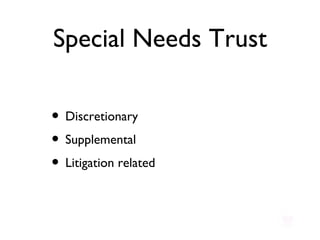
Special Needs Trust Discretionary Supplemental Litigation related
Special Needs Trust Self-settled [(d)(4)(A) trust/Medicaid Payback Trust] Pooled account [(d)(4)(C) trust] Third party-settled
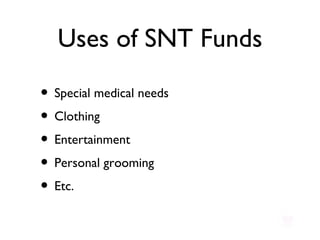
Uses of SNT Funds Special medical needs Clothing Entertainment Personal grooming Etc.
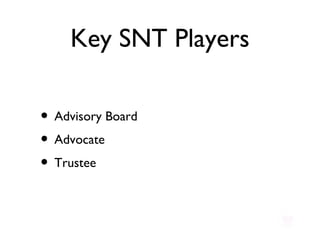
Key SNT Players Advisory Board Advocate Trustee
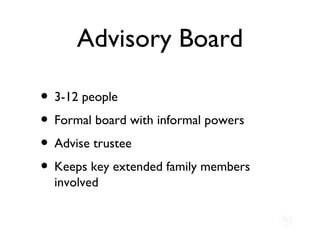
Advisory Board 3-12 people Formal board with informal powers Advise trustee Keeps key extended family members involved
Advocate Family member or professional Ensures quality of care is acceptable Makes recommendations regarding living arrangements and therapeutic regimens
Trustee Controls all the assets in the SNT Bank, professional, family member, friend Critical that  qualified  person is named Others can be advisors
Trustee Professional trustee often the solution Acting alone or as co-trustee Family members usually focused on care, not finances Assets under management may be significant Assets must last for lifetime care of beneficiary
Taxation Distributions taxable to the beneficiary Retained earnings taxable to the trust Accountant key member of the team
Funding How much is enough? SNTs typically funded with as much as $2M Source? Savings, financial planning Life insurance
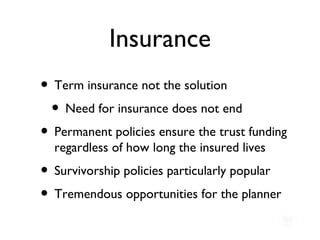
Insurance Term insurance not the solution Need for insurance does not end Permanent policies ensure the trust funding regardless of how long the insured lives Survivorship policies particularly popular Tremendous opportunities for the planner
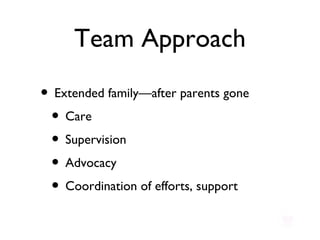
Team Approach Extended family—after parents gone Care Supervision Advocacy Coordination of efforts, support
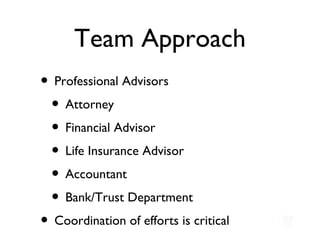
Team Approach Professional Advisors Attorney Financial Advisor Life Insurance Advisor Accountant Bank/Trust Department Coordination of efforts is critical
Law Offices of David G. Ledbetter 1695 Service Road NE Grand Rapids, Michigan 49503 (616) 459-3333 [email_address] [email_address] [email_address] [email_address] [email_address]

Special Needs Planning

  • 1.
    Special Needs PlanningFirst Thursday Workshop April 2, 2009
  • 2.
    The Need 51.2million with disabilities 13-16% families children with special needs (2002 census) Autism — 1 in 150 births; 1-1.5 million (Autism Society of America)
  • 3.
    Support Programs Entitlementprograms Social Security Medicare Means-tested programs SSI (Supplemental Security Income) Medicaid
  • 4.
    Challenges Provide forall of family without jeopardizing special needs beneficiary’s eligibility Supplement government benefits and enhance quality of life for special needs beneficiary Treat family equitably
  • 5.
    Challenges Ensure sufficientfunds are available to continue care of special needs beneficiary after death of parent(s) Provide proper supervision and management of assets for special needs beneficiary
  • 6.
    Mistakes Direct distributionDisinheriting Relying on other family members Failing to protect privacy and dignity of special needs child Choosing the wrong professional advisor for help
  • 7.
    Direct Distribution Entitlementprograms very limited Needs-based programs Direct distribution leaves beneficiary ineligible Inheritance must be spent down before re-qualifying
  • 8.
    Disinheriting Attempt toprotect government benefits Government benefits provide minimal levels of support Special needs child relies on parents more than the other kids do Short-sighted planning
  • 9.
    Relying On OthersMay be temporary help, but many long-term drawbacks May not have the financial resources May not have emotional resources Risk of that person’s divorce, creditor problems, incapacity, or death
  • 10.
    Privacy and DignityUnnecessary exposure of affairs in public forum (Probate Court) Predators may learn of special needs beneficiary’s assets, disabilities Relying on government assistance alone provides only very basic support Fails to protect the dignity of the beneficiary
  • 11.
    Choosing Wrong ProfessionalAdvisors not experienced in this area can do more harm than good Experienced advisors can help maximize resources available Team approach critical
  • 12.
    Key Support TeamMembers Advisor who identifies the need Litigation attorney, if relevant Special needs planning attorney Financial advisor Tax accountant
  • 13.
    Key Tools GeneralDurable Power of Attorney with appropriate special needs provisions Durable Healthcare Power of Attorney HIPAA Authorization Revocable Living Trust with appropriate special needs provisions Detailed letter of intent Special Needs Trust (state specific)
  • 14.
    Special Needs TrustDiscretionary Supplemental Litigation related
  • 15.
    Special Needs TrustSelf-settled [(d)(4)(A) trust/Medicaid Payback Trust] Pooled account [(d)(4)(C) trust] Third party-settled
  • 16.
    Uses of SNTFunds Special medical needs Clothing Entertainment Personal grooming Etc.
  • 17.
    Key SNT PlayersAdvisory Board Advocate Trustee
  • 18.
    Advisory Board 3-12people Formal board with informal powers Advise trustee Keeps key extended family members involved
  • 19.
    Advocate Family memberor professional Ensures quality of care is acceptable Makes recommendations regarding living arrangements and therapeutic regimens
  • 20.
    Trustee Controls allthe assets in the SNT Bank, professional, family member, friend Critical that qualified person is named Others can be advisors
  • 21.
    Trustee Professional trusteeoften the solution Acting alone or as co-trustee Family members usually focused on care, not finances Assets under management may be significant Assets must last for lifetime care of beneficiary
  • 22.
    Taxation Distributions taxableto the beneficiary Retained earnings taxable to the trust Accountant key member of the team
  • 23.
    Funding How muchis enough? SNTs typically funded with as much as $2M Source? Savings, financial planning Life insurance
  • 24.
    Insurance Term insurancenot the solution Need for insurance does not end Permanent policies ensure the trust funding regardless of how long the insured lives Survivorship policies particularly popular Tremendous opportunities for the planner
  • 25.
    Team Approach Extendedfamily—after parents gone Care Supervision Advocacy Coordination of efforts, support
  • 26.
    Team Approach ProfessionalAdvisors Attorney Financial Advisor Life Insurance Advisor Accountant Bank/Trust Department Coordination of efforts is critical
  • 27.
    Law Offices ofDavid G. Ledbetter 1695 Service Road NE Grand Rapids, Michigan 49503 (616) 459-3333 [email_address] [email_address] [email_address] [email_address] [email_address]