Special Needs Planning
The Basics of Special Needs Planning
The Statistics…
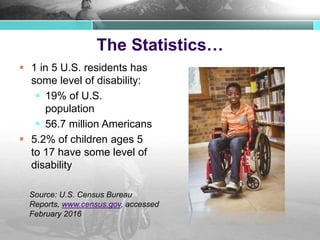
 1 in 5 U.S. residents has
some level of disability:
 19% of U.S.
population
 56.7 million Americans
 5.2% of children ages 5
to 17 have some level of
disability
Source: U.S. Census Bureau
Reports, www.census.gov, accessed
February 2016
The Statistics…
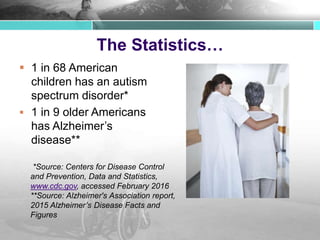
 1 in 68 American
children has an autism
spectrum disorder*
 1 in 9 older Americans
has Alzheimer’s
disease**
*Source: Centers for Disease Control
and Prevention, Data and Statistics,
www.cdc.gov, accessed February 2016
**Source: Alzheimer's Association report,
2015 Alzheimer’s Disease Facts and
Figures
What Is Special Needs Planning?
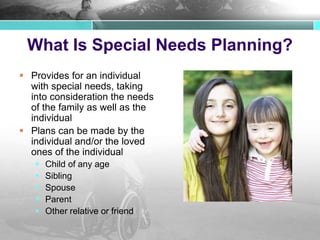
 Provides for an individual
with special needs, taking
into consideration the needs
of the family as well as the
individual
 Plans can be made by the
individual and/or the loved
ones of the individual
 Child of any age
 Sibling
 Spouse
 Parent
 Other relative or friend
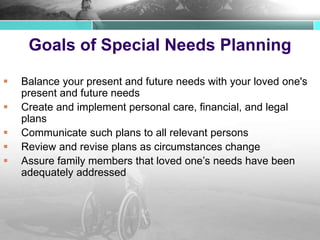
Goals of Special Needs Planning
 Balance your present and future needs with your loved one's
present and future needs
 Create and implement personal care, financial, and legal
plans
 Communicate such plans to all relevant persons
 Review and revise plans as circumstances change
 Assure family members that loved one’s needs have been
adequately addressed
Risks of Not Planning Ahead
 Upon your death, certain
decisions will be made for
you:
 Appointment of a
guardian and/or
a conservator
 The state will determine
how much
of your estate your loved
one will inherit
 The money might run out
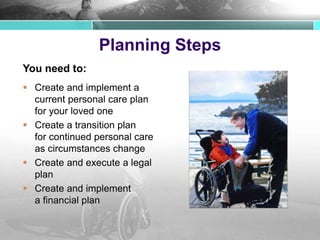
Planning Steps
You need to:
 Create and implement a
current personal care plan
for your loved one
 Create a transition plan
for continued personal care
as circumstances change
 Create and execute a legal
plan
 Create and implement
a financial plan
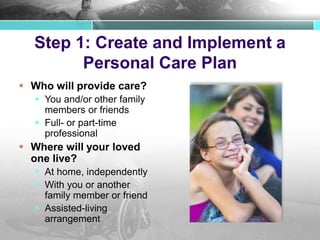
Step 1: Create and Implement a
Personal Care Plan
 Who will provide care?
 You and/or other family
members or friends
 Full- or part-time
professional
 Where will your loved
one live?
 At home, independently
 With you or another
family member or friend
 Assisted-living
arrangement
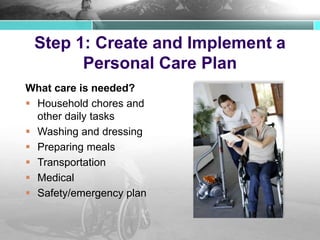
Step 1: Create and Implement a
Personal Care Plan
What care is needed?
 Household chores and
other daily tasks
 Washing and dressing
 Preparing meals
 Transportation
 Medical
 Safety/emergency plan
Step 2: Create a Transition Plan
 Continuity of care and
supervision
 Choosing alternate
people and services to
replace those in original
plan if needed
 Anticipate and prepare for
future life events
Answer “what if” questions
 What if you die
unexpectedly?
 What if your loved one
becomes
unable to make his/her
own medical/financial
decisions?
Step 3: Create and Execute a Legal
Plan
Ensure that legal
precautions are in place:
 Medical directives
 Durable powers of
attorney
 Your last will and
testament
 Letter of intent or
instruction (not legally
binding)
Hire an attorney
An experienced estate
planning or special needs
planning attorney will help
coordinate your will with
other financial plans that
have been made or will be
made
Step 4: Create and Implement a
Financial Plan
 Estimate the monthly cost
to care for your loved one
 Project the cost over
your loved one’s
expected lifespan
 Factor in inflation
Step 4: Create and Implement a
Financial Plan
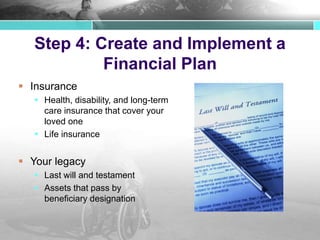
 Insurance
 Health, disability, and long-term
care insurance that cover your
loved one
 Life insurance
 Your legacy
 Last will and testament
 Assets that pass by
beneficiary designation
Need to Preserve Government
Benefits
 Some government
benefits are need-based
 You may need to legally
protect some assets in
order to maintain
entitlement to public
benefits
Sources of Government Benefits
 National organizations
 Community aid
 State aid
 Federal aid
www.disability.gov
Federal Benefits: Not Based on
Financial Need
 Medicare
 Social Security
Disability Income
(SSDI)
 Other benefits,
including special
education assistance
Federal Benefits: Need-based
 Medicaid
 Joint federal and state program that helps
with medical costs for some people with low
incomes and limited resources
 Supplemental Social Security Income (SSI)
 Provides monthly income to people age 65
or older, or who are blind or disabled, and
who have limited income and financial
resources
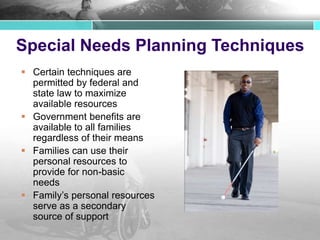
Special Needs Planning Techniques
 Certain techniques are
permitted by federal and
state law to maximize
available resources
 Government benefits are
available to all families
regardless of their means
 Families can use their
personal resources to
provide for non-basic
needs
 Family’s personal resources
serve as a secondary
source of support
Special or Supplemental Needs Trust
 Special needs trust also
called supplemental
needs trust (SNT)
 SNTs given “official” legal
status in 1993
 Assets in a properly
drafted and administered
SNT will not be counted
as available assets
 Trust disbursements will
not be counted as income
Types of SNTs
 Self-settled or
first-party SNT
 Pooled SNT
 Third-party SNT
Self-Settled or First-Party SNT
 Created for sole benefit of
disabled individual under
age 65
 Created by parent,
grandparent, guardian, or
by the court
 Cannot be created by the
disabled individual
 Disabled individual can
fund the trust
Self-Settled or First-Party SNT
 Avoids Medicaid and SSI “look-back” provisions
 Assets in trust will not be countable as resources for
eligibility purposes
 Upon the disabled individual's death, any money or
assets remaining in the trust must be used to
reimburse the government for Medicaid benefits
extended to the individual during his/her lifetime
Pooled SNT
 Managed by a nonprofit organization
 Funds are pooled for investment purposes
 Subaccounts maintained for each disabled
beneficiary
 Can be created by the disabled individual for
himself/herself
 Pay back to Medicaid or help others in the pool,
depending on state law
 Created by disabled person's parent or other
third party
 No payback requirement
 Creator of trust must not have a duty to support
the disabled person
 Disabled person does not need to be under age
65
 May or may not trigger Medicaid or SSI penalty
period
Third-Party SNT
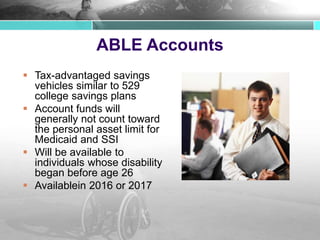
ABLE Accounts
 Tax-advantaged savings
vehicles similar to 529
college savings plans
 Account funds will
generally not count toward
the personal asset limit for
Medicaid and SSI
 Will be available to
individuals whose disability
began before age 26
 Availablein 2016 or 2017
Conclusion
If you have a loved one
who is disabled or has
special needs:
 Are you concerned
about his or her future
personal needs and
financial security?
 Are you concerned
about meeting both
your loved one’s needs
and your own?
I would welcome the
opportunity to meet
individually with each of
you to address any
specific concerns or
questions that you may
have.
Disclaimer
IMPORTANT DISCLOSURES
D’Arcy Wealth Management, Inc. does not provide investment, tax, or legal advice. The information
presented here is not specific to any individual's personal circumstances.
To the extent that this material concerns tax matters, it is not intended or written to be used, and
cannot be used, by a taxpayer for the purpose of avoiding penalties that may be imposed by
law. Each taxpayer should seek independent advice from a tax professional based on his or
her individual circumstances.
These materials are provided for general information and educational purposes based upon publicly
available information from sources believed to be reliable—we cannot assure the accuracy or
completeness of these materials. The information in these materials may change at any time
and without notice.

Special Needs Planning

  • 1.
    Special Needs Planning TheBasics of Special Needs Planning
  • 2.
    The Statistics…  1in 5 U.S. residents has some level of disability:  19% of U.S. population  56.7 million Americans  5.2% of children ages 5 to 17 have some level of disability Source: U.S. Census Bureau Reports, www.census.gov, accessed February 2016
  • 3.
    The Statistics…  1in 68 American children has an autism spectrum disorder*  1 in 9 older Americans has Alzheimer’s disease** *Source: Centers for Disease Control and Prevention, Data and Statistics, www.cdc.gov, accessed February 2016 **Source: Alzheimer's Association report, 2015 Alzheimer’s Disease Facts and Figures
  • 4.
    What Is SpecialNeeds Planning?  Provides for an individual with special needs, taking into consideration the needs of the family as well as the individual  Plans can be made by the individual and/or the loved ones of the individual  Child of any age  Sibling  Spouse  Parent  Other relative or friend
  • 5.
    Goals of SpecialNeeds Planning  Balance your present and future needs with your loved one's present and future needs  Create and implement personal care, financial, and legal plans  Communicate such plans to all relevant persons  Review and revise plans as circumstances change  Assure family members that loved one’s needs have been adequately addressed
  • 6.
    Risks of NotPlanning Ahead  Upon your death, certain decisions will be made for you:  Appointment of a guardian and/or a conservator  The state will determine how much of your estate your loved one will inherit  The money might run out
  • 7.
    Planning Steps You needto:  Create and implement a current personal care plan for your loved one  Create a transition plan for continued personal care as circumstances change  Create and execute a legal plan  Create and implement a financial plan
  • 8.
    Step 1: Createand Implement a Personal Care Plan  Who will provide care?  You and/or other family members or friends  Full- or part-time professional  Where will your loved one live?  At home, independently  With you or another family member or friend  Assisted-living arrangement
  • 9.
    Step 1: Createand Implement a Personal Care Plan What care is needed?  Household chores and other daily tasks  Washing and dressing  Preparing meals  Transportation  Medical  Safety/emergency plan
  • 10.
    Step 2: Createa Transition Plan  Continuity of care and supervision  Choosing alternate people and services to replace those in original plan if needed  Anticipate and prepare for future life events Answer “what if” questions  What if you die unexpectedly?  What if your loved one becomes unable to make his/her own medical/financial decisions?
  • 11.
    Step 3: Createand Execute a Legal Plan Ensure that legal precautions are in place:  Medical directives  Durable powers of attorney  Your last will and testament  Letter of intent or instruction (not legally binding) Hire an attorney An experienced estate planning or special needs planning attorney will help coordinate your will with other financial plans that have been made or will be made
  • 12.
    Step 4: Createand Implement a Financial Plan  Estimate the monthly cost to care for your loved one  Project the cost over your loved one’s expected lifespan  Factor in inflation
  • 13.
    Step 4: Createand Implement a Financial Plan  Insurance  Health, disability, and long-term care insurance that cover your loved one  Life insurance  Your legacy  Last will and testament  Assets that pass by beneficiary designation
  • 14.
    Need to PreserveGovernment Benefits  Some government benefits are need-based  You may need to legally protect some assets in order to maintain entitlement to public benefits
  • 15.
    Sources of GovernmentBenefits  National organizations  Community aid  State aid  Federal aid www.disability.gov
  • 16.
    Federal Benefits: NotBased on Financial Need  Medicare  Social Security Disability Income (SSDI)  Other benefits, including special education assistance
  • 17.
    Federal Benefits: Need-based Medicaid  Joint federal and state program that helps with medical costs for some people with low incomes and limited resources  Supplemental Social Security Income (SSI)  Provides monthly income to people age 65 or older, or who are blind or disabled, and who have limited income and financial resources
  • 18.
    Special Needs PlanningTechniques  Certain techniques are permitted by federal and state law to maximize available resources  Government benefits are available to all families regardless of their means  Families can use their personal resources to provide for non-basic needs  Family’s personal resources serve as a secondary source of support
  • 19.
    Special or SupplementalNeeds Trust  Special needs trust also called supplemental needs trust (SNT)  SNTs given “official” legal status in 1993  Assets in a properly drafted and administered SNT will not be counted as available assets  Trust disbursements will not be counted as income
  • 20.
    Types of SNTs Self-settled or first-party SNT  Pooled SNT  Third-party SNT
  • 21.
    Self-Settled or First-PartySNT  Created for sole benefit of disabled individual under age 65  Created by parent, grandparent, guardian, or by the court  Cannot be created by the disabled individual  Disabled individual can fund the trust
  • 22.
    Self-Settled or First-PartySNT  Avoids Medicaid and SSI “look-back” provisions  Assets in trust will not be countable as resources for eligibility purposes  Upon the disabled individual's death, any money or assets remaining in the trust must be used to reimburse the government for Medicaid benefits extended to the individual during his/her lifetime
  • 23.
    Pooled SNT  Managedby a nonprofit organization  Funds are pooled for investment purposes  Subaccounts maintained for each disabled beneficiary  Can be created by the disabled individual for himself/herself  Pay back to Medicaid or help others in the pool, depending on state law
  • 24.
     Created bydisabled person's parent or other third party  No payback requirement  Creator of trust must not have a duty to support the disabled person  Disabled person does not need to be under age 65  May or may not trigger Medicaid or SSI penalty period Third-Party SNT
  • 25.
    ABLE Accounts  Tax-advantagedsavings vehicles similar to 529 college savings plans  Account funds will generally not count toward the personal asset limit for Medicaid and SSI  Will be available to individuals whose disability began before age 26  Availablein 2016 or 2017
  • 26.
    Conclusion If you havea loved one who is disabled or has special needs:  Are you concerned about his or her future personal needs and financial security?  Are you concerned about meeting both your loved one’s needs and your own? I would welcome the opportunity to meet individually with each of you to address any specific concerns or questions that you may have.
  • 27.
    Disclaimer IMPORTANT DISCLOSURES D’Arcy WealthManagement, Inc. does not provide investment, tax, or legal advice. The information presented here is not specific to any individual's personal circumstances. To the extent that this material concerns tax matters, it is not intended or written to be used, and cannot be used, by a taxpayer for the purpose of avoiding penalties that may be imposed by law. Each taxpayer should seek independent advice from a tax professional based on his or her individual circumstances. These materials are provided for general information and educational purposes based upon publicly available information from sources believed to be reliable—we cannot assure the accuracy or completeness of these materials. The information in these materials may change at any time and without notice.