




Planning For the Future:
Long Term Care
Jennifer Lavelli
Certified Senior Advisor
Life, Disability and Health Insurance Advisor
Topics We’ll Cover Today
• Why Are We Hearing So Much About Long Term Care (LTC)?
• What is LTC?
• What Does it Cost to Receive LTC, and How is it Paid For?
• Planning for Future Needs
• Resources
Why Are We Hearing So Much About Long
Term Care?
What’s New, What’s Changed?
The World’s New
Demographics• For the first time in history, people aged 65 and over will soon
outnumber children under the age of 5
• Throughout the world today, there are more people aged 65 and
older than the entire populations of Russia, Japan, France,
Germany and Australia—combined
• By 2030, 55 countries are expecting their 65 and older
populations to represent at least 20 percent of their total
• By 2050, the U.N. estimates that the proportion of the world's
population age 65 and over will more than double, from 7.6%
today to 16.2%
Source: United Nations, 2009
*Residential Care Facility in California
Other Dynamics
• The U.S. Dept. of Health and Human Services predicts that 70% of
all Americans age 65 and older will likely need some form of LTC
• Health care advances keep more people (of all ages) alive, and
often create a need for long term care where none existed
previously
• Alzheimer’s and other forms of dementia (and the associated need
for 24/7 care) are more likely as one ages (1 in 8 older Americans
currently have Alzheimer’s)
• Seniors with fixed incomes have longer lives, more care needs, and
higher healthcare costs - - this combination can have devastating
financial impacts
Source: U.S. Dept. of Health and Human Services’ National Clearinghouse for Long Term Care Information
What Exactly Is Long Term Care, Anyway?
Long Term Care Defined
• Long Term Care is a phrase used to define care required during a
persistent or chronic state of health, throughout which time a person
is unable to independently handle some of the basic activities of
daily living (ADL’s), or requires supervision due to cognitive
impairment (conditions that can be due to Alzheimer’s disease, brain
injury, or stroke)
• This type of care is referred to as Custodial Care, and most health
plans and insurances do not cover this care
• Activities of Daily Living (basic physical maneuvers that healthy
individuals perform daily without assistance) include:
- Eating - Bathing
- Dressing - Toileting
- Continence - Transferring (from bed to chair)
Other Levels of Care
• Though a need for assistance with ADL’s, or a cognitive impairment
define and “trigger” Long Term Care from an insurance perspective,
there are also Instrumental Activities of Daily Living (IADL’s) that
define another range of tasks considered instrumental to self-
sufficiency:
- Shopping - Preparing meals
- Performing household tasks - Doing laundry
- Managing money - Using the telephone
- Taking medications by oneself
Where Do People Receive LTC
Services?
• Family Home
• Adult Day Care Center
• Assisted Living Facility (ALF)
• Nursing Home
• Hospice Facility
*Residential Care Facility in California
Staying Home: the #1 Choice - - Who is
Providing Care?
• 65.7 million family caregivers make up 29% of the U.S. population
• 52 million family caregivers provide care to an adult 18+
• 43.5 million of adult family caregivers care for someone 50+ years of age
and 14.9 million care for someone who has Alzheimer's disease or other
dementia
• Many caregivers of older people are themselves growing frail. Of those
caring for someone aged 65+, the average age is 63 years with one third
of these caregivers in fair to poor health
• An estimated 66% of family caregivers are female. One-third (34%)
take care of two or more people, and the average age of a female
caregiver is 48
• 70% of working caregivers suffer work-related difficulties due to their
dual caregiving roles
Source: Caregiving in the U.S.: AARP and National Alliance for CareGiving, 2012
Staying Home: the #1 Choice - - How Can a
Better Family Outcome be Facilitated?
• Planning ahead for staying at home can go a long way to helping
relatives age in place, and stay OUT of a facility
• Support services typically necessary for the frail and elderly to
continue living in their own home:
– Help with household tasks, like cleaning and meal preparation
– Help with personal tasks, like bathing and dressing
– Services provided by a visiting nurse or home health aide
– Special equipment, like a walker, wheelchair or respirator
– Home modifications to enhance safety at home
• Planning and financing for required resources can free up family
members to continue with their lives, while overseeing a loved
one’s care, and spending quality time with them
How Much Does it Cost to Receive Long
Term Care Services?
- And -
How is It Paid For?
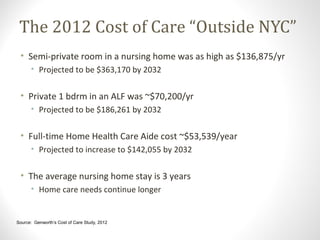
The 2012 Cost of Care “Outside NYC”
• Semi-private room in a nursing home was as high as $136,875/yr
• Projected to be $363,170 by 2032
• Private 1 bdrm in an ALF was ~$70,200/yr
• Projected to be $186,261 by 2032
• Full-time Home Health Care Aide cost ~$53,539/year
• Projected to increase to $142,055 by 2032
• The average nursing home stay is 3 years
• Home care needs continue longer
Source: Genworth’s Cost of Care Study, 2012
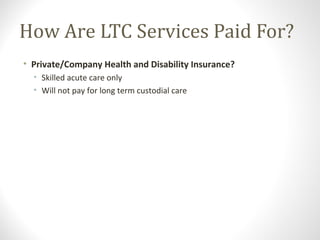
How Are LTC Services Paid For?
• Private/Company Health and Disability Insurance?
• Skilled acute care only
• Will not pay for long term custodial care
How Are LTC Services Paid For?
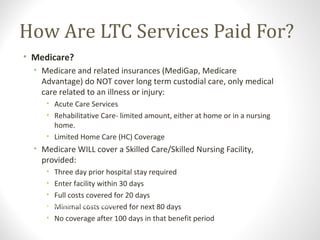
• Medicare?
• Medicare and related insurances (MediGap, Medicare
Advantage) do NOT cover long term custodial care, only medical
care related to an illness or injury:
• Acute Care Services
• Rehabilitative Care- limited amount, either at home or in a nursing
home.
• Limited Home Care (HC) Coverage
• Medicare WILL cover a Skilled Care/Skilled Nursing Facility,
provided:
• Three day prior hospital stay required
• Enter facility within 30 days
• Full costs covered for 20 days
• Minimal costs covered for next 80 days
• No coverage after 100 days in that benefit period
8. The Centers for Medicare & Medicaid Services and U.S. Department of Health and Human Services. “The 2005 Guide to
Health Insurance for People with Medicare.”
How Are LTC Services Paid
For?
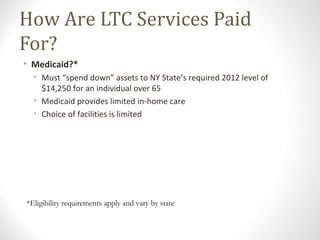
• Medicaid?*
• Must “spend down” assets to NY State’s required 2012 level of
$14,250 for an individual over 65
• Medicaid provides limited in-home care
• Choice of facilities is limited
*Eligibility requirements apply and vary by state
How Are LTC Services Paid
For?
• Personal Assets/Family?
• One long term illness may jeopardize an accumulated retirement
savings/nest egg, and leave a partner/spouse without resources
• Most family members are struggling to manage their own
finances, and cannot afford to support a loved one’s care
Planning for YOUR Future Needs
Have “The Talk”
• Every day, thousands of Americans over age 40 experience a significant
change in their health status. Even changes that, due to advances in health
care, are no longer life threatening... can be life altering
• 75% of people have not had a conversation with their loved ones about
long term care planning in the last 12 months
• Talk to your parents. No doubt you hope your parents have made plans
that consider a potential health or financial crises, have finalized their will
and power(s) of attorney, and made plans for their long term care.
Unfortunately, the odds are good that they have not.
• Talk to your spouse and other close family members. Even couples and
family members that have shared “everything” may find they don't always
know each other’s preferences - or may find those preferences have
changed over time. Talking about health, finances, and long term care will
better equip you to make informed decisions together; decisions that will
reflect both your individual and collective wishes.
Source: Genworth 2011 Financial Reality Check
Make a Plan: Important At Any Age
• Complete your financial/health/estate plans and documents, and
share them with family:
• Advance Directive (Durable Power of Attorney for healthcare, Living Will,
DNR)
• Will and Trust to pass on assets
• Durable Power of Attorney for financial affairs
• Funeral and Burial plans
• A serious accident or debilitating illness can happen at age. That is
why it’s wise to make a plan when you are young - and healthy.
• 37% of those that needed LTC in 2000 were under the age of 65¹
• The probability of losses in physical functioning increases with age –
dramatically so for the population aged 65 and older.²
¹Kaiser Family Foundation, “Medicaid and Long Term Care”
²Congressional Budget Office, “Financing Long-Term Care for the Elderly”
A Sound Plan for Your Future
May Include Long-Term Care
Insurance The statistical risk of needing long term care is greater than the risk of a
house fire, and more likely than an auto accident.*
 People have many types of insurance to help protect their assets:
– Automobile insurance protect their car
– Homeowners insurance protects their home
– Life insurance protects their family
– Disability insurance protects their income
 Most people would never consider going without home and car insurance --
but haven't planned to protect their finances and family in case of a critical
or chronic illness
Source: www.longtermcare.gov/LTC
Should You Consider LTC
Insurance?
Some considerations -- do you need to or want to :
Protect your retirement and other family savings
Rely on additional financial support for future care needs
Preserve your independence
Free your family/other care-givers to spend quality time with you
Retain control over your choices
Obtain care planning expertise, advice and resources when you need
care₁
₁With traditional LTC policies only
Is LTC Insurance Something You Can
Afford?
• Premiums are based on a variety of factors, including your age and
health when you buy a policy and the level of coverage, benefits and
options you select for your policy
• If you buy a policy with a large daily benefit, a longer maximum
benefit period, or a home health care benefit, it will cost you more
• Inflation protection and non-forfeiture benefits (return of premium,
reduced paid up policies, etc.) can increase premiums for long-term
care substantially
• Inflation protection can add 25% to 40% to the premium.
• Non-forfeiture benefits can add 10% to 100% to the premium
Is LTC Insurance Something You Can
Afford?
 The older you are when you buy long-term care
insurance, the higher your premiums will be, as it’s
more likely you will need long-term care services
 If you buy at a younger age, your premiums will be lower,
but you will pay premiums for a longer period of time
 Recent studies have found the average age of purchasers
was age 65 in the individual market
Additional Options and Resources
Additional LTC Funding Options
 Life Insurance and Annuities with Chronic Illness
coverage
 Health Care Savings accounts
RESOURCES YOU SHOULD USE
 The U.S. Dept. of Health and Human Services’
National Clearinghouse for Long Term Care
Information
 www.longtermcare.gov/LTC
 National Institutes of Health
 http://nihseniorhealth.gov/longtermcare
 New York State Dept. of Health
 http://www.health.ny.gov/facilities/long_term_care/
 Family CareGiver Alliance, National Center on
CareGiving
 http://www.caregiver.org

Planning for Your Future - - All About Long Term Care

  • 1.
    Planning For theFuture: Long Term Care Jennifer Lavelli Certified Senior Advisor Life, Disability and Health Insurance Advisor
  • 2.
    Topics We’ll CoverToday • Why Are We Hearing So Much About Long Term Care (LTC)? • What is LTC? • What Does it Cost to Receive LTC, and How is it Paid For? • Planning for Future Needs • Resources
  • 3.
    Why Are WeHearing So Much About Long Term Care? What’s New, What’s Changed?
  • 4.
    The World’s New Demographics•For the first time in history, people aged 65 and over will soon outnumber children under the age of 5 • Throughout the world today, there are more people aged 65 and older than the entire populations of Russia, Japan, France, Germany and Australia—combined • By 2030, 55 countries are expecting their 65 and older populations to represent at least 20 percent of their total • By 2050, the U.N. estimates that the proportion of the world's population age 65 and over will more than double, from 7.6% today to 16.2% Source: United Nations, 2009 *Residential Care Facility in California
  • 5.
    Other Dynamics • TheU.S. Dept. of Health and Human Services predicts that 70% of all Americans age 65 and older will likely need some form of LTC • Health care advances keep more people (of all ages) alive, and often create a need for long term care where none existed previously • Alzheimer’s and other forms of dementia (and the associated need for 24/7 care) are more likely as one ages (1 in 8 older Americans currently have Alzheimer’s) • Seniors with fixed incomes have longer lives, more care needs, and higher healthcare costs - - this combination can have devastating financial impacts Source: U.S. Dept. of Health and Human Services’ National Clearinghouse for Long Term Care Information
  • 6.
    What Exactly IsLong Term Care, Anyway?
  • 7.
    Long Term CareDefined • Long Term Care is a phrase used to define care required during a persistent or chronic state of health, throughout which time a person is unable to independently handle some of the basic activities of daily living (ADL’s), or requires supervision due to cognitive impairment (conditions that can be due to Alzheimer’s disease, brain injury, or stroke) • This type of care is referred to as Custodial Care, and most health plans and insurances do not cover this care • Activities of Daily Living (basic physical maneuvers that healthy individuals perform daily without assistance) include: - Eating - Bathing - Dressing - Toileting - Continence - Transferring (from bed to chair)
  • 8.
    Other Levels ofCare • Though a need for assistance with ADL’s, or a cognitive impairment define and “trigger” Long Term Care from an insurance perspective, there are also Instrumental Activities of Daily Living (IADL’s) that define another range of tasks considered instrumental to self- sufficiency: - Shopping - Preparing meals - Performing household tasks - Doing laundry - Managing money - Using the telephone - Taking medications by oneself
  • 9.
    Where Do PeopleReceive LTC Services? • Family Home • Adult Day Care Center • Assisted Living Facility (ALF) • Nursing Home • Hospice Facility *Residential Care Facility in California
  • 10.
    Staying Home: the#1 Choice - - Who is Providing Care? • 65.7 million family caregivers make up 29% of the U.S. population • 52 million family caregivers provide care to an adult 18+ • 43.5 million of adult family caregivers care for someone 50+ years of age and 14.9 million care for someone who has Alzheimer's disease or other dementia • Many caregivers of older people are themselves growing frail. Of those caring for someone aged 65+, the average age is 63 years with one third of these caregivers in fair to poor health • An estimated 66% of family caregivers are female. One-third (34%) take care of two or more people, and the average age of a female caregiver is 48 • 70% of working caregivers suffer work-related difficulties due to their dual caregiving roles Source: Caregiving in the U.S.: AARP and National Alliance for CareGiving, 2012
  • 11.
    Staying Home: the#1 Choice - - How Can a Better Family Outcome be Facilitated? • Planning ahead for staying at home can go a long way to helping relatives age in place, and stay OUT of a facility • Support services typically necessary for the frail and elderly to continue living in their own home: – Help with household tasks, like cleaning and meal preparation – Help with personal tasks, like bathing and dressing – Services provided by a visiting nurse or home health aide – Special equipment, like a walker, wheelchair or respirator – Home modifications to enhance safety at home • Planning and financing for required resources can free up family members to continue with their lives, while overseeing a loved one’s care, and spending quality time with them
  • 12.
    How Much Doesit Cost to Receive Long Term Care Services? - And - How is It Paid For?
  • 13.
    The 2012 Costof Care “Outside NYC” • Semi-private room in a nursing home was as high as $136,875/yr • Projected to be $363,170 by 2032 • Private 1 bdrm in an ALF was ~$70,200/yr • Projected to be $186,261 by 2032 • Full-time Home Health Care Aide cost ~$53,539/year • Projected to increase to $142,055 by 2032 • The average nursing home stay is 3 years • Home care needs continue longer Source: Genworth’s Cost of Care Study, 2012
  • 14.
    How Are LTCServices Paid For? • Private/Company Health and Disability Insurance? • Skilled acute care only • Will not pay for long term custodial care
  • 15.
    How Are LTCServices Paid For? • Medicare? • Medicare and related insurances (MediGap, Medicare Advantage) do NOT cover long term custodial care, only medical care related to an illness or injury: • Acute Care Services • Rehabilitative Care- limited amount, either at home or in a nursing home. • Limited Home Care (HC) Coverage • Medicare WILL cover a Skilled Care/Skilled Nursing Facility, provided: • Three day prior hospital stay required • Enter facility within 30 days • Full costs covered for 20 days • Minimal costs covered for next 80 days • No coverage after 100 days in that benefit period 8. The Centers for Medicare & Medicaid Services and U.S. Department of Health and Human Services. “The 2005 Guide to Health Insurance for People with Medicare.”
  • 16.
    How Are LTCServices Paid For? • Medicaid?* • Must “spend down” assets to NY State’s required 2012 level of $14,250 for an individual over 65 • Medicaid provides limited in-home care • Choice of facilities is limited *Eligibility requirements apply and vary by state
  • 17.
    How Are LTCServices Paid For? • Personal Assets/Family? • One long term illness may jeopardize an accumulated retirement savings/nest egg, and leave a partner/spouse without resources • Most family members are struggling to manage their own finances, and cannot afford to support a loved one’s care
  • 18.
    Planning for YOURFuture Needs
  • 19.
    Have “The Talk” •Every day, thousands of Americans over age 40 experience a significant change in their health status. Even changes that, due to advances in health care, are no longer life threatening... can be life altering • 75% of people have not had a conversation with their loved ones about long term care planning in the last 12 months • Talk to your parents. No doubt you hope your parents have made plans that consider a potential health or financial crises, have finalized their will and power(s) of attorney, and made plans for their long term care. Unfortunately, the odds are good that they have not. • Talk to your spouse and other close family members. Even couples and family members that have shared “everything” may find they don't always know each other’s preferences - or may find those preferences have changed over time. Talking about health, finances, and long term care will better equip you to make informed decisions together; decisions that will reflect both your individual and collective wishes. Source: Genworth 2011 Financial Reality Check
  • 20.
    Make a Plan:Important At Any Age • Complete your financial/health/estate plans and documents, and share them with family: • Advance Directive (Durable Power of Attorney for healthcare, Living Will, DNR) • Will and Trust to pass on assets • Durable Power of Attorney for financial affairs • Funeral and Burial plans • A serious accident or debilitating illness can happen at age. That is why it’s wise to make a plan when you are young - and healthy. • 37% of those that needed LTC in 2000 were under the age of 65¹ • The probability of losses in physical functioning increases with age – dramatically so for the population aged 65 and older.² ¹Kaiser Family Foundation, “Medicaid and Long Term Care” ²Congressional Budget Office, “Financing Long-Term Care for the Elderly”
  • 21.
    A Sound Planfor Your Future May Include Long-Term Care Insurance The statistical risk of needing long term care is greater than the risk of a house fire, and more likely than an auto accident.*  People have many types of insurance to help protect their assets: – Automobile insurance protect their car – Homeowners insurance protects their home – Life insurance protects their family – Disability insurance protects their income  Most people would never consider going without home and car insurance -- but haven't planned to protect their finances and family in case of a critical or chronic illness Source: www.longtermcare.gov/LTC
  • 22.
    Should You ConsiderLTC Insurance? Some considerations -- do you need to or want to : Protect your retirement and other family savings Rely on additional financial support for future care needs Preserve your independence Free your family/other care-givers to spend quality time with you Retain control over your choices Obtain care planning expertise, advice and resources when you need care₁ ₁With traditional LTC policies only
  • 23.
    Is LTC InsuranceSomething You Can Afford? • Premiums are based on a variety of factors, including your age and health when you buy a policy and the level of coverage, benefits and options you select for your policy • If you buy a policy with a large daily benefit, a longer maximum benefit period, or a home health care benefit, it will cost you more • Inflation protection and non-forfeiture benefits (return of premium, reduced paid up policies, etc.) can increase premiums for long-term care substantially • Inflation protection can add 25% to 40% to the premium. • Non-forfeiture benefits can add 10% to 100% to the premium
  • 24.
    Is LTC InsuranceSomething You Can Afford?  The older you are when you buy long-term care insurance, the higher your premiums will be, as it’s more likely you will need long-term care services  If you buy at a younger age, your premiums will be lower, but you will pay premiums for a longer period of time  Recent studies have found the average age of purchasers was age 65 in the individual market
  • 25.
  • 26.
    Additional LTC FundingOptions  Life Insurance and Annuities with Chronic Illness coverage  Health Care Savings accounts
  • 27.
    RESOURCES YOU SHOULDUSE  The U.S. Dept. of Health and Human Services’ National Clearinghouse for Long Term Care Information  www.longtermcare.gov/LTC  National Institutes of Health  http://nihseniorhealth.gov/longtermcare  New York State Dept. of Health  http://www.health.ny.gov/facilities/long_term_care/  Family CareGiver Alliance, National Center on CareGiving  http://www.caregiver.org

Editor's Notes

  • #5 On a global scale, governments, academics and citizens are seeing demographic trends that will undoubtably have significant impact inmost of the world over the next decades.
  • #6 Long Term Care is viewed as an important financial planning need . It is become more and more apparent in the American consciousness . You’ve no doubt read about this topic in the news more and more lately, and most boomers know of someone in a long-term care situation. Thanks to medical advances and more healthy living, Americans are living longer than ever. The
  • #8 Long term care is the type of care you or someone in your family may need if you no longer can take care of yourself, either due to a physical or cognitive impairment. Most people equate long term care with nursing homes. But care often begins in the home and may progress to adult day care, assisted living, or nursing home care. Eligibility for long-term care is established when your doctor develops a plan of care that states that you require assistance with 2 of the 6* ADL’s There are many circumstances that lead to a need for LTC, including a stroke, Alzheimer’s disease, cancer or a just gradual deterioration due to normal aging. As an example, if you have severe arthritis and are unable to dress or bathe without assistance, you could be eligible for benefits.
  • #9 Besides the 2/6 Activities of Daily Living requirement, there is another way that you could qualify for coverage-- by having a cognitive impairment A cognitive impairment is a condition that has you requiring substantial supervision to protect Yourself or others from threats to health and safety . For example, a person with Alzheimer’s may be able to perform all activities of daily living but potentially be a harm to themselves or others if they are not supervised.
  • #10 If you are like most people , when you think about long term care, you tend to think in terms of nursing homes. These faciltiies are certainly one place to get care, but often Long term care is a journey, where care begins at home. The care may then progress to assisted living facilities or adult day care or even a nursing home. A good advisor can help you put together a plan with the flexibility and options that suits your needs.
  • #11 Most people say that a nursing home is the last place they want to go. And, for some, getting care n the comfort of their own home is a viable option. This may include: Help with household tasks, like cleaning and meal preparation Help with personal tasks, like bathing and dressing Services provided by a visiting nurse or home health aide Special equipment, like a walker, wheelchair or respirator Home modifications to enhance your ability to remain safely at home With the ability to pay for this type of assistance, many people can stay home longer.
  • #12 Most people say that a nursing home is the last place they want to go. And, for some, getting care n the comfort of their own home is a viable option. This may include: Help with household tasks, like cleaning and meal preparation Help with personal tasks, like bathing and dressing Services provided by a visiting nurse or home health aide Special equipment, like a walker, wheelchair or respirator Home modifications to enhance your ability to remain safely at home With the ability to pay for this type of assistance, many people can stay home longer.
  • #14 We all hope that we never have to face the need for long-term care. But if we did, are we prepared for the financial impact it will have? Could You Afford almost $600,000 for Nursing Home Care in 9 years?
  • #15 While you may think you are already covered – long term care is not typically covered by health or long term disability insurance. As for government programs – Medicare only pays for short periods of care a related to illness after hospitalization
  • #16 Medicare is similar to private and company health plans, short term acute care. Medicare and related health insurance generally pays only for skilled care in a Skilled Nursing Facility. This is the problem; no conventional health insurance plan or Medicare pays for custodial care. Let’s look at an example: You fall and break your hip, spend a few days in the hospital, then require additional care in a nursing home. While in the nursing home, you have physical therapy daily to restore you to prior health. What would Medicare pay? You first need to meet the 3 day prior hospital stay and enter the facility within 30 days of leaving the hospital. If you meet these requirements, then Medicare will cover the first 20 days in full, all but the annual deductible for the next 80 day. If care continues beyond 100 days there is no coverage in that benefit period.
  • #17 In order to qualify for Medicaid, you would need to “spend down” your assets and income. Medicaid is a federal welfare program administered by each state. Medicaid will require that you use your assets and income to pay nursing home costs, down to state required levels. Once you have “spent down” your assets, the state will step in. And even then, Medicaid doesn’t cover most care at home - where many people would prefer to be when receiving care (Obtain your individual state limits - but the Federal ceiling on the total allowed assets for a couple in 2005 is $95,100 and a minimum of $19,020 for community spouse. To spend down to that level, could mean quite a change in lifestyle for the at-home spouse.
  • #20 More & more people are turning to private LTCI to cover the high costs. If these things are important, LTCI may help you: If these items are important to you…if so LTCI may help you: (review above)
  • #21 If something were to happen when you were young you would want ample coverage because most of us don’t accumulate savings until we’re older. If something were to happen later in life, you’d want to be sure you could remain independent, protect your retirement assets and maintain your family’s well being. Long term care is not just a need for those 65 and older. 40% of people receiving long-term care services are adults between the ages of 18 and 64. One of the challenges in planning for long-term care is accepting that you or a family member may need care in the future. Overcoming this hurdle is critical to the planning process. Sixty percent of people who may need long term care are 65 or older. The probability of losses in physical functioning increases with age – dramatically so for the population aged 65 and older.
  • #22 Long-term care insurance may be an important part of your financial plan for the future. You already have many types of insurance to protect your assets: Automobile insurance to protect your car Homeowners insurance to protect your home Life insurance to protect your family Disability insurance to protect your salary Why not protect your retirement assets with long-term care insurance?
  • #23 More & more people are turning to private LTCI to cover the high costs. If these things are important, LTCI may help you: If these items are important to you…if so LTCI may help you: (review above)
  • #24 If something were to happen when you were young you would want ample coverage because most of us don’t accumulate savings until we’re older. If something were to happen later in life, you’d want to be sure you could remain independent, protect your retirement assets and maintain your family’s well being. Long term care is not just a need for those 65 and older. 40% of people receiving long-term care services are adults between the ages of 18 and 64. One of the challenges in planning for long-term care is accepting that you or a family member may need care in the future. Overcoming this hurdle is critical to the planning process. Sixty percent of people who may need long term care are 65 or older. The probability of losses in physical functioning increases with age – dramatically so for the population aged 65 and older.
  • #25 If something were to happen when you were young you would want ample coverage because most of us don’t accumulate savings until we’re older. If something were to happen later in life, you’d want to be sure you could remain independent, protect your retirement assets and maintain your family’s well being. Long term care is not just a need for those 65 and older. 40% of people receiving long-term care services are adults between the ages of 18 and 64. One of the challenges in planning for long-term care is accepting that you or a family member may need care in the future. Overcoming this hurdle is critical to the planning process. Sixty percent of people who may need long term care are 65 or older. The probability of losses in physical functioning increases with age – dramatically so for the population aged 65 and older.
  • #27 Financial support is not the only type of support you need when you are faced with a long term illness or injury. You’ll want a resource you can talk to about care in general, a care coordinator that can help design a plan of care that meets your needs and makes the most of your benefits.
  • #28 Financial support is not the only type of support you need when you are faced with a long term illness or injury. You’ll want a resource you can talk to about care in general, a care coordinator that can help design a plan of care that meets your needs and makes the most of your benefits.