1 | P a g e
SPEAKING: The Productive Skill
To be well understood, you must be able to pronounce words correctly. Faulty pronunciation does
not only cause misunderstanding of the message to be conveyed, but it also distracts the listeners.
Pronunciation does not refer only to the saying of vowel and consonant sounds. It also includes correct
stress.Stress or accent refers to the greater or lesser force given to certain syllables or words.
Elements of Stress
1. loudness or force or intensity;
2. pitch (highness or lowness of a sound); and
3. duration (the length of time a certain syllable or word is uttered)
A. Pronounce the following words accenting the first syllable sharply.
1. PREFace
2. PRImary
3. JANuary
4. PLAUsible
5. GOVern
6. CEMetery
7. CHARacter
8. ALlergy
9. LUnatic
10. HONorable
11. FAScinating
12. ADmirable
13. PARamount
14. INstantly
15. CATHolic
16. THIRty
17. MILitary
18. FORtunate
19. ACcurate
20. COMfortable
21. LABoratory
22. CERtainly
23. COMmunism
24. ORator
25. VENerable
26. SEVeral
27. DYsentery
28. TOUrists
29. CONference
B. Pronounce the following words accenting the second syllable sharply.
1. diOXide
2. uTENsil
3. bamBOO
4. adVENture
5. aBANdon
6. seMESter
7. thirTEEN
8. fourTEEN
9. comMITtee
10. maCHInery
11. oRAtion
12. inEVitable
13. voCABulary
14. disTRIbute
15. lieuTENant
16. conTRIbute
17. inSANE
18. conDOlence
19. inCOMparable
20. sinCEREly
21. rePORted
22. magNIFicence
23. imMENsity
24. conGLOmerate
25. coMMUnity
26. oPPOnent
27. exTRAORdinary
2 | P a g e
C. Pronounce the following words accenting the third syllable sharply.
1. horiZONtal
2. interFERE
3. lamenTAtion
4. geoGRAphic
5. psychoLOgical
6. imiTAtion
7. indePENdent
8. paraNORmal
9. pandeMOnium
10. declaMAtion
You have learned that having correct pronunciation is one defining element to success in
speaking. Moreover, observing proper intonation in speaking is helpful. Intonation is defined as the
tune of what we say. It is the rise and fall of the voice in speaking. It refers to the way the voice goes
either up or down at the end of the sentence.
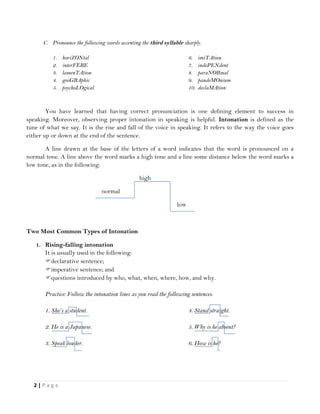
A line drawn at the base of the letters of a word indicates that the word is pronounced on a
normal tone. A line above the word marks a high tone and a line some distance below the word marks a
low tone, as in the following:
high
normal
low
Two Most Common Types of Intonation
1. Rising-falling intonation
It is usually used in the following:
declarative sentence;
imperative sentence; and
questions introduced by who, what, when, where, how, and why.
Practice: Follow the intonation lines as you read the following sentences.
1. She’s a student.
2. He is a Japanese.
3. Speak louder.
4. Stand straight.
5. Why is he absent?
6. How is he?
3 | P a g e
2. Rising intonation
It is usually used in the following:
questions that may be answered with yes or no;
statements that express surprise or doubt; and
tag questions which mean that the speaker is not sure whether the answer to his or her
question is yes or no (tag questions mean that the speaker is not sure whether the answer to
his/her question is a yes or no).
Practice: Follow the intonation lines as you read the following sentences.
1. Are you busy?
2. Have you done your work?
3. She topped the test?
4. Our school team won the championship?
5. He isn’t busy, is he?
6. We aren’t late, are we?
Note the following:
1. Alternative withor. The rising intonation is used for all alternatives except the final one, which
uses rising-falling intonation, as in the following sentences.
Juncture

Speaking

  • 1.
    1 | Pa g e SPEAKING: The Productive Skill To be well understood, you must be able to pronounce words correctly. Faulty pronunciation does not only cause misunderstanding of the message to be conveyed, but it also distracts the listeners. Pronunciation does not refer only to the saying of vowel and consonant sounds. It also includes correct stress.Stress or accent refers to the greater or lesser force given to certain syllables or words. Elements of Stress 1. loudness or force or intensity; 2. pitch (highness or lowness of a sound); and 3. duration (the length of time a certain syllable or word is uttered) A. Pronounce the following words accenting the first syllable sharply. 1. PREFace 2. PRImary 3. JANuary 4. PLAUsible 5. GOVern 6. CEMetery 7. CHARacter 8. ALlergy 9. LUnatic 10. HONorable 11. FAScinating 12. ADmirable 13. PARamount 14. INstantly 15. CATHolic 16. THIRty 17. MILitary 18. FORtunate 19. ACcurate 20. COMfortable 21. LABoratory 22. CERtainly 23. COMmunism 24. ORator 25. VENerable 26. SEVeral 27. DYsentery 28. TOUrists 29. CONference B. Pronounce the following words accenting the second syllable sharply. 1. diOXide 2. uTENsil 3. bamBOO 4. adVENture 5. aBANdon 6. seMESter 7. thirTEEN 8. fourTEEN 9. comMITtee 10. maCHInery 11. oRAtion 12. inEVitable 13. voCABulary 14. disTRIbute 15. lieuTENant 16. conTRIbute 17. inSANE 18. conDOlence 19. inCOMparable 20. sinCEREly 21. rePORted 22. magNIFicence 23. imMENsity 24. conGLOmerate 25. coMMUnity 26. oPPOnent 27. exTRAORdinary
  • 2.
    2 | Pa g e C. Pronounce the following words accenting the third syllable sharply. 1. horiZONtal 2. interFERE 3. lamenTAtion 4. geoGRAphic 5. psychoLOgical 6. imiTAtion 7. indePENdent 8. paraNORmal 9. pandeMOnium 10. declaMAtion You have learned that having correct pronunciation is one defining element to success in speaking. Moreover, observing proper intonation in speaking is helpful. Intonation is defined as the tune of what we say. It is the rise and fall of the voice in speaking. It refers to the way the voice goes either up or down at the end of the sentence. A line drawn at the base of the letters of a word indicates that the word is pronounced on a normal tone. A line above the word marks a high tone and a line some distance below the word marks a low tone, as in the following: high normal low Two Most Common Types of Intonation 1. Rising-falling intonation It is usually used in the following: declarative sentence; imperative sentence; and questions introduced by who, what, when, where, how, and why. Practice: Follow the intonation lines as you read the following sentences. 1. She’s a student. 2. He is a Japanese. 3. Speak louder. 4. Stand straight. 5. Why is he absent? 6. How is he?
  • 3.
    3 | Pa g e 2. Rising intonation It is usually used in the following: questions that may be answered with yes or no; statements that express surprise or doubt; and tag questions which mean that the speaker is not sure whether the answer to his or her question is yes or no (tag questions mean that the speaker is not sure whether the answer to his/her question is a yes or no). Practice: Follow the intonation lines as you read the following sentences. 1. Are you busy? 2. Have you done your work? 3. She topped the test? 4. Our school team won the championship? 5. He isn’t busy, is he? 6. We aren’t late, are we? Note the following: 1. Alternative withor. The rising intonation is used for all alternatives except the final one, which uses rising-falling intonation, as in the following sentences. Juncture