Spatial Operation
Let’s
Discuss !!
-Averaging
-Median
-Filtering Spatial Low pass
-Filtering Spatial High pass
INTRODUCTION TO FILTERS
Filter:
Filter is a process that removes some unwanted components or
Small details in a image.
Types of Filters :
• Spatial Domain Filters
• Frequency Domain Filters
Spatial Domain Filters
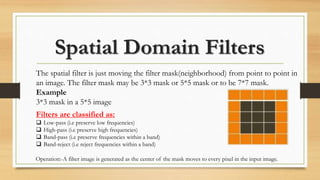
The spatial filter is just moving the filter mask(neighborhood) from point to point in
an image. The filter mask may be 3*3 mask or 5*5 mask or to be 7*7 mask.
Example
3*3 mask in a 5*5 image
Filters are classified as:
 Low-pass (i.e preserve low frequencies)
 High-pass (i.e preserve high frequencies)
 Band-pass (i.e preserve frequencies within a band)
 Band-reject (i.e reject frequencies within a band)
Operation:-A filter image is generated as the center of the mask moves to every pixel in the input image.
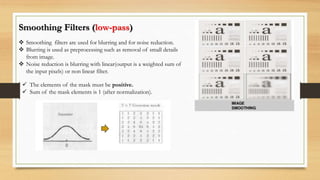
Smoothing Filters (low-pass)
 Smoothing filters are used for blurring and for noise reduction.
 Blurring is used as preprocessing such as removal of small details
from image.
 Noise reduction is blurring with linear(output is a weighted sum of
the input pixels) or non linear filter.
 The elements of the mask must be positive.
 Sum of the mask elements is 1 (after normalization).
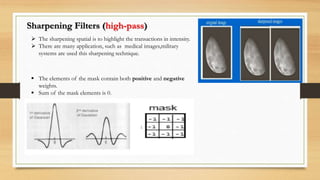
Sharpening Filters (high-pass)
 The sharpening spatial is to highlight the transactions in intensity.
 There are many application, such as medical images,military
systems are used this sharpening technique.
 The elements of the mask contain both positive and negative
weights.
 Sum of the mask elements is 0.
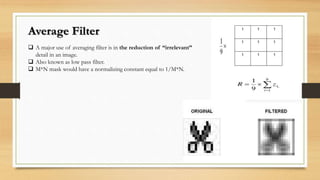
Average Filter
 A major use of averaging filter is in the reduction of “irrelevant”
detail in an image.
 Also known as low pass filter.
 M*N mask would have a normalizing constant equal to 1/M*N.
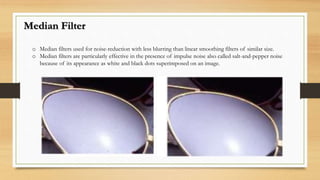
Median Filter
o Median filters used for noise-reduction with less blurring than linear smoothing filters of similar size.
o Median filters are particularly effective in the presence of impulse noise also called salt-and-pepper noise
because of its appearance as white and black dots superimposed on an image.

Spatial operation.ppt

  • 1.
    Spatial Operation Let’s Discuss !! -Averaging -Median -FilteringSpatial Low pass -Filtering Spatial High pass
  • 2.
    INTRODUCTION TO FILTERS Filter: Filteris a process that removes some unwanted components or Small details in a image. Types of Filters : • Spatial Domain Filters • Frequency Domain Filters
  • 3.
    Spatial Domain Filters Thespatial filter is just moving the filter mask(neighborhood) from point to point in an image. The filter mask may be 3*3 mask or 5*5 mask or to be 7*7 mask. Example 3*3 mask in a 5*5 image Filters are classified as:  Low-pass (i.e preserve low frequencies)  High-pass (i.e preserve high frequencies)  Band-pass (i.e preserve frequencies within a band)  Band-reject (i.e reject frequencies within a band) Operation:-A filter image is generated as the center of the mask moves to every pixel in the input image.
  • 4.
    Smoothing Filters (low-pass) Smoothing filters are used for blurring and for noise reduction.  Blurring is used as preprocessing such as removal of small details from image.  Noise reduction is blurring with linear(output is a weighted sum of the input pixels) or non linear filter.  The elements of the mask must be positive.  Sum of the mask elements is 1 (after normalization).
  • 5.
    Sharpening Filters (high-pass) The sharpening spatial is to highlight the transactions in intensity.  There are many application, such as medical images,military systems are used this sharpening technique.  The elements of the mask contain both positive and negative weights.  Sum of the mask elements is 0.
  • 6.
    Average Filter  Amajor use of averaging filter is in the reduction of “irrelevant” detail in an image.  Also known as low pass filter.  M*N mask would have a normalizing constant equal to 1/M*N.
  • 7.
    Median Filter o Medianfilters used for noise-reduction with less blurring than linear smoothing filters of similar size. o Median filters are particularly effective in the presence of impulse noise also called salt-and-pepper noise because of its appearance as white and black dots superimposed on an image.