
• Sparta (Doric Greek: Σπάρτα, Spártā; Attic Greek: 
Σπάρτη, Spártē) was a prominent city-state in 
ancient Greece. In antiquity the city-state was known
as Lacedaemon (Λακεδαίμων, Lakedaímōn), while the
name Sparta referred to its main settlement on the
banks of the Eurotas River in Laconia, in south-
eastern Peloponnese.[1]
 Around 650 BC, it rose to
become the dominant military land-power in ancient
Greece.
SPARTA

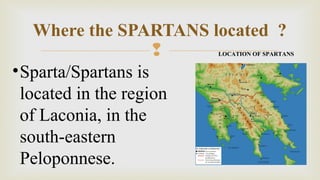
Where the SPARTANS located ?
LOCATION OF SPARTANS
•Sparta/Spartans is
located in the region
of Laconia, in the
south-eastern
Peloponnese.
 Sparta, also known as Lacedaemon, was an ancient Greek
city-state located primarily in the present-day region of
southern Greece called Laconia. The population of Sparta
consisted of three main groups: the Spartans, or
Spartiates, who were full citizens; the Helots, or
serfs/slaves; and the Perioeci, who were neither slaves nor
citizens. The Perioeci, whose name means “dwellers-
around,” worked as craftsmen and traders, and built
weapons for the Spartans.
SPARTAN SOCIETY

•CONSTITUTION
Sparta was an oligarchy. The state was ruled
by two hereditary kings of the 
Agiad and Eurypontid families, both
supposedly descendants of Heracles and equal
in authority, so that one could not act against
the power and political enactments of his
colleague.
STRUCTURE OF CLASSICAL
SPARTAN SOCIETY

 Not all inhabitants of the Spartan state were
considered to be citizens. Only those who had
undertaken the Spartan education process
known as the agoge were eligible. However,
usually the only people eligible to receive
the agoge were Spartiates, or people who could
trace their ancestry to the original inhabitants
of the city.
CITIZENSHIP

 Others in the state were the perioikoi,
who were free inhabitants of Spartan
territory but were non-citizens, and
the helots,the state-owned serfs.
Descendants of non-Spartan citizens
were not able to follow the agoge.
Non citizens

The Spartans were a minority
of the Lakonian population.
The largest class of inhabitants
were the helots (in Classical
Greek Ε λωτες / ἵ Heílôtes).
HELOTS

 The Perioikoi came from similar origins as the helots
but occupied a significantly different position in
Spartan society. Although they did not enjoy full
citizen-rights, they were free and not subjected to
the same restrictions as the helots. The exact nature
of their subjection to the Spartans is not clear, but
they seem to have served partly as a kind of military
reserve, partly as skilled craftsmen and partly as
agents of foreign trade. 
PERIOIKOI

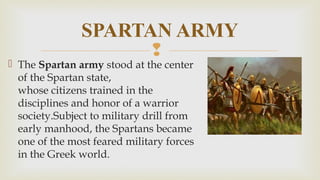
 The Spartan army stood at the center
of the Spartan state,
whose citizens trained in the
disciplines and honor of a warrior
society.Subject to military drill from
early manhood, the Spartans became
one of the most feared military forces
in the Greek world.
SPARTAN ARMY

• BIRTH AND DEATH
Sparta was above all a militarist state,
and emphasis on military fitness began
virtually at birth.
LIFE IN CLASSICAL
SPARTA

 When male Spartans began military
training at age seven, they would enter
the agoge system. The agoge was designed
to encourage discipline and physical
toughness and to emphasize the importance
of the Spartan state.
EDUCATION

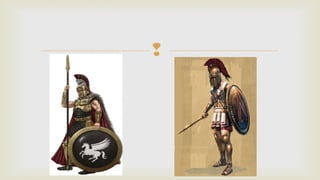
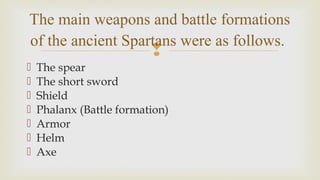
EQUIPMENT'S OF SPARTANS

EQUIPMENT'S OF SPARTANS


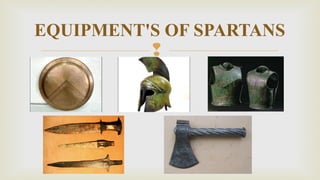
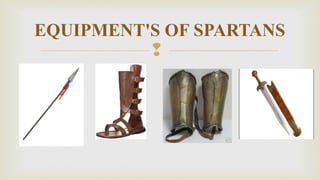
 The spear
 The short sword
 Shield
 Phalanx (Battle formation)
 Armor
 Helm
 Axe
The main weapons and battle formations
of the ancient Spartans were as follows.

• SPARTANS HAD TO PROVE THEIR FITNESS EVEN AS
INFANTS
• SPARTAN CHILDREN WERE PLACED IN A MILITARY-
STYLE EDUCATION PROGRAM
• HAZING AND FIGHTING WERE ENCOURAGED AMONG
SPARTANS CHILDREN
• ALL SPARTANS MEN WERE EXPECTED TO BE
LIFELONG SOLDIERS
8 Reasons it wasn’t easy being a
SPARTANS
• SPARTANS YOUTHS WERE RITUALISTICALLY
BEATEN AND FLOGGED
• FOOD WAS INTENTIONALLY KEPT SCARCE, AND
POOR FITNESS WAS CAUSE FOR RIDICULE
• SPARTAN MEN WERE NOT ALLOWED TO LIVE
THEIR WIVES UNTIL AGE 30.
• SURRENDER IN BATTLE WAS THE ULTIMATE
DISGRACE

• Spears gave the Spartans a great advantage in battle. The length of it 
was varied, but believed to have been between 6-10 feet in 
length. Traditionally the spear was held with one hand either over the 
Spartan's head, or underhand beneath the shield. At the tip of the spear, 
there was either an iron or bronze leafed spearhead. The shaft was 
made of a sturdy wood so as not to break easily. 
• These deadly swords of weaponry were typically only about 10-12
inches in length. Although short, these swords were favored by the 
Spartans for their ability to thrust through enemy's phalanxes and into the 
enemies throat or head. However, their small length did make them only 
useful for breaking into an enemy's phalanx. 

 One of the most iconic things for Sparta is the battle formation 
phalanx. The phalanx formation was a close-rank, dense
grouping of warriors armed with long spears and interlocking
shields. The Spartan soldier provided his own weapon (most 
commonly a spear) and shield as well as breast plate, helmet 
and greaves. This provided an extreme amount of protection to 
the men inside, as each man was lined up next to his brother's
shield and very little space was in between shields. 

  The Spartan shield was mainly used for defensive purposes,
however it was common for the Spartans to bash thier shield
into enemies, causing them to become disoriented and 
confused. This tactic was mainly used to knock down an enemy 
warrior to make room for another weapon, such as the short 
sword. These shields were very study, made out of woods and 
had an outer covering of bronze, this did cause the shields to 
become very heavy though, commonly weighing 30 pounds. 

 The Spartans were a great military-focused city-states and 
many remember them for it. From dominance as a 
military force to a technologically advanced people, 
Sparta is one of the most remembered civilizations to this 
day. However, all of the fame and glory wouldn't be
possible to achieve without the technological military
advantages the Spartans had over their opponents. 

Spartans

  • 2.
     • Sparta (Doric Greek:Σπάρτα, Spártā; Attic Greek:  Σπάρτη, Spártē) was a prominent city-state in  ancient Greece. In antiquity the city-state was known as Lacedaemon (Λακεδαίμων, Lakedaímōn), while the name Sparta referred to its main settlement on the banks of the Eurotas River in Laconia, in south- eastern Peloponnese.[1]  Around 650 BC, it rose to become the dominant military land-power in ancient Greece. SPARTA
  • 3.
     Where the SPARTANSlocated ? LOCATION OF SPARTANS •Sparta/Spartans is located in the region of Laconia, in the south-eastern Peloponnese.
  • 4.
     Sparta, alsoknown as Lacedaemon, was an ancient Greek city-state located primarily in the present-day region of southern Greece called Laconia. The population of Sparta consisted of three main groups: the Spartans, or Spartiates, who were full citizens; the Helots, or serfs/slaves; and the Perioeci, who were neither slaves nor citizens. The Perioeci, whose name means “dwellers- around,” worked as craftsmen and traders, and built weapons for the Spartans. SPARTAN SOCIETY
  • 5.
     •CONSTITUTION Sparta was an oligarchy.The state was ruled by two hereditary kings of the  Agiad and Eurypontid families, both supposedly descendants of Heracles and equal in authority, so that one could not act against the power and political enactments of his colleague. STRUCTURE OF CLASSICAL SPARTAN SOCIETY
  • 6.
      Not allinhabitants of the Spartan state were considered to be citizens. Only those who had undertaken the Spartan education process known as the agoge were eligible. However, usually the only people eligible to receive the agoge were Spartiates, or people who could trace their ancestry to the original inhabitants of the city. CITIZENSHIP
  • 7.
      Others inthe state were the perioikoi, who were free inhabitants of Spartan territory but were non-citizens, and the helots,the state-owned serfs. Descendants of non-Spartan citizens were not able to follow the agoge. Non citizens
  • 8.
     The Spartans werea minority of the Lakonian population. The largest class of inhabitants were the helots (in Classical Greek Ε λωτες / ἵ Heílôtes). HELOTS
  • 9.
      The Perioikoicame from similar origins as the helots but occupied a significantly different position in Spartan society. Although they did not enjoy full citizen-rights, they were free and not subjected to the same restrictions as the helots. The exact nature of their subjection to the Spartans is not clear, but they seem to have served partly as a kind of military reserve, partly as skilled craftsmen and partly as agents of foreign trade.  PERIOIKOI
  • 10.
      The Spartan army stood atthe center of the Spartan state, whose citizens trained in the disciplines and honor of a warrior society.Subject to military drill from early manhood, the Spartans became one of the most feared military forces in the Greek world. SPARTAN ARMY
  • 11.
     • BIRTH ANDDEATH Sparta was above all a militarist state, and emphasis on military fitness began virtually at birth. LIFE IN CLASSICAL SPARTA
  • 12.
      When maleSpartans began military training at age seven, they would enter the agoge system. The agoge was designed to encourage discipline and physical toughness and to emphasize the importance of the Spartan state. EDUCATION
  • 13.
  • 14.
  • 15.
  • 16.
      The spear The short sword  Shield  Phalanx (Battle formation)  Armor  Helm  Axe The main weapons and battle formations of the ancient Spartans were as follows.
  • 17.
     • SPARTANS HADTO PROVE THEIR FITNESS EVEN AS INFANTS • SPARTAN CHILDREN WERE PLACED IN A MILITARY- STYLE EDUCATION PROGRAM • HAZING AND FIGHTING WERE ENCOURAGED AMONG SPARTANS CHILDREN • ALL SPARTANS MEN WERE EXPECTED TO BE LIFELONG SOLDIERS 8 Reasons it wasn’t easy being a SPARTANS
  • 18.
    • SPARTANS YOUTHSWERE RITUALISTICALLY BEATEN AND FLOGGED • FOOD WAS INTENTIONALLY KEPT SCARCE, AND POOR FITNESS WAS CAUSE FOR RIDICULE • SPARTAN MEN WERE NOT ALLOWED TO LIVE THEIR WIVES UNTIL AGE 30. • SURRENDER IN BATTLE WAS THE ULTIMATE DISGRACE
  • 19.
     • Spears gavethe Spartans a great advantage in battle. The length of it  was varied, but believed to have been between 6-10 feet in  length. Traditionally the spear was held with one hand either over the  Spartan's head, or underhand beneath the shield. At the tip of the spear,  there was either an iron or bronze leafed spearhead. The shaft was  made of a sturdy wood so as not to break easily.  • These deadly swords of weaponry were typically only about 10-12 inches in length. Although short, these swords were favored by the  Spartans for their ability to thrust through enemy's phalanxes and into the  enemies throat or head. However, their small length did make them only  useful for breaking into an enemy's phalanx. 
  • 20.
      One of the most iconic things for Sparta is the battle formation  phalanx. The phalanxformation was a close-rank, dense grouping of warriors armed with long spears and interlocking shields. The Spartan soldier provided his own weapon (most  commonly a spear) and shield as well as breast plate, helmet  and greaves. This provided an extreme amount of protection to  the men inside, as each man was lined up next to his brother's shield and very little space was in between shields. 
  • 21.
       The Spartanshield was mainly used for defensive purposes, however it was common for the Spartans to bash thier shield into enemies, causing them to become disoriented and  confused. This tactic was mainly used to knock down an enemy  warrior to make room for another weapon, such as the short  sword. These shields were very study, made out of woods and  had an outer covering of bronze, this did cause the shields to  become very heavy though, commonly weighing 30 pounds. 
  • 22.