Date
Spark Job Server
Evan Chan and Kelvin Chu
Overview
WhyWe Needed a Job Server
• Created at Ooyala in 2013
• Our vision for Spark is as a multi-team big data service
• What gets repeated by every team:
• Bastion box for running Hadoop/Spark jobs
• Deploys and process monitoring
• Tracking and serializing job status, progress, and job results
• Job validation
• No easy way to kill jobs
• Polyglot technology stack - Ruby scripts run jobs, Go services
Spark as a Service
• REST API for Spark jobs and contexts. Easily operate Spark from any
language or environment.
• Runs jobs in their own Contexts or share 1 context amongst jobs
• Great for sharing cached RDDs across jobs and low-latency jobs
• Works for Spark Streaming as well!
• Works with Standalone, Mesos, any Spark config
• Jars, job history and config are persisted via a pluggable API
• Async and sync API, JSON job results
http://github.com/ooyala/spark-jobserver
Open Source!!
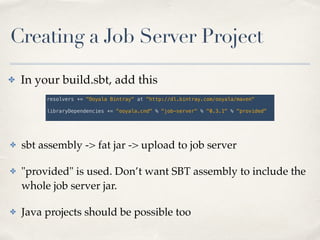
Creating a Job Server Project
✤ sbt assembly -> fat jar -> upload to job server!
✤ "provided" is used. Don’t want SBT assembly to include the
whole job server jar.!
✤ Java projects should be possible too
resolvers += "Ooyala Bintray" at "http://dl.bintray.com/ooyala/maven"
!
libraryDependencies += "ooyala.cnd" % "job-server" % "0.3.1" % "provided"
✤ In your build.sbt, add this
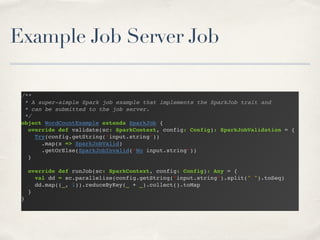
Example Job Server Job
/**!
* A super-simple Spark job example that implements the SparkJob trait and!
* can be submitted to the job server.!
*/!
object WordCountExample extends SparkJob {!
override def validate(sc: SparkContext, config: Config): SparkJobValidation = {!
Try(config.getString(“input.string”))!
.map(x => SparkJobValid)!
.getOrElse(SparkJobInvalid(“No input.string”))!
}!
!
override def runJob(sc: SparkContext, config: Config): Any = {!
val dd = sc.parallelize(config.getString(“input.string”).split(" ").toSeq)!
dd.map((_, 1)).reduceByKey(_ + _).collect().toMap!
}!
}!
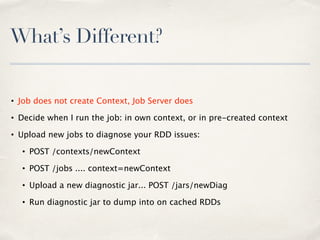
What’s Different?
• Job does not create Context, Job Server does
• Decide when I run the job: in own context, or in pre-created context
• Upload new jobs to diagnose your RDD issues:
• POST /contexts/newContext
• POST /jobs .... context=newContext
• Upload a new diagnostic jar... POST /jars/newDiag
• Run diagnostic jar to dump into on cached RDDs
Submitting and Running a Job
✦ curl --data-binary @../target/mydemo.jar localhost:8090/jars/demo
OK[11:32 PM] ~
!
✦ curl -d "input.string = A lazy dog jumped mean dog" 'localhost:8090/jobs?
appName=demo&classPath=WordCountExample&sync=true'
{
"status": "OK",
"RESULT": {
"lazy": 1,
"jumped": 1,
"A": 1,
"mean": 1,
"dog": 2
}
}
Retrieve Job Statuses
~/s/jobserver (evan-working-1 ↩=) curl 'localhost:8090/jobs?limit=2'
[{
"duration": "77.744 secs",
"classPath": "ooyala.cnd.CreateMaterializedView",
"startTime": "2013-11-26T20:13:09.071Z",
"context": "8b7059dd-ooyala.cnd.CreateMaterializedView",
"status": "FINISHED",
"jobId": "9982f961-aaaa-4195-88c2-962eae9b08d9"
}, {
"duration": "58.067 secs",
"classPath": "ooyala.cnd.CreateMaterializedView",
"startTime": "2013-11-26T20:22:03.257Z",
"context": "d0a5ebdc-ooyala.cnd.CreateMaterializedView",
"status": "FINISHED",
"jobId": "e9317383-6a67-41c4-8291-9c140b6d8459"
}]
Use Case: Fast Query Jobs
Spark as a Query Engine
✤ Goal: spark jobs that run in under a second and answers queries
on shared RDD data!
✤ Query params passed in as job config!
✤ Need to minimize context creation overhead!
✤ Thus many jobs sharing the same SparkContext!
✤ On-heap RDD caching means no serialization loss!
✤ Need to consider concurrent jobs (fair scheduling)
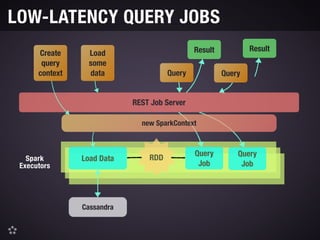
LOW-LATENCY QUERY JOBS
RDDLoad Data
Query
Job
Spark

Executors
Cassandra
REST Job Server
Query
Job
Query
Result
Query
Result
new SparkContext
Create
query
context
Load
some
data
Sharing Data Between Jobs
✤ RDD Caching!
✤ Benefit: no need to serialize data. Especially useful for indexes etc.!
✤ Job server provides a NamedRdds trait for thread-safe CRUD of
cached RDDs by name!
✤ (Compare to SparkContext’s API which uses an integer ID and
is not thread safe)!
✤ For example, at Ooyala a number of fields are multiplexed into the
RDD name: timestamp:customerID:granularity
Data Concurrency
✤ Single writer, multiple readers!
✤ Managing multiple updates to RDDs!
✤ Cache keeps track of which RDDs being updated!
✤ Example: thread A spark job creates RDD “A” at t0!
✤ thread B fetches RDD “A” at t1 > t0!
✤ Both threads A and B, using NamedRdds, will get the RDD at
time t2 when thread A finishes creating the RDD “A”
Production Usage
Persistence
✤ What gets persisted?!
✤ Job status (success, error, why it failed)!
✤ Job Configuration!
✤ Jars!
✤ JDBC database configuration: spark.sqldao.jdbc.url!
✤ jdbc:mysql://dbserver:3306/jobserverdb
✤ Multiple Job Servers can share the same database.!
✤ The default will be H2 - single file on disk.
Deployment and Metrics
✤ spark-jobserver repo comes with a full suite of tests
and deploy scripts:!
✤ server_deploy.sh for regular server pushes!
✤ server_package.sh for Mesos and Chronos .tar.gz!
✤ /metricz route for codahale-metrics monitoring!
✤ /healthz route for health check0o
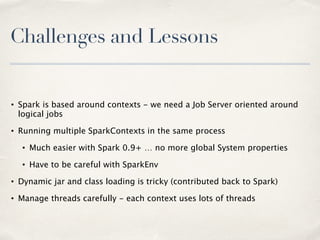
Challenges and Lessons
• Spark is based around contexts - we need a Job Server oriented around
logical jobs
• Running multiple SparkContexts in the same process
• Much easier with Spark 0.9+ … no more global System properties
• Have to be careful with SparkEnv
• Dynamic jar and class loading is tricky (contributed back to Spark)
• Manage threads carefully - each context uses lots of threads
FutureWork
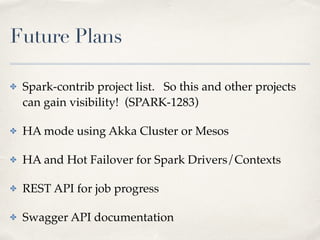
Future Plans
✤ Spark-contrib project list. So this and other projects
can gain visibility! (SPARK-1283)!
✤ HA mode using Akka Cluster or Mesos!
✤ HA and Hot Failover for Spark Drivers/Contexts!
✤ REST API for job progress!
✤ Swagger API documentation
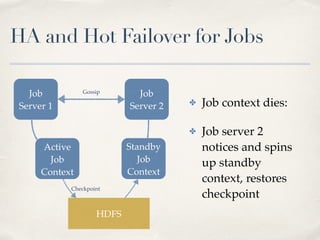
HA and Hot Failover for Jobs
Job
Server 1
Job
Server 2
Active
Job
Context
HDFS
Standby
Job
Context
Gossip
Checkpoint
✤ Job context dies:!
✤ Job server 2
notices and spins
up standby
context, restores
checkpoint
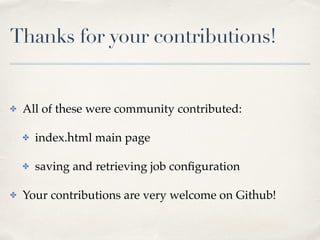
Thanks for your contributions!
✤ All of these were community contributed:!
✤ index.html main page!
✤ saving and retrieving job configuration!
✤ Your contributions are very welcome on Github!
Architecture
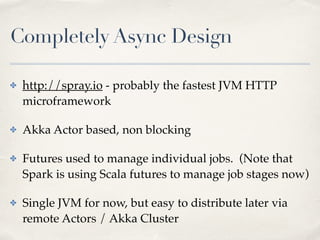
Completely Async Design
✤ http://spray.io - probably the fastest JVM HTTP
microframework!
✤ Akka Actor based, non blocking!
✤ Futures used to manage individual jobs. (Note that
Spark is using Scala futures to manage job stages now)!
✤ Single JVM for now, but easy to distribute later via
remote Actors / Akka Cluster
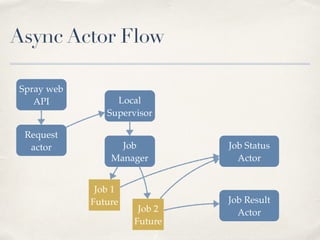
Async Actor Flow
Spray web
API
Request
actor
Local
Supervisor
Job
Manager
Job 1
Future
Job 2
Future
Job Status
Actor
Job Result
Actor
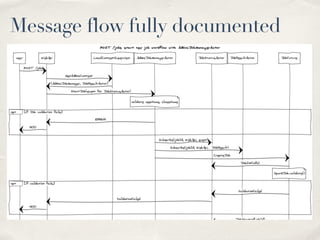
Message flow fully documented
Thank you!
And Everybody is Hiring!!
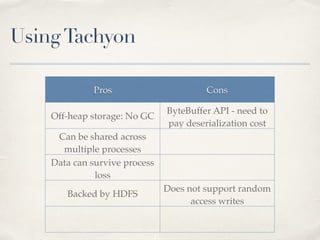
UsingTachyon
Pros Cons
Off-heap storage: No GC
ByteBuffer API - need to
pay deserialization cost
Can be shared across
multiple processes
Data can survive process
loss
Backed by HDFS
Does not support random
access writes

Spark Summit 2014: Spark Job Server Talk

  • 1.
    Date Spark Job Server EvanChan and Kelvin Chu
  • 2.
  • 3.
    WhyWe Needed aJob Server • Created at Ooyala in 2013 • Our vision for Spark is as a multi-team big data service • What gets repeated by every team: • Bastion box for running Hadoop/Spark jobs • Deploys and process monitoring • Tracking and serializing job status, progress, and job results • Job validation • No easy way to kill jobs • Polyglot technology stack - Ruby scripts run jobs, Go services
  • 4.
    Spark as aService • REST API for Spark jobs and contexts. Easily operate Spark from any language or environment. • Runs jobs in their own Contexts or share 1 context amongst jobs • Great for sharing cached RDDs across jobs and low-latency jobs • Works for Spark Streaming as well! • Works with Standalone, Mesos, any Spark config • Jars, job history and config are persisted via a pluggable API • Async and sync API, JSON job results
  • 5.
  • 6.
    Creating a JobServer Project ✤ sbt assembly -> fat jar -> upload to job server! ✤ "provided" is used. Don’t want SBT assembly to include the whole job server jar.! ✤ Java projects should be possible too resolvers += "Ooyala Bintray" at "http://dl.bintray.com/ooyala/maven" ! libraryDependencies += "ooyala.cnd" % "job-server" % "0.3.1" % "provided" ✤ In your build.sbt, add this
  • 7.
    Example Job ServerJob /**! * A super-simple Spark job example that implements the SparkJob trait and! * can be submitted to the job server.! */! object WordCountExample extends SparkJob {! override def validate(sc: SparkContext, config: Config): SparkJobValidation = {! Try(config.getString(“input.string”))! .map(x => SparkJobValid)! .getOrElse(SparkJobInvalid(“No input.string”))! }! ! override def runJob(sc: SparkContext, config: Config): Any = {! val dd = sc.parallelize(config.getString(“input.string”).split(" ").toSeq)! dd.map((_, 1)).reduceByKey(_ + _).collect().toMap! }! }!
  • 8.
    What’s Different? • Jobdoes not create Context, Job Server does • Decide when I run the job: in own context, or in pre-created context • Upload new jobs to diagnose your RDD issues: • POST /contexts/newContext • POST /jobs .... context=newContext • Upload a new diagnostic jar... POST /jars/newDiag • Run diagnostic jar to dump into on cached RDDs
  • 9.
    Submitting and Runninga Job ✦ curl --data-binary @../target/mydemo.jar localhost:8090/jars/demo OK[11:32 PM] ~ ! ✦ curl -d "input.string = A lazy dog jumped mean dog" 'localhost:8090/jobs? appName=demo&classPath=WordCountExample&sync=true' { "status": "OK", "RESULT": { "lazy": 1, "jumped": 1, "A": 1, "mean": 1, "dog": 2 } }
  • 10.
    Retrieve Job Statuses ~/s/jobserver(evan-working-1 ↩=) curl 'localhost:8090/jobs?limit=2' [{ "duration": "77.744 secs", "classPath": "ooyala.cnd.CreateMaterializedView", "startTime": "2013-11-26T20:13:09.071Z", "context": "8b7059dd-ooyala.cnd.CreateMaterializedView", "status": "FINISHED", "jobId": "9982f961-aaaa-4195-88c2-962eae9b08d9" }, { "duration": "58.067 secs", "classPath": "ooyala.cnd.CreateMaterializedView", "startTime": "2013-11-26T20:22:03.257Z", "context": "d0a5ebdc-ooyala.cnd.CreateMaterializedView", "status": "FINISHED", "jobId": "e9317383-6a67-41c4-8291-9c140b6d8459" }]
  • 11.
    Use Case: FastQuery Jobs
  • 12.
    Spark as aQuery Engine ✤ Goal: spark jobs that run in under a second and answers queries on shared RDD data! ✤ Query params passed in as job config! ✤ Need to minimize context creation overhead! ✤ Thus many jobs sharing the same SparkContext! ✤ On-heap RDD caching means no serialization loss! ✤ Need to consider concurrent jobs (fair scheduling)
  • 13.
    LOW-LATENCY QUERY JOBS RDDLoadData Query Job Spark
 Executors Cassandra REST Job Server Query Job Query Result Query Result new SparkContext Create query context Load some data
  • 14.
    Sharing Data BetweenJobs ✤ RDD Caching! ✤ Benefit: no need to serialize data. Especially useful for indexes etc.! ✤ Job server provides a NamedRdds trait for thread-safe CRUD of cached RDDs by name! ✤ (Compare to SparkContext’s API which uses an integer ID and is not thread safe)! ✤ For example, at Ooyala a number of fields are multiplexed into the RDD name: timestamp:customerID:granularity
  • 15.
    Data Concurrency ✤ Singlewriter, multiple readers! ✤ Managing multiple updates to RDDs! ✤ Cache keeps track of which RDDs being updated! ✤ Example: thread A spark job creates RDD “A” at t0! ✤ thread B fetches RDD “A” at t1 > t0! ✤ Both threads A and B, using NamedRdds, will get the RDD at time t2 when thread A finishes creating the RDD “A”
  • 16.
  • 17.
    Persistence ✤ What getspersisted?! ✤ Job status (success, error, why it failed)! ✤ Job Configuration! ✤ Jars! ✤ JDBC database configuration: spark.sqldao.jdbc.url! ✤ jdbc:mysql://dbserver:3306/jobserverdb ✤ Multiple Job Servers can share the same database.! ✤ The default will be H2 - single file on disk.
  • 18.
    Deployment and Metrics ✤spark-jobserver repo comes with a full suite of tests and deploy scripts:! ✤ server_deploy.sh for regular server pushes! ✤ server_package.sh for Mesos and Chronos .tar.gz! ✤ /metricz route for codahale-metrics monitoring! ✤ /healthz route for health check0o
  • 19.
    Challenges and Lessons •Spark is based around contexts - we need a Job Server oriented around logical jobs • Running multiple SparkContexts in the same process • Much easier with Spark 0.9+ … no more global System properties • Have to be careful with SparkEnv • Dynamic jar and class loading is tricky (contributed back to Spark) • Manage threads carefully - each context uses lots of threads
  • 20.
  • 21.
    Future Plans ✤ Spark-contribproject list. So this and other projects can gain visibility! (SPARK-1283)! ✤ HA mode using Akka Cluster or Mesos! ✤ HA and Hot Failover for Spark Drivers/Contexts! ✤ REST API for job progress! ✤ Swagger API documentation
  • 22.
    HA and HotFailover for Jobs Job Server 1 Job Server 2 Active Job Context HDFS Standby Job Context Gossip Checkpoint ✤ Job context dies:! ✤ Job server 2 notices and spins up standby context, restores checkpoint
  • 23.
    Thanks for yourcontributions! ✤ All of these were community contributed:! ✤ index.html main page! ✤ saving and retrieving job configuration! ✤ Your contributions are very welcome on Github!
  • 24.
  • 25.
    Completely Async Design ✤http://spray.io - probably the fastest JVM HTTP microframework! ✤ Akka Actor based, non blocking! ✤ Futures used to manage individual jobs. (Note that Spark is using Scala futures to manage job stages now)! ✤ Single JVM for now, but easy to distribute later via remote Actors / Akka Cluster
  • 26.
    Async Actor Flow Sprayweb API Request actor Local Supervisor Job Manager Job 1 Future Job 2 Future Job Status Actor Job Result Actor
  • 27.
  • 28.
  • 29.
    UsingTachyon Pros Cons Off-heap storage:No GC ByteBuffer API - need to pay deserialization cost Can be shared across multiple processes Data can survive process loss Backed by HDFS Does not support random access writes