Español 101

   Lección 5
 4 Junio 2012
VII. Sentence Structure
      Type            Order          Example          Comment

Statement      Subject, verb    Roberto estudia.  This word order is
                                (Robert is        extremely common
                                studying.)        and can be
                                                  considered the
                                                  norm.
Statement      Subject, verb,   Roberto compró el This word order is
               object           libro. (Robert    extremely common
                                bought the book.) and can be
                                                  considered the
                                                  norm.
Type           Order             Example                    Comment

Statement     Subject, objectRoberto lo compró. This word order is extremely
              pronoun, verb  (Roberto bought it.) common and can be considered
                                                  the norm. Object pronouns
                                                  precede conjugated verbs; they
                                                  can be attached at the end of
                                                  infinitives and present participles.
Question    Question word, ¿Dónde está el         This word order is extremely
            verb, subject    libro? (Where is the common and can be considered
                             book?)               the norm.
Exclamation Exclamatory      ¡Qué linda es        This word order is extremely
            word, adjective, Roberta! (How        common and can be considered
            verb, subject    beautiful Roberta the norm. Many exclamations
                             is!)                 omit one or more of these
                                                  sentence parts.
Statement   Verb, noun       Sufren los niños.    Placing the verb ahead of the
                             (The children are    noun can have the effect of
                             suffering.)          placing more emphasis on the
                                                  verb. In the sample sentence, the
                                                  emphasis is more on the suffering
                                                  than who is suffering.
Type          Order              Example                     Comment

Statement   Object, verb,     El libro lo escribió   Placing the object at the
            noun              Juan. (John wrote      beginning of the sentence can
                              the book.)             have the effect of placing more
                                                     emphasis on the object. In the
                                                     sample sentence, the emphasis is
                                                     on what was written, not who
                                                     wrote it. The pronoun lo,
                                                     although redundant, is customary
                                                     in this sentence construction.
Statement   Adverb, verb,     Siempre hablan los     In general, Spanish adverbs are
            noun              niños. (The children   kept close to the verbs they
                              are always talking.)   modify. If an adverb starts a
                                                     sentence, the verb frequently
                                                     follows.
Phrase      Noun, adjective   la casa azul y cara    Descriptive adjectives, especially
                              (the expensive blue    ones that describe something
                              house)                 objectively, usually are placed
                                                     after the nouns they modify.
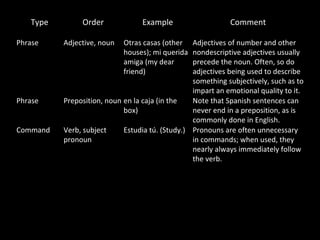
Type        Order             Example                    Comment

Phrase    Adjective, noun   Otras casas (other   Adjectives of number and other
                            houses); mi querida  nondescriptive adjectives usually
                            amiga (my dear       precede the noun. Often, so do
                            friend)              adjectives being used to describe
                                                 something subjectively, such as to
                                                 impart an emotional quality to it.
Phrase    Preposition, noun en la caja (in the   Note that Spanish sentences can
                            box)                 never end in a preposition, as is
                                                 commonly done in English.
Command   Verb, subject     Estudia tú. (Study.) Pronouns are often unnecessary
          pronoun                                in commands; when used, they
                                                 nearly always immediately follow
                                                 the verb.
Más expresiones - More
            expressions
• Buen Trabajo! - Great job!
• Hoy me cepillé (lavé) los dientes - Today, I
  brushed my teeth
• Subí en el ascensor/elevador - I took the lift
  upstairs
• ¿Puedes enseñarme cómo hacer esto? - Can
  you teach me how to do this?
• ¿Qué vamos a hacer hoy? - What are we going
  to do today?
Más expresiones - More
         expressions, cont.
• ¿Dónde está el supermercado? - Where is the
  supermarket?
• ¿Qué puedo traer a mis amigos en Singapur?
  What is famous here that I can buy back for
  my friends in Singapore?
• Mantente en contacto/Escríbeme - Keep in
  touch
Conversación - Conversation
• ¿Qué te gusta hacer en tu tiempo libre? -
  What do you like to do in your free time?
• ¿Cuál es tu
  comida/bebida/deporte/hobby/pasatiempo
  favorito(a)? - What is your favourite
  food/drink/sport/hobby/past time/band...
• Me gustaría hablar con - I would like to talk to
• ¿Te gustaría hablar con él/ella en privado? -
  Would you like to talk to him/her in private?
Conversación – Conversation, cont.
• ¿Qué haremos hoy? - What are we going to do
  today?
• Hoy vamos a… - Today we are going to...
  – ir al cine - go to the cinema
  – ir a la playa - go to the beach
  – programar - do some programming
  – ir de paseo - walk around
Más Expresiones – More
            Expressions
• Aún si... - Even if
• ¿Qué pasaría si...? - What if
• ¿Hablas en serio?/¿Estás bromeando? - Are
  you serious
• (Eso es) Muy interesante - That’s interesting
• Guau! - Wow
Más Vocabulario - More
            Vocabulary
• Encendido/Apagado - On/off
• Enciende la luz/Apaga la luz - Turn on/off the
  light
• Adelantar/Retrasar - Forward/backward
• Arriba - Up/upstairs
• Abajo - Down/downstairs
• He perdido… - I have lost...
• ¿Cómo se usa este(a)…? - How to use this...
Aritmética Básica – Basic
             Arithmetic
• Sumar, restar, dividir, multiplicar - Plus, minus,
  divide, multiply
Algunos Adjetivos de Cantidad -
   Some Adjectives of Quantity
• Mucho, muchos, mucha, muchas
  – Much for singular
  – Many for plural
• El tiene mucho poder - He has much power
• Ella tiene muchas gatas - She has many cats
Por - For
• Expressing movement along, through, around,
  by or about
  – Anduve por las calles de la ciudad - I walked
    through the streets of the city.
• Denoting a time or duration when something
  occurs
  – Viajamos por tres semanas - We're traveling for
    three weeks.
Por – For, cont.
• Expressing the cause (not the purpose) of an
  action
  – Me caí por la nieve - I fell down because of the
    snow.
• Meaning per
  – Dos por ciento - Two percent.
• Meaning supporting or in favor of
  – Trabajamos por derechos humanos - We work for
    human rights.
Por – For, cont.
• Introducing the agent of an action after a
  passive verb
  – Fue escrito por Neruda - It was written by Neruda
• Indicating means of transportation
  – Viajaré por avión - I will travel by plane.
• Used in numerous expressions.
  – Por ejemplo - For example
  – Por favor – Please.
Para - For
• Meaning for the purpose of or in order to
  – Para bailar aquí se necesita - In order to dance
    here you need
• With a noun or pronoun as object, meaning
  for the benefit of or directed to
  – Es para usted - It's for you.
• Meaning to or in the direction of when
  referring to a specific place
  – Voy para Chile - I'm heading to Chile
Para – For, cont.
• Meaning by or for when referring to a specific
  time
  – Necesito el regalo para mañana - I need the gift
    for tomorrow
• Para el fin de semana vamos a la casa de mi
  madre
  – For the weekend we're going to my mother’s
Gramática - Grammar
• Grande - Big
• Pequeño(a) - small
• Mediano(a) - medium
Presente Continuo – Present Continuous

• Estoy hablando - I am speaking
  – Juan está comiendo - John is eating
  – María está escribiendo una carta - Mary is writing
    a letter
Presente Continuo – Present Continuous

• Estar - To be
  – estoy
  – estás
  – está
  – estamos
  – están
Presente Continuo – Present Continuous

• Present participle (regular -ar verbs)
  1. hablar: hablando
     • (hablar - ar + ando)
  2. trabajar: trabajando
     • (trabajar - ar + ando)
  3. estudiar: estudiando
     • (estudiar - ar + ando)
Presente Continuo – Present Continuous

• Present participle (regular -er verbs)
  1. comer: comiendo
     • (comer - er + iendo)
  2. hacer: haciendo
     • (hacer - er + iendo)
Presente Continuo – Present Continuous

• Present participle (regular -ir verbs)
  1. vivir: viviendo
     • (vivir - ir + iendo)
  2. escribir: escribiendo
     • (escribir - ir + iendo)
Presente Continuo – Present Continuous

• Present participle (irregular -ir verbs)
  1.   servir: sirviendo
  2.   pedir: pidiendo
  3.   decir: diciendo
  4.   dormir: durmiendo
  5.   morir: muriendo
  6.   poder: pudiendo
Presente Continuo – Present Continuous

• Present participle (orthographic change)
  1.   caer: cayendo
  2.   creer: creyendo
  3.   huir: huyendo
  4.   ir: yendo
  5.   influir: influyendo
  6.   oír: oyendo
  7.   traer: trayendo
  8.   leer: leyendo
  9.   seguir: siguiendo
Verbos - Verbs
• Yo fuí/voy/iré... - I went/am going/will be going
  for…
• Tú fuíste/vas/irás… - You went/were going/will
  be going for...
• El/Ella fué/va/irá… - He/She went/was
  going/will be going for...
• Nosotros fuímos/vamos/iremos… - We
  went/are going/will be going for...
• Ustedes/Ellos fueron/van/irán… - You/they
  went/are going to/will be going for…
Verbos – Verbs, cont.
•   a correr - a run
•   a comer un helado - to have ice cream
•   a hacer una llamada - to make a call
•   a ver una película - to watch a movie
•   a nadar - to swim
•   a cambiar dinero - to change money

Spanish lesson 5

  • 1.
    Español 101 Lección 5 4 Junio 2012
  • 2.
    VII. Sentence Structure Type Order Example Comment Statement Subject, verb Roberto estudia. This word order is (Robert is extremely common studying.) and can be considered the norm. Statement Subject, verb, Roberto compró el This word order is object libro. (Robert extremely common bought the book.) and can be considered the norm.
  • 3.
    Type Order Example Comment Statement Subject, objectRoberto lo compró. This word order is extremely pronoun, verb (Roberto bought it.) common and can be considered the norm. Object pronouns precede conjugated verbs; they can be attached at the end of infinitives and present participles. Question Question word, ¿Dónde está el This word order is extremely verb, subject libro? (Where is the common and can be considered book?) the norm. Exclamation Exclamatory ¡Qué linda es This word order is extremely word, adjective, Roberta! (How common and can be considered verb, subject beautiful Roberta the norm. Many exclamations is!) omit one or more of these sentence parts. Statement Verb, noun Sufren los niños. Placing the verb ahead of the (The children are noun can have the effect of suffering.) placing more emphasis on the verb. In the sample sentence, the emphasis is more on the suffering than who is suffering.
  • 4.
    Type Order Example Comment Statement Object, verb, El libro lo escribió Placing the object at the noun Juan. (John wrote beginning of the sentence can the book.) have the effect of placing more emphasis on the object. In the sample sentence, the emphasis is on what was written, not who wrote it. The pronoun lo, although redundant, is customary in this sentence construction. Statement Adverb, verb, Siempre hablan los In general, Spanish adverbs are noun niños. (The children kept close to the verbs they are always talking.) modify. If an adverb starts a sentence, the verb frequently follows. Phrase Noun, adjective la casa azul y cara Descriptive adjectives, especially (the expensive blue ones that describe something house) objectively, usually are placed after the nouns they modify.
  • 5.
    Type Order Example Comment Phrase Adjective, noun Otras casas (other Adjectives of number and other houses); mi querida nondescriptive adjectives usually amiga (my dear precede the noun. Often, so do friend) adjectives being used to describe something subjectively, such as to impart an emotional quality to it. Phrase Preposition, noun en la caja (in the Note that Spanish sentences can box) never end in a preposition, as is commonly done in English. Command Verb, subject Estudia tú. (Study.) Pronouns are often unnecessary pronoun in commands; when used, they nearly always immediately follow the verb.
  • 6.
    Más expresiones -More expressions • Buen Trabajo! - Great job! • Hoy me cepillé (lavé) los dientes - Today, I brushed my teeth • Subí en el ascensor/elevador - I took the lift upstairs • ¿Puedes enseñarme cómo hacer esto? - Can you teach me how to do this? • ¿Qué vamos a hacer hoy? - What are we going to do today?
  • 7.
    Más expresiones -More expressions, cont. • ¿Dónde está el supermercado? - Where is the supermarket? • ¿Qué puedo traer a mis amigos en Singapur? What is famous here that I can buy back for my friends in Singapore? • Mantente en contacto/Escríbeme - Keep in touch
  • 8.
    Conversación - Conversation •¿Qué te gusta hacer en tu tiempo libre? - What do you like to do in your free time? • ¿Cuál es tu comida/bebida/deporte/hobby/pasatiempo favorito(a)? - What is your favourite food/drink/sport/hobby/past time/band... • Me gustaría hablar con - I would like to talk to • ¿Te gustaría hablar con él/ella en privado? - Would you like to talk to him/her in private?
  • 9.
    Conversación – Conversation,cont. • ¿Qué haremos hoy? - What are we going to do today? • Hoy vamos a… - Today we are going to... – ir al cine - go to the cinema – ir a la playa - go to the beach – programar - do some programming – ir de paseo - walk around
  • 10.
    Más Expresiones –More Expressions • Aún si... - Even if • ¿Qué pasaría si...? - What if • ¿Hablas en serio?/¿Estás bromeando? - Are you serious • (Eso es) Muy interesante - That’s interesting • Guau! - Wow
  • 11.
    Más Vocabulario -More Vocabulary • Encendido/Apagado - On/off • Enciende la luz/Apaga la luz - Turn on/off the light • Adelantar/Retrasar - Forward/backward • Arriba - Up/upstairs • Abajo - Down/downstairs • He perdido… - I have lost... • ¿Cómo se usa este(a)…? - How to use this...
  • 12.
    Aritmética Básica –Basic Arithmetic • Sumar, restar, dividir, multiplicar - Plus, minus, divide, multiply
  • 13.
    Algunos Adjetivos deCantidad - Some Adjectives of Quantity • Mucho, muchos, mucha, muchas – Much for singular – Many for plural • El tiene mucho poder - He has much power • Ella tiene muchas gatas - She has many cats
  • 14.
    Por - For •Expressing movement along, through, around, by or about – Anduve por las calles de la ciudad - I walked through the streets of the city. • Denoting a time or duration when something occurs – Viajamos por tres semanas - We're traveling for three weeks.
  • 15.
    Por – For,cont. • Expressing the cause (not the purpose) of an action – Me caí por la nieve - I fell down because of the snow. • Meaning per – Dos por ciento - Two percent. • Meaning supporting or in favor of – Trabajamos por derechos humanos - We work for human rights.
  • 16.
    Por – For,cont. • Introducing the agent of an action after a passive verb – Fue escrito por Neruda - It was written by Neruda • Indicating means of transportation – Viajaré por avión - I will travel by plane. • Used in numerous expressions. – Por ejemplo - For example – Por favor – Please.
  • 17.
    Para - For •Meaning for the purpose of or in order to – Para bailar aquí se necesita - In order to dance here you need • With a noun or pronoun as object, meaning for the benefit of or directed to – Es para usted - It's for you. • Meaning to or in the direction of when referring to a specific place – Voy para Chile - I'm heading to Chile
  • 18.
    Para – For,cont. • Meaning by or for when referring to a specific time – Necesito el regalo para mañana - I need the gift for tomorrow • Para el fin de semana vamos a la casa de mi madre – For the weekend we're going to my mother’s
  • 19.
    Gramática - Grammar •Grande - Big • Pequeño(a) - small • Mediano(a) - medium
  • 20.
    Presente Continuo –Present Continuous • Estoy hablando - I am speaking – Juan está comiendo - John is eating – María está escribiendo una carta - Mary is writing a letter
  • 21.
    Presente Continuo –Present Continuous • Estar - To be – estoy – estás – está – estamos – están
  • 22.
    Presente Continuo –Present Continuous • Present participle (regular -ar verbs) 1. hablar: hablando • (hablar - ar + ando) 2. trabajar: trabajando • (trabajar - ar + ando) 3. estudiar: estudiando • (estudiar - ar + ando)
  • 23.
    Presente Continuo –Present Continuous • Present participle (regular -er verbs) 1. comer: comiendo • (comer - er + iendo) 2. hacer: haciendo • (hacer - er + iendo)
  • 24.
    Presente Continuo –Present Continuous • Present participle (regular -ir verbs) 1. vivir: viviendo • (vivir - ir + iendo) 2. escribir: escribiendo • (escribir - ir + iendo)
  • 25.
    Presente Continuo –Present Continuous • Present participle (irregular -ir verbs) 1. servir: sirviendo 2. pedir: pidiendo 3. decir: diciendo 4. dormir: durmiendo 5. morir: muriendo 6. poder: pudiendo
  • 26.
    Presente Continuo –Present Continuous • Present participle (orthographic change) 1. caer: cayendo 2. creer: creyendo 3. huir: huyendo 4. ir: yendo 5. influir: influyendo 6. oír: oyendo 7. traer: trayendo 8. leer: leyendo 9. seguir: siguiendo
  • 27.
    Verbos - Verbs •Yo fuí/voy/iré... - I went/am going/will be going for… • Tú fuíste/vas/irás… - You went/were going/will be going for... • El/Ella fué/va/irá… - He/She went/was going/will be going for... • Nosotros fuímos/vamos/iremos… - We went/are going/will be going for... • Ustedes/Ellos fueron/van/irán… - You/they went/are going to/will be going for…
  • 28.
    Verbos – Verbs,cont. • a correr - a run • a comer un helado - to have ice cream • a hacer una llamada - to make a call • a ver una película - to watch a movie • a nadar - to swim • a cambiar dinero - to change money