EDUCATIVE PROJECT
LEARNING AND
TEACHING
METHODS.
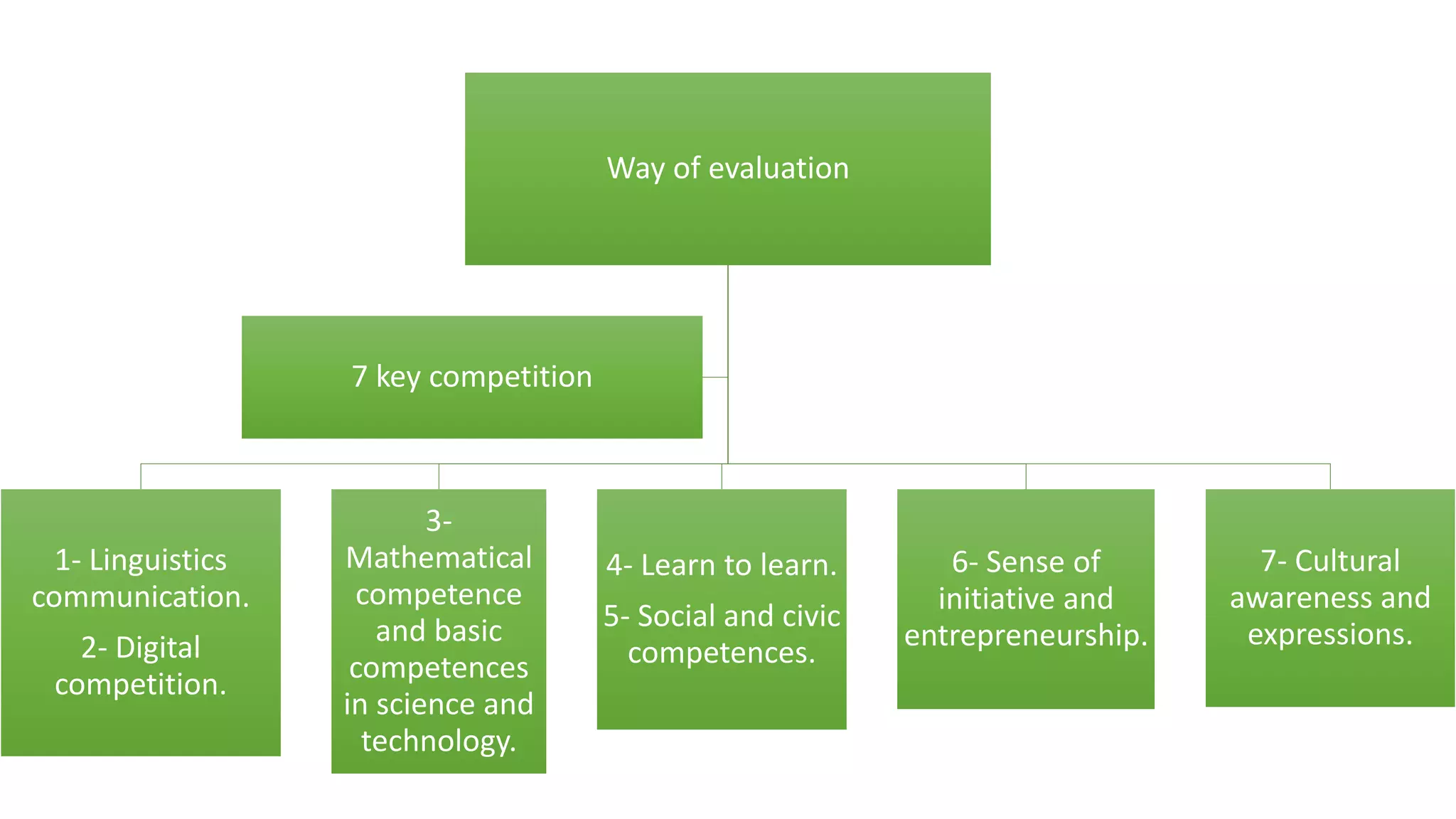
Way of evaluation
1- Linguistics
communication.
2- Digital
competition.
3-
Mathematical
competence
and basic
competences
in science and
technology.
4- Learn to learn.
5- Social and civic
competences.
6- Sense of
initiative and
entrepreneurship.
7- Cultural
awareness and
expressions.
7 key competition
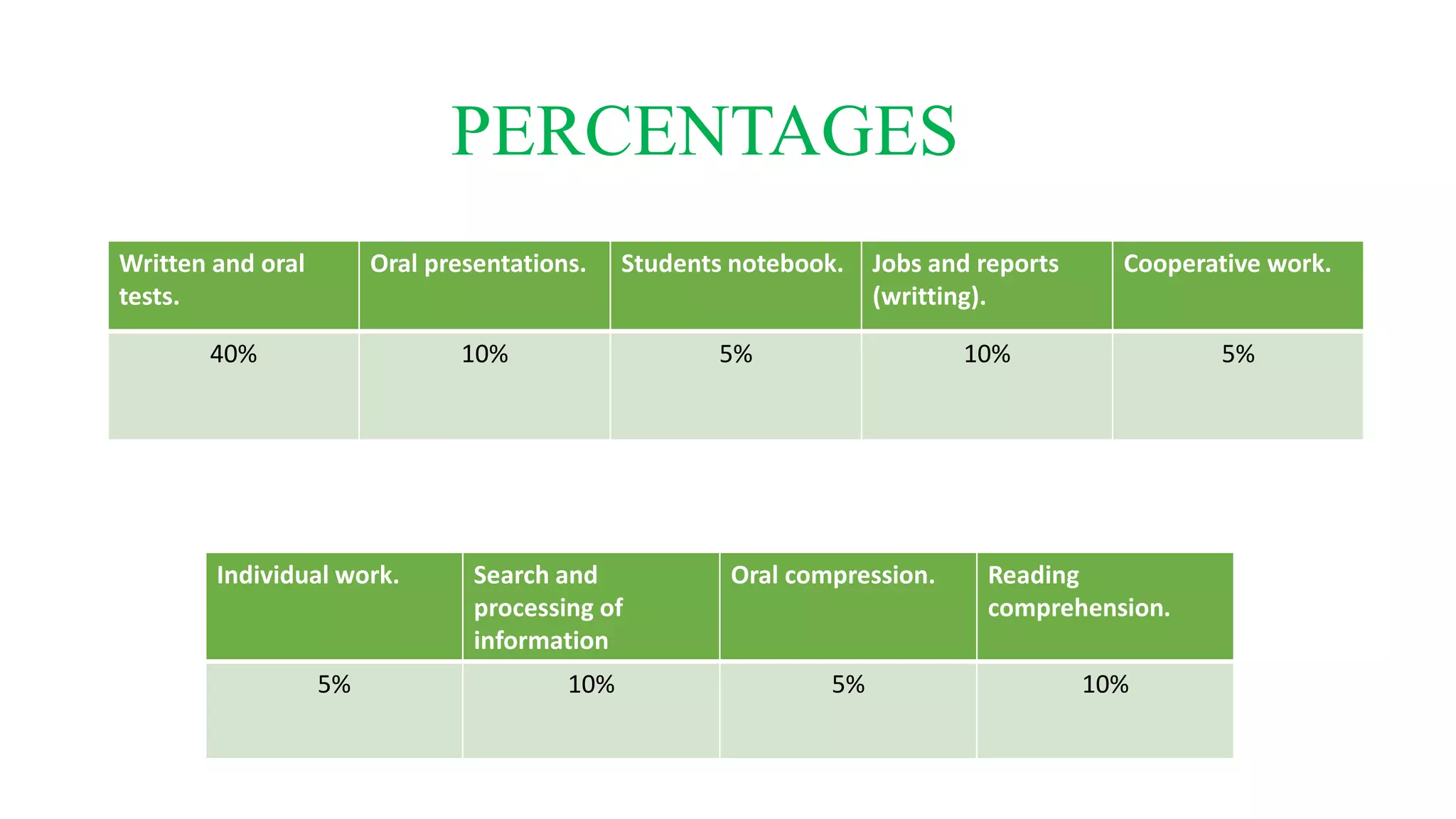
Written and oral
tests.
Oral presentations. Students notebook. Jobs and reports
(writting).
Cooperative work.
40% 10% 5% 10% 5%
Individual work. Search and
processing of
information
Oral compression. Reading
comprehension.
5% 10% 5% 10%
PERCENTAGES
TECNHIQUES TEACHERS
-Las observation techniques.
-Las measurement techniques.
-Self-assessment techniques.
Teacher´s notebook.
Teacher registre quarterly.
Profile of competition área.
Rubrics.
Portfolio.
WAYS IN WICH TEACHERS TEACH:
LENGUAGUE: listen,
talk, dialogue,
Reading and writting.
MATHS: information
processing,
application and new
learning knowledge.
SCIENCE: provide
new experience,
observe the reality, aks
questions, and make
them able to responses
new questions.
SOCIAL SCIENCE:
use of different types
of texts, pictures and
graphics that are
useful to identify and
locate objects and
geographical facts.
Use maps and some
graphic representation.
DYNAMICS CLASSES
Motivation
activities
Development
activities
Reinforcement
activities -
recovery
Extension
activities:
Transverse
activities
Evaluation
activities
TEACHING METHODS
• Develop of different áreas as cognitive, analyze, identify, establish, locate,
recognize, solve…
• Promote in students autonomy, creativity, reflection and critical thinking.
• To contextualize learning so that students apply their knowledge, skills or attitudes
beyond our own content area and is able to transfer their learning to different school
contexts.
• Empower students in autonomous learning processes.
• Encourage experiential and research methodology.
• Use different sources (direct, literature, Internet, etc.) information and diversify
teaching materials and resources.
• To promote collaborative work, mutual acceptance and empathy.
• To diversify.
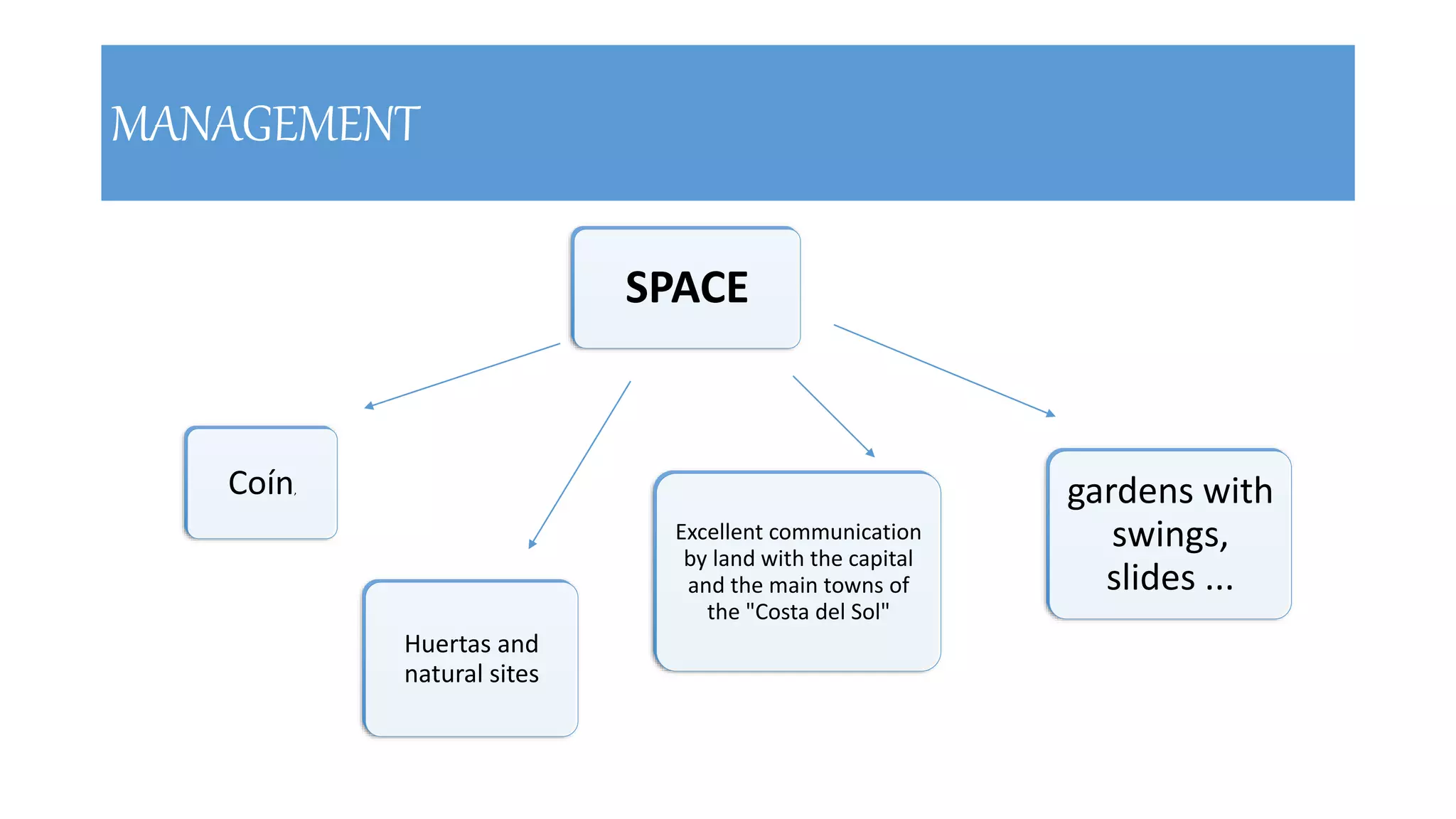
MANAGEMENT
SPACE
Coín,
Huertas and
natural sites
Excellent communication
by land with the capital
and the main towns of
the "Costa del Sol"
gardens with
swings,
slides ...
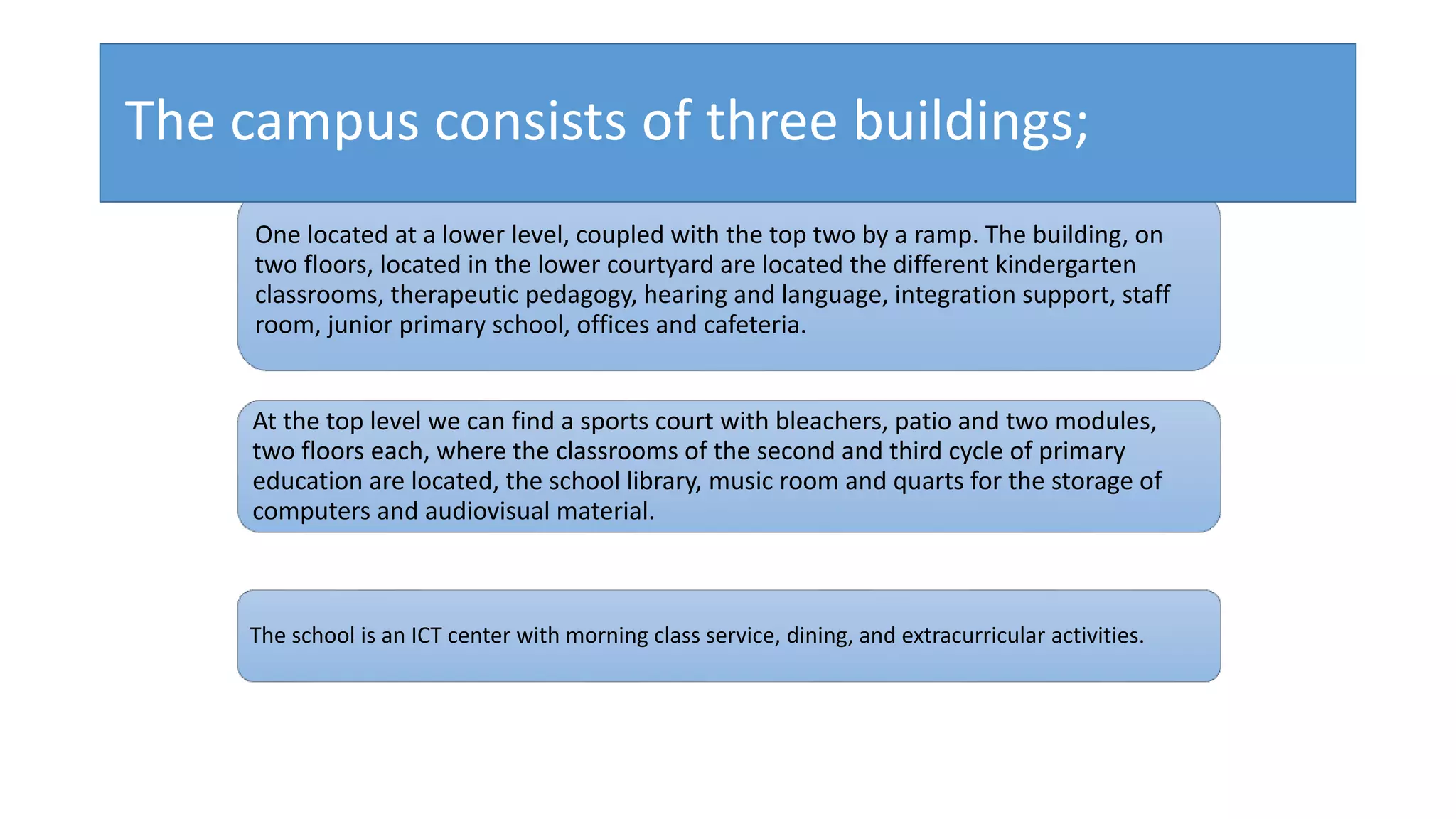
One located at a lower level, coupled with the top two by a ramp. The building, on
two floors, located in the lower courtyard are located the different kindergarten
classrooms, therapeutic pedagogy, hearing and language, integration support, staff
room, junior primary school, offices and cafeteria.
At the top level we can find a sports court with bleachers, patio and two modules,
two floors each, where the classrooms of the second and third cycle of primary
education are located, the school library, music room and quarts for the storage of
computers and audiovisual material.
The school is an ICT center with morning class service, dining, and extracurricular activities.
The campus consists of three buildings;
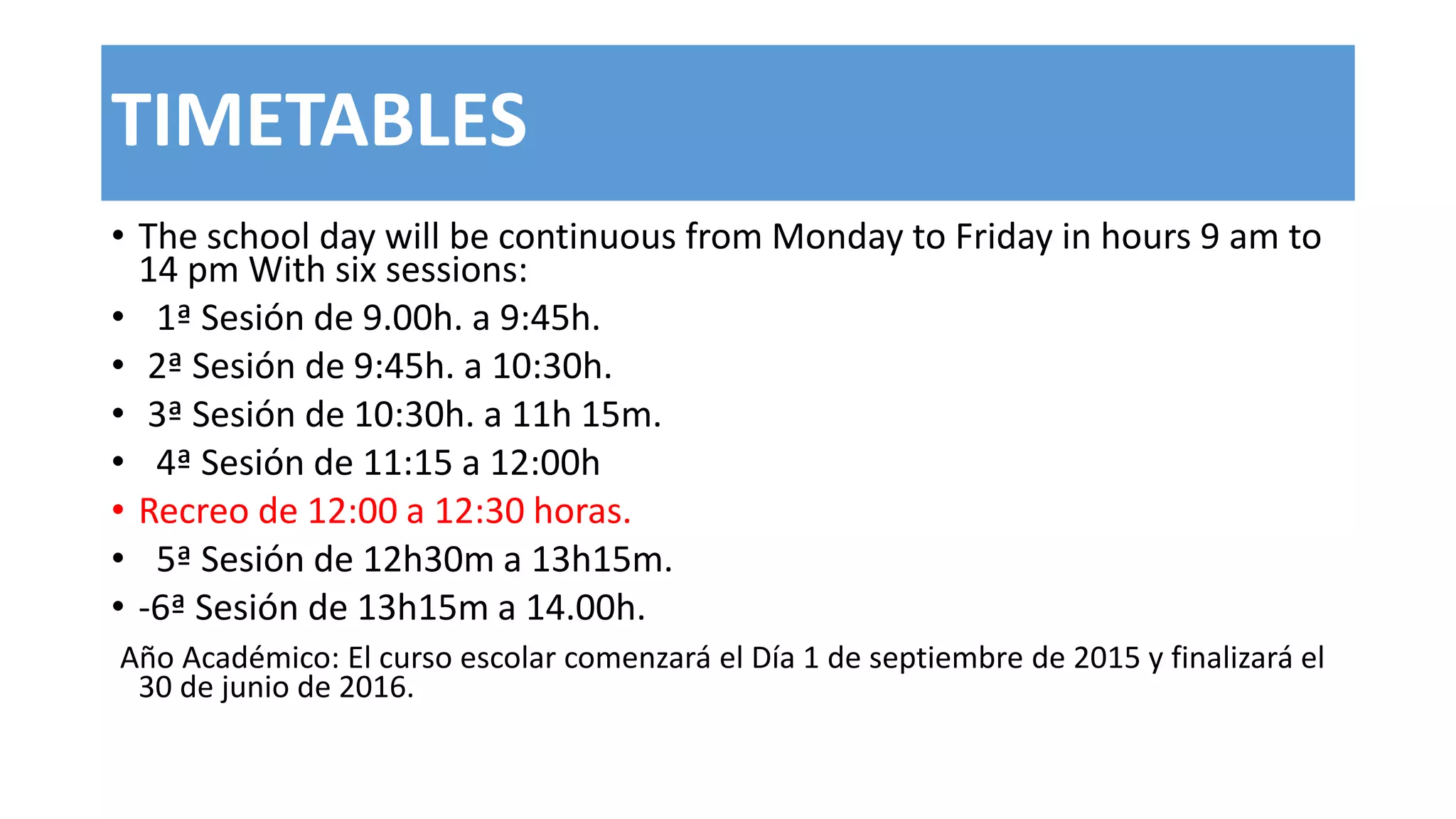
TIMETABLES
• The school day will be continuous from Monday to Friday in hours 9 am to
14 pm With six sessions:
• 1ª Sesión de 9.00h. a 9:45h.
• 2ª Sesión de 9:45h. a 10:30h.
• 3ª Sesión de 10:30h. a 11h 15m.
• 4ª Sesión de 11:15 a 12:00h
• Recreo de 12:00 a 12:30 horas.
• 5ª Sesión de 12h30m a 13h15m.
• -6ª Sesión de 13h15m a 14.00h.
Año Académico: El curso escolar comenzará el Día 1 de septiembre de 2015 y finalizará el
30 de junio de 2016.
EXTRACURRICULAR ACTIVITIES
• Día de la Constitución.
• Día de la casta a.
• Fiesta de la Navidad
• Día de la Paz .
• Fiesta de Carnaval.
• Día de Andalucía
• Día contra la Violencia de Género
• Día del libro
• Concierto de Primavera
• Fiesta Fin de Curso
Social
Families have an average sociocultural and
economic level.
We could say that most of the families of our
students are usually well structured and are
involved in the education of their children.
Desarrollo social
a) peer interaction and group living increases: cooperation, participation and strengthening
bonds of friendship.
b) Advances notably on knowledge, empathy and acceptance of others.
c) learn rules and unfolds easily in systems of social organization.
d) progress in building an autonomous moral, assimilating value systems and beliefs and
develop positive attitudes.
In general, the heterónoma phase culminates with the invaluable help of the peer group and
play, basis for the introduction and construction of personal and social autonomy.
Integration Activities
 Organize activities "host" in the early going, especially for students who come to the center for the first time.
 Explain the functions and tasks of mentoring.
 Knowing school background and personal situation.
 Encourage student-knowledge and self-acceptance.
 Encourage and guide the group of students to raise their needs.
 Deepen the knowledge of skills, interests and motivations of each of the students.
 Students analyze the advantages and disadvantages of various options of educational and career paths.
 Promote and coordinate activities that promote coexistence, integration and participation of students in the life of the Centre and
the environment.
Relationship with families
On the one hand families will have to work
closely and should commit to the daily work of
their children and the life of schools.
On the other hand, Article 91 of the LOE says:
"The tutor must regularly inform families about
the learning process of their children, as well as
guidance for their cooperation in it."
POLITICAL
NORMATIVE JUSTIFICATION
The educational program presented below is a specific
tool for planning, development and evaluation of the
different areas of the first cycle of primary education,
adapted to the provisions of the following legislation:
 Ley Orgánica de 2/2006, de 3 de mayo, de Educación modificada parcialmente por Ley
Orgánica 8/2013, de 9 de diciembre, para la mejora de la calidad educativa (LOMCE)
 Real Decreto 82/1996, de 26 de enero, por el que se aprueba el Reglamento Orgánico de
las Escuelas de Educación Infantil y de los Colegios de Educación Primaria.
 Real Decreto 126/2014, de 28 de febrero, por el que se establece el currículo básico de
la Educación Primaria.
 Decreto 97/2015, de 3 de marzo, por el que se establece la ordenación y el currículo de la
Educación Primaria en la Comunidad Autónoma de Andalucía (BOJA 13-03-15)
 Orden de 25 de julio de 2008, por la que se regula la atención a la diversidad del
alumnado que cursa la educación básica en los centros docentes públicos de Andalucía.
(BOJA 22-8-2008)
 Orden ECD/65/2015, de 21 de enero, por la que se describen las relaciones entre las
competencias, los contenidos y los criterios de evaluación de la educación primaria, la
educación secundaria obligatoria y el bachillerato (BOE 29-01-2015).
 Orden de 17 de marzo de 2015, por la que se desarrolla el currículo correspondiente a la
Educación Primaria en Andalucía (BOJA 27-03-2015).
 Orden de 28 de abril de 2015, por la que se modifica la Orden de 20 de junio de 2011, por
la que se adoptan medidas para la promoción de la convivencia en los centros docentes
sostenidos con fondos públicos y se regula el derecho de las familias a participar en el
proceso educativo de sus hijos e hijas (BOJA 21-05-2015).
 Instrucciones de 24 de julio de 2013 sobre el fomento de la lectura y bibliotecas.
 Instrucciones de 22 de junio de 2015, de la Dirección General de Participación y Equidad,
por las que se establece el protocolo de detección, identificación del alumnado con
necesidades específicas de apoyo educativo y organización de la respuesta educativa.
For its development they were taken into
account the general criteria set out in the
educational project and the needs and
characteristics of students.
They have been developed by teams cycle
and approved by the Senate of Teachers.
However, you can update or modify, if
necessary, after self-assessment processes.
• The school will make activities where children will development some skill as creativity and communication skills.
• Process: searching, sorting, processing, creation and communication.
• The school will make outdoor activities.
CULTURE
Day of the constitution
 Peace Day
 Andalucia's day
Book day as noted outputs
to the environment: Know
the scenic environment of
the school.
Activities to Naturale in
Llano de Matagallar.
Reforestation As planned
excursions: Visit the
Alhambra in Granada Exit
to the plains of Matagallar
to participate in the
exhibition of state security
bodies, such as police, civil
guard, firefighters, etc.

Presentación

  • 1.
  • 2.
  • 3.
    Way of evaluation 1-Linguistics communication. 2- Digital competition. 3- Mathematical competence and basic competences in science and technology. 4- Learn to learn. 5- Social and civic competences. 6- Sense of initiative and entrepreneurship. 7- Cultural awareness and expressions. 7 key competition
  • 4.
    Written and oral tests. Oralpresentations. Students notebook. Jobs and reports (writting). Cooperative work. 40% 10% 5% 10% 5% Individual work. Search and processing of information Oral compression. Reading comprehension. 5% 10% 5% 10% PERCENTAGES
  • 5.
    TECNHIQUES TEACHERS -Las observationtechniques. -Las measurement techniques. -Self-assessment techniques. Teacher´s notebook. Teacher registre quarterly. Profile of competition área. Rubrics. Portfolio.
  • 6.
    WAYS IN WICHTEACHERS TEACH: LENGUAGUE: listen, talk, dialogue, Reading and writting. MATHS: information processing, application and new learning knowledge. SCIENCE: provide new experience, observe the reality, aks questions, and make them able to responses new questions. SOCIAL SCIENCE: use of different types of texts, pictures and graphics that are useful to identify and locate objects and geographical facts. Use maps and some graphic representation.
  • 7.
  • 8.
    TEACHING METHODS • Developof different áreas as cognitive, analyze, identify, establish, locate, recognize, solve… • Promote in students autonomy, creativity, reflection and critical thinking. • To contextualize learning so that students apply their knowledge, skills or attitudes beyond our own content area and is able to transfer their learning to different school contexts. • Empower students in autonomous learning processes. • Encourage experiential and research methodology. • Use different sources (direct, literature, Internet, etc.) information and diversify teaching materials and resources. • To promote collaborative work, mutual acceptance and empathy. • To diversify.
  • 9.
    MANAGEMENT SPACE Coín, Huertas and natural sites Excellentcommunication by land with the capital and the main towns of the "Costa del Sol" gardens with swings, slides ...
  • 10.
    One located ata lower level, coupled with the top two by a ramp. The building, on two floors, located in the lower courtyard are located the different kindergarten classrooms, therapeutic pedagogy, hearing and language, integration support, staff room, junior primary school, offices and cafeteria. At the top level we can find a sports court with bleachers, patio and two modules, two floors each, where the classrooms of the second and third cycle of primary education are located, the school library, music room and quarts for the storage of computers and audiovisual material. The school is an ICT center with morning class service, dining, and extracurricular activities. The campus consists of three buildings;
  • 11.
    TIMETABLES • The schoolday will be continuous from Monday to Friday in hours 9 am to 14 pm With six sessions: • 1ª Sesión de 9.00h. a 9:45h. • 2ª Sesión de 9:45h. a 10:30h. • 3ª Sesión de 10:30h. a 11h 15m. • 4ª Sesión de 11:15 a 12:00h • Recreo de 12:00 a 12:30 horas. • 5ª Sesión de 12h30m a 13h15m. • -6ª Sesión de 13h15m a 14.00h. Año Académico: El curso escolar comenzará el Día 1 de septiembre de 2015 y finalizará el 30 de junio de 2016.
  • 12.
    EXTRACURRICULAR ACTIVITIES • Díade la Constitución. • Día de la casta a. • Fiesta de la Navidad • Día de la Paz . • Fiesta de Carnaval. • Día de Andalucía • Día contra la Violencia de Género • Día del libro • Concierto de Primavera • Fiesta Fin de Curso
  • 13.
    Social Families have anaverage sociocultural and economic level. We could say that most of the families of our students are usually well structured and are involved in the education of their children.
  • 14.
    Desarrollo social a) peerinteraction and group living increases: cooperation, participation and strengthening bonds of friendship. b) Advances notably on knowledge, empathy and acceptance of others. c) learn rules and unfolds easily in systems of social organization. d) progress in building an autonomous moral, assimilating value systems and beliefs and develop positive attitudes. In general, the heterónoma phase culminates with the invaluable help of the peer group and play, basis for the introduction and construction of personal and social autonomy.
  • 15.
    Integration Activities  Organizeactivities "host" in the early going, especially for students who come to the center for the first time.  Explain the functions and tasks of mentoring.  Knowing school background and personal situation.  Encourage student-knowledge and self-acceptance.  Encourage and guide the group of students to raise their needs.  Deepen the knowledge of skills, interests and motivations of each of the students.  Students analyze the advantages and disadvantages of various options of educational and career paths.  Promote and coordinate activities that promote coexistence, integration and participation of students in the life of the Centre and the environment.
  • 16.
    Relationship with families Onthe one hand families will have to work closely and should commit to the daily work of their children and the life of schools. On the other hand, Article 91 of the LOE says: "The tutor must regularly inform families about the learning process of their children, as well as guidance for their cooperation in it."
  • 17.
    POLITICAL NORMATIVE JUSTIFICATION The educationalprogram presented below is a specific tool for planning, development and evaluation of the different areas of the first cycle of primary education, adapted to the provisions of the following legislation:
  • 18.
     Ley Orgánicade 2/2006, de 3 de mayo, de Educación modificada parcialmente por Ley Orgánica 8/2013, de 9 de diciembre, para la mejora de la calidad educativa (LOMCE)  Real Decreto 82/1996, de 26 de enero, por el que se aprueba el Reglamento Orgánico de las Escuelas de Educación Infantil y de los Colegios de Educación Primaria.  Real Decreto 126/2014, de 28 de febrero, por el que se establece el currículo básico de la Educación Primaria.  Decreto 97/2015, de 3 de marzo, por el que se establece la ordenación y el currículo de la Educación Primaria en la Comunidad Autónoma de Andalucía (BOJA 13-03-15)  Orden de 25 de julio de 2008, por la que se regula la atención a la diversidad del alumnado que cursa la educación básica en los centros docentes públicos de Andalucía. (BOJA 22-8-2008)  Orden ECD/65/2015, de 21 de enero, por la que se describen las relaciones entre las competencias, los contenidos y los criterios de evaluación de la educación primaria, la educación secundaria obligatoria y el bachillerato (BOE 29-01-2015).  Orden de 17 de marzo de 2015, por la que se desarrolla el currículo correspondiente a la Educación Primaria en Andalucía (BOJA 27-03-2015).  Orden de 28 de abril de 2015, por la que se modifica la Orden de 20 de junio de 2011, por la que se adoptan medidas para la promoción de la convivencia en los centros docentes sostenidos con fondos públicos y se regula el derecho de las familias a participar en el proceso educativo de sus hijos e hijas (BOJA 21-05-2015).  Instrucciones de 24 de julio de 2013 sobre el fomento de la lectura y bibliotecas.  Instrucciones de 22 de junio de 2015, de la Dirección General de Participación y Equidad, por las que se establece el protocolo de detección, identificación del alumnado con necesidades específicas de apoyo educativo y organización de la respuesta educativa.
  • 19.
    For its developmentthey were taken into account the general criteria set out in the educational project and the needs and characteristics of students. They have been developed by teams cycle and approved by the Senate of Teachers. However, you can update or modify, if necessary, after self-assessment processes.
  • 20.
    • The schoolwill make activities where children will development some skill as creativity and communication skills. • Process: searching, sorting, processing, creation and communication. • The school will make outdoor activities. CULTURE Day of the constitution  Peace Day  Andalucia's day Book day as noted outputs to the environment: Know the scenic environment of the school. Activities to Naturale in Llano de Matagallar. Reforestation As planned excursions: Visit the Alhambra in Granada Exit to the plains of Matagallar to participate in the exhibition of state security bodies, such as police, civil guard, firefighters, etc.