SPAIN
I. BASIC FACTS
Language, Currency, Capital, Flag, Government, Trivia
• LANGUAGE
Spanish
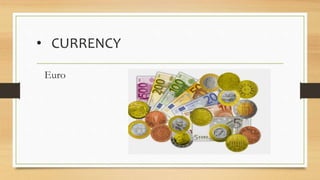
• CURRENCY
Euro
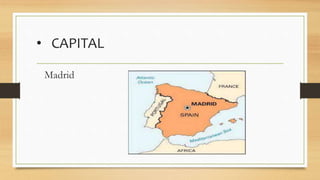
• CAPITAL
Madrid
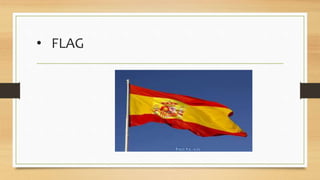
• FLAG
• GOVERNMENT
Spain is a constitutional monarchy whose government is defined by the
Constitution of Spain. This was approved by a general referendum of the
people of Spain in 1978. The final interpretation of the Constitution, in the
case of dispute, is the business of the Constitutional Court of Spain.
• TRIVIA
1. When your car is towed away, a message left on the street so you
know where it was taken
2. Spain has a very low birthrate. Most attribute this to high
unemployment, low wages and steep housing costs.
3. Sunflower seeds are big deal in Spain. More importantly, Spaniards are
really talented at opening and eating them at a shocking speed.
4. Spanish food is not spicy and very seldom hot. Learn more about the
Mediterranean diet.
5. Same-sex marriage in Spain became legal on July 3, 2005.
II. ACCESS ROUTES
Air, Sea, Land
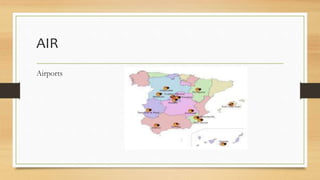
AIR
Airports
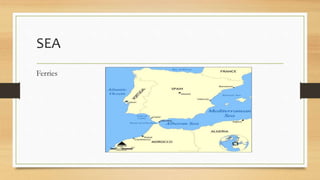
SEA
Ferries
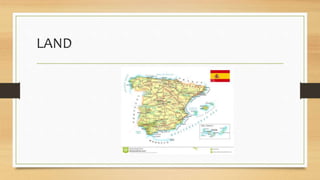
LAND
III. GEOGRAPHICAL
FEATURES
Most visited tourist attractions
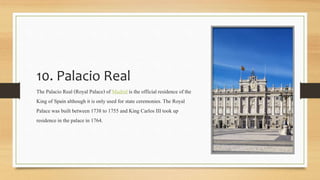
10. Palacio Real
The Palacio Real (Royal Palace) of Madrid is the officialresidence ofthe
King of Spain although it is only used for state ceremonies.The Royal
Palace was built between 1738 to 1755 and King Carlos III took up
residence in the palace in 1764.
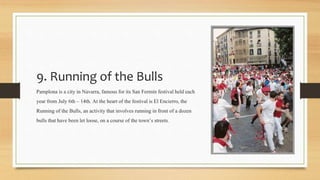
9. Running of the Bulls
Pamplona is a city in Navarra, famous for its San Fermín festivalheld each
year from July 6th – 14th. At the heart of the festival isEl Encierro, the
Running of the Bulls, an activitythat involvesrunning in front of a dozen
bulls that have been let loose, on a course of the town’s streets.
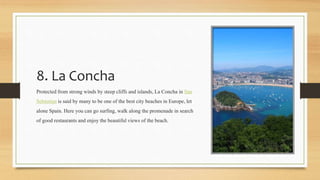
8. La Concha
Protectedfrom strong winds by steep cliffs and islands, La Concha in San
Sebastian is said by many to be one of the best city beaches in Europe, let
alone Spain. Here you can go surfing, walk along the promenade in search
of good restaurants and enjoy the beautifulviews of the beach.
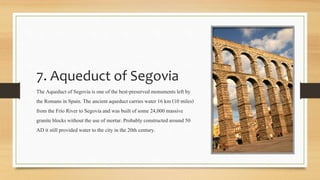
7. Aqueduct of Segovia
The Aqueduct of Segovia is one of the best-preservedmonuments left by
the Romans in Spain. The ancientaqueduct carrieswater 16 km (10 miles)
from the Frío River to Segovia and was built of some 24,000 massive
granite blocks without the use of mortar. Probably constructed around 50
AD it still providedwater to the city in the 20th century.
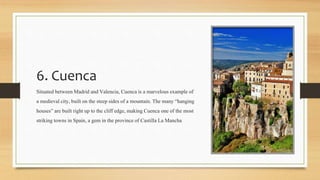
6. Cuenca
Situated between Madrid and Valencia, Cuenca is a marvelousexample of
a medieval city, built on the steep sides of a mountain. The many “hanging
houses” are built right up to the cliff edge, making Cuenca one of the most
strikingtowns in Spain, a gem in the provinceof Castilla La Mancha
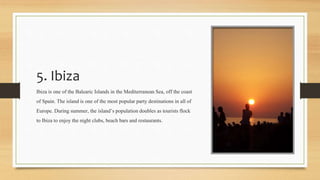
5. Ibiza
Ibiza is one of the Balearic Islands in the MediterraneanSea, off the coast
of Spain. The island is one of the most popular party destinationsin all of
Europe. During summer, the island’spopulationdoubles as tourists flock
to Ibiza to enjoy the night clubs, beach bars and restaurants.
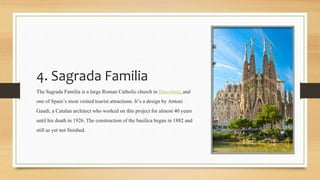
4. Sagrada Familia
The Sagrada Familia is a large Roman Catholic church in Barcelona,and
one of Spain’s most visited touristattractions. It’s a design by Antoni
Gaudí, a Catalan architect who worked on this project for almost 40 years
until his death in 1926. The construction ofthe basilicabegan in 1882 and
still as yet not finished.
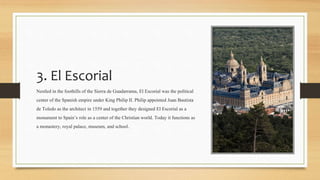
3. El Escorial
Nestled in the foothills of the Sierra de Guadarrama, El Escorial was the political
center of the Spanish empire under King Philip II. Philip appointed Juan Bautista
de Toledo as the architect in 1559 and together they designed El Escorial as a
monument to Spain’s role as a center of the Christian world. Today it functions as
a monastery, royal palace, museum, and school.
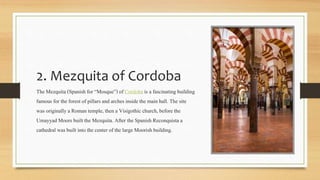
2. Mezquita of Cordoba
The Mezquita (Spanish for “Mosque”) of Cordoba is a fascinating building
famous for the forest of pillars and arches inside the main hall. The site
was originallya Roman temple, then a Visigothic church, before the
Umayyad Moors built the Mezquita.After the Spanish Reconquista a
cathedral was built into the center of the large Moorish building.
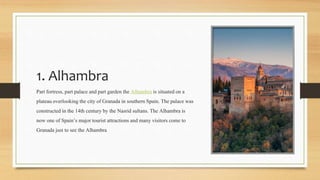
1. Alhambra
Part fortress, part palace andpart garden the Alhambra is situatedon a
plateauoverlookingthe city of Granada in southern Spain. The palace was
constructed in the 14th century by the Nasrid sultans. The Alhambra is
now one of Spain’s major tourist attractions and many visitors come to
Granada just to see the Alhambra
IV. DISTINCT CULTURAL
ATTRIBUTES
Unique culture, Religion, Festivals
UNIQUE CULTURE
The culture of Spain is known for its folklores in different regions of Spain. A mixed culture has emerged in the
recent time in Spain with the increasingmigration of Europeansto Spain. The culture ofSpain is acknowledgedfor
its festivalsduring New Year and Easter weeks. There is a fine blend of spiritualand cheerful characteristicsin the
Spanish culture.
TREE MAGI - where the children receive gifts from Santa Claus.
BULL FIGHTING - Practiced in two different ways, either the rider or his mount were to face the
bull directly or they practically sideswiped the animal trying to spear it during the fight. This is one
of the most dangerous and unique sport of Spain and an integral part of the traditions in Spain.
MUSIC - Music in Spain is varied in form and style, although for many citizens, it is synonymous to
Flamenco,an Andalusian genre of music. But here is also existence of rock music, folks, pop, and
hip hops in Spanish lands.
SPANISH DANCE - Spanish Dance can be defined as a complicated dance movement that
originates from the native country of Spain and is not predominately influenced by other
communities or culture. It is mainly performed by talented professionals who had formal training in
any of the categories of Spanish dance and / or attained a degree in it.
The 6 categories of Spanish Dance are:
• Folklore
• Eighteenth Century Dances
• Classical Ballet Dance
• Castanets
• Flamenco
• Classical Spanish Dance or Estilización
RELIGION
Roman Catholicism is by far the largest denomination present in Spain.
According to a study by the Spanish Centre for Sociological Research in 2014
about 68% of Spaniards self-identify as Catholics, 2% other faith, and about
27% identify as atheists or declare they have no religion.
FESTIVALS
Spain is the land of fiestas or festivals. In every single city, town and village
there is a festival of some kind which gets all the townsfolk out on the streets
partying with their neighbours. The biggest festivals of international fame are
the BULL RUNNING OF PAMPLONA, the fireworks of LAS FALLAS in
Valencia, the mock battles of MOROS Y CRISTIANOS in Alcoy, SEMANA
SANTA in all of Andalucia and the massive FERIA DE ABRIL in Seville.
V. GASTRONOMY
Cuisines
CUISINE
Spanish cuisine is a way of preparing varied dishes, which is enriched by the
culinary contributions of the various regions that make up the country. It is a
cuisine influenced by the people who, throughout history, have conquered the
territory of that country, as well by the subsequently colonized regions.

Tour10 spain bacani

  • 1.
  • 2.
    I. BASIC FACTS Language,Currency, Capital, Flag, Government, Trivia
  • 3.
  • 4.
  • 5.
  • 6.
  • 7.
    • GOVERNMENT Spain isa constitutional monarchy whose government is defined by the Constitution of Spain. This was approved by a general referendum of the people of Spain in 1978. The final interpretation of the Constitution, in the case of dispute, is the business of the Constitutional Court of Spain.
  • 8.
    • TRIVIA 1. Whenyour car is towed away, a message left on the street so you know where it was taken 2. Spain has a very low birthrate. Most attribute this to high unemployment, low wages and steep housing costs. 3. Sunflower seeds are big deal in Spain. More importantly, Spaniards are really talented at opening and eating them at a shocking speed. 4. Spanish food is not spicy and very seldom hot. Learn more about the Mediterranean diet. 5. Same-sex marriage in Spain became legal on July 3, 2005.
  • 9.
  • 10.
  • 11.
  • 12.
  • 13.
  • 14.
    10. Palacio Real ThePalacio Real (Royal Palace) of Madrid is the officialresidence ofthe King of Spain although it is only used for state ceremonies.The Royal Palace was built between 1738 to 1755 and King Carlos III took up residence in the palace in 1764.
  • 15.
    9. Running ofthe Bulls Pamplona is a city in Navarra, famous for its San Fermín festivalheld each year from July 6th – 14th. At the heart of the festival isEl Encierro, the Running of the Bulls, an activitythat involvesrunning in front of a dozen bulls that have been let loose, on a course of the town’s streets.
  • 16.
    8. La Concha Protectedfromstrong winds by steep cliffs and islands, La Concha in San Sebastian is said by many to be one of the best city beaches in Europe, let alone Spain. Here you can go surfing, walk along the promenade in search of good restaurants and enjoy the beautifulviews of the beach.
  • 17.
    7. Aqueduct ofSegovia The Aqueduct of Segovia is one of the best-preservedmonuments left by the Romans in Spain. The ancientaqueduct carrieswater 16 km (10 miles) from the Frío River to Segovia and was built of some 24,000 massive granite blocks without the use of mortar. Probably constructed around 50 AD it still providedwater to the city in the 20th century.
  • 18.
    6. Cuenca Situated betweenMadrid and Valencia, Cuenca is a marvelousexample of a medieval city, built on the steep sides of a mountain. The many “hanging houses” are built right up to the cliff edge, making Cuenca one of the most strikingtowns in Spain, a gem in the provinceof Castilla La Mancha
  • 19.
    5. Ibiza Ibiza isone of the Balearic Islands in the MediterraneanSea, off the coast of Spain. The island is one of the most popular party destinationsin all of Europe. During summer, the island’spopulationdoubles as tourists flock to Ibiza to enjoy the night clubs, beach bars and restaurants.
  • 20.
    4. Sagrada Familia TheSagrada Familia is a large Roman Catholic church in Barcelona,and one of Spain’s most visited touristattractions. It’s a design by Antoni Gaudí, a Catalan architect who worked on this project for almost 40 years until his death in 1926. The construction ofthe basilicabegan in 1882 and still as yet not finished.
  • 21.
    3. El Escorial Nestledin the foothills of the Sierra de Guadarrama, El Escorial was the political center of the Spanish empire under King Philip II. Philip appointed Juan Bautista de Toledo as the architect in 1559 and together they designed El Escorial as a monument to Spain’s role as a center of the Christian world. Today it functions as a monastery, royal palace, museum, and school.
  • 22.
    2. Mezquita ofCordoba The Mezquita (Spanish for “Mosque”) of Cordoba is a fascinating building famous for the forest of pillars and arches inside the main hall. The site was originallya Roman temple, then a Visigothic church, before the Umayyad Moors built the Mezquita.After the Spanish Reconquista a cathedral was built into the center of the large Moorish building.
  • 23.
    1. Alhambra Part fortress,part palace andpart garden the Alhambra is situatedon a plateauoverlookingthe city of Granada in southern Spain. The palace was constructed in the 14th century by the Nasrid sultans. The Alhambra is now one of Spain’s major tourist attractions and many visitors come to Granada just to see the Alhambra
  • 24.
    IV. DISTINCT CULTURAL ATTRIBUTES Uniqueculture, Religion, Festivals
  • 25.
    UNIQUE CULTURE The cultureof Spain is known for its folklores in different regions of Spain. A mixed culture has emerged in the recent time in Spain with the increasingmigration of Europeansto Spain. The culture ofSpain is acknowledgedfor its festivalsduring New Year and Easter weeks. There is a fine blend of spiritualand cheerful characteristicsin the Spanish culture. TREE MAGI - where the children receive gifts from Santa Claus. BULL FIGHTING - Practiced in two different ways, either the rider or his mount were to face the bull directly or they practically sideswiped the animal trying to spear it during the fight. This is one of the most dangerous and unique sport of Spain and an integral part of the traditions in Spain.
  • 26.
    MUSIC - Musicin Spain is varied in form and style, although for many citizens, it is synonymous to Flamenco,an Andalusian genre of music. But here is also existence of rock music, folks, pop, and hip hops in Spanish lands. SPANISH DANCE - Spanish Dance can be defined as a complicated dance movement that originates from the native country of Spain and is not predominately influenced by other communities or culture. It is mainly performed by talented professionals who had formal training in any of the categories of Spanish dance and / or attained a degree in it.
  • 27.
    The 6 categoriesof Spanish Dance are: • Folklore • Eighteenth Century Dances • Classical Ballet Dance • Castanets • Flamenco • Classical Spanish Dance or Estilización
  • 28.
    RELIGION Roman Catholicism isby far the largest denomination present in Spain. According to a study by the Spanish Centre for Sociological Research in 2014 about 68% of Spaniards self-identify as Catholics, 2% other faith, and about 27% identify as atheists or declare they have no religion.
  • 29.
    FESTIVALS Spain is theland of fiestas or festivals. In every single city, town and village there is a festival of some kind which gets all the townsfolk out on the streets partying with their neighbours. The biggest festivals of international fame are the BULL RUNNING OF PAMPLONA, the fireworks of LAS FALLAS in Valencia, the mock battles of MOROS Y CRISTIANOS in Alcoy, SEMANA SANTA in all of Andalucia and the massive FERIA DE ABRIL in Seville.
  • 30.
  • 31.
    CUISINE Spanish cuisine isa way of preparing varied dishes, which is enriched by the culinary contributions of the various regions that make up the country. It is a cuisine influenced by the people who, throughout history, have conquered the territory of that country, as well by the subsequently colonized regions.