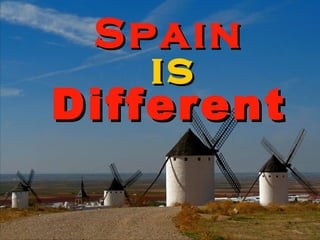
Spain    is Different Presented by:  Kai Garcia
General information & comparison Quick look at History in Spain Main Cities : Madrid Barcelona Seville Granada Pamplona Valencia Flamenco & Dancing Bullfight
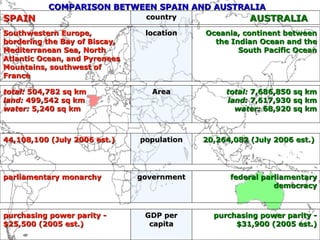
COMPARISON BETWEEN SPAIN AND AUSTRALIA AUSTRALIA  country SPAIN purchasing power parity -$31,900 (2005 est.) GDP per capita purchasing power parity - $25,500 (2005 est.) total:  7,686,850 sq km land:  7,617,930 sq km water:  68,920 sq km Area total:  504,782 sq km land:  499,542 sq km water:  5,240 sq km Oceania, continent between the Indian Ocean and the South Pacific Ocean location Southwestern Europe, bordering the Bay of Biscay, Mediterranean Sea, North Atlantic Ocean, and Pyrenees Mountains, southwest of France 20,264,082 (July 2006 est.)  population 44,108,100 (July 2006 est.) federal parliamentary democracy government parliamentary monarchy
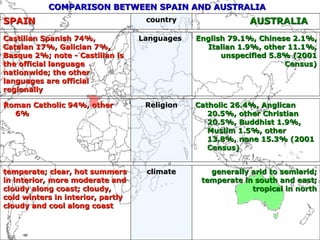
COMPARISON BETWEEN SPAIN AND AUSTRALIA Catholic 26.4%, Anglican 20.5%, other Christian 20.5%, Buddhist 1.9%, Muslim 1.5%, other 13.8%, none 15.3% (2001 Census) Religion Roman Catholic 94%, other 6% English 79.1%, Chinese 2.1%, Italian 1.9%, other 11.1%, unspecified 5.8% (2001 Census) Languages Castilian Spanish 74%, Catalan 17%, Galician 7%, Basque 2%; note - Castilian is the official language nationwide; the other languages are official regionally generally arid to semiarid; temperate in south and east; tropical in north climate temperate; clear, hot summers in interior, more moderate and cloudy along coast; cloudy, cold winters in interior, partly cloudy and cool along coast AUSTRALIA  country SPAIN
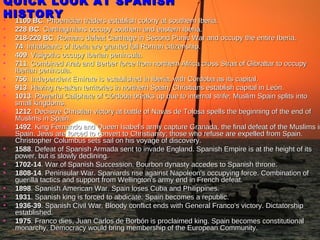
QUICK LOOK AT SPANISH HISTORY 1100 BC . Phoenician traders establish colony at southern Iberia. 228 BC . Carthaginians occupy southern and eastern Iberia. 218-220 BC . Romans defeat Carthage in Second Punic War and occupy the entire Iberia. 74 . Inhabitants of Iberia are granted full Roman citizenship. 409 . Visigoths occupy Iberian peninsula. 711 . Combined Arab and Berber force from northern Africa cross Strait of Gibraltar to occupy Iberian peninsula. 756 . Independent Emirate is established in Iberia, with Córdoba as its capital. 913 . Having re-taken territories in northern Spain, Christians establish capital in León. 1013 . Powerful Caliphate of Córdoba breaks up due to internal strife; Muslim Spain splits into small kingdoms. 1212 . Decisive Christian victory at battle of Navas de Tolosa spells the beginning of the end of Muslims in Spain. 1492 . King Fernando and Queen Isabel's army capture Granada, the final defeat of the Muslims in Spain. Jews are forced to convert to Christianity; those who refuse are   expelled from Spain. Christopher Columbus sets sail on his voyage of discovery. 1588 . Defeat of Spanish Armada sent to invade England. Spanish Empire is at the height of its power, but is slowly declining. 1702-14 . War of Spanish Succession. Bourbon dynasty accedes to Spanish throne. 1808-14 . Peninsular War. Spaniards rise against Napoleon's occupying force. Combination of guerilla tactics and support from Wellington's army end in French defeat. 1898 . Spanish American War. Spain loses Cuba and Philippines. 1931 . Spanish king is forced to abdicate. Spain becomes a republic. 1936-39 . Spanish Civil War. Bloody conflict ends with General Franco's victory. Dictatorship established. 1975 . Franco dies, Juan Carlos de Borbón is proclaimed king. Spain becomes constitutional monarchy. Democracy would bring membership of the European Community.
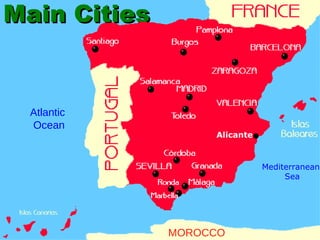
Main Cities Alicante Atlantic  Ocean Mediterranean  Sea MOROCCO
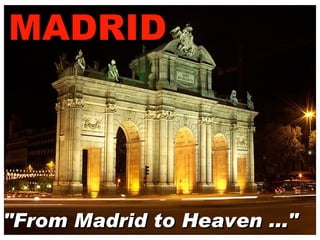
MADRID "From Madrid to Heaven ..."
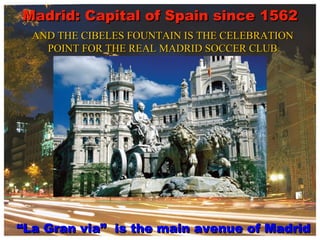
Madrid: Capital of Spain since 1562 “ La Gran via”  is the main avenue of Madrid AND THE CIBELES FOUNTAIN IS THE CELEBRATION POINT FOR THE REAL MADRID SOCCER CLUB
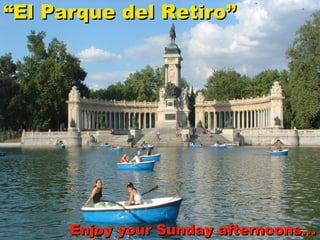
“ El Parque del Retiro” Enjoy your Sunday afternoons…
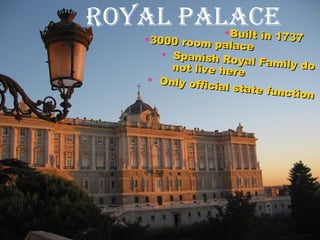
Royal Palace  Spanish Royal Family do not live here Only official state function  Built in 1737 3000 room palace
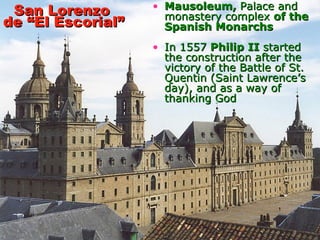
San Lorenzo  Mausoleum,  Palace and monastery complex  of the Spanish Monarchs In 1557  Philip II  started the construction after the victory of the Battle of St. Quentin (Saint Lawrence’s day), and as a way of thanking God de “El Escorial”
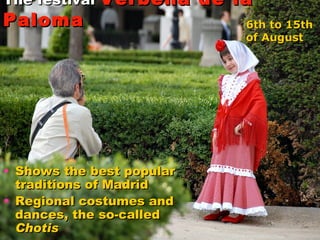
The festival  Verbena de la Paloma   Shows the best popular traditions of Madrid  Regional costumes and dances, the so-called  Chotis 6th to 15th  of August
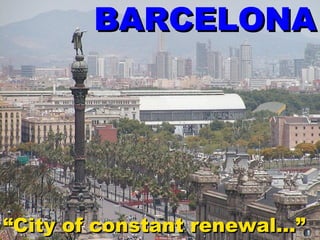
BARCELONA “ City of constant renewal…”
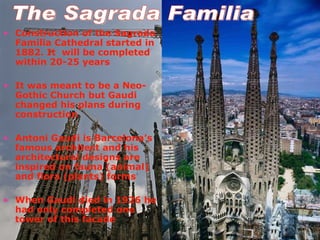
Construction of the Sagrada Familia Cathedral started in 1882. It  will be completed within 20-25 years  It was meant to be a Neo-Gothic Church but Gaudi changed his plans during construction Antoni Gaudi is Barcelona’s famous architect and his architectural designs are inspired on fauna (animal) and flora (plants) forms When Gaudi died in 1926 he had only completed one tower of this facade The Sagrada Familia
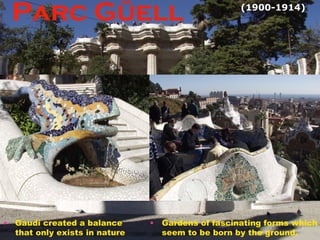
Gaudí created a balance that only exists in nature (1900-1914)  Parc Güell Gardens of fascinating forms which seem to be born by the ground.
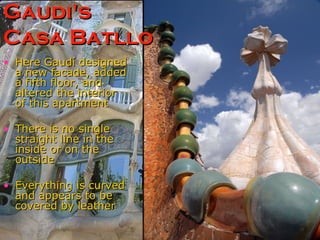
Here Gaudí designed a new facade, added a fifth floor, and altered the interior of this apartment   There is no single straight line in the inside or on the outside Everything is curved and appears to be covered by leather  Gaudi's  Casa Batllo
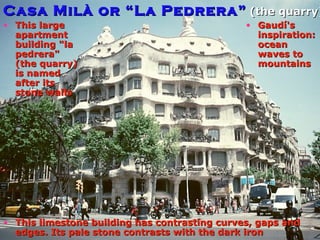
Casa Milà or “La Pedrera”   (the quarry)   This large apartment building "la pedrera" (the quarry) is named after its stone walls   This limestone building has contrasting curves, gaps and edges. Its pale stone contrasts with the dark iron   Gaudí's inspiration: ocean waves to  mountains
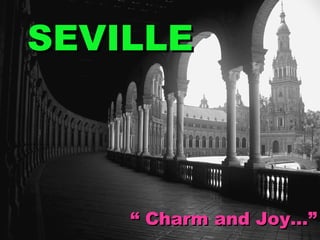
SEVILLE “  Charm and Joy…”
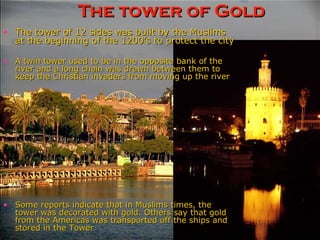
The tower of Gold A twin tower used to be in the opposite bank of the river and a long chain was drawn between them to keep the Christian invaders from moving up the river Some reports indicate that in Muslims times, the tower was decorated with gold. Others say that gold from the Americas was transported off the ships and stored in the Tower The tower of 12 sides was built by the Muslims at the beginning of the 1200’s to protect the city
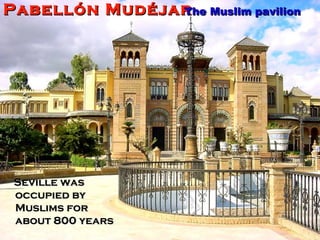
Pabellón Mudéjar Seville was occupied by Muslims for  about 800 years The Muslim pavilion
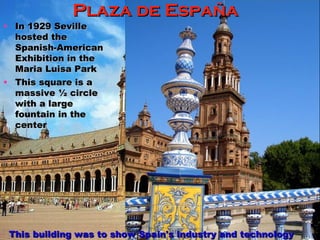
This building was to show Spain's industry and technology Plaza de España If you check out the 2nd "Star Wars" Episode (Attack of the Clones), it appears as the “city of Naboo” In 1929 Seville hosted the Spanish-American Exhibition in the Maria Luisa Park This square is a massive ½ circle with a large fountain in the center
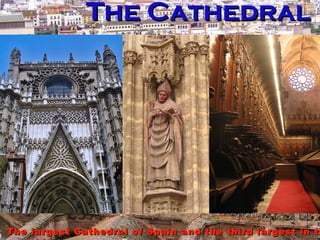
The Cathedral The largest Cathedral of Spain and the third largest in the world
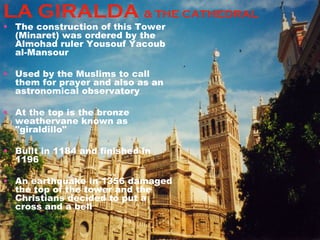
LA GIRALDA  & THE CATHEDRAL The construction of this Tower (Minaret) was ordered by the Almohad ruler Yousouf Yacoub al-Mansour  Used by the Muslims to call them for prayer and also as an astronomical observatory At the top is the bronze weathervane known as "giraldillo"  Built in 1184 and finished in 1196 An earthquake in 1356 damaged the top of the tower and the Christians decided to put a cross and a bell
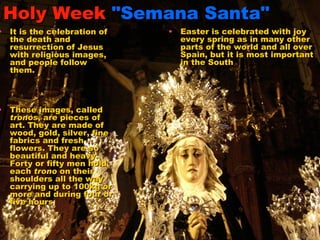
Holy Week   "Semana Santa" Easter is celebrated with joy every spring as in many other parts of the world and all over Spain, but it is most important in the South   It is the celebration of the death and resurrection of Jesus with religious images, and people follow them.  These images, called  tronos , are pieces of art. They are made of wood, gold, silver, fine fabrics and fresh flowers. They are so beautiful and heavy. Forty or fifty men hold each  trono  on their shoulders all the way carrying up to 100kg or more and during four or five hours
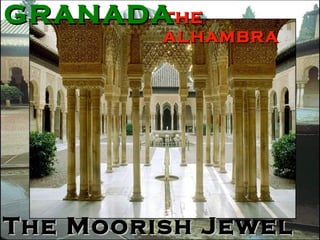
The Lions Court THE ALHAMBRA   GRANADA  The Moorish Jewel
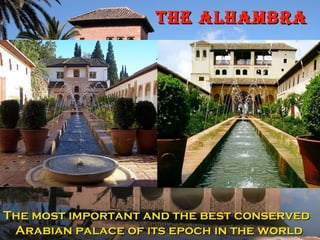
The most important and the best conserved Arabian palace of its epoch in the world the alhambra
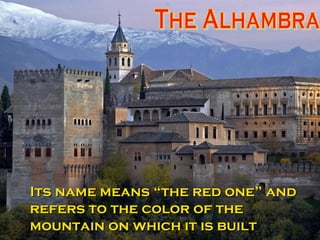
Its name means “the red one” and refers to the color of the mountain on which it is built   The Alhambra
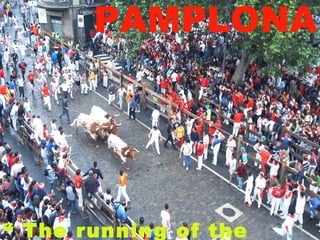
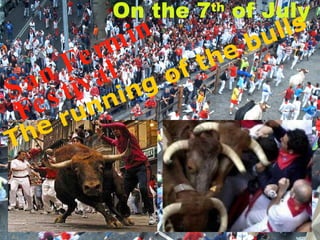
PAMPLONA “  The running of the Bulls…”
On the 7 th  of July The running of the bulls San Fermin  Festival
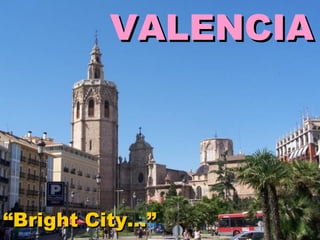
VALENCIA “ Bright City…”
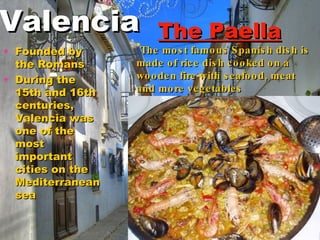
The Paella The most famous Spanish dish is made of rice dish cooked on a wooden fire with seafood , meat and more vegetables Founded by the Romans  During the 15th and 16th centuries, Valencia was one of the most important  cities on the Mediterranean sea  Valencia
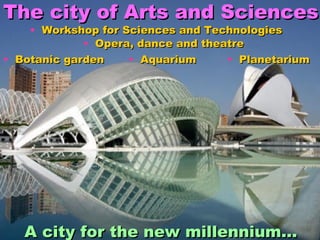
A city for the new millennium… Workshop for Sciences and Technologies Opera, dance and theatre  Botanic garden Aquarium Planetarium The city of Arts and Sciences
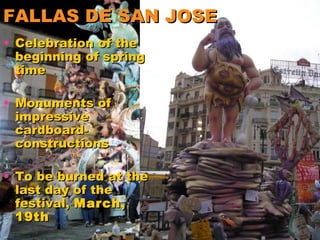
FALLAS DE SAN JOSE Celebration of the beginning of spring time  Monuments of impressive cardboard-constructions  To be burned at the last day of the festival,  March, 19th
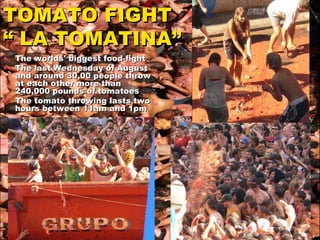
TOMATO FIGHT  “ LA TOMATINA” The worlds' biggest food-fight  The last Wednesday of August  and around 30,00 people throw at each other more than 240,000 pounds of tomatoes The tomato throwing lasts two hours between 11am and 1pm
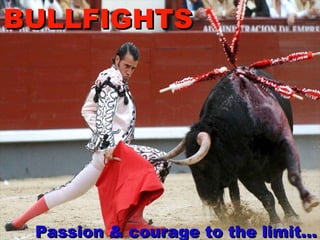
BULLFIGHTS Passion & courage   to the limit…
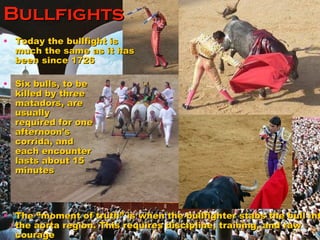
Bullfights Today the bullfight is much the same as it has been since 1726 The “moment of truth” is when the bullfighter stabs the bull into the aorta region. This requires discipline, training, and raw courage Six bulls, to be killed by three matadors, are usually required for one afternoon's corrida, and each encounter lasts about 15 minutes
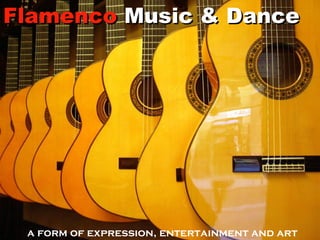
a form of expression, entertainment and art  Flamenco  Music & Dance
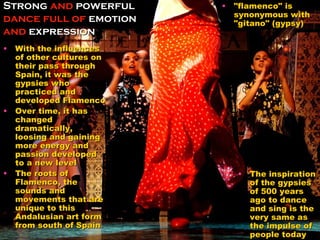
Strong  and  powerful  dance full of  emotion  and  expression  With the influences of other cultures on their pass through Spain, it was the gypsies who practiced and developed Flamenco Over time, it has changed dramatically, loosing and gaining more energy and passion developed to a new level  The roots of Flamenco, the sounds and movements that are unique to this Andalusian art form from south of Spain "flamenco" is synonymous with "gitano" (gypsy) The inspiration of the gypsies of 500 years ago to dance and sing is the very same as the impulse of people today
I HOPE TO SEE YOU IN  SPAIN  ONE DAY I HOPE THAT YOU HAD ENJOYED &

Spanish Life Style

  • 1.
    Spain is Different Presented by: Kai Garcia
  • 2.
    General information &comparison Quick look at History in Spain Main Cities : Madrid Barcelona Seville Granada Pamplona Valencia Flamenco & Dancing Bullfight
  • 3.
    COMPARISON BETWEEN SPAINAND AUSTRALIA AUSTRALIA country SPAIN purchasing power parity -$31,900 (2005 est.) GDP per capita purchasing power parity - $25,500 (2005 est.) total: 7,686,850 sq km land: 7,617,930 sq km water: 68,920 sq km Area total: 504,782 sq km land: 499,542 sq km water: 5,240 sq km Oceania, continent between the Indian Ocean and the South Pacific Ocean location Southwestern Europe, bordering the Bay of Biscay, Mediterranean Sea, North Atlantic Ocean, and Pyrenees Mountains, southwest of France 20,264,082 (July 2006 est.) population 44,108,100 (July 2006 est.) federal parliamentary democracy government parliamentary monarchy
  • 4.
    COMPARISON BETWEEN SPAINAND AUSTRALIA Catholic 26.4%, Anglican 20.5%, other Christian 20.5%, Buddhist 1.9%, Muslim 1.5%, other 13.8%, none 15.3% (2001 Census) Religion Roman Catholic 94%, other 6% English 79.1%, Chinese 2.1%, Italian 1.9%, other 11.1%, unspecified 5.8% (2001 Census) Languages Castilian Spanish 74%, Catalan 17%, Galician 7%, Basque 2%; note - Castilian is the official language nationwide; the other languages are official regionally generally arid to semiarid; temperate in south and east; tropical in north climate temperate; clear, hot summers in interior, more moderate and cloudy along coast; cloudy, cold winters in interior, partly cloudy and cool along coast AUSTRALIA country SPAIN
  • 5.
    QUICK LOOK ATSPANISH HISTORY 1100 BC . Phoenician traders establish colony at southern Iberia. 228 BC . Carthaginians occupy southern and eastern Iberia. 218-220 BC . Romans defeat Carthage in Second Punic War and occupy the entire Iberia. 74 . Inhabitants of Iberia are granted full Roman citizenship. 409 . Visigoths occupy Iberian peninsula. 711 . Combined Arab and Berber force from northern Africa cross Strait of Gibraltar to occupy Iberian peninsula. 756 . Independent Emirate is established in Iberia, with Córdoba as its capital. 913 . Having re-taken territories in northern Spain, Christians establish capital in León. 1013 . Powerful Caliphate of Córdoba breaks up due to internal strife; Muslim Spain splits into small kingdoms. 1212 . Decisive Christian victory at battle of Navas de Tolosa spells the beginning of the end of Muslims in Spain. 1492 . King Fernando and Queen Isabel's army capture Granada, the final defeat of the Muslims in Spain. Jews are forced to convert to Christianity; those who refuse are expelled from Spain. Christopher Columbus sets sail on his voyage of discovery. 1588 . Defeat of Spanish Armada sent to invade England. Spanish Empire is at the height of its power, but is slowly declining. 1702-14 . War of Spanish Succession. Bourbon dynasty accedes to Spanish throne. 1808-14 . Peninsular War. Spaniards rise against Napoleon's occupying force. Combination of guerilla tactics and support from Wellington's army end in French defeat. 1898 . Spanish American War. Spain loses Cuba and Philippines. 1931 . Spanish king is forced to abdicate. Spain becomes a republic. 1936-39 . Spanish Civil War. Bloody conflict ends with General Franco's victory. Dictatorship established. 1975 . Franco dies, Juan Carlos de Borbón is proclaimed king. Spain becomes constitutional monarchy. Democracy would bring membership of the European Community.
  • 6.
    Main Cities AlicanteAtlantic Ocean Mediterranean Sea MOROCCO
  • 7.
    MADRID "From Madridto Heaven ..."
  • 8.
    Madrid: Capital ofSpain since 1562 “ La Gran via” is the main avenue of Madrid AND THE CIBELES FOUNTAIN IS THE CELEBRATION POINT FOR THE REAL MADRID SOCCER CLUB
  • 9.
    “ El Parquedel Retiro” Enjoy your Sunday afternoons…
  • 10.
    Royal Palace Spanish Royal Family do not live here Only official state function Built in 1737 3000 room palace
  • 11.
    San Lorenzo Mausoleum, Palace and monastery complex of the Spanish Monarchs In 1557 Philip II started the construction after the victory of the Battle of St. Quentin (Saint Lawrence’s day), and as a way of thanking God de “El Escorial”
  • 12.
    The festival Verbena de la Paloma Shows the best popular traditions of Madrid Regional costumes and dances, the so-called Chotis 6th to 15th of August
  • 13.
    BARCELONA “ Cityof constant renewal…”
  • 14.
    Construction of theSagrada Familia Cathedral started in 1882. It will be completed within 20-25 years It was meant to be a Neo-Gothic Church but Gaudi changed his plans during construction Antoni Gaudi is Barcelona’s famous architect and his architectural designs are inspired on fauna (animal) and flora (plants) forms When Gaudi died in 1926 he had only completed one tower of this facade The Sagrada Familia
  • 15.
    Gaudí created abalance that only exists in nature (1900-1914) Parc Güell Gardens of fascinating forms which seem to be born by the ground.
  • 16.
    Here Gaudí designeda new facade, added a fifth floor, and altered the interior of this apartment There is no single straight line in the inside or on the outside Everything is curved and appears to be covered by leather Gaudi's Casa Batllo
  • 17.
    Casa Milà or“La Pedrera” (the quarry) This large apartment building "la pedrera" (the quarry) is named after its stone walls This limestone building has contrasting curves, gaps and edges. Its pale stone contrasts with the dark iron Gaudí's inspiration: ocean waves to mountains
  • 18.
    SEVILLE “ Charm and Joy…”
  • 19.
    The tower ofGold A twin tower used to be in the opposite bank of the river and a long chain was drawn between them to keep the Christian invaders from moving up the river Some reports indicate that in Muslims times, the tower was decorated with gold. Others say that gold from the Americas was transported off the ships and stored in the Tower The tower of 12 sides was built by the Muslims at the beginning of the 1200’s to protect the city
  • 20.
    Pabellón Mudéjar Sevillewas occupied by Muslims for about 800 years The Muslim pavilion
  • 21.
    This building wasto show Spain's industry and technology Plaza de España If you check out the 2nd "Star Wars" Episode (Attack of the Clones), it appears as the “city of Naboo” In 1929 Seville hosted the Spanish-American Exhibition in the Maria Luisa Park This square is a massive ½ circle with a large fountain in the center
  • 22.
    The Cathedral Thelargest Cathedral of Spain and the third largest in the world
  • 23.
    LA GIRALDA & THE CATHEDRAL The construction of this Tower (Minaret) was ordered by the Almohad ruler Yousouf Yacoub al-Mansour Used by the Muslims to call them for prayer and also as an astronomical observatory At the top is the bronze weathervane known as "giraldillo" Built in 1184 and finished in 1196 An earthquake in 1356 damaged the top of the tower and the Christians decided to put a cross and a bell
  • 24.
    Holy Week "Semana Santa" Easter is celebrated with joy every spring as in many other parts of the world and all over Spain, but it is most important in the South It is the celebration of the death and resurrection of Jesus with religious images, and people follow them. These images, called tronos , are pieces of art. They are made of wood, gold, silver, fine fabrics and fresh flowers. They are so beautiful and heavy. Forty or fifty men hold each trono on their shoulders all the way carrying up to 100kg or more and during four or five hours
  • 25.
    The Lions CourtTHE ALHAMBRA GRANADA The Moorish Jewel
  • 26.
    The most importantand the best conserved Arabian palace of its epoch in the world the alhambra
  • 27.
    Its name means“the red one” and refers to the color of the mountain on which it is built The Alhambra
  • 28.
    PAMPLONA “ The running of the Bulls…”
  • 29.
    On the 7th of July The running of the bulls San Fermin Festival
  • 30.
  • 31.
    The Paella Themost famous Spanish dish is made of rice dish cooked on a wooden fire with seafood , meat and more vegetables Founded by the Romans During the 15th and 16th centuries, Valencia was one of the most important cities on the Mediterranean sea Valencia
  • 32.
    A city forthe new millennium… Workshop for Sciences and Technologies Opera, dance and theatre Botanic garden Aquarium Planetarium The city of Arts and Sciences
  • 33.
    FALLAS DE SANJOSE Celebration of the beginning of spring time Monuments of impressive cardboard-constructions To be burned at the last day of the festival, March, 19th
  • 34.
    TOMATO FIGHT “ LA TOMATINA” The worlds' biggest food-fight The last Wednesday of August and around 30,00 people throw at each other more than 240,000 pounds of tomatoes The tomato throwing lasts two hours between 11am and 1pm
  • 35.
    BULLFIGHTS Passion &courage to the limit…
  • 36.
    Bullfights Today thebullfight is much the same as it has been since 1726 The “moment of truth” is when the bullfighter stabs the bull into the aorta region. This requires discipline, training, and raw courage Six bulls, to be killed by three matadors, are usually required for one afternoon's corrida, and each encounter lasts about 15 minutes
  • 37.
    a form ofexpression, entertainment and art Flamenco Music & Dance
  • 38.
    Strong and powerful dance full of emotion and expression With the influences of other cultures on their pass through Spain, it was the gypsies who practiced and developed Flamenco Over time, it has changed dramatically, loosing and gaining more energy and passion developed to a new level The roots of Flamenco, the sounds and movements that are unique to this Andalusian art form from south of Spain "flamenco" is synonymous with "gitano" (gypsy) The inspiration of the gypsies of 500 years ago to dance and sing is the very same as the impulse of people today
  • 39.
    I HOPE TOSEE YOU IN SPAIN ONE DAY I HOPE THAT YOU HAD ENJOYED &