Tribology 101 – Introduction to
the Basics of Tribology
SJ Shaffer, Ph.D. – Bruker-TMT
Steven.shaffer@bruker-nano.com
Outline
1/29/2013 2
• Origin/Definition of “Tribology” (Term and Field)
• Encompassing Fields
• Fundamentals of Tribology:
• Surfaces in Contact
• Friction
• Lubrication
• Wear
• Concluding Words
• Upcoming Topics in Series
What is Tribology ?
1/29/2013 3
• Tribology comes from the Greek word, “tribos”,
meaning “rubbing” or “to rub”
• And from the suffix, “ology” means “the study
of”
• Therefore, Tribology is the study of rubbing,
or… “the study of things that rub”.
• This includes the fields of:
• Friction,
• Lubrication, and
• Wear.
“Tribology” is a new word…
1/29/2013 4
• Coined by Dr. H. Peter Jost in England in
1966
• “The Jost Report”, provided to the British Parliament –
Ministry for Education and Science, indicated… “Potential
savings of over £515 million per year ($800 million) for
industry by better application of tribological principles
and practices.”
But…
Tribology is not a new field!
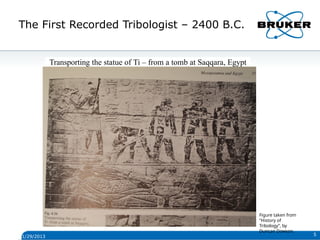
The First Recorded Tribologist – 2400 B.C.
Transporting the statue of Ti – from a tomb at Saqqara, Egypt
Figure taken from
“History of
Tribology”, by
Duncan Dowson.
5
1/29/2013
The First Recorded Tribologist – 2400 B.C.
Transporting the statue of Ti – from a tomb at Saqqara, Egypt
6
1/29/2013
7
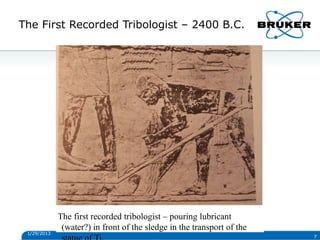
The First Recorded Tribologist – 2400 B.C.
The first recorded tribologist – pouring lubricant
(water?) in front of the sledge in the transport of the
1/29/2013
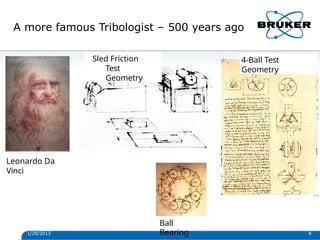
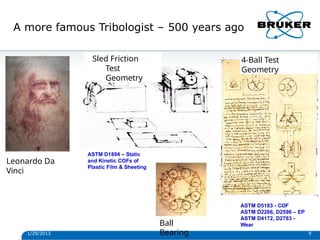
A more famous Tribologist – 500 years ago
Leonardo Da
Vinci
Ball
Bearing
1/29/2013 8
4-Ball Test
Geometry
Sled Friction
Test
Geometry
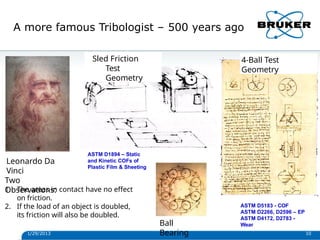
A more famous Tribologist – 500 years ago
Leonardo Da
Vinci
Ball
Bearing
1/29/2013 9
4-Ball Test
Geometry
Sled Friction
Test
Geometry
ASTM D5183 - COF
ASTM D2266, D2596 – EP
ASTM D4172, D2783 -
Wear
ASTM D1894 – Static
and Kinetic COFs of
Plastic Film & Sheeting
A more famous Tribologist – 500 years ago
Leonardo Da
Vinci
1/29/2013 10
Ball
Bearing
4-Ball Test
Geometry
Sled Friction
Test
Geometry
Two
Observations:
1. The areas in contact have no effect
on friction.
2. If the load of an object is doubled,
its friction will also be doubled.
ASTM D5183 - COF
ASTM D2266, D2596 – EP
ASTM D4172, D2783 -
Wear
ASTM D1894 – Static
and Kinetic COFs of
Plastic Film & Sheeting
Tribology 101 - Basics
1/29/2013 11
Applications and Fields which
Encompass Modern Tribology
Tribology is All Around Us,
In Applications from Simple to Complex
and Scales from Small to Large
1/29/2013 12
• Individual Components
• Assemblies or Products
• Manufacturing Processes
• Construction/Exploration
• Natural Phenomena
Individual Components
Gears
1/29/2013 13
Bearing
s
Brake & Clutch
Pads
Assemblies or Products
Engine
s
1/29/2013 14
Curling
Stones
Rock
Climbing
Shoes
Pocket
Watch
Manufacturing Processes
Rollin
g
Stampin
g
Turnin
g
Grinding/
Polishing
1/29/2013 15
Construction/Exploration
Mine Slurry
Pumps
1/29/2013 16
Excavato
r
Chunnel Digging
Drill
Oil Drilling
Rig
Space
Shuttle
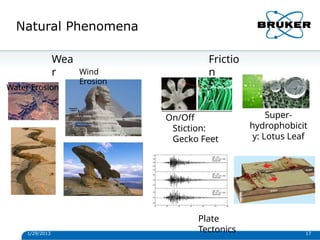
Natural Phenomena
Plate
Tectonics
Wind
Erosion
Wea
r
Water Erosion
Frictio
n
On/Off
Stiction:
Gecko Feet
Super-
hydrophobicit
y: Lotus Leaf
1/29/2013 17
Tribology 101 - Basics
1/29/2013 18
In Parallel to these different Scales,
There are Many Areas of
Engineering and Industry which
have a Need to
Use/Understand Tribology
Tribology is also in Virtually every Area of
Engineering and Industry
1/29/2013 19
• Aerospace
• Agriculture
• Automotive
• Engine: Piston ring/cylinder,
Bearings, valve seats, injectors
• Brakes/clutch
• Tooling/Machining/Sheet metal
forming
• Coatings Providers
• Low Friction
• Wear Resistant
• Thin Films or Hardfacings
• Cosmetics/Personal Care
• Dental Implants
• Energy
• Nuclear
• Wind
• Fossil
• Solar
• Fabric/Clothing
• Flooring
• Food Processing
• Highway/Transportation
Depts.
• Lubricant Manufacturers
• Medical Diagnostics
• Medical Implants
• Military
• Pharmaceutical
• Shoe Manufacturers
• Sports Equipment
Companies
• Universities/Educators
• Mechanical Engineering
• Materials Science
Engineering
• Physics
Commonality in Tribology
1/29/2013 20
What do All These Diverse Fields
and Applications have in Common?
What do we need to think about as
engineers and scientists when we
design products or friction/wear
experiments?
Commonality…
1/29/2013 21
Every Application has:
Surfaces in Contact, and
in Relative Motion
(e.g. sliding, rolling, impacting)
Tribology Basics - Surfaces in Contact
1/29/2013 22
So let’s begin by looking
closely at a surface…
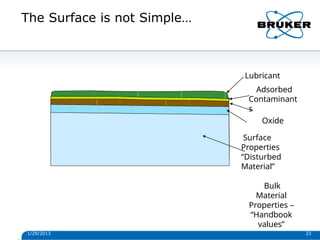
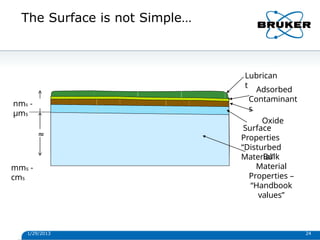
The Surface is not Simple…
Lubricant
Adsorbed
Contaminant
s
Oxide
Surface
Properties
“Disturbed
Material”
Bulk
Material
Properties –
“Handbook
values”
1/29/2013 23
The Surface is not Simple…
Bulk
Material
Properties –
“Handbook
values”
Surface
Properties
“Disturbed
Material”
Adsorbed
Contaminant
s
Oxide
Lubrican
t
≈
mms -
cms
1/29/2013 24
nms -
µms
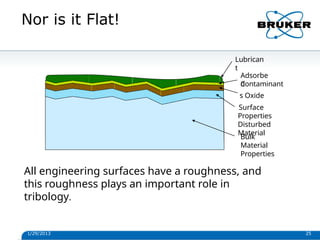
Nor is it Flat!
Bulk
Material
Properties
Adsorbe
d
Contaminant
s Oxide
Surface
Properties
Disturbed
Material
Lubrican
t
All engineering surfaces have a roughness, and
this roughness plays an important role in
tribology.
1/29/2013 25
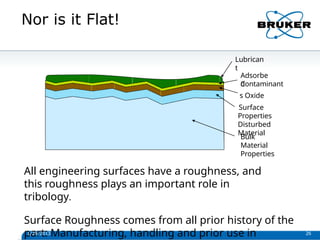
Nor is it Flat!
Bulk
Material
Properties
Adsorbe
d
Contaminant
s Oxide
Surface
Properties
Disturbed
Material
Lubrican
t
All engineering surfaces have a roughness, and
this roughness plays an important role in
tribology.
Surface Roughness comes from all prior history of the
part: Manufacturing, handling and prior use in
1/29/2013 26
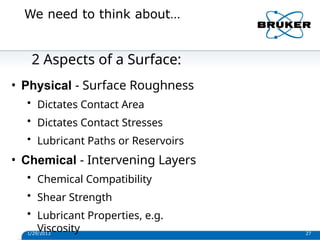
We need to think about…
1/29/2013 27
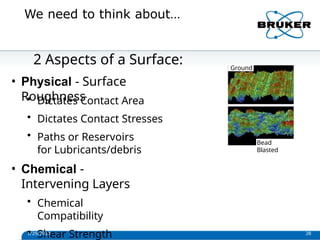
2 Aspects of a Surface:
• Physical - Surface Roughness
• Dictates Contact Area
• Dictates Contact Stresses
• Lubricant Paths or Reservoirs
• Chemical - Intervening Layers
• Chemical Compatibility
• Shear Strength
• Lubricant Properties, e.g.
Viscosity
We need to think about…
• Dictates Contact Area
• Dictates Contact Stresses
• Paths or Reservoirs
for Lubricants/debris
• Chemical -
Intervening Layers
• Chemical
Compatibility
• Shear Strength
2 Aspects of a Surface:
• Physical - Surface
Roughness
Ground
1/29/2013 28
Bead
Blasted
We need to think about…
2 Aspects of a Surface:
• Physical - Surface Roughness
• Dictates Contact Area
• Dictates Contact Stresses
• Lubricant Paths or Reservoirs
• Chemical - Intervening Layers
• Chemical Compatibility
• Shear Strength
• Lubricant Properties, e.g.
Viscosity, EP or boundary-
forming
1/29/2013 29
Surface Characterization
1/29/2013 30
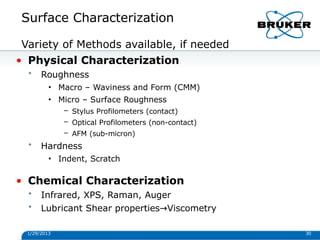
Variety of Methods available, if needed
• Physical Characterization
• Roughness
• Macro – Waviness and Form (CMM)
• Micro – Surface Roughness
– Stylus Profilometers (contact)
– Optical Profilometers (non-contact)
– AFM (sub-micron)
• Hardness
• Indent, Scratch
• Chemical Characterization
• Infrared, XPS, Raman, Auger
• Lubricant Shear properties→Viscometry
Tribology 101-Basics
1/29/2013 31
Summary of Surfaces in Contact
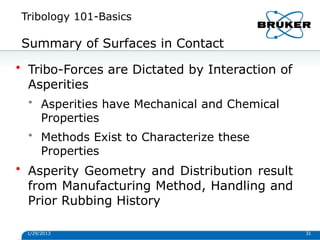
• Tribo-Forces are Dictated by Interaction of
Asperities
• Asperities have Mechanical and Chemical
Properties
• Methods Exist to Characterize these
Properties
• Asperity Geometry and Distribution result
from Manufacturing Method, Handling and
Prior Rubbing History
Friction
Fundamental
s
1/29/2013 32
Friction Fundamentals
Conceptual Definition of Friction
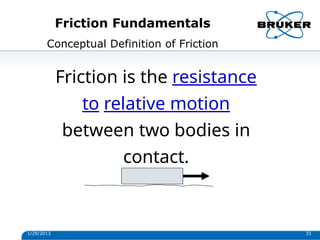
Friction is the resistance
to relative motion
between two bodies in
contact.
1/29/2013 33
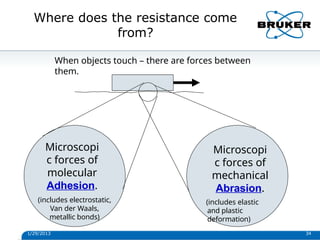
Where does the resistance come
from?
When objects touch – there are forces between
them.
1/29/2013 34
Microscopi
c forces of
molecular
Adhesion.
(includes electrostatic,
Van der Waals,
metallic bonds)
Microscopi
c forces of
mechanical
Abrasion.
(includes elastic
and plastic
deformation)
Where does friction come from?
Remember, there are also “contaminants” at the
interface
1/29/2013 35
Oxides,
Adsorbed films,
Adsorbed
gases,
Foreign or
“domestic”
particles
Friction Fundamentals – “The COF”
1/29/2013 36
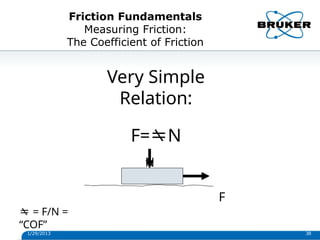
• The Coefficient of Friction: A simple
constant of proportionality.
Friction Fundamentals – “The COF”
1/29/2013 37
• The Coefficient of Friction: A simple
constant of proportionality.
• Or is it?
Friction Fundamentals
Measuring Friction:
The Coefficient of Friction
Very Simple
Relation:
F=N
N
F
 = F/N =
“COF”
1/29/2013 38
Friction Fundamentals – “The COF”
• Suppose a colleague wants to know:
“What is the
COF of steel?”
1/29/2013 39
Friction Fundamentals – “The COF”
• Is that close enough for your needs?”
• A: “Well, dear colleague, you can use from
0.1 to 0.6. Take your pick.
“What is the
COF of steel?”
1/29/2013 40
Friction Fundamentals – “The COF”
Well not
really.
1/29/2013 41
?
Friction Fundamentals – “The COF”
• “Then I guess we’ll need a bit more
information.”
Well not
really.
1/29/2013 42
?
Friction Fundamentals – “The COF”
1/29/2013 43
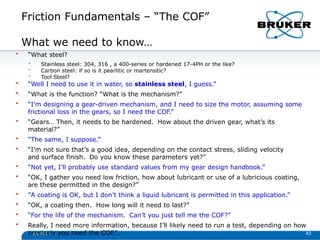
What we need to know…
• “What steel?
• Stainless steel: 304, 316 , a 400-series or hardened 17-4PH or the like?
• Carbon steel: if so is it pearlitic or martensitic?
• Tool Steel?
• “Well I need to use it in water, so stainless steel, I guess.”
• “What is the function? “What is the mechanism?”
• “I’m designing a gear-driven mechanism, and I need to size the motor, assuming some
frictional loss in the gears, so I need the COF.”
• “Gears… Then, it needs to be hardened. How about the driven gear, what’s its
material?”
• “The same, I suppose.”
• “I’m not sure that’s a good idea, depending on the contact stress, sliding velocity
and surface finish. Do you know these parameters yet?”
• “Not yet, I’ll probably use standard values from my gear design handbook.”
• “OK, I gather you need low friction, how about lubricant or use of a lubricious coating,
are these permitted in the design?”
• ”A coating is OK, but I don’t think a liquid lubricant is permitted in this application.”
• “OK, a coating then. How long will it need to last?”
• “For the life of the mechanism. Can’t you just tell me the COF?”
• Really, I need more information, because I’ll likely need to run a test, depending on how
precisely you need the COF.”…
All things considered,
1/29/2013 44
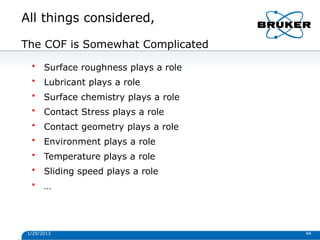
The COF is Somewhat Complicated
• Surface roughness plays a role
• Lubricant plays a role
• Surface chemistry plays a role
• Contact Stress plays a role
• Contact geometry plays a role
• Environment plays a role
• Temperature plays a role
• Sliding speed plays a role
• …
All things considered
1/29/2013 45
It’s not so bad after all
Fortunately, while it appears
complicated, friction is relatively easy
to measure,
(Only two things: Normal Load and Friction
Force)
But, we have to measure it under the
right conditions.
Summary of Friction Fundamentals
1/29/2013 46
The equation is simple, but measuring it
correctly requires care:
When assessing a system’s tribology need,
we must consider:
Materials, Coating, Lubricant
Contact Area, Geometry,
Stress Surface Roughnesses
Sliding Speed
Sliding Mode (unidirectional, reciprocating,
multidirectional) Duty Cycle (continuous contact,
intermittent contact)
Environment
Temperature, Humidity,
Atmosphere (air, exhaust gases, vacuum)
Friction is NOT a Material
Property Friction is a “System”
Lubrication
Fundamental
s
1/29/2013 47
Lubrication Fundamentals
1/29/2013 48
• The role of a lubricant is to:
• Reduce Friction
• Prevent / Minimize Wear
• Transport Debris away from
Interface
• Provide Cooling
Lubrication Fundamentals:
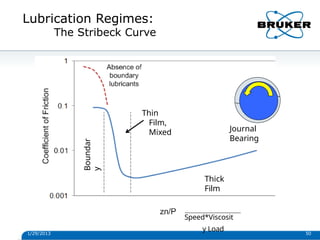
Lubrication Regimes, with liquid present
1/29/2013 49
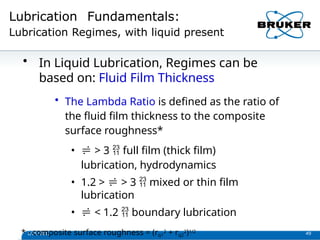
• In Liquid Lubrication, Regimes can be
based on: Fluid Film Thickness
• The Lambda Ratio is defined as the ratio of
the fluid film thickness to the composite
surface roughness*
•  > 3  full film (thick film)
lubrication, hydrodynamics
• 1.2 >  > 3  mixed or thin film
lubrication
•  < 1.2  boundary lubrication
* - composite surface roughness = (rq1
2 + rq2
2)1/2
Lubrication Regimes:
The Stribeck Curve
Journal
Bearing
Thick
Film
Speed*Viscosit
y Load
Thin
Film,
Mixed
Boundar
y
1/29/2013 50
Lubrication Regimes:
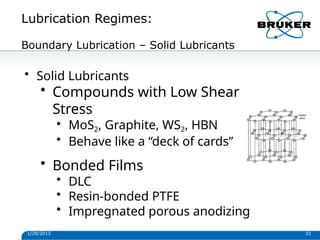
Boundary Lubrication – Solid Lubricants
• Solid Lubricants
• Compounds with Low Shear
Stress
• MoS2, Graphite, WS2, HBN
• Behave like a “deck of cards”
• Bonded Films
• DLC
• Resin-bonded PTFE
• Impregnated porous anodizing
1/29/2013 51
Summary of Lubrication
Fundamentals:
1/29/2013 52
• Key Factors in Lubricant Effectiveness
• Fluid Shear Properties
• Viscosity, Viscosity Index
• Pressure-Viscosity Index
• Chemistry
• Reactivity with the Surface
• Boundary Film-Forming Properties
• Extreme Pressure Constituents
• Shear strength of solid lubricant or coating
• Thermal Conductivity/Heat Capacity
Wear
Fundamental
s
1/29/2013 53
Wear Fundamentals
1/29/2013 54
Conceptual Definition of Wear
Removal (or displacement) of material
from one body when subjected to
contact and relative motion with
another body.
Wear Fundamentals - Wear Modes
6 Primary Wear Modes:
1. Abrasive Wear, Scratching
2. Adhesive Wear, Galling, Scuffing
3. Fretting/Fretting Corrosion
4. Erosive Wear, Cavitation, Impact, Electro-
arcing
5. Rolling Contact Fatigue, Spalling,
Delamination
6. Tribo-Corrosion
1/29/2013 55
Wear Fundamentals
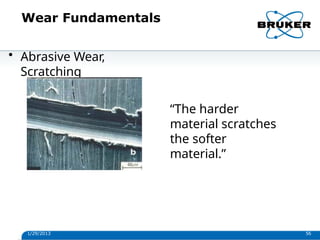
• Abrasive Wear,
Scratching
“The harder
material scratches
the softer
material.”
1/29/2013 56
Wear Fundamentals
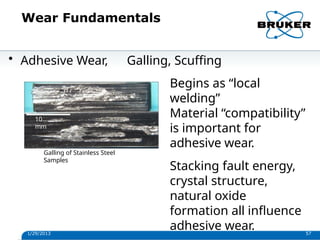
Galling of Stainless Steel
Samples
10
mm
1/29/2013 57
• Adhesive Wear, Galling, Scuffing
Begins as “local
welding”
Material “compatibility”
is important for
adhesive wear.
Stacking fault energy,
crystal structure,
natural oxide
formation all influence
adhesive wear.
Wear Fundamentals
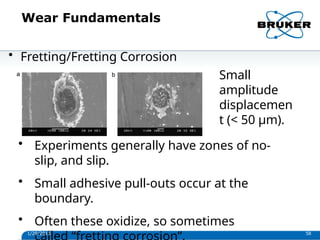
• Fretting/Fretting Corrosion
Small
amplitude
displacemen
t (< 50 µm).
• Experiments generally have zones of no-
slip, and slip.
• Small adhesive pull-outs occur at the
boundary.
• Often these oxidize, so sometimes
1/29/2013 58
Wear Fundamentals
Cavitation
Damage
1 cm
Steam Control
Valve
“Fluting”
Damage
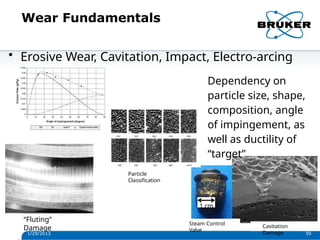
• Erosive Wear, Cavitation, Impact, Electro-arcing
Dependency on
particle size, shape,
composition, angle
of impingement, as
well as ductility of
“target”
Particle
Classification
1/29/2013 59
Wear Fundamentals
Spalled Bearing Inner
Race
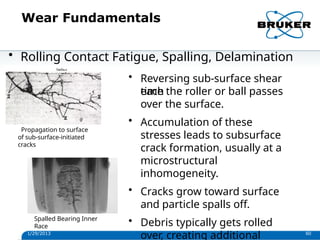
• Rolling Contact Fatigue, Spalling, Delamination
• Reversing sub-surface shear
each
1/29/2013 60
Propagation to surface
of sub-surface-initiated
cracks
time the roller or ball passes
over the surface.
• Accumulation of these
stresses leads to subsurface
crack formation, usually at a
microstructural
inhomogeneity.
• Cracks grow toward surface
and particle spalls off.
• Debris typically gets rolled
over, creating additional
Wear Fundamentals
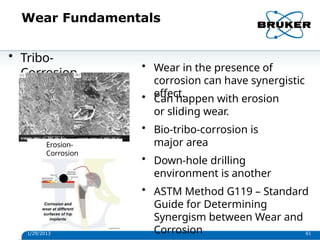
• Tribo-
Corrosion
Erosion-
Corrosion
1/29/2013 61
• Wear in the presence of
corrosion can have synergistic
effect.
• Can happen with erosion
or sliding wear.
• Bio-tribo-corrosion is
major area
• Down-hole drilling
environment is another
• ASTM Method G119 – Standard
Guide for Determining
Synergism between Wear and
Corrosion
Wear Assessment
1/29/2013 62
• The Wear Coefficient, k
• k  volume of material removed per unit load and sliding
distance
• Units of k are:
• mm3/Nm
• Please do NOT reduce the units of k to mm2/N or 1/kPa
• This has no physical meaning
• k can be used to predict component lifetimes, providing
the tribosystem does not change wear modes
• Duty cycle and directionality can influence wear
• Start-stop can be much more damaging than continuous
motion
• Unidirectional sliding is very different from reciprocating
sliding
Summary of Wear Fundamentals
1/29/2013 63
• Like Friction, Wear is a System Property, NOT a
Materials Property
• There are several distinct wear regimes, though
some can operate simultaneously, or sequentially
• Observed abrasive wear can results from initial
adhesive wear
• If you properly simulated the system and wear
mode, the wear coefficient, k, can be used to
predict lifetimes
Some
Final Words for
Today’s
Webinar
1/29/2013 64
Tribology Fundamentals
Key Concepts
1/29/2013 65
1.COF is not a material property, it is a system
property.
2.Wear Rate or wear resistance depends on the wear
mode, which is a function of the Tribosystem.
3.If we properly characterize and understand the
Tribosytem, the odds are better that we will
succeed, because we can make the right choice for
materials, contact geometry and chemistry, and
make the appropriate measurements to give us
the answer we seek for our design.
Means to
Assess Tribo-
systems
Tribology & Mechanical Testing (TMT)
• Universal platform for Tribology studies: Wear, Friction,.. when 2
surfaces meet.
• Large load range
• Wide variety of environments (corrosion, HT, liquid)
• Wide variety of configurations (rotating & translating motions)
Many different Tribology tests
Linear
Stage
Block-on-Ring
Drive
Reciprocating
Drive
Rotary
Drive
Indentation & Scratch Testing
• Large load range: nano & micro
• Wide variety of imaging options
• (AFM, profiler, optical)
• Indentation & Scratch Tester
Scratch test example
Indentation
example
www.bruker.com
© Copyright Bruker Corporation. All rights reserved.

Conceptos Basicos de Tribologia y desgaste .pptx

  • 1.
    Tribology 101 –Introduction to the Basics of Tribology SJ Shaffer, Ph.D. – Bruker-TMT Steven.shaffer@bruker-nano.com
  • 2.
    Outline 1/29/2013 2 • Origin/Definitionof “Tribology” (Term and Field) • Encompassing Fields • Fundamentals of Tribology: • Surfaces in Contact • Friction • Lubrication • Wear • Concluding Words • Upcoming Topics in Series
  • 3.
    What is Tribology? 1/29/2013 3 • Tribology comes from the Greek word, “tribos”, meaning “rubbing” or “to rub” • And from the suffix, “ology” means “the study of” • Therefore, Tribology is the study of rubbing, or… “the study of things that rub”. • This includes the fields of: • Friction, • Lubrication, and • Wear.
  • 4.
    “Tribology” is anew word… 1/29/2013 4 • Coined by Dr. H. Peter Jost in England in 1966 • “The Jost Report”, provided to the British Parliament – Ministry for Education and Science, indicated… “Potential savings of over £515 million per year ($800 million) for industry by better application of tribological principles and practices.” But… Tribology is not a new field!
  • 5.
    The First RecordedTribologist – 2400 B.C. Transporting the statue of Ti – from a tomb at Saqqara, Egypt Figure taken from “History of Tribology”, by Duncan Dowson. 5 1/29/2013
  • 6.
    The First RecordedTribologist – 2400 B.C. Transporting the statue of Ti – from a tomb at Saqqara, Egypt 6 1/29/2013
  • 7.
    7 The First RecordedTribologist – 2400 B.C. The first recorded tribologist – pouring lubricant (water?) in front of the sledge in the transport of the 1/29/2013
  • 8.
    A more famousTribologist – 500 years ago Leonardo Da Vinci Ball Bearing 1/29/2013 8 4-Ball Test Geometry Sled Friction Test Geometry
  • 9.
    A more famousTribologist – 500 years ago Leonardo Da Vinci Ball Bearing 1/29/2013 9 4-Ball Test Geometry Sled Friction Test Geometry ASTM D5183 - COF ASTM D2266, D2596 – EP ASTM D4172, D2783 - Wear ASTM D1894 – Static and Kinetic COFs of Plastic Film & Sheeting
  • 10.
    A more famousTribologist – 500 years ago Leonardo Da Vinci 1/29/2013 10 Ball Bearing 4-Ball Test Geometry Sled Friction Test Geometry Two Observations: 1. The areas in contact have no effect on friction. 2. If the load of an object is doubled, its friction will also be doubled. ASTM D5183 - COF ASTM D2266, D2596 – EP ASTM D4172, D2783 - Wear ASTM D1894 – Static and Kinetic COFs of Plastic Film & Sheeting
  • 11.
    Tribology 101 -Basics 1/29/2013 11 Applications and Fields which Encompass Modern Tribology
  • 12.
    Tribology is AllAround Us, In Applications from Simple to Complex and Scales from Small to Large 1/29/2013 12 • Individual Components • Assemblies or Products • Manufacturing Processes • Construction/Exploration • Natural Phenomena
  • 13.
  • 14.
    Assemblies or Products Engine s 1/29/201314 Curling Stones Rock Climbing Shoes Pocket Watch
  • 15.
  • 16.
  • 17.
  • 18.
    Tribology 101 -Basics 1/29/2013 18 In Parallel to these different Scales, There are Many Areas of Engineering and Industry which have a Need to Use/Understand Tribology
  • 19.
    Tribology is alsoin Virtually every Area of Engineering and Industry 1/29/2013 19 • Aerospace • Agriculture • Automotive • Engine: Piston ring/cylinder, Bearings, valve seats, injectors • Brakes/clutch • Tooling/Machining/Sheet metal forming • Coatings Providers • Low Friction • Wear Resistant • Thin Films or Hardfacings • Cosmetics/Personal Care • Dental Implants • Energy • Nuclear • Wind • Fossil • Solar • Fabric/Clothing • Flooring • Food Processing • Highway/Transportation Depts. • Lubricant Manufacturers • Medical Diagnostics • Medical Implants • Military • Pharmaceutical • Shoe Manufacturers • Sports Equipment Companies • Universities/Educators • Mechanical Engineering • Materials Science Engineering • Physics
  • 20.
    Commonality in Tribology 1/29/201320 What do All These Diverse Fields and Applications have in Common? What do we need to think about as engineers and scientists when we design products or friction/wear experiments?
  • 21.
    Commonality… 1/29/2013 21 Every Applicationhas: Surfaces in Contact, and in Relative Motion (e.g. sliding, rolling, impacting)
  • 22.
    Tribology Basics -Surfaces in Contact 1/29/2013 22 So let’s begin by looking closely at a surface…
  • 23.
    The Surface isnot Simple… Lubricant Adsorbed Contaminant s Oxide Surface Properties “Disturbed Material” Bulk Material Properties – “Handbook values” 1/29/2013 23
  • 24.
    The Surface isnot Simple… Bulk Material Properties – “Handbook values” Surface Properties “Disturbed Material” Adsorbed Contaminant s Oxide Lubrican t ≈ mms - cms 1/29/2013 24 nms - µms
  • 25.
    Nor is itFlat! Bulk Material Properties Adsorbe d Contaminant s Oxide Surface Properties Disturbed Material Lubrican t All engineering surfaces have a roughness, and this roughness plays an important role in tribology. 1/29/2013 25
  • 26.
    Nor is itFlat! Bulk Material Properties Adsorbe d Contaminant s Oxide Surface Properties Disturbed Material Lubrican t All engineering surfaces have a roughness, and this roughness plays an important role in tribology. Surface Roughness comes from all prior history of the part: Manufacturing, handling and prior use in 1/29/2013 26
  • 27.
    We need tothink about… 1/29/2013 27 2 Aspects of a Surface: • Physical - Surface Roughness • Dictates Contact Area • Dictates Contact Stresses • Lubricant Paths or Reservoirs • Chemical - Intervening Layers • Chemical Compatibility • Shear Strength • Lubricant Properties, e.g. Viscosity
  • 28.
    We need tothink about… • Dictates Contact Area • Dictates Contact Stresses • Paths or Reservoirs for Lubricants/debris • Chemical - Intervening Layers • Chemical Compatibility • Shear Strength 2 Aspects of a Surface: • Physical - Surface Roughness Ground 1/29/2013 28 Bead Blasted
  • 29.
    We need tothink about… 2 Aspects of a Surface: • Physical - Surface Roughness • Dictates Contact Area • Dictates Contact Stresses • Lubricant Paths or Reservoirs • Chemical - Intervening Layers • Chemical Compatibility • Shear Strength • Lubricant Properties, e.g. Viscosity, EP or boundary- forming 1/29/2013 29
  • 30.
    Surface Characterization 1/29/2013 30 Varietyof Methods available, if needed • Physical Characterization • Roughness • Macro – Waviness and Form (CMM) • Micro – Surface Roughness – Stylus Profilometers (contact) – Optical Profilometers (non-contact) – AFM (sub-micron) • Hardness • Indent, Scratch • Chemical Characterization • Infrared, XPS, Raman, Auger • Lubricant Shear properties→Viscometry
  • 31.
    Tribology 101-Basics 1/29/2013 31 Summaryof Surfaces in Contact • Tribo-Forces are Dictated by Interaction of Asperities • Asperities have Mechanical and Chemical Properties • Methods Exist to Characterize these Properties • Asperity Geometry and Distribution result from Manufacturing Method, Handling and Prior Rubbing History
  • 32.
  • 33.
    Friction Fundamentals Conceptual Definitionof Friction Friction is the resistance to relative motion between two bodies in contact. 1/29/2013 33
  • 34.
    Where does theresistance come from? When objects touch – there are forces between them. 1/29/2013 34 Microscopi c forces of molecular Adhesion. (includes electrostatic, Van der Waals, metallic bonds) Microscopi c forces of mechanical Abrasion. (includes elastic and plastic deformation)
  • 35.
    Where does frictioncome from? Remember, there are also “contaminants” at the interface 1/29/2013 35 Oxides, Adsorbed films, Adsorbed gases, Foreign or “domestic” particles
  • 36.
    Friction Fundamentals –“The COF” 1/29/2013 36 • The Coefficient of Friction: A simple constant of proportionality.
  • 37.
    Friction Fundamentals –“The COF” 1/29/2013 37 • The Coefficient of Friction: A simple constant of proportionality. • Or is it?
  • 38.
    Friction Fundamentals Measuring Friction: TheCoefficient of Friction Very Simple Relation: F=N N F  = F/N = “COF” 1/29/2013 38
  • 39.
    Friction Fundamentals –“The COF” • Suppose a colleague wants to know: “What is the COF of steel?” 1/29/2013 39
  • 40.
    Friction Fundamentals –“The COF” • Is that close enough for your needs?” • A: “Well, dear colleague, you can use from 0.1 to 0.6. Take your pick. “What is the COF of steel?” 1/29/2013 40
  • 41.
    Friction Fundamentals –“The COF” Well not really. 1/29/2013 41 ?
  • 42.
    Friction Fundamentals –“The COF” • “Then I guess we’ll need a bit more information.” Well not really. 1/29/2013 42 ?
  • 43.
    Friction Fundamentals –“The COF” 1/29/2013 43 What we need to know… • “What steel? • Stainless steel: 304, 316 , a 400-series or hardened 17-4PH or the like? • Carbon steel: if so is it pearlitic or martensitic? • Tool Steel? • “Well I need to use it in water, so stainless steel, I guess.” • “What is the function? “What is the mechanism?” • “I’m designing a gear-driven mechanism, and I need to size the motor, assuming some frictional loss in the gears, so I need the COF.” • “Gears… Then, it needs to be hardened. How about the driven gear, what’s its material?” • “The same, I suppose.” • “I’m not sure that’s a good idea, depending on the contact stress, sliding velocity and surface finish. Do you know these parameters yet?” • “Not yet, I’ll probably use standard values from my gear design handbook.” • “OK, I gather you need low friction, how about lubricant or use of a lubricious coating, are these permitted in the design?” • ”A coating is OK, but I don’t think a liquid lubricant is permitted in this application.” • “OK, a coating then. How long will it need to last?” • “For the life of the mechanism. Can’t you just tell me the COF?” • Really, I need more information, because I’ll likely need to run a test, depending on how precisely you need the COF.”…
  • 44.
    All things considered, 1/29/201344 The COF is Somewhat Complicated • Surface roughness plays a role • Lubricant plays a role • Surface chemistry plays a role • Contact Stress plays a role • Contact geometry plays a role • Environment plays a role • Temperature plays a role • Sliding speed plays a role • …
  • 45.
    All things considered 1/29/201345 It’s not so bad after all Fortunately, while it appears complicated, friction is relatively easy to measure, (Only two things: Normal Load and Friction Force) But, we have to measure it under the right conditions.
  • 46.
    Summary of FrictionFundamentals 1/29/2013 46 The equation is simple, but measuring it correctly requires care: When assessing a system’s tribology need, we must consider: Materials, Coating, Lubricant Contact Area, Geometry, Stress Surface Roughnesses Sliding Speed Sliding Mode (unidirectional, reciprocating, multidirectional) Duty Cycle (continuous contact, intermittent contact) Environment Temperature, Humidity, Atmosphere (air, exhaust gases, vacuum) Friction is NOT a Material Property Friction is a “System”
  • 47.
  • 48.
    Lubrication Fundamentals 1/29/2013 48 •The role of a lubricant is to: • Reduce Friction • Prevent / Minimize Wear • Transport Debris away from Interface • Provide Cooling
  • 49.
    Lubrication Fundamentals: Lubrication Regimes,with liquid present 1/29/2013 49 • In Liquid Lubrication, Regimes can be based on: Fluid Film Thickness • The Lambda Ratio is defined as the ratio of the fluid film thickness to the composite surface roughness* •  > 3  full film (thick film) lubrication, hydrodynamics • 1.2 >  > 3  mixed or thin film lubrication •  < 1.2  boundary lubrication * - composite surface roughness = (rq1 2 + rq2 2)1/2
  • 50.
    Lubrication Regimes: The StribeckCurve Journal Bearing Thick Film Speed*Viscosit y Load Thin Film, Mixed Boundar y 1/29/2013 50
  • 51.
    Lubrication Regimes: Boundary Lubrication– Solid Lubricants • Solid Lubricants • Compounds with Low Shear Stress • MoS2, Graphite, WS2, HBN • Behave like a “deck of cards” • Bonded Films • DLC • Resin-bonded PTFE • Impregnated porous anodizing 1/29/2013 51
  • 52.
    Summary of Lubrication Fundamentals: 1/29/201352 • Key Factors in Lubricant Effectiveness • Fluid Shear Properties • Viscosity, Viscosity Index • Pressure-Viscosity Index • Chemistry • Reactivity with the Surface • Boundary Film-Forming Properties • Extreme Pressure Constituents • Shear strength of solid lubricant or coating • Thermal Conductivity/Heat Capacity
  • 53.
  • 54.
    Wear Fundamentals 1/29/2013 54 ConceptualDefinition of Wear Removal (or displacement) of material from one body when subjected to contact and relative motion with another body.
  • 55.
    Wear Fundamentals -Wear Modes 6 Primary Wear Modes: 1. Abrasive Wear, Scratching 2. Adhesive Wear, Galling, Scuffing 3. Fretting/Fretting Corrosion 4. Erosive Wear, Cavitation, Impact, Electro- arcing 5. Rolling Contact Fatigue, Spalling, Delamination 6. Tribo-Corrosion 1/29/2013 55
  • 56.
    Wear Fundamentals • AbrasiveWear, Scratching “The harder material scratches the softer material.” 1/29/2013 56
  • 57.
    Wear Fundamentals Galling ofStainless Steel Samples 10 mm 1/29/2013 57 • Adhesive Wear, Galling, Scuffing Begins as “local welding” Material “compatibility” is important for adhesive wear. Stacking fault energy, crystal structure, natural oxide formation all influence adhesive wear.
  • 58.
    Wear Fundamentals • Fretting/FrettingCorrosion Small amplitude displacemen t (< 50 µm). • Experiments generally have zones of no- slip, and slip. • Small adhesive pull-outs occur at the boundary. • Often these oxidize, so sometimes 1/29/2013 58
  • 59.
    Wear Fundamentals Cavitation Damage 1 cm SteamControl Valve “Fluting” Damage • Erosive Wear, Cavitation, Impact, Electro-arcing Dependency on particle size, shape, composition, angle of impingement, as well as ductility of “target” Particle Classification 1/29/2013 59
  • 60.
    Wear Fundamentals Spalled BearingInner Race • Rolling Contact Fatigue, Spalling, Delamination • Reversing sub-surface shear each 1/29/2013 60 Propagation to surface of sub-surface-initiated cracks time the roller or ball passes over the surface. • Accumulation of these stresses leads to subsurface crack formation, usually at a microstructural inhomogeneity. • Cracks grow toward surface and particle spalls off. • Debris typically gets rolled over, creating additional
  • 61.
    Wear Fundamentals • Tribo- Corrosion Erosion- Corrosion 1/29/201361 • Wear in the presence of corrosion can have synergistic effect. • Can happen with erosion or sliding wear. • Bio-tribo-corrosion is major area • Down-hole drilling environment is another • ASTM Method G119 – Standard Guide for Determining Synergism between Wear and Corrosion
  • 62.
    Wear Assessment 1/29/2013 62 •The Wear Coefficient, k • k  volume of material removed per unit load and sliding distance • Units of k are: • mm3/Nm • Please do NOT reduce the units of k to mm2/N or 1/kPa • This has no physical meaning • k can be used to predict component lifetimes, providing the tribosystem does not change wear modes • Duty cycle and directionality can influence wear • Start-stop can be much more damaging than continuous motion • Unidirectional sliding is very different from reciprocating sliding
  • 63.
    Summary of WearFundamentals 1/29/2013 63 • Like Friction, Wear is a System Property, NOT a Materials Property • There are several distinct wear regimes, though some can operate simultaneously, or sequentially • Observed abrasive wear can results from initial adhesive wear • If you properly simulated the system and wear mode, the wear coefficient, k, can be used to predict lifetimes
  • 64.
  • 65.
    Tribology Fundamentals Key Concepts 1/29/201365 1.COF is not a material property, it is a system property. 2.Wear Rate or wear resistance depends on the wear mode, which is a function of the Tribosystem. 3.If we properly characterize and understand the Tribosytem, the odds are better that we will succeed, because we can make the right choice for materials, contact geometry and chemistry, and make the appropriate measurements to give us the answer we seek for our design.

  • 66.
  • 67.
    Tribology & MechanicalTesting (TMT) • Universal platform for Tribology studies: Wear, Friction,.. when 2 surfaces meet. • Large load range • Wide variety of environments (corrosion, HT, liquid) • Wide variety of configurations (rotating & translating motions)
  • 68.
    Many different Tribologytests Linear Stage Block-on-Ring Drive Reciprocating Drive Rotary Drive
  • 69.
    Indentation & ScratchTesting • Large load range: nano & micro • Wide variety of imaging options • (AFM, profiler, optical) • Indentation & Scratch Tester Scratch test example Indentation example
  • 70.
    www.bruker.com © Copyright BrukerCorporation. All rights reserved.